Federal dollars help El Dorado County become more energy efficient

More than 2,500 interior building lights were upgraded with lower wattage fluorescent lamps in four buildings at the El Dorado County Government Center in Placerville, and at three county facilities in South Lake Tahoe.

The $729,734 for the project came form federal stimulus funds.

In addition, 77 parking lights and 165 High Pressure Sodium traffic signal safety lights were retrofitted to LED fixtures. The lighting upgrades consume less energy and require less maintenance compared to older lighting technologies.

The county also replaced 15 older motors for wastewater pumps at the Union Mine Waste Water Treatment Facility with energy efficient models and installed five new variable frequency drives. The new technology electronically controls and regulates the amount of power the wastewater pumps use.

Placerville received a separate grant of $55,226 to retrofit streetlights and parking lot lights to energy saving LEDs. Interior lights at the public safety buildings, town hall, and city hall were switched to 28 watt florescent bulbs and energy efficient ballasts.

The grant paid for the labor required to install the interior lights while the El Dorado Energy Watch program provided the lighting equipment. The grant paid for equipment and labor for the parking lot and streetlight retrofit.

El Dorado County and Placerville are expecting to save a combined 525,090 kilowatt hours annually.


Report: Median net worth at lowest level since 1969

By Harry Bradford, Huffington Post

Stunning new research from a New York University economics professor reveals just how wide the chasm between the rich and everyone else has grown over the past few decades.

In 2010 median net worth in the U.S. hit its lowest point since 1969 at $57,000, according to a recent study by NYU Professor Edward Wolff, who studied Americans’ net worth from 1983 – 2010.

During the same period, income inequality skyrocketed in the U.S., Wolff found, largely thanks to the housing bust, which took a significant bite out of middle-class Americans’ assets. Wolff found that while middle income earners lost 18 percent of their net worth, those in the top 1 percent increased their wealth by 71 percent over the same time period, according to Wolff’s report.

The findings bring into sharper relief existing evidence that average Americans are getting squeezed ever tighter, while the country’s wealthiest watch their fortunes explode. In 2010, the annual median wage fell to $26,364, its lowest level since 1999, according to a separate study. The decline in wages may have, in part, contributed to growing wealth inequality, resulting in a member of the 1 percent’s worth equaling 288 times that of the median U.S. household, the Economic Policy Institute found in a report released in September.

The Great Recession is responsible for much of that disparity with the wealth of the median family declining a record 38.8 percent between 2007 and 2010. Those between the ages of 35 and 44 were hit particularly hard. Partly as a result, half of American households now possess just 1 percent of the nation’s wealth.


Senate likely to fold on online poker

By Karoun Demirjian, Las Vegas Sun

It’s sad times for online poker in the Senate.

A few months ago, Nevada Sens. Harry Reid and Dean Heller were talking big about the Internet poker bill they would be sure to pass before the year was out.

Now they are hinting, in noticeably deflated tones, that a big poker bill may once again be a political impossibility.

Heller and Reid blamed different political forces of nature Tuesday for stymieing their best efforts to get a bill legalizing online poker onto the Senate’s agenda.

Poker “is an issue that’s on the front burner for me, for Sen. Reid and Sen. Kyl,” Heller said Tuesday. “The front burner for everybody else is this rules package and the fiscal cliff … it’s just hard getting it to the forefront so that we can make it an issue and get it moving.”

“I said on a number of occasions that to bring an Internet poker bill to come to the floor you need 15, 17 Republican votes,” Reid said Tuesday. “At this stage, we’ve gotten none.”

Reid and Heller promised to bury the hatchet after the elections and work together to get a bill that would roll back the Department of Justice’s reading of the 1961 Wire Act to render all forms of interstate gambling online illegal, save for poker, and regulate the internet poker market. The legislation, which exists presently in draft form, is seen as hugely beneficial to the Nevada gaming industry.

Two years ago, Reid tried unsuccessfully to work legislation mainstreaming online poker into a tax compromise bill.

Now once again, a bill to regulate taxes and spending — the much-anticipated but ever-elusive legislation to avoid the fiscal cliff — likely provides the best potential vehicle to get poker language going through the Senate.

But doing so requires the support of at least 60 members of the Senate, so that members can be sure they could avoid a filibuster.

Prior to the election, Reid and his staffers stated that he expected Heller to corral 15 Republicans and bring the poker bill over the finish line.

That number appeared to inch up slightly on Tuesday, as Reid hearkened back to the deal as requiring Republicans to pony up “15, 17” votes.

Reid’s staffers have estimated they have approximately 45 votes for an online poker bill on the Democrats’ side of the aisle.


AT&T service out in parts of South Lake Tahoe

Phone and Internet service are out in parts of South Lake Tahoe because a vehicle damaged an AT&T pole.

Electricity is not affected.

The areas impacted are in the Bonanza neighborhood, and businesses and residents behind the Raley’s at the Y.

It is not known when service will be restored.


Public slow to weigh in on Northstar’s expansion

By Kathryn Reed

KINGS BEACH – Electrical transmissions and connectivity of the various land holdings were the two main concerns brought up at the Wednesday scoping session of the Northstar Mountain Master Plan.

Of the approximately 20 people at the Nov. 28 meeting, only two members of the public spoke.

Dave McClure of Tahoe Vista would like to see a power consumption table based on what the ski resort is using today and what it expects to use if the proposed new lifts were operational.

He also asked planners to explain how the CalPeco transmission upgrades will play into this. CalPeco is the parent company of Liberty Utilities, which provides electricity to the California side of Lake Tahoe as well as to the Truckee area.

Gerry Haas with Placer County on Nov. 28 goes over Northstar’s proposals. Photo/LTN

Ann Nichols, representing the North Tahoe Preservation Alliance, wants a map that shows Northstar’s plans, but one that also includes the CalPeco line, the timberland production zone, along with adjacent parcels and their uses.

The comments will be addressed in the environmental document.

Nichols also brought up the issue of whether the Tahoe Regional Planning Agency will be involved with any of this because she said Mount Pluto – the highest point on the mountain – is considered to be in the Lake Tahoe Basin.

Northstar is in Truckee; where the tentacles of TRPA do not reach.

Gerry Hass, senior planner with Placer County, told Lake Tahoe News after the meeting that his department has contacted TRPA. There has been no definitive ruling as to whether any of the proposed plans are technically in Lake Tahoe. He pointed to a map showing the changes for the Mount Pluto area on the Truckee side, not the Tahoe side of the peak.

Wednesday’s meeting was to gather input from people regarding environmental impacts of the plan. It had nothing to do with the merits of the plan.

Most of Northstar, which is privately held property and not U.S. Forest Service land, is zoned forestry. A portion, mostly on the perimeter, is considered timberland production zone. These TPZ areas are what necessitate a special use permit.

“… such uses and facilities are already permitted by Alpine, Sierra and Lassen counties. Placer County is not being placed in a position of approving a TPZ that has not already been implemented by other surrounding counties,” Jessica VanPernis, spokeswoman for Northstar, told Lake Tahoe News after the meeting. “Further, Northstar is the only existing resort in Placer County with TPZ lands within its boundaries, therefore limiting the proposed ski lifts, trails, snowmaking and related facility uses to Northstar.”

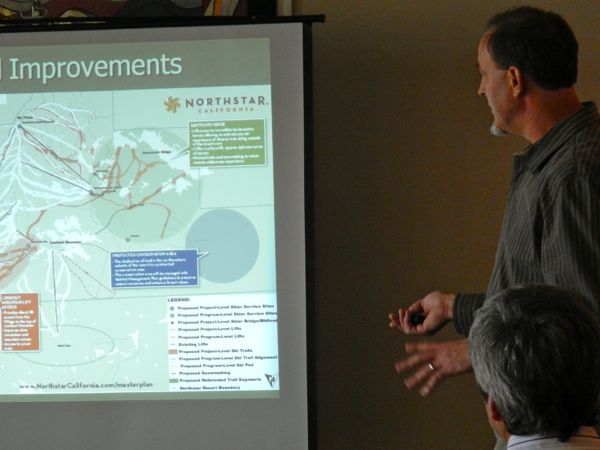
Of the proposed seven new lifts, it’s possible five would be built in the short term. They are all labeled with letters for now – which ironically is how Northstar used to label all of its chairlifts.

What’s called the C Lift would start on the north side of Sawmill Lake (the reservoir used for snowmaking) and would end just below the current Vista Express. The base of the lift area might have campsites and could be where the cross country center would be relocated.

On the opposite side of the mountain two lifts and a surface lift are being talked about so the Sawtooth Ridge area would be opened up. This would add 550 acres of terrain, but little actual trail creation would be done in order to retain the remote wilderness experience.

The J Lift would go from the village to Lookout Mountain.

Five skier bridges are proposed. They would need to be sturdy enough to hold a snowcat.

Haas said widening of trails is proposed mostly on existing routes.

Expanding the current restaurant at the top of Mount Pluto is planned. Adding a warming hut to the backside is also on the drawing board.

People have until Dec. 6 to comment on what Vail Resorts, owners of Northstar, want to do at the Truckee-area resort in the next 15 years. In the spring the draft environment impact report is expected to be released for a 45-day comment period. Future meetings are planned before the Planning Commission and Board of Supervisors. More information is online. Here is a map of the proposed changes.

The EIR will tackle the usual spectrum of concerns – from aesthetics to air quality to biological and cultural resources – along with any comments people submit.

No written comments had been received before the meeting. Haas said that’s pretty typical with a plan like this – comments tend to come in closer to the deadline.


California bonds looking a bit more appealing

By Kelly Nolan, Wall Street Journal

California has long ranked second only to Illinois in the dubious honor of being the least-loved state among municipal-bond investors.

But since Election Day, some investors have had a change of heart.

On Nov. 6, California voters approved temporary tax increases that Standard & Poor’s estimates will boost the state’s revenue by more than $6 billion over the next several years. The tax rise was a controversial move in the already high-tax state, but it suddenly made California’s bonds more appealing, market participants said. California also passed modest pension changes this year.

Meanwhile, Illinois has done little to address its $83 billion unfunded pension liability. The state had roughly $6 billion in unpaid bills as of the end of September, according to the state comptroller’s office.

That has separated the two states in the minds of some investors. The difference in yield, or spread, between the debt of the two lowest-rated states has increased to its widest point since early March 2011, according to Thomson Reuters Municipal Market Data.

Last week, the yield on 30-year Illinois debt was 0.60 percentage point above that of similar California debt. As prices fall, yields rise. The higher the yield, the bigger the perceived risk. On Election Day, the spread was 0.42 percentage point. In July, it was 0.18 percentage point.

“Over the past year, California has done much more than Illinois to help its fiscal situation,” said Tom Weyl, head of municipal research at Barclays. As a consequence, “there appears to be decoupling” in the way the states’ bonds are trading.

California’s debt has rebounded so much that its yields this month fell below that of Nevada for the first time since August 2009, according to MMD.

In November, California munis have returned 1.50 percent through Friday, according to S&P Dow Jones Indices, compared with 1.43 percent for Illinois. For 2012, S&P Municipal Bond California index has returned 9.80 percent, while the Illinois index has returned 9.78 percent.

Both states are outperforming the broader muni market, as investors hunt for extra yield amid rock-bottom rates in markets such as Treasury bonds. The S&P National AMT-Free Municipal Bond index has returned 1.32 percent in November and 7.88 percent so far this year, through Friday.

The passage of the tax increase, under Proposition 30, was the “catalyst for this rally” in California bonds, said Dan Berger, MMD’s senior market strategist.

Investors are favoring California debt, even though S&P and Fitch Ratings give the Golden State the lowest rating of all 50 states, at A-minus, while Illinois is rated a notch higher, at A. Moody’s Investors Service gives Illinois the lowest state rating at A2, while it rates California a notch higher at A1.

“The market is signaling California has a better chance of getting upgraded, while Illinois may see a downgrade,” said Cynthia Clemson, vice president and co-director of municipal investments at Eaton Vance.

John Flahive, director of fixed income at BNY Mellon Wealth Management, said his firm has bought more California bonds in light of Proposition 30’s passage, while keeping exposure to Illinois debt steady. “Illinois has to make some fiscal changes.…California can grow their way out of the problem,” said Mr. Flahive, whose firm oversees about $22 billion in munis.

To be sure, California still faces challenges, market participants say, and the tax increase voters approved this month is only for seven years, meaning a more permanent solution must be found to mend the state’s budget woes.

Robert Donahue, managing director at research advisory firm Municipal Market Advisors, said investors should be leery of California’s boom-and-bust economy, as well as its more tenuous cash position. The state’s current cash deficit stands at $24.7 billion, covered with $14.7 billion of internal borrowing, and a $10 billion short-term debt deal from earlier this year, he said.

“Things can change relatively rapidly,” especially if there is an event that hinders the state from selling short-term debt, Mr. Donahue said. California is “lucky Proposition 30 passed, because if it didn’t, we’d be having a different conversation right now.”

Eaton Vance’s Clemson said her firm is keeping its holdings of California bonds steady, while it has avoided buying Illinois’s general obligation debt. With Illinois, “we are waiting for them to signal they are serious about fixing their problems,” she said. With California, “I’d prefer to see them come up with more permanent budget solutions.”


Nevada tourism director aims to have people discover entire state

By Richard N. Velotta, Las Vegas Sun

When Claudia Vecchio accepted the job as director of the state Department of Tourism and Cultural Affairs a year ago, she knew she was entering uncharted territory.

The state had just combined its tourism, arts, museums and Native American culture departments into one office because of a budget crunch. It was anybody’s guess how well the parts would fit.

Vecchio came from the tourism industry, having headed Destination Integration, a Dallas company that promotes tourism and economic development for midsize communities. She previously directed the Ohio Division of Travel and Tourism.

Vecchio, who is based in Carson City, spent a year familiarizing herself with the state and the entities that comprise her department. During a recent visit to Las Vegas, she reflected on what she has learned:

What has been the biggest eye-opener for you in terms of marketing tourism in the state?

I think the big surprise was the fact that there is so much in this state that people don’t know is here. There are some incredible natural resources, like the Valley of Fire, Great Basin National Park and the Ruby Mountains. And there are some great special events in this state.

Because there are — and rightly so — great marketing machines in Las Vegas and Reno, some of these really extraordinary things get overlooked. I didn’t know they were here, and I consider myself to be someone who knows the world and the good things that there are to see.

It also has been a surprise the level of education we have to do to help people understand what there is besides Las Vegas and Reno. When you’re driving along, all these great wonderful things are just five minutes off the freeway, but nobody knows they’re there because there’s no signage, no rest stops, no visitor services infrastructure, no nothing to help the regular person know what’s in the area. That’s something I feel pretty passionately about trying to change — working with the Department of Transportation and others that manage those kinds of services.

Where are some of the places you have been since you arrived in Nevada?

I’m getting out there. I’ve been across Interstate 80 from Wendover to Reno. I’ve been to Elko on a couple of occasions and was there for the Cowboy Poetry Gathering, which I love. I went out for the opening of the California Trail Interpretive Center, which is an extraordinary facility about 10 miles west of Elko. They’ve positioned it so that not only is it on the California Trail, but you can see where the trail splits as it goes west. It’s really smart. The facility is just gorgeous and definitely worth the trip out there.

I was out in Ely not too long ago and came across Highway 50, which is aptly called “the Loneliest Road.” There are some wonderful little towns along there that are fun to see. I was up with some State Parks folks on Highway 93 to some of the parks up in Lincoln County. We didn’t get as far as Great Basin, but we did get to Kershaw-Ryan and Cathedral Gorge state parks. It was really cool to see all that.

I can see why people who live in Las Vegas are a little hesitant to go out there because you’re into nothing pretty quickly, and there are very few gas stations and services out there. It’s a little intimidating to make the trip.

When I’ve been down in Southern Nevada, I’ve been to Hoover Dam, Lake Mead and Boulder City. I still need to do the U.S. 95 corridor, because I keep flying between Carson City and Las Vegas.

Because of agency consolidation, the Tourism Commission also markets the arts, museums and Indian culture. What challenges have you faced as a result of that consolidation?

Each of those agencies still does some of their own marketing, because they have their own marketing needs. The Nevada Arts Council does a lot of grants giving, so their marketing needs are significantly different from the museums, which have to work to get people in the door.

The Nevada Indian Commission is very different because they spend a lot of time on the social services of Native Americans — education, health care and daily living kinds of things, with the tourism piece being a part of it.

In total, I think the challenge is that every entity has to retain its own identity while trying to find the overarching brand of the organization and how that all ties into the yet-to-be-determined brand of the state. We’re kind of finding ourselves, while retaining the individuality of these different organizations.

Arts and museums are under your purview, but state parks — something your office promotes — are not. Should the Tourism Commission be tied more closely to parks?

I think having them be a part of the natural resources department is a good place for them to be. We are tied very closely to parks, and I think the interagency cooperation and collaboration is really important.

We do some state park brochures and some collateral materials with them, and we promote the state parks in what we do. We’re also trying to work more closely with the Department of Wildlife because hunting is a big part of tourism in Nevada, and we’re trying to integrate that message into what we’re doing and help promote the wildlife piece of this, too.

I don’t know that it matters so much where these components are housed. The State Historic Preservation Office, which is very closely tied to museums and history, oversees natural resources as well. We’re housed in different places, but we have to work really closely together to make it work.

What’s the biggest challenge about marketing Nevada?

There are a couple of technical challenges. I mentioned that infrastructure is a big challenge. It’s no surprise that there’s world-class, best-in-the-business marketing coming out of Las Vegas. That’s part of the reason I’m here, to learn from those people.

The marketing challenge of the state is to try to craft the message of Nevada and the unique offerings outside of the Las Vegas market, while still being very synergistic with what they’re doing.

We’re taking this whole program from advertising to public relations, because we can’t advertise. We don’t have the dollars to advertise the differences between the rest of Nevada and these two big urban centers. But we do have the PR ability to drive social-media conversations and to get media coverage. The media out there in the travel and leisure world loves these kinds of stories that aren’t the ones that are always being told. I think they’ll embrace these other-side-of-Nevada kinds of stories.

That’s the age-old issue with Nevada, trying to find a message that’s different yet synergistic with the big players.

Is it intimidating to be in the same room with Las Vegas?

It’s exciting because we have so much to gain from that. Learning from what they do is really fun. Thank goodness they’re there.

I think we need to do a better job of integrating what they’re doing into what we’re doing. There has been some separation in the past between us. It’s certainly OK for them; they don’t need us. But we definitely need them. I would welcome the chance to do that even more.

What’s the status of developing a brand identity for the state? That’s been ongoing for several months.

It’s actually been ongoing for more than a year. We had an agency, GreenRubino, doing the brand development and they did some really good research. The language that they used to identify and differentiate this state down to its core DNA is wonderful.

Now, we have a new agency on board, Burson-Marsteller, that is going to drive the creative beyond this point. They’ve also been given the tagline project to come up with a tagline that is going to bring all this together.

Some political leaders were upset that a Nevada company wasn’t selected for the two-year $3 million contract that Burson-Marsteller won. What’s your response?

We had a group of seven travel industry professionals from throughout the state that were part of the evaluation committee, and we all worked to follow the rules to a T in this process.

When we started, I had asked how many points extra you give to a Nevada company. When I had done this in Ohio, there was a 10 percent advantage to Ohio companies. They said there was no preference.

As we started moving through this process and we got our responses back, the evaluation committee scored the responses based on their merit. It was clear when we went through the responses that there was a difference between the ones we got from Nevada companies and the ones that we got from the national-level companies. The goal from the Nevada Tourism Commission all along was to get the best and the brightest. And the best ended up coming from outside Nevada.

I knew going through this that it has always been an issue for people in my role in other states, and there probably would be some conversation about this. After we did the initial selection of finalists, I brought the whole staff together and I said, “Folks, the committee has selected all out-of-state vendors. It’s going to get attention.” And it did.

I think the conversation was always good. We followed the process, we did what we needed to do, and we’re incredibly pleased with who we got. They have really stepped up to the plate, and they have a lot to do. The expectations now are about six times higher than they would have been if this had just been normal, and we know that. But I think Burson-Marsteller is up to the challenge.

The commission also voted to spend $600,000 to sponsor the Reno air races. How did the state benefit from that deal?

They were very careful to take this $600,000 and craft it into a sponsorship, just like a sponsorship we would have for any event. There was a very long list of marketing considerations.

This title sponsorship will be in place for at least three years. We’ll be able to extend our brand through the kind of marketing this event does. It makes business sense, and it’s also a good community gesture.

Both ways, it worked in our favor. The response was very positive. People were very glad that this event was able to remain in Reno.

With this precedent set, how will the commission be able to reject sponsorship requests for other events in the future that are equally important to other communities?

This was an extraordinary set of circumstances. If somebody has an event that they feel needs some sponsorship, I would welcome anybody to talk to me about it.

It has never been that much money. But if there is an event that’s significant — and we really look for events that bring international exposure that are tied well with the brand of the state — we will consider it. The Reno air races is intended to be a one-time shot for these folks. But if other people have other events, we’re open to looking at urban events and how to sponsor them because I think they’re in everybody’s best interest.

Why was it the state’s responsibility to save the Reno air races?

It’s the last of its kind in the world: these kinds of races in these kinds of aircraft in this type of setting. It’s important to retain that kind of legacy here in the state.

The thing I like about it is that it brings people here who are risk-takers and adventurers, so they’re like Nevadans, even though some are coming from the U.K. They’re embracing the Nevada spirit.

There are very few events that are statewide events that everybody’s going to recognize. I’d like to do more events in the southern part of the state, but nobody has really come to me and said they want funding.

Do you think it’s possible to have an event to tie everyone together for the 2014 sesquicentennial?

We’re definitely looking at those kinds of legacy events that can help tie the state together for that year. Hopefully, there will be ongoing events that would continue to remind people of the unique heritage of this state.

The sesquicentennial steering committee has started to look at types of events and touring exhibits that are fun and interactive and really would engage people in different communities throughout the state. It has to be a statewide, collaborative effort. There will be lots of events that will happen during that time, but maybe one or two real signature events.

The Governor’s Conference on Tourism has had a difficult history, having been canceled twice. Are you planning to keep it going?

We’re definitely planning to keep it going. It’s going to be Dec. 4 to Dec. 5.

What we’re trying to do is to make it a significantly different event from Rural Roundup, which is a wonderful educational event for tourism industry members.

To make it retain some viability, we’re going to bring back some elements of the past, including a sales and marketing event with a trade show to give members of the Nevada industry a chance to go one-on-one with tour operators, travel agents and the media. We’re also going to do a pre-conference technology summit that helps people start to understand the emerging technology world. We’re going to try to find some pockets and make this more of a business-building conference than an educational conference.

I don’t know if we’ll get there this year, but that’s the idea because they’re different markets. As far as I know, we’re the only state in the nation that has two conferences — the Governor’s Conference and the Rural Roundup. But to retain the difference between them, I think, is an important thing. We’re going to keep looking at how we can make sure there are reasons for people to go to both conferences.

I understand the Tourism Commission is developing a statewide tourism app. Tell me about that.

I haven’t seen the finished product, but I’ve seen the idea. It really starts to answer some of our infrastructure issues in a 21st-century way.

The app will be designed to be downloaded in a place that has cellphone service. Obviously, we don’t have statewide cellphone coverage, and that’s always an issue. But once you have the app on your device, you can use it even if you don’t have cell service.

So if you’re driving along I-80 and you’re at Exit 46, it would tell you what’s in the area. The idea is that at some point, if you’ve landed at McCarran Airport, it will offer you coupons: “I see you’re in Las Vegas, here’s $20 off at X Hotel and $10 off at the restaurant.”

It becomes a much more retail deal. It is meant to be both a wayfaring kind of piece, as well as something for business.

Will a traditional place like Nevada be able to adapt to 21st-century efforts?

Just having people willing to take a little bit of a risk with us is the key to success. We’ll be going in some new directions, and I’ll be trying some things out to see if they work.

This isn’t your father’s Oldsmobile. To be successful, we’re going to have to do some things differently. We’ll always have a strategic business reason for doing things, but we’ll be asking people to go with us to see if they work.

The thing I like about Nevada is that we’re a blank slate. Yes, Las Vegas has done it better than anybody, and Reno-Tahoe has some great things. We can do things that are really innovative and different than any other state because of the fact that we are a new brand because so many people don’t know what is here.

We’re going to be doing a whole new cooperative marketing program for the state in the digital space, as well as in more traditional advertising. But we’re not doing new just to be new. We’re thinking it through. The idea is to build business.


Supreme Court inaction allows people to videotape, record cops

By Radley Balko, Huffington Post

On Monday, the U.S. Supreme Court declined to review a decision by the 7th U.S. Circuit Court of Appeals blocking the enforcement of an Illinois eavesdropping law. The broadly written law — the most stringent in the country — makes it a felony to make an audio recording of someone without their permission, punishable by four to 15 years in prison.

Many states have similar “all-party consent” law, which mean one must get the permission of all parties to a conversation before recording it. But in all of those states — except for Massachusetts and Illinois — the laws include a provision that the parties being recorded must have a reasonable expectation of privacy for it to be a crime to record them.

The Illinois law once included such a provision, but it was removed by the state legislature in response to an Illinois Supreme Court ruling that threw out the conviction of a man accused of recording police from the back of a squad car. That ruling found that police on the job have no reasonable expectation of privacy.

The Illinois and Massachusetts laws have been used to arrest people who attempt to record on-duty police officers and other public officials. In one of the more notorious cases, Chicago resident Tiawanda Moore was arrested in 2010 when she attempted to use her cell phone to record officers in a Chicago police station.

Moore had come to the station to report an alleged sexual assault by a Chicago cop, and says she became frustrated when internal affairs officers allegedly bullied her and attempted to talk her out of filing the report. Moore was eventually acquitted.

The lawsuit was filed by the American Civil Liberties Union, which is planning a police accountability project in Chicago that will involve recording police while they’re on duty. The organization wanted to be sure its employees and volunteers wouldn’t be charged with felonies.

The 7th Circuit Court found a specific First Amendment right to record police officers. It’s the second federal appeals court to strike down a conviction for recording police. In August 2011, the U.S. Court of Appeals for the First Circuit ruled that a man wrongly arrested for recording cops could sue the arresting officers for violating his First Amendment rights.

That decision also found a broad First Amendment right to record on-duty government officials in public: “Gathering information about government officials in a form that can readily be disseminated to others serves a cardinal First Amendment interest in protecting and promoting ‘the free discussion of governmental affairs.'” And in fact, in that it strips police who make such arrests of their immunity from lawsuits, it’s an even stronger opinion. Of course, the police themselves rarely pay damages in such suits — taxpayers do.

The Supreme Court’s refusal to grant certiorari in the case doesn’t necessarily mean the justices endorse the lower court’s ruling. But it does mean that at least six of the current justices weren’t so opposed to the ruling that they felt the case needed to be heard.

The First and 7th circuit decisions mean that it is now technically legal to record on-duty police officers in every state in the country. Unfortunately, people are still being arrested for it. Police officers who want to make an arrest to intimidate would-be videographers can always use broadly-written laws that prohibit public disorder, interfering with a police officer, or similar ordinances that give law enforcement wide discretion.

The charges are almost always either subsequently dropped or dismissed in court, but by then the innocent person has been illegally detained, arrested, sometimes jailed, and possibly paid expensive legal fees.

Journalist Carlos Miller, who has been arrested multiple times for recording police, documents such cases on a daily basis. He has also documented countless cases in which police officers have deleted incriminating video from cell phones — a crime in and of itself.


South Lake Tahoe finance director gives notice

By Kathryn Reed

Four months into the job and Michael Nakama knew the public sector was not for him.

Nakama at the end of the year will leave his post as finance director for South Lake Tahoe. He gave notice in October, but no one at the city chose to let anyone know until now.

Nakama had been laid off from Southern California Edison when former City Manager Tony O’Rourke tapped him for the $130,000 year position. The hire was made one week before O’Rourke left his job with the city.

Michael Nakama

Nakama had no experience working in the public sector. What O’Rourke touted was Nakama’s MBA from Stanford. But apparently that degree didn’t translate into real world government know-how.

Nakama was not available for comment. He is returning to Southern California, where his family has remained since he started the city job in June.

City Manager Nancy Kerry told Lake Tahoe News she is taking her time to assess how to structure the finance department. In the interim she plans to hire a consultant to work on special projects. This person would be paid on an hourly basis. She has conducted phone interviews and plans to do in-person interviews in the next month so the person could start in January.

Kerry said the main issues she wants the interim person to address are the budget (to do a cost-benefit analysis), health care (it accounts for one-sixth of the budget), Harrison Avenue (becoming a business district), and the parking garage (bonds may be refinanced).


El Dorado County man missing since early November

By Cathy Locke and Bill Lindelof, Sacramento Bee

David Clement spent the past two years pursuing his dream of creating a computer game for market and was within days of sending it out for testing when he went missing from his Camino home.

John Clement said it appears his 30-year-old son had been on the computer working on graphic designs in the early morning of Nov. 6. He had told his father the night before that he planned to run some errands in the morning and the two talked about getting together later in the day.

But family and friends have not heard from him since then.

John Clement, a former pastor at Camino Community Church, thinks his son went out for a run. He fears that he may have been injured, or possibly attacked by a mountain lion sighted in the area in recent weeks.

When he was unable to reach his son by phone, John Clement went to the house. His son’s motorcycle was there, but the weather was bad so his father figured he had gone somewhere with friends.

After a couple more days passed, John Clement again went to the Camino house David shared with a roommate. The roommate hadn’t seen David either but assumed they had just been missing one another.

David Clement’s new running shoes and a jacket were gone, along with a pistol he usually carried as protection against mountain lions when he ran in the woods. His cellphone and wallet were still at the house.

John Clement tracked his son’s computer activities up to about 5am Nov. 6. “I was over here within five hours of him getting up,” he said.

El Dorado County sheriff’s officials say there is no evidence of foul play.

“We are investigating it as a missing person case,” sheriff’s spokesman Sgt. Jim Byers said Monday. “We had our search and rescue unit go up last week with cadaver dogs and do an extensive search of the area. We were unable to find anything.”

John Clement said his son spent two years in the Army and was discharged in 2001. He pursued acting for a time, serving as an extra in movies, before taking an IT job with the California Highway Patrol – a position he left two years ago.

David Clement had been depressed for a time as he struggled to pay bills while developing the computer game, “but he had worked through that,” his father said.

Friend Marty Crossley Jr. of Rancho Cordova said he has known David for about six years and that it is not uncommon for gamers to stay at each others homes when they play into the night.

Crossley said David Clement discussed his game with friends, bouncing ideas off them, and Crossley was among those preparing to “beta test” the game, to identify any flaws and make sure it worked as intended.

Friends say they don’t think Clement was suicidal or that he would intentionally go off for an extended period without notifying family.

“Because it’s been such a long time and he didn’t contact anyone — with the (Thanksgiving) holiday, that’s unlikely,” said friend Erica Scoggins.

Family and friends, on Thanksgiving Day and again on Saturday, searched the area around Camino where David Clement typically ran. John Clement said a search of a broader area is tentatively scheduled for this coming weekend.

Anyone with information regarding David Clement’s whereabouts is asked to call the El Dorado County Sheriff’s Office Dispatch Center at (530) 621.6600. Friends also have set up of a Facebook page to assist in the search: www.facebook.com/HelpFindDavidClement.