El Dorado County cemetery gets headstones without epithet

By Carlos Alcalá, Sacramento Bee

A 57-year-old injustice weighing on El Dorado County may have finally been lifted Wednesday, when Derrick Bonar raised a 90-pound piece of granite and carefully set it into wet concrete prepared by John Cooks.

The two men, inmates from Folsom Prison, were installing the last of 36 new markers on graves at the Mormon Island Relocation Cemetery, which straddles the El Dorado-Sacramento county line near Folsom Lake.

The graves were those of people who had been buried in the town of Negro Hill before the reservoir rose behind the dam and flooded the old cemetery.

The new stones culminated a decadelong effort to replace older concrete markers that bore a racist version of the town’s name.

“I feel like I’m a part of history,” Cooks said. “I’m giving back to society.”

The cemetery is now operated by El Dorado County, but the U.S. Army Corps of Engineers took responsibility for having placed the markers bearing the epithet in the 1950s.

Read the whole story


River restoration, golf course move OK’d by state board

By Kathryn Reed

MEYERS – Tears of relief. Gearing up for the next hearing.

Those were the reactions from the two sides in the divisive Washoe Meadows State Park, Upper Truckee River, Lake Tahoe Golf Course issue.

On Friday, before a crowd that at times numbered more than 100 people, the California State Park and Recreation Commission unanimously approved staff’s recommendation to accept the final EIR for the river restoration project, and to swap land between the park and Lake Valley Recreation Area to allow the golf course to be reconfigured.

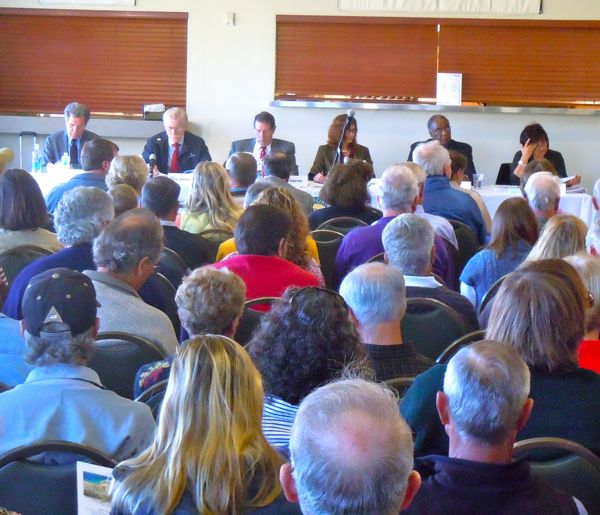
State Park and Recreation commissioners on Oct. 20 get an earlful. Photo/Kathryn Reed

State Park and Recreation commissioners on Oct. 20 get an earlful. Photo/Kathryn Reed

It was Cyndie Walck, State Parks hydrologist who after the vote was taken, broke down in tears. She had no idea how the six commissioners would vote. She has been working on this project for five years, attending dozens of public forums.

“I’m surprised,” Walck told Lake Tahoe News after the vote.

On the opposite side are members of Washoe Meadows Community. They don’t want undisturbed parkland on the South Shore to be developed into nine holes of golf. They have been working just as hard as Walck – but for a different outcome.

“We revise our strategy and we get ready for TRPA,” Lynne Paulson said outside Lake Tahoe Golf Course as to what is next for her group.

(On Dec. 7 at 9:30am, Tahoe Regional Planning Agency APC votes on the EIR at the Stateline office. On Dec. 15 at 9am, the TRPA Governing Board votes on certification of final EIR at the Stateline office.)

Fifty people spoke during the 2½ hours of public testimony. Thirty-one were against the preferred alternative 2 in the environmental impact report, 17 in favor, and two were in the middle.

The reach of the Upper Truckee River that flows through State Parks property is called one of the worst. Banks are eroding, causing sediment to plop into the river and be carried into Lake Tahoe – which is said to be helping to maintain that body of water’s clarity loss.

Most of the opponents to alternative 2 are in favor of river restoration. What they opposed is moving half of the 18-hole course into the park.

Each side disputes how much pristine v. disturbed land will be affected. Each side gives tours that are very different and show their respective realities.

Ultimately, though, the commissioners know that if they don’t fix the sediment issue, Lahontan Water Quality Control Board will level the hammer. While they had issues with Washoe cultural sites being covered in dirt as a way to preserve them, it wasn’t enough to vote against the project.

Commissioner Elva Yanez echoed LTVA Executive Director Carol Chaplin’s comments that the triple bottom line is crucial – the economic, environmental, and social needs.

“It’s very clear river restoration has to happen,” Yanez said. “I’m moved by the notion that millions of dollars are generated by the golf course.”

But alarming to many is that Goldman Sachs and Starwood Capital own American Golf Corporation, the concessionaire of the Meyers course on Highway 50.

Jeff Perry, with American Golf, said the Meyers course generates $2 million a year in revenue, of which the State Parks receives one-quarter of that figure. His firm is interested in bidding on redesigning the course.

(Any concessionaire will pay for moving the holes, which will likely mean a smaller annual fee to State Parks. But in the end the park system owns the upgrades.)

Huey Johnson, California secretary of Resources from 1978 -82, gave the commissioners a book about how Michigan put together a trust from oil serverance taxes to fund its parks.

Some questioned how the parks people could think about spending millions of dollars on river restoration when dozens of parks are slated for closure in 2012. Officials said the money for restoration would come from grants, while the concessionaire pays for the golf course.


S. Tahoe investment broker pleads guilty

A South Lake Tahoe investment broker who in July pleaded not guilty to wire fraud switched her plea Oct. 21 to guilty.

Lori Zoval, 46, was indicted in July 2010 on three charges of wire fraud stemming from an alleged investment fraud scheme in 2005-06. She declined a plea agreement in February.

According to a Department of Justice press release, Zoval today admitted to embezzling nearly $25,000 in client money while working for a Folsom brokerage firm.

Zoval confessed she took the money after lying to clients about setting up tax shelters with the funds. Authorities say Zoval created false documents to make everything look legitimate.

Sentencing by U.S. District Judge Garland E. Burrell Jr. is scheduled for Jan. 6.

Lake Tahoe News first reported about Zoval in February regarding her dealings with Holly’s Place, a South Lake Tahoe vacation resort. However, no charges have been brought against Zoval concerning her interactions there.

— Lake Tahoe News staff report


Rise ordered to apologize to STPUD employee

By Kathryn Reed

After a 90-minute closed session and another hour of discussing the issue in open session, Dale Rise’s colleagues on the South Tahoe Public Utility District board told him to apologize to the employee who brought a complaint against him.

Rise, who is chair of the board, was out of the room during the open deliberations per counsel’s advice.

Dale Rise

Dale Rise

He was given a chance to speak before the board members talked among themselves on Thursday afternoon.

“I did nothing wrong,” Rise told the board. He also went into great detail about issues leading up to the alleged incident.

Jeri Callian, whom works in customer service and is the employee who filed the claim, said, “I can’t express in words my shock and disappointment.”

Callian claims Rise created a hostile work environment when he came to the district in his capacity as a contractor. The investigator’s report says otherwise. What was determined is Rise violated three board policies.

It was as though the two were not party to the same incident in listening to their words.

After the public spoke – which was Kenny Curtzwiler and John Runnels on behalf of Rise – counsel told the board to focus on the facts, the report and not the extraneous words that had been spoken.

It was left to board members Eric Schafer, Chris Cefalu and Jim Jones to decide what to do. Marylou Mosbacher, who is vice chairwoman of the board and who should have been running the meeting on this matter, decided she could only stay two hours.

As she left at 4pm she said, “Maybe you could give me a little more notice.” Apparently no one told her elected officials are supposed to stay until the end of the meeting and not put personal matters first on meeting days.

Schafer then took the gavel.

The three members agreed to accept the report given to them in regards to the findings from the investigation. But it was 2-1 vote in regards to what punishment should be meted. Jones was the dissenter.

“This is very serious. He has violated what code of ethics we do have. I think more needs to be done than an apology,” Jones said before the vote.

Cefalu and Schafer were of like minds in that not much could be done based on the infractions, which in large part have to do with a board member talking policy with an employee.

In the end, Rise must apologize to Callian in writing or verbally.

But it was also agree board members should be conducting themselves at a higher level as an elected official. Staff was directed to review the policy manual regarding board member conduct to see if it should be beefed up.


States borrowing billions from feds to pay unemployment taxes

By Sean Whaley, Nevada News Bureau

CARSON CITY — A report from the Tax Foundation on unemployment insurance taxes says 34 states have had to borrow $37 billion from the federal government to pay jobless benefits, and employers around the country face the prospect of higher tax rates as a result.

“Businesses are in danger of facing higher UI (unemployment insurance) taxes at a time when private sector hiring is already at a low level,” says the background paper by Joseph Henchman titled “Unemployment Insurance Taxes: Options for Program Design and Insolvent Trust Funds” released this month.

Henchman, vice president of legal and state projects at the Tax Foundation, said the adverse conditions currently existing within the unemployment insurance programs could be an impetus for reforms, such as experimenting with individual accounts to encourage saving.

“These changes can enhance the program’s ultimate goal of ensuring a viable safety net for transition periods between employment,” he said.

Nevada and California are two of those states borrowing from the federal government to pay benefits. An amount that totals $773 million so far for the Silver State. Even so, the Nevada Employment Security Council voted earlier this month to recommend against raising the tax next year from its current 2 percent average rate. The taxes are assessed on the first $26,400 of an employees’ wages.

The rate was raised in Nevada for this calendar year to 2 percent from 1.33 percent. Concerns over stifling job creation led to the recommendation to maintain the 2 percent tax rate into next year, even though it means the federal loans won’t be paid off until 2018. The rate will be formally set later this year by the state Employment Security Division.

The Tax Foundation report shows that Nevada was one of nearly 20 states with a healthy trust fund when the national recession began in December 2007. But Nevada’s highest-in-the-nation jobless rate depleted the fund and required the state to borrow from the federal government beginning in October 2009.

Of the 34 states that have borrowed to pay benefits, seven have repaid the loans, either by dipping into general funds or by borrowing instead from the private sector, Henchman said in his report.

The idea of having Nevada borrow money on its own to pay benefits instead of relying on loans from the federal government was considered by the Nevada Legislature but was not pursued.

States that have repaid their federal loans are Hawaii, Idaho, Maryland, Massachusetts, New Hampshire, South Dakota and Texas.

States have to pay interest on the borrowed federal funds starting this year. Nevada was the only state to get an extension on its $22.5 million interest payment until June 30, 2012, due to the state’s high unemployment rate. Other states had to make their interest payments by Oct. 1 of this year.

In addition to raising taxes on employers, several states have opted to reduce unemployment benefits.

Nevada pays benefits for 26 weeks as do most states, although federal funding has allowed payments to be extended for up to 99 weeks during the recession.

States reducing the number of weeks of benefits are Arkansas, Florida, Illinois, Michigan, Missouri and South Carolina. Three states, Florida, Rhode Island and South Carolina, also implemented reforms to their unemployment insurance programs.

The Tax Foundation reports that in Florida, reforms include an expansion of what constitutes misconduct that would make someone ineligible for benefits, and making laid-off employees who get severance pay ineligible for benefits.

“Lawmakers have an opportunity to take a new look at benefit levels, program requirements, and whether such programs should be expected to accomplish additional fiscal and social policy goals,” Henchman said.

Nevada has not thus far considered reforms to its unemployment insurance program.

The Tax Foundation is a nonprofit, non-partisan tax research organization based in Washington, D.C.


Beware of carbon monoxide scam

By Claudia Buck, Sacramento Bee

Something didn’t smell right, and it certainly wasn’t carbon monoxide.

Alert constituents and an inquisitive state senator’s office apparently halted a mail scam attempting to con homeowners, based on a new state law requiring carbon monoxide alarms.

The scam was apparently run from a post office box directly across the street from the state Capitol, where lawmakers last year passed SB 183, which requires the alarms as a way to prevent carbon monoxide poisoning deaths.

“It’s absolutely brazen,” said Mark Spannagel, chief of staff for state Sen. Doug LaMalfa, R-Richvale, who said about a dozen constituents reported receiving letters asking them to send $76 in order to comply with the law and avoid a possible fine. LaMalfa’s district covers parts of Placer, Yuba and Nevada counties.

Read the whole story


S. Tahoe settles case involving CPS

By Kathryn Reed

South Lake Tahoe has written a check for $39,130 to settle a case involving how police officers removed children from a home on the behalf of Child Protective Services.

“The officers followed the policy and practice at the time (2008), and therefore I would not say they did anything ‘wrong.’ I would say the policy and practices should have been reviewed by city staff in light of 9th Circuit of Appeals decisions that were being issued by the court since about 2007,” City Attorney Patrick Enright wrote in an email to Lake Tahoe News.

The $39,230 will be put in a trust for the children and divvied up among the other litigating parties. Who all is involved in the case has not been disclosed.

“Since it involves minors, I am limited as to what I can tell you about the case, except it occurred in 2008 and involved the removal of children in the city by CPS and the police department,” Enright said.

“The city is working with the police department to revise its policy on the removal of children for CPS and will be providing training to the officers. The new policy will be barring life-threatening conditions to the children, the officer must obtain a judicial warrant prior to removing the children and placing them with CPS except in very limited circumstances.”

This is the revised juvenile custody policy.

El Dorado County was also a defendant in the case. That settlement is still in the works, according to Enright.


A vision for South Shore’s future begins to unfold

By Kathryn Reed

STATELINE – Vision – that is what has been missing from the South Shore.

“If we are going to be a world-class outdoor destination, we need the commercial areas to complement the scenery,” Mike Bradford told Douglas County commissioners Thursday.

Design Workshop's vision for the South Shore near the state line.

Design Workshop's vision for the South Shore near the state line.

The county in its quest to bring economic vitality to the lake and valley created 12 project areas to focus on, with the casino corridor at Stateline being one of them. Bradford, who is part owner and runs Lakeside Inn and Casino, is the leader of that project.

As he brought others into the scoping process it became evident work needed to start at the state line and spread from there – which meant going into South Lake Tahoe.

While in the past the line separating California and Nevada has been a point of demarcation for those in charge, tourists never saw a line – except for where it was legal to gamble.

Ironically, it’s gaming that has erased the line for local officials and what is bringing them to the same table. Indian casinos in California have put the kibosh on gaming being king of the South Shore. While people move to Lake Tahoe for the outdoors and tourists have been drawn to the area for the same reason, it took the casino industry to be in decline for a decade for those who control the marketing dollars to realize a new business model is needed.

Lake Tahoe News first reported in July that the South Shore Vision Plan was in the works. Aspects of it were outlined for Douglas County commissioners at their Oct. 20 meeting in Stateline. A formal presentation will be made to that board when it has a joint meeting with the South Lake Tahoe City Council on Nov. 4 at noon at Edgewood Tahoe. It is a public meeting.

What the commissioners agreed to Thursday was to put up $10,000 of the $35,000 needed to fund the economic analysis of the plan. Lake Tahoe Visitors Authority and South Lake Tahoe are each being asked to put up $10,000, while the South Tahoe Alliance of Resorts is giving $5,000. The latter paid the $50,000 to Design Workshop to create the plan.

Dealing with TRPA

“We are giving the reigns to the governments to move forward and get it into the (TRPA) Regional Plan,” Bradford said.

One issue to overcome in order to get this plan on the ground is to allow the five counties and one city in the Lake Tahoe Basin to have greater control of their destiny instead of being told what to do by the Tahoe Regional Planning Agency.

Harmon Zuckerman, who until last month when his contract was not renewed was spearheading the much overdue Regional Plan update, supported a more liberal approach to planning than had occurred in the past. Sources have told Lake Tahoe News that Arlo Stockham is pulling back on transect planning that integrates mixed uses. However, TRPA says just the opposite is true. In fact, the plan is to give greater authority to local jurisdictions.

With the TRPA being Big Brother in the basin, for the last 40 years local jurisdictions have been under the bi-state regulatory agency’s thumb. While local politicians have not orchestrated an Occupy Lake Tahoe movement, they are talking and do want more control of what happens in their borders.

When the TRPA Governing Board meets Oct. 26 at 9:30am in Kings Beach it will hear a presentation from staff about the approach.

In some ways, South Lake Tahoe may have the most power because its boundaries are entirely within the basin. This compares to the five counties whose seat of governance is outside the basin.

“This plan should serve as a foundation, a catalyst for what can and should happen for the South Shore and Douglas County,” Douglas County Manager Steve Mokrohisky told Lake Tahoe News before the meeting. “I think everyone recognizes the current model does not allow for pedestrian friendly development, access to the lake, and has challenges regarding the environment.”

The plan

Richard Shaw with the Aspen office of Design Workshop will be at the November meeting to go over the 32-page South Shore Vision Plan. (He was not available to comment for this story.) The plan will be available to the public at that time.

What is presented in the document is not completely new. The loop road directing traffic off Highway 50 and around the casinos is still the major focal point. Overall, the plan goes from Ski Run Boulevard to Kahle Drive.

Stateline Avenue is being propoased as a gateway to lake recreation. Renderings/Design Workshop

Stateline Avenue is being propoased as a gateway to lake recreation. Renderings/Design Workshop

“The cost of Loop Road is something in the $70 million range. That is a tough nut to crack,” Mokrohisky said.

Both state transportation departments are likely to be asked to fund the bulk of the work, with the possibility of tapping into the federal jobs bill if that were to pass.

Mokrohisky said the county is talking to NDOT and that it will be up to city officials to get Caltrans on board.

While the plan put forth by Design Workshop is just that – a plan – it is something the government bodies on the South Shore need to vote on to proceed with. That could happen at the joint November meeting in two weeks.

The plan calls for a minimum sidewalk zone of 20-feet from Park Avenue to the Horizon. The speed limit would be 25mph, with multiple crossings for pedestrians.

The idea is it would make the state line area a more walkable, downtown destination, with the bulk of the traffic diverted behind the casinos.

While this idea has literally been talked about for decades, the powers that be believe now is the time to carry the idea forward.

“The principal focus at this point is from Stateline to the end of Loop Road. If we can get that fixed, the rest will be easy,” Tony O’Rourke, South Lake Tahoe city manager, told Lake Tahoe News.

He is one of the nearly 50 people who has been involved in the process to work with Design Workshop to build the vision.

“This is a bold, progressive plan. I like the whole thing,” O’Rourke said. “Clearly it’s an attempt to redefine that corridor. It’s dated and old and won’t meet the needs of destination guests.”

Part of the vision put forth by the Design Workshop says, “Retail activities will frame places for pedestrians; the centers of activity will be engaging places, providing for event programming and strong design appeal; the streets will be developed with outside dining, landscaped edges and ‘complete street design character’; local community orientation and service can be incorporated creating a rich mix of retail opportunities.”

Giving the casinos a makeover is proposed – especially at the ground level to have them be something other than spacious, vacant gaming venues.

Access to the lake has long been talked about. This, too, is a bit of an irony considering all the marketing-tourism gurus say people come to Lake Tahoe for the lake. One would think if this were the main reason, people wouldn’t be having such a hard time finding it if that were their goal.

Now the gurus say no one can find the lake and it needs to be more of a focal point.

“We need to deliver the lake to residents and visitors,” Mokrohisky said. “I have known people who came to Lake Tahoe and they are here several days before they see the lake or get access or know how to get there. This plan lays out the fundamental principals of what we need to do to provide access.”

The plan says, “A new public recreation beach will expand to the north side of Stateline Ave. to fulfill needed water based recreation. Scenic views will result form the recreational acquisitions.”

Maybe someone should ask the visitors and locals why they are here. Maybe it’s the mountains and not the lake.

What’s next?

After the elected officials on the South Shore review the plan in two weeks they will be tasked with deciding how to go forward. Douglas County without even seeing the full presentation is on board to study if the plan is economically feasible. Presuming that study is funded and comes to fruition (LTVA will oversee the bid process), and then environmental analyses will be conducted.

Bradford said the economic component would likely look at what happens if nothing were done, and then forecast for five, 10 and 20 years out.

Everyone agrees public buy-in is crucial. Also agreed to is to make any plan a reality it will take public-private partnerships.

Jobs and tax revenue – those will be the economic indictors that will push the plan forward.

If the numbers work, then the environmental concerns will be looked at. Lake clarity, total maximum daily loads, coverage, height issues, transportation, density – all of that would be addressed. That is why if TRPA doesn’t get its Regional Plan done by the latest deadline of December 2012 (originally it was due in 2007), nothing will happen.

The other buy-in needed is from private property owners who have not been at the table but whose property the planners have other ideas for.

The right players, the right time – the stars being aligned – that is what makes this vision different, according to officials.

“The vision plan creates a path we can head down together,” Mokrohisky.


Drug lab found in S. Tahoe apartment, resident arrested

By Kathryn Reed

A homemade contraption to extract THC from marijuana, along with ecstasy and Oxycontin pills were seized from an apartment in South Lake Tahoe on Thursday afternoon.

“This can blow up just as easily as a meth lab,” SLEDNET Cmdr. Jeff Catchings told Lake Tahoe News. “They are very dangerous, especially the type of lab he had.”

Officers with South Lake El Dorado Narcotics Enforcement Team went to the residence on Lake Tahoe Boulevard just after 2pm on a probation search. Tyrone Brown, 27, was on probation for domestic violence.

Now Brown faces charges of being in possession of a drug lab, manufacturing narcotics, possession of narcotics within 1,000 feet of a school (there is a preschool close by), and possession of the pills. An enhancement could be added because a child was living in the house.

He posted bail, which was set at $117,500, the same day.

Brown’s girlfriend and her 11-year-old daughter also live in the apartment. The woman was not arrested, but Catchings said Child Protective Services has been notified. It’s possible she could be charged with maintaining a house for drug use.

“We did not see a need to remove (the child) from the house since we removed the problem — namely him,” Catchings said.

Evidence the suspect was selling drugs was found, but not much money, Catchings said.

Some of the trash from the lab was scattered on the lawn of the Sierra Vista complex. Now it’s in police custody.

Catchings said butane honey oil labs are not common in Tahoe, but they are growing in number. Marijuana sellers have to do something with the leftover product – dump it, burn it or extract it. The extracted product is sellable.

Catchings explained the extracted THC can be put in food products, smoked and used in other ways.


Nevada 1 of 6 states to participate in Policy Academy

By Sean Whaley, Nevada News Bureau

CARSON CITY – The National Governors Association announced this week that Nevada has been selected as one of six states to participate in a Policy Academy on strengthening post-secondary education performance measures.

The NGA defines a Policy Academy as a highly interactive, team-based process for helping a select number of states develop and implement an action plan to address a complex public policy issue.

In announcing the project, the NGA said: “States must have a strategy for getting more career-ready graduates for the dollars they have, and the NGA Policy Academy will focus on helping states build that strategy.”

“Having good performance metrics is important, but it is not enough,” said Dane Linn, director of the NGA Center for Best Practice’s Education Division. “Governors and other policymakers must be equipped to use performance measures, whether in developing budgets, approving or evaluating programs or deciding how or whether to regulate administrative and academic services. This Policy Academy will help states focus on those measures.”

Gov. Brian Sandoval said, “Nevada is diligently working to improve accountability systems and measures throughout the K-12 system and this Policy Academy will enable us to expand that work through the higher education realm.”

The work will complement the Legislature’s interim funding study, he said.

“As always, higher education’s goals have been focused on continuous improvement in how we educate our students and how we help Nevada’s economy prosper,” said Dan Klaich, chancellor of the Nevada System of Higher Education. “I’m excited we were selected for the Complete to Compete Initiative and I am looking forward to working with the governor and representatives of the Legislature to define accountability metrics that will support our ongoing initiatives related to student success and effectiveness and efficiency.”

The NGA Policy Academy is aimed at improving post-secondary education accountability systems and consists of two workshops, technical assistance from NGA Center staff, and grants of up to $30,000 per state for additional expertise.

The academy is designed to help states strengthen their post-secondary education systems by focusing on efficiency and effectiveness metrics in their accountability systems and incorporating those metrics into their decision making processes.

The NGA Center will help selected states in their efforts to review and revamp their existing state post-secondary accountability system. States will also work with the NGA Center to identify ways to use efficiency and effectiveness metrics as part of the state’s higher education policy agenda.

Funding for the academy is provided by the Lumina Foundation and the Bill & Melinda Gates Foundation.

Nevada’s governor-appointed state team consists of: Heidi Gansert, chief of staff to Sandoval; Julia Teska, a budget analyst from the Department of Administration; Denice Miller, vice president of government relations, MGM Resorts International; Assemblyman Marcus Conklin, D-Las Vegas; Klaich; and Neal Smatresk, president of the UNLV.