Politicians harp on private partnerships at Lake Tahoe without providing a vision

By Kathryn Reed

STATELINE – Based on the title of the 16th annual Lake Tahoe Environment Summit – Public-Private Partnerships-Investing in the Future of Lake Tahoe – a huge component was missing. That component is the private entities that are going to do the work and pony up the money.

No one who has tried (successfully or unsuccessfully) to bring the economic and environmental change that was touted by politician after politician as being so critical to the survival of the Lake Tahoe Basin spoke at the Aug. 13 event.

Real life stories of why people and/or corporations are or are not coming to Tahoe were not delivered. And yet, the politicians went on ad nauseam about the private component being the key.
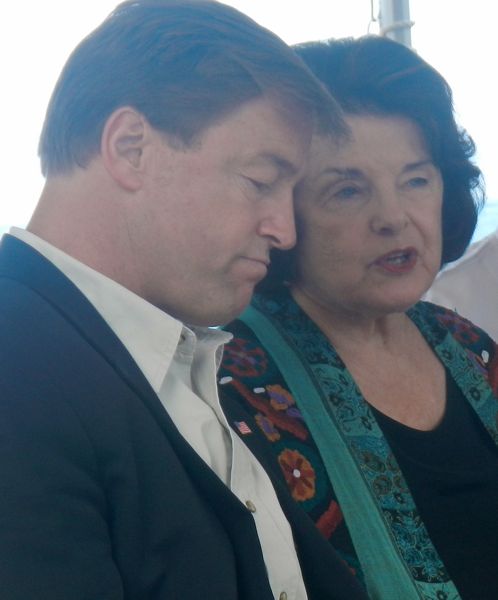
Sens. Dean Heller, R-Nev., and Dianne Feinstein, D-Calif., talk at the Aug. 13 Lake Tahoe Environmental Summit. Photos/Kathryn Reed

Without knowing what is or isn’t working for the private sector, encouraging the positives and fixing the negatives are not possible.

Summit host Sen. Dean Heller, R-Nev., and Rep. Tom McClintock, R-Granite Bay, touched on how the process for how projects get off the ground needs to change.

Heller said he has heard from the private sector that it needs the approval process to be streamlined in order for capital to come in.

“Last year we talked about collaboration and needing to do more with less,” Heller said. “We have made progress and we have more to do.”

McClintock pointed to how a constituent wanted to fix a dock and the permits cost more than the project. He talked about how Homewood has been a ski resort for 40 years, but a long-term use permit has been stalled by environmental litigation. He spoke of an economic report just released to the El Dorado County Board of Supervisors that talked about people leaving Lake Tahoe in droves. (A county official later told Lake Tahoe News she didn’t know what report McClintock was talking about.)

“Decisions are being made by regulatory boards they can’t even elect,” McClintock said of his constituents. The Tahoe Regional Planning Agency and Lahontan Regional Water Quality Board are the entities he was referring to.

California Gov. Jerry Brown in talking about collaborating said, “It’s time to rise out of our comfort zones.

“We need to transcend our small parochial views.”

Three non-elected persons did speak:

• Sudeep Chandra, an associate professor at UNR in the Natural Resources and Environmental Science Department, touched on aquatic invasive species, just as the politicians had. He said in the last year no new species have been discovered in Lake Tahoe, but that for every native species there two non-natives.

• Allen Biaggi, former director of Nevada’s Department of Conservation and Natural Resources and a former TRPA board member, spoke as vice chairman of the Tahoe Fund. He talked about the nonprofit coming out with an app for phones in the next couple weeks for beaches at Lake Tahoe. This was after Sen. Dianne Feinstein, D-Calif., had earlier touted how the preceding night $150,000 was raised in one dinner for this group. (She has attended every summit.)

• Mike Brown, chief of the North Lake Tahoe Fire Protection District, talked about the need for continued awareness of the threat of wildfires. From Edgewood Tahoe, where the summit was, it is possible to see the scar of the 2002 Gondola Fire and 2007 Angora Fire.

Money is a large reason the private sector is now needed to be a major player in restoring Lake Tahoe – which includes the lake, the infrastructure and the economy. Gone is the Lake Tahoe Restoration Act, even though Feinstein said she and Heller are reintroducing it.
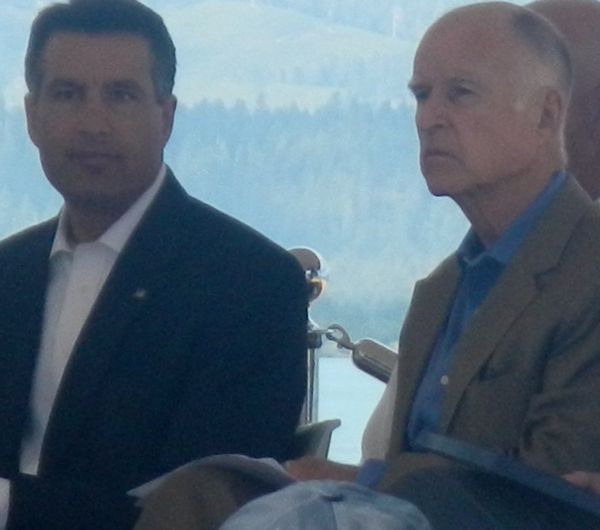
This is the second year in a row Govs. Brian Sandoval (Nevada) and Jerry Brown (California) have attended the summit.

Gone is the cash from the Southern Nevada Public Lands Management Act. This brought in $300 million of the $521 million the federal government has spent on environmental improvement at Lake Tahoe since the inaugural summit of 1997.

Of the $1.62 billion spent at Lake Tahoe on environment upgrades in the last 16 years, $299 million has come from the private sector.

Nevada Gov. Brian Sandoval summed up the current state of Lake Tahoe: “While the basin’s economy is largely dependent on the environmental health, the environmental health is dependent on the economy.”

Other than needing cooperation and money from the private sector, the public officials provided no path to truly improve the environment or stimulate the economy.



Recreation, fire, revenues top S. Tahoe council’s priorities

By Kathryn Reed

Raising revenue, including via taxes, which would fund recreation; dissecting the workings of the fire department; and prioritizing capital improvement projects dominated a nearly four-hour meeting Saturday of the South Lake Tahoe City Council.

The lively discussion among the five, along with the city manager and finance director, also touched on the future of the airport, what’s going on with the concrete-rebar hole at Stateline, and how staff is overworked and keep having more work piled on.

South Lake Tahoe City Manager Nancy Kerry talks finances and priorities Aug. 11 with the council. Photo/Kathryn Reed

An irony was at the end of the meeting there was a discussion about how long the regular council meetings are. This took place in the fourth hour when the meeting was supposed to be three hours. Talking less was the emphasis – and being concise.

Suzie Alessi, city clerk, said more public praise and less public criticism of staff would go a long ways.

She is giving a workshop today to staff about efficient staff reports. That is one way meetings may be streamlined; by providing council the material they desire in the most logical manner.

Jim Boylan with Pathfinders Consulting of Carlsbad facilitated the meeting. His $12,000 fee included the Aug. 11 workshop along with time spent with staff to elicit their thoughts, concerns and desires.

The overriding message is that no matter what the council sets as goals and priorities, the workload cannot increase based on current staffing levels. That is why council needs to finally make specific decisions, leave staff alone so they have time to actually get their work done and not waffle on policy decisions.

“The message is ‘we can provide core services and not much more’,” Boylan relayed to the council from staff. He explained how when council says something is routine business, it still consumes time and resources.

Boylan will cull all the information he has obtained into a report for the council and staff by the end of the month.

Only three members of the public attended the meeting. One was City Council candidate JoAnn Conner – no other candidates were in attendance other than the incumbents.

Future of recreation

The council agreed a recreation master plan needs to be developed.

Then in 2014 the voters are likely to be asked to increase the hotel tax and institute an amusement-entertainment tax. These sources of revenue would then fund the recreation plan.

Most of the council agreed increasing taxes to merely fill the general fund is not what they or their constituents want.

Fire department issues

Councilman Tom Davis is most concerned about outdated equipment.

Even though negotiations are under way with Lake Valley Fire Protection District regarding consolidation of the departments, the county entity has not backed down from mandating that the city have functioning equipment to bring to the table.

Staff is an issue for South Lake. An unsafe structure exists now because the incident commander doubles as someone working the scene, too.

What to do with the aging Station 2 will be explored.

Looking at how Lake Tahoe Community College wants to expand the fire academy, fire science program and build physical resources could affect what the city does.

Mayor Claire Fortier said in six months she expects to have a “holistic views of the fire department.” She said with that knowledge it will better drive the budget discussion about this department, too.

Nearly 50 percent of the city’s entire budget is allocated for public safety – police and fire. It was pointed out by City Manager Nancy Kerry and reiterated by councilmembers that the cities filing for bankruptcy in California sacrificed other departments for public safety so that at some point revenue-generating sections were essentially non-existent. Kerry said South Lake Tahoe is on the edge and needs to be aware of this as priorities are decided.

From the midyear revision of the current budget to what is projected for the next fiscal year that begins Oct. 1, fire is the only department to have its expenses increase. Part of this is reflected in the recent hiring of three firefighters and programmed raises. Firefighters were given a raise last year because they were the first to come to the table to agree to other budget cuts.

Other items

• Aug. 30 is the date to settle the dispute with Lahontan Regional Water Quality Control Board regarding the stormwater permit. South Lake Tahoe’s stance is that it does not have the money to do everything Lahontan is mandating. This ties into the city figuring out its priorities. Out of four items related to that permit, it can comply with a quarter.

• Harrison Avenue is near the top of the list of things to get done.

• Staff will be asked to present to council how much work it will take to go forward with the Stateline and Tahoe Valley area plans that would need to be completed in an updated Tahoe Regional Planning Agency Regional Plan. Then council will decide which to pursue first. Transportation, including the Loop Road, would be part of the Stateline discussion.

• An area-by-area paid parking plan will be brought back to the council. (In the working budget for 2012-13 is $150,000 from paid parking.)

• Council at its Aug. 7 meeting agreed to have someone go after the unpaid transient occupancy tax. This remains a priority, with a conservative estimate of net revenues of $50,000 in the next fiscal year.

• A capital plan for equipment replacement will be devised.

• Fortier and Councilwoman Angela Swanson will form the subcommittee to work with Kerry to formulate a collaborative approach to getting projects in the ground regionally.

• The council may broach Douglas County commissioners when the two elected bodies meet Oct. 23 about having them pay to help keep Lake Tahoe Airport open. There is a precedent for this.

• If all employees don’t agree to a 2 percent pay cut, more layoffs are inevitable. This is to cope with the nearly $1 million budget deficit.

• The council wants a future workshop to discuss the airport, decide if a request for proposal to privatize the airport should go out, what to do regarding the settlement agreement, and look at land uses for that area.

• The council would like movement on the rebar-concrete that was once going to be a convention center. Bill Owens of Owens Financial is working on a plan that would divvy up some of the area, but nothing has been solidified.


Ancient town of Bath matures into modern marvel

By Susan Wood

BATH, England — You have to hand it to the Romans – they knew how to immerse themselves in decadence early on.

More than 2,000 years ago, they discovered England’s only natural hot springs west of London, dove into building a complex of bathing spots, as well as a temple to Sulis-Minerva and paved the way for three developers (Richard “Beau” Nash, Ralph Allen, John Wood) to build a chic, fun and historic city aptly known today as Bath. The mid-sized town may seem small, but is huge in culture, fashion and a celebratory blend of the old and modern-day British life.

It was the home of author Jane Austen, who has a center created on Gay Street as a tribute to her time there. It is still home to some of the oldest Georgian architectural buildings in Great Britain – including the Bath Abbey, a medieval church built in 1499.

Roman Baths provide a look back at English history in the town of Bath. Photos/Kathryn Reed

But the absolute must for any Bath visitor would be a tour of the Roman Baths located at the popular Abbey Courtyard, where musicians entertain passersby at any given hour. Exploring the ruins can take a tourist back in time, which started about 10,000 years ago when the water draining down the hill was considered sacred by the Romans. From the terrace of the Roman Baths, one will notice the statues of historic dignitaries such as Julius Caesar, a Roman emperor who also holds the notoriety of invading Britain twice. This story is told through an informative audio tour and displays. One exhibit features coins – some representing a month’s salary for soldiers. Others date back to 133 BC.

The primary attraction to the Roman Baths is the historic main pool where upon closing one’s eyes a visitor can imagine them bathing there steps away from an ancient concrete atrium kept intact as a world heritage site.

Old architecture is very much celebrated here. This is demonstrated by the shape of the Circus, a circle of 33 houses inspired by the look of the Roman Colosseum; and the Royal Crescent, another complex towering over the royal park named after Princess Victoria.

History aside, the benefits to visiting Bath have stood the test of time. It is owned by the National Trust (which would be like the National Park System in the U.S.) and even private enterprise has contributed to its unique flair. Quarry owner and stamp inventor Ralph Allen built a Greek palace to ensure a superior view of the beautiful city.

Visitors seeking their own superior views are assured that on the Bath sightseeing double-decker bus tours. The 40-minute, hop on-and-off rides that start at the scenic Pulteney Bridge offer 38 stops with an audio tour and run about every 10 minutes in the summer. One tour stays in the city. The other crests the skyline.

“We’re finding increasingly that national and international visitors are showing more interest in Bath, not just for its natural beauty but also for its World Heritage Site status,” Visit Bath spokeswoman Audra McSherry said.

Staying in Bath worth a weekend getaway or more

Bath is not one of those towns one would want to do in just an overnight stay. There’s so much to do in the city and beyond by train or car no time frame will seem adequate to cover it all.

After all, a visitor will want to spend an entire day at the Thermae Bath Spa, the royal bath built in 2006 at the Abbey Courtyard next to the Roman Baths historic site. Thermae uses the natural hot springs in its multi-pool, multi-facility complex for the modern-day visitor to enjoy and soak like the Romans.

Also relaxing, though in a much different way, is the Marlborough House. The bed and breakfast is an elegant and enchanting Victorian house known for its made-to-order vegetarian, organic breakfasts and inviting atmosphere. The rooms are exquisitely decorated with lacey curtains and provide nice touches including a heated bath floor, ample toiletries, a push-button shower and a tub that makes it clear these people know how to bathe. A hostess tray of snacks and refrigerator are on hand, along with a bottle of sherry for a nightcap to unwind from the day. Rooms range from 80 pounds for singles to 145 for families.

The staff is led by owner Peter Moore, who took over the inn the same year Thermae opened. He has much support from his workers Sarah and Lily, who go out of their way to ensure a place to enjoy before and after a day out taking in the sites and multitude of eateries. (Highly recommended: Sarah’s suggestion of the Lime Lounge for dinner with its discounts and outrageously tasty fish and chips is a must.)

When a guest wants to venture outside Bath, the award-winning Marlborough House presents an ideal launching pad to some of southern England’s most picturesque countryside. These include the roads to Stonehenge, the sacred, ancient rock site outside of Amesbury that is one of the most recognizable attractions in the world.

Shuttles to the world heritage site are offered through Bath’s local Scarper Tours starting at 9am. But for the ambitious who want to witness its spectacle at sunrise, a 10-minute walk from the Marlborough House is the town’s Hertz rental car station. Stonehenge isn’t open at sunrise, but the formation can be seen from the road. It is a memorable experience no matter the time of day.

ngg_shortcode_0_placeholder (Click on photos to enlarge.)


Bona Fide proves people still want to read good books

By Kathryn Reed

STATELINE – Instead of finding people who wanted to trade blood pressure for salmon, Kim Wyatt found people who wanted to tell their stories.

“I believe in the power of stories changing lives,” Wyatt said.

That belief led her from a career in nursing to a life as a writer and editor, and now to being a book publisher. With her latest endeavor, she is able to tell even more stories.

As sole owner of Bona Fide Books in Meyers, this book publisher is putting into print the stories of locals and those living beyond the Lake Tahoe Basin.

On Aug. 8 she told a bit of her own story to Soroptimist International South Lake Tahoe. (For those who missed her talk at Harrah’s Lake Tahoe, she will be at the Soroptimist International Tahoe Sierra meeting Aug. 23 at 7:30am, South Lake Tahoe Senior Center.)

Wyatt told the group her love of literature and desire to promote community helped lead her to start Bona Fide.

Art vs. commerce was the subject of conversations she had with friends and colleagues prior to launching Bona Fide in 2009. It’s a topic creative types struggle with – rewarding work is not always the most profitable. At that time she decided to pursue her dreams even if the paychecks became less secure.

While her books are popular, the profit margin for publishers can be slim. Amazon takes 55 percent of the cut. Bookstores are few and far between, which means finding other retailers who will sell her wares.

“Permanent Vacation” came out last year. It’s all about people who have lived and worked in national parks in the West.

“I did an anthology because I didn’t want to screw up anyone’s career,” Wyatt said.

“Tahoe Blues” is another collection of stories, but this time they are not all non-fiction. Sixty essays fill the book – all about Tahoe. Life in Tahoe is such a popular topic that she got a call this month from someone inquiring about purchasing 350 copies for people attending an event. This reflects another unconventional way to get her books into people’s hands.

Bona Fide also has a poetry contest each year in honor of Wyatt’s friend and Lake Tahoe poet Melissa Lanitis Gregory who died in February 2009 at the age of 47. (Submissions for the third book will be accepted through Aug. 31.)

The goal is to publish three to five books a year. In the works is one about the Tahoe Rim Trail; with proceeds going to the association that oversees the 165-mile trail around Lake Tahoe. (Submissions are open until Dec. 1 for this collection.)

But it’s not just about Wyatt and her books. Bona Fide HQ is the place for artist receptions, workshops and other events. It is where kids can read to dogs through the Buddy Program. And it’s where college interns launch their careers.

In five years, Wyatt plans to have the Tahoe Center for Writers, which in part will be a national residency program, launched.

More information about Bona Fide Books may be found online.


High-tech sandbox teaches all ages about Lake Tahoe

By Katherine E. Hill

INCLINE VILLAGE — What do you get when you mix a sandbox, 3D imaging and a Wii Kinect? A cutting-edge exhibit designed to teach kids, and adults, about hydrology and topography.

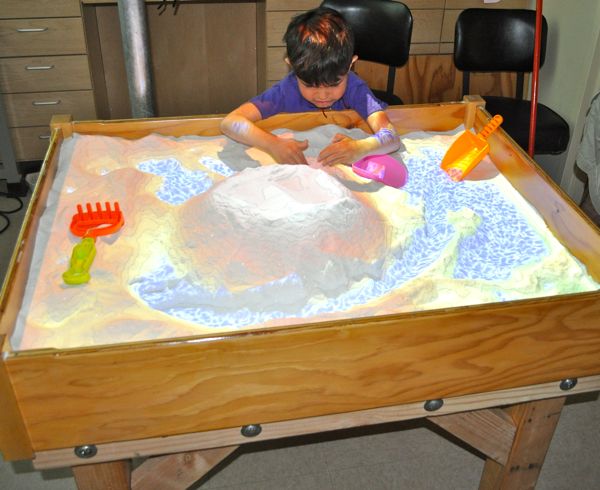
The Augmented Reality Sandbox uses 3D technology to teach kids of all ages about science, and in this case, the movement of water as the landscape changes that will be part of the exhibits at the Thomas J. Long Foundation Environmental Research Center in Incline Village. The sandbox will be added to the center by next summer, but a prototype is likely to be on site during the Children’s Environmental Science Day on Aug. 11.

A sandbox of information for children to play in on Aug. 11 in Incline Village. Photo/TERC

Imagine that you build mountains and rivers in a sandbox with a Wii Kinect mounted above the box projecting topographic features onto the sand in real time. You dig a large lake in the box, and the computer puts an image of a lake in the sand. And, when you’ve built mountains, meadows and streams, you can make it rain (virtually, of course) and see how water flows.

Playing in the sand will never look the same again.

The sandbox is one of several projects that the Tahoe Environmental Research Center is developing to add to its education component – an app is in the works, as well as several other exhibits using augmented reality technologies.

Augmented reality is a live view of a physical, real-world environment (such as an image viewed through a cell phone or other device) that is augmented by audio, video, graphics or GPS data.

“It’s exciting that Tahoe is one of the places that will get these exhibits right off the bat,” Heather Segale, TERC education and outreach director, told Lake Tahoe News.

The app, which uses a location-based augmented reality, uses GPS coordinates to display points on interest based on the user’s location. Sitting in Segale’s office on the campus of Sierra Nevada College, she demonstrated a prototype of the app using her phone. She pointed the phone at the lake (through a wall for this demo) and the app located Lake Tahoe, based on GPS coordinates, and then offered points of interest from environmental improvement projects around the lake to the Tahoe City Marina to earthquake faults to local beaches. TERC envisions a component that could be used by visitors, or for learning about wetlands and topography, to sailors being able to access weather conditions on different parts of the lake. TERC is still working on a way for the app to designate elevation differences.

TERC also is looking to incorporate what it calls tabletop prototypes into the Incline Village center. The tabletop prototypes are activity-based exhibits in areas from the movement of water to stewardship of fresh water lakes like Lake Tahoe and ecology, among others.

The projects are being funded through a National Science Foundation grant and is a joint venture with the Lawrence Hall of Science for the tabletop exhibits and the U.C. Davis KeckCAVES for the 3D visualizations. When complete, the technologies also will be made available to other education centers.

—-

Children’s Environmental Science Day

Children are invited to spend the day with scientists, and see the Augmented Reality Sandbox up close, on Aug. 11 from 1 to 4pm learning about the ecology, function, restoration and preservation of Lake Tahoe. And, free ice cream will be provided from 2 to 4pm.

The 13th annual Children’s Environmental Science Day is a free event sponsored by TERC with more than 40 interactive science activities for children ages 6 and older. The day will include interactive science demonstrations by UC Davis scientists, local agency and nonprofit organization staff, and AmeriCorps members. Hands-on activities are designed for the whole family.

About the center

The Thomas J. Long Foundation Education Center is a resource for children and anyone interested in learning more about Lake Tahoe.

The center features three unique stations offering different perspectives on the lake. The first is the Virtual Research Vessel with a two-thirds model of the research vessel John LeConte, which features some of the research tools including a Secchi disc, a net used to collect Zooplankton and a Van Dorn sampler used to captured water from 1,600 feet.

The second station is a Virtual Laboratory with informative videos and beakers with Mysis shrimp, an invasive species, Zooplankton and other experiments.

The 3-D Visualization Lab, the third station, offers three 3-D movies including the Global Earthquake View, “Lake Tahoe in Depth,” which lets viewers dive under the surface of Lake Tahoe to see fault lines, the footprint of glaciers and underwater landslides, and the newest film, “Mapping Change,” on the changing face of our forests.


Significant improvement to Lake Tahoe’s clarity confounds scientists

By Kathryn Reed

Another year of data about Lake Tahoe’s clarity provides more confusion for scientists.

“This last year has defied conventional wisdom in many ways,” Geoffrey Schladow, director of the UC Davis Tahoe Environmental Research Center, said in a statement. “In the past, very wet years have led to decreases in lake clarity, whereas we are now seeing the opposite. This only reinforces the fact that the underlying, driving forces are themselves starting to change.”

The “Tahoe: State of the Lake Report 2012” was released Aug. 9 by the Tahoe Environmental Research Center at UC Davis.

Summer clarity of 51.5 feet in 2011 was the second worst on record. Winter clarity of 84.9 feet was an improvement of 11.9 feet. Overall, the 2011 average lake clarity improved 4.5 feet from 2010.

Scientists speculate the winter improvement was from efforts to reduce fine sediment from reaching Lake Tahoe. However, they also stressed that monitoring is the only way to prove that statement.

A Secchi disc, which looks like a white dinner plate, has been used since 1968 to figure out how clear Lake Tahoe is. Researchers drop the disc overboard and use their naked eye to see how far down the disc goes.

For most of those years the clarity has been decreasing. Throughout these 44 years the reasons why keep changing. The latest thinking is fine sediment is the main culprit. That is why every project that is proposed in the basin must have an environmental component that would reduce the amount of sediment reaching the lake from that particular parcel.

That is why close to $2 billion has been pumped into what is called the environmental improvement program. The EIP was established after President Bill Clinton and Vice President Al Gore came to Tahoe for the first Lake Tahoe Environmental Summit. (The next one is Aug. 13, 10am at Edgewood Tahoe, Stateline.) Much of that money came through the Lake Tahoe Restoration Act. Reauthorization of it is not expected any time soon. Other money has come from the Southern Nevada Public Lands Management Act.

With the tap dry on both those sources, local jurisdictions and regulatory agencies are scratching their heads as to how future projects will be get paid. And with the Lahontan Regional Water Quality Control Board and Nevada Department of Environmental Protection Agency implementing the total maximum daily load protocols, the gauntlet has been laid down for the five counties, one city, U.S. Forest Service and two state transportation agencies.

Clarity readings since 2000

Lake Tahoe's clarity improved in 2011, but why remains unknown. Photo/LTN file

  • 2011: 68.9 feet
  • 2010: 64.4 feet
  • 2009: 68.1 feet
  • 2008: 69.6 feet
  • 2007: 70.1 feet
  • 2006: 67.7 feet
  • 2005: 72.4 feet
  • 2004: 73.6 feet
  • 2003: 71 feet
  • 2002: 78 feet
  • 2001: 73.6 feet
  • 2000: 67.3 feet                                    Source: UC Davis

Other data from the latest clarity report:

• Despite the cold winter and a cool July, the annual average surface water temperatures rose by 0.6 degrees.

• The length of time a summerlike stratification — where layers of water form with different temperatures — persists has increased by almost 20 days, a likely outcome of climate change. Researchers fear if this trend continues, oxygen replenishment to the bottom of the lake will become less frequent.

• A potential culprit to reduced summer clarity is a microscopic algae cell called Cyclotella. The tiny cells have grown exponentially in the past five years, scattering light and reducing clarity. Research shows that times of the highest concentrations of Cyclotella coincide with the lowest summer clarity levels.

• The 2007 Angora Fire, which burned 9 percent of the Upper Truckee River drainage, had almost no effect on lake water quality.

• An experiment using rubber mats on a half-acre site in the southeast portion of Lake Tahoe to control the spread of Asian clams appears to be effective.


S. Tahoe officials looking at ways to stimulate economy

By Kathryn Reed

With a deficit of more than $1 million that could grow to $1.5 million depending on how property taxes come in, South Lake Tahoe City Manager Nancy Kerry is looking at ways to bring more money into city coffers.

She presented a plan to the council on Tuesday that calls for an era of cooperation instead of competition. That discussion will be further expanded on Aug. 11 when the City Council has a three-hour workshop starting at 9am at Lake Tahoe Airport to discuss its priorities.

Kerry on Aug. 7 spoke of the need to meet with government and regulatory agencies, as well as private businesses in the basin to find the common themes each has in their respective strategic plans in order to find the common denominator.

The council believes recreation is the theme. But that in itself is a broad goal. It could mean having an Olympic training ground, something involving sports medicine, or having a sports complex for various athletic pursuits.

The idea Kerry presented is that the entities will need to give up some of their turf – literally and figuratively – for the greater good. She doesn’t want a plan; she wants to define projects and bring them to fruition.

Mayor Claire Fortier asked how this is different than the Prosperity Plan.

“The Prosperity Plan is a planning document. This is an implementation discussion,” Kerry told the council as to what the gathering of the players would be.

While it was not brought up at the meeting Tuesday, a piece to the puzzle could be the use of the vacant Kingsbury Middle School site in Stateline. While Douglas County School District wants to sell this acreage and the buildings on it, it could possibly be repurposed as the South Shore attempts to find its niche in the world of tourism. The ultimate goal is to find an economic driver.

Entities throughout the basin continue to go into debt (roads for South Lake Tahoe) or borrow from reserves (softball field for Lake Tahoe Unified) to make ends meet and provide what residents would call “the basics”.

Revenues are stagnant everywhere.

Councilman Tom Davis was the biggest naysayer to Kerry’s idea to create a collective vision by getting everyone to agree to focus on one or two projects. He believes it will take too long and not everyone will get on the same page and sounded reluctant to even try.

Councilwoman Angela Swanson was the most supportive of the idea.

“I think the time is now. The agencies are hungry for an action plan,” Swanson said. “This gets us beyond siloing.”

Kerry’s idea to go from recession to recovery to revitalization will be talked about more by the council at Saturday’s workshop.

In other city news:

• A $150,000 ambulance bought by the city-county joint powers authority is on the streets.

• For the umpteenth time, the council talked about signs. Now sandwich boards will be allowed Saturdays (8am-5pm), Sundays (8am-5pm), holidays, and Dec. 24-Jan. 11 (8am-5pm each day).


South Lake Tahoe trying to solve problems created by Lakeview Commons’ success

By Kathryn Reed

While Thursday night concerts have been a success at Lakeview Commons based on attendance, the complaints about it being something less than a family event dominated a portion of the afternoon session of Tuesday’s South Lake Tahoe City Council meeting.

Mayor Claire Fortier said the number and types of calls she has received has her constituents saying families don’t want to go back to the concerts.

Her colleague said it’s not quite that bad based on his experience of being at all but one show.

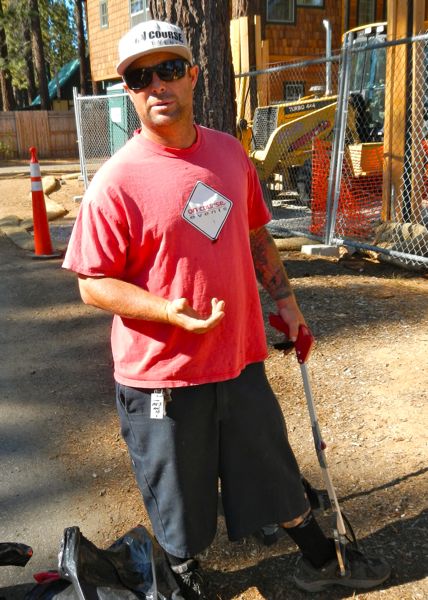
Rob Giustina of OnCourse Events talks about all the trash people leave in the neighborhoods by Lakeview Commons. Photo/Kathryn Reed

“I’m concerned it could go that way real easy if we don’t take proactive action now,” Councilman Tom Davis said in terms of the free event turning away families.

Police Chief Brian Uhler responded by saying, “We will have a heavy presence at Lakeview.”

He said people smoking marijuana would be cited and that officers also have the authority to cite anyone who throws a cigarette butt on the ground.

Pot and tobacco smoke are the predominant complaints, along with the literally thousands of cigarette butts that are picked up each week by volunteers. (Having a card for medicinal marijuana will not stop cops from telling someone to take it elsewhere.)

The council at its Aug. 21 meeting is expected to entertain an ordinance that would ban smoking of all kinds at city parks – which would include Lakeview Commons.

“There shouldn’t be any smoking at all, whether it’s cigarettes or marijuana. We need an ordinance to cover that,” Davis said.

The other thing the city needs to do is bring its special use permit and park rules into compliance. Permits can be granted for alcohol, but park rules say no alcohol ever.

Right now OnCourse Events, the promoter of Live at Lakeview, has a beer garden. (Wednesday paddleboard does as well, as do the Derby Dames at Bijou Community Park. Even the city has operated a beer booth at Bijou Bash.)

In September, the council will also be looking at refining what it wants from concessionaires in the future, what is allowed and not allowed. The businesses operating at Lakeview Commons and Regan Beach are only there for this season.

Standup Paddle, which operates the boathouse at Lakeview, is being taken to court by Beachcomber Lake Tahoe, a private resort on Lakeview Avenue. The dispute is over the paddleboard’s tent on El Dorado Beach blocking the view of Beachcomber guests.

City Manager Nancy Kerry told Lake Tahoe News the city is not named in the complaint and that staff is trying to facilitate a resolution. If that doesn’t happen, Beachcomber could be asking a judge on Friday to tell Standup Paddle to move its tent.

When the city first awarded the contract to the South Tahoe company to operate the boathouse it was not envisioned the beach would become an extension of the building for doing business. But there is nothing in Standup Paddle’s contract preventing it from using all of El Dorado Beach.

And not part of OnCourse’s contract is cleanup. Still, owners Rob and CarolAnne Giustina along with an employee and any volunteers who show up each Monday between 8-10am fill multiple large trash bags. (Meet at the fire pit to help each Monday.)

“We do the beach, but the heavy focus is the neighborhood,” Leslie Schultz with OnCourse told Lake Tahoe News.

Crews go down about three blocks on Lakeview Avenue and to Tallac Avenue along Harrison Avenue.

The reason to do this on Monday instead of Friday is so anything left from the weekend gets picked up, too.

The city takes care of the cleanup in the street level area of Lakeview Commons.

Rob Giustina’s thinking is the neighborhood is already impacted by the music; it shouldn’t be troubled by the litter left behind.

But what shocked the Giustinas and Schultz as they picked up trash this week was the abundance of cigarette butts and people leaving empty bottles on the side of the road. They also can’t believe people are bringing their dogs to such a crowded event – and to a location that doesn’t allow canines.

Giustina said they put up 12 signs saying no alcohol, no smoking, no dogs. The response by many was – no compliance. Plus, multiple announcements are made about the smoking – whether it’s tobacco or weed – that it impacts the enjoyment of others.

Giustina is a firm believer this is “everybody’s park” and wants to make sure everybody is comfortable coming to his free Thursday concerts that will go on through Sept. 6 from 4-8:30pm.


Former member appointed to LTUSD board of education

By Kathryn Reed

Barbara Bannar is returning to the Lake Tahoe Unified School District board of education.

She was selected Tuesday by the board to fill the seat that was abruptly vacated by Judy Cefalu on June 26.

Five people vied for the position that expires in December 2013.

Barbara Bannar is returning to the LTUSD board staring Aug. 21. Photo/Kathryn Reed

The sitting board members praised Bannar and Kathy Haven the most for their knowledge of the district and involvement with education. But they also said it was refreshing to have such a qualified field of candidates. The other candidates were Mark Bissonnette, Cathy Giardina and Heather Clelan.

While the deliberations were in public, the voting was by secret ballot. There were three votes for Bannar and one for Haven. When it came time to vote on Bannar joining the board it was unanimous.

Each of the candidates was asked the same 10 questions and then was able to make a comment at the end.

It was pointed out how current board members Sue Novasel and Larry Green tried to be appointed as provisional board members and failed; but won when they ran for election. This was said to those who didn’t get appointed so they might be encouraged to run in the future.

Bannar was on the board from 2004-08. She ran for re-election in 2008 and lost by three votes to Larry Green. Now she will be a colleague of his.

During her 20-minute interview before the board Bannar said she would want to run for a full term in November 2013.

“I really am thrilled to be back on the board and be working with everyone at the school district,” Bannar told Lake Tahoe News after the vote.

Bannar will be sworn in at the Aug. 21 meeting. She already has one meeting under her belt because she stayed for the Aug. 7 meeting.


State’s top educator promotes LTCC’s Spanish institute

By Kathryn Reed

“The key to dreams is education.”

That was one of the messages Tom Torlakson, state superintendent of public instruction, delivered Monday at Lake Tahoe Community College.

Not only was Torlakson the guest speaker on the first day of the college’s Intensive Spanish Summer Institute, he was also one of the students.

He called the program a role model for the state – one he would like to see expanded to other two-year institutions.

Superintendent of Public Instruction Tom Torlakson launches ISSI Aug. 6 at Lake Tahoe Community College. Photo/Kathryn Reed

“I feel this is a great institute. It is the gold standard of language learning,” Torlakson told the group of students ready to start their week of intensive learning.

He is a firm believer that the more people who know more than one language, the better off California’s economy will be because they will be able to communicate with the state’s diverse population as well as the world beyond.

Torlakson relayed how 38 percent of Californians identify themselves as Latino, one-quarter and soon to be one-third of the state’s students are English learners, and that one-quarter of the students in California grow up in poverty without health care.

All of those stats are why he believes an educated society is important.

He shared how one way the state is emphasizing the importance of being multilingual is by putting a bi-literacy seal on high school diplomas. This was the first year for the program, with 10,000 students receiving the designation.

While the LTCC program goes through Aug. 10, the California official was in town for two days.

On Monday after the opening of the Spanish immersion program, Torlakson received some language instruction, learned how to make tapas, went to Spanish through Storytelling and dropped in on a variety of other classes.

He had to be back in Sacramento today for budget issues and what he told Lake Tahoe News would be “three more intensive weeks.”

What brought him to South Lake Tahoe was the opportunity to see what the summer Spanish program is all about, how the 400-plus students get an education, and how the college has been able to sustain it for 19 years.

Maxine Alper and Sue O’Connor who run the program (O’Connor and Diane Rosner started it) said they have had to pay attention to every penny.

“We are being very frugal,” O’Connor told Lake Tahoe News. Staff cuts and cutting back on materials have been essential in this economy.

More changes are likely next year, with the potential of LTCC’s Connect Ed being a more integral component as the state keeps taking away dollars.

A pre-institute course was offered Aug. 5 through Connect Ed that Torlakson attended. Besides two hours of learning verbs, the group went to Taylor Creek to explore the natural environment of the South Shore.

The coordinators are taking feedback to heart by offering for the first time a three-day Spanish institute Oct. 5-7, which will be through Connect Ed.

ISSI offers 12 levels of instruction, which is why nearly one-third of the students are returnees. Plus, new break out sessions are added each year.

More information about ISSI may be found online.

Information about Connect Ed is also online.