City attorney hampers efforts to have South Lake Tahoe voters decide pot initiative

Updated Dec. 4, 4:15pm: City Attorney Tom Watson has given the title and summary to Steve Kubby.

By Kathryn Reed

While hundreds of hours, including multiple public meetings, were spent devising South Lake Tahoe’s medical marijuana ordinance, there is an effort under way to tweak the law that is on the books.

Steve Kubby, a local medical marijuana advocate, wants the voters in the city to have the opportunity to revise the ordinance. This is the second time he has started the ballot process. The first time was aborted in early 2012 when he planned to move to Canada. Those plans changed and he has resumed his quest to alter the language of the law.

But it has hit a few roadblocks on the way to the June ballot. City Attorney Tom Watson last week said he would not write the title and summary for the initiative, which is required before signatures can be sought.

A flurry of emails was exchanged during the weekend and through Monday between Kubby, Watson, City Manager Nancy Kerry and Mayor Tom Davis. Kubby told Lake Tahoe News he received a call from a city official Dec. 3 saying in all likelihood Watson would issue the title and summary some time today. This would still allow time for the question to be posed to voters in June.

If this happens, it will be the second time this week Watson has done a 180 regarding title and summaries. Late last month he said “no” to writing the documents for the group wanting a paid parking question on the ballot.  At the time he told Lake Tahoe News he could not be an advocate for that group. However, on Dec. 3 he summoned Tahoe4Tahoe members to his office.

“The topic of discussion was refining the petition request to be resubmitted for the title and summary that the city attorney is required by law to provide the petitioners. The meeting was productive and the committee remains focused on getting this issue in front of the voters for the June ballot,” Peggy Bourland of Tahoe4Tahoe told Lake Tahoe News.

Watson did not return a call to LTN. Lake Tahoe News sent Watson a series of questions on Dec. 1 to which he has not responded. These are the questions:

• Can you tell me if you have had to deal with Title and Summary issues before you came to South Lake Tahoe? If so, did you ever write one? If yes, what was different about those compared to the two that just came before you?

• If you have not dealt with Title and Summary issues before, was your decision for the two recent decisions made on your own or did you consult others? If you consulted others, who did you consult?

• What would the two SLT petitioners need to do to get you to write a Title and Summary? What is stopping you from helping them get the verbiage correct for you to write the Title and Summary?

• On the marijuana issue, how can one city attorney say yes one year and another say no to almost the identical wording nearly two years later?

The law states that the city attorney “shall” write the title and summary. In other words, he must. If passed by the voters, it can always be challenged in court if someone believes it violates the law.

“We are presenting an alternative to the current policy which we believe is illegal and unconstitutional and overly oppressive for patients,” Kubby said of his initiative.

His initiative would allow the market to determine the number of dispensaries and delivery services that could operate in the city, reduce fines, not mandate people disclose they are growing marijuana, increase rules regarding odor and limit local law enforcement working with federal agents.

The last item could be where a legal challenge would arise.

The exact wording is, “Elected, appointed, hired employees, officers, and officials of the city of South Lake Tahoe shall not directly or indirectly cooperate with or assist federal, state, or county officers or officials, volunteers, or employees who eradicate marijuana, act for seizure or forfeiture, or demand entry without a warrant or to defeat any liberally construed purpose of this act, nor may any state or local agency contract to eradicate marijuana that is being grown, manufactured or stored under the provisions of this act. Knock and talk shall be the first act taken by the above officers/employees. Violation of this clause shall be a misdemeanor, punishable by fine and up to one year in prison.”

While Kubby worked on the ordinance that is on the books along with the three operators of the collectives that were open at the time and the former city attorney and manager, he was under the impression certain items would be removed. They weren’t.

Kubby said he believes the current ordinance has negative health and safety consequences for people who use and grow marijuana for medicinal purposes.

Here is a copy of the revised ordinance Kubby is proposing.



U.S. teens not as smart as their peers

By Motoko Rich, New York Times

Fifteen-year-olds in the United States score in the middle of the developed world in reading and science while lagging in math, according to international standardized test results being released on Tuesday.

While the performance of American students who took the exams last year differed little from the performance of those tested in 2009, the last time the exams were administered, several comparable countries — including Ireland and Poland — pulled ahead this time.

As in previous years, the scores of students in Shanghai, Hong Kong, Singapore, Japan and South Korea put those school systems at the top of the rankings for math, science and reading. Finland, a darling of educators, slid in all subjects but continued to outperform the averages, and the United States.

The Program for International Student Assessment, commonly known as PISA, was administered to 15-year-olds in 65 countries and school systems by the Organization for Economic Cooperation and Development, a Paris-based group that includes the world’s wealthiest nations. Just over 6,100 American students took the exams.

Read the whole story


Supreme Court declines online sales tax case

By Robert Barnes, Washington Post

On one of the busiest online-shopping days of the year, the Supreme Court declined Monday to get involved in state efforts to force Web retailers such as Amazon.com to collect sales tax from customers even in places where the companies do not have a physical presence.

The multibillion-dollar issue — which could end tax-free online shopping for many Americans — is one of the most important in modern retailing. Traditional bricks-and-mortar businesses say the online retailers receive an unfair advantage by not having to collect sales taxes in some areas.

It is the second time the court has opted against hearing such a challenge.

All but five states impose sales taxes on purchases, whether online or not, and an increasing number have passed legislation to force online retailers such as Overstock.com and eBay to begin collecting those taxes from customers.

The court’s decision to stay out of the issue for now may put more pressure on Congress to come up with a national solution, as both online and traditional retailers complain about a patchwork of state laws and conflicting lower-court decisions.

Read the whole story


Politically-charged Briggs family at center of land deal to build courthouse in Placerville

By Kathryn Reed

El Dorado County supervisors are proceeding with buying the land for a courthouse in Placerville even though it is mired in controversy.

On today’s meeting agenda is a closed session item to discuss allowing the county to go forward with negotiating buying property owned by John Briggs. He is the father of Supervisor Ron Briggs, grandfather of Placerville Planning Commissioner Brian Briggs and father-in-law of Superior Court Judge Steve Bailey. John Briggs is also the former state senator who is famous for the 1978 proposition called the Briggs Initiative that had it passed, would have meant all employees in California’s education system who are gay or lesbian and their supporters would have been fired.

While the courthouse project has been in the planning phase since 2008, earlier this fall an anonymous letter was sent to the Judicial Council of California outlining a tangled web of conflicts of interest that would financially benefit the Briggs family.

The county needs to buy some of the land owned by the Briggs Family Trust, which is controlled by John Briggs. Ron Briggs owns two nearby parcels.

Ron Briggs did not return a phone call.

This is the courthouse in Placerville that would be replaced.

This is the courthouse in Placerville that would be replaced.

Curt Child, chief operating officer of the Judicial Council, told Lake Tahoe News his office sent the county a series of questions and is in the process of reviewing the responses. A decision whether the parcel in question is deemed a controversial site is expected by the end of the month. Steven Jahr, administrative director of the courts, will make that determination.

If it’s deemed controversial, then the entire Judicial Council will review the matter. If Jahr says there is no controversy, the process moves forward.

“Courthouses are important to communities. Often there is some difference of views of where it should be located,” Child said. “The anonymous letter raised some other issues beyond location.”

The letter says, “Ron Briggs and his son purchased several nearby parcels of land adjacent to and abutting the 26.5 acre courthouse site that are also benefiting from all of these government funded improvements, in essence, they are land speculating with a guaranteed outcome paid for by the taxpayers.”

Briggs, during his tenure on the board since 2007, has recused himself anytime courthouse matters have been before the board. However, the anonymous group contends Briggs “has been quite busy behind the scenes making things happen for this project. He often shows up at redevelopment meetings and other meetings pushing the project.”

John and Ron Briggs signed legal documents for the Judicial Council stating in essence they have done nothing unethical.

El Dorado County Counsel Ed Knapp responded to Judicial Council, saying, “The county is aware of no conflicts that should impair the ability of the county, city of Placerville, and the state to move forward with the construction of this much needed courthouse. Nor is the county aware of any legitimate reason this should be considered a controversial site.”

The anonymous group says twice it has asked the grand jury to investigate whether improprieties have occurred and each time the jury was prevented from doing so. The 2012-13 grand jury was disbanded midterm. Bailey was the presiding judge of the grand jury at the time.

The group said in its letter, “As concerned citizens and taxpayers for honest, open and transparent government, and in light of the current state budget problems, we request that the state Office of the Courts not fund this site acquisition or any further construction costs until the matter has been fully investigated to be assured there is not illegal activity, misuse of government funds, profiteering, favoritism or impropriety and that taxpayers, the state and federal government are not paying for the private real estate development interest of the Briggs family.”

The new facility would replace the two Placerville buildings now being used by the court. One is the courthouse built in 1913 on Main Street. The court also uses a portion of a building in the county government center. Neither building has adequate security nor do they meet current regulations such as seismic and Americans with Disabilities Act rules.

The Main Street courthouse is the oldest of the five court facilities in the county.

If all goes forward, the building could be completed in the third quarter of 2018. The 87,642-square-foot facility would contain six courtrooms – the same number Placerville now has. The new building would be able to handle any type of case, have holding cells for defendants, and secure parking for judges as well as 240 spaces for on-site parking for support staff, visitors, and jurors.

The expected cost is $91 million.

The money comes from assessments on traffic and criminal convictions – not from the budget of the trial court. The cash is supposed to be put in a trust fund, but the Legislature more than once has tapped into the account for its own purposes.


Nevada child care costs among highest in nation

By Paul Takahashi, Las Vegas Sun

Aaron Trujillo wasn’t expecting sticker shock when he started searching for an affordable day care center for his 1-year-old daughter last month.

Trujillo, 30, and his wife both work for a Las Vegas apartment management company and make a combined $72,000 annually. When his wife returned to her job as a real estate agent in November, Trujillo began looking at putting their toddler, Bealla, into day care.

The Trujillo family looked at three preschools near their central valley home. The first charged $240 a week. That’s $960 a month — the equivalent of a rent or mortgage check for many Southern Nevadans.

“It was ridiculous,” Trujillo said. “That’s really not affordable.”

After much searching — even checking Craigslist for cheaper child care — the Trujillos settled on a Kidz Kidz Kidz preschool near Tropicana Avenue and Jones Boulevard. The family was swayed by a special deal of $140 a week.

Still, with their older son Andres, 10, in a Safekey afterschool program and Bealla in preschool, Trujillo estimates he will spend about $800 a month for child care on his two children. “It’s still really pricey,” Trujillo said.

His observation is on the mark.

A national study found that Nevada has among the highest child care costs in the country. The Silver State is among 31 states nationally where child care costs could exceed the cost of college tuition and fees, according to a 2013 report from the advocacy group Child Care Aware of America.

Read the whole story


Bone-chilling cold to envelop Lake Tahoe

By Kathryn Reed

Record-breaking cold weather is about to descend upon the greater Lake Tahoe area.

“Today is probably the last nice day. By tomorrow we are looking at a 32-degree drop for Reno and a 25, 26 drop for South Lake. That is for the high, so the low will tank as well,” Edan Lindaman, meteorologist with the National Weather Service in Reno, told Lake Tahoe News.

Icy cold is the forecast this week in Lake Tahoe. Photo/LTN file

Icy cold is the forecast this week in Tahoe. Photo/LTN file

The record low for South Lake Tahoe on Dec. 4 is minus 2 degrees. It was set in 2001. The forecast now is for the low temp that day to be 2 degrees.

Truckee is more likely to break a record for Dec. 5, according to Lindaman. The record for that day is negative 7, which was recorded in 1972. And that is the same low temperature that is forecast for Thursday.

“It will all depend if we have snowfall on the ground. If we have 2, 3 inches of snow, it will be that much colder,” Lindaman explained.

The snow is expected to come late tonight and continue through Tuesday evening. By the time the storm blows through it’s possible a half foot will have fallen in the basin. Reno and Carson are also expected to get measurable snow.

A lake wind advisory is in effect through 1am Tuesday.

Highs through the week are not expected to reach freezing.

The good news is this means more snow for the ski resorts and the likelihood of more terrain opening.


Firefighting capabilities a concern at Fallen Leaf

By Kathryn Reed

Firefighting capabilities at Fallen Leaf Lake are not great, but they might get a little better soon.

On the Dec. 7 community services district board’s agenda is a resolution supporting the El Dorado County Board of Supervisors’ proposal to fund a new pump for the fire boat.

The current pumping capacity is so minimal that it is causing some residents of the South Shore enclave to pay extremely high homeowner insurance rates, while others don’t qualify for coverage in case there were a fire.

Fallen Leaf Lake is trying to become better equipped to fight a fire. Photo/LTN file

Fallen Leaf Lake is trying to become better equipped to fight a fire. Photo/LTN file

The Insurance Service Office, better known as ISO, gives areas a rating, which then plays a role into the cost of insurance.

“Many on the west side of the lake are paying exorbitant property insurance or can’t get it,” board President Tom Bacchetti told Lake Tahoe News.

Fallen Leaf Lake is also looking at obtaining a used pumper truck from CalFire that would replace one of its four older apparatuses.

While the area has never been flush with a large operating budget, the county took away $60,000 in 2009. That was the Aid to Fire program. To make up the difference the board raised the special tax from $395 per parcel to $595 a year. Still, there is a systemic deficit.

Bacchetti said the community doesn’t want to raise that fee, so likely when it’s up for a three-year renewal next summer the fee will be the same.

“There’s always a shortfall. We have reserves,” Bacchetti said. “There are things that should be done that are not getting done.”

The dismal financial situation has also gotten the attention of the Local Area Formation Commission, which has some oversight of the community service district.

In the staff report from this fall’s LAFCO meeting it says, “The fire chief indicated that the district had made deep across-the-board cuts in its equipment and other unspecified line items. For example, the district has stopped purchasing turnouts and [personal protective equipment] and has not made any repairs to its radios, hoses and apparatuses to bring them up to compliance with [National Fire Protection Association] standards.”

Ironically, the Fallen Leaf Lake Community Services District was formed in 1982 to provide better fire suppression to the area. It was another five years before the district incorporated parks and recreation into its purview.

While the mostly volunteer department doesn’t get that many fire calls, the threat is there. There were six structure fires between 2003 and 2012. However, there were 49 non-structure fires in that 10-year period. And had firefighters not stopped the 2007 Angora Fire on the ridge, it would have swept through the Fallen Leaf Lake community.

South Lake Tahoe Fire Department has a longstanding agreement to provide aid when necessary. The city also handles Fallen Leaf Lake’s dispatch needs.

Knowing Fallen Leaf Lake is having issues, South Tahoe Chief Jeff Meston told Lake Tahoe News he plans to reach out to Chief Gary Gerren to see if the city could do more.

—-

Notes:

• The board meets Dec. 7 at noon at the El Dorado Hills Community Center.

• New officers will be named to the board. Bacchetti will remain on the board, but is stepping down as president.


Plenty of fresh Christmas trees in Apple Hill

By Debbie Arrington, Sacramento Bee

Farm to fork? These farmers specialize in field to floor.

“We’re growing something that’s sustainable,” said Dee Kobervig, president of the El Dorado County Christmas Tree Growers Association. “We’re trying to grow something for our (Northern California) Christmas tree market, something that people want.”

On Apple Hill, it’s looking a lot like Christmas, which is just the way tree farmers like it. This weekend marks the official opening of cut-your-own-tree season as dozens of mom-and-pop farms open their gates to city folks who drive up.

“A lot of people are going back to the basics with family traditions,” Kobervig said. “(Looking for a tree) is a fun adventure. You can drink hot chocolate and munch a candy cane. And the trees look fantastic this season.”

Mild fall weather helped the firs and pines develop lots of branches and grow lustrous new needles.

Read the whole story


Opinion: AIDS becoming a forgotten disease

By Warner C. Greene

I saw my first AIDS case in 1981, the year the disease was identified. And for most of the time since then, I’ve conducted laboratory research to better understand the precise mechanisms by which the virus HIV causes AIDS.

Lately, however, I’ve been equally worried about a related condition that is prevalent, persistent and threatens to bankrupt us. People in my world call it AIDS fatigue.

AIDS fatigue has several telltale symptoms. One is thinking that the AIDS crisis is under control. Another is believing that AIDS is someone else’s problem, while still another is assuming that antiretroviral medications cure HIV/AIDS. All three notions, unfortunately, are false.

World AIDS Day — Dec. 1 — is a great opportunity to begin treating these malignant misconceptions, which we must do to address one of the most lethal pandemics ever to strike mankind. As a global community, we are not supplying — and may not even be able to afford to supply — enough of the lifesaving drugs required to prevent an HIV infection from progressing to AIDS for all the people who need them.

Our best option is to cure this disease — thereby eliminating the need to fund a lifetime of expensive medications for tens of millions of people — while also developing a vaccine to prevent new infections. And to do this, we must first treat AIDS fatigue with the only medicine known to address it: facts.

Warner C. Greene is a physician and the director of virology and immunology research at the Gladstone Institutes in San Francisco.

Read the whole story


Expanding N. Shore electric lines being studied

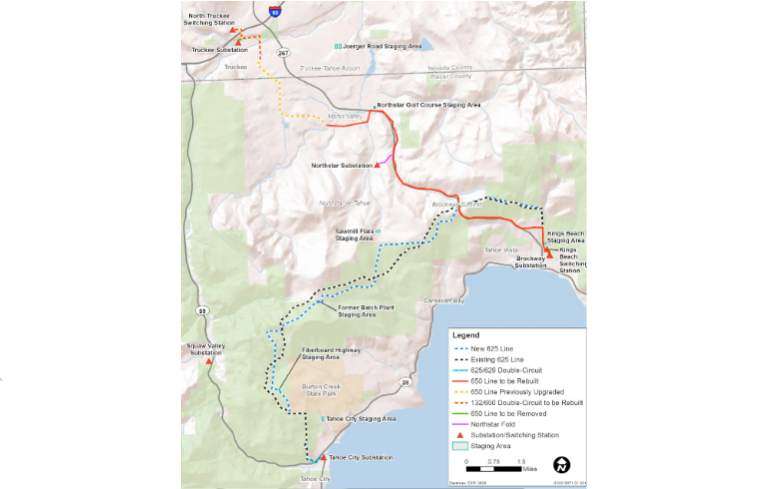
Proposed route changes to Liberty Utilities’ North Shore lines.

Proposed route changes to Liberty Utilities’ North Shore lines.

By Kathryn Reed

Five routes for a massive electrical line on the North Shore are being studied in the environmental documents that were released in November.

CalPeco – short for California Pacific Electric Company – wants to strengthen its ability to provide power to that area. CalPeco is the parent company of Liberty Utilities, the electric company for the California side of the Lake Tahoe Basin, Truckee and Alpine County.

For Northstar to be able to grow it needs to be able to tap into more power. These upgrades would allow for the ski resort to grow as outlined in its master plan.

CalPeco officials had expected the process to move faster.

The draft environmental documents that are out for circulation are a joint effort between the U.S. Forest Service, Tahoe Regional Planning Agency and California Public Utilities Commission. Much of the land involved with the project is on Forest Service property.

The project also includes Truckee, Kings Beach, Tahoe City, Martis Creek Lake Recreation Area and Burton Creek State Park, as well as private property.

The existing lines run in a northeast-southwest direction between Kings Beach and Tahoe City and then parallel to Highway 267 form Truckee to Kings Beach.

CalPeco wants to remove that first segment and replace it with a higher voltage line. The second line would be realigned. Where exactly will be determined through the environmental analysis. Six substations on the Truckee-Kings Beach route could be upgraded or eliminated.

The current lines are 60 kilovolts and new ones would be 120 kilovolts. Substations would also be upgraded to the increased voltage.

“These improvements would increase the ability to maintain the current maximum system loads during an outage on any of the four key power lines within the North Lake Tahoe Transmission System, increasing the system’s reliability,” according to the three entities that released the draft EIR/EIS.

A year ago this month planners didn’t now if the line would require Tahoe Regional Planning Agency approval – it does.

The Advisory Planning Commission of TRPA will hear the proposal Dec. 4, with the Governing Board discussing it Dec. 18. Public comment will be taken at both meetings. These meetings were pushed back from earlier this fall because of the federal government shutdown.

Informational meetings are set for Dec. 10 from 2-4pm at the Tahoe National Forest Truckee Ranger District Office at 10811 Stockcrest Springs Road, Truckee and Dec. 10 from 6-8pm at the North Tahoe Events Center, 8318 North Tahoe Blvd., Kings Beach.

The 971-page draft environmental impact report and draft environmental impact statement are available online. Public comment is being accepted until Jan. 7.