Sweeney: ‘Teach the next generation to think critically’

Publisher’s note: Lake Tahoe News asked the two Lake Tahoe Community College District 5 candidates a series of questions. The responses are being run in the order LTN received them.
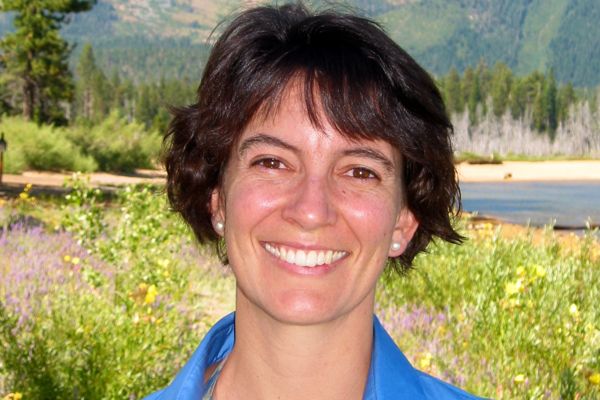
michelle sweeneyName: Michelle Sweeney

Profession/work experience: Please see my resume following:
Strategic Planning | Policy Development | Knowledge-building
High-integrity, energetic, listening leader building management structure and culture for high performance and productivity
· Organizational development
· Leadership development
· Strategic planning
· Fundraising and collaboration building
· Policy and program development
· Communication strategy development

PROFESSIONAL EXPERIENCE
TAHOE PROJECT, INC. a 501(c)3
Facilitating critical thinking about people and nature in the twenty-first century
Executive Officer / Founder (February 2011 – present)
The objective of Tahoe Project is to steer attention and capital to enterprises adept at creating environmental, social and economic resilience and prosperity. Toward this end our writers and speakers engage diverse audiences in discourse about 21st century environmental issues. Through this discourse we seek to contextualize claims, technologies and policy approaches. We explain environmental science findings, integrate social science into discourse and convene and facilitate discussion among diverse experts, advocates and publics.

ALLEGRO COMMUNICATION CONSULTING
Developing organizations and leaders

President and Principal Consultant (2004 – present) Projects have included:
The Clarity Challenge | Author

Authored The Clarity Challenge (2013), a policymaker’s handbook of prioritized solutions to Lake Tahoe clarity decline.
Lake Tahoe Aquatic Invasive Species Program | Communication Consultant (2010-2011)
Conducted institutional and policy assessment of the Lake Tahoe Aquatic Invasive Species program resulting in a comprehensive suite of strategic planning recommendations including: performance indicators, a communication plan and toolbox, and policy and strategic alliance guidance.

CA Governor appointee to TRPA Governing Board | Governmental and Public Affairs Consultant (2009-2011)
Conducted institutional and policy assessment of Lake Tahoe interagency management of aquatic invasive species, land use planning, water quality and transportation. Provided strategic recommendations for streamlining operations, utilizing existing resources to better result, transforming leadership culture and building capacity.

Lake Tahoe Crediting Program | Editor, Communication Consultant, Facilitator (2008-2009)
Facilitated the inter-agency design and deployment of the bi-state program to address fine sediment—the primary cause of lake clarity decline. Edited The Lake Tahoe Crediting Program Handbook (2009), the management framework for connecting on-the-ground actions to the goal of restoring lake clarity.

Large-Cost Fire Independent Review to Congress | Editor (2008-2009)
Edited the Large-Cost Fire Independent Review to Congress (2009) regarding the fires of fiscal year 2008 with suppression costs exceeding $10 million. Conducted a review of fiscal diligence. Participated in the collaborative development of recommendations for managing major wildland fire.

Lake Tahoe Total Maximum Daily Load | Facilitator, Communication Consultant, Editor (2006-2009)
Facilitated inter-agency and public meetings in the design of the Integrated Water Quality Management System that highlights pollutant reduction opportunities to inform the design of regional plans and management strategies. Designed the community outreach and communication process.

Edited Charting the Course to Clarity (versions 2008 and 2009).

Sierra Nevada Yard & Garden | Author and Presenter (2007-2008)

Authored Sierra Nevada Yard & Garden (2008), a homeowner’s guide to property management that integrates best practices for erosion control, wildfire prevention, water quality improvement and wildlife habitat conservation. Led workshops featuring pragmatic solutions to the complex interplay of these mountain issues at the 2008 Sierra Nevada Alliance conference.

ADDITIONAL ENGAGEMENTS
Nevada Tahoe Conservation District | Watershed Program Manager, Fundraiser (2001-2004)
Santa Monica Pier Aquarium/UCLA Ocean Discovery Center | Educator, Fundraiser (1999-2001)
Conservation Department, New England Aquarium | Editor, Facilitator (1998-1999)
Centre d’Echanges Culturels Internationaux, Lyon, France | Program Administrator (1996-1997)
The Berkeley Guides | Travel Writer, France (1994-1996)

EDUCATION, BOARD MEMBERSHIPS, COMMUNITY AFFILIATIONS
University of California Berkeley, BA English
Lake Tahoe Basin Federal Advisory Committee Member (2009-2012)
University of California Berkeley, Oral History Institute
Stanford University, Gould Center for Dispute Resolution, Dispute Resolution Systems Design
Harvard / MIT Program on Negotiation, Mediation and Conflict Management
Sierra Business Council, Sierra Leadership Institute (2005-2006)
U.S. Environmental Protection Agency, Mediation and Meeting Facilitation Training
Lincoln Institute of Land Policy, Mediating Land Disputes, Advanced Course
Women’s Health Leadership, California Policy and Advocacy Institute
Alliance Francaise, Diplôme de Langue

Age: 41

What organizations, committees or groups are you or have you been involved with?: As a mother I value giving all children a strong foundation in reading, math, science and foreign language. Presently I help first- and fourth-grade students learn to read in English and Spanish at Bijou School where I am in my fifth year as a parent volunteer. In the period 2008-2011 I volunteered at Tahoe Parents Nursery School teaching preschool children how to be well rounded, composed, courageous and courteous lifelong learners. Meanwhile, I am the founder of the nonprofit Tahoe Project where I host interviews about the present and future of Lake Tahoe. In addition, I’ve recently entered into collaboration with Mountain Yoga where I am developing the Happy Series — a course that invites students to craft unique approaches to the “pursuit of happiness”, that core ambition of the U.S. Declaration of Independence.
What is your educational background?: I earned a B.A. in English from the University of California at Berkeley. I strive to learn continuously. Among the themes I have emphasized are facilitation and conflict resolution, particularly in the context of land use planning and water resources management. The following are courses and certificate programs I’ve completed in this domain
· Harvard / MIT Program on Negotiation, Mediation and Conflict Management
· Sierra Business Council, Sierra Leadership Institute
· U.S. Environmental Protection Agency, Mediation and Meeting Facilitation Training
· Lincoln Institute of Land Policy, Mediating Land Disputes, Advanced Course
· Stanford University, Gould Center for Dispute Resolution, Dispute Resolution Systems Design

Additionally I have a longstanding interest in women’s health and participated in the yearlong Women’s Health Leadership course of the California Policy and Advocacy Institute. In support of the sound reporting I do in the context of Tahoe Project I graduated from the UC Berkeley Oral History Institute. I speak French fluently, am proficient in Spanish and enjoy maintaining basic Italian. I have been a student of parenting since my son’s birth in 2005.

Why do you want to serve on the college board?: In 2011 I was asked the question, “What is the best thing that can be done for Tahoe?” Our economy was in the dumps, tourism trends were (and are) in dramatic flux, the housing market was host to bankruptcy and the outfall of instability in our families and civic institutions and we were in dire need of a new perspective on future prospects for the Lake Tahoe region. In pursuit of the answer to this question I have interviewed business, agency and academic leaders throughout the Tahoe region and elsewhere. I have read extensively on the subjects of education, current affairs, leadership, conflict resolution and environmental policy. My conclusion: Striving for a four-year institution of higher learning focused on educating future regional and global leaders is one of the best things that I can do for Lake Tahoe. This is why I want to serve on the college board. I can make a difference at the college. The college can make a difference in the lives of students, among them our children. These students will make Tahoe in our 21st century world. The best thing that can be done for Tahoe is to nurture a classically educated, critical-thinking, thoughtful and nature-oriented generation of leaders.

Why should people vote for you over the other candidate?: As a forty-something female entrepreneur, mother of children born in 2005 and 2008, student of environmental policy and practitioner of facilitation and conflict resolution, by virtue of identity and experience I have a vision for the college and an approach to implementation distinct from that of the other candidate. I think voters in District 5 have in this election a great opportunity to choose between different futures for the college. “Exceptional energy” is a character trait others have noted in me consistently throughout my career. I’m asking voters to give me the opportunity to contribute this energy to a prosperous, globally oriented, 21st century college for Lake Tahoe.

What do you think is the most pressing issue facing Lake Tahoe Community College and how will you deal with it?: The most pressing issue facing LTCC is revenue generation. The best way to generate revenue is to enroll more students. Leadership at the college is employing good strategies to address this issue. For my part I would encourage the following:

Strategic planning
· Data supported
· Stabilizing cost while increasing revenue always providing high quality educational experience
· Emphasis on success realized in the classic Core Curriculum

Community partnership
· Especially internships and work experience
· Close collaboration with LTUSD

Collaborative program development
· Articulation programs (e.g., South Bay Regional Public Training Consortium)
· Build relationships with other educational institutions outside of Tahoe where Tahoe has a unique contribution to offer

Targeted recruitment
· Targeting specific communities we would like to recruit from and building relationships there
· Building programs in coordination with communities with like interests whose students value the unique offerings of a Tahoe education.

How will you be voting for the bond the college has on the ballot and why?: I believe a “yes” vote on Measure F is a vote for higher education. Measure F will enable three things critical to the future viability of the college. Measure F will fund the technological revamp of the college — giving our faculty, students and community the technological tools essential to success in our contemporary world. Measure F will fund maintenance of existing infrastructure, ensuring maintenance of the community’s infrastructure investments to-date. New boilers, repairs to rooftops and other maintenance would compete with teaching students for college general fund dollars if Measure F funds were not secured. Finally, Measure F is the mechanism by which our community will provide matching funds to state and other monies for new educational infrastructure such as the proposed Public Safety Training Center — a place to house not only existing successful programs like the Fire Academy, but also envisioned future programs consistent with the promising partnership with the South Bay Regional Public Training Consortium. I support Measure F.

What is working well at the college and what isn’t; and how would you go about changing what isn’t working?: I am enthusiastic about running for trustee of the college in part because I have seen the college leadership take on the task of creating a new vision and updating the mission with considerable success. This vision, mission and the bylaws and procedures that govern the college form the foundation of the institution’s prospects for success. I can look forward to a positive and productive working relationship with fellow trustees and with the ever-evolving leadership team at the college. As a trustee I will advocate for student success, strong core curriculum offerings, data-and-experience-driven strategy development with faculty. I will think critically about opportunities to increase enrollment and revenue. I will advocate that we focus effort on a focused, strategic set of actions. All of these approaches are consistent with what I see leadership at the college doing in 2014.

What programs are not offered that should be?: In terms of programs I would emphasize investment and growth in those areas where the college has existing strengths: the core math, science and humanities curriculum (in-person and online), the Fire Academy and public safety training, Community Connect programs and foreign language (especially the Intensive Spanish Summer Institute). I think we should invest in enhancement and expansion of the programs we already have. I do think that the college can do better at integrating existing regional assets into existing programs. In particular, there is opportunity to integrate Lake Tahoe’s unique natural and socio-political environment into the higher learning experience. I believe this will not only intensify our students’ learning but also make our college an attractive partner for other higher learning institutions that lack these unique real-world assets.

What classes have you taken at LTCC?:
· Accounting
· Algebra
· Ballroom dance
· Calculus for Business
· Geometry
· Italian Conversation
· P.E.
· Intensive Spanish Summer Institute
· Statistics
· Tahoe Parents Nursery School Parenting Courses
· Yoga.

What other involvement have you had with LTCC?: In addition to being a student at the college I have been on campus on a regular basis in the past decade in these capacities: My children attended the Child Development Center. I am a regular in the campus library where I often work, research and meet for community projects. In my capacity as journalist at Tahoe Project I interviewed Kindred Murillo in her first and third years as president of the college inquiring about her vision for the college and the strengths and weaknesses of the institution as she took the helm. I have also over the years interviewed faculty, staff and students at LTCC to periodically gauge enthusiasm for and criticism of the college. Some of these interviews are published, others are not. This has informed my understanding of the dynamics at the college as has attendance at events like the 40th anniversary celebration and the Taste of Gold fundraiser. I should mention I’m a fan of the drama department productions and the chorus, which also bring me to college events. Suffice to say, given all of this interaction I am so enthusiastic about the trajectory I see the college on that I would like to proactively contribute by becoming a trustee.

What should be the role of higher education in South Lake Tahoe?: The role of higher education in South Lake Tahoe should be to teach the next generation to think critically. Critical thinking is marked by the ability to choose an informed course of action based on listening, research and application of standards based on the core disciplines of math, science, language and history. Critical thinking is necessary for performing the functions of an informed electorate and an inspired workforce.

Critical thinking is taught by:
· Teaching the core disciplines — math, science, language, writing, history, art (including dramatic art)
· Modeling standards and stamina
· And then, by demonstrating how to evaluate disciplinary evidence.

Those that excel in the 21st century will have more knowledge, ask better questions and exercise independent thinking. The college’s role in developing workforce readiness is to teach our students, among them our children, to be critical thinkers and leaders. Chief among our tasks is teaching them how to discern a future course for themselves and society.

What do you believe should be the financial priorities of the college?: The financial priority of the college should be to invest in high-quality, in-person core curriculum courses in math, science and the humanities.

The college needs a technology overhaul including the modernization of labs and classrooms.

The college needs facilities better suited to collaborative learning and hosting community events. I envision bigger classrooms with more open space and technology integrated as well as meeting and small conference space.

In terms of programs I would emphasize investment in those areas where the College has existing strengths: the core math, science and humanities curriculum (in-person and online), the Fire Academy and public safety training, Community Connect programs and foreign language, especially the Intensive Spanish Summer Institute.

Being on the board requires working with four others. Give readers an example of how you work well others in difficult situations with differing opinions: I served as the at-large representative of the South Shore on the Lake Tahoe Federal Advisory Committee in the years 2008-2012. It was a privilege to serve. I learned a great deal and am proud of the contributions I was able to make. In particular I was able to build a coalition around the proposal to double the funding amount allocated toward the prevention and control of aquatic invasive species. The monies allocated during those negotiations are still the mainstay of the important work happening on this front today. I am a facilitator by training, having studied facilitation at the Lincoln Institute of Land Policy at the Harvard Program on Negotiation and at the Stanford Gould Center for Conflict Resolution. During my second term on the LTFAC I offered criticism of the decision-making structure and operating procedures of the federal advisory process at Tahoe. While I was not successful in creating change in these aspects of the SNPLMA process I earned the respect of many in the group who appreciated the courage I demonstrated in advocating for procedural change they agreed was needed. I learned a great deal about advocacy and coalition building from both my successes and my failures on the LTFAC. One of my peers on the LTFAC approached me in 2010 to ask me to consider becoming a Trustee of the Community College lauding the ability I had demonstrated to articulate independent and strategic thought.

How much time can you commit to carry out trustee duties?: In addition to preparing for and participating in semi-monthly trustee meetings and the regular business and extracurricular activities (fundraisers, community events, professional development) of the board I would like to work collaboratively with college leadership and the foundation in the pursuit of targeted grants and strategic partnerships with other educational institutions and communities (from which we aim to recruit new student populations). I anticipate this will amount to approximately 200-250 hours a year for the duration of my term.

What do you think is the most important mission of LTCC?: The mission of LTCC is to maximize college accessibility; to facilitate students’ learning, support success and the timely completion of their educational goals; to support the development of a sustainable and prosperous community; and finally to ensure college financial, human, technology and facilities resources are sufficient to meet the evolving educational needs of the community.

Tell the voters something about yourself that they may not know: I am a community leader insofar as I am an entrepreneur, a professional, a wife, a mother, a community organizer and a friend. To these roles I would now like to add the role of trustee of Lake Tahoe Community College.
I would like to underscore what I believe are the most important leadership actions I have taken in my 13 years at Lake Tahoe. First, I established Allegro Communication Consulting, the sole proprietorship in which I as a communication consultant have played a role in facilitating the development of Lake Tahoe environmental policy while demonstrating to my peers that one can have a professional, entrepreneurial career while being a parent and partner in Lake Tahoe. Second, I helped my husband at the completion of his Stanford MBA start his company at Lake Tahoe. Environmental Incentives LLC now employs 10 professionals at its headquarters in Lake Tahoe and eight in Washington D.C. Finally, I founded the nonprofit Tahoe Project in 2011 as a means to research and host dialogue about the future of Lake Tahoe. Thanks to the work I have undertaken at Tahoe Project including interviews with a wide array of professionals and business leaders I have come to the conclusion that I can be an instrumental contributor to a positive future for Lake Tahoe by becoming a trustee of the college. The future of the Lake Tahoe region is in the foundation this generation creates in our institutions — none more than our families and our educational institutions. As a trustee my energy will be committed to helping our students and Lake Tahoe’s public institution of higher learning realize their considerable potential in a 21st century paradigm.




King Fire uses record amount of retardant

By Raquel Maria Dillion and Gillian Flaccus, AP

Firefighters are dropping record-breaking amounts of retardants on the King Fire that is burning explosively because of the prolonged drought.

California firefighters and the U.S. Forest Service together had bombarded the conflagration with more than a half-million gallons of retardant, fire spokeswoman Lynne Tolmachoff said Friday. That included more than 203,000 gallons in a single day.

Retardant — a water-and-fertilizer mix colored with red dye — are used as an initial attack tool on wildfires to buy time for crews to get to the scene and dig fire lines.

A jet aerial tanker drops its load of fire retardant on a fire near Pollack Pines, Calif., Monday, Sept. 15, 2014. The fire, which started Sunday has consumed more than 3,000 acres and forced the evacuation of dozens of homes. (AP Photo/Rich Pedroncelli) Photo: Rich Pedroncelli, Associated Press

A tanker drops a load of fire retardant on the King Fire. Photo/Rich Pedroncelli/AP

But the fire activity is so extreme it’s pushing through their lines.

“They can slow it down a little bit. But they’re not able to hold it long enough to get ground units in there to extinguish it before it burns through and continues its path,” Tolmachoff said.

The King Fire, which authorities said was deliberately set, has chewed through nearly 120 square miles of timber and vegetation east of Pollock Pines.

The blaze in steep terrain forced the evacuation of 2,800 people and burned multiple structures in the White Meadows area of Pollock Pines. One resident who has been helping carve fire lines with his bulldozer told the Sacramento Bee he lost his home on White Meadows Road when he went to check on it Friday.

“My house got burned. My house is gone. My outbuildings are gone,” Tom Boscow said. “I just wish I’d been here.”

The fire is threatening a key UC Berkeley research station that is home to scores of experiments on trees, plants and other wildlife. It is also threatening hydroelectric facilities and power lines that deliver water and electricity to the Sacramento region and some treasured Sierra Nevada recreations areas, the Bee reported. Some power stations and lines either burned or were shut down as a precaution, cutting off energy from three utility agencies’ hydroelectric reservoirs.

The man suspected of setting the fire, Wayne Allen Huntsman, 37, pleaded not guilty to an arson charge Friday in El Dorado County Superior Court. He was being held on $10 million bail.

Authorities have not said what evidence they have linking Huntsman to the fire, by far the largest of about a dozen fires burning statewide.

The record retardant drop occurred Wednesday, and Thursday was another heavy day. Authorities reduced drops on Friday because smoke affected visibility for pilots.

Firefighters have used retardant since the 1950s to slow the advance of wildfires, but the practice is controversial because of its potential effect on wildlife. The Forest Service recently adjusted its retardant rules after two lawsuits that alleged the drops were killing fish, damaging watersheds and harming endangered species.

The agency now can’t drop retardant within 300 feet of bodies of water on federal forest land and can’t dump the slurry in certain exclusion zones designed to protect endangered plant species. The only exception is if people are in immediate danger from flames.

Andy Stahl, executive director of Forest Service Employees for Environmental Ethics, said the intended purpose of retardant was to attack “very remote fire” until crews could get to the blaze.

“But now we’re seeing a dramatic increase in the amount of retardant being dumped because we’re not just using it in those remote wilderness areas, but we’re using it on every fire, everywhere, and there are more fires,” he said.

The Forest Service used 12 million gallons of retardant nationwide last year, and 60 percent of it was dumped on California fires, Stahl said.

The federal restrictions don’t apply to California firefighters, and CalFire has increased the amount of retardant during the past decade.

Tolmachoff, the state fire spokeswoman, didn’t know how many gallons her agency dropped on fires last year. But she said retardant use was rising because of the addition of bigger DC-10 air tankers, expanding populations in fire-prone areas and the increasing size and frequency of fires caused by drought.

“Our main goal in California is to protect lives and the property and resources, and we put every effort we can into it,” she said.


West Shore Inn oozes relaxation

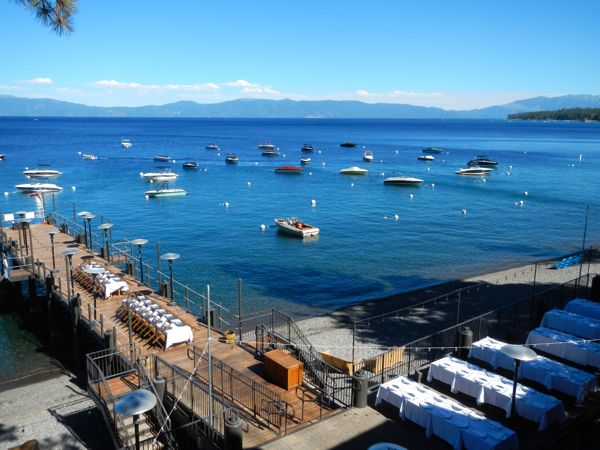
No need to get out of bed to  see the sunrise from the West Shore Inn. Photos/Kathryn Reed

No need to get out of bed to see the sunrise from the West Shore Inn. Photos/Kathryn Reed

By Susan Wood

HOMEWOOD – As active as I am, I never dreamed I’d look so forward to waking up early on vacation. I also never thought I’d go to a hotel and have sitting be my favorite activity.

But a couple days at the West Shore Café and Inn isn’t just any experience – especially with a stay in the Marlette Peak suite.

This peak experience right on the lakefront starts with the sun rising. Views of Heavenly Mountain Resort runs remind us this waterfront experience is in our backyard. The many shades of pink and yellow of the shoreline seep through the morning clouds then changed in a matter of minutes, thus keeping me stationary for hours. Between the mesmerizing lapping of the waves only 20 feet out the window, a ski boat breaks the rhythm cutting across the shoreline with a water skier in tow.

Breakfast with a view.

Breakfast with a view.

If one wants to move around, there are two balconies – one with two cushy chairs and an end table for morning coffee, another with a bench. The best seated-view, though, is smack dab in front of the floor-to-ceiling living room window.

A throw blanket is carefully placed on one of the chairs in case the temperature dips. When it got nippy, we turned on either the gas fireplace in the living room or bedroom. When the sun was beating it, we’d open the two balcony doors.

The first morning, I got up to take in the different views and to await a breakfast tray of assorted muffins and orange juice that would soon arrive at the door. Coffee is made in the living room/office area.

The rooms, which are inviting all day and night, are a tastefully decorated with an alpine feel, along with beautiful walnut wood furnishings and finishing accents. Even the nightstands in the bedroom look as though someone attached a tree-round steppingstone to legs. Elegant touches may have guests never wanting to leave. Tile floors and a full-size tub add to the relaxing experience. (Suggestions: Fix the shower so it drains properly, and so water is not being wasted, and provide consistent quality towels.)

A view that never gets old.

A view that never gets old.

Cushy robes let you lounge all day in comfort. The mini fridge filled with complimentary water and sodas is a nice touch, as was a tray of glasses for water, coffee and wine.

The wine glasses are Riedel, one of the finer things in life for wine enthusiasts. When Kae noticed what type of glass it was, she immediately took it off the balcony railing where she was snapping a photo.

Old black and white photos line the walls in the hallway outside the suite and continue to dot the walls inside. In the bathroom is one of Tahoe City, just five miles north on Highway 89 from the inn. The living room shows one of fishing on the East Shore.

Forget pulling the drapes, unless you totally want to sleep in or completely seclude yourself. For us, they were up and away the whole time. After all, the view is a huge reason to be here.

Even the large wedding on the deck below where the inn hosts dinner guests provided entertainment from one of our balconies that first evening.

The water taxi beats driving.

The water taxi beats driving.

The West Shore Inn has the wedding thing down, hosting about 90 for the year. More than two-thirds of those are planned in the summer. Three fell on our recent fall weekend. (Note: Those who want access to the restaurant and quiet time at night may want to check this out ahead of time, as weddings can be quite festive into the wee hours.

Not having dinner there was no big deal on the first night. We simply added the North Lake Tahoe Express boat to our experience. In its third and final trial year, the shuttle runs from June 21 to Sept. 21 and can be used for pickups or drop-offs from five docks between Homewood and Carnelian Bay.

Through a recommendation of the West Shore Inn’s concierge Bill Gaines, we opted for the five-minute walk south on Highway 89 to Obexer’s marina to take it to Tahoe City for $10 a person, where Moe’s barbecue awaited. It’s fun and exciting to be on a motorboat on the lake. What’s nice about the shuttle is the plastic lining the bow to shield the wind — considering J.T., the skipper, cranks up the motor to travel 24 mph on the 25-minute excursion.

With his own personal experience to draw from, J.T. endorses the experience for those who simply don’t want to drive or may partake in too many cocktails. As one of the original drivers since its inception, J.T. has also done his civic duty on the water, having to rescue a stranded boater at Dollar Point.

Scallops at the West Shore Cafe.

Scallops at the West Shore Cafe.

Bikes are allowed on the boat, which can accommodate a dozen people. Crewmembers J.T. and Matt are pleasant, professional and admit they like their jobs being out on the water. This is even with a slight slowdown after Labor Day weekend and with the drought’s impact of a low water level making docking a little bit more challenging. The shuttle service funded through Placer County’s transient occupancy tax was forced to remove Captain John’s as a drop off and pickup point.

If the boat shuttle doesn’t work out for the return from Tahoe City to Homewood, there are a handful of various vehicle taxi services. After dinner, we hopped into a North Shore Checkered Taxi cab where our local driver was courteous.

When asked about the upcoming big plans from the West Shore Inn’s owner JMA Ventures that is expected to change the face of Homewood, he said he liked the idea. In particular, the prospect of the West Shore’s first major development seemed appealing to him because it would be good “for the local economy.” He also backed the underground parking structure to deter the possible eyesore that goes with a major attraction as a large hotel planned at the base of Homewood Mountain Resort.

The development planned across the street from the West Shore Café and Inn may alter the identity of the small boutique hotel, but its place under the cloak of an upcoming 180-room hotel remains to be seen.

West Shore Inn General Manager Jessica Barton said it’s “tough to compete” with an upscale resort of that size, but it sounds like the West Shore Inn is holding its own in its own niche of weddings and group events. A few weeks ago, JMA – which has owned the 14-year-old inn for five years – bought two villas on the north side of the inn as additional lodging options. One is considered lakefront, the other serves up a mountain view.

“It’s important to get something more to accommodate large groups,” Barton told Lake Tahoe News of the popularity of retreat gatherings.

The full moon provided plenty of photo ops.

The full moon provided plenty of photo ops.

The inn is evolving. Barton said much of the focus in the West Shore’s experience is on amenities. Guests can now enjoy complimentary access to paddleboards and kayaks off their dock. The inn also partnered with a motorboat vendor that will offer charters with a 10 percent discount to guests. There’s a certain charm in being able to dock their boat or yours just steps from your room.

The second day of our stay, we hauled the 17-foot canoe down to the beach – with help Gaines had arranged as concierge extraordinaire. The paddling trip was both gorgeous and challenging, as our mid-morning jaunt to Sugar Pine Point was a little too late to avoid the headwind. Despite the workout, this activity is highly recommended.

Hugging the shoreline provides an interesting architectural tour, along with glimpses of residents’ ensembles of various water toys. One home had a slide that could be attached to a boat. A few boaters cruised by, but for the most part, the trip was peaceful and quiet. One woman sitting at the end of her pier was knitting and smiled as we paddled by. This was the universal sign for, ah yes, the good life.

Water at Sugar Pine Point looks like the Caribbean.

Water at Sugar Pine Point looks like the Caribbean.

Three miles down from the inn, the water got a little rougher with more exposure to the wind, and the shoreline looked more rugged. I knew we were entering Sugar Pine Point State Park. And because I was told by an inn worker that an eagle bird’s nest is near the rock outcropping that we negotiated in the canoe, I found myself often looking overhead while trying to keep my eyes on where we were going.

We brought the canoe to the shore and walked down the beach to the large pier in front of a giant grassy area in front of the Hellman-Ehrman Mansion, a century-old-plus residence passed down from a San Francisco businessman. The California State Parks system, which bought it in 1965 from heirs, is maintained as a museum and an example of the opulence of yesteryear.

From shore-to-shore, Tahoe pioneering families have shown through chronicled history how life at the lake can be good and fulfilling. Before dinner, I glanced at the nightstand where the classic Tahoe novel “Lake of the Sky” by George Wharton sits alongside historian Mark McLaughlin’s popular “True Tales of Tahoe” series. I read all of Volume 1 while lounging at the end of the West Shore Inn pier, where a fire pit, stimulating conversation with other diners and a tray full of s’mores ingredients beckoned me on the second night of our stay.

Dinner at the West Shore Café is yet another example of the modern-day good life at Tahoe. The food is excellent, but the setting on the deck on the lakefront is untouchable. Add to that a full harvest moon and you get an experience as savory as my seared Maine scallops and Kae’s perfectly seasoned pasta.

An eclectic wine list offers varietals from Oregon to Italy and Australia to Hungary. We went with the Oveja Negra Sauvignon Blanc from Chile.

Before the delivery of our entrees, Kae joined many diners away from the table to take photos of the moon rising above the East Shore ridge. It was a picture-perfect night.

And the service was exemplary. Hoke, our waiter from Scottsdale who works in Tahoe for the summer season, was excellent, noticing every slight detail. He even fixed an uneven table, which most waiters in Tahoe would have ignored.

The West Shore Café offers two-for-one entrees in September, a nice gesture for the shoulder season. (However, I found the 20 percent mandatory gratuity a bit presumptuous, though I would have gladly given Hoke that and told him so.)

The lemon tart with wafer and strawberry sorbet and rhubarb is worth saving room for.

In the peak seasons, the West Shore Café is open for lunch and dinner, but is now open for dinners only through this month. In October, the inn is open without the restaurant. The first two weeks of November, JMA closes the whole operation for a major cleanup leading into the ski season.

——

Notes:

• West Shore Café and Inn is located on Highway 89 across from Homewood Mountain Resort, five miles south of Tahoe City.

• Rooms in the fall range from $199 to $499 a night; in winter, they can run from $399 to $549.

• For more info, go online.


Sullivan assumes judgeship ahead of schedule

Dylan Sullivan has started her job as El Dorado County Superior Court judge four months sooner than expected.

Presiding Judge Suzanne Kingsbury swore Sullivan in on Sept. 19.

Gov. Jerry Brown appointed her to the position this week. This is the only judicial interim appointment Brown has made.

Dylan Sullivan

Dylan Sullivan

Sullivan was elected in June to fill the vacancy created by the retirement of Judge Daniel Proud. The governor’s appointment allows her to immediately assume the position she was elected to begin in January 2015.

Sullivan has been assigned to Department 7, the criminal pre-trial department in Placerville. She will conduct felony and misdemeanor arraignments, hear preliminary matters, traffic matters, and drug court.

Kingsbury, in a release, said Dylan would be handling these matters because of her training and experience, to assist the court in effectively implementing criminal justice realignment in El Dorado County.

The 48-year-old Sullivan has served as a commissioner at the El Dorado County Superior Court since 2011. She served in several positions at the California Department of Corrections and Rehabilitation Board of Parole Hearings from 2005 to 2011, including deputy commissioner and associate chief deputy commissioner. Sullivan was an attorney at the Law Offices of Dylan Sullivan from 2000 to 2008 and a contract attorney at the Law Offices of Patricia Lynne Nelson from 1998 to 2000.

She earned a juris doctor degree from the University of the Pacific, McGeorge School of Law and a bachelor of science degree from UC Davis.

— Lake Tahoe News staff report


Calif. water bill barely floating in Congress

By Michael Doyle, McClatchy Washington Bureau 

WASHINGTON — Secret California water bill negotiations have a “55 percent to 60 percent chance” of success during the fast-fading 113th Congress, Democratic Sen. Barbara Boxer said Thursday.

In her first extended public comments on the closely held water talks, Boxer voiced cautious optimism even as she criticized House Republicans for trying to exclude Northern California Democrats.

“I’m very hopeful,” Boxer told reporters. “I would say the discussions are going well.”

Some negotiators convened as recently as Sunday in an effort to narrow remaining differences, Boxer revealed. Like everyone else involved in the ongoing negotiations, she carefully avoided discussing any specifics and declined to identify what the major sticking points might be.

But with so little time remaining, Boxer could find herself holding the key card in what she described as “pretty good, often intense” negotiations.

The negotiators are trying to resolve significant differences between House and Senate bills that respond to California’s drought. The GOP-controlled House passed a far-reaching bill in February. It would roll back a landmark 1992 law that directed more water to protect the Sacramento-San Joaquin Delta, remove wild-and-scenic protections from a half mile of the Merced River and authorize new water storage projects, among other provisions.

Read the whole story


Marsh restoration compromise proposed

The Upper Truckee Marsh in April 2013. Photo/LTN file

The Upper Truckee Marsh in April 2013. Photo/LTN file

By Kathryn Reed

A possible project to come out the California water bond that is on the Nov. 4 ballot is restoration of the Upper Truckee Marsh.

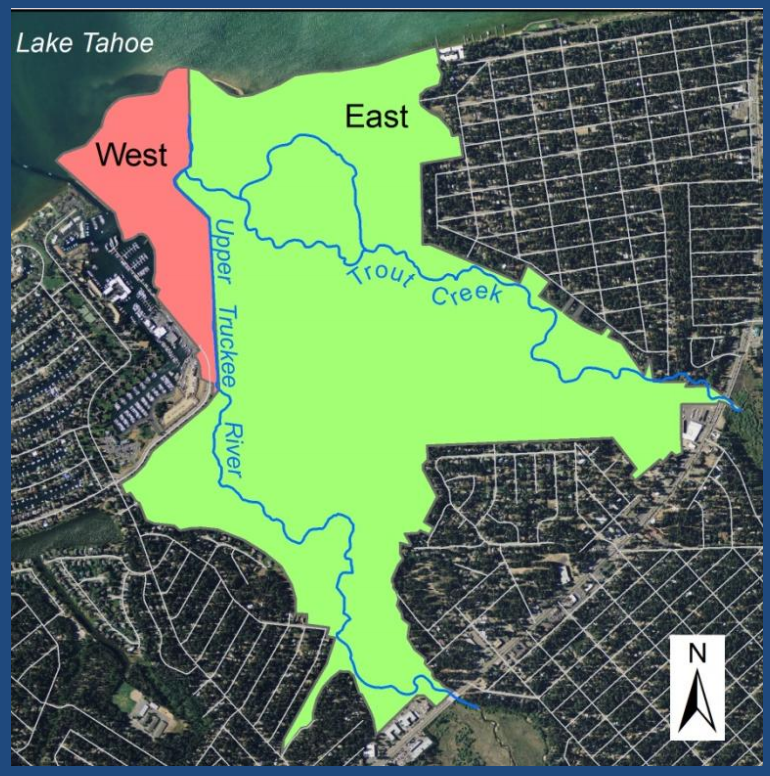
On Thursday the California Tahoe Conservancy board heard a presentation about staff’s recommendation for how to restore this approximately 500-acre parcel. The CTC owns this swath of land that borders the Tahoe Keys and Al Tahoe neighborhoods in South Lake Tahoe and goes from Highway 50 to Lake Tahoe.

The west and east sides of the marsh. Image/CTC

The west and east sides of the marsh. Image/CTC

Four alternatives were studied in the environmental documents, with the Conservancy not having a preferred one. Now staff is recommending a hybrid. The final environmental impact report and environmental impact study should be out in late spring, early summer 2015. The soonest any work could start is 2017, and that would not be anything substantive, according to staff.

Residents in Al Tahoe have been vocal about their opposition to increasing recreation opportunities on their side of the marsh. Parking would be an issue, plus they questioned how this would be good for plants and animals. Their concerns were heard.

And at the Sept. 18 meeting many applauded the decision.

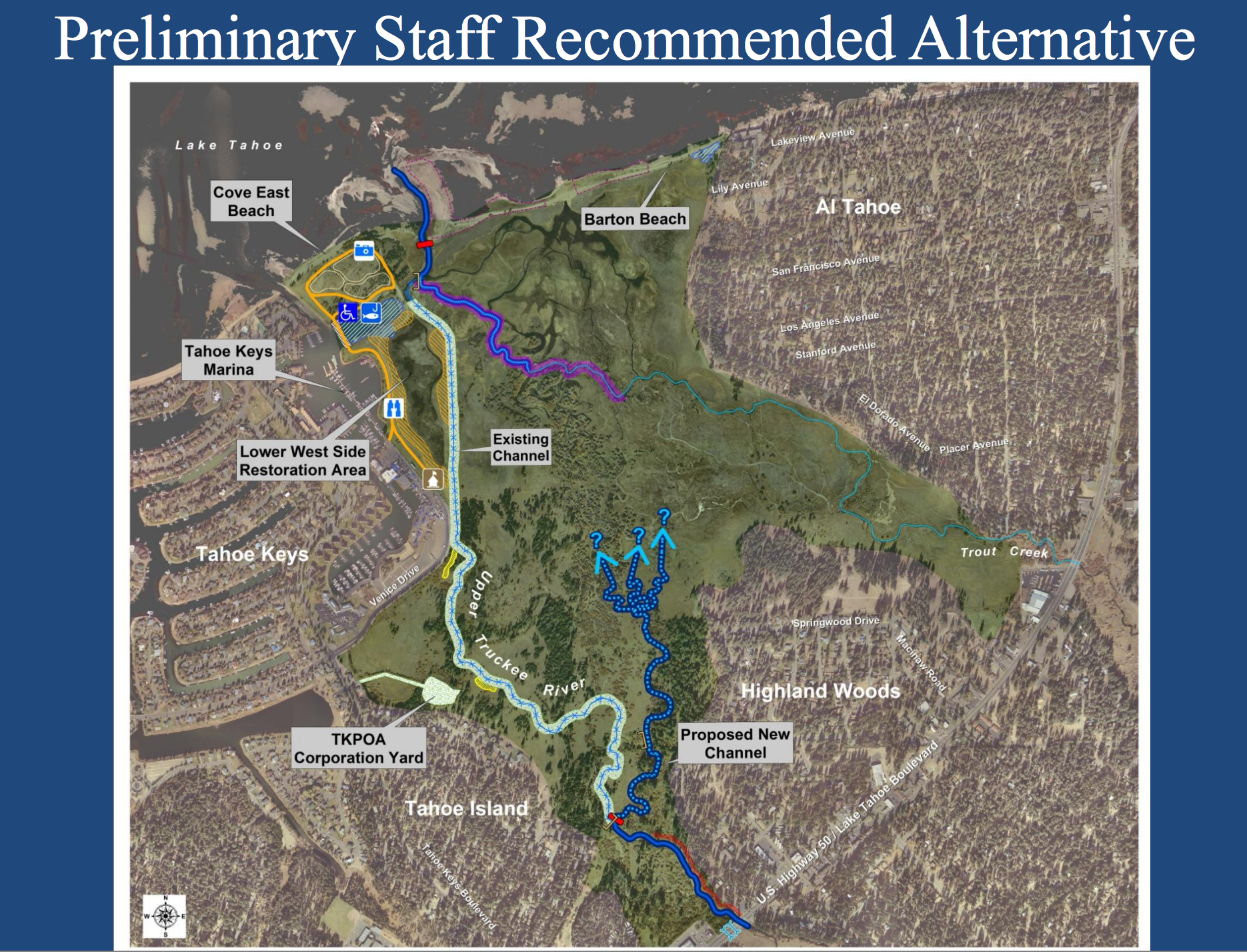
No elevated boardwalks or viewing areas will be erected on the east side of the marsh. Trout Creek, which runs on this side, will see some restoration work. In the future it will come into the marsh as one channel, but then will be allowed to meander through the marsh to Lake Tahoe without a defined route. This returns the waterway to how it functioned before settlers messed with it.

One person raised issues about flooding, questioning if enough analysis has been done to ensure tweaking the area even a few inches won’t cause problems for residents.

On the west side of the marsh is where most of the visible changes will take place. This includes rerouting the trail at Cove East, changing how the lagoon off the boat channel functions and possibly relocating the Tahoe Keys Property Owner Association’s corporation yard.

Screen Shot 2014-09-18 at 7.50.31 PMOverall goals of the entire project include:

• Restoring and enhancing habitat

• Improving water quality

• Protecting Tahoe yellow cress

• Providing appropriate public access

• Preserving cultural heritage

• Avoiding flood hazards.

CTC staff is in the process of responding to the 65 public comments and 12 agency comments. However, many centered on enforcement of the area and not the actual alternatives.

The east side has more issues with people being unruly, letting dogs run wild, parties and trash. The Conservancy said it is looking into how to better address these concerns.


CTC’s go-to guy saying goodbye after 25 years

Ray Lacey is retiring from the California Tahoe Conservancy after 25 years. Photos/Kathryn Reed

Ray Lacey is retiring from the California Tahoe Conservancy after 25 years. Photos/Kathryn Reed

By Kathryn Reed

Ray Lacey knew what job he wanted to have before it even existed. Now, after 25 years with the California Tahoe Conservancy, the deputy director is calling it quits.

Lacey earned an undergraduate and graduate degree from UC Berkeley and then a graduate degree in watershed planning from UC Davis. While at Davis he described the job he wanted to his advisor. That person informed him it didn’t exist. Five years later it did with the Conservancy.

The 58-year-old attended his last board meeting on Thursday – at least as a full-time employee. The South Shore resident isn’t going anywhere, so the board has said he will be tapped as a resource to train his successor and to work on projects. But officially his status as a regular employee ends latter this month.

“I think of myself as a community planner from an environment perspective. I tried to take the social and human interest as well and not just the ecological perspective,” Lacey told Lake Tahoe News. “This is not a preserve or reserve. This is a living, breathing community.”

Now he’ll be spending more time with family – his mom is 104, and traveling.

“I always thought of him as being the ideal employee. He has never not done what he was supposed to do. He never makes a mistake, always does what he says he’s going to, and is always on time. He’s the perfect person,” Larry Sevinson, chair of the CTC board, told Lake Tahoe News. “He has also been a friend to everybody. No matter what I throw at him he gets it resolved.”

Lacey’s fingerprints are on most of the Conservancy’s projects in the basin. But he describes what he does as putting the icing on the cake; that it was others who are not always recognized and the land acquisition folks who deserve credit for providing him a canvas to transform.

“His legacy is working with Tahoe City Public Utility District on Commons Beach and Lakeview Commons on the South Shore. They have become community gathering places largely because of his work,” Patrick Wright, CTC executive director, told Lake Tahoe News.

Community has been Lacey’s focus from Day 1 and continues to be. (The Conservancy was formed in 1984 and Lacey joined it in 1989.) His approach to projects has been to strive for the greater good – especially knowing it is taxpayer dollars that is paying for whatever improvements are being made.

He said listening to constituents is key to getting community projects in the ground.

Lacey reflected back on how in the 1980s Kings Beach was trying to figure out what to do with lakefront property. A common goal is to put things by the water that could not be put elsewhere. So when people wanted a basketball court the Conservancy’s thinking was this could go elsewhere. But meeting after meeting young people voiced the desire for the basketball court. That court got built. A few years latter he went by it and some young men were playing. It was in good shape. No graffiti or vandalism. They told him they were going to take care of it and did; and they thanked him for making their dream become a reality.

“That’s the power of listening to your constituency,” Lacey said.

Listening is one of the traits Lacey is known for – as well as having a vision.

Ray Lacey, center, at the groundbreaking of Lakeview Commons with Jerry Birdwell, from right, Bruce Grego, Kathay Lovell and Norma Santiago.

Ray Lacey, center, at the groundbreaking of Lakeview Commons with Jerry Birdwell, from left, Bruce Grego, Kathay Lovell and Norma Santiago.

“He is insightful and very diplomatic. He has Conservancy in his blood and always will,” Bruce Eisner, longtime Conservancy employee, told Lake Tahoe News. “He’s always been someone people can talk to within the agency. He listens to what you have to say. People will miss that.”

He also joked how Lacey has always been better dressed than everyone else.

“Ray always set a dress standard the rest of us could only dream about … double and triple starched shirts. I’m sure John’s Cleansers will miss him as much as us,” Eisner said with a laugh.

At the Sept. 18 board meeting others also commented on the dapper Lacey.

Another thing he is known for is taking fabulous vacations. He’ll be doing that again as soon as he becomes a retiree. He’s headed for Spain.

“I admire his work ethic and diplomacy. But I also admire his long vacations. When he got away, he got away,” Cindy Gustafson said.

Gustafson, who is executive director of the Tahoe City Public Utility District, has worked with Lacey since the late 1980s when she was a planner with Placer County. She credits him for helping to bring $16 million in CTC funds to the TCPUD and another nearly $5 million in other state funding. Bike trails, river access, Commons Beach, and the 64-acres are the bigger projects on the North Shore that Lacey had a part in.

Lacey has a knack for getting people to envision an idea for a parcel they would have never imagined. Such was the case when he took then CTC members Kathay Lovell and Norma Santiago to see what he and Gustafson had created with Commons Beach in Tahoe City. They were convinced something similar could be done with El Dorado Beach.

“That epitomizes that you can do projects for enormous good, but are all about community,” Lacey said.

That’s not to say it was always easy to get things accomplished, especially in such a heavily regulated area like the Lake Tahoe Basin.

Ray Lacey speaking to a community group about Conservancy issues.

Ray Lacey speaking to a community group about Conservancy issues.

“He always managed to see the positive side. It was evident this was not a job for him. He truly loves Lake Tahoe and he wanted to do everything possible to enhance the ability for people to recreate in Lake Tahoe on the California side,” said Lovell, who spent six of her eight years as a South Lake Tahoe City Council member on the CTC board.

Gustafson said Lacey has an ability to listen to everyone’s concerns, be diplomatic, always be professional, problem-solve and build consensus, which made him stand out above others.

“He was always able to work through issues with folks and gain their respect, maybe not agreement,” Gustafson told Lake Tahoe News. “I never saw anyone walk away and be hurt by Ray.”

Through the years Lacey has had other job offers. But Tahoe has been in his blood since he was a young man, spending as much time during high school and college as he could at the lake. His college work also centered on Lake Tahoe. But more important to him is that sense of community. He doesn’t believe it’s possible to effect change without understanding the fabric of a community. That’s why community comes before environmental planning for him.

“You need to know how the community works, to have the pulse of it, and know what makes people feel connected to their environment,” Lacey said.


Arrest in King Fire; 10% contained; Tahoe safe

Updated Sept. 18 7pm:

By Kathryn Reed

An arrest has been made in the out-of-control King Fire near Pollock Pines.

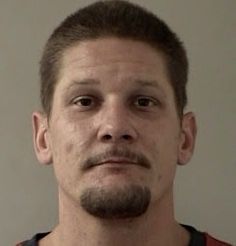
Wayne Allen Huntsman, 37, was arrested Sept. 17 on a charge of arson – forestland. His bail was set at $10 million.

Wayne Allen Huntsman

Wayne Allen Huntsman

The King Fire erupted Sept 13 and has since burned 73,184 acres and is 10 percent contained.

A criminal complaint was filed by the El Dorado County District Attorney’s Office on Sept. 18 alleging Huntsman “willfully and maliciously set fire to and burn, and caused to be burned forest land” in what is now known as the King Fire. Aggravating factors have been added because two people fighting the fire have been injured.

Huntsman has a criminal past. In Santa Cruz County he has been convicted of assault with a deadly weapon and in Plumas County on property theft charges.

He is scheduled to be arraigned Sept. 19 at 1pm in Placerville.

How the fire was started has not been released.

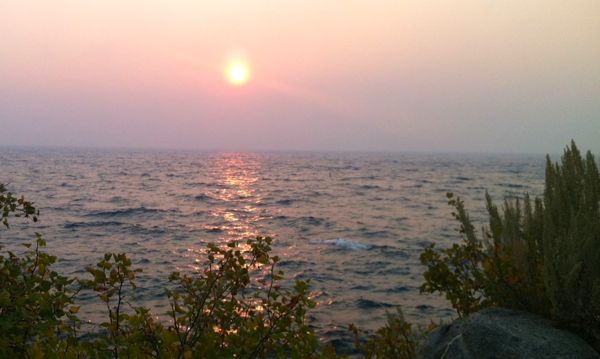
Smoke from the King Fire makes for a colorful sunset at Cave Rock. Photo/Susan Wood

Smoke from the King Fire makes for a colorful sunset at Cave Rock. Photo/Susan Wood

Fire update

“The fire is a not a threat to the basin at this time,” Dave Zaski with North Tahoe Fire told Lake Tahoe News Thursday afternoon. There are also no evacuations in the basin. And Truckee is also not threatened.

The terrain that ignited last night was heavily wooded, whereas the areas close to Alpine Meadows and Squaw Valley are full of granite.

“We are telling people to have an evacuation plan ready. If something goes bad, we will tell them,” Zaski said.

Winds are also expected to decrease and the humidity level should be good for fighting the fire this evening.

The fire is moving east toward Desolation Wilderness. It has moved into Placer County. As of Thursday morning it was almost at Hell Hole Reservoir. The U.S. Forest Service has issued an advisory for people to not hike or backpack in Desolation and Granite Chief wilderness areas. The McKinney Rubicon Trail has been closed. A closure notice has been issued for Eldorado National Forest until the fire is out.

While no structures have been lost as of Sept. 18, thousands of residents are temporarily displaced as fire threatens them. As of Thursday night, 12,000 single residences and 9,000 other minor structures are in the path of the fire.

Because of evacuations advised for the areas of Kyburz and Silver Fork, Silver Fork Elementary School will be closed Sept. 19.

Highway 50 is closed from Pollock Pines to Riverton. For updates from Caltrans, click on the state icon on the home page of Lake Tahoe News.

The fire is moving north from Pollock Pines into popular wilderness areas. Map/Google Images

The fire is moving north from Pollock Pines into popular wilderness areas. Hell Hole Reservoir is at the top, then Loon Lake to the right, and Union Valley Reservoir near the center. Map/Google Images

On Wednesday, Gov. Jerry Brown issued an emergency proclamation for El Dorado and Siskiyou counties because of the King and Boles fires. The Boles Fire is the one that swept through the town of Weed and continues to burn.

Smoke is expected to continue to be a problem for Truckee, Carson City and Reno areas. Washoe County is reporting unhealthy air quality and recommending people not go outside, especially people with respiratory issues, older people and the very young.

The evacuation center is at the Seventh-day Adventist Church in Camino, where small animals are welcome. Another Red Cross evacuation center is located at 6530 Wentworth Springs Road in Georgetown. Late Thursday afternoon the South Lake Tahoe Recreation Center opened as an evacuation site. Lake Tahoe Humane Society has provided cages for small animals because the West Slope ran out of them.

The Ironman race on the North Shore this weekend is still scheduled. The air show at Lake Tahoe Airport on the South Shore is also still happening, only now the admission is free.

Nearly 3,700 people are working the King Fire with 327 engines, 15 helicopters, 49 dozers and 80 water tenders. Crews from Lake Tahoe are at the fire.

Officials say it is costing $5 million a day to fight the fire.


S. Lake Tahoe cops busy dealing with gangs

By Kathryn Reed

STATELINE – Gang members are among us – in schools, at stores, in our neighborhoods. They get recruited at the elementary level and often don’t leave until they’re killed.

While these facts seemed to come as a surprise to many members of Soroptimist International South Lake Tahoe, the reality is gangs are nothing new to the Lake Tahoe Basin. Every year law enforcement tries to figure out how to get a handle on the situation, and how best to educate kids, parents and the public at large. And every year media writes about it.

There are 26 known gangs in South Lake Tahoe, with about a half dozen of those being inactive. And there are 159 documented members in those gangs. Sureño – aka Southside 13 in Tahoe, Norteño – aka Eastside Familia, Juggalos, OMG (Outlaw Motorcycle Gang), TNB (Trust NoBitch), and Cyclones are some of the more active gangs locally.

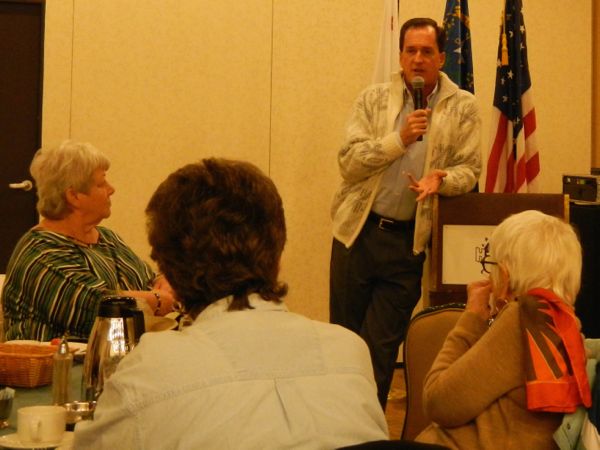
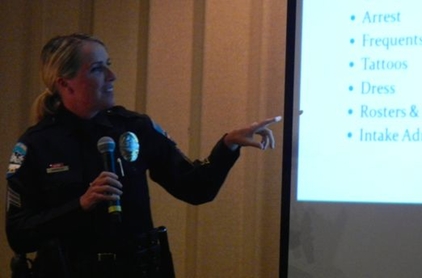
South Lake Tahoe police Sgt. Shannon Norrgard on Sept. 17 talks about local gangs. Photo/LTN

South Lake Tahoe police Sgt. Shannon Norrgard on Sept. 17 talks about local gangs. Photo/LTN

Blue, red, 13, 14, TNB, ESF – see those colors, numbers or letters and know it’s gang related. Thirteen comes from M being the 13th letter in the alphabet. M is for Mexico and the Southerners. The letter N is the 14th letter and represents the Northerners.

South Lake Tahoe police Sgt. Shannon Norrgard and Detective Nick Carlquist gave an overview of the local gang situation to Soroptimist on Sept. 17 at Harveys.

One Soroptimist member talked about having just served on a jury that convicted Cesar Caro in the 2012 gang related shooting on Bonanza Street. He could get 25 years to life when he is sentenced in October.

Carlquist said there is a link between guns being easy to obtain in Nevada and marijuana accessible in California. The two are often traded without any money exchanging hands.

“Where there are gangs, there are weapons and where there are weapons, there are drugs,” he said.

While there are a slew of crimes tied to gangs, in South Lake Tahoe assault with a deadly weapon and vandalism are the predominant issues.

In state Penal Code it doesn’t use gang, but instead considers this behavior street terrorism.

“They will recruit anyone,” Norrgard said.

She said the more a gang member is feared and can intimidate others, the more respect that person garners in the group. And gang members are both genders. Females are often the ones to carry the drugs and weapons.

The officers said without the community’s help it’s impossible to get the gang-bangers off the streets. People need to pay attention to what kids are wearing, scribbling on paper, tattooing on themselves; letting officials know about graffiti; and having an awareness in neighborhoods, and when out and about. But they also cautioned not to intervene. Anonymous calls about suspected gang activity may be placed to Secret Witness at 530.541.6800.


Grant: ‘Create a tourism, hospitality and recreation program’

Publisher’s note: Lake Tahoe News asked the two Lake Tahoe Community College District 5 candidates a series of questions. The responses are being run in the order LTN received them.

bob grant

Name: Robert “Bob” Grant

Profession/work experience: Educator, professional director and conductor. I have taught 25 years with Lake Tahoe Unified School District at the high school and elementary levels. I was a co-writer of the grants for STHS. I taught as adjunct faculty at both Lake Tahoe Community College and Western Nevada College. I was also the director and conductor of “Ebenezer Scrooge” at Harrah’s for 23 years as well as directing over 100 theatre productions in the region.

Age: 54

What organizations, committees or groups are you or have you been involved with?: I am a founding member of the Performing Arts Boosters Association (PABA) and worked on the committees for both the Measure A and Measure G bonds. I have served as the choir director of Lake Tahoe Community Presbyterian Church since I was 17. I have also been involved with the AB86 Adult Education Project in conjunction with LTCC and currently serve as president of the STHS Site Council. I am a curriculum writer for the University of California Curriculum Integration Project and have written collaborative career/core curriculum that is used statewide. I also serve on visiting committees for the Western Association of Schools and Colleges accrediting and learning about schools in other areas.

What is your educational background?: I have my bachelor’s degree from Sacramento State University and advanced credentials in elementary and secondary education from Sierra Nevada College. I also hold a certification in arts, media and entertainment.

Why do you want to serve on the college board?: Since I was in high school, I was interested in elected office, especially school boards. I was the student representative to the Lake Tahoe Unified Schools board for two years. I also ran for that office in the general election when I was 18. I am interested in increasing the collaboration with both the school and college districts. I believe my experiences in both institutions provide a unique perspective that would add to the effectiveness of the board. I believe it is crucial to keep student-centered and make decisions that are in the students’ best interests.

Why should people vote for you over the other candidate?: I believe my many years as a South Lake Tahoe resident and my experiences as both a student and instructor at LTCC provide an understanding of the college and community partnership. My experiences in dealing with education funding and policy at both at the local, county and state levels will allow me begin to be an effective board member immediately.

What do you think is the most pressing issue facing Lake Tahoe Community College and how will you deal with it?: Enrollment seems to be a concern at the college. New legislation that limits repeatability of classes has changed the demographics of the LTCC student. The college provides a world-class education and we need to increase our marketing efforts and connections with prospective students to keep the enrollment growing.

How will you be voting for the bond the college has on the ballot and why?: As a supporter of both Measure A and Measure G, and a grant writer for some of the projects at the high school, I have seen both the economic and prestige benefits of the infrastructure spending. Dignitaries, educators and political leaders have all come to see not only the facilities at STHS, but I have seen the changes in learning and innovative curriculum that the bond inspired. I believe the college and the community would benefit in the same ways. There were jobs created by the construction and upgrading, and even when the contracts could not be fulfilled by locals, the economic benefits of housing, food and restaurants, building supplies and other collateral extras were realized.

What is working well at the college and what isn’t; and how would you go about changing what isn’t working?: There are many programs that are working well at the college. Dr. [Kindred] Murillo is a strong leader and is very adept at moving the college’s vision forward. The EMT and fire science career programs are very strong and very much in demand. The core academic programs are exemplary and prepare students for the rigors of four-year colleges and beyond. The fine and performing arts create a cultural anchor for the students, staff and community. I believe that programs should be reviewed regularly and assessed for viability. Programs that are not as strong may undergo revision and possible integration with other pathways. Sharing appropriate resources with the community and possibly the unified school district would help to eliminate waste and redundancy.

What programs are not offered that should be?: Although the college has pieces of this curriculum, I believe the college should create a focused tourism, hospitality and recreation program that is centered on the needs of the South Lake Tahoe workforce and encourage entrepreneurship and sound management techniques. The program should focus on guest services, but also provide the infrastructure needed to sustain business, the environment, and our way of life.

What classes have you taken at LTCC?: I began taking classes at LTCC after I graduated high school (when the school was next to Taco Bell) and received an A.A. degree before moving on to Sacramento State. Since that time I have been in many theater productions and have taken the full gambit of Spanish courses they have to offer.

What other involvement have you had with LTCC?: As I stated earlier, I am currently part of the AB86 Adult Education program and have worked with the LTCC staff on the SB1070 Career Pathways Program ensuring there are clear connections for students that encourage them to continue their education throughout their lives.

What should be the role of higher education in South Lake Tahoe?: The role of the college is threefold: To prepare students for higher education and training experiences, to improve the quality of life in our community through education, and to be a hub of culture and enlightenment.

What do you believe should be the financial priorities of the college?: The priority has been and should remain the students of the college. Funds should be allocated as close to the student as possible to maintain academic excellence. This means investing in and acquiring the best faculty and staff available and providing funds for infrastructure, marketing and growth. The college should always be looking for redundancy and overlap in operations and program, and redirect funds towards the students.

Being on the board requires working with four others. Give readers an example of how you work well others in difficult situations with differing opinions: I have been on many committees and boards that work well together. I believe I have a problem-solving type of personality and often try to coalesce ideas and strategies to make them palatable and effective for everyone. I would not hesitate, however to vote in the negative if I believed the decision was not in the best interests of the students or the college.

How much time can you commit to carry out trustee duties?: I believe I have ample time to devote to the board and the college. My children are grown, my wife is very supportive of the time commitment and serving as trustee would be an honor not a “time-burden.” I am willing to devote all the time it takes to be an effective trustee.

What do you think is the most important mission of LTCC?: Student success. Whether that means training for a job or career, acquiring basic-skills, getting ready to move to a four-year university, or developing a better life for yourself and your family. LTCC is a place where that can happen and does happen everyday.

Tell the voters something about yourself that they may not know: I was honored by a proclamation from the governor of Nevada for my work in the arts. And, if I may, I am proud of the fact that all my children and now my granddaughter have attended LTCC.