Grand jury slams El Dorado County HR Dept.

By Kathryn Reed

A highly-critical assessment of El Dorado County’s Human Resources Department was released this week by the grand jury.

The report’s title is “Board of Supervisors neglects Human Resources”.

“Members of the Board of Supervisors fail to comply with the legal requirement to notify the HR Department when they become aware of alleged unlawful activity against one of their employees,” the report says.

It points out how the same issues the civil grand jury found in 2006-07 are occurring today.

“Human Resource policies are nonexistent or out of date, employee classifications are suspect, significant work is being contracted out to private contractors and no effort has yet been initiated to satisfy various requirements of state and federal employment law,” the report says.

Pam Knorr

Pam Knorr

Part of the problem is there have been four HR directors since 2009. Today Pam Knorr, who is also the acting chief administrative officer, runs the department. She took over the CAO duties in November when Terri Daly was run out of office by the Board of Supervisors and was appointed in February to have the job for one year.

Knorr was hired by Daly to be in charge of the Human Resources Department. No background check had ever been done on Knorr. Knorr has served in various positions in Amador, Napa, Placer and Alpine counties. Before coming to El Dorado County in September 2013 she was CAO in Alpine County for five years. An employee from Alpine County has since filed a lawsuit against her.

Knorr did not return a call from Lake Tahoe News.

“Employees fear that a complaint submitted to the HR Department will not be kept confidential and they may be subject to retaliation. The HR director acknowledged that this a reasonable fear, based upon past behavior,” the report says.

Besides recommending the county follow state and federal law, it also believes Knorr should be shown the door.

Recommendations include:

• The Board of Supervisors should aggressively seek a new and qualified chief administrative officer.

• The Board of Supervisors should appoint a qualified manager of Human Resources.

• The Human Resources function should be centralized under a manager reporting to the chief administrative officer.

“I believe that the Board of Supervisors is doing our due diligence to make necessary changes within our organization to ensure that the concerns of the grand jury as well as doing what is best for our employees are addressed. Change does not happen overnight — especially when it comes to cultural climate change within a large organization,” Supervisor Sue Novasel told Lake Tahoe News. “I am confident that the county is on the right track to making the long overdue and appropriate changes to our organization.”

Novasel said she did not disagree with report. She believes the hiring of an assistant CAO and risk manager will help Knorr be able to focus on HR more.

The lack of a strong HR Department has been impacting several departments.

Without a functioning HR Department, the county’s legal team is relegated to deal with many issues that come up. This, the grand jury says, has led to more of a punitive reaction to complaints than problem solving.

“Because county counsel is acting as de facto HR director, legal work that could be handled in house is contracted out. The county spends significant sums of money on outside consultants and attorneys for HR related issues. The county has spent significant sums of money on private consultants identifying personnel issues but has taken only the initial steps toward resolving the issues identified,” the grand jury found.

The report goes on to say, “Failure to strengthen the Human Resources Department has led to personnel issues being inadequately and improperly addressed by individual managers or supervisors who do not understand their obligations under California employment law. El Dorado County has a reputation for poor employer-employee practices. It does not attract the most qualified applicants for employment.”

No employee manual exists and training is virtually non-existent.

The civil grand jury usually makes its findings public in June, but instead posted five reports this week. In addition to the HR report, there are ones on the jails, Ponderosa football field, El Dorado Hills Community Services District, and outpatient mental health.

A call was placed to the grand jury office. No one answered and it was not possible to leave a message.



Despite drought, produce prices stay stable

By Russ Parsons, Los Angeles Times

California’s drought has driven the prices of some fruits and vegetables up substantially, but others are actually cheaper than they were a year ago. In fact, the U.S. Agriculture Department’s forecast for produce prices predicts modest increases of 2 to 3 percent.

Why aren’t fruit and vegetable prices skyrocketing in these dry times?

There are several reasons, farm experts say. For one, many produce products are grown in coastal areas that have not been as affected by the drought as the Central Valley has been.

Also, they say, it’s partly because the actual cost of growing the produce makes up only about 10 percent of the retail price — the rest covers transportation, handling, packaging and mark-up.

And almost paradoxically, except for the lack of rain, growing conditions have been nearly ideal.

Read the whole story


Gaming industry comes out swinging against tax bill

By Ray Hagar, Reno Gazette-Journal

A major tax plan proposed by Assembly Republicans — that features an expansion of the Modified Business Tax as a main component — met its major adversary Tuesday at the Legislature.

And that is the gaming industry — Nevada’s largest taxpayer and employer.

The Nevada Resort Association made its opposition clear to a plan that officially is sponsored by the Assembly Taxation Committee and raises the rate of the state’s payroll tax — or Modified Business Tax — and expands its reach by about 5,000 more Nevada businesses.

Gaming representatives pushed back on Assembly Bill 464, saying the tax will have a narrow base of taxpayers, hurts job growth and lacks fairness.

Read the whole story


Washoe Meadows State Park EIR ruled invalid

By Kathryn Reed

A five-year legal battle ended this month with a judge ruling the Washoe Meadows State Park environmental impact report is invalid.

Friends of Washoe Meadows filed the lawsuit against California State Parks saying the EIR was not consistent with the California Environmental Quality Act.

The state wants to restore the section of the Upper Truckee River that runs through its property on the South Shore, reconfigure holes at Lake Tahoe Golf Course in Meyers and reclassify some of the property so there would be less land as a state park and more as a recreation area.

All public landowners are reconfiguring the river so it flows more naturally – before it was straightened during the heyday of cattle grazing in the basin. Through the years the channel has gotten steeper, erosion became a problem and fine sediment was and is being carried to Lake Tahoe.

“We would really like to see them take a more rational approach to river restoration that does not sacrifice Washoe Meadows’ resources,” Lynne Paulson, who spearheaded the lawsuit, told Lake Tahoe News. “We are sorry it had to come to this. There should be river restoration and a better plan for the park and the golf course.”

Paulson’s group is concerned that downgrading the state park status will be precedent setting.

“The plan to move up to nine holes of a golf course into Washoe Meadows State Parks is inconsistent with the new vision for California State Parks issued by the Parks Forward Commission. The Commission’s priorities include long-term natural resource protection, the preservation of habitats that may serve as a climate refuge, and increasing the diversity of park users,” Paulson said. “In addition, it seems inconsistent for the state to encourage any golf course development on its land in light of the new demand for stringent reduction in water usage.”

The state has a few options. It can do nothing, it can appeal the decision of the Alameda County Superior Court judge, or it can fix the segments of the document the judge took issue with and hope for a different outcome. It will be up to the Attorney General’s Office to decide how to proceed.

“We are very disappointed in the decision and we were not expecting it,” Cyndie Walck, hydrologist with State Parks, told Lake Tahoe News. “Most of what the issue was was procedural.”

Crews will continue improving the trail network this summer, but nothing substantive can occur until the master plan for the park is developed. That got derailed because State Parks headquarters took away the funding as the lawsuit lingered. The golf course continues to be on a year-to-year lease.


Sandoval creates forum to tackle drought

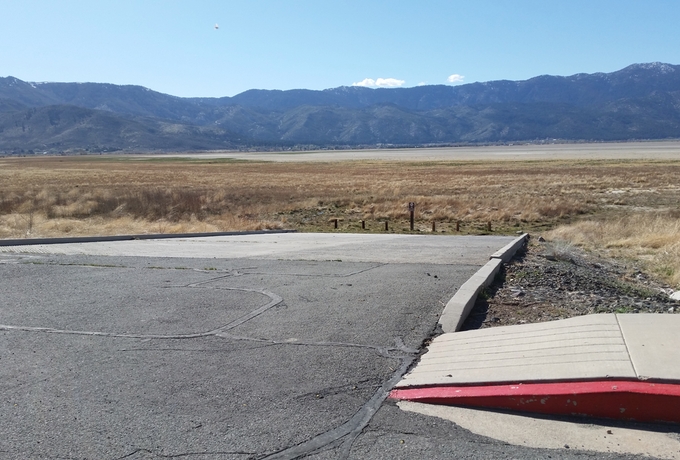
Gov. Brian Sandoval on But he's standing in what should be three feet of water, now dry Washoe Lake. Lake water is half a mile away. Photos/Anne Knowles

Gov. Brian Sandoval talks April 8 about Nevada’s drought. He should be standing in 3 feet of water, but Washoe Lake is a half mile away. Photo/Anne Knowles

By Anne Knowles

WASHOE VALLEY — Standing on Washoe Lake’s dry lakebed, yards from the state park’s boat ramp but half a mile from any water, Gov. Brian Sandoval signed an executive order creating the Nevada Drought Forum.

The forum is tasked with finding ways to address the ongoing drought and provide sustainable water resources for the state’s citizens, farmers and businesses.

“I’m establishing the Nevada Drought Forum to ensure a path forward for all Nevadans,” Sandoval said Wednesday.

Anticipating comparison to California, where Gov. Jerry Brown last week signed an executive order mandating a statewide 25 percent reduction in water use, Sandoval was quick to say the two states are not alike.

“Some of the things they’re doing, we’ve been doing for years,” said Sandoval. “I commend Gov. Brown. But Nevada is different.”

When asked, Sandoval conceded he also lacks the same authority to call for cuts, a power that lies with the Southern Nevada Water Authority and the Truckee Meadows Water Authority.

“Nevada water law is very different than California’s,” he said.

It's hard to see Washoe Lake from the boat ramp.

It’s hard to see the water in Washoe Lake from the boat ramp. Photo/Anne Knowles

TMWA last week asked its customers to voluntarily reduce water use by 10 percent in order for the water purveyor to save and store 5,000 acre-feet of water for use next year. (An acre-foot will cover 1 acre with 1 foot of water.)

TMWA is also working with the state to secure a loan to build a $17 million pipeline to transport water between Fish Springs, 40 miles north of Reno, to the Truckee Meadows.

Mark Foree, TMWA general manager, said the water authority is working with its myriad partners to implement the Truckee River Operating Agreement signed in 2008, which will eventually double TMWA’s upstream drought storage.

TMWA also has access to some water in Stampede Reservoir, in addition to water in Independence and Donner lakes, something the water purveyor didn’t have during the state’s worst drought from 1987-1994.

During that time, Lake Tahoe was below the rim for 4½ years, Foree said. He said the lake fell below the rim six months ago and is 2½ inches below it now.

“This is not the worst drought on record. Could it become the worst drought? We’ll know more next year,” said Foree. “We are not expecting any flow into the Truckee (at Tahoe City) and by the end of May or early June all natural flows into it will probably end.”

Lake Tahoe normally provides water to the Reno area via the Truckee River. Photo/Kathryn Reed

Lake Tahoe normally provides water to the Reno area via the Truckee River. Photo/Kathryn Reed

The state engineer, Jason King, has ordered a 50 percent reduction in groundwater pumping in two of the state’s basins, orders that have been stayed by the court.

“We have seen significant groundwater declines and if left unchecked, the basins will not be sustained,” Leo Drozdoff, director of the Nevada Department of Conservation and Natural Resources, said at the forum announcement.

The Truckee Carson Irrigation District, which serves farmers in the Fallon and Fernley area, last month told farmers they would receive just 20 percent of their normal allocation.

SNWA, which relies on the Colorado River, has long worked to conserve water.

John Entsminger, general manager of SNWA, said the Las Vegas area has reduced water use by 40 percent in the last 15 years despite a 25 percent increase in population during the boom before the recession.

“Nevada is the poster child for the country,” said Entsminger. “We’ve shown how you can grow the economy and use less water.”

Despite all that, some didn’t think the governor’s response to the ongoing drought was enough.

“I thought it was a start, but not a very strong one,” Bob Fulkerson, state director of the Progressive Leadership Alliance, told Lake Tahoe News. “I wanted to see more action, more recognition of the dire problem we’re in, and more of a commitment to a new way of thinking instead of status quo like ‘we’ll make sure there’s always enough water for anyone who comes’.”

The forum, according to the executive order, will comprise the director of the Nevada Department of Conservation and Natural Resources; director of the Nevada Department of Agriculture; state engineer; chief of the Nevada Division of Emergency Management; Nevada climatologist; dean of the University of Nevada Cooperative Extension; and representatives from the Desert Research Institute and SNWA.

DRI announced that its representative would be Justin Huntington, associate research professor of Hydrology.

Sandoval ordered all state offices to conduct an audit of their water use. He also ordered all state agencies with drought responsibilities and all municipal water providers to deliver a summary of their actions to the forum by May 15, which the forum will consolidate and make available by June 15.

The Western Governors’ Association Drought Forum, created by Sandoval, is delivering its final report in late June, which the state’s agencies and water suppliers will then utilize to make recommendations to the Nevada forum by the end of August, according to the executive order.

The Nevada Drought Forum will have a multi-day summit in September and deliver a final report by Nov. 1.


Casino exec: Gaming will keep evolving

By J.D. Morris, Las Vegas Sun

When former Las Vegas Mayor Jan Jones Blackhurst began working at Caesars Entertainment about 15 years ago, it was a very different company.

Then known as Harrah’s Entertainment, the company had just moved its headquarters from Tennessee to Las Vegas, so it was, in many ways, the new kid on the block. Since then, Jones Blackhurst has seen Caesars expand dramatically. It’s now a corporate giant on the Strip and in the broader global casino industry.

As executive vice president of communications, government relations and corporate responsibility, Jones Blackhurst is responsible for growing the company’s corporate philanthropy work. Her achievements recently earned her a 2015 Corporate Social Responsibility Professional of the Year award from PR News.

Jones Blackhurst recently spoke about Caesars’ corporate social responsibility and other gaming industry issues, including the bankruptcy restructuring of Caesars’ largest operating division.

Read the whole story


Millennials changing the hotel market

By Hugo Martin, Los Angeles Times

At the latest breed of hotel, rooms are up to one-third smaller than traditional quarters, with furniture that looks fresh from an Ikea showroom.

The work desk is downsized and might double as a nightstand. The Internet speed is super fast. The Wi-Fi is free. Power outlets and USB ports dot the walls, especially near the bed to accommodate binge watching.

The target is the millennial traveler, ages 18 to 34, who likes to stay connected online, eat on the run and commune with other millennials.

Hotel giants, including Marriott International and Hilton Worldwide, are launching brands with names such as Moxy, AC, Edition, CitizenM and Canopy. Even billionaire Sir Richard Branson has a new millennial-oriented chain, dubbed Virgin Hotels.

Read the whole story


SLT council solidifies vacation rental rules

By Kathryn Reed

Vacation rentals are a $20 million business in South Lake Tahoe – and then some.

That’s just how much is collected each year by property managers. It’s a big business that was brought to light at Tuesday’s South Lake Tahoe City Council meeting. People and entities are profiting greatly from this somewhat controversial industry.

The city collects a 10 percent hotel tax on those properties. That amounts to $2 million a year.

Some property managers – the middlemen between owners and renters – take 40 percent off the top.

House cleaners, repair people, hot tub cleaners and others are ancillary businesses benefiting from the vacation home rental (VHR) market. Then there are the businesses and employees in and around the neighborhoods that provide services and goods to the tourists.

This economic pyramid was brought to light April 7 during the course of the several-hour discussion about how the VHR ordinance should or should not be changed.

On the flip side were those who are furious about having residential areas being turned into lodging rows, where it’s not about having neighbors, but instead being party central every weekend. It’s about having strangers populate the street on a regular basis.

Some wondered why permitted lodging establishments must meet Americans with Disabilities Act requirements and other laws, while VHR properties don’t.

An unknown is whether the proliferation of VHRs is contributing to the low occupancy rate at hotels in the city.

In all, 30 people spoke at the meeting. The city received 57 letters. The room was packed, with about another two dozen in the lobby watching the proceedings on television. (Councilman Tom Davis was outside the chambers because he is not allowed to participate because of his ownership in Tahoe Keys Resort.)

Enforcement of the rules already on the books was a constant refrain. Property managers were quick to point to the 162 complaints the city received from the 22,000 rentals — saying that is minuscule. What the industry doesn’t disclose is how many complaints are made to them that the city – aka public – never knows about.

At the end of the day, the council agreed:

• To have future VHR permit applicants follow a process similar to getting a special use permit, which will include notifying neighbors of the desire to use the structure as a vacation rental. Exact details will be brought back to the council this spring.

• Occupancy should be limited to two people in a studio, four in a one-room, then two per bedroom plus four others for two-bedroom and larger places.

• To have two ordinances – one dealing with rentals in neighborhoods, one for those in tourist areas that would include places like Marriott and Lakeland Village. This is because the commercial areas have different rules already for things like trash, and health and safety regs.

• No noise is permitted after 10pm.

• Trash mandates would be deferred to the Waste Management JPA, which expects to have rules in place for its three jurisdictions – South Lake Tahoe, El Dorado and Douglas counties – in the coming months.

• To not deal with individual room rentals in a residence.

• Renters and owners who violate the ordinance will face fines, with the fourth infraction in a 12-month period resulting in revocation of the VHR permit.

• To hire people to make the program work — including more and better enforcement.


Lake Tahoe clarity improves substantially

Drought is a good thing for Lake Tahoe’s clarity.

This was proved with today’s announcement that the largest gain in clarity in more than a decade occurred in 2014. A disc that looks like a white dinner plate could be seen to a depth of 77.8 feet, an increase of 7.5 feet.

The Secchi disk has been used for decades to measure lake clarity. It’s dropped over the side of a boat at various locations and then someone eyeballs how far they can clearly see it. The deepest point was 93.5 feet on July 7, and the lowest was 57.4 feet on Sept. 16.

Annual average clarity readings since 1997: • 2014: 77.8 feet  • 2013: 70.2 feet  • 2012: 75.3 feet  • 2011: 68.9 feet  • 2010: 64.4 feet  • 2009: 68.1 feet  • 2008: 69.6 feet  • 2007: 70.1 feet  • 2006: 67.7 feet  • 2005: 72.4 feet  • 2004: 73.6 feet  • 2003: 71 feet • 2002: 78 feet  • 2001: 73.6 feet  • 2000: 67.3 feet  • 1999: 69 feet  • 1998: 66.1 feet  • 1997: 64.1 feet  Source: TERC

Annual average clarity readings since 1997:
• 2014: 77.8 feet
• 2013: 70.2 feet
• 2012: 75.3 feet
• 2011: 68.9 feet
• 2010: 64.4 feet
• 2009: 68.1 feet
• 2008: 69.6 feet
• 2007: 70.1 feet
• 2006: 67.7 feet
• 2005: 72.4 feet
• 2004: 73.6 feet
• 2003: 71 feet
• 2002: 78 feet
• 2001: 73.6 feet
• 2000: 67.3 feet
• 1999: 69 feet
• 1998: 66.1 feet
• 1997: 64.1 feet
Source: TERC

“While these latest data are very reassuring, they should not be interpreted as victory in our joint restoration efforts,” Geoff Schladow, director of the UC Davis Tahoe Environmental Research Center, said in a statement. “Complete restoration is still decades away, and some of the greatest challenges still lie ahead of us. We are enduring drier and warmer conditions than we have ever encountered, and the restoration consequences of that are still far from understood.”

In light winters there is less runoff into the lake. This means less sediment to cloud the water. Warmer temps also means the lake water is mixing less; this also is good for clarity. (It also brings a whole different set of ecological issues.)

Researchers provided measurements for winter (December–March) and summer (June–September). Winter clarity last year improved by 1 foot. The winter average of 78.7 feet was well above the worst winter average, 66.6 feet seen in 1997. The largest improvement was seen in summer clarity, where there was a 13-foot improvement over the preceding year. At 78.7 feet this is the highest value since 2002.

Scientists are also giving credit for the improvement to the entities working to curtail sediments from reaching the lake. This is through the total maximum daily load and environmental improvement programs. More than $1 billion has been spent in the last decade on projects related to Lake Tahoe’s clarity.

In 1968, the disk could be seen to 102.4 feet. Efforts are under way to get back to that level, but it’s not expected to happen for more than a half century.

— Lake Tahoe News staff report


Healthy strategies key to dealing with stress

By Kathryn Reed

Getting rid of stress might not be possible, but how one deals with it can lead to a healthier outcome.

Money, work, health and relationships are the top stressors for people in the United States.

Identifying the stressors is the first step to being able to get rid of them.

Sonia Rupp with Barton Psychiatry last week shared ideas about how to cope with stress. Nearly 70 people gathered at Lake Tahoe Community College to hear the talk.

One of the problems is people often choose ways to cope with the stress that compound the problem. It could be chilling in front of the TV, overeating or choosing unhealthy food, or drinking alcohol.

Rupp said a drink at the end of the day to take the edge off is probably one of the worst things someone can do. This is because alcohol is a depressant. The booze also can lead to a poor night’s sleep.

“More and more women are using alcohol as an unhealthy strategy,” Rupp said.

Lack of sleep comes with its own set of issues, which can exacerbate the stress.

Bed is not the place to be reading, watching TV or working on a computer. Sleep and intimacy, Rupp said, are the only activities that should occur in bed.

Being active, getting quality sleep and not drinking are the better ways to handle the stress.

“When you can’t control the stress, it’s important to have healthy coping habits,” Rupp said.

She suggested taking a few minutes every day to breathe. It doesn’t have to be full-on meditation, but just enough time to let the brain turn off and not have the worrisome thoughts be all consuming.

Rupp also suggested mental exercises to divert attention to something other than what is causing the stress. Creative outlets are also encouraged, especially because they tend to provide a sense of accomplishment.