Letter: Ski patrollers help at Bread & Broth

To the community,

On Feb. 17, Heavenly ski patrol members Rebecca Strmiska, Kris Morehead, Brook Linnell, Tom Burkart and Marissa Streck exchanged their skis for aprons at Bread & Broth’s evening dinner. B&B would like to thank the Heavenly ski patrol for the $250 sponsorship of an Adopt A Day of Nourishment and the great crew they sent to help the B&B volunteers serve the evening’s healthy, filling meal.

Bread and Broth is a nonprofit, all volunteer program that serves a full course dinner every Monday at St. Theresa Church’s Grace Hall and a soup and pasta meal every Friday at Lake Tahoe Presbyterian Church. The financial and time donation that our Adopt A Day sponsors provide, like the Heavenly ski patrol, guarantee B&B is able to sustain our support of those in our community who are experiencing difficult times.

“Bread & Broth is a great way to give back to the community!” said Burkhart. “As ski patrollers we are all about helping others and that is why we come to B&B. We want to help the South Lake Tahoe community.”

B&B salutes the ski patrol for their concern for the community and looks forward to their hosting another AAD on April 21s.

To help B&B as a donor or sponsor, contact me at (530) 542.2876 or carolsgerard@aol.com.

Carol Gerard, Bread & Broth


Opinion: Plenty of time for Meyers to be involved

By Norma Santiago

In the early ’90s, the Meyers community established a committee whose primary task was to create a community plan that was reflective of the Meyers community’s vision. The plan concept, as stated in the Meyers Community Plan, “is to enhance the identity and image of Meyers as a community center and a gateway to Lake Tahoe.” During the course of the plan’s development 20 years ago, concerns were expressed that the community plan would allow for large development or create policy that could impact the scenic character of Meyers.
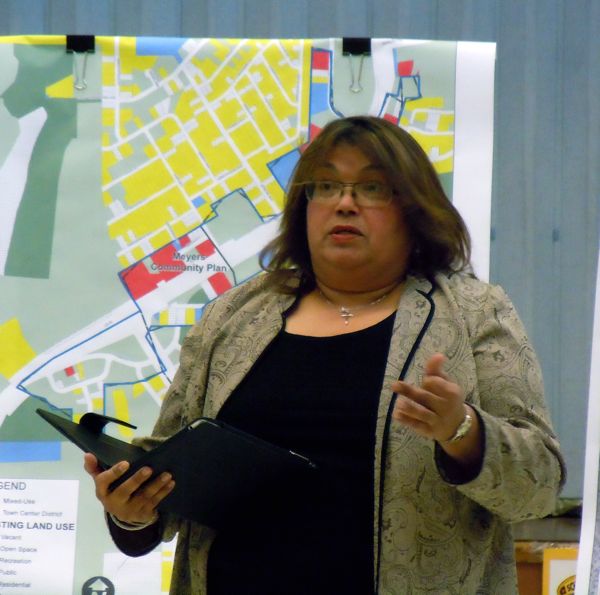
Norma Santiago

Norma Santiago

As was then, today we are having the same expressions of concern, and today we are allowing a very public discussion of the new Meyers Area Plan.

Unfortunately, the misconceptions are being labeled as fact, creating fear within the community, that a large development called a “catalyst project” is waiting in the wings ready to be developed as soon as the new plan is adopted.

There is no catalyst project. There is no large development.

What can be built in Meyers is up to the community of Meyers. This two-year public process allows for input and discussion of what the Meyers Community wants to create for itself. And, that discussion continues as we approach another community meeting on Feb. 26. From more than 30 meetings, a new vision was created; something that reflects the community’s unique character. That vision states:

“Meyers is an ideally situated, spacious, historic, and walkable mountain community that values sustainability, health, wellbeing and the natural environment. Uniquely concentrated with year-round outdoor sport and recreational opportunities, the Meyers mountain culture is the hallmark of our thriving local-based economy boasting a diverse commercial and retail environment, welcoming visitors and providing residents with an extraordinary place to live, work and play.”

This effort, like the visioning workshops 20 years ago, helps to guide the community toward its future, created the vision by which a plan can be drafted, and proposes reasonable expectations within the plan.

Like the Meyers Roundtable 20 years ago, the Meyers Community Advisory Council (MCAC) was created to represent a broad spectrum of interest. Council members are Meyers’ residents and neighbors, business owners and recreation enthusiasts, who have volunteered their time to represent the community and this unique mountain town they call home. An enormous amount of input from all interests, business, recreation, education, and community members came in after numerous public meetings, with first hand access to county and TRPA supplying detailed responses.

The TRPA’s recent Regional Plan update provided a much-needed update to the rules for our communities, but there is a tremendous amount of misunderstanding as to how those rules are applied in individual town centers like Meyers. TRPA moved away from a “one-size-fits-all” approach, limiting things like height and density, to give each community specific input and help define or maintain a community’s unique character. Meyers now has the opportunity to choose what it wants to be in the future.

What has been expressed to the MCAC and the county by the community is protection of Meyers’ rural character and the surrounding sensitive lands along the Upper Truckee River, safer ways for all of us to get across Highway 50, connectivity of bike trails, a welcome sign, and simplified processes for smaller projects, to name a few. The draft plan proposes height and density limits similar to those that have been in place for years, and sets those limits significantly lower than what could have been pursued under the new Regional Plan. These elements of the plan are not final. The MCAC and the county are always accepting input.

On Feb. 26 at 6pm, a public workshop will be held at the California Conservation Corps dining hall to specifically compare the existing 1993 Meyers Community Plan with the current draft of the Meyers Area Plan. The draft plan is on the El Dorado County website.

Comments, questions, and suggested revisions to the draft Meyers Area Plan can be submitted to MeyersAreaPlan@edcgov.us.

In the coming months, there will be a formal comment period, an additional community workshop, and several public meetings at the El Dorado County Board of Supervisors and Planning Commission meetings, as well as, the TRPA Governing Board and Advisory Planning Commission meetings.

I am proud to be a part of this dynamic, public process to help mold the future of Meyers. It’s an incredibly exciting time for the Meyers community and I invite everyone to take part in this great purpose.

Norma Santiago represents Meyers on the El Dorado County Board of Supervisors.


Editorial: Nev. needs to address mental health

Publisher’s note: This editorial is from the Feb. 16, 2014, Las Vegas Sun.

A federal judge last week dismissed a lawsuit alleging that Nevada dumped mental health patients on other states.

The lawsuit came after a string of damning news stories about Nevada’s mental health system, and it says officials at the Rawson-Neal Psychiatric Hospital in Las Vegas regularly discharged patients with one-way bus tickets out of Nevada.

For Nevada, it was a technical win, but it is hardly a victory.

Read the whole story


Letter: Meyers should focus on locals

To the community,

I was asked, “What did we want Meyers to look like?” After some thought, the things that matter to the people who live here are the things they care about like having a quiet, mountain neighborhood. The fact that people feel secure walking their dogs in the evening is a great part of living here. To know that you are safe in your neighborhood and that your neighbor will help you when you are in need are comforting; also, knowing your neighbors by name, everyone waving to each other as they pass by, and having spectacular views of the mountains and seeing stars above at night.

What else? A stoplight at the intersection of Apache and Highway 50 would be a great start. Why is it not even on the Capital Improvement Project list in our new draft Meyers Area Plan? Meyers residents like us have been asking for the signal light for more that 15 years. A traffic study was completed, funding was approved, and residents were even given a start date for the signal light. Now our request falls on deaf ears.

In one of the Meyers Planning meetings it was brought up again and had lots of residents support, but did not even make the top 25 on the list. Are they saying that giving away free Sierra juniper seedlings (Page 7-5 in Meyers Area Plan) is more important than the safety of our children trying to cross Highway 50 on a Friday afternoon to visit a friend or buy ice cream at Lira’s? To try to get across 50 now is like playing dodge and dash across to the other side. I have been told a stoplight costs about $150,000 and with about 3,000 people living in Meyers, it costs about $16 per person for three years. Is a child’s life worth that or do we have to have a body count high enough to meet the Caltrans requirements for a stoplight?

I am in support of a Meyers Community Hall, a building that would have multiple uses for the community, such as crab feeds, spaghetti dinners, or local fund-raising events. We need a place to have dances, community meetings and other social events. Yes, I would like to see a “Welcome to Meyers” sign and a facelift of the Highway 50 corridor.

I prefer locally owned businesses rather than corporations that really don’t have an interest in our local affairs. Why is it so hard for a local resident to build a small business here? Why does government make the process so convoluted?

On that note, have you looked at the new Meyers Area Plan yet? Don’t cross your eyes trying to figure out what Chapter 2 really says in the Meyers plan. Our government agencies should be looking at what the needs of the community are, not 45-foot-high buildings with high-density housing for tourists, multi-unit apartments, or a 477-space parking garage, or changing zoning boundary lines so that currently protected land could meet the condition for “incentive” projects. Why is the California Tahoe Conservancy able to sell taxpayer owned, conserved property for new land coverage projects? If that is your ideal vision, you probably live near state line.

With agencies such as the TRPA and entities like the MCAC talking about the MAP to the CTC with the new RPU, and trading ERUs or TAUs for CFA, and mixing CUP with just P’s only if you have footnotes (4) and (6) as a condition to build, and don’t forget the BMPs, you really get a feeling that something is not right in Meyers.

Joe Cardinale, Meyers


Letter: Time for Meyers to speak out

To the community,

Much a do about nothing?

Then why did our county supervisor write this letter to [Sen. Dianne] Feinstein back in July supporting the One Globe/Hub One Project? Is “Hub Living” really the neatest thing since peanut butter?

Personally, I’ve grown out of living with my bicycle in the living room and snow tires under my bed. I like my garage. I like my back yard, too. I guess, overall, I like my freedom.

Imagine having to move into a multi-storied Hub Structure, where Hub One controls the heat, water, sewer, lights, food, transportation, telephone, television, email and computer data? Sort of goes against the grain. Now imagine how much money this One company will be collecting for those services. Globe One claims to be a “green” developer. They’ll be green all right, all the way to the bank. Besides, if I wanted to live in small, cramped space above a parking garage, I’d move to New York.

I live and work in Meyers because Meyers is great. Clean, open areas, beautiful mountains, great neighbors and friends, and while growth is good, inappropriate growth is not. This Hub One “megapolitan” just isn’t right for Meyers.

We can stop this train wreck, please read the attached letter. Check out the facts.

Angela Olson, Meyers


Opinion: Olympians prove Tahoe is recreation oasis

By Joanne Marchetta

The roster of U.S. Olympic athletes competing in Sochi this year is testament to the Tahoe region’s reputation as an outdoor Mecca for mountain athletes. More than a dozen of our nation’s competitors at the Games hail from the Tahoe area and our communities couldn’t be more proud of these young athletes.

Lake Tahoe’s natural attributes make it an incredible place to live, work and play and we are hearing more and more that communities want recreation and the outdoor lifestyle to play a larger role here.

Joanne Marchetta

Joanne Marchetta

The Tahoe Regional Planning Agency and the Olympics are connected historically. Following the 1960 Winter Games at Squaw Valley an uncontrolled development boom ensued that spurred TRPA’s creation in 1969. Over the last 45 years, TRPA has evolved and since the update of the Regional Plan in 2012, the agency is embracing its leadership role in sustaining Tahoe as an outdoor legend.

Our updated priorities include raising TRPA’s focus back to the regional level that was originally envisioned when California and Nevada created the bi-state agency. The area plan framework of the Regional Plan encourages local governments to take on more responsibility for planning, environmental improvement, and project permitting, which streamlines the permit process for property owners while enabling TRPA to focus on issues that affect the entire Basin and build the partnerships to address them.

As conditions change in the Tahoe basin such as prolonged drought or less snowfall over time, how we connect people to recreation opportunities has regional importance to our $5 billion regional economy as well as our quality of life. Many of our Olympians could testify to both. They and their families had to support themselves while reaching for their Olympic dreams. The reality is that many families struggle to stay here and with a regional economy that is based on tourism, recreation improvements can bolster our economy while making Lake Tahoe an even better place to earn a living and raise a family.

Topping the regional list for needed recreation improvements is completion of a bikeway around the lake. Many key segments of this trail have been in use for years and TRPA has prioritized completing connections and seeing this project through. We share this goal with many partner agencies and the collaborative efforts are bringing forward new sections through Homewood, between Incline Village and Sand Harbor, and from Van Sickle Bi-State Park in Stateline to Roundhill Pines Beach in Nevada. Bike trails deliver air and water quality improvements while resulting in millions of dollars of economic activity to our local economy.

The southern anchor of the Stateline-to-Stateline Bikeway near Nevada Beach is already proving to be an amazing sample of the basin’s transition from gaming to outdoor recreation. People now can bike through the forest to one of several marquee beaches, or hike to the Tahoe Rim Trail right from the largest hotel base on South Shore without once getting in a car. Continuing to plan for and implement these types of improvements will help reduce driving and congestion, enhance our quality of life, and make Tahoe more competitive among mountain resorts.

Other than improving connections between people and recreation, in the coming year TRPA is focusing on basinwide sustainability initiatives, transportation improvements in key corridors, finding a stable source of funding for the Environmental Improvement Program, and supporting forest fuel reduction and defensible space efforts in one of the driest years on record. Also, regional partnerships are critically important this year for the lake. Already we are preparing for the possibility of drought conditions in the shorezone, making strides in aquatic invasive species protection, working with scientists on near shore-shoreline clarity and algae growth, and helping improve systems to monitor environmental quality as well as social and economic issues.

As a region and as individual communities mapping out their unique destinies, Lake Tahoe is on a path of positive progress. As we welcome home the many Tahoe Olympians who represented the U.S. in this Winter Games, let’s remember that we owe it to future Olympians to continue protecting our mountain lifestyle, improving our fragile environment, and preparing for a changing landscape.

Joanne Marchetta is executive director of the Tahoe Regional Planning Agency.


Opinion: Local publications prove their relevance

By David Carr, New York Times

A lot of important journalism begins with a simple, seemingly obvious question, like why traffic is snarled in New Jersey on the way into New York.

Traffic coverage may be the lowest species in the dog-bites-man pantheon of news, except when it is not.

David Carr

David Carr

John Cichowski writes the “Road Warrior” commuter column for the Record, a daily newspaper in northern New Jersey that covers Bergen County. In September, the editor of the newspaper, Martin Gottlieb, received a tip from the publisher that navigating onto the George Washington Bridge from Fort Lee was taking hours. Gottlieb told Cichowski, who called the police in Fort Lee and was informed that the problem went far beyond a routine traffic tie-uup.

Shawn Boburg, who reports on the Port Authority of New York and New Jersey for the Record, was in the middle of a big investigative story at the time, but in December, he dug in and tried to find out what was behind the lane closings. After a number of articles, on Dec. 28, he wrote that emails showed that officials at the Port Authority, in spite of their earlier claims, knew about the closing and the resulting mayhem, some of it potentially life-threatening. On Jan. 8, he was first with an article linking the closings directly to the staff of Gov. Chris Christie.

Read the whole story


Editorial: Politics won’t solve California’s drought

Publisher’s note: This editorial is from the Feb. 3, 2014, Los Angeles Times.

As California’s drought continues, and more than a dozen rural communities ponder what to do when their drinking water runs out sometime in March, it would be nice if the state’s Republican politicians brought some straightforward plans for relief to the table. But what many of them are bringing instead is a tired political tactic barely, and laughably, disguised as a remedy for the lack of rainfall.

The “man-made California drought” is the term House Republicans use to describe the state’s current dry condition, as if it were somehow the hand of humankind, environmentalists or, even worse, Democrats that has stopped the snowfall over the Sierra and kept the dams that store water for fields, orchards and homes from being replenished. Funny, isn’t it, that folks who question man’s ability to affect the global climate are so quick to assign human causes to the drought?

Read the whole story


Opinion: Machines can’t do everything

By David Brooks, New York Times

We’re clearly heading into an age of brilliant technology. Computers are already impressively good at guiding driverless cars and beating humans at chess and Jeopardy. As Erik Brynjolfsson and Andrew McAfee of the Massachusetts Institute of Technology point out in their book “The Second Machine Age,” computers are increasingly going to be able to perform important parts of even mostly cognitive jobs, like picking stocks, diagnosing diseases and granting parole.

David Brooks

David Brooks

As this happens, certain mental skills will become less valuable because computers will take over. Having a great memory will probably be less valuable. Being able to be a straight-A student will be less valuable — gathering masses of information and regurgitating it back on tests. So will being able to do any mental activity that involves following a set of rules.

But what human skills will be more valuable?

In the news business, some of those skills are already evident. Technology has rewarded sprinters (people who can recognize and alertly post a message on Twitter about some interesting immediate event) and marathoners (people who can write large conceptual stories), but it has hurt middle-distance runners (people who write 800-word summaries of yesterday’s news conference). Technology has rewarded graphic artists who can visualize data, but it has punished those who can’t turn written reporting into video presentations.

Read the whole story


Letter: Heavenly crew volunteers at Bread & Broth

To the community,

Members of Heavenly Mountain Resort’s skier services joined Bread & Broth volunteers to serve the Feb. 10 Adopt A Day evening meal. Normally, Heavenly’s volunteer crew for the evening spends their days making sure that the guests at Heavenly Mountain Resort are enjoying all the amenities offered at our local ski resort. As sponsor volunteers for the Adopt A Day dinner, they showed the same spirit of working to make the evening meal an enjoyable experience for the diners.

Besides helping with bagging the “give aways”, Mike Allen, director of skier services; Leslie Amato, day care manager; and James Kayser, adult ski school manager, served the dinner guests on the main food line. Manning the dessert and drink table was Tom Sbertoli, children’s manager. Ryan Werick, photo manager, bagged and handed out “give away” bags.

This energetic group ended their evening by cleaning and stacking tables and chairs.

“We love volunteering and appreciate being able to give back to the community,” said Amato. “Great experience!” Bread & Broth is very fortunate to not only have Heavenly employees enthusiastically donate their personal time to serve the community but are very thankful for Heavenly’s financial support of B&B’s cause of feeding the less fortunate of our South Shore community.

For more information about B&B, go online or find us on Facebook.

Carol Gerard, Bread & Broth