Opinion: Is rising inequality poisoning our democracy?

By  Zócalo

Back in the 1980s, President Ronald Reagan famously took a jab at the policies of Lyndon Johnson with the remark, “In the ’60s we waged a war on poverty, and poverty won.” Since then, poverty has apparently continued its victorious march. According to the Census, 43.3 million people were living in poverty in 2013 — down from the year before, but way up from 2007 pre-recession numbers.

With the 2016 presidential election cranking up, soon the airwaves will swell with candidates’ ideas for how to remedy the woes of America’s poor. What should we do about economic disadvantage — particularly in a country that holds the concept of equality as a democratic principle in such high regard?

As a preview for Zócalo’s fifth annual book prize event “Can Democracy Exist Without Equality?”, we asked scholars: What effects could increasing inequality have on democracy in America?

Stephen Pimpare: Mark Twain was right

A hedge fund manager just paid $92 million for an apartment he has no intention of living in; it’s just a “fun” investment, he says. Meanwhile, 28 percent of U.S. workers earn wages so low that even if they work full time, year-round, they will still live in poverty (it’s 36 percent for African Americans). In 2014, just the bonuses paid by Wall Street banks equaled twice the total earnings of all full-time minimum wage workers.

Welcome to the New Gilded Age.

There is nothing “natural” about our unprecedented level of inequality. Economic forces didn’t mysteriously cause this; political ones did — a backlash against New Deal and Great Society programs that redistributed money and power from a narrow elite to the broader public. The pushback has been seen in a decades-long assault on unions, cuts in tax rates for high income Americans, the repeal of regulations that restrain corporate power, stagnation in the minimum wage, and cutbacks on the very social welfare programs that mitigate the worst effects of the “unfettered” market.

Meanwhile, because we define “welfare” so narrowly, we are blind to the “submerged” state that further redistributes money through the tax code to upper-income families.

That money buys them political power, which gets them more money, which secures yet more power. This is not hypothetical: A growing body of research demonstrates that U.S. policy-making institutions have become “utterly unresponsive” to the needs and wants not just of poor and low-income Americans, but increasingly of middle-class ones as well.

Political philosophers since Plato have condemned excessive inequality, and not typically on moral grounds. Rather, they worried about how one maintains political stability and legitimacy in the face of such distance between classes — after all, people who struggle while they see others prosper can only be made so miserable before they feel they have nothing to lose by fighting back.

Stephen Pimpare is author of “The New Victorians: Poverty, Politics, and Propaganda in Two Gilded Ages” and “A People’s History of Poverty in America”.

Nicole Austin-Hillery: Inequality is a moral issue

The United States as a nation boasts about the virtues of equality and the ability of all Americans to “pull themselves up by their bootstraps.” But in the reality of the 21st century, this concept is little more than a catchphrase. The United States is a nation divided by wealth and income, where it is difficult, if not impossible, for individuals with decreasing economic power to connect with the inner workings of this country.

We see examples of the power that money buys everywhere. Most notably, the Supreme Court’s Citizens’ United ruling reminded us that when it comes to free speech within the electoral system, one’s voice gets much louder when it’s amplified by dollar signs.

Larger, equally complicated issues like race (particularly if one is African American or Latino) and gender are inextricably linked to the subject of wealth and power in the United States, and a multitude of research has been devoted to the various intersections of race, gender and wealth disparity. This does not bode well for the future of America, where the racially diverse population of the country is projected to become the majority over the next several decades.

Nobel Prize-winning economist Joseph Stiglitz recently discussed the growing chasm between the haves and the have-nots in his book, “The Great Divide”, and concluded that the consequences for this nation will be devastating as the divide widens.

Stiglitz warns that we must treat inequality as an urgent political and moral issue. As numerous candidates begin vying for votes ahead of the 2016 presidential election, one can only hope that this issue will be more than a talking point. Those who benefit from political power owe it to the nation, and to the furtherance of our democracy, to recognize and address the larger issue of inequality.

Nicole Austin-Hillery is the director and counsel of the Brennan Center for Justice, Washington Office. She directs the organizations work in Washington in the Justice and Democracy areas, with a particular focus on mass incarceration, racial and criminal justice, and voting.

Michael Tanner: Warren Buffet and the Koch brothers don’t share a brain

The idea that growing inequality threatens our democracy is a three-legged stool, each leg of which is fatally flawed.

1) “Inequality has never been worse.”

Most claims that income inequality is at a record high in the United States are based on a measure of “market income,” which does not take into account taxes or transfer payments. Yet, America already has a significantly redistributive political process. We tax the rich heavily and provide benefits to the non-rich.

According to Gary Burtless of the Brookings Institution, hardly a right-winger, fully accounting for taxes and benefits actually shows that income inequality between the top one percent and everyone else actually decreased in the United States from 2000 to 2010.

2) “The rich vote in lockstep.”

The idea that the rich threaten the democratic process presumes that the wealthy share a common political philosophy or interest. But the idea that Tom Steyer, Warren Buffet, David Koch, and Sheldon Adelson agree on much of anything is preposterous. The rich don’t even agree on basic questions of taxes and redistribution. Moreover, the rich don’t contribute to campaigns just for personal gain. Like the rest of us, they are expressing views on everything from gay marriage to war and peace.

3) “Money in politics favors the rich.”

The influence of money on politics is vastly overstated. According to the Center for Responsive Politics, candidates for Congress spent roughly $3.76 billion in 2014. Yet that was less than the $6 billion spent on auto insurance advertisements in 2013, with Geico alone spending almost $1.2 billion. Aren’t election choices worth as much as insurance choices? Besides, 16 of the top 25 political campaign contributors since 2002 are unions, the CRP reports. Over the same period, the arch-villain Koch brothers, in fact, ranked 50th in total political contributions. Elections are littered with losers that thought they could buy an election. Remember California gubernatorial candidate Meg Whitman?

Inequality remains a powerful rallying cry. But this stool is about to fall over.

Michael Tanner is a senior fellow with the Cato Institute, where he heads research into a variety of domestic policies with a particular emphasis on poverty and social welfare policy, health care reform, and Social Security.

Victor Tan Chen: Debunking the myth of self-made success

When Michael Young coined the term “meritocracy” half a century ago, he meant it to be an insult, not an ideal. In his view, a society where only the best and brightest can advance would soon become a nightmare. Young predicted that democracy would self-destruct as the talented took power and the inferior accepted their deserved place at the bottom.

Of course, the world we live in today is still no meritocracy. If most Americans are expected to go it alone, without the help of government or unions, elites continue to block competitors and manipulate the rules — as Wall Street did in spectacular fashion in the lead-up to the 2008 financial crisis.

Celebrated French economist Thomas Piketty argues that even when — or especially when — the market operates efficiently, inherited wealth becomes an ever more potent force within the economy, slowly strangling the opportunities for ordinary individuals to advance.

Nevertheless, the myth of meritocracy tells us that the rich are rich because they — like Young’s talented ruling class — are smarter and better. They worked their way up. They are the “makers” growing the economy. Anyone who can’t do it on his or her “own” is just a “taker,” suckling on the government’s teat.

I found hints of this viewpoint when I interviewed the long-term unemployed for my book. Some felt enormous shame and blamed themselves for their inability to land another job. Often, the sense of failure had a negative impact on their personal relationships and their belief that they had something at all to contribute to society.

Preserving our democracy will require forceful government regulation and strong unions. Such approaches have their own flaws, but there is no other way to restore balance to an economy and society increasingly under the sway of an elite class.

Beyond that, we need to tackle head-on the culture of judgment, materialism, and ruthless advancement used to justify extreme inequality — and temper it with a measure of grace.

Victor Tan Chen is the author “Cut Loose: Jobless and Hopeless in an Unfair Economy”, which will be published by the University of California Press in August. He is an assistant professor of sociology at Virginia Commonwealth University and the editor in chief of In The Fray. He can be reached at victortanchen.com and @inthefray.

Valerie R. Wilson: Disenfranchisement can create momentum

American democracy, in theory, is rooted in equality — the idea that each of us is entitled to an equal say in decisions that affect us all. In reality, however, money and power have always been used to tilt the outcome of democracy in one direction or another.

America’s history is littered with examples of powerful entities denying entire segments of the population the right to vote based on race or gender. And this continues to happen through corruption, intimidation and arbitrary restrictions (e.g. voter ID laws, cutting voting hours, purging voter rolls, or ending same-day registration) to steal, buy or suppress votes.

But the power of political activism among the disadvantaged and disenfranchised has also been an important tool in rebalancing the scales of American justice and democracy.

Increasing economic inequality is the direct result of the influence of money and power in the democratic process. Public policy choices on behalf of a wealthy and privileged minority have intentionally suppressed wage and income growth for most Americans and concentrated income gains at the top of the income distribution. This has given the already-rich even more resources with which to lobby for policies that benefit them.

A desire to break this destructive dynamic has mobilized an increasingly diverse majority to fight for their fair share of the economic gains they help to produce. The momentum behind the workers’ movement to raise the minimum wage, Fight for $15, continues to build as it expands beyond its base of fast food workers. But it remains to be seen whether this momentum can be successfully marshaled on a larger scale to prevail against the influence of wealth and power in American politics.

Valerie R. Wilson is an economist and director of the Program on Race, Ethnicity and the Economy at the Economic Policy Institute in Washington, D.C.

Indivar Dutta-Gupta: Why the wealthy always win

Inequalities in income, wealth, and opportunity have risen to virtually unprecedented levels. In “Affluence and Influence”, political scientist Martin Gilens demonstrates that in policy disagreements between the most well-off and everyone else, the wealthy consistently win. And while it’s not too late to change things, if this problem gets worse, it could seriously impair our democracy.

One glaring cause and consequence of rising inequality is that Congress has not raised the minimum wage since 2007. FDR described the minimum wage as necessary in any “self-supporting and self-respecting democracy.” So why does it lag so far behind growth in worker output per hour, despite widespread support for increases throughout nearly all the income and wealth distribution? To understand the lack of recent minimum wage increases, look to the highest one percent of the wealth distribution, where one starts to see significant opposition.

Expanding economic inequality may also enlarge gaps in policy preferences between the affluent and the rest of us. We increasingly see proposals to shrink the wildly popular and successful Social Security program, despite the fact that most Americans prefer to expand these programs.

The good news is that we know how to protect our democracy. Leveling the playing field for political contributions, strengthening voting rights, and limiting the influence of corporate lobbyists are a good start. So are full employment, modernized labor standards and worker empowerment, and public investments in education and care. And, imperfect as they are, elections, like the one we are having next November, still offer less affluent Americans a chance to be heard.

Indivar Dutta-Gupta is a senior fellow at the Georgetown University Center on Poverty and Inequality. He has worked policy analysis and development related to tax, budget, savings, education, training, and public insurance programs and policies.



Opinion: Has Adelson learned from his mistakes?

By Josh Voorhees, Slate

The Koch brothers are set to play a historic role in 2016, but they’re not the only conservative mega-donors who could shape the election. This weekend, casino mogul Sheldon Adelson will host a pair of GOP contenders and a slew of other Republican politicians at one of his Las Vegas hotels. There, Texas Sen. Ted Cruz and former Texas Gov. Rick Perry will be addressing the Republican Jewish Coalition — but in reality their eyes will be on Adelson, who spent a staggering $100 million in 2012, making him the largest individual donor (non-dark money category) that election cycle .

If Adelson chooses to crack open his checkbook again — and all signs suggest he will — he could have a drastic impact on the GOP nominating contest. In 2012, Adelson almost single-handedly kept Newt Gingrich’s primary bid afloat far longer than it had any right to be by donating $20 million to the former House speaker’s super PAC. Of course, Gingrich is also proof of the limits of deep-pocketed patrons like Adelson. His cash was enough to allow Gingrich to prolong the inevitable, but it wasn’t enough to avoid it. (Adelson’s other political bets didn’t turn out much better for him that year.)

Read the whole story


Opinion: U.S. families need same-sex parents

By Gary J. Gates

Opponents of marriage for same-sex couples have made dire predictions of marital instability, falling birthrates, and increases in children being born outside of marriage if the U.S. Supreme Court rules that same-sex couples can marry throughout the nation.

But an examination of the data – particularly as it relates to children most in need of stable families – does not support those predictions.

Today, nearly 1.4 million men and women are part of the estimated 700,000 same-sex couples living in this country. About 350,000 of them are married couples and 122,000 are raising more than 200,000 children under the age of 18. Michigan couple April DeBoer and Jayne Rouse, plaintiffs in one of the Supreme Court cases, have adopted four children, two with developmental disabilities who require special care. U.S. Census Bureau data show that April and Jayne are not alone.

Same-sex couples are three times more likely than their different-sex counterparts to be raising adopted or foster children. Among married couples, same-sex couples are five times more likely. In states where same-sex couples can legally marry, more than 3 percent of adopted or foster children have same-sex parents. Since only about 0.3 percent of all children in those states have same-sex parents, it means that adopted and foster children there are nearly 10 times more likely than children in general to have same-sex parents.

As marriage becomes more widely available for same-sex couples, they will likely expand their already disproportionate role as parents to some of the nation’s neediest children. In 2013, 19 percent of same-sex couples without children were married compared to 33 percent of those with children. If they had adopted or foster children, the figure was 41 percent. In states where same-sex couples can marry, 60 percent of those with adopted or foster children are married. Clearly same-sex couples raising kids, especially adopted and foster kids, have a strong preference for marriage.

Opponents of marriage for same-sex couples argue that children do best when they are raised by their married biological parents. They reason that reserving marriage only for different-sex couples promotes that ideal. But that’s a false read of social science research. A more careful review of the literature shows that children tend to do better when they are raised by two parents who are in a stable and committed relationship. Marriage offers a way for many couples to strengthen and support their desire for stability, love, and commitment. Kids with married parents, regardless of the sexual orientation or gender of those parents, benefit from the security that marriage offers to many couples.

What about the argument that reserving marriage for different-sex couples encourages them to raise children within marriage? The notion that the marriages of same-sex couples could alter the behavior of the other 99 percent of married couples seems ludicrous on the face of it. It turns out that the research agrees.

Two studies published last year in Demography, the premier academic journal in the field, find no evidence that allowing same-sex couples to marry has altered the marriage rates of different-sex couples in the U.S. or in the Netherlands, the country that has allowed same-sex couples to marry longer than any other in the world. In 2013, the portion of children being raised by married different-sex parents in the U.S. was actually a little bit higher in states where same-sex couples could legally marry (65 percent) compared to states where marriage was restricted to different-sex couples (64 percent).

A Supreme Court decision bringing marriage for same-sex couples to all parts of the nation won’t end political conflict associated with LGBT rights. But it will improve America’s families. The nation will have more married couples, more kids with married parents, and more stable homes and families for the country’s most vulnerable children. It’s hard to understand how that could ever be a bad thing.

Gary J. Gates is the research director and Blachford-Cooper Distinguished Scholar at the Williams Institute, UCLA School of Law.  He served as an expert witness in the DeBoer v. Snyder trial, one of the cases currently before the Supreme Court. He wrote this for Thinking L.A., a partnership of UCLA and Zócalo Public Square.


Opinion: Time to stand up for public lands

By Todd Tanner, High Country News

As Google Earth flies, it’s five miles and change from the Echo Lake Café in the Flathead Valley, one of Montana’s great little restaurants, up to a parking area at a trailhead that leads to Jewel Basin. Down here in the valley, we’re at 3,000 feet. Up where the gravel road dead-ends, you’re looking at 5,700 feet. If you make it all the way to the top of 7,500-foot-high Mount Aeneas, you’ll be rubbing elbows with some top-of-the-world views, not to mention mule deer and mountain goats.

We’re talking about almost a mile of elevation change, yet the amazing thing is that once you leave the valley floor, all that land stretching on seemingly forever belongs to you and me and all of our fellow Americans. It doesn’t matter whether you live here in Montana, or in Colorado, Wyoming, New Mexico or New Jersey. All that acreage, which is administered on our behalf by the U.S. Forest Service, is ours. We can roam where we choose, we can hike, we can fish the lakes and pick fresh huckleberries for lunch and pitch our tents under all that Big Sky. We’re free to wander to our heart’s content on public land, and for a lot of Americans, that’s an incredible thing.

I’d go so far as to say that here in Montana and across the West, our public lands, which make up 50 percent or more of our states, equate to freedom. Let’s make that freedom and prosperity, because almost everything of substance, from our Western heritage to our economy to our recreation, flows from the bounty of our public lands.

That is why it’s so disappointing that 51 U.S. senators, every single one of them entrusted with our nation’s well-being, recently cast a vote that could help destroy the West — one that could turn over America’s public lands to multinational corporations, lock out hunters and hikers, and shift control of our timber, our grazing rights, and our minerals, along with the very lifeblood of the West — our water — to profiteers and foreign interests.

Read the whole story


Letter: Thanks to tourism forum participants

To the community,

Lake Tahoe South Shore Chamber of Commerce, the Lake Tahoe Visitors Authority, El Dorado County, South Tahoe Alliance of Resorts and Sacramento International Airport would like to thank all of the attendees of Tuesday’s Tourism Forum at Lake Tahoe Resort Hotel. Over 100 people attended to get more information on upcoming recreation projects, hear lessons learned from Park City courtesy of keynote speakers Ken Fisher and Jonathan Weidenhamer, and to learn about the opportunities businesses may seize to target and accommodate the recreation guest.

Thank you to Lake Tahoe Resort Hotel for hosting. A special thanks to participating exhibitors Tahoe Fund, Tahoe Regional Planning Agency, Tahoe Area Mountain Biking Association, Douglas County, United States Forest Service, Heavenly Mountain Resort, Tahoe Sport Fishing Co., Amgen Tour of California, and the city of South Lake Tahoe.

Materials from the Tourism Forum, including tips for leveraging special event opportunities and a downloadable PDF of recreation information for frontline staff, can be found online.

Shannon Earley, chamber communications coordinator


Opinion: Use natural methods for pesky rodents

By Stella McMillin

Rats, mice and voles are commonly sighted around homes and businesses this time of year. The California Department of Fish and Wildlife encourages Californians to let nature control rodent populations by actively protecting their natural predators – owls, hawks, falcons, eagles and vultures – rather than using poisons to eliminate pests. Environmentally friendly tactics such as providing tall trees that raptors favor will encourage these birds of prey to hang around your yard and remove rodents for you.

Most raptors use the same nest for many years and some even pass from one generation to the next. Bald eagles are known to have used the same nest as long as 35 years. That makes them an excellent long-term control for rodent populations in the immediate area.

During breeding season, a family of five owls can eat as many as 3,000 rodents. You can encourage them by hanging a nest box on your property, but please don’t do that if you or any of your neighbors are using anticoagulant rodenticides. Remember that poisoned rodents can poison the predators, scavengers and pets that eat them!

Even though the state Department of Pesticide Regulation and U.S. Environmental Protection Agency have restricted public access to the most dangerous rodenticides, all rodenticides – including the types still available to consumers – are poisons that can kill wildlife, pets and children.

More wildlife could be saved if people would use sanitation, removal and exclusion to keep rodents out of homes and reduce their numbers. Like most animals, rodents will congregate and multiply where food is available and they feel safe. The easiest way to discourage them is to remove or modify anything that could make them comfortable. Sanitation is the first step to controlling rodents. For example:

  • Keep your home and yard neat and clean. Don’t give rats places to hide.
  • Remove objects and plants that rodents can hide under, such as wood piles, debris, construction waste, dense vegetation and ground-covering vines like ivy.
  • Pick up fruit that has fallen from trees as soon as possible.
  • Secure your garbage in a tightly sealed can.
  • Seal water leaks and remove standing water that can attract unwelcome animals, breed mosquitoes and waste water.

To remove unwelcome rodents, set traps in secluded areas where they’ve been seen or are likely to travel: close to walls, behind objects, in dark corners, on ledges, shelves, fences, pipes and garage rafters. In areas where children, pets or birds might go, put the trap inside a box or use some kind of barrier for their safety. Check traps daily and wear disposable gloves when removing rodents from traps. Place them in a sealed plastic bag then into your garbage bin for weekly collection. Wash your hands after handling traps or rodents, even when using gloves.

Once you’ve removed mice and rats from inside the building, seal the entries they used to get in: openings where cables, wires and pipes enter buildings, and cracks or holes in the foundation, walls and roofs. Rodents can squeeze into holes as narrow as half inch diameter. Use hardware mesh and concrete, plaster or metal whenever possible. At the very least, stuff stainless steel or copper pot scrubbers, or Stuf-fit copper mesh wool into the spaces. All of these are sold online and at hardware and dollar stores.

If you feel you must use “rat poison,” please carefully follow the label directions for all rodenticides. Only use them in small treatment areas indoors or right against building walls in tamper-resistant bait stations, never out in open field or garden areas, where they’re most likely to reach wildlife and pets.

Stella McMillin works for the CDFW Wildlife Investigations Lab.


Opinion: Tahoe — a continual work in progress

Lake Tahoe's natural beauty is not reflected in the South Shore ad campaign. Photo/Kathryn Reed

Lake Tahoe’s natural beauty is not reflected in the South Shore ad campaign. Photo/Kathryn Reed

By Kathryn Reed

Park City is being held up as the latest poster child of tourism for the South Shore to emulate.

The theme of the ninth annual South Shore Tourism Forum was economic and community revitalization. Instead of a to-do list for the South Shore it was more of a tutorial on what the Utah resort community has done.

Lake Tahoe South Shore Chamber of Commerce, Lake Tahoe Visitors Authority and North Lake Tahoe Resort Association employees and members traveled to Park City in April 2014 to learn what that ski town has done to be successful. Ever since then there has been a litany of dog-and-pony shows to tout how great Park City is.

Tuesday afternoon was another chance for about 150 people to hear the same story that has been repeated multiple times since the excursion. Only this time it was two Park City officials who did much of the talking. This was after a lengthy video was shown of their town when the Tahoe brigade was there.

Ken Fisher, recreation manager, and Jonathan Weidenhamer, economic development manager, were the Park City officials who came west for the two-hour event at Lake Tahoe Resort Hotel on April 21.

Park City is an old mining town that in the 1950s was practically a ghost town with boarded up businesses on Main Street. Now it embraces that history which is evident by walking through the downtown.

One of the more revealing comments from the duo was prompted by a question from Ty Polastri with Lake Tahoe Bicycle Coalition. He asked what authentic elements they saw on the South Shore.

An awkward pause and chuckle ensued.

Heavenly Village has been full of people all winter even without snow. Photo/LTN file

Heavenly Village has been full of people all winter even without snow. Photo/LTN file

“I think the authentic experience is the vibrancy, the people,” Fisher said. “I love that you have a campground on the main street. And obviously the lake.”

But he admitted he would not publicly say what he would rather see the campground land used for.

They were both most impressed with how Heavenly Mountain Resort’s gondola starts from the center of Heavenly Village. What they’d like to see is the energy of the village carried all the way to the lake.

The problem, they didn’t have to point out, is that it’s like walking or driving through a ghetto near the state line going from Highway 50 to the lake.

They smirked at the names of some of the hotels that reflect a bygone era, and scooted by how some of those lodging establishments look.

Then they commented on how their recreation center is a true community gathering place. That isn’t true of South Lake Tahoe’s or even Kahle in Stateline. They did have good things to say about the operators of the city owned ice rink.

It was the 2002 Salt Lake City Olympics that spurred revitalization. (Winter is Park City’s main season, unlike Lake Tahoe where summer dominates.)

But what was lacking in the presentation was how Tahoe – any of the shores – could capture a bigger piece of the winter market.

Leading up to those 2002 Games and afterward Park City taxpayers approved a slew of bonds that primarily fund recreation and arts. There are restaurant taxes, higher property taxes for second homeowners, and additional sales tax beyond what the state mandates.

Taxes for the "right" reason will get voter approval. Photo/LTN file

Taxes for the “right” reason will get voter approval. Photo/LTN file

Todd Poth with Getaway Reno-Tahoe said how the South Shore isn’t about to tax itself to have what Park City has. It has a ton of public art, free public transit and embraces its mining history. It has a performing arts center and other venues for people to gather.

But the reality is people on the South Shore will tax themselves. Just look at the $55 million Lake Tahoe Community College bond that was passed last fall and the $64.5 million Lake Tahoe Unified School District bond voters approved a few years ago. Those are for facilities. Voters approved Measure S for recreation. South Lake Tahoe voters approved an increase in hotel and sales taxes.

This community has demonstrated it will pay for what it believes in.

Douglas County Board of Commissioners this month gave direction to staff to come back in June with ordinances that would raise nearly $4 million a year. This money would be used on the South Shore Vision and in the valley. The dollars could be leveraged to obtain grants so the total pot of money to invest in the county is even greater.

A 2.5 percent utility operator fee (natural gas, electricity, landlines, and a portion of cell phones), 0.05 percent fuel tax and 0.25 sales tax are likely to be approved this summer. State law allows the county to implement all of these taxes by ordinance without going to the voters.

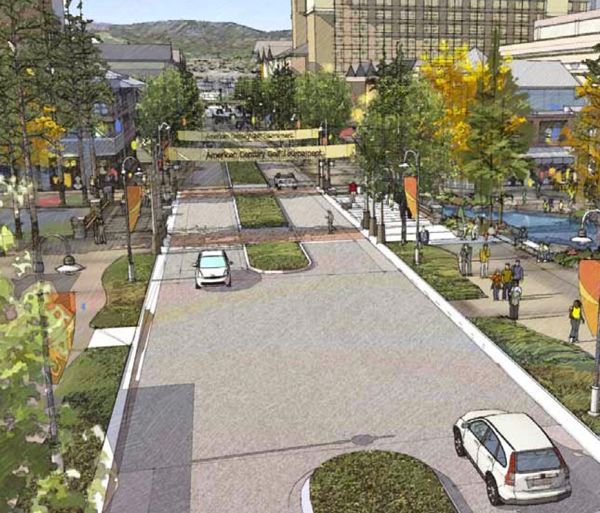
Douglas County is moving forward with the South Shore Vision. Rendering/Design Worshop

Douglas County is moving forward with the South Shore Vision. Rendering/Design Worshop

“Figure out your vision. What’s the prize? I think you can build a better place if you figure out what it is,” Weidenhamer said. “Doing nothing is a terrible choice.”

He admitted it will be hard and that some people will be mad, but that is a side effect of progress and change.

The problem is that the South Shore has not figured out what it wants to be. Instead of looking inward for self-reflection, for authenticity to grow upon the reasons we all moved here or stay here, the community looks elsewhere for answers.

Plenty of consultants have come through with ideas. Pretty drawings have been composed of what the area could be. The same “leaders” trot out the same ideas and yet nothing changes. At some point one has to question whether it’s ineffective leadership that is stalling progress, or perhaps the wrong ideas are being presented, or perhaps the will of the people is being ignored. Or maybe it’s the rules that are in place – like being the only place in the country that has tourist accommodation units and commercial floor area as commodities – that are hindering forward movement.

It’s pretty evident by anyone who travels elsewhere that the South Shore is tired looking and that there is no “there there” – as in no soul, no wow factor (other than the lake), no defining event or visual that says Tahoe. There is the lake, but it’s been pointed out for years that the body of water has not been marketed as well is should have been or could be. Access points are not well marked. Think about visiting Tahoe for the first time. Would you know how to get to the beach? Lakeview Commons in South Lake Tahoe and Tahoe Commons in Tahoe City are the only obvious places. A vast swath of the shoreline is visible on the West Shore but it’s rocky and every “private” sign on all the docks is not welcoming.

We have this incredible jewel, but it’s like a museum piece that is locked behind a gated wall. Bringing the lake to the forefront may be our answer.

This is the 2014 ad campaign which is similar to 2015's. Photo/Duncan Shannon

This is the 2014 ad campaign which is similar to 2015’s. Photo/Duncan-Channon

Lake Tahoe Visitors Authority is trying to do just that with its summer 2015 ad campaign even though it is continuing to keep with the comic book-like characters instead of the true natural environmental that is so stunning. And, of course, gaming is still part of the mix. And it should be. But maybe it’s time for the marketers to emphasize the natural beauty of the lake – not a caricature of it – (have you seen the ads for Colorado and Montana?) – that also touts recreation, and then have separate gaming ads with a bit of that scenery. Because, really, no gaming destination is as beautiful as Lake Tahoe.

Or maybe the current ad campaign reflects the South Shore perfectly – colorful, a bit schizophrenic, without a true focus and a message the masses can’t understand. LTVA’s summer campaign message is “Summer rules your face”.


Opinions: Ways to deal with bears

Publisher’s note: The following letter was sent to the South Lake Tahoe Basin Waste Management Authority from Ray Jarvis the director of Public Works for South Lake Tahoe, Jeanne Lear the Human Resource manager for South Tahoe Refuse, and Catherine Cecchi the executive Director of Clean Tahoe Program.

The South Lake Tahoe service area covers the City of South Lake Tahoe, unincorporated El Dorado County East Slope and American River Watershed and Douglas County Tahoe Township, generally from south of Emerald Bay to Spooner Summit. All three jurisdictions have ordinances addressing nuisances caused by animal disturbance of trash and similar code compliance procedures, involving notices, fines and/or installation of animal resistant trash boxes.

Currently, South Tahoe Refuse provides clean up of trash messes during regular collection routes. This has been a long time customer service practice, reflecting STR’s respect for our customers and our environment. However, STR is now tracking and taking photos of trash messes through its customer account system. Last year, STR changed the residential start time from 5 am to 7 am to encourage residents to put garbage out the morning of pickup. This does not, of itself, change the bears’ behavior or resolve the problem, but it does make it more reasonable for residential customers to put their garbage out the morning of pickup.

Clean Tahoe, a non-profit organization operating in California, provides additional response to calls from the public on individual properties where wildlife has had access to trash. Clean Tahoe has been cleaning up messes, without compensation, and also provides courtesy notices to property owners with information that refers to applicable ordinance violations. Clean Tahoe responded to, and cleaned up, 265 animal-in-trash incidents last year and reports multiple infractions on at least 100 properties a year in the California areas. These are usually properties that have placed trash out days before their collection day, often vacation and long-term rentals. Neighbors call them into Clean Tahoe. Repeat offenders and problem properties are eventually referred to City of South Lake Tahoe’s Code Enforcement Division or El Dorado County’s Environmental Management Division for code enforcement. Douglas County code enforcement staff responds to and issues violation notices in the Tahoe Township area.

The South Lake Tahoe Solid Waste Management Joint Powers Authority, comprised of elected representatives from the three jurisdictions, oversees a wide range of solid waste issues, including recent discussions of coordinating and improving policies to reduce bear interaction with the human environment. At the JPA’s direction, City and County staff and staff from STR and Clean Tahoe have been meeting and submit the following update:

Preliminary strategies include:

• Utilize STR and Clean Tahoe databases to collect data on location and number of incidents at problem properties, including photos of incidents. Add Douglas County incident records, consolidate data and map through City GIS department to identify problem areas. STR will merge Clean Tahoe’s data into its customer data base so that incidents can be sorted by property address. Incline Village, which has been actively addressing these issues for years, has taken a similar approach by mapping problem locations and animal movement.

• Make jurisdiction ordinances as compatible as possible on compliance procedures. A three tiered notification process is recommended as a reasonable level to make property owners aware and initiate compliance. Tighten ordinance language to limit the time that residential trash can be placed at curbside; the morning of pickup, not the night before. Require locking of dumpsters at commercial properties. Clarify language on suitable refuse containers.

• Discuss the efficiency and effectiveness of civil compliance, i.e., fines, versus administrative compliance, i.e., service fees leading to installation of animal resistant enclosures. Pursuing civil penalties requires staff time from compliance personnel and ultimately legal staff and may not be as effective in reaching the ultimate goal of reducing animal interaction with trash as the administrative process of tiered notification and requiring enclosure installation. Likewise, collecting fines and then rebating them back for enclosure installation requires additional administrative time. Make the message straightforward and clear – three notifications means installation of a residential animal resistant metal trash enclosure.

• Include waste management as part of vacation rental regulations. Many vacation rentals are overseen by property management companies, which, by and large, handle the solid waste responsibly. Many have the cleaning staff remove the garbage and bring it directly to the South Tahoe Transfer Station. Others may have arrangements with neighbors or friends to place the garbage out on collection day. Vacation rental regulations should address problem properties, using the tiered notification process to eventually require installation of an animal resistant metal trash enclosure.

• STR to work with individual commercial properties for appropriate resources and equipment, i.e., locking dumpsters and/or installing compactors at resorts and retail complexes. Ordinances should require that dumpsters located at these commercial properties must remain closed and locked when not in use or be subject to fines if problems develop because of access to open dumpsters. Multi-family complexes have a particular problem with metal dumpsters that are both animal resistant and still manageable for young and senior residents. STR is testing several designs that integrate hand leveraged metal doors on dumpsters so that tenants are not struggling with metal lids. In the meantime, ordinances should require that multi-family complex owners, or their managers or a designated tenant, close and lock dumpster lids each night before dark. This may be another area where a fine schedule is necessary to reinforce compliance.

• Clean Tahoe has as existing service fee of $35 for various services, such as picking up bulk items. It is recommended that this service fee should also apply to cleaning up animal in the trash incidents at properties. As a fee, not a fine, it can be administered by Clean Tahoe and STR through existing billing mechanisms to cover the cost of staff time and disposal of the material.

• Coordinate among our jurisdictions and with other Lake Tahoe and Sierra region jurisdictions on educational platforms that provide a strong and consistent message that “a fed bear is a dead bear”. Incline Village General Improvement District has excellent educational material that can be modified to address our particular community needs. IVGID is also developing a bear/human conflict management plan by working with other resources and agencies. The Tahoe Fund includes bears and trash in its new “Take Care” campaign. Linking with area resources to get the word out can help create the public and community support necessary to move from reactive bear management to a proactive approach that reduces bear deaths and improves public safety.


Letter: DA needs to play fair in Ready Mix case

To the community,

Prosecutorial misconduct in the Michael Wallace matter?

The El Dorado County District Attorney’ Office approved issuance of a false press release incorrectly stating that concrete poured by Sierra Tahoe Ready Mix could fail. This created unnecessary hysteria in our community.

In contrast, all concrete was tested prior to being poured, and all of the concrete passed.

The assistant DA handling the case wrongfully withheld information from Mr. Wallace for over four months. She falsely promised Mr. Wallace that if he agreed to her third continuance request, she would finalize a misdemeanor offer for him, and the additional time was “to Mr. Wallace’s advantage.” Instead, she used the delay to attempt to amend her complaint, and increase her offer substantially. At an April 3, 2015, hearing, she further misrepresented her conduct to Judge Suzanne Kingsbury when trying to file additional charges without complying with the law.

Prosecutor overreaching: The majority of charges against Mr. Wallace involve conduct that was done with permission of his supplier and is a common industry practice: “Bing Materials gave Mike permission to use the mix design criteria for his mix design” “this is not uncommon in the Ready-Mix Industry.” Mr. Wallace had permission to take the actions he did. Despite this, the DA ignores Mr. Wallace’s lack of culpability and instead pursues multiple felonies based on this legitimate conduct.

Even the alleged “victim” in the DA’s case supports Mr. Wallace: “[STPUD] does not consider there to be any potential damage or resulting required restitution, from the use of concrete from Sierra Tahoe Ready Mix on the projects referenced in the above lawsuit.” Richard Solbrig, STPUD general manager.

The DA should do the right thing, particularly in light of the inexplicable prosecutor actions in this case. Offer Mr. Wallace the promised misdemeanor. That alone would be commensurate with what happened in this case.

Jacqueline Mittelstadt, Tahoe Law Center


Opinion: West Nile virus awareness critical

By Ada Barros Heiser

The Placer Mosquito and Vector Control District is announcing the official beginning of the season during West Nile virus and Mosquito and Vector Control Awareness Week, April 19-25.

“With another mild and brief winter this year, a lot of our residents did not get much of a break from mosquitoes.” stated Joel Buettner, district manager. “Many of our residents understand the cycle of West Nile virus throughout the season, but many are also wondering how yet another dry year will affect mosquito populations.”

In past drought years, district surveillance data show very little impact on mosquito populations, but show a slight increase in West Nile virus activity. Experts believe this could be attributed to more infected birds congregating around fewer water sources, creating hotspots for bird to mosquito transmission of the virus.

“The good news is, we have not yet seen any West Nile virus activity in Placer County. This gives all our residents time to help us minimize mosquito populations by dumping out containers and eliminating drainage problems on your property. By reducing mosquito breeding locations now, we can reduce the risks associated with mosquito bites and West Nile virus later in the season” states Buettner.

The district also supports water conservation efforts, as many conservation measures also help reduce standing water in certain areas. Simple strategies such as cutting down on watering your lawn can help reduce the amount of water that goes into storm drain systems, which are a popular habitat for urban and suburban mosquitoes.

The week of April 19-25 is West Nile virus and Mosquito and Vector Control Awareness Week in California. Mosquito control districts throughout the state are gearing up for what could be an unpredictable and unusual season. The Placer Mosquito and Vector Control District is enlisting the public’s help to slow down the West Nile virus cycle this season. Residents can do a variety of things to help the community. Among these things are reporting potential mosquito sources or unusual mosquito behavior, such as mosquitoes biting during the daytime. Residents can also help identify high-risk areas for West Nile virus by reporting dead birds to the California Dead Bird Hotline at 877.968.2473.

In 2014, Placer County had seven human cases of West Nile virus, including one fatality, 40 dead birds that tested positive for the virus, and 77 virus-positive mosquito samples.

Ada Barros Heiser works for Placer County.