Bahrke finishes 14th at World Cup

By USSA

MINSK, Belarus – Battling high winds and changing snow conditions, coaches were forced to slingshot athletes down the aerials run where Dylan Ferguson of Amesbury, Mass., finished seventh in the FIS Freestyle World Cup in Minsk Saturday.

Teammate Scotty Bahrke of Squaw Valley, who won the previous World Cup, ended the day in 14th. Weather played a critical role in the competition.

Yang Yu of China was the women’s winner, while Stanislav Kravchuk of the Ukraine took top honors for the men.


Wildlife photographers becoming conservationists

By Juliet Eilperin, Washington Post

Steve Winter has followed snow leopards through the Himalayas, been trapped in quicksand in the world’s largest tiger reserve, in Burma, and been stalked by jaguars in Brazil. As a National Geographic photographer, that’s all just part of his job.

But he also serves as media director for Panthera, a nonprofit group that works on behalf of big cats in the wild. He will soon have dinner with the Honduran president and some of the group’s scientists to discuss creating a wildlife corridor for jaguars between the United States and Central America.

“The world needs no more pictures of pretty animals,” Winter said. “What the world needs is the story behind these animals and their struggle of being around humans.”

Michael “Nick” Nichols, a National Geographic editor at large, has been worrying about the decline of the world’s lion population for more than a decade and spent years devising equipment to chronicle the animals on the Serengeti. Because they’re active at night, Nichols is using infrared lights and sensors. He’s employing a miniature German-built helicopter to capture how lions live. “The technology is in place to look at lions in a new way,” he said.

Nichols and Winter belong to a new breed of environmental photographers who not only record wild animals and the stunning worlds they inhabit, but also push to preserve them.

Prominent wildlife photographers, including Ansel Adams, have spoken out for conservation in the past. But today’s photographers have taken the mission to new heights by changing how they craft their images and by lobbying policymakers in Washington and abroad.

Winter, who speaks about the threats to big cats in National Geographic lectures, has met with government officials in Burma, Costa Rica, Cuba and India to discuss species he has photographed. Brian Skerry, an underwater photographer with National Geographic, sent his new book, “Ocean Soul,” to every member of the Senate Ocean Caucus along with a personal note thanking them for their conservation efforts.

Nature photographer Amy Gulick published a book, “Salmon in the Trees,” that documents the links among wild salmon, grizzly bears and old-growth trees in Alaska’s Tongass National Forest. A copy of it sits on the desk of Harris Sherman, the Agriculture Department’s undersecretary for natural resources and environment. He says it “connects the critical dots between healthy forests and rivers with sustainable salmon fisheries,” and describes it as “a must-read” for understanding ecosystems such as the Tongass.

Once they’ve captured the images, many of these photographers hit the road to advocate for conservation. Alan Rabinowitz and Howard Quigley, scientists who are spearheading the effort to create a wildlife corridor for jaguars, invited Winter to dine with Honduran President Porfirio Lobo so he can show him some of the images of jaguars he has taken in the field. A group from the International League of Conservation Photographers joined with the Sierra Club in 2009 to campaign successfully against mountaintop removal mining in British Columbia’s Flathead River Valley.

Read the whole story


Record highs melting as cold front moves into Lake Tahoe

By Kathryn Reed

Put away the shorts and bring out the long pants. All the flesh that has been visible in the Lake Tahoe Basin has to do with record highs being set. But winter temps are returning.

South Lake Tahoe was 61 degrees on Feb. 24. This broke the previous record of 59 set in 1995.

Apparently 1995 was a warm February as well because the high on Feb. 23 of 56 degrees tied the record of 17 years ago.

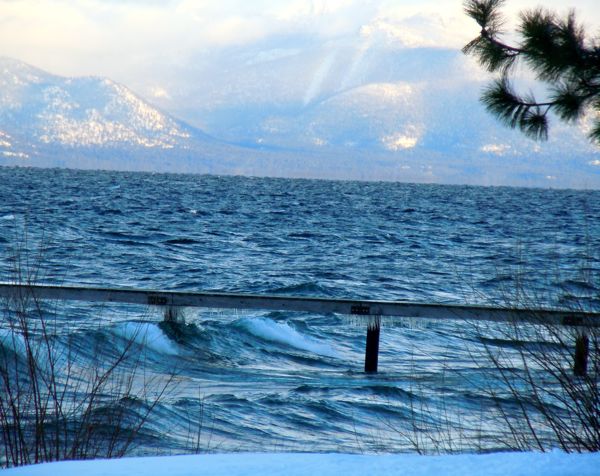
Waves like these near Tahoe City on Feb. 15 will be the norm today on Lake Tahoe. Photo/Kathryn Reed

Reno by contrast has not been much warmer than Tahoe. The high on Friday was 64 degrees.

But things have already changed with a cold front having started to blow in last night. Today’s high in South Lake Tahoe is expected to be 45, then 37 on Sunday and 28 on Monday.

A wind advisory is in effect until 10 this morning for Tahoe, Truckee, Carson City and the Reno areas. This means gusts of 50 mph, with ridgetops being whipped twice as hard.

A couple inches of snow may fall in the basin Sunday night into Monday.

“It’s not looking good for any big winter storms coming up,” Alex Hoon, meteorologist with the National Weather Service in Reno, told Lake Tahoe News.

February has been super dry throughout California and Nevada. It’s so bad that water officials have scaled back allocations to farmers and others who rely on reservoir storage from the North State.

Exactly how bad things are will be calculated Feb. 28 at the next snow survey.

Most yards in Tahoe are showing more grass or dirt than snow. People with bikes are coming into town, when normally it’s only skiers and snowboarders who are here.

While the Weather Service only has precipitation records for South Lake Tahoe that date to 2000, in that time the average has been 1.93 inches for February. So far this February 0.38 inches have been tallied.

In Tahoe City, where records date to the early 1900s, the normal February is 5.27 inches of precip. To date there have been 0.31 inches.

Hoon said it is wishful thinking to believe a dry February will bring a wet March. That’s not to say March will be dry, but he said don’t bank on March being a miracle.

A storm is sitting off the coast that is expected to arrive Wednesday that could bring a foot of snow to ski resorts. This would be welcome as most ski areas still don’t have 100 percent of their terrain open.


Trapped Incline bear to be returned to the wild

By Jeff Delong, Reno Gazette-Journal

A black bear caught in a trap that generated significant controversy in Incline Village will be released back to the wild Friday in a manner experts hope to make as unpleasant as possible.

The decision to spare the captured bruin came in part because wildlife officials aren’t sure if it’s the same problem-causing bear that prompted them to set the trap in the first place.

“There’s enough doubt as to whether this is really the offending bear,” said Chris Healy, spokesman for the Nevada Department of Wildlife. “This bear will not be euthanized.”

Game wardens set the trap last Saturday after a bear – believed to be a female because two yearling bears were reported in the same area – tore into the side of a house and entered some cars in search of food, Healy said. Such aggressive behavior could justify killing the bear as a threat to public safety under state policy, Healy said.

But the trap quickly generated its own problems associated with people who consider Nevada’s approach to dealing with nuisance bears to be overly lethal. Over the weekend, someone illegally tampered with the trap by spraying it with cleaning fluids to keep bears away. Residents of the homes where the bear went on its food raids were subjected to threatening phone calls.

The trap was cleaned up and baited again. On Wednesday night, a bear got caught.

Experts examining the tranquilized animal Thursday were in for a shock. It wasn’t a female but a three-year-old, 250-pound male.

Read the whole story


Efforts under way to forever save Lahontan cutthroat trout

By Kathryn Reed

Catching five species of trout in a day is an incredible experience for an angler. Just ask Victor Babbitt.

Babbitt, who owns Tahoe Fly Fishing Outfitters in South Lake Tahoe, was at the Feb. 21 open house where people could learn about the proposal to turn 32 miles of the Upper Truckee River and its tributaries into a federally recognized wild and scenic area.

“I don’t think there is a negative side,” Babbitt told Lake Tahoe News. “When my kids are my age I want them to have a place to go to for sure.”

Organizations want this area of the Lake Tahoe Basin classifed as wild and scenic.

Trout Unlimited and California Trout hosted two open houses this week to inform the public about their desire to seek Wild and Scenic River Designation for the Upper Truckee River through Meiss Meadows. The Lake Tahoe Basin Management Unit and Pacific Southwest Region of the U.S. Forest Service recommended this in a 1990 management plan and subsequent 1999 report.

But it takes an act of Congress to get the designation. That is what the groups are seeking.

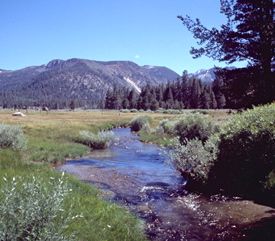
It’s the Lahontan cutthroat trout that makes this area so special. They are listed as threatened under the federal Endangered Species Act. And this area of the Lake Tahoe Basin in one of the few places to find them.

Catch and release is the rule with a single-fly barbless lure. And then fishing is only allowed in the summer months.

Trout Unlimited and CalTrout at a minimum want 7.3 miles of the Upper Truckee River to receive the federal designation. But they believe expanding that to 32 miles to include the area around Round, Dardanelles, Showers, and Meiss lakes, and other creeks in the watershed would be better for the fish and ecosystem.

The designation usually means a quarter mile area on either side of the waterway is protected as well.

Jenny Hatch with CalTrout said, “It’s really about keeping it the way it is.”

Hatch said the desire for the larger area is because the fish population is growing and this will ensure what her group considers proper management of the natural resources.

While the Forest Service basically manages the area today as though the designation is in place, without it, the federal agency can change its protocol.

Dave Lass with Trout Unlimited said the cost to create a management plan if the designation goes through was estimated to be less than $50,000 in 1999 when the last Forest Service report came out.

He believes groups like his and others could work with the Forest Service to create a public-private partnership so dollars are not diverted from local resources.

Lass foresees meadow restoration, removing conifer encroachment, improving mountain bike trails, and putting in signage as projects that could occur.

“It’s not building roads or more trails. You will still have to sweat to get in there,” Lass told Lake Tahoe News.

At the Wild and Scenic Film Festival on March 9 in Stateline a short film about the subject will be aired.

It’s definitely possible this area, which is most easily accessed off Luther Pass, could see more visitors. Right now the number of visitors is not limited in terms of day hikers, fishermen or backpackers.

The Merced River has a wild and scenic designation that is impacting the number of visitors to Yosemite National Park and might have a ripple affect to all national parks.

The designation could also open commercial guide service to the area. This is something Babbitt did in this location about a dozen years ago, but has been unable to get a permit from the Forest Service since then.

No one from the Forest Service filtered into the Feb. 21 open house while Lake Tahoe News was there. The second meeting was Feb. 22 in Markleeville.

While support from supervisors in Alpine and El Dorado counties is not necessary to go forward, officials with the conservation groups recognize it would help their cause to have it. No date has been set when those boards will discuss the issue again. October was the last time the county officials discussed the designation at a public meeting.

Hatch said she would like the issue to be part of the annual environmental summit in August, including tours of the area.

The goal of the trout groups is to have the designation in two years.

For more information or to make a comment, email dlass@tu.org.


State looking at building tunnels to divert water

By Matt Weiser, Sacramento Bee

On a clear day, it’s plain to see why many of California’s leading water officials want to get their hands on Peter Stone’s property.

From his driveway along the Sacramento River south of Freeport, the view to the east offers a peek at the snow-capped Sierra Nevada. When that snow melts, it flows relentlessly by, just across the levee road from Stone’s front windows.

From the state and federal governments’ point of view, his 20-acre property in the Sacramento-San Joaquin Delta is an ideal spot for one of the five large pumping stations they’re proposing to feed what may be the largest water tunnel ever contemplated in North America.

Even in a state known for building some of the world’s largest waterworks, the plan is audacious. Twin 33-foot-diameter tunnels would carry a portion of the Sacramento River’s flow deep under the Delta on a 37-mile path underground to the present head of the California Aqueduct, near Tracy.

Pumps that now serve that aqueduct and its nearby federal counterpart kill millions of fish every year and are blamed for altering the habitat of the estuary itself, once among the world’s most productive fisheries.

The tunnel project is intended to move the intakes upstream, to locations presumed to be less harmful to fish and their habitat. It would also secure the freshwater diversions from threats such as earthquakes, floods and sea level rise, ensuring that the 25 million Californians who depend upon that water do not go without.

Those risks are considered inevitable, so the DWR and its partner water agencies view the project as vital to the state’s economy and well- being.

To make it happen, all of those water ratepayers, from the Silicon Valley to San Diego, likely will have to pay higher bills. The project must also survive a maze of potential construction troubles.

Digging a couple of tunnels sounds simple on its face. In reality, the project would turn much of the Delta into a vast construction zone for at least a decade, and permanently industrialize numerous scenic locations that have always been quietly rural.

“This is certainly what we consider a megaproject,” said Richard Sanchez, chief of engineering at the California Department of Water Resources, the project’s primary sponsor. “And it’s something that is certainly several orders of magnitude above what we normally do here in California as far as water projects. It would be a huge undertaking if we move forward.”

The tunnel is the centerpiece of the Bay Delta Conservation Plan, an effort to balance water demand and wildlife protection. After three years of often-contentious meetings and innumerable studies, a draft environmental impact report is anticipated later this year.

The DWR is expected to make a formal decision in 2013 on whether to proceed. It would be subject to approval by state and federal wildlife agencies.

Read the whole story


Vail Resorts buys Kirkwood Mountain for $18 million

By Kathryn Reed

Vail Resorts has added a third Lake Tahoe area ski resort to its portfolio – Kirkwood Mountain Resort.

The $18 million acquisition was announced today.

Pending approval of the U.S. Forest Service, which owns the bulk of the land that is mostly in Amador and Alpine counties – with a slice in El Dorado County, the deal will go through. The Colorado-based ski company will take over the resort, retail operations at the base and rights to develop an area near Timber Creek at the base of chairs 7 and 9.

Kirkwood is Vail Resort's third Tahoe area ski resort. Photo/LTN file

The immediate change for skiers is anyone with a Heavenly or Northstar pass may ski at Kirkwood and anyone with a Kirkwood pass may ski at Heavenly or Northstar.

“Kirkwood skiers have a lot of passion because it is a really special place. One of the biggest things in our mind is to respect what Kirkwood is – the vibe, the small community feel. We really want to make sure we support that,” Blaise Carrig, co-president of Vail Resort’s Mountain Division, told Lake Tahoe News.

Kirkwood is much more of a big-mountain resort with its steeps compared to Heavenly (which Vail acquired in 2001) and Northstar (which Vail purchased in 2010).

The Wood, as locals call it, also attracts a different type of skier than Heavenly or Northstar. It’s more of a rugged individual who makes the nearly hour drive from South Lake Tahoe to Kirkwood over two mountain passes. After all, it’s a skull and cross bones that represent The Wall.

Plus, the snow at Kirkwood is usually deeper – nearly 800 inches last season – lighter and more constant than in Tahoe because of where the resort is located.

Kirkwood, though, needs some help to get to the next level in terms of infrastructure and improving the guest experience. It has two high-speed quad chairlifts, with one accessing beginner terrain.

“With every asset we look at what needs there are to improve the experience for the guests. We don’t have any specific plans at the moment,” Carrig said.

He said the sudden and dramatic improvements Vail Resorts did for this season at Northstar with the addition of a mid-mountain lodge and high-speed quad chairlift will not likely come as quickly to Kirkwood.

No dining facility at Kirkwood is memorable in a good way. The retail is basic.

Kirkwood’s master plan calls for substantial on-mountain improvements as well as real estate development.

Carrig said he is aware of the master plan, but it will take time to prioritize what to do first.

He and Casey Blann, who heads mountain operations at Heavenly, will lead the management team at Kirkwood for the time being.

David Likins, who has been CEO of Kirkwood, will take on the same title at Kirkwood Mountain Development. That is the company that retains the rights to most of the real estate holdings at Kirkwood.

“This is a great day,” Likins told Lake Tahoe News. “Vail will get us to the next level of user and guest experience. They operate fantastic resorts throughout the West.”

Likins also said Vail’s desire to retain the uniqueness of Kirkwood was important before he would agree to the sale.

Vail is not worried about the price or reliability of power that has plagued Kirkwood in the past. State-of-the-art diesel generators are expected to be online in two weeks. These replace the plant that burned to the ground in January 2010.

Kirkwood Mountain Public Utility District is its own entity since July. Mountain Utilities was an arm of Mountain Springs Kirkwood, the umbrella firm that had owned the ski resort as well.


Barton doc in Russia scouting out site of next Winter Games

By Rebecca Wass

Sochi, Russia, is next on the list for orthopedic surgeon Terry Orr’s medical volunteerism. As a physician with Tahoe Orthopedic & Sports Medicine, he will be previewing the site of the 2014 Winter Olympic Games as part of his role as head team physician for the U.S. Men’s Alpine Ski Team — a position he has had since 1999.

Orr has dedicated much of his orthopedic career to treating the world’s top winter athletes, including Olympians. With his experience in the Olympics, he was chosen to serve as chief medical officer at the first Winter Youth Olympics in Innsbruck, Austria, in January. There, he oversaw medical care for the U.S. team.

Terry Orr

The youth event included athletes from more than 60 nations competing in skiing, snowboarding, bobsleigh, biathlon, cross country skiing, figure skating, freestyle skiing, luge, ice hockey, speed skating, Nordic combined, ski jumping, skeleton and short track speed skating events.

When it comes to the winter games, Orr is a seasoned veteran of Olympic athlete medical care.

Lake Tahoe News caught up with Orr before the 2010 Vancouver Games.

Orr is currently spending a few weeks in Russia providing medical coverage for the U.S. team at the first Alpine World Cup races in Sochi. Traveling to Sochi will give Orr an opportunity to assess the event venue and help develop an emergency action plan in case of any emergency incidents at the site of the 2014 Winter Olympic Games.

“As the host nation for the Olympics, Russia will set up a mini-medical-center and provide the necessary equipment and facilities to care for all athletes,” Orr said. “Such a center typically features exam rooms, X-ray, laboratory, pharmacy, MRI, along with a mobile operating room and includes all of the basic necessities of a hospital. In addition to injuries, we also treat illnesses that come along with just being on the road.”

Orr has volunteered much of his time on the medical team for the U.S. Ski Team. This has included covering training camps, World Cup races, World Cup finals and World Championships throughout the world. He says he will be on the side of the race course in Sochi whenever the U.S. team is training or competing. If someone is injured, he travels down with the athlete to evaluate, treat and/or assist in treatment.

“We build great relationships with the athletes while they are competing to qualify for the Olympics,” Orr said. “When the physicians that have been there by the athlete’s side during their competitions are able to follow them through to the Olympics, it gives the athlete a sense of ease, because we know them, their medical background, as well as the sport.”

In the 2002, 2006 and 2010 Winter Olympic Games, Orr served as a physician on the medical staff for Team U.S.A., with a primary focus on the Men’s Alpine Ski Team.

“When he [Dr. Orr] talks, you listen,” said Daron Rahlves, men’s downhill and alpine champion and U.S. skicross Olympian. “He has seen me throughout my career about 10 times; he’s also taken care of my family and friends. I have 4-year-old twins now. If they were ski racing, I would definitely want Terry there.”

In 2010, Rahlves suffered a dislocated hip during a competition and Orr took care of him with platelet rich plasma injections — a procedure based on a once seemingly revolutionary idea: inject people with their own blood, concentrated so it is mostly platelets, the tiny colorless bodies that release substances that help repair tissues.

“He’s really cutting-edge and I was back on my skis in two weeks and competing in three,” Rahlves said. “He really reduced my recovery time. When you travel someplace new, it’s not only imperative to have someone experienced who really knows the team, but someone you trust and has been around for a while.”

Selections for the 2014 Winter Olympic Games medical team for United States’ athletes will take place in 2013.

“The Olympics has always been my favorite sporting event, and it has been great to be able to be a part of it,” Orr stated.

Rebecca Wass works for Barton Health.


Mancuso wins nighttime parallel slalom race

By USSA

MOSCOW – Julia Mancuso of Squaw Valley ripped through the head-to-head style parallel slalom to win under the lights for her second Audi FIS Alpine World Cup win this season.

“Events like this are really exciting, anything can happen. You’re bummed out if you lose and when you win, it’s a big surprise,” Mancuso said. “I knew that if you can have a good start, you can make up any amount of time, so I really focused on my start.”

Teammate Lindsey Vonn of Vail tacked another 60 points to her immense overall World Cup lead with third on the 170 foot tall ramp built in Luznhiki Olympic Complex as thousands of fans braved the fridgid Moscow tempuratures. The event, presented by Soelden, the official European Training base of the U.S. Ski Team, capped a brilliant showcase of alpine skiing in Russia, host country for the 2014 Olympic Winter Games.

Each match featured two runs with the fastest racer from the first earning a time advantage on the second.

Mancuso knocked out Vonn in the semifinal and Austrian Mikaela Kirchgasser in the final to win.

Vonn was down 0.30 to Riesch after the first run of the small final, but won the second run.

Frenchman Alexis Pinterault won the men’s event as Ted Ligety of Park City was knocked out in the first round.

The women’s World Cup moves to Bansko, Bulgaria, while the men race in Crans Montana, Switzerland.


Scarcity of snow puts winter businesses in Tahoe in a bind

By Bill O’Driscoll, Reno Gazette-Journal

Presidents Day weekend is when Paco Lindsay usually puts sale prices on ski gear in Paco’s Bike & Ski shop in Truckee.

Not this year. Sales at Paco’s began the day after Christmas — a first for Lindsay. Now eight weeks later, struggling like others in a winter devoid of snow by Sierra standards, he aims simply to survive what’s left of the ski season and look to next year.

Clouds on Presidents Day deliver zero moisture to Lake Tahoe. And temps are expected to be in the 50s all week. Photo/Kathryn Reed

“This is one of those winters you just want to get out of,” Lindsay said of a Tahoe Basin snowpack that last week was less than one-third of last winter’s epic depths as measured by the Natural Resources Conservation Service.

“It’s tough. On the ski side, we’re off by a good 35 percent,” he said. “This is the first time I’ve had to go to my vendors and restructure my payments. In talking to credit people, it’s a bad year everywhere. Everybody’s pulling the ripcord.”

With up to a foot of new snow earlier this week, Tahoe-area ski operators are hoping for something extra out of the Presidents Day holiday, the last three-day weekend of the season, to boost visitor numbers running as much as 40 percent below a year ago.

“It’s crucial. We’re tremendously down from last year,” said Janet Tuttle, co-owner of Donner Ski Ranch. “We opened Jan. 25, the latest opening since we’ve owned it in eight years. So this will be the first holiday we get this year.”

Other operators who opened earlier on machine-made snow say it’s difficult to overcome perceptions the dry winter has created in their key drive-up market, the San Francisco-Sacramento corridor.

Read the whole story