LTWC returns cubs to the wild

By Lawrence Dechant, KGO-TV

When Cheryl and Tom Millham went to an AM/PM convenience store last summer, they ended up rescuing a couple of bear cubs.

The Millhams responded to a call to rescue the two baby bears from a man who was allegedly trying to poach them for money outside the store. They took the two black bears, which weighed 15 pounds each, to the Lake Tahoe Wildlife Care animal rehabilitation facility, where she’s the executive director and he’s secretary-treasurer.

“The man claimed the mother bear came and started taking his groceries, so he shot her,” Cheryl Millham said. “He said he was going to save their lives by selling the cubs so since we are the only agency in California, we were called to come and rescue the bears before they were illegally sold.”

The two baby bears (a male and a female) were rescued more than seven months ago, and are now 90 and 55 pounds respectively. They have just been released back into the wild with a clean bill of health.

She said that the animals, if left to fend for themselves, could not thrive in the forest alone.

“If you were a baby black bear and you were alone, something definitely happened to your mom,” Cheryl Millham said. “Either she died of old age or was hunted, and as a baby bear orphan you were killed or put in a zoo.”

The Millhams have owned Lake Tahoe Wildlife Care for 35 years and rehabilitate more than just bears. This past year, the Millhams have saved 10 bears, six bobcats, hawks, owls, falcons, bats, and river otters, just to name a few.

“It took us four to five years for them to allow us to raise and rehab bears, and we knew it could be done because it was done across the U.S.,” Cheryl Millham said. “In 2000, we finally received a permit for bears, and now we take the baby bears until they reach 50 pounds. ”

She said they usually get the bears during the summer and begin the rehabilitation phase immediately.

During the rehab phase, the bears are placed in fenced areas and are taught to find appropriate foods.

“The local fisherman are good to us and bring us fish all summer long. The fish are given to bears in water; they learn that if they want to fish they have to get their feet wet,” Cheryl Millham said. “We give them acorns as well if they go south, because that is what they’re exposed to in the south. A lot of it depends on where they came from and where they’re going to be released.”
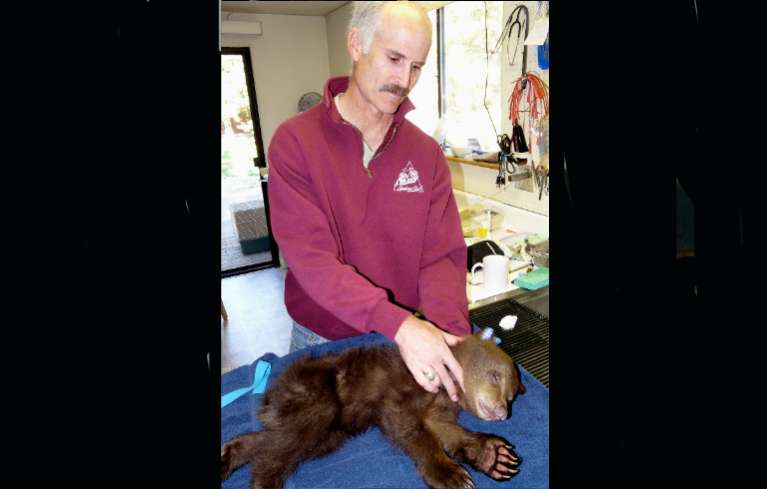
Vet Kevin Willitts in 2012 examines a LTWC bear before it is released. Photo/LTN file

The cages are sectioned into three parts and have a camera in each section so they can monitor the bears. The bears never see humans, because the goal is to get them used to their natural habitat in a safe way.

The cages are cleaned daily. There is an open ceiling, so the bears get used to rain, sunshine and snow.

Cheryl Millham said they also prepare the bears for hibernation during the winter months.

The Lake Tahoe Wildlife Care facility partners with California Department of Fish and Wildlife to release the animals back into the wild. Fish and Wildlife makes the final determination, and will usually release the bears within 50 miles of where they were first found.

“They’re ear tagged and numbered by who they are,” Cheryl Millham said. “They will anesthetize them, draw blood and check their bodies for any illness, and if everything is perfect, they’re given another dose and put in a snow den just like they were sleeping, transported to their location and placed in a make shift den. It is sealed up and they sleep for the rest of the winter. When spring comes, they wake up and don’t seem to have any memory about being around people or being rehabbed. It’s like they have another life, another year.”

The man who is accused of illegally killing the cub’s mother and trying to poach the young bears is facing four misdemeanor charges.

“These animals are not supposed to be in a zoo, they should be able to move freely, frolic freely,” Cheryl Millham said. “Since 2000, we have released all 53 bears we’ve had successfully.”


Study: Prescription drugs affecting wild fish

By Amina Khan, Los Angeles Times

A common psychiatric drug may be affecting the feeding behavior of wild fish as it filters out of our bodies, through our toilets and into treated wastewater that is released into natural water sources, according to a new study in the journal Science.

The findings, which examined the effect of trace levels of the anti-anxiety medication oxazepam on wild European perch, have implications for the survival rates of fish and the way in which human pharmaceuticals may affect the delicate food web in aquatic ecosystems.

Scientists have known for years that such “micropollutants” end up in natural waterways like streams and rivers after being flushed through human systems into wastewater. But current research hasn’t really looked at whether psychotherapeutic drugs can affect the behavior of aquatic creatures, the authors noted – which is surprising, because a common class of anti-anxiety medications known as benzodiazepines works by binding to receptors that are found in a wide range of animals.

To test one such drug’s effect, the researchers took fish that were hatched in the wild and exposed them to either low concentrations of oxazepam (1.8 micrograms per liter) or high concentrations of the drug (910 micrograms per liter) for seven days.

These “personality changes” clearly had an effect on feeding behavior as well — fish on oxazepam ate more zooplankton and did so faster than their peers, quickly depleting the food source. In the short term, this might sound like an evolutionary advantage for the perch – but the increased boldness also means they may be taking riskier behaviors, making them more vulnerable to predators.

And regardless, eating all that zooplankton may allow the zooplankton’s food source, algae, to run unchecked, resulting in algal blooms that suck the oxygen out of the ocean and create dead zones devoid of aquatic life.

The researchers’ findings could well reflect reality in waters worldwide: Their low concentrations in the lab were roughly equivalent to levels found in wild fish in the River Fyris in Sweden. And they found that the fish’s muscle tissue held more than six times that amount, evidence that the drug was building up over time.

The study may require humans to rethink the idea of pollutants, lead author Tomas Brodin, a researcher at Umea University in Sweden, said at a news conference Thursday at the American Association for the Advancement of Science meeting in Boston.

“It’s a global issue,” Brodin said. “We find these concentrations all over the world – and it’s quite possible, even probable, that these behavioral effects are actually happening as we speak.”


Smoke from controlled burn filling Lake Tahoe Basin

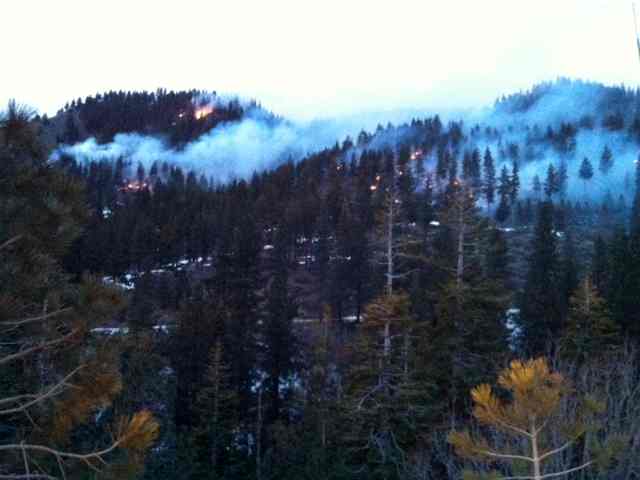
The controlled burn Feb. 19 from a lookout on Spooner Summit. Photo/Susan Wood

Updated Feb. 20, 2:50pm

U.S. Forest Service fuels management crews continued prescribed fire operations above Glenbrook today. Crews burned approximately 100 acres Tuesday, and have completed the ignition of the remaining 35 acres today.

Operations may continue through the end of the week as weather and conditions allow.

On Feb. 19 smoke impacts to the basin were light, with most of the smoke carried east by the wind. Today, the wind changed direction and smoke is impacting Glenbrook residents on the East Shore of Lake Tahoe. Smoky conditions are expected to last through the rest of Wednesday, with anticipated clearing tomorrow.

Basin residents and visitors may see a significant amount of smoke rising from the project area. Smoke may be visible on highways 50 and 28.


—–

Updated Feb. 19 4:30pm

Smoke is filling the skies in Carson City. It’s from a prescribed fire in Lake Tahoe.

—-

U.S. Forest Service fuels management crews are preparing for a possible larger-scale prescribed fire operation above Glenbrook on Feb. 19.

If conditions are favorable, crews could burn up to 135 acres to reduce hazardous forest fuels that could feed a wildfire. The Forest Service is considering staffing a fire information station in the Spooner Summit area for this operation. Updates will follow as more information on weather and fuels conditions becomes available.

Smoke from this operation could be visible in the Reno and Carson City areas, as well as in the Lake Tahoe Basin. The Forest Service strives to minimize the impacts of smoke on local communities.

Smoke-sensitive residents should consider staying indoors and keeping doors, windows and outside vents closed. To directly receive prescribed fire updates, send an email to pa_ltbmu@fs.fed.us.

Forest Service staff will post road signs around areas affected by prescribed fire, and update the local fire information line at (530) 543.2600, No. 6.


Gar Woods to host polar swim in Lake Tahoe

Gar Woods Grill & Pier will be hosting the 23rd annual Coolest and Largest Shrinkage event – the Polar Bear Swim on March 2 at 2:30pm following the SnowFest parade in Tahoe City.

Each year hundreds of spectators line the pier and deck to watch hardy souls brave the frigid waters of Lake Tahoe. Participants swim approximately 250 yards in 39 degree water before returning to Gar Woods.

Additional information and the entry form is available on online.


Search and rescue missions a monetary dilemma

By Laura Zuckerman, Reuters

After an all-terrain vehicle accident in the Utah desert last spring, 53-year-old Mikki Babineau expected a long recuperation for collapsed lungs and 18 broken ribs.

What the Idaho woman didn’t expect was a $750 bill from the local Utah sheriff’s office for sending a volunteer search and rescue unit to her aid, a service for which the sheriff in that county regularly charges fees.

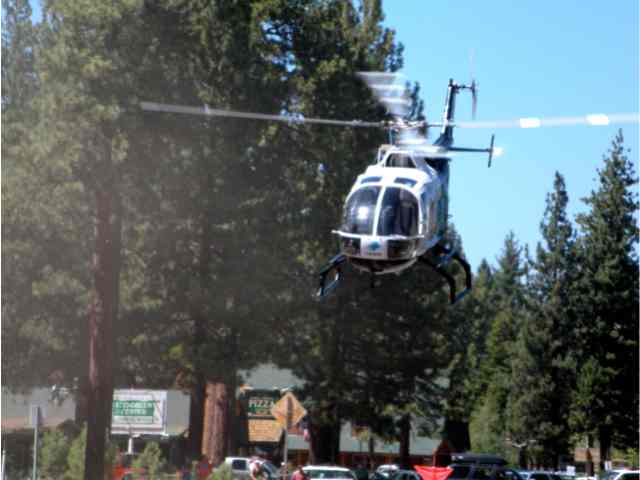
CalStar is the main helicopter company helping with search and rescue in Lake Tahoe. Photo/LTN file

Just a handful of states, including Oregon, Maine and Babineau’s home state of Idaho, have laws authorizing local agencies to bill for rescues when factors such as recklessness, illegal activity or false information led to the predicament.

Lawmakers from the Rockies to the Appalachians periodically question why adventurers who incur costs should not have to pay the price – literally. That debate has heated up this year as legislators in at least two states have sought, so far unsuccessfully, to enact laws to allow fees for rescues.

“In the rare case where a person took unnecessary risks, that person should be sent a bill,” said Wyoming Republican Representative Keith Gingery, who tried but failed to pass such a law in his state.

That few states currently allow such billing is chiefly due to objections by national search and rescue groups, who say the prospect of payment could prompt people to delay seeking needed aid, possibly making a dangerous situation worse.

But that has not stopped lawmakers from considering such laws. Legislators in New Hampshire, for example, are seeking to shore up search and rescue funds by establishing fees ranging from $350 to $1,000.

That legislation, designed to address deficits in a state rescue fund paid through licensing of hunters, snowmobilers and other outdoor recreationists, is pending before a New Hampshire House committee.

A similar effort to impose payment in Wyoming came to naught this year after Gingery failed to persuade a state House panel last month to approve a provision to give county sheriffs – who in many Western states oversee search and rescue teams – the right to recover rescue costs.

The issue came to the fore last winter in the state’s Teton County, home to mountains as perilous as they are scenic, when a group of snowmobilers entered the back country near a steep pass northeast of Jackson Hole and required a helicopter rescue.

When the county later asked them to contribute to the $14,000 cost of the operation, an attorney for the snowmobilers wrote a letter contending local officials had no authority to ask for reimbursement.

Wyoming’s Gingery and other backers of billing those saved say the issue is broader than money. Billing for rescues, they argue, would place ill-prepared hikers, skiers and snowmobilers, especially those engaged in extreme sports, on notice.

Recent advancements in outdoor equipment, navigational devices and off-road vehicles are allowing greater access to remote areas by more people with fewer outdoors and survival skills, complicating rescue missions, Gingery said.

Rescue expenses are also rising in states like Idaho, where gas taxes cover part of the tab. Since July, nearly $85,000 has been distributed for searches from a state fund. That compares to roughly $63,000 for all of fiscal year 2012 and about $71,000 the year before, Idaho State Police documents show.

Search and rescue groups say their services make up just a fraction of the emergency costs incurred by law enforcement and medical agencies nationwide, and that efforts to bill for rescues are tied to rare but highly publicized incidents in which the stranded made foolish errors in judgment.

“There is a lot of hue and cry about recovering rescue costs, but we never question people’s right to dial 911 for authorities, fire departments and paramedics and we don’t begrudge those costs,” said Howard Paul, spokesman for the Colorado Search and Rescue Board, which oversees 50 volunteer teams in that state.

Colorado logged 1,428 missions in 2010, the most recent year data was available. While that was a high for search and rescue operations compared to the four preceding years, the record since 1995 was set in 2002 with 1,582 missions.

Dan Lack, chairman of the Rocky Mountain Rescue Association, said the specter of paying for a rescue can instill fear in some of those in need.

He was on hand in August when a climber became wedged between rocks in the Colorado mountains and ordered people who became aware of his plight not to call for help because he didn’t want to be charged. They dialed 911 anyway.

“If others had not alerted us, he wouldn’t have called for help until the sun went down, thunderstorms came in and my teammates and I would have been in danger,” Lack said.

“I, for one, am happy to go out and rescue someone, free of charge, who’s had a bad day,” he said.

That ethos has underpinned 40 years of rescue work for Roger Beckett, resource coordinator for Olympic Mountain Rescue in Washington state, where lawmakers have unsuccessfully floated bills to force payment for rescues. Volunteer teams have opposed those proposals every time, he said.

Beckett said poor judgment, if defined loosely, and the lesser evil of inexperience are chief reasons for rescues.

“Inexperience won’t get you in trouble but it will keep you from getting out of trouble,” he said, adding he finds no fault in the relative few whose misadventures trigger a rescue.

“Every day you get out of bed, you take a risk,” he said. “Should we bill you?”


USFS reissues Camp Rich upgrade proposal

By Kathryn Reed

Parking on the road leading to the Beacon restaurant is no longer part of the U.S. Forest Service’s plans when it overhauls the Camp Richardson area.

A group of homeowners along Jameson Road had protested the original proposal, which brought a halt to the process, withdrawal of the earlier decision and forced the Forest Service to reconvene.

Alleviating congestion at Camp Rich is a goal of the Forest Service. Photo/LTN file

The houses are beyond the marina, but the way to access them is via the same road one uses for the restaurant. There is also a question as to who owns that road.

Another environmental analysis is back on the street for a 30-day comment period that ends March 15.

“Based on subsequent discussions and analysis, the Forest Service has concluded that resolving concerns surrounding day use parking along Jameson Beach Road is important and that these actions need to be considered in more detail and in a broader scope. Appropriately addressing the retrofit of these resort areas and the 75 parking spaces for day use beach users will need to consider the reconfiguration of the area west of Jameson Beach Road,” Daniel Cressy, USFS landscape architect and recreation planner, told Lake Tahoe News. “The retrofit of circulation and day use parking along Jameson Beach Road is outside of the scope of the current project and is not considered in detail at this time.”

The residents are not completely thrilled with what the Forest Service is doing by not including Jameson Road in the revised plan.

“In a message to me, a USFS representative indicated that the U.S. Forest Service has ‘scaled back’ the project to only address BMP campground issues thereby ‘allowing further time to discuss residents’ concerns regarding Jameson Beach Road.’ This too overlooks that the residents have been not only willing, but trying to engage the USFS in discussions for at least three years in hopes of amicably resolving the issues, yet to date the USFS has failed to engage in any meaningful discussions,” Jacqueline Mittelstadt, attorney for the Jameson Beach Association, told Lake Tahoe News. “We will scrutinize carefully the new proposed project and EA. Hopefully, their second try is a better try.”

The project’s goals for these three South Shore campgrounds that are on both sides of Highway 89 include substantial upgrades for overnight guests, improved traffic flow for all motorists, installation of erosion control measures, and better access for those with disabilities.

Improvements include replacing the four bathrooms with seven ADA accessible facilities, adding bear-proof dumpsters and food lockers, upgrading utilities, installing barbecues at all campsites, and adding fire hydrants for the area.

The total area to be addressed is 79 acres.

Other proposed improvements include more paved bike trails, a restroom near the beach, and replacing fencing between Camp Richardson Resort and Pope Beach Road.

Four alternatives are in the environmental document. The preferred alternative includes the possible remove of 40 trees with a 30-inch diameter and 910 trees smaller than that.

Work could be begin this building season. All the work is estimated to take five years. As work is being done, the public won’t have access to certain areas.

Comments may be submitted electronically to comments-pacificsouthwest-ltbmu@fs.fed.us. For more information, contact Daniel Cressy or Matt Dickinson at (530) 543.2694, or go online.


Fundraiser blends skiing, eating

Glide, stride, or snowshoe through a gourmet on-snow wonderland at the 12th annual Gourmet Ski Tour on March 10.

A fundraiser for the Tahoe Cross Country Ski Education Association, the epicurean event is at the Tahoe Cross Country Center in Tahoe City from 12:30-2:30pm.

Work up a hearty appetite and experience quilt free noshing before, during, or after touring some of the cross country center’s 65 kilometers of forested trails.

Outdoors enthusiasts and foodies will advance from one food station to the next all the while socializing with other participants. Don your most inventive hat creation for this year’s event theme, “The Mad Hatter’s Ski Party”, for a chance to win a season pass to the Tahoe XC Center for most original hat.

Beginners may rent skis or snowshoes at the Tahoe Cross Country Center and move around at their leisure sampling tastes. The afternoon ends up with margaritas and live music by The Jelly Bread Band from 2:30-5pm.

Food and beverages will be provided by Sugar Pine Cakery, Uncorked, Tahoe House, Coffee Connexion, Christy Hill, Wolfdale’s, Sunnyside, Lanza’s, Mamasake, Jake’s on the Lake, Brockway Bakery, Bridgetender, Ron Allen Personal Chef, Men Wielding Fire, and Uncommon Kitchen. Tickets are $35 (includes a free half day trail pass), $30 for season pass holders, and $25 for volunteers. A limited number of tickets are available — (530) 583.5475.


Balmy Tahoe weather to be replaced with winter

The National Weather Service in Reno has issued a winter weather advisory for the Lake Tahoe Basin for Tuesday from 4am-10pm.

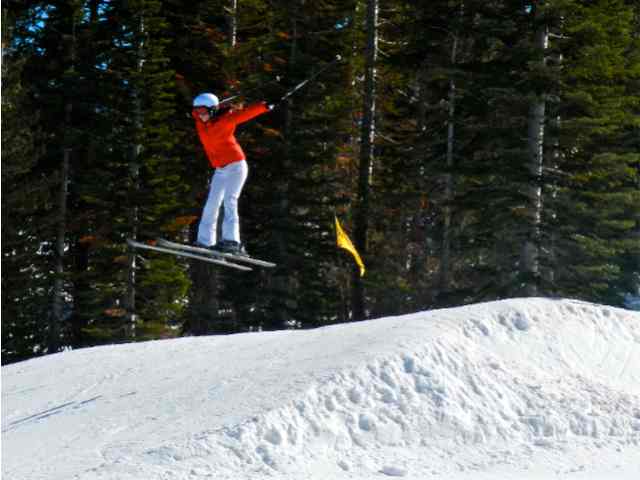
A skier at Northstar plays in the terrain park Feb. 17. Photo/Kathryn Reed

Expect the snow to start falling tonight. The storm could bring between 4 and 10 inches at lake level, and between 7 and 14 inches above 7,000 feet.

Winds will be out of the southwest at 15 to 25 mph, with gusts up to 40 mph. Ridge gusts could reach 90 mph.

There is a chance the white stuff will keep falling through Friday. And the temps will be falling too.

— Lake Tahoe News staff report


Tahoe City area campground to be modernized

By Kathryn Reed

When the William Kent Campground near Tahoe City was created in 1924 there wasn’t much else around. Now it’s a bit like urban camping, as is the case with most developed campsites in the Lake Tahoe Basin.

But not many upgrades have been made in the last 89 years either. It’s still a bit rustic when it comes to amenities even though residences surround it. The road and camping spur design was implemented in 1963, flush toilets came in 1969, and a bathroom at the day use beach was built in 2004.

Proposed changes for William Kent Campground. Rendering/USFS

A range of changes is in store for the campground as well as the Meeks Bay Fire Station that is manned by the Forest Service.

The USFS has allocated $1 million to improve the campground and day-use beach area. (This is the only public camping facility on the West Shore.)

Work on the 22-acre site that is about one mile south of Sunnyside and adjacent to Meeks Bay Resort could start in May 2014. The forest supervisor signed off on the environmental assessment on Feb. 8, which started a 45-day appeal period.

“The Forest Service recognizes that trends in recreation interests are changing. One of the changes we have observed is that many campground visitors are interested in experiences other than traditional tent camping. One such experience that has become popular is camping in a yurt,” Ashley Sommer with the U.S. Forest Service told Lake Tahoe News.

These tent-like cabins have a permanent platform. A wood or metal frame is erected on a seasonal basis.

“Yurts vary in their amenities, but generally have a heated sleeping area and eating area at a minimum,” Sommer said. “We have seen success with the yurts at Fallen Leaf Campground on the South Shore. The proposed yurts would be purchased and owned by the concessionaire that operates the campground.”

This project is just outside the scoping area of the much talked about realignment of Highway 89 to deal with the seismically challenged Fanny Bridge as well as the visioning area for Tahoe City.

Moving the fire station is designed to reduce response time by firefighters because most of that station’s calls are north of Meeks Bay.

“The Meeks Bay fire station is currently the only fire station responsible for wildland fire response and wildland‐urban‐interface (WUI) fire response on the West and North shores of Lake Tahoe,” Sommer said. “The Meeks Bay Fire Station is also no longer adequate for the size and mission of the fire engine module. The Meeks Bay site is too small, which does not allow enough space for a new building that meets current standards, as well as adequate parking for station employees. Furthermore, the site does not have a year‐round water source, which would limit the use of a new facility during the winter months.”

The new building will be about 3,500-square-feet and look much like the facility on Spooner Summit.

For more information about the project, contact Ashley Sommer at (530) 543.2615 or go online.


Holland takes 4th in snowboardcross in Russia

By USSA

ROSA KHUTOR, Russia — Alex Deibold (Manchester Center, N.H.) rode to a career first FIS Snowboard World Cup podium Sunday, finishing second in the pre-Olympic snowboardcross test event.

Nate Holland

U.S. Snowboarding teammate Nate Holland (Squaw Valley) was fourth.

Faye Gulini (Salt Lake City) was eighth to lead the U.S. women.

Alessandro Haemmerle of Austria won for the men with Michela Moioli of Italy taking the women’s race.

Deibold picked up his first career podium in his 31st World Cup start.

Despite the weather, riders were impressed with the Olympic course in Rosa Khutor outside Sochi. All of the snowboarding, freeskiing and freestyle venues are in the same sector of the mountain with the alpine venues nearby.