Northstar ramping up for summer operations

By Kathryn Reed

Zipping through the trees is soon going to have a different meaning for people visiting Northstar.

No longer will skis, a snowboard or mountain bike be necessary.

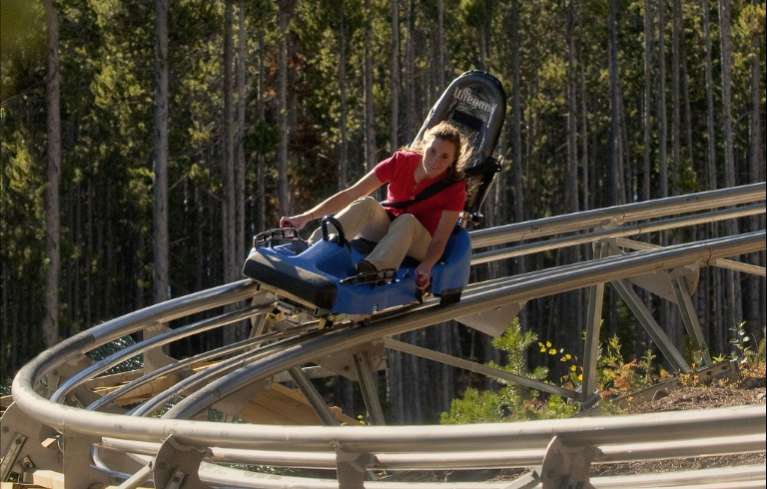
The Forest Flyer is expected to be in operation next winter. It’s a toboggan of sorts that is on wheels on a track. People will be towed to the top of the track, then gravity will take them through the bank turns, loops, over bridges, through the forest and back to the starting point at the bottom of the Vista lift at mid-mountain.

This will be an attraction that is designed to be open year-round. (Pricing has yet to be set.)

A ride similar to this could be operational at Northstar this winter. Photo/Provided

A ride similar to this could be operational at Northstar this winter. Photo/Provided

“People have a need to get out in the woods and some don’t have the ability or skill to do it,” Bill Rock, chief operating officer of Northstar, told Lake Tahoe News. “One thing about this project and ziplines is they make the outdoors more accessible to people. You really can get a sense of flying through the forest.”

Since Vail Resorts took over the Truckee resort, the location of the flyer has been changed. This is in large part to accommodate those who had voiced concerns.

Plans still need to be approved by Placer County. Then the state needs to sign off on the designs, too.

Also working its way through the halls of the county’s planning department is the resort’s master plan. The draft environmental impact report is expected to be released for public comment in June.

It’s possible some of the items in the plan could be implemented in 2014. A priority list has not been disclosed.

Events continue to be huge draw for Northstar. This year Tough Mudder will be over two weekends – one in July, the other in September.

Rock said last year it attracted so many people to the resort who had not been there before, that the organizers and Northstar thought doubling the exposure of the endurance event would benefit everyone.

This will be the third summer Northstar has hosted the Tahoe Trail 100. The amateur mountain bike race is a qualifier for Colorado’s Leadville 100.

On a less intense note are the Strider bike series for those who are new to cycling. Rock’s twins, who are now 8, learned at age 2 on Striders.

“It’s revolutionizing how to ride bikes,” Rock said. “We do it on the ice rink so it’s a contained environment.”

And when the rink isn’t full of little kids learning to ride a bike, that rink is for roller skating this time of year.

While Rock would like Northstar to be as popular in summer as it is winter, he knows it will take more work to make that happen. But he said the interest in the resort sans snow is growing.


Golf event raises money in Gene Upshaw’s name

More than 25 NFL players and other sports celebrities will pay tribute to football great Gene Upshaw on July 14-15 during the 5th annual Gene Upshaw Memorial Golf Classic at Gray’s Crossing in Truckee.

Proceeds from the celebrity tournament go to the Gene Upshaw Memorial Fund held at Tahoe Forest Health System Foundation. The fund benefits the Gene Upshaw Memorial Tahoe Forest Cancer Center and the Tahoe Institute for Rural Health Research.

Since 2009, the event has raised nearly $500,000 for pancreatic cancer research, medical treatment and care for cancer patients and their families, sustainability and advancement of medical technology, and funding for research in areas such as traumatic brain injury. Support care programs at the Cancer Center are considered among the best in the country along with the latest in technology and treatment options, including access to clinical trials through its affiliation with the UC Davis Cancer Care Network.

Upshaw died in August 2008 of pancreatic cancer at the age of 63. He was a founding member of the Golf Club at Gray’s Crossing.

For more information, go online.


Nevada taking input on recreation rates

The Nevada Division of State Parks is having Recreational Trails Committee meetings May 8-9 to hear and rate applications for 2013 federal funding.

The meetings will be at 901 S. Stewart St., Carson City, on the fifth floor starting at 8am each day.

Public comment periods will be at 9:30am May 8 and at 8:20am May 9.

For an agenda, email jscanland@parks.state.nv.gov.


Northstar to host 2 weekends of Tough Mudder

Tough Mudder returns to Northstar on July 13-14 and Sept. 28-29.

Tough Mudder events are 10-plus mile obstacle courses designed by British Special Forces to test all-around strength, stamina, mental grit and camaraderie. Tough Mudder’s courses have attracted 750,000 participants worldwide to date. Through Tough Mudder, these participants have raised more than $5 million for the Wounded Warrior Project.

Registration is open, with the summer event 77 percent sold. Rates for the summer and fall events are scheduled to increase May 3.

Spectator tickets will be available for sale online for $20 until noon on the Friday before the event weekends. They will be sold for $40 cash only onsite. Dogs are not permitted.

For more information about the Tough Mudder events at Northstar or to register to participate, go online.


Frozen oasis — just a helicopter ride away

By Kathryn Reed

Hover. Just hover. Go back. Lower, please. And then it was all over – and way too quickly.

If only I had been able to commandeer the helicopter or shout commands.

But the memory of flying over Emerald Bay and near Desolation Wilderness, that will last forever even if the 30-minute flight wasn’t long enough. (I’m not really sure how many hours would have been required before I would have been satiated.)

Three of the area’s most iconic waterfalls – Eagle, Cascade and Horsetail – at the same time lost a bit of their majesty and gained even more. All of this because of a helicopter ride.

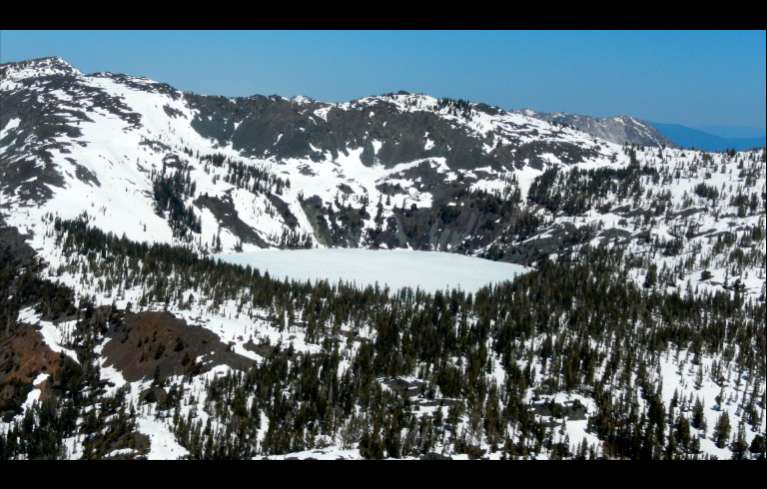
Helicopter tours reveal a frozen back country lake west of Lake Tahoe. Photos/Kathryn Reed

A helicopter tour reveals a frozen backcountry lake west of Lake Tahoe. Photos/Kathryn Reed

They were magnificent, but something about hiking to them – the time that it takes, the views, the sound – is such a classic way of viewing them. But this eagle’s view, well, it gives a different perspective to all that rushing water.

Water is flowing strong now down the falls. The whir of the blade replaces the thunder of the water.

The waterfall tour is one of six that Reno Tahoe Helicopters provides for those who want to see the Lake Tahoe area from a different perspective.

“I would have never known all of those lakes were there,” Cheryl Johnston of Atlanta said when touching down at Lake Tahoe Airport. The ride was one of the highlights of her first vacation to the area.

The pilot says there are about three dozen lakes to see on this trip. Some are recognizable to a local – Eagle, Echo, Cascade, Fallen Leaf.

Others are ones found on summer hikes – the Velmas, Susie, Heather, Aloha.

Oh, those frozen ones. That is a sight not seen on a hike. The icy blue looks like something out of Alaska. Mesmerizing, chilling, spectacular, otherworldly – find a superlative and it’s bound to fit.

With snow in abundance in the higher elevations, much of the terrain was a winter wonderland last Monday.

This is the slow season for the helicopter company, despite its being the height of waterfall season. Though, the waterfall tour is the most popular right now.

On a busy summer Saturday they could make 20 tours.

The pilot said there is no rule about how high they must be, but they are usually at 8,200 feet. The reason is to not be a noise polluter, so to speak, for those who are on the ground.

Claudio Bellotto, who has been flying out of the South Shore since 2005, gives a bit of history while flying over the Tahoe Keys, then Emerald Bay and beyond into the backcountry.

The Bell Long Ranger IV has a window seat for the five passengers it can seat. Three helicopters are in the South Tahoe fleet, with two others now operating out of the Truckee airport.

A fly fishing guide out of Truckee arranges for helicopter rides for his clients – landing at a resort near Markleeville so they can cast along the Carson River.

It’s not just tourists – or the occasional local – who buckle into the bird. Pilots have taken film crews around the area for various shoots. This winter a helicopter was in the air for five hours to film the Freeride ski event at Kirkwood. A cineflex was attached to the nose.

Range Rover hired a pilot to shoot aerial shots for a commercial. Boeing is coming up soon – but the helicopter company hasn’t been told the exact assignment. National Geographic has been a repeat client.

After the 2007 Angora Fire, a pilot took a crew up with infrared devices to look for smoldering hot spots.

In addition to the scenic and commercial flights, Bellotto operates a helicopter flight school. It’s the highest elevation flight school in North America.

More information about Reno Tahoe Helicopters may be found online.

ngg_shortcode_0_placeholder (Click on photos to enlarge.)


Target shooting has its limitations

With increased citizen concern regarding target shooting in congested areas, Washoe County sheriff’s deputies are reminding residents of county ordinances governing discharge of firearms in congested areas.

It is unlawful to discharge: any gun, pistol, or rifle, with the exception of shotguns, air rifles, or BB guns, within 5000 feet of an occupied dwelling; shotguns, air rifles, or BB guns within 1,000 feet of an occupied dwelling; a firearm from, upon, over or across any federal or state highway or any county road or highway; a firearm within a Nevada State Park, unless otherwise designated by the administrator; within the jurisdiction of the U.S. Forest Service it is prohibited to discharge a firearm in or within 150 yards of a residence, building, campsite, developed recreation site or occupied area, or across or on a National Forest System road or a body of water adjacent thereto, or in a manner or place whereby any person or property is exposed to injury or damage as a result in such discharge, or into or within any cave.

A “congested area” is a geographic location where discharge of any firearm is prohibited. Because congested areas are generally densely populated, it has a high risk of personal injury.

A “restricted congested area” is a location where residents must be a minimum of 1,000 feet from any occupied dwelling.

A “non congested area” is a location where residents must be 5,000 feet away from an occupied dwelling. In these areas they may shoot guns, pistols, rifles, shotguns, air rifles, BB guns, or any other firearms.

If anyone has concerns about activity that may be illegal, or dangerous, call (775) 785.9276.


3-day basketball tournament on South Shore

Expect to see a lot of young basketball players on the South Shore during Memorial Day weekend.

South Tahoe Basketball Academy, a nonprofit run by people affiliated with South Tahoe High’s girls’ and boys’ basketball programs, is partnering with Hardwood Palace to put on the May 25-27 tournament.

Grades 3 through 12 will participate.

South Tahoe Basketball Academy will donate all of its proceeds back to the local youth programs.

Games will be played at STHS, South Tahoe Middle School, Kahle Community Center, Bijou Community School, Tahoe Valley Elementary, Sierra House Elementary, and possibly Lake Tahoe Community College and South Lake Tahoe Parks and Recreation Center.

More info is online.


Massive fuels reduction project to resume

The 10,000-plus acres South Shore Fuels Reduction and Healthy Forest Restoration Project will start again in early May.

The first area scheduled for treatment this season consist of 280 acres between Golden Bear Estate off Pioneer Trail and the Sierra Tract.

Those who mountain bike, run, hike and walk their dogs in this area will need to temporarily find another playground. The U.S. Forest Service will officially close the area due to the hazards posed by heavy equipment operation and falling trees. The work should take about two months to complete.

Heavy equipment is needed for the South Shore fuels reduction project. Photo/LTN file

Heavy equipment is needed for the South Shore fuels reduction project. Photo/LTN file

Possible alternatives for recreational access include National Forest lands south of the Golden Bear subdivision and the reopened Railroad Grade Trail east of Pioneer Trail.

While the two treatment units are heavily crisscrossed with neighborhood trails, they have very few official roads and trails. After work is completed, the Forest Service will restore official trails. but will not restore user-created trails.

As the season progresses, mechanical thinning may occur in a number of other South Shore locations as conditions allow, including Christmas Valley, Fallen Leaf Lake, Meyers, the Highway 89 corridor, Gardner Mountain and the Pioneer Trail side of Trout Creek.

In addition to mechanical operations, the Forest Service also expects crews to complete at least 300 acres of hand thinning, which will include urban lots and areas near Hawley Grade in Meyers.

Early season work also will include removing log decks, slash and biomass from landings in units near Trout Creek and Fallen Leaf Campground and decommissioning them.

For local residents who’ve been wondering what will become of the very large deck of logs near Camp Richardson Resort, Forest Service staff expect to eventually remove the pile, potentially later this year.

The Forest Service will post closure orders for mechanical work online and provide periodic updates as work moves to new areas. For general information on the South Shore project, also go online.


Residential burning requires permit

In 2012, 23 percent of all wildfires in the Amador-El Dorado Unit of CalFire were caused by residential debris burning. The 47 fires burned 52 acres.

Residential burn permits will be required beginning May 1. These permits are issued to the public for free and are valid for three years from the date of issuance. Permits allow for the burning of dry vegetation (not household trash) that originates on the landowners property. Burn permits are available at most of the local staffed fire stations.

The use of burn barrels is no longer legal in Amador or El Dorado counties.

Safety tips for burning:

  • Make sure your pile(s) are no larger than four feet by four feet in size
  • Scrape a 10-foot wide ring around each debris pile down to bare dirt
  • Have a shovel and water supply (charged hose) close by to use in the event your fire escapes from the pile
  • Make sure an adult is in attendance until the pile is completely extinguished
  • You can only burn on “permissive burn days” so make sure to call your local Air Quality Management District immediately prior to lighting your pile(s).

For Amador County call (209) 223.6246, El Dorado County call (530) 621.5897 or 866.621.5897, Lake Tahoe area of El Dorado County call (530) 621.5842 or 888.332-2876 or Alpine County call (916) 445.0745.


Endurance events not all fun and games

By Luna Shyr, National Geographic News

The first fatality in a Tough Mudder endurance event this past weekend raises a dire prospect that’s typically far from the minds of participants or buried in the fine print of contracts.

Such extreme activities, with names like Rugged Maniac and Warrior Dash, have surged in popularity. Their novelty challenges include crawling under live wires, plunging into an icy dumpster, and dangling from monkey bars coated with butter and mud.

At best, such obstacle courses push mental and physical stamina and build teamwork; at worst, people get injured or even die.
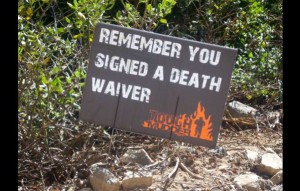
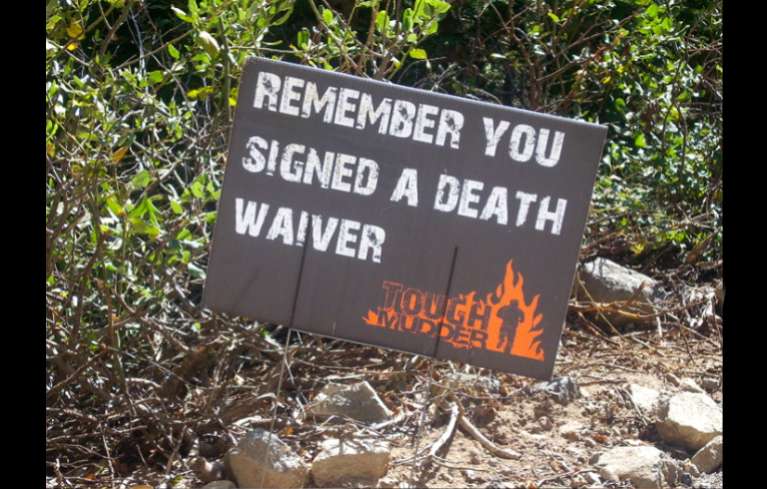
Tough Mudder may reconsider posting signs like this one that was on the Northstar course in 2012. Photo/Jessie Marchesseau

Tough Mudder may want to reconsider using signs like this one that was on the Northstar course in September. The event returns to the Truckee ski resort July 13-14 and Sept. 28-29. Photo/Jessie Marchesseau

After the Tough Mudder in Gerrardstown, W. Va., this past weekend, 20 participants were treated at the local hospital, including two people with heart attacks and several people with hypothermia, head injuries, and orthopedic injuries. Avishek Sengupta, a 28-year-old from Maryland, drowned. His death has been ruled an accident after he jumped from a plank into a pool of muddy water during the race.

In April 2012, a 30-year-old man died in Texas after a similar event called the Warrior Dash. Two men died in another Warrior Dash in Missouri later that summer.

Tough Mudder is a nine- to 12-mile (14- to 19-kilometer) endurance challenge that bills itself as “probably the toughest event on the planet.” An estimated 750,000 people have participated in Tough Mudder courses since 2010, running through mud and over obstacles. There are more than 50 Tough Mudder events planned for the rest of this year in the U.S., Australia, Japan, South Africa, and Europe. The company that puts on the events says that its courses are designed with safety experts, and that emergency personnel are present.

To reduce risk of competing in such events, sport psychologists and physicians emphasize preparation and awareness. We asked two experts—Justin Anderson of Premier Sport Psychology in Minneapolis/St. Paul and Dave Olson, a team physician for the Minnesota Vikings — to share their insights on extreme activities.

Justin Anderson, a sport psychologist, on extreme endurance events:

The term “extreme” has been applied to everything from Tough Mudder to Ironman to things like heli-skiing or BASE jumping. What makes a sport extreme?

It depends on whom you ask, but I think “extreme sports” include anything that’s on the fringe of the mainstream and can be incredibly grueling or incredibly dangerous. All of those activities fit those categories.

Why do you think endurance events like Tough Mudder have become so popular?

Humans always want to continue to push the envelope. People tend to feel most content when they’re growing and hitting or exceeding goals. Then there are additional gains like triggering dopamine in the brain—it acts as a natural high, and we can feel euphoric once we’ve completed one of these things.

There’s also this identity factor of being someone who’s tough and a go-getter. Finally there’s the community; we get to interact with folks like ourselves who are high achievers, and that can be a really attractive thing.

What should anyone who participates in an extreme activity consider before they go out there?

It’s important to be mindful of why we’re getting into these activities and see if it’s really worth it. When our dopamine levels get triggered, it becomes a natural high. What tends to happen is it takes more and more to get that psychological and biochemical effect, so we push and say we can go to this next level.

Also be careful not to be too caught up in the “rah rah” of the event. Once you jump into these things, it can be really seductive — that social persuasion of “let’s go,” even though your body and mind might be saying to slow down or take it back a notch.

Do people tend to overestimate their ability to do these endurance events? Underestimate the risks?

It depends on the person. Certainly a lot of people overestimate their ability. Ask yourself what you’re doing to get your body prepared. Pay attention to your body and mind, especially when it’s telling you to stop. That’s the beauty of endurance sports like Ironman — the athletes are incredibly tough and they’ve learned in training how to focus on other things when they’re running through cramps or their body wants to stop.

But the key is knowing which signals to pay attention to and which ones not to, and that comes from years of experience of knowing your body and its limits.

When you talk about the difference between pros and amateurs, we say pros practice far, far more than they play, and amateurs play far more than they practice. In the case of high-level athletes, they do a lot of training and understand what the extremes are. They know they have to build up to them. I recommend getting to know the process because these things are much more challenging than they appear, both mentally and physically.

Dave Olson, a team physician for the Minnesota Vikings, on preparedness:

What’s the minimum training you would recommend for an event like Tough Mudder?

These events are tricky for sports medicine doctors. With sports teams we really get to see the athletes and review their histories. With mass events like Tough Mudder or a marathon, pretty much the only requirement is to sign up and think you’re ready to do it.

Train smart for an event, ideally over a series of months to ramp up your activity, and get a medical checkup to make sure it’s safe for you to do so. Tough Mudder events can be tricky because with, say, marathons, people go online and can read about how to train. But with events like Tough Mudder being new and different, a lot of times we see people going because friends say, “You should come do this.” They may do some runs but often they don’t end up doing the training they need to prepare. People have to be realistic and look at their medical background.

How do you best avoid injury on the day of the event?

Hydration is big, and equipment — making sure you’re dressed properly and have good shoes that have been worn before so you don’t get blisters, that kind of thing. If it’s 100°F (38°C) out, have the proper shirt. And have an extra set of clothes for when you’re done — something warm to put on in case you’ve been through an icy stretch. Dress smartly, look at the weather, and plan ahead.

To Justin’s point about knowing which body signals to pay attention to and which to plow through, how do you know when you should stop?

It can be really tricky. I think it’s hard for an athlete who hasn’t been doing a lot of training — the first signal like chest pain might already be too late. You have to really listen to early signals like dizziness, cramping, and listen to them as warning signs. It’s hard in those events because it’s a group event — there’s a lot of cheering and pushing through — but you really have to be smart about it, especially if you’re not well trained.