Sex offender arrested in Truckee

Registered sex offender Gustavo Ramirez, 20, of Truckee was arrested on charges related to not telling police officers where he was actually living.

Officers said when Ramirez first registered he gave a false address. The reality, officers said, is Ramirez was living closer to a day care facility than he was legally allowed.

He was booked into jail Nov. 21 on charges of failing to register and violating his probation.

— Lake Tahoe News staff report


Reforming California: Easier said than done

By Evan Halper, Los Angeles Times

SACRAMENTO — For the last couple of years, some of the state’s most influential business titans and elder statesmen have taken time off to grapple with the mess in Sacramento.

Former Secretaries of State George Shultz and Condoleezza Rice, Google Inc. Chairman Eric Schmidt, Los Angeles philanthropist Eli Broad and other heavyweights have all attended an effort known as the Think Long Committee for California, which is focused on squaring away the years of mismanagement from Sacramento and conflicting mandates from citizen initiatives.

They haven’t gotten very far.

Nor has a similar effort launched by U.S. Secretary of Defense Leon Panetta and others before he departed California for the Obama administration. A push by Bay Area business leaders to launch a constitutional convention to deal with the state’s vexing policy problems sputtered and died.

Gov. Arnold Schwarzenegger had some very big names working on blowing up the boxes of government — almost all of which are still intact.

It’s a decades-old pattern in California. The state plunges into financial crisis, Wall Street sounds an alarm about reckless management, celebrity thinkers spend countless hours hashing out solutions, only to see them pushed aside when special interests push back or tax receipts start to pick up.

Now, with billions of dollars of new taxes that voters approved in November, the urgency is easing again.

“These reform efforts have been going on for a long, long time,” said Bill Leonard, a former GOP lawmaker from the Inland Empire who served for decades.

Leonard was the member of a bipartisan commission drafted by the governor and legislative leaders to find ways to revise the state Constitution to avoid future budget crises — in 1996.

“I can’t remember a single one of our recommendations being enacted,” he said. “We didn’t even get the courtesy of a hearing.”

The big names at Think Long, which also include former Gov. Gray Davis and former Assembly Speakers Willie Brown and Bob Hertzberg, have yet to propose any laws for their plans to overhaul the state tax code. But billionaire Nicolas Berggruen, the group’s leader, struck out on his own to help bankroll a less ambitious measure on the ballot this year.

It was badly beaten.

Proposition 31, a medley of changes to state budget rules drafted by the group Panetta helped form, California Forward, got panned by environmental organizations, unions and the state Democratic Party. Tea party activists, meanwhile, warned that it was part of a global conspiracy — rooted at the United Nations — to take away personal liberties.

In the weeks before election day, with polls showing the measure destined for defeat, Gov. Jerry Brown expressed skepticism about outside groups swooping in with big, far-reaching packages to make state government function smoothly.

“There is no quick, easy big fix,” he said. “It is incremental. Step by step … government, like everything else living, evolves.”

Joe Mathews, coauthor of “California Crackup: How Reform Broke the Golden State and How We Can Fix It,” also predicted change will be slow going.

“These guys are rich and impatient and want to do everything in the next election cycle,” he said. “They are nuts. Change doesn’t happen that way. You have to seed the politics of the state to have actual deliberation and debate. They want to push a button and get it fixed.”

Berggruen said Think Long adopted its name because its members are in it for the long haul, not the next election cycle. He’s pledged to spend at least $20 million to push his group’s plans for rewriting the tax code, reshaping the initiative system and rebooting the relationship between state and local government.

An international man-about-town and intellectual who lives out of luxury hotels in the world’s great cities, Berggruen has launched movements to reshape governance on three continents. He said he was drawn to this state because “if California can reform, it shows democracy can reform.”

Berggruen, sometimes known as the “homeless billionaire,” said Think Long’s efforts have been delayed but not derailed. The group, which initially wanted to bring a package before voters this year, put its plans on hold when Brown decided to go to voters seeking billions of dollars in new taxes.

“We thought with two tax measures on the ballot, it would be difficult to win,” he said. “Anything that is complex in front of voters, even if well intended, will have difficulty.”

Although some efforts to reshape government have been successful, they have been narrowly focused. Voters have approved measures to ease term limits, allow lawmakers to pass a budget with a simple majority vote and put the job of mapping political districts in the hands of an independent commission, all of which proponents argue result in a more adept, responsive Legislature.

It is generally agreed among economists and budget analysts, however, that bolder action is needed.

“Our larger, underlying problems are as acute as they have ever been,” said Lt. Gov. Gavin Newsom, noting that state government’s overreliance on income taxes from a small group of wealthy earners will continue to result in cash shortages with even slight dips in the economy.

Newsom still supports a constitutional convention, in which a large group of citizens would draft far-reaching changes to the state Constitution for voters to consider. The last effort fizzled, he said, because too many power brokers were too threatened by it.

But change doesn’t have to take the form of such a convention, Newsom said — it just needs to take form.

“How many times have we promoted and been promised reforms but fallen short?” he said.


Hwy. 50 slope expected to be secured next week

By Kathryn Reed

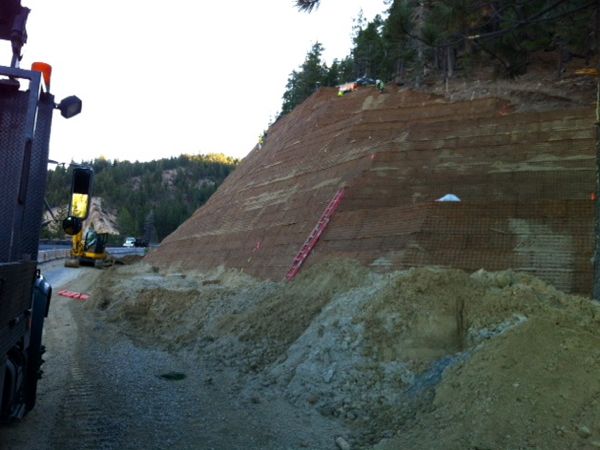
The nearly two-year grind of construction on Highway 50 just below Spooner Summit on the Tahoe side is about to come to an end.

“That project has a grading season exception based on the concern a serious hazard could occur if the project were not allowed to be completed,” Kristi Boosman, Tahoe Regional Planning Agency spokeswoman, told Lake Tahoe News.

That hazard is the hillside winding up in the middle of the highway.

Usually dirt is not supposed to be moved in the Lake Tahoe Basin after Oct. 15 per TRPA rules. Those rules are in place so added sediment won’t flow into the lake during the wet season.

Slope stabilization along Highway 50 in Douglas County should be completed next week. Photos/Susan Wood

However, with this in part being an erosion control project and it not possible to stop work without leaving the hillside to the south in jeopardy, work has continued well past the first substantial snow. And while heavy rain at lake level and snow at the higher elevations are in the forecast starting Wednesday, work is not expected to be wrapped up until the end of next week.

During the storm earlier this month that had snow at the summit being counted by feet instead of inches, the commute between Tahoe and Carson City was even more gnarly than usual. This is because one lane of the highway headed east is closed with all the construction work. It was bumper to bumper with low visibility and oncoming traffic inches away.

“It’s definitely not an ideal situation. We can’t just remove the barrier and leave the slope exposed. It’s just one of those things. We have to get it done,” Scott MacGruder with the Nevada Department of Transportation told Lake Tahoe News.

The work took longer than expected because as the slope was being stabilized the crews realized the hillside was much weaker than anticipated, MacGruder said. This meant more reinforcement was needed, which took more time. He said geologists have been on-site to give input.

Heavy equipment and piles of dirt have been the norm for months along Spooner Summit.

“Sometimes you get sloughing that is unforeseen,” MacGruder said. “You can’t make up time.”

On Nov. 28 an inspector from TRPA is scheduled to assess the work.

Granite Construction is doing the work. The $3.6 million project started in 2011. In all, it included about five miles on Highway 50 from Cave Rock to nearly the junction of Highway 28.


Mammoth settles suit with developer; bankruptcy a done deal

By Steven Church, Bloomberg

Mammoth Lakes won dismissal of its bankruptcy case after settling the $43 million development lawsuit that forced the city to seek court protection from its creditors.

U.S. Bankruptcy Judge Thomas Holman in Sacramento this month signed an order ending the case about four months after the town became the second of three in California to file bankruptcy this year.

Community leaders put the town into bankruptcy in July after being ordered by a state court to pay $43 million to its biggest creditor, Mammoth Lakes Land Acquisition. The town announced a settlement with the company the following month, and in September it asked Holman to dismiss the case.

The settlement allows Mammoth Lakes “to resolve numerous significant creditor issues and will provide for the town’s prompt exit from bankruptcy,” the city said in court papers filed in September.

Details of the accord weren’t filed in the bankruptcy case. Ending it voluntarily allows the city to avoid paying lawyers and financial advisers to develop and win court approval of a plan to adjust its debts.

Mammoth Lakes, a ski resort community of 8,200, has an annual budget of $19 million. It entered bankruptcy saying it couldn’t afford to pay the developer.

The company sued the town in 2006 and accused it of breaching a development agreement allowing the company to build homes, retail space, hangars and other structural improvements near the Mammoth Yosemite Airport. Terrence Ballas, who holds the development rights at issue in the lawsuit, is part of the settlement, the city said.


DiMatteo pleads not guilty; counsel change possible

Gino DiMatteo pleaded not guilty to all charges Nov. 26 during his arraignment in federal court in Sacramento.

The South Lake Tahoe resident was indicted on three drug charges on Nov. 21.

The bail review scheduled for Monday was postponed because DiMatteo may be having a change in lawyers. In the meantime, DiMatteo remains behind bars.

Attorney Rob Woelfel has declared a possible conflict of interest. Woelfel was not available for comment so it is unknown what the conflict may be.

— Lake Tahoe News staff report


1 person killed in Tahoe City traffic accident

By KCRA-TV

A driver died in a wreck on Highway 89 near Tahoe City on Monday morning, the California Highway Patrol said.

The crash was reported about 7:45am Nov. 26. A vehicle went off the road and into several trees, according to the Truckee CHP.

Part of Highway 89 was closed so a tow truck could access the scene.

The roadway is now open.

No other vehicles were involved.


Redevelopment agency dissolution gets stickier, more complicated in South Lake Tahoe

Updated Nov. 28 2:30pm: The oversight committee has been changed to Dec. 7 at 2pm at Lake Tahoe Airport.

——

By Kathryn Reed

The agency left dealing with South Lake Tahoe’s redevelopment issues is fighting the state Department of Finance regarding nearly a half million dollars.

The DOF on Nov. 9 wrote a letter to city officials saying the $426,210 must be given to the taxing entities and not kept in the Low and Moderate Income Housing Fund, as the oversight board voted to do.

The oversight committee at its Thursday meeting has on the agenda a discussion and possible action item regarding the yet-to-be scheduled meeting with the DOF regarding this issue. The agency is appealing the DOF’s decision.

“I’m not surprised the Department of Finance wrote a letter supporting the conclusions in my report. I understand that the city is appealing that decision. Regardless, very soon we need to focus on how the bond payments are going to be made,” El Dorado County Auditor Joe Harn told Lake Tahoe News.

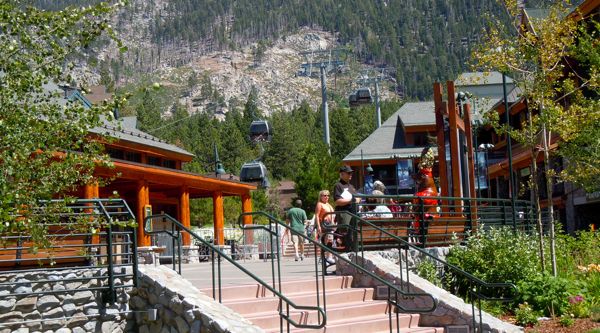
Heavenly Village is one redevelopment area in South Lake Tahoe that comes with outstanding debt. Photo/LTN file

Bondholders from redevelopment projects throughout South Lake Tahoe are owed more than $100 million. The problem is there is likely not going to be enough revenue to pay those bonds.

Harn believes that is where the successor agency should be focusing its attention and not trying to keep the $426,210 for housing.

“I agree with (Joe Harn) when he argued to the state. The revenue should go to pay all bond debt and not distributed to taxing entities. What we disagree on is the revenue,” South Lake Tahoe City Manager Nancy Kerry told Lake Tahoe News. “The Redevelopment Agency borrowed it from its own housing fund account, so it’s an internal loan. It’s not between the city and Redevelopment Agency.”

Part of the successor agency’s arguments to the state is that in addition to disputing the $426,210, the agency believes any money should go to bondholders and not the taxing entities, as the DOF would like to happen.

When California officials decided to disband redevelopment agencies throughout the state they didn’t fully think through what happens if there is remaining debt and what happens to items like stormwater basins that are owned by the redevelopment agencies. No one is going to buy those basins. And as the process went along the Legislature passed a few contradicting laws. So, depending on when an action was taken, it may have been the correct protocol at the time, but not so a few months later. Timing plays into the dispute between the local successor agency and the state.

Kerry said if cash is not in hand to pay bondholders the successor agency can seek a loan from the county or Department of Finance.

But Harn said there is no guarantee either entity would grant such a loan.

Then what?

The state in the Assembly Bill 26 decision promised the California Supreme Court that debtors, bondholders and everybody would be made whole – meaning they would all get their money. Where the state would come up with the money, though, is the big unknown.

—–

Note:

The successor agency meets Nov. 29 at 3pm at Lake Tahoe Airport in the downstairs conference room. Here is the agenda.


Victims identified in Hwy. 50 fatal crash

By Loretta Kalb and Kim Minugh, Sacramento Bee

Officials released the names Sunday of four people, including two children, who were killed in a two-car collision on Highway 50 just east of Placerville.

The crash happened about 6pm Saturday, when a 2004 Toyota Prius headed west in the Apple Hill area veered across four lanes of traffic and into the path of a minivan.

Three people in the Prius who died at the scene were identified by the El Dorado County Sheriff’s Office as 38-year-old Sheng Kun Su, who was driving; 39-year-old Shu Zhen Zhao; and 8-year-old Shawn Su, all from Oakland.

The other occupant of that vehicle, identified as 10-year-old Elly Aili Su, was hospitalized with severe injuries, CHP Officer Sean Ricci said.

A 4-year-old Pollock Pines girl riding in the minivan, Nora Elizabeth Temple, was pronounced dead at a hospital, Ricci said.

The collision left two other people – the 35-year-old driver, identified as Danielle Marie Temple; and passenger Will John Temple, 52 – with minor to moderate injuries. Twin 1-year-old boys, John Maxwell Temple and John James Temple, were also in the minivan but were not injured, Ricci said.

The minivan was headed east in the slow lane of Highway 50 when the Prius crossed its path. Ricci said he did not know the speeds of the two vehicles or what caused the Prius in the westbound slow lane of Highway 50 to veer across the fast lanes in each direction and into the minivan’s path.

The crash occurred along a stretch of Highway 50 that does not have a center divider. Ricci said El Dorado County has been erecting road dividers in recent years tied to location and traffic level.


Community colleges attracting people with college degrees

By David Koeppel, Fortune

In the aftermath of the Great Recession, thousands of students have learned the bitter lesson that the college degrees they paid for do not guarantee a steady job. In response, many have opted for grad school to give their status, pay, and job security a bump.

Then there are those who seem to be taking a step backward. It may seem counter-intuitive but some graduates are choosing to pursue community college associate degrees, after their bachelor’s.

“There is a lot of anecdotal evidence that this is on the rise as a phenomenon,” says Doug Shapiro, executive research director of the National Student Clearinghouse Research Center.

The National Post Secondary Student Aid Study (NPSAS) estimates that during the 2007-2008 academic year, 8 percent of entering community college students had already completed their bachelor’s degrees. This data was collected before the surge in enrollment at community colleges in recent years, says Norma Kent, senior vice president at the American Association of Community Colleges.

Some of the returning students are recent graduates who have found that their sociology or philosophy major has not been enough to find gainful employment. They are now training for careers as nurses, IT specialists, or medical technicians. Radiation therapists and registered nurses with associate’s degrees earn median salaries of $74,200 and $63,800 respectively, according to a 2009 report from the Bureau of Labor Statistics.

“Many of these students have graduated fairly recently and the job market didn’t pan out the way they expected, says Felix Matos Rodriguez, the president of Hostos Community College in the Bronx. “Some say their initial choice of major was not the right one. For some folks that were laid off, it was a wake-up call.”

Baby Boomers are also among those returning for associate degrees to improve their marketability in their current careers, or to retrain for a new one after getting laid off.

Associate degrees often take two years or less to complete, cost considerably less than public or private graduate programs, and offer greater flexibility for those who work full-time. In 2010-11, the average public two-year college tuition was $2,713, compared to $7,605 at public four-year institutions, according to a 2011 report by the College Board.

Over the past three years, Matos Rodriguez says that each semester, between 35 and 60 college graduates have enrolled at Hostos to earn associate’s degrees, when previously there had been virtually none.

Matos Rodriguez believes that the economy has fueled this trend, but also credits the Obama Administration’s role in promoting and investing in community college programs. In September, the Department of Labor announced the second $500 million grant to community colleges as part of a four-year, $2 billion job training initiative. Since the recession, community colleges have seen a spike in overall enrollment.

According to the National Center for Education Statistics, 849,000 associate’s degrees were awarded during the 2009-2010 academic year, a 50.4 percent increase from 10 years earlier. Associate’s degrees in health and related fields saw a 105 percent jump during that same period.

“Community college programs train people for more career-oriented fields, and that has resonated,” Matos Rodriguez says.

In January, Camille Mcintosh, 28 of Liverpool, N.Y. enrolled at Bryant & Stratton College in Syracuse to get an AAS degree in human resources. Mcintosh graduated in 2006 from Devry College in Miramar, Fla. with a BS in technical management and a concentration in hospitality management.

Mcintosh says she felt frustrated working a series of entry-level jobs at companies like Hard Rock and Marriott (MAR). She realized that she wanted to pursue a career in human resources. In 2011, she spent months searching unsuccessfully for an entry-level HR job. “The bachelor’s degree without the HR experience didn’t help me at all,” she says. “This was the way to get my foot in the door.”

She says she discovered that, with her college credits, she could complete Bryant & Stratton’s HR specialist program in just under a year. Most importantly, the program offered her an HR internship with the Adecco Group, a staffing corporation that employs more than 500,000 people worldwide.

At first, she admits, she was embarrassed by the stigma of going back to get an associate’s degree after her bachelor’s. “Sometimes you have to take a step back to go forward,” she says.

Mcintosh says she still has $40,000 in debt from her four-year college and will incur about another $15,000 in her current program. The average debt for all student loan borrowers in 2011 was $23,300, according to the Federal Reserve Bank of New York. Ten percent owe more than $54,000, while 3 percent owe more than $100,000.

“A fair number of students with bachelor’s are worried about the debt they’ve accumulated,” says Robert Templin, the president of Northern Virginia Community College (NOVA). He calls the combination of a bachelor’s and associate degree “a powerful cocktail” and says he has witnessed this trend at his own school for the last four or five years.

Depending on major and school, associate’s degrees and post-secondary certificates can be more economically beneficial than a bachelor’s degree. Mark Schneider, a vice president at the American Institutes for Research and the president of CollegeMeasures.org, recently compared the earning power of graduates with associate’s and bachelor’s degrees in Virginia, Arkansas, and Tennessee, and found that “an associate’s degree can have a payoff that exceeds that of a bachelor’s degree.”

In Virginia, graduates of occupational or technical associate’s degree programs with an average salary of just under $40,000 “out-earned not only non-occupational associate’s degree graduates, by about $6,000, but also bachelor’s degree graduates, by almost $2,500 statewide.”

Schneider says it’s understandable for bachelor’s degree graduates to return to school for associate’s degrees. “It doesn’t reflect badly on students who did something they loved at 18 years old, but five years later they can’t find a job, and now they have to feed themselves,” he says.

Younger students aren’t the only former graduates assessing their careers and going back for associate degrees. College graduates over 50 are returning to community college in record numbers; 388,000 were enrolled nationwide in fall 2009, according to the AACC, a 12 percent increase from 2005.

Cathy Webb, 61, of Roanoke, Va., a nursing student at NOVA, returned to school in 2010 and is six months away from graduation day. Webb received her BA in 1973 from Longwood University in Farmville, Va. She started her career as a music teacher. By the 1980s, she had moved into medical sales. She ultimately became a mortgage broker. When the mortgage crisis hit in 2008, she lost her job and her career “came to a screeching halt,” she says. Soon after, Webb contracted meningitis.

As she recovered from her illness, Webb says she began to consider returning to school to become a nurse. When she was younger, Webb had wanted to go to medical school and now she saw an opportunity to at least fulfill part of that dream by pursing a health care career. She plans to begin working as a nurse when she graduates and then continue her studies to become a nurse paramedic.

Matos Rodriguez of Hostos says there’s not enough data yet to know how well these graduates will do with their hybrid bachelor’s and associate’s degree. He says he worries that those who make the decision to return strictly based on the job market could find that their emotional skills may not match jobs like nursing. “I’ll be happy if these students finish on time, don’t take on too much debt, and go into the labor market earning between $50,000 and 70,000.”


Bay Area man dies in cycling accident in Truckee

By Barbara Barte Osborn, Sacramento Bee

TRUCKEE — A Los Gatos man died Saturday after his bicycle and a vehicle collided at the west end of downtown Truckee.

Robert Koechlin Jr., 45, was pronounced dead at Tahoe Forest Hospital in Truckee, where he was transported by firefighters who had taken over life-saving efforts from citizens at the scene.

The early-afternoon accident occurred at the McIvers Roundabout on Donner Pass Road.

Truckee police officers closed the roundabout and the eastbound lane through town for several hours, diverting traffic around High Street, while investigating the accident.

Anyone who saw the accident is asked to call Sgt. Bob Womack at (530) 550.2335.