Officials scour South Shore; no signs of Petaluma woman

By Paul Payne and Mary Callahan, Press Democrat

STATELINE — Law enforcement officials in Nevada and South Lake Tahoe expanded their search Thursday for a missing Petaluma woman, combing the snowy region by air and land, conducting a room-to-room sweep of her hotel and poring over her cellphone activity.

But so far, there has been no sign of Alyssa Byrne, 19, who vanished New Year’s Eve while attending a three-day music festival at Lake Tahoe Community College.

The aerial search will resume this morning with help from an additional helicopter from Reno, Douglas County Undersheriff Paul Howell said in a news conference.

Alyssa Byrne

He stressed the importance of finding Byrne soon because of the below-freezing overnight temperatures in the ski resort area.

“We’re concerned,” he said. “And we’re putting every resource we have into it.”

Howell said the last activity from Byrne’s cell phone was recorded at 12:03am Jan. 1, or about 10 minutes later than previously thought.

One message on her Twitter account read, “After tonight you’ll never be apart of my life you won’t be a memory of 2013 a new year you’ll never be apart your nothing to me.”

The last message was, “Just lost trust in the person I trusted most.”

But Undersheriff Paul Howell cautioned, “We’ve seen those, and there’s still a debate as to the actual author of those tweets.”

Howell added, “Since that time, the phone has gone inactive.”

He cautioned that activity on her phone wouldn’t necessarily pinpoint her location — just her phone’s.

The Rescue Coordination Center at Tyndall Air Force Base in Florida is examining the cell activity, Howell said.

The FBI and search and rescue officials from Nevada and California also joined the search, as have those from the National Center for Missing and Exploited Children.

Sheriff’s deputies were in Petaluma interviewing acquaintances.

Howell said authorities were doing a “room-to-room search” of the Horizon casino in Stateline, where Byrne and her friends were staying.

Security officers at the Horizon and other casinos are going through their security footage, Howell said.

Friends and family blanketed the South Lake Tahoe area with fliers describing the missing woman and urging anyone with information to call authorities.

Her father, Kevin Byrne, drove to Stateline on Wednesday to help find his daughter. He said Thursday he was optimistic since police “didn’t find her body in the snow.”

“When this is all said and done and we get her back home, then we’ll have a nice party,” he said Thursday night while seated near the Horizon resort lobby.

“Maybe she partied harder than normal,” he said. “I don’t know.”

Concerns for Byrne’s safety were mounting Thursday amid a sense that something wasn’t right with her in the hours before she disappeared.

Friends who saw her shortly before she went missing said she wasn’t acting quite herself when she unexpectedly left a New Year’s Eve concert an hour before midnight and, later, passed on a chance to visit with old high school friends at her hotel in the wee hours of New Year’s Day.

Douglas County sheriff’s Sgt. Pat Brooks said people often go missing at Tahoe without so much ado, but single-digit temperatures made it imperative Byrne be found, he said.

Investigators said they had no leads as of Thursday evening.

A reward was being offered in hopes someone would come forward with information, even confidentially.

Byrne lives with her mother and father in Petaluma. She works as a hostess at the Cattlemens restaurant in Petaluma and attends Santa Rosa Junior College. Her plan is to become a paramedic-firefighter, according to her mother, Kim Miller-Byrne.

Last Saturday, Alyssa Byrne and friend Jay Donnellan, a high school classmate, and two other friends from Napa drove to South Lake Tahoe for the outdoor SnowGlobe Music Festival, a three-day event on the community college campus that began Saturday afternoon.

The four shared a room at the Horizon, and spent most of the ensuing days together, shuttling between their hotel and the festival, Donnellan said.

Monday night, New Year’s Eve, they were outdoors at the festival about 11pm when Byrne got slightly ahead of her friends as they made their way through the crowd and then, suddenly, disappeared, Donnellan said.

Byrne had left a bit earlier than her friends a night earlier, after falling in a puddle and getting wet enough that the outdoor temperature was unbearable, he said.

But it was odd for her to leave without saying anything or even alerting them she planned to go, Donnellan said.

But Byrne called his cell phone twice. He missed the first call, but about 11:30pm she got through to him, saying she was on a shuttle bus back to the Horizon, he said.

About 20 minutes later, her friends tried to leave the event, but were held up by midnight fireworks and crowds in the street that delayed their return to the hotel until about 12:30am.

When Byrne wasn’t in the hotel room they shared, Donnellan called her cell phone, but it went unanswered — as it would each of the 10 or 15 times he called that night, until it began going straight to voicemail the next day.

That night, sometime between 12:30 and 1am Jan. 1, Alex — who was among several groups of young people from Petaluma attending the festival — crossed paths with Byrne in a passageway between the Horizon lobby and a bar. She had put her hair in a pony tail and was wearing a black sweatshirt, not the heavy, white winter jacket she had had on earlier at the festival.

They hugged and exchanged greetings, but she didn’t seem herself, Alex said, and showed no interest in visiting with his girlfriend, a close high school friend, or several other classmates with them.

Usually very social, she “was just kind of in her own little world,” Alex said. “That was the last time we saw her.”

Donnellan said he was not aware of her having consumed anything besides beer, but Alex said she appeared to be under the influence of drugs or alcohol, and clearly would have been too impaired to drive.

Alex was among those with whom Donnellan talked that night as the hours went by and he and his friends were unable to locate Byrne.

Donnellan and the others in their traveling party went out until about 5:30am, in part enjoying the evening and in part looking for Byrne. Two other friends stayed back at the hotel room in case she returned, he said.

Donnellan said he figured, at the time, Byrne might have gone off with a girlfriend, though she’d made no mention of meeting anyone new or running into someone the others weren’t aware of.

He said his friend is strong and smart enough to take care of herself, and would never “wander off with some random guy.”

“It was almost like she was ignoring our phone calls for some reason. I mean, I don’t know — like she was meeting up with somebody (and) she didn’t want us to know where she was going. I don’t know.”

By morning, conversations between friends and Byrne’s father had intensified as they struggled for answers.

Donnellan and the others delayed their departure from the Horizon — until security was about to kick them out, he said — as they checked with other hotels, hospitals, the jail, the sheriff’s office and any other place they could think of, Donnellan said.

They filed a missing person report with the South Lake Tahoe Police Department. The case was then referred to the sheriff’s office in Douglas County in which the Horizon is located.

Kevin Byrne said he’s been impressed with the work of both departments and has a cadre of friends and relatives working with him to distribute fliers about his daughter’s disappearance. Thursday, he was fielding multiple calls from media outlets around the nation interested in the story.

He was at the sheriff’s office until midnight Wednesday as investigators combed through Horizon surveillance tape in an unsuccessful search for images of Byrne, and again on Thursday morning, while a search and rescue effort was organized on his daughter’s behalf.

Alyssa Byrne is described as 5-feet-3-inches tall, weighing about 125 pounds with fair skin, dyed black hair and blue eyes. She was last seen wearing a black sweat shirt, black snow boots and black yoga-type pants, with her hair pulled back.

Anyone with information about her is asked to contact Douglas County at (775) 782.5126, Investigator Dennis Slater at (775) 586.7255 or an anonymous tip line at (775) 782.CRIME.




Recycling gives Christmas trees a second life

By Kathryn Reed

With the holidays officially over, it’s time to restore the house to pre-holiday décor. This means out goes the tree.

South Tahoe Refuse has been recycling Christmas trees since 1992. In 2007, it hit the 100,000 mark for the number of trees that had been repurposed.

Even though people have cut back on spending in many areas of their lives, based on the constant number of trees STR recycles each year, the recession has not affected the Christmas tree industry – at least on the South Shore.

Christmas trees at South Tahoe Refuse are ready to be turned into mulch. Photo/LTN

It used to be that garbage crews would collect the trees and take them to a South Lake Tahoe facility for them to be chipped. The city would then use the material at various locations.

Now the refuse company sends them to Full Circle Compost and Bentley Agrowdynamics in the Carson Valley.

With the opening of STR’s Resource Recovery Center in April 2010, the trees can be sent through a chipper on site. A little bit of the matter is kept at STR in case a construction project might need the material for erosion control purposes.

STR has increased its green waste recycling by 73 percent since the recovery center opened. John Marchini, who runs the garbage company, said this far exceeds expectations.

Trees are starting to trickle into the South Lake Tahoe facility from homes throughout the South Shore. STR folks believe the abundance of snow has kept people from discarding their tree immediately after Christmas. STR will send a special truck on regular routes for the first two weeks in January to pick up trees. They need to be 6-feet or shorter, or cut into pieces – and absolutely no decorations on it.

A small pile of trees sits in a corner. Marchini reaches down to pick off a piece of tinsel.

“The No. 1 problem in composts is plastic,” Marchini tells Lake Tahoe News.

That shiny silver decoration is made from plastic.

People can also drop the trees off for free at the recovery center. This includes commercial businesses that might have a tree that is larger than the average tree found in a home.

While these trees are clearly a seasonal occurrence, the recycling of them helps STR meet the state mandate of keeping at least 50 percent of garbage out of landfills. South Tahoe Refuse has a 66 percent diversion rate. But that state regulation in 2020 changes to 75 percent.

“Food waste will come into play to meet that mandate,” Marchini said.

Right now STR is not licensed to recycle food waste. The program it has with a few restaurants on the South Shore requires a truck to pick up the food waste and take it directly to Full Circle Compost.

“Craig (Whitt who runs Full Circle) has indicated to us he can take everything we have,” Marchini said.

But some issues still need to be worked out before food waste would be the norm here. For one, there is limited space in Tahoe to put bins to collect the product. The other is to ensure people understand what food products can be recycled. If it gets contaminated, the entity doing the contaminating is charged.

And right now, recycling food and turning it into compost is two to three times more expensive than dumping it in the landfill. That is one of the deterrents for people with food waste – the cost involved can be prohibitive.

—-

Other tree recycling programs:

• Tahoe Truckee Sierra Disposal has curbside tree recycling Jan. 14-18. Clean, undecorated trees cut in 3-foot segments should be placed by trash.

• Tahoe Truckee Sierra Disposal customers may drop off trees anytime through Jan. 18 at Glenshire Clubhouse, Tahoe Donner Clubhouse, Truckee Rodeo Grounds and the high school soccer fields. Trees must be undecorated. Place them in the bins provided.

• Incline Village-Crystal Bay residents may place clean trees curbside on their standard service day between Jan. 7- 11 for recycling collection conducted by Waste Management. Trees may be whole up to 6 feet.

• Incline Village General Improvement District’s Waste Not Program has partnered with the North Lake Tahoe Fire Protection District to offer free Christmas tree chipping Jan. 7-11.


Tax deal not pain free for most people

By Ron Lieber, New York Times

It is tempting for people who earn less than $400,000 to think that they got off easy this week under the tax deal to end the fiscal impasse, given that only those with incomes above that level will be in a higher income tax bracket in 2013.

But the legislation that both houses of Congress have now approved could increase taxes on people with incomes that are not quite that high as well. That’s because the bill includes language that begins to do what both President Obama and Mitt Romney proposed at various points in the past: Limit certain tax breaks available to people who are affluent.

The new rules target two tax breaks: personal exemptions and many popular deductions like those for state and local taxes, mortgage interest and charitable contributions. For both breaks, single people with at least $250,000 in adjusted gross income and married people filing jointly with at least $300,000 in income are vulnerable. A hypothetical Texas couple could end up paying about $2,500 more in taxes, for instance.

The mechanics of how the new limits will work are now clear, though it takes a fair bit of explaining to lay them out in plain English. What we don’t know yet is how many people will end up paying more in 2013 than they did in 2012.

The uncertainty is tied to the fact that many of the targets of the legislation often end up ensnared by the alternative minimum tax. The A.M.T., and its high tax bill, may continue to catch most of them.

But let’s start with the basics. Most of the discussion here begins with that adjusted gross income figure. That’s the number you get when you subtract items from your salary or take-home pay that are often referred to as above-the-line deductions.

For the income range we’re talking about, these deductions tend to include things like health savings account contributions and alimony. People who work for themselves also get deductions for health insurance premiums, certain retirement contributions and self-employment taxes that an employer would otherwise pay.

Mark Luscombe, principal analyst with CCH, a tax information provider, points out just how confusing the use of adjustable gross income is, given that the new tax limits, the new tax bracket and the new Medicare tax are all based on different definitions of income.

Under normal circumstances, a personal exemption, for a specific dollar amount, is available for each member of your household. You then add all of the exemptions and subtract the total from your adjusted gross income, which has the effect of lowering your taxable income. CCH predicts that the personal exemption amount for 2013 will be $3,900 per person.

The new law requires taxpayers in the targeted income range to reduce the amount of their exemptions by 2 percent for every $2,500 by which their income exceeds the $250,000 or $300,000 limit. So a married, childless couple with $400,000 in adjusted gross income and $7,800 in potential exemptions could lose $6,240 of that $7,800.

The math for the limit on deductions is different. There, the rules call for you to add up the applicable deductions. Let’s say that equals $50,000. Then, you subtract from that 3 percent of the amount by which your adjusted gross income exceeds those $250,000 or $300,000 thresholds.

So if you’re a married couple with $400,000 in income, you’re $100,000 over the threshold. Three percent of that is $3,000. So you’d subtract that from $50,000. The rule, which existed for years but had been phased out more recently, is known as the Pease limitation, for Representative Donald J. Pease, the Ohio newspaper editor-turned-legislator who got it passed. As before, you can’t lose more than 80 percent of your deductions, no matter how high your income gets.

If you’re trying to figure out whether and how this may affect you, well, join the club. So much depends on your income, your state and your various deductions. All of that will affect whether the A.M.T. hits you as well.

For people who are already in the A.M.T. but will not end up with the $400,000 (for individuals) or $450,000 (for married couples filing jointly) in income necessary to be in the new 39.6 percent tax bracket in 2013, the new exemption and deduction rules may not hurt you. “I don’t think there’s enough there that you would no longer be in the A.M.T.,” said Jude Coard, a tax partner at Berdon L.L.P., of people with income in the $300,000 to $400,000 range.

Much will depend on your own situation. CCH ran two hypothetical cases for me, which you can see in the accompanying graphic. The first examined a family of four in New York with $400,000 in adjusted gross income and $79,000 in total itemized deductions. The household pays the A.M.T. in both 2012 and under the new tax rules in 2013. They pay just $790 more in 2013, but that includes $1,350 in new Medicare taxes. (The total does not include the Social Security payroll tax that has been restored to its prerecession level.)

A family in Texas, however, might have the same income but lower property taxes and no income tax and thus lower deductions for its federal tax return. Their deductions are just $43,700, but they end up being hurt more by the new rules. They would have no A.M.T. liability in 2013 and would end up paying $3,852 more, or about $2,500 if you don’t count the $1,350 from the new Medicare tax.

This is a lot to digest, so much so that even the experts at the Tax Policy Center have not yet finished updating their online calculator. Once they do, if you have the stomach to gather (or try to predict) all of the data, you can take your shot at projecting what these new rules may cost you.


Study: A little body fat is a healthy thing

By Allison Aubrey, NPR

Being a little overweight may tip the odds in favor of living a long life, according to a new analysis. Researchers say there may be some benefit to having a little extra body fat.

This isn’t the first time researchers have raised questions about the link between body weight and how long someone will live. While there’s no debate that being severely obese will raise the risk of all kinds of illnesses and even cut some lives short, it’s less clear what happens to people who are less overweight.

When Katherine Flegal of the Centers for Disease Control and Prevention set out to answer this question, she wanted to include as many people as possible in her analysis — from as many places around the world as she could find.

“We searched all the literature, thousands of articles, found almost 100 articles with 3 million people, that really addressed this question head on,” Flegal says.

And she concludes that being overweight is actually associated with a lower risk of death. It’s certainly not dramatic, but about a 6 percent decreased risk.

“It’s statistically significant,” Flegal says. The findings appear in the latest Journal of the American Medical Association.

So who are we talking about here? A lot more people than you might think. About one-third of all Americans fall into this category of overweight. And Flegal found that even among those who are technically, slightly obese, there was no increased risk of death.

At a time when we’re bombarded with weight-loss messages, Flegal says it isn’t popular to suggest that heavier people may live longer. In fact a few years back, when she published a paper that came to a similar conclusion, her findings were attacked.

“Our article got called rubbish and ludicrous,” Flegal says. “So it really opens you to lots of criticism. I discovered much to my sorrow that this is kind of a flashpoint for people.”

One of the experts who takes issue with Flegal’s conclusions is epidemiologist Walter Willett of the Harvard School of Public Health. He’s read her new paper and says he’s not buying it.

“This study is really a pile of rubbish and no one should waste their time reading it,” he says.

Willett says it’s not helpful to look simply at how peoples body mass indexes, or BMIs, influence their risk of death — as this paper did without knowing something about people’s health or fitness. Some people are thin because they’re ill, so of course they’re at higher risk of dying. The study doesn’t tease this apart.

Also, he says the analysis doesn’t address the bigger, more important issues of quality of life. If an overweight person does live longer — is he or she living with chronic diseases?

“We have a huge amount of other literature showing that people who gain weight or are overweight, have increased risk of diabetes, heart disease, stroke, many cancers and many other conditions,” Willett says.

For those of you who want to know whether your body weight is a problem, Willett says rather than comparing your BMI to those around you, think about what you weighed when you were 20 years old.

“For most people, our ideal weight, if we weren’t seriously overweight at age 20, is about what we weighed then,” Willett says. That’s why weight change is a good number to keep an eye on. It can be an early warning sign that you’re on the path to more weight gain.

Not everyone’s convinced the new paper is rubbish. Dr. Steven Hymsfield, of the Pennington Biomedical Research Center in Baton Rouge, La., says there are a couple of scenarios in which extra body weight might help people live longer.

“If you fall and you fall on vulnerable bone, like the hip, having a little extra fat there might protect you from hip fracture,” Hymsfield says.

Or he says, if an illness leaves you unable to eat, extra body fat could be useful.

Hymsfield acknowledges this is just speculation. He says while this paper won’t end the debate over whether a little extra body fat could be a good thing, it does show that the relationship between weight and health may be more complicated than just a simple calculation.

In an editorial accompanying Flegal’s paper, Hymsfeld and a colleague wrote that determining a person’s BMI is only one step in figuring out future health risks.


Helicopter, ground searches no help in locating missing woman

By Kathryn Reed

A Washoe County sheriff’s helicopter on Thursday has been flying over the shallow areas of Lake Tahoe, the meadows near Stateline and the area around the SnowGlobe venue in hopes of finding Alyssa Byrne.

As of 4pm Jan. 3 her whereabouts remain unknown.

The 19-year-old Petaluma woman has not been seen since the early hours of New Year’s Day. While she had been at SnowGlobe in South Lake Tahoe on New Year’s Eve, friends last saw her at the Horizon hotel after the clock struck midnight. That is the hotel where the friends were staying.

Alyssa Byrne

Douglas County officials have been looking at tapes from the casino.

“The tapes have not revealed her presence, but they don’t cover the entire casino floor,” Undersheriff Paul Howell told Lake Tahoe News.

Howell said reports of officials from his department calling people in Christmas Valley are erroneous. There have been no sightings of Byrne since she went missing.

The sheriff’s department did do a reverse 911 call to residents in Stateline asking them to be on the lookout for Byrne.

“The last friend to see her, Micah Alex of Petaluma, said it was his impression that Byrne was altered by alcohol or drugs when they embraced and greeted each other near the lobby of the Horizon casino before she went missing,” the Santa Rosa Press Democrat said. “‘She just seemed like something was wrong with her, like she wasn’t all there, you know?’”

It is still not known if foul play is involved or if Byrne went somewhere willingly.

Byrne was first reported missing Jan. 1 at about 9:30pm. South Tahoe police officers started the investigation, with Douglas County taking over the next day when it was determined she was last seen in their jurisdiction.

Search and rescue crews from Douglas County and El Dorado County sheriff’s departments are working the case. South Lake Tahoe police and El Dorado sheriff’s detectives, along with the FBI are also assisting.

A reward of up to $1,000 is available for information leading to the location of Byrne.

Anyone with information regarding this incident is urged to call Secret Witness at: (775) 782.7463 or DCSO at (775) 782.9905.


Nearly 12,000 caught using phone on Nevada highways

Troopers from the Nevada Highway Patrol in 2012 issued nearly 12,000 traffic citations to motorists observed talking, texting or reading non-voice communication while driving.

And for some, this was not their first offense.

Last year was the first year Nevada banned the use of cell phones while driving.

The total fine for a first-time offense is $112.00 with zero points assessed against a driver’s license while the second, third and subsequent offenses each have four demerit points added to the monetary fine. When convicted, a second offense will cost a violator $192 while third and subsequent offenses each will total $352.

The following details the total number of citations issued for each month in 2012:

MON-YEAR

1ST OFFENSE

2ND OFFENSE

3RD OFFENSE

01-2012

1,122

1

4

02-2012

1,188

0

2

03-2012

1,149

0

3

04-2012

1,168

4

3

05-2012

1,265

2

2

06-2012

876

1

1

07-2012

864

4

1

08-2012

1,063

3

2

09-2012

1,052

4

6

10-2012

1,008

5

0

11-2012

747

3

1

12-2012

435

3

0

TOTAL

11,937

30

25

— Lake Tahoe News staff report


Missing Petaluma woman’s friend: She wasn’t acting like herself

Santa Rosa Press Democrat and Lake Tahoe News

A Petaluma teen who vanished more than two days ago while in South Lake Tahoe for a three-day music festival remained missing Thursday afternoon amid mounting concerns for her safety and a sense that something wasn’t quite right.

Friends who saw Alyssa Byrne, 19, shortly before she disappeared said she wasn’t acting like herself when she unexpectedly left a New Year’s Eve concert an hour before midnight and later passed on a chance to visit with old high school friends at her hotel.

Alyssa Byrne

The last friend to see her, Micah Alex of Petaluma, said it was his impression that Byrne was altered by alcohol or drugs when they embraced and greeted each other near the lobby of the Horizon casino before she went missing.

“She just seemed like something was wrong with her,” Alex said Thursday, “like she wasn’t all there, you know?”

But no one foresaw days of waiting and worrying as law enforcement got involved in the effort to find the missing Casa Grande High School grad, and details about her last interactions with friends mixed with confusion and misunderstanding.

A resident in the Christmas Valley area of the South Shore received a call from Douglas County Sheriff’s Office about noon today saying there were reports Byrne had been seen in that vicinity and to be on the lookout. However, Douglas County and El Dorado County law enforcement told Lake Tahoe News they have not made any such calls and there have been zero sightings of Byrne.

“There’s a lot of snow up at Lake Tahoe. The weather is cold,” Douglas County sheriff’s Sgt. Pat Brooks said.

Douglas County Search and Rescue has been activated to assist in the search.

The circumstances to her disappearance are unknown — meaning law enforcement doesn’t know if foul play is involved or if Byrne went somewhere willingly.

The 19-year-old had attended SnowGlobe in South Lake Tahoe on New Year’s Eve. She left the event at Lake Tahoe Community College via the bus shuttle prior to her friends.

However, her friends have told authorities they last saw her just after midnight New Year’s Day at the Horizon casino in Stateline. They all had a room at the hotel there.

The Douglas County Sheriff’s Office is seeking the public’s help in developing any suspects or leads. A reward of up to $1,000 is available for information leading to the location of Byrne.

Anyone with information regarding this incident is urged to call Secret Witness at: (775) 782.7463 or DCSO at (775) 782.9905.

Also working the case are official from the South Lake Tahoe Police Department, El Dorado County Sheriff’s Department, FBI, Douglas County Search and Rescue and air support from the Washoe County Sheriff’s Office.


SnowGlobe attendee from Petaluma missing

Updated Jan. 3 4pm with investigation time line information.

Updated: Jan. 2 at 5:25pm

By Kathryn Reed

A 19-year-old Petaluma woman has not been seen since the last night of SnowGlobe.

“Our best hope is she is with somebody and she is safe. It is not like her not to respond or to try to get a hold of us to let us know she is OK,” Kim Miller-Byrne told Lake Tahoe News of her daughter, Alyssa Byrne.

Alyssa Byrne came to the South Shore on Dec. 29 to attend the three-day music festival in South Lake Tahoe. She and friends were staying at the Horizon hotel-casino in Stateline.

Alyssa Byrne

Family members say the last text the 19-year-old sent to a friend was several hours before midnight on New Year’s Eve.

South Lake Tahoe Police Chief Brian Uhler told Lake Tahoe News the initial report came to his department at 9:26pm Jan. 1. He said South Tahoe officers made contact with the missing woman’s friends who had been with her at the Horizon who said they saw Byrne at the casino between 12:30 and 1am New Year’s Day.

The case has been turned over to Douglas County Sheriff’s Department because the casino is in that department’s jurisdiction.

Sgt. Pat Brooks with Douglas County told Lake Tahoe News casino tapes are being pulled so investigators can see if Byrne is on any of them and if so, who else is with her.

Uhler told LTN, “We sent a teletype to DCSO, (which is) standard procedure at 0010 hours [12:30am Jan. 2] just 3½ hours after we learned she was missing. Between the time she was reported to us and we learned that she was at the Horizon, we actively looked for her and tracked information which led to our discovery about her being seen in Horizon. We learned this minutes before sending the teletype. Further, complete report information was sent to DCSO shortly after the start of the business day the following morning.”

Douglas County officially took the lead on the investigation at 3pm Jan. 2.

Earlier Uhler said a sweep of the surrounding area was made each night to look for anyone who may have fallen into a snowbank or had some other mishap.

Miller-Byrne said the last text her daughter made to a friend said she was catching the shuttle back to the hotel.

Byrne had been texting her parents every day as a way to check in.

“(Tuesday) she did not text. We texted her and got no response. We called her cell phone. It goes straight to voicemail,” Miller-Byrne said.

“The friends she went up with looked for her and could not find her. They left and brought all of her belongings, including her cell phone charger.”

The missing woman’s parents contacted police in South Tahoe on Jan. 1. Her dad, Kevin, is in town now.

“My husband has been going from casino to casino to try to get her picture out and get as much information out as possible,” Miller-Byrne said. “I just want her back.”

Byrne is 19, 5-feet-3-inches tall, about 125 pounds, blue eyes, dyed black hair, fair complexion, and was last wearing all black.

Anyone with information, should call Douglas County Sheriff’s Office at (775) 782.5126.


CA snowpack water content 33% above average

By Kathryn Reed

PHILLIPS STATION – While the state is faring well when it comes to water content from the snowpack, the measurement closest to South Lake Tahoe is just average this time of year.

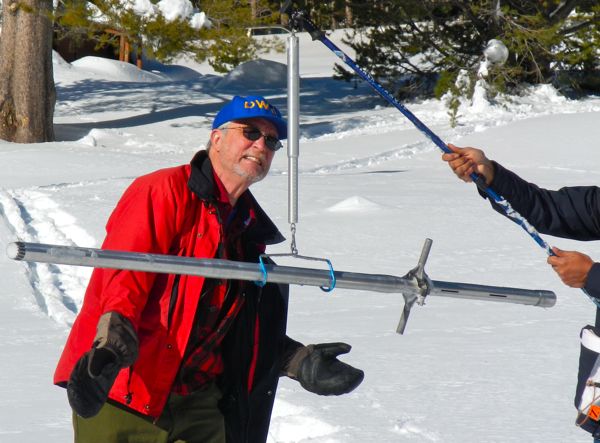
In the field paralleling the road to Sierra-at-Tahoe, Frank Gehrke with the state Department of Water Resources on Jan. 2 took a series of samples to determine there is 12.1 inches of water content in the 48.6 inches of snowpack. This is 101 percent of average.

Statewide, though, the water content is 133 percent of average.

Frank Gehrke on Jan. 2 measures the water content of the snowpack at Phillips Station. Photo/Kathryn Reed

A year ago on the first survey of the season, Gehrke almost didn’t bring his equipment out of the truck. There was one patch of snow to measure. This year snowshoes were required to break trail along the route.

“It’s a good, encouraging start, but it’s just average,” Gehrke said.

While ski resorts rejoice in the immediacy of snowfall and at this point could fare OK if there were an extended break between storms because of what is on the ground, water managers downstream don’t celebrate this time of year. It’s too early.

It’s the April reading that counts most to them because after that the snowfall is negligible. The snowpack fills reservoirs throughout Northern California, which allows water to be sent to points south for drinking and to irrigate farmlands.

According to the Department of Water Resources, the white stuff accounts for about one-third of the water for California households, farms and industry users.

The theory is the snowpack will keep growing between now and the last reading in April. Had this been the April reading, the state average would be at 49 percent.

While the storms in early December brought rain to the Lake Tahoe Basin, they were also filling up reservoirs. This in some ways is a bonus for the water system.

Lake Oroville in Butte County, the State Water Project’s principal reservoir, is at 71percent of capacity, 113 percent of average for the date; while Shasta Lake near Redding, the federal Central Valley Project’s principal storage reservoir, is at 73 percent of capacity, 115 percent of normal for the date.

Right now there is a lull between storms, which isn’t uncommon in January in Tahoe.

Gehrke said it’s hard to find any definitive trends with snowpack and water content totals in this area because there can be dramatic swings from year-to-year. And he wasn’t about to make predictions for what the water content will be like as the winter progresses.


Reno woman located unharmed

Updated: Jan. 2 8:05pm

South Lake Tahoe police at about 8pm Jan. 2 said Chantel Good of Reno had been located.

She was not injured and she had not been abducted.

—-

South Lake Tahoe police officers are looking for a missing Reno woman.

Chantel Good, 21, was reported missing on Jan. 1.

Chantel Good

According to police officials, friends said they dropped Good off in front of the Heavenly Village and have not heard from her since.

A flyer says she is 5-foot-4, was last wearing brown boots, a blue dress with a flower print and a cream-colored pullover sweater.

It is not known if there is any connection between Good and Alyssa Byrne, who went missing from the South Shore early New Year’s Day.

— Lake Tahoe News staff report