Fabrication business to add jobs at Zephyr Photonics

By Northern Nevada Business Weekly

Zephyr Photonics Inc., a manufacturer of highly sophisticated optical devices, said last week it’s offering manufacturing services at its plant at Lake Tahoe to outside customers.

The upshot may be increased employment over the next couple of years for the company, which has employed about 30 people in recent years.

The company previously handled only its own work at the 17,000-square-foot Zephyr Cove facility which includes a 10,000-square-foot clean room.

Tom Steding, chief executive officer of Zephyr Photonics, said the company’s new semiconductor fabrication and foundry services unit was created to meet the needs of companies that design and sell semiconductors but outsource the actual manufacturing to businesses known as semiconductor foundries.

The production services are an outgrowth of development and testing that Zephyr Photonics has provided under contract with customers in the technology sector, Steding said.

Zephyr has developed and manufactured optical-interconnection equipment that’s used in harsh environments. Its customers include the U.S. Defense Department and industrial companies in the aerospace and energy sectors.

Tim McAllister, Zephyr Photonics’ vice president of business development, said the company believes that the standards established for defense and intelligence contracts will help it win private work as well.

McCallister said the company expects to ramp up the contract manufacturing through 2013 and 2014, hiring at first to cover additional shifts within its current facilities.

Zephyr Photonics plans to further increase its production capacity with new facilities and new equipment next year, he said.

The new business unit marks another step in the repositioning of the company under new ownership.

The company was launched more than 25 years ago as Opticomp, and it operated as a small, stealth research firm that handled more than 60 research grants for federal agencies and defense contractors.

Torch Hill Investment Partners of Washington, D.C., bought the Lake Tahoe company in 2011 with a plan to move its work into the light of product-oriented commercial operations.

Since then, it’s been developing contracts with companies such as Teledyne Microelectronic Technologies of Los Angeles to move its technology into commercial applications.


Domestic violence call ends with 6 lbs. of pot recovered

A domestic violence call in Meyers on Monday ended with 6 pounds of marijuana being confiscated in Stateline.

A 20-year-old woman called El Dorado County sheriff’s deputies at 10:08am Feb. 11 saying her 28-year-old husband had hurt her. He was not at the Delaware Street residence when deputies arrived.

“While deputies were interviewing [the woman] at her mother’s residence, a neighbor in the area of the Delaware residence reported seeing two males break a window and enter the residence,” sheriff’s Lt. Pete Van Arnum told Lake Tahoe News.

The suspects left in a dark colored Toyota Corolla. Douglas County sheriff’s deputies in Stateline located it, but no one was with the vehicle. Van Arnum said Douglas officials found about 6 pounds of marijuana in the car.

The domestic violence incident and drug recovery remain under investigation.

 — Lake Tahoe News staff report


911 system in Washoe County experiencing problems

The 911 system in Washoe County is having problems.

The local land line phone system is currently experiencing issues at this time. Parts of Washoe County, Reno, Sparks and Carson City have been affected. As a result, some residents’ land line phone service is temporarily unavailable.

Citizens who are experiencing an emergency where they need to call 911 should dial 911 on their cell phones.

The cell phone network is unaffected at this time.

— Lake Tahoe News staff report


2 groups sue to stop implementation of TRPA Regional Plan

By Kathryn Reed

The Sierra Club and Friends of the West Shore filed a lawsuit Monday in U.S. District Court in Sacramento to stop the Tahoe Regional Planning Agency’s Regional Plan from taking effect in its entirety.

“We hope to achieve a reconciliation with the TRPA over their plan and get it strengthened,” Laurel Ames with the Tahoe Area Sierra Club told Lake Tahoe News. Feb. 11 was the deadline to file such a lawsuit.

Those two conservation groups had been vocal at most of the meetings leading up to the adoption of the Regional Plan in December. The new plan replaced the 1987 document.

Politics at Lake Tahoe can be as turbulent at the lake itself. Photo/LTN file

Water quality, air quality, local delegation, appeals process and coverage are some of the main issues the two groups have problems with in the latest Regional Plan.

“This lawsuit shows just how out of touch the Sierra Club is with the realities that face Lake Tahoe today,” TRPA Executive Director Joanne Marchetta said in a statement.

It will be up to the court to decide if an injunction is put in place, which the groups are seeking. For now, though, the bi-state regulatory agency is acting on the belief the 2-month-old plan is the law of the land.

“It is in effect until a judge or some other process tells us it is not,” Jeff Cowen, spokesman with the TRPA, told Lake Tahoe News.

The League to Save Lake Tahoe, often a lead agency when comes to suing the TRPA, is not a party of the lawsuit. In a prepared statement Executive Director Darcie Goodman Collins condemned the suit.

“The League is disappointed that litigation has been filed on the Regional Plan. This is the wrong move for Lake Tahoe. While litigation is a useful tool of last resort, in this case, it will only delay the implementation of any positive environmental benefits contained in Tahoe’s new Regional Plan. While the plan is not perfect, it is a product of community collaboration and compromise, and is designed to be adaptive,” Goodman said.

An unknown is what the state of Nevada will do in regards to Senate Bill 271. That remains in place with the threat of the Silver State pulling out of the bi-state Compact in 2015. Passage of a Regional Plan is part of what SB271 was about. But if the Regional Plan unravels, so might the plans of some Nevada lawmakers to repeal SB271.

“Any litigation will likely result in the dissolution of this Compact and no Compact means no regional environmental standards for Lake Tahoe. Preserving the Compact and implementing the (Regional Plan update) will provide the greatest long-term benefit to the lake and its communities,” Goodman said.


S. Tahoe council votes to challenge property owner

By Kathryn Reed

The South Lake Tahoe City Council is ready to fight.

“I believe our rules have purpose and when they are broken knowingly, we should not settle,” Councilwoman Brooke Laine said.

The four met Feb. 11 to continue last week’s discussion of whether to take the City Attorney’s Office recommendation to settle the dispute over the property at 1348 Wildwood Ave. or let the court decide. It was a 4-0 vote to litigate. (Councilman Hal Cole recused himself because he owns property in the vicinity.)

South Lake Tahoe is going to court to make the owner of the parcel at 1348 Wildwood Ave. adhere to the easement tied to the property. Photo/LTN

Councilwoman Angela Swanson said she could not reward someone who started construction knowing there was an easement on the property precluding such action.

Today the parcel has a foundation poured, and plywood up with openings for a garage, front door and windows. The court will decide if a full house is erected or if it returns to open space like the U.S. Forest Service lot next door.

A case management meeting will likely take place in March, with a trial beginning six months to a year from now.

Attorney Paul Gumina spoke on behalf of his client Thang Vu. Vu and his now ex-wife Jennifer Khuu bought the property in 2002, were issued a building permit in 2007, had that revoked in 2008 when the easement blocking the building surfaced, and sued the city in 2009. Khuu now owns the property, but Vu based on court records, is the plaintiff, according to Gumina.

“They knew they could not build on the lot,” Gumina told the council Tuesday morning. “Then they embarked on the long process to turn it from unbuildable to buildable.”

They did this, in their belief, by securing a building allocation and building permit. But the easement restricting developing the parcel was never altered. While Gumina told the council Vu had the allocation from the Tahoe Regional Planning Agency before obtaining the building permit, the opposite is what happened.

In addition to that, Vu and Khuu falsified their application to the city, as noted at the meeting by City Attorney Patrick Enright.

“On the building application it says there are no restrictions,” Enright said, in reference to what the applicants wrote.

But Gumina had already admitted to the council that his client was well aware of the easement.


Realtors in Nevada want Legislature to clarify ‘robosigning’ law

By Eli Segall, Las Vegas Sun

With the Nevada Legislature back in session, a real estate lobbying group has a slate of issues it wants lawmakers to consider.

The most important is whether to change the state’s controversial “robosigning” law. The Nevada Association of Realtors is pushing for changes to the law while at the same time trying to downplay its impact on business.

AB284 forces banks to provide a signed affidavit saying they have personal knowledge of a property’s document history before they can foreclose on a house.

Real estate brokers have blamed the legislation for reducing the inventory of homes for sale.

One in every 37 housing units in Nevada received a foreclosure filing last year, down almost 57 percent from 2011.

While AB284 tops the Association of Realtors’ agenda for the legislative session, association officials recently told Vegas Inc. that the law has not been nearly as destructive as many people think. They said foreclosures are falling for a number of reasons, including the improved economy and last spring’s $25 billion National Mortgage Settlement between the nation’s five largest mortgage service companies, a coalition of federal agencies and 49 state attorneys general.

Under the settlement, which sought to address lending and foreclosure abuses, the banks must offer at least $17 billion in homeowner relief and $3 billion to refinance underwater borrowers. As a result, the banks now have little incentive to seize homes because they get credit under the settlement for short sales and principal reductions, not foreclosures, association members said.

Also on the agenda:

The association, which has 15,000 members statewide, wants Carson City to adopt criteria this session to help define whether a house is vacant or abandoned.

It cautioned against adopting a homeowners’ bill of rights, saying a balance needs to be struck between consumer protection and banks’ ability to lend money.

And it wants lawmakers to more closely examine how real estate lawyers handle property transactions. According to members, many law firms have overstepped state statutes by “pushing clients into loan modifications or bankruptcy when, in reality, a short sale is the best step for the consumer.”

Short sales soared to record levels last year and now account for nearly half of all sales in the region. The association last July released its “Face of Foreclosure” survey that showed that Nevadans are divided on whether it’s OK to willingly default on a mortgage loan.


Towns on way to Lake Tahoe want a 4-year college

By Loretta Kalb, Sacramento Bee

Cordova Hills, the newly approved 2,700-acre development in southeast Sacramento County, isn’t the only locale aiming to lure a private university.

Cordova Hills won 4-1 approval last week from the county Board of Supervisors, based at least in part on the appeal of the developer’s plan to seek a university campus.

And while developer Ron Alvarado has said he will continue to work to attract another university after one candidate withdrew, a check with other jurisdictions in the region shows he’ll have to get in line.

The mayor of Folsom, in a letter to Supervisor Roberta MacGlashan last week, wrote that the city has been aggressively pursuing development of a four-year university for the last three years.

On Friday, Folsom Mayor Steve Miklos said a couple universities have shown serious interest in Folsom and one is likely close to a decision.

Several communities in Sacramento and Placer counties are making such efforts to draw four-year campuses.

The strategy: Attract institutions that can diversify local economies, spawn entrepreneurship, produce higher-paying university jobs and bring the cachet that comes with higher learning.

Miklos said the presence of two-year Folsom Lake College, with its importance to the city and its growing amenities, has buoyed his optimism that his city will soon be named the winning candidate for a private university.

Large universities in the region, when they do come, will likely look for strategic sites along the Interstate 80 and Highway 50 corridors, he said.

“You are probably not going to put one in Folsom and one in Cordova Hills,” Miklos added. “That probably doesn’t make a lot of sense.”

Of course, not all universities are made the same.

Clark Whitten, Mather program manager for Sacramento County, said the possible universities run the gamut, with differing focuses and enrollment, so there is no rule of thumb about how close campuses can be.

Sacramento County already is in contract with a partnership of California investors, Mather South LLC, to develop about 800 acres at the south end of Mather. About 175 acres are planned for a university.

The recruitment effort hasn’t yet begun. But when it does, Whitten said, “That will test, nationwide, what the appetite for a university at our location is.”

The city of Roseville is in discussions with a half-dozen universities – Sierra College, Drexel University, University of the Pacific, Brandman University, William Jessup and the College of Continuing Education at Sacramento State – on a plan for a 40,000- to 100,000-square-foot learning center, perhaps in downtown Roseville.

The aim, said Mike Isom, project manager for Roseville’s higher education efforts, is to increase access for residents and businesses to higher learning at a central site. One university would serve as landlord, with the other participants having access for teaching space.

The Van Hook University Center at the College of the Canyons in Valencia operates such a program, with 23 “smart” classrooms, two computer laboratories, six meeting/seminar rooms and a lecture hall/theater at the disposal of its constituent universities and their students.

In Elk Grove, Mayor Gary Davis said his goal is to attract a university to the city’s southeast area, along the Highway 99 corridor south of Elk Grove Boulevard and north of Kammerer Road.

Even the infrastructure for the defunct Elk Grove Promenade site – the mall that former owners General Growth Properties partially built before seeking bankruptcy protection – could be a potential higher education site, he said.

Outreach done so far, Davis said, shows that universities “expect free land or close to it.”

Providing land was Placer County’s plan in 2008, when the county Board of Supervisors adopted a 1,300-acre specific plan for West Placer that included 600 acres for a university.

The idea, Supervisor Kirk Uhler said, was that a four-year university such as Drexel would accept donation of the entire 1,300 acres and then sell the non-university land for planned housing and commercial uses. Proceeds from that, he said, would help pay for at least part of the university construction.

Drexel was interested, but withdrew in 2011.

Uhler said that, nevertheless, the site will work for other private universities.

Is it possible, or practical, for all of the jurisdictions to land a university?

Uhler likes the concept.

“I would love to see us all start sprouting university opportunities,” Uhler said. “I’d love for Placer County to have a good, thriving university environment. I think it only helps overall with educational and economic development opportunities to have more than one.

“You’re not just serving the local needs, which is what we need to do,” he added. “We currently export the vast majority of our kids to other areas.

“So we need to serve the local, indigenous population and actually begin importing these finer young minds and the business and research opportunities that come with that.”



Free bus service increases BlueGo ridership

STATELINE – Free buses at the end of December helped BlueGo increase its ridership by 39 percent compared to 2011 for the same month.

Curtis Garner, who runs the South Shore bus system, called the 131,545 passenger trips in December “extraordinary”.

He gave a presentation to the Tahoe Transportation District board on Feb. 8. TTD oversees the entire transit operation.

BlueGo provided free rides on two routes Dec. 22-Jan. 6 as spare the air days.

The ski shuttles saw an increase in ridership of 42 percent in December. In addition to the buses being free during the holidays, it helped that the fresh snow was being measured by the foot and not in inches.

“It shows ridership responds when it’s free,” TTD Executive Director Carl Hasty said.

— Lake Tahoe News staff report


Fresh Ketch under new ownership

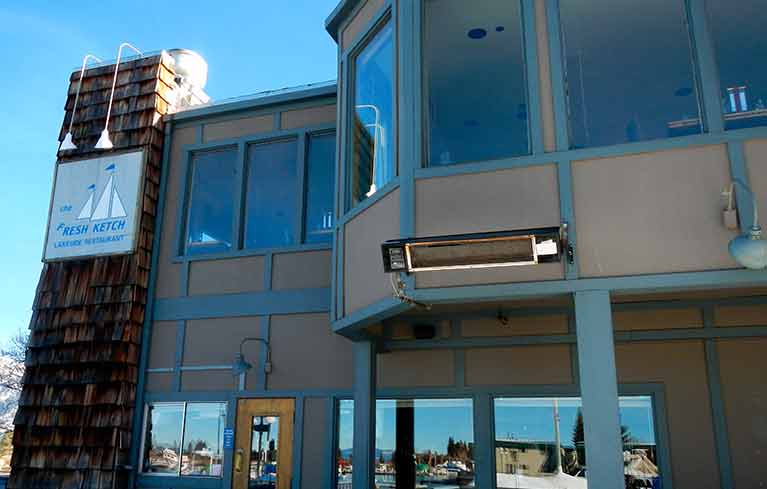
The Fresh Ketch in South Lake Tahoe has new owners. Photo/LTN

The Fresh Ketch in South Lake Tahoe has new owners.

Longtime owner Bob Hassett has sold the restaurant to the majority owners of the Tahoe Keys Marina – Donna and Robert Krilich of Illinois.

Details of the transaction that closed in January have not been disclosed. Neither Hassett nor Donna Krilich returned calls. This means it is not known if there will be changes coming to the waterfront eatery.

The El Dorado Count Assessor’s Office lists the value of the property and business at $1,224,913.

The Krilichs bought the Tahoe Keys Marina in early 2009 for more than $20 million. South Shore real estate agent Jean Merkelbach has a minority interest in the marina, but is not part of the restaurant deal.

Robert Krilich has an extensive criminal history.

According to court documents, “(Robert Krilich) has been convicted of racketeering and other offenses related to a scheme that included bribery of public officials in order to obtain assistance in the approval and financing of construction projects.”

He was also convicted of drunken driving in South Lake Tahoe in 2009.

— Lake Tahoe News staff report


Factory Stores at the Y going under

This South Lake Tahoe center used to be bustling.

By Kathryn Reed

One by one businesses at the Factory Stores at the Y have been closing. Now the whole center is on the auction block.

While the notice of default was filed in June 2012, the trustee sale is scheduled for Feb. 27 in Placerville.

Sisters Shannon Casteel and Nancy Irmer, who own the center at the corner of highways 89 and 50 in South Lake Tahoe, use the business name Two Sisters LP. They are based in Genoa. Neither could be reached for comment. Their property manager, Chad Coons, did not return a call.

The sisters bought the center from their brother Gary Casteel in 2004. He still operates the Heavenly Village.

The sisters owe more than $8 million, according to documents.

At one time Casteel also operated Blue Willow Lingerie in the center with her daughter-in-law Lori McKinney.

The last anchor tenant, Adidas, left in December 2011.

Much of the 51,811-square-feet of leasable space has sat empty for years.

Another business is leaving – Fragrance Outlet. Doors will probably be locked for good in April.

Gary Campbell who has operated the store for the last 18 years told Lake Tahoe News he just couldn’t make it anymore. He has significantly slashed prices to get rid of the inventory before he closes shop and moves out of South Lake Tahoe.

“It was pretty obvious when the mall was emptying out that they were in trouble. But they never told us they were in trouble. But when 70 percent of the stores are vacant, they had to be,” Campbell said.

There was a time when it was difficult to find a parking spot at the outlet stores. Locals and tourists would shop there. After the Outdoorsman closed, the factory stores offered one of the few places in town to be able to buy reasonably priced clothes, gifts and other goods.

Campbell said the decline at the factory stores has been combination of things – “Indian casinos, poor economy and poor management for the mall.”

He added, “I just think the whole town is struggling.”