Dry January-February sets records

By Kathryn Reed

It’s another record snow year in Lake Tahoe and the greater Sierra Nevada. It’s just not the kind of record anyone wants to brag about.

Graphic/National Weather Service Reno

Graphic/National Weather Service Reno

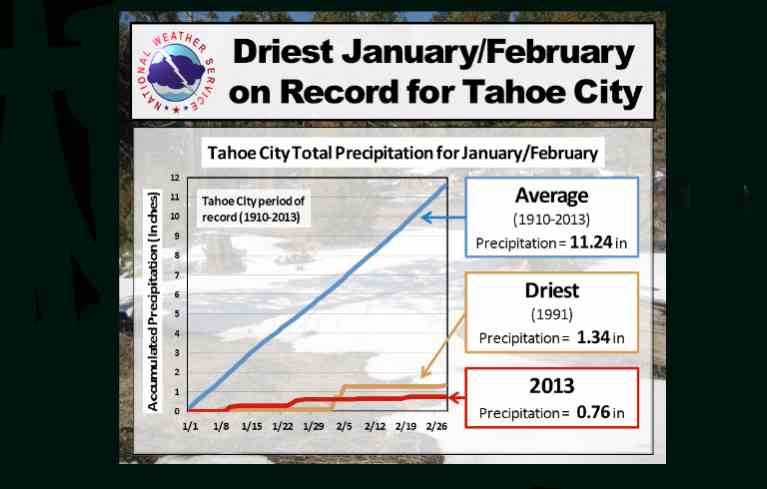
The National Weather Service in Reno has been collecting data from a station in Tahoe City since 1910. And with a matter of hours to go and no precipitation in sight for the rest of February, the first two months of 2013 will go down as the driest (0.76 inches) since stats have been collected there. The record was 1.34 inches in 1991, while the average is 11.24 inches. (See graphic to left.)

Snow surveyors across the Sierra found the same thing Feb. 28 as the water content was tabulated at various spots. Normally the reading this time of year builds on the totals from the previous two months. Not the case on Thursday.

Statewide, the snowpack water content is at 66 percent of average. It’s even worse at the Echo Summit location near Sierra-at-Tahoe where it came in at 54 percent of average. The snow measured 29 inches deep with 12.4 inches of water content at Phillips Station.

The Department of Water Resources, which conducts the snow surveys, has data dating to 1920. The driest January-February was in 1991, when 4 inches of precip fell from the mountainous area near Shasta Lake to the American River basin. For 2013, 2.2 inches of rain has fallen since December.

There is no substantial precipitation in the forecast to turn the tide. Reno weather officials say a small storm will move into the Lake Tahoe Basin on Saturday night, with another one rolling in Wednesday. But they said the snow totals are not expected to amount to much.

Despite the dismal snowpack, Lake Oroville in Butte County, the State Water Project’s principal storage reservoir, is at 113 percent of average and Lake Shasta by Redding, the federal Central Valley Project’s largest reservoir, is at 108 percent of its normal storage level.

The snow survey measurements by the Department of Water Resources determine how much water is released from Northern California reservoirs to irrigate crops and provide potable water for Southern California. Estimates by DWR are that it will be able to deliver 40 percent of the slightly more than 4 million acre-feet of State Water Project water requested for this calendar year by the 29 public agencies that supply more than 25 million Californians and nearly a million acres of irrigated farmland.


Out-of-bounds Heavenly skier found

It took search and rescue crews several hours Wednesday to find a Southern California man who had skied under the boundary ropes at Heavenly Mountain Resort.

Vahe Saradjian, 62, of Glendale told El Dorado County sheriff’s search and rescue team members that he ducked under the resort boundary ropes near the Powder Bowl Express lift.

Saradjian called 911 saying he was disorientated, lost and unable to navigate the terrain because of the lack of snow. He was not prepared to stay overnight in the wilderness.

At about 6:20pm Feb. 27 a CHP helicopter located Saradjian next to a campfire in the Cold Creek drainage. This is below the resort boundary lines. Teams from El Dorado and Douglas counties reached him at about 7:15pm.

Heavenly won’t be letting Saradjian ski at the resort the rest of the season.

— Lake Tahoe News staff report


Southwest Gas profits soar in 2012

By Eli Segall, Las Vegas Sun

Southwest Gas Corp. gave shareholders their best year ever with the company in 2012 as rate hikes and new customers pushed up profits.

The Lake Tahoe natural-gas provider said it earned $62.4 million of net income, or $1.35 per share, in the three months ending Dec. 31. That’s up from $55.3 million in profit, or $1.20 per share, in the same period a year earlier.

sw gasThe company, with almost 1.9 million customers in Arizona, Nevada and California, booked $133.3 million in profit for all of 2012, up from $112.3 million in 2011.

Its earnings per share last year, $2.89, rose 18 percent from $2.45 in 2011 and was the highest in company history, according to President and CEO Jeffrey W. Shaw.

Operating revenue increased to $1.93 billion last year from $1.89 billion in 2011. Its “operating margin,” defined as revenue minus the cost of gas sold, rose by $52 million in 2012. That was largely because of “rate relief” in Arizona (accounting for $45 million of the increase) and, to a much lesser extent, in Nevada ($2 million).

Arizona state regulators voted in December 2011 to let the company raise rates by about 8 percent starting Jan. 1, 2012.

The company’s 17,000 net new customers last year accounted for the remaining $5 million bump in operating margin.


Study: Coordinated healthcare could save California $110 billion

By Chad Terhune, Los Angeles Times

California could cut $110 billion in healthcare spending over the next decade, saving the average household $800 a year, by quickly moving away from conventional fee-for-service medicine and embracing more coordinated care, a report says.

medicalThese findings released Tuesday come from the Berkeley Forum, a new group of healthcare executives, state officials and academics that studied California’s healthcare market for the last year in hopes of finding ways to make care better and more affordable. The main recommendations are not entirely new, and these shifts are already underway in response to the federal healthcare law and pressure from employers to tame runaway medical costs.

But the group’s report does quantify how much work remains to be done and the potential savings if major changes are made in how doctors and hospitals are paid. Health-policy experts at UC Berkeley convened this group, which included high-ranking executives from Kaiser Permanente, Anthem Blue Cross, Cedars-Sinai Medical Center and other industry players.

“This could be a game changer in the state,” said Stephen Shortell, dean of the School of Public Health at UC Berkeley and a coauthor of the report. “These are the CEOs of big insurers, big health systems and large medical groups saying it’s time for a change, and these are the people who can get things done.”

The Berkeley Forum calls for a major shift toward “global budgets,” in which physicians and hospitals provide care under preset amounts that are adjusted to reflect the health of their patients. These payments would also be tied to providers’ performance on several quality measures.

This is similar to the “capitated” payments managed-care companies and HMOs have used for years in California. HMOs already cover 44 percent of California’s population, which is about double the nationwide rate.

Despite that high penetration, the report’s authors found that 78 percent of the state’s healthcare costs, or about $245 billion annually, are still paid through fee-for-service arrangements, which can encourage medical providers to perform unnecessary tests and procedures. The report calls for reducing the share of fee-for-service payments to 50 percent by 2022.

The Berkeley Forum also says California should double the share of the state’s population receiving integrated care from medical providers to 60% within the next decade. The most visible example of integrated care in California is Kaiser Permanente, the Oakland nonprofit that coordinates care across its hospitals and physician groups.

Other health insurers, hospitals and doctors are collaborating in similar ways through accountable-care organizations, medical homes and other initiatives that have strong backing from Medicare. Shortell acknowledged that there are “legitimate concerns” about this integration leading to higher prices as hospitals, clinics and physician groups rapidly consolidate.

The $110 billion in healthcare savings targeted by the group would amount to 2.5% of overall spending of $4.4 trillion over 10 years in California, according to the report. Those savings would mean an extra $800 annually for every California household.

Overall, the report found that 53 percent of the state’s healthcare dollars are spent on just 5 percent of the population, illustrating the high cost of treating certain chronically ill patients.

Pam Kehaly, president of Anthem Blue Cross in California, said this industrywide collaboration “puts us on a path to improving the ailing California healthcare system.”


Petition aims to block some NV Energy rate increases

By Cy Ryan, Las Vegas Sun

CARSON CITY — The state Bureau of Consumer Protection wants the rules changed to head off some future rate hikes by NV Energy, which announced last week its profits nearly doubled in 2012.

nv energyThe bureau petitioned the state Public Utilities Commission on Monday to require the utility to reveal if it made excessive profits when filing for more revenue due to lost sales.

“We are asking the commission to require NV Energy to make a showing as to whether they are earning more than authorized,” said Dan Jacobsen, technical staff manager for the consumer bureau.

NV Energy was granted an application by the PUC last year to impose a near $10 million rate surcharge to make up for revenue lost by conservation measures by customers. NV Energy, which serves 2.4 million customers in Northern and Southern Nevada, maintains that the law entitles it to make up for such reduced revenue.

Karl Walquist of NV Energy said he has not seen the newly filed petition and would not comment. But he added the company files a quarterly public report listing the finances of the utility.

In its latest announcement, NV Energy reported it earned a net income of $322 million, up from $163.4 million from 2011.

Jacobsen said, “Consumers should not be required to provide lost sales compensation if the company is earning more than the commission authorized at the most recent rate case.”

The utility said a rate increase of $158.6 million effective in January 2012 was a factor in the improved earnings. And the unusually hot weather in Southern Nevada aided the earnings and cash flow last year.

Michael Saunders, senior deputy attorney general who drafted the petition for the consumer bureau, said the quarterly information released by NV Energy does not reveal if the company earned a profit that exceeded the rate approved by the PUC.

He asked the PUC to enact a rule to require the power companies to submit this profit data when they seek to impose a surcharge for lost sales.

NV Energy has also introduced a bill in the state Senate to extend from three years to five years the time when it is required to file a general rate increase. The consumer bureau has opposed the measure arguing it would allow the companies to possibly keep excess profits longer.

Chairman Kelvin Atkinson of the Senate Commerce, Labor and Energy Committee said Monday that bill, SB93, has been put on hold at the request of NV Energy. A hearing scheduled for last week was canceled.

Atkinson, D-North Las Vegas, said the company informed him it wanted to “work out some of the difference” with opponents.

In light of the announcement of higher earnings by NV Energy, Atkinson said, “I don’t think it (the bill) will be considered anymore.”


Lake Tahoe clarity increases 6.4 feet

By Kathryn Reed

For the second year in a row the water in Lake Tahoe is clearer than the preceding year.

As noted last year by the UC Davis scientists who take the measurements, the lake’s clarity has been stable for the last decade. Still, the last time the white dinner plate looking Secchi dish could be seen more than 70 feet below the surface was in 2007.

The Secchi disc is ready to be used to test Tahoe's clarity. Photo/LTN

The Secchi disc is ready to be used to test Tahoe’s clarity. Photo/LTN

The 2012 reading of 75.3 feet is a 6.4-foot improvement from 2011. The disc is dropped over the side of a boat and eyeballed by the scientists on deck. Twenty-two readings are taken throughout the year to come up with the average clarity figure. In 2012, 107 feet was the best reading and 57 feet the worst.

“We are very excited about the results from 2012, especially within the context of the long-term record for annual and winter clarity,” John Reuter, associate director of the UC Davis Tahoe Environmental Research Center, said in a statement. “It is particularly encouraging to see clarity improve during wet years when the amount of fine sediments and nutrients going into the lake is high.”

In the world of science a trend is established at about the five-year mark, according to Kristi Boosman with the Tahoe Regional Planning Agency.

Lake Tahoe clarity readings
• 2012: 75.3 feet
• 2011: 68.9 feet
• 2010: 64.4 feet
• 2009: 68.1 feet
• 2008: 69.6 feet
• 2007: 70.1 feet
• 2006: 67.7 feet
• 2005: 72.4 feet
• 2004: 73.6 feet
• 2003: 71 feet
• 2002: 78 feet
• 2001: 73.6 feet
• 2000: 67.3 feet
— Source: UC Davis

A concerted effort has been under way since 1997, when then President Bill Clinton visited Lake Tahoe for the first environmental summit, to restore the lake’s clarity. That summit led to the environmental improvement program being created and the Lake Tahoe Restoration Act providing money for the program. In the past 15 years more than $1 billion has been spent on various projects in the basin with the primary focus of reducing sediment that clouds the waters of Tahoe.

While monitoring is in place at many of the projects to test what is reaching the lake, it is not possible at this time to point to one thing that is responsible for the improvements.

Researchers say they need more data on stormwater to make more definitive conclusions about why the numbers are changing. Another troubling thing to scientists is the summer clarity numbers continue to decline and they don’t know why.

The Secchi disc has been used since 1968, when the apparatus could be seen to an average depth of 102.4 feet.


Loop road financial study focuses on one route

Updated Feb. 28 10:50am

By Kathryn Reed

If Highway 50 were to go behind Harrah’s Lake Tahoe and MontBleu casinos, would this be a good financial decision?

Yes, according to the study done by Economic & Planning Systems Inc., a Sacramento-based land economics-consulting firm hired by the Tahoe Transportation District.

The report says retail sales could increase by $16 million to $25 million per year if the loop road were built. What year that would happen is not known.

“A complete street has much slower traffic and is easier to cross, so when people shop they want to cross back and forth. It slows the rate of traffic,” David Zehnder, managing principal of the consulting firm, told Lake Tahoe News. “And with a more friendly streetscape you provide a new dynamic that is more favorable in attracting spending.”

A delivery truck needs all five lanes of Highway 50 to get to Embassy Suites South Lake Tahoe. Photo/Kathryn Reed

A delivery truck needs all five lanes of Highway 50 to get to Embassy Suites South Lake Tahoe. Photo/Kathryn Reed

The loop road project spearheaded by the Tahoe Transportation District, a sister agency of the Tahoe Regional Planning Agency, proposes turning Highway 50 from about the eastern end of Pioneer Trail in South Lake Tahoe into a city street until Lake Parkway in Stateline. The highway would go around the casinos on the mountain side.

Would another realignment of the highway provide greater financial reward for the area? Would sprucing up the area without a highway realignment bring added revenues?

Those answers are unknown.

The consultants, who were paid $39,963, only studied one version. (The taxpayer dollars came from the Federal Highway Administration and Southern Nevada Public Lands Management Act.)

Also unknown is what happens to businesses along the current highway that have delivery trucks that don’t have another way to access the property if the road were narrowed.

“We are looking at various options for deliveries, however, have not made any decisions as of today,” Bill Cottrill with Embassy Suites told Lake Tahoe News.

The financial study was done despite the fact that no preferred alternative has been picked, though the forces driving the proposal want the mountain-only alternative; and that the environmental study has not begun; and that the city of South Lake Tahoe has yet to host its workshop. (That is set for March 12, 6pm, Lake Tahoe Airport.)

Even though the full report has not been released, the executive summary of the financial analysis is out. It says, “It should be noted that this economic analysis has not been scoped to address the potential relocation of any specific businesses that may be required to accommodate the right-of-way for the roadway realignment. It should also be noted that, although other potential alignments have been evaluated as part of current and past planning efforts, this analysis is predicated on a ‘mountain-side’ alternative under which the roadway realignment generally occurs along the southern portion of the existing commercial district behind the existing Village Shopping Center along Montreal Avenue/Lake Parkway.”

Officials say the full document could be released any day. But it’s not known if it will be out by Friday when the business coalition put together to analyze the study meets for the first time. (The meeting is March 1, 11:30am. Here is the finance meeting agenda, which includes the executive summary. Future meetings of this group are tentatively set for March 6 and March 20.)

South Lake Tahoe City Manager Nancy Kerry would not comment until she has read the full report.

Douglas County Manager Steve Mokrohisky told Lake Tahoe News, “A revitalized downtown in the South Shore is critical to creating a vibrant and accessible community for local residents and visitors, as well as reversing the environmental and economic decline in the Tahoe basin. The study is an important step in identifying the need for and quantifying the impact of revitalizing our downtown area through use of the complete streets model, including $16 million-$25 million in increased retail sales annually. The challenge in front of all of us that care about the future of the community, environment and economy in the South Shore is to pursue reasonable solutions that move us forward.”

Zehnder claims people will stop at the Heavenly Village and Village Center more often because a reduced speed limit will get them to notice the area and signage in the back will let those going by know what’s in the buildings.

What isn’t known, because the study isn’t out, is if it addresses the financial impact to the properties that aren’t developed and how the casinos may be impacted. It’s possible the vacant lots zoned commercial would become more valuable if the highway were to go in front of those locations.

Caesars Entertainment, parent company of Harrah’s and Harveys, owns the parcel behind Harrah’s up to Lake Parkway. A lot listed as undevelopable is owned by the casino giant on the south side of Lake Parkway in Stateline.

Edgewood Companies owns a large swath of vacant land that abuts Van Sickle Bi-State Park, goes behind MontBleu and links up with Lake Parkway at Highway 50.

Randy Lane, who created the hole on the north side of Highway 50 on the California side of the state line, owns a parcel on Montreal Road before it becomes Lake Parkway, between Fern Road and Heavenly Village Way. He owns another plot adjacent to that one just going up the mountain. He also owns vacant commercial land adjacent to Van Sickle Bi-State Park at the end of Heavenly Village Way. (This would be to the right of the park if facing the entrance.)

A company called Tahoe I Nv Lic, with a post office box in Carson City, bought commercial acreage from Falcon Capital, the company run by Lane, which is on Lake Parkway in California at the state line.


California bill would require ski resorts to report injuries, deaths

By Joel Grover, NBC-4

A bill that would for the first time require California ski areas to report all deaths and injuries to the state has been introduced in the state Senate.

California’s 24 ski areas are largely unregulated, making the Golden State the only major ski state with no ski safety law. Previous attempts to enact legislation have failed, but in the wake of an NBC4 I-Team investigation exposing multiple dangers across the state, one lawmaker is trying again.

ski injuries“When there are injuries or deaths, that should be a matter of public record,” said state Sen. Bill Monning, of Carmel, who sponsored the Ski Safety Bill.

In early February, the NBC4 I-Team revealed that there are numerous injuries and deaths at California ski areas that are not required to be reported to the state or made public, including an accident involving 9-year-old Keely Proctor of Redlands.

Two years ago, Proctor fell 32 feet from a chairlift at Snow Valley that didn’t have safety bars. Keely had six surgeries in five days that saved her life.

“We could’ve lost her,” Keely’s mother Terri Proctor told NBC4.

The California Ski and Snowboard Safety Organization, a group advocating ski area safety, said there are hundreds of unreported accidents a year on the state’s ski slopes.

Monning’s bill would also require ski areas to prepare an annual safety plan to prevent accidents and lessen hazards on the slopes. Resorts would have to post that safety plan on their websites.

“It’s really a question of transparency and the public’s right to know. People are spending a lot of money to enjoy the resorts,” Monning said.

The Ski Safety Bill will be heard in committee within 30 days. If it passes both houses of the legislature, it will land on Gov. Jerry Brown’s desk in September. But that doesn’t assure its success.

Similar ski safety bills have passed the legislature twice in the past four years, but then were vetoed by governors, first by Arnold Schwarzenegger then by Jerry Brown.


S. Tahoe man who pulled gun on bar patron going to jail

Scott Enerson of South Lake Tahoe was sentenced Feb. 25 to seven years in prison.

Enerson pulled a gun on a fellow patron at Whiskey Dick’s in June 2012.

He pleaded guilty to felony assault with a firearm and the enhancement of using a firearm during the commission of a crime.

El Dorado County Assistant District Attorney Hans Uthe said Enerson and the victim presented compelling testimony at Monday’s sentencing hearing.

“Ultimately the crime was just far too serious for us to permit anything less than a state prison commitment,” Uthe told Lake Tahoe News. “ And, although he was fortunately not physically harmed, from what the victim, a really decent guy, said at sentencing, his life just isn’t going to be the same again either, and not in a good way.”

 — Lake Tahoe News staff report


El Dorado County mid-year budget beats forecast

El Dorado County’s financial situation is looking the best it has in years.

In a presentation Feb. 25 by Chief Budget Officer Laura Schwartz to the Board of Supervisors it was revealed the current projections are that the general fund revenues will exceed budget by 1 percent for a total of $223,322,518.

edcGeneral fund expenses are projected at $212,526,135, or 96 percent of what was budgeted.

The mid-year budget projection also maintains a $9 million reserve for economic uncertainties.

“We are looking pretty good in the current fiscal year,” Schwartz told the board at the special budget workshop. “But we still need to continue spending conservatively and investing wisely in order to manage out-year shortfalls.”

Despite the good news, it’s not all good. The county is still looking at a shortfall of up to $5.3 million for the fiscal year beginning July 1. But at this time top officials are not calling for cuts.

“Our track record suggests that the amount of savings departments achieve at the end of the year is greater than what we are able to forecast at mid-year,” Schwartz said.

— Lake Tahoe News staff report