Thieves snag copper from USFS Tahoe sites

By Kathryn Reed

Copper thieves have hit the South Shore again; this time U.S. Forest Service structures.

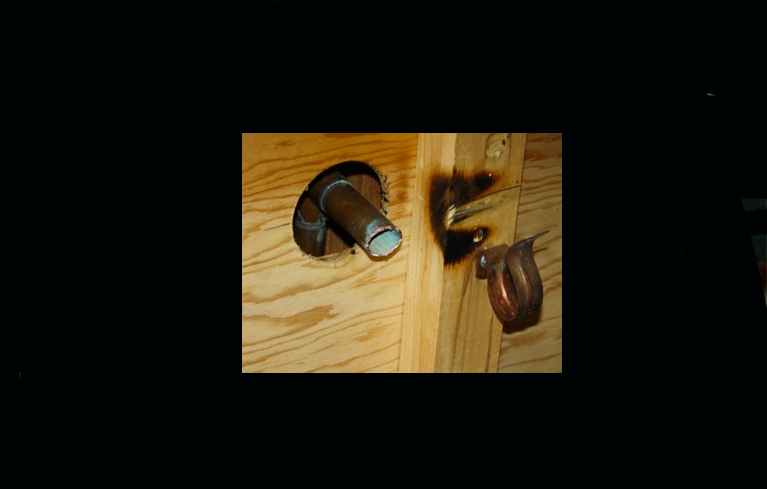
USFS spokeswoman Cheva Heck told Lake Tahoe News the thieves caused “extensive damage in order to get to the copper.” She said it could cost as much as $200,000 to make the repairs at the Kiva picnic area, Fallen Leaf Campground, and Pope and Baldwin beaches.

The goal is to repair the damage by Memorial Day – the normal time the seasonal areas open for the summer.

Damage done by copper thieves to a USFS bathroom on the South Shore. Photo/USFS

Damage done by copper thieves to a USFS bathroom on the South Shore. Photo/USFS

The damage was discovered in the last several weeks.

Thieves this winter have also made off with copper pipes from Camp Concord, and Emerald Bay and D.L. Bliss state parks.

No one has been arrested in any of the heists and authorities have not identified any suspects.

The Forest Service is working with El Dorado County sheriff’s detectives to track down the culprits.

The violations, which include damaging and removing government property, carry the standard criminal penalty of fines of up to $5,000 and six months in jail for each charge. The Forest Service said it could also pursue civil penalties aimed at recovering the cost of repairing the facilities.

Some of the sites had been recently renovated. Non-copper plumbing will be used when the fixes are made.

The copper plumbing is targeted because the pipes can fetch cash at scrap metal yards that will buy it.

Anyone with information may anonymously call Secret Witness Program at (530) 541.6800 or USFS law enforcement at (530) 545.9853.


El Dorado County looks to tighten mental health privacy issues

El Dorado County Board of Supervisors on March 12 authorized staff to look at different options to house the county’s mental health program.

In addition to exploring renewal options for its space at 670 Placerville Drive, facilities staff will consider lease options for the Victory Mine Building in Diamond Springs.

County Health and Human Services Agency Director Daniel Nielson has expressed concerns about the future of mental health program in the existing facility in regards to being able to meet privacy requirements of the Health Insurance Portability and Accountability Act, as well has accessibility standards under the Americans with Disabilities Act.

Most of the funding for the Mental Health Division is provided by state and federal sources. This funding may be jeopardized by continuing to operate in a facility that cannot meet accessibility and privacy standards for clients.

County facilities manager Russ Fackrell also noted that the market for commercial office space has significantly changed since the county began leasing the current location nearly six years ago.

 — Lake Tahoe News staff report


Truckee police arrest burglary suspects

Two suspects in the February and early March residential and vehicle burglaries in Truckee have been arrested.

Truckee police officers on March 9 served several search warrants related to the burglaries. Officers contacted Anthony Torres, 19. He allegedly had a large amount of crystal methamphetamine and U.S. currency on him. Torres was arrested on charges of possession of controlled substances for sale. Additional charges related to the original burglaries and gang affiliation were later added.

On March 12, officers located a second suspect in the burglaries, 19-year-old Sergio Sanchez. Sanchez attempted to flee by hiding in a vehicle driven by his girlfriend, Sabrina Kantlehner, 18. Officers detained Kantlehner and subsequently found Sanchez in the rear of the vehicle.

Sanchez reportedly had crystal methamphetamine and an air-soft pistol in the vehicle with him. Sanchez was arrested on charges of possession of a controlled substances for sale and attempted burglary from the earlier case.

Kantlehner was arrested on charges of aiding and abetting a known felon when she tried to hide Sanchez during his escape.

 — Lake Tahoe News staff report


South Lake Tahoe council wants environmental study of loop road

By Kathryn Reed

Will a loop road beyond what exists today ever be built is a question to be answered on another day. What the South Lake Tahoe City Council on Tuesday night decided is that the environmental process needs to move forward.

After four hours of input from the community, the project engineer, the financial consultant and the council, the vote was 4-1, with Councilwoman Angela Swanson the dissenter, to take it to the next level. The motion was to recommend to the Tahoe Transportation District board members that at their April meeting when they are expected to vote on what to include in the EIR-EIS that they include the following alternatives: the two triangle proposals, no action, and a fourth to be determined by the TTD board that is not the proposal that they first talked about. Transit is also to be incorporated into one of the alternatives.

Swanson wanted the TTD suggestions to be studied plus the 2004 alternative A to provide more variety.
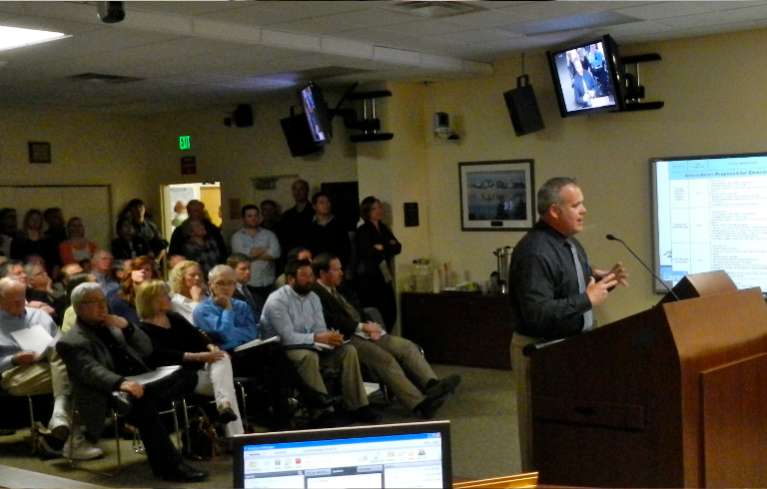
Loop road project manager Mark Rayback talks Mach 12 to the South Lake Tahoe City Council. Photo/Kathryn Reed

Loop road project manager Mark Rayback talks March 12 to the South Lake Tahoe City Council. Photo/Kathryn Reed

She is the city’s rep on the TTD board. Swanson assured everyone she would vote the conscious of the council at the TTD meeting.

While the council recognizes the need for change, they aren’t convinced the loop road is the change that is needed. But they also don’t believe now is the time to stop progress.

They worry about how businesses that are barely hanging on will be able to endure three-plus years of construction, how deliveries will be made to existing businesses if the front and back of centers change, if people will bypass Heavenly Village if the highway no longer takes them directly in front of it, and if this is the best idea for the city.

Mayor Tom Davis is tired of consultants saying X number of dollars will come to town if the council builds something and then the city winds up in debt over unrealized promises.

For more than 30 years people have talked about having Highway 50 go behind all the Stateline casinos or on one side and making the current highway a city street that would be narrowed, have a reduced speed limit and be able to be closed off for events.

(The TTD presentation will be on the city’s website. It includes historical alignments that have been studied, the ones TTD staff favors, along with information about the economic study that was done.)
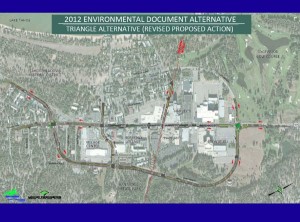
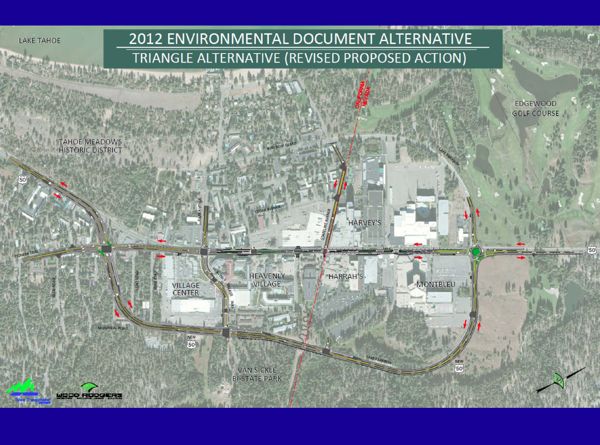
The proposed preferred alternative by Tahoe Transportation District staff.

The proposed preferred alternative by Tahoe Transportation District staff.

It’s estimated it could take up to two years for the final environmental documents to be done. Through that process there will be more opportunities for public input.

Of the 23 people who spoke March 12, 11 were in favor of a loop road, eight against the project and four took no distinct position. In the latter category is Tahoe Crescent Partners, owners of the Village Center.

Mark Rayback, project engineer with Wood Rogers, said it’s possible an all-season bridge could be built to cross over Highway 50, if it goes on the mountain side, to take people to Van Sickle Bi-State Park.

It’s possible Stateline Avenue could be three lanes by using the right-of-way that exists. This way during special events the traffic could be two lanes in the direction with the most vehicles.
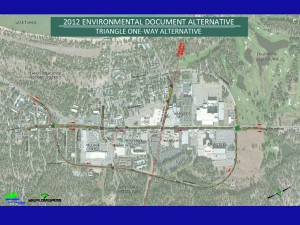
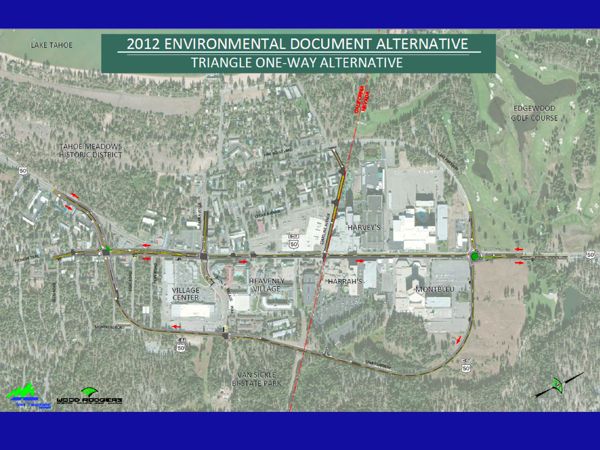
The second triangle proposed route.

The second triangle proposed route.

Vision. That is the word that was used the most.

Many speakers embraced wikeable, a word coined by City Manager Nancy Kerry at last week’s economic forum. It’s walkable and bikeable all at the same time. That is one vision.

Complete streets. This would bring sidewalks, lighting and landscaping.

Community. It would better erase the state line, thus tying the South Shore together, with the goal of creating a place for locals that tourists want to visit.

Environment. It would reduce traffic congestion, increase air quality, retain the same number of streets (so nothing more is being paved, it would just be repurposed).

A big vision goes beyond talking about the highway, but looking at four to five blocks deep at what the “tourist district” could evolve into.

Having signs telling people where things are, allowing easy crossing of the roads, transit that is reliable and better access to the lake are all components of the vision.


Bay Area man going to prison for Stateline casino beating

By CBS-San Francisco

A Bay Area man has been sentenced to 32 months in prison for beating two women at a Lake Tahoe casino so severely that one victim suffered a miscarriage.

Douglas County District Judge Tod Young imposed the sentence last week on 27-year-old Huy Phan of Fremont.

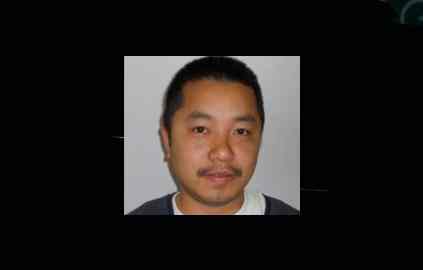
Huy Phan

Huy Phan

Phan pleaded guilty in December to battery causing substantial bodily harm, which carried a maximum penalty of 10 years in prison.

Phan is accused of beating the two women in a Stateline casino hallway on Jan. 8, 2012, while he was with his sister and four men.

The other victim has undergone multiple surgeries for facial injuries after being knocked unconscious.

Neither victim knew the others or what prompted the attack. They’re close friends.

Phan claims he was trying to protect his sister.


Nevada considers erecting war memorial

By Ed Vogel, Las Vegas Review-Journal

CARSON CITY — A Nevada War Memorial honoring all fallen Nevadan soldiers since statehood would be added to Capitol Complex under a bill introduced Monday in the state Senate.

The move to establish a memorial for fallen veterans came from Brad Williams, a South Lake Tahoe police officer, whose son, Army Pfc. Brandon Williams, 21, of Gardnerville, was killed in Iraq in 2006.

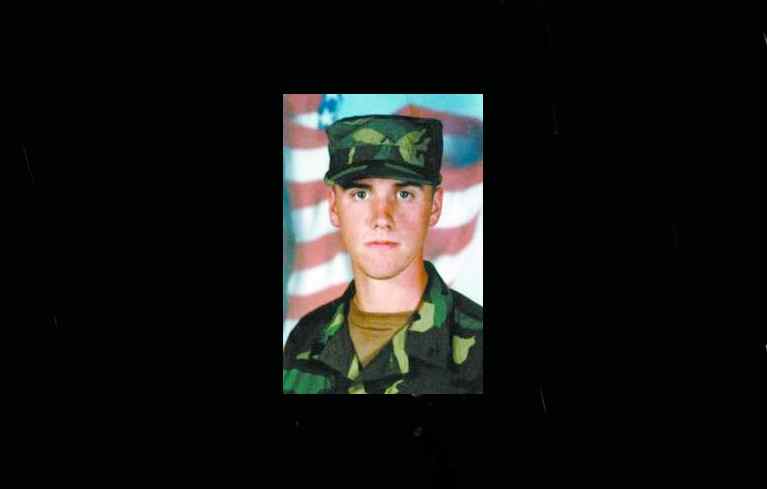
Brandon Williams

Brandon Williams

Under Senate Bill 230, introduced by Sen. David Parks, D-Las Vegas, the inclusive memorial for all fallen armed forces members would be constructed only through donations to the state Public Works Division, not with tax money.

It is estimated to cost several million dollars, said Caleb Cage, executive director of the Office of Veterans Services.

The memorial, envisioned as more than 200 feet with benches, a pavilion and a wall of names, would be an addition to others on Capitol grounds.

Nevada already has a State Veterans Memorial; a memorial for the sailors who died on the USS Nevada battleship at Pearl Harbor on Dec. 7, 1941; statues for mining; Abraham Curry, the founder of Carson City; Kit Carson; and fallen police officers.


Landing gear folds up on plane in Minden

Pilot survives scare at Minden Tahoe Airport. Photo/Provided

Pilot survives scare at Minden Tahoe Airport. Photo/Provided

The pilot of a plane that landed without its landing gear down was not injured.

Alfred Asti, 77, landed his Piper Camanche 400 at Minden Tahoe Airport about 12:28pm March 12.

Asti told Douglas County sheriff’s deputies that his approach was high and as the plane came into contact with the ground, the plane bounced. When it bounced a second time the landing gear folded up and the plane collapsed to the ground sliding off the runway.

— Lake Tahoe News staff report


Nevada bill would keep state in TRPA Compact

By Sandra Chereb, AP

CARSON CITY — A bill that would rescind Nevada’s threat to leave the decades-old Lake Tahoe Compact over a rift with California was introduced Monday in the state Senate.

SB229 seeks to repeal a law passed by lawmakers in 2011 and signed by Republican Gov. Brian Sandoval. The law would allow Nevada to leave the Compact and the Tahoe Regional Planning Agency that has governed development and environmental controls in the scenic Lake Tahoe Basin since 1969.

Politicians see a state line, but Lake Tahoe is one lake. Photo/LTN file

Politicians see a state line, but Lake Tahoe is only one lake. Photo/LTN file

Two years ago, Nevada lawmakers blamed their counterparts in California for favoring tough environmental standards that they said were hindering development and the economy. Among other things, they cited a regional plan that hadn’t been updated since the late 1980s.

That hurdle was cleared in December, when TRPA’s Governing Board approved a plan giving more development control to local governments. The plan was viewed by most as far from perfect, but a necessary compromise that wouldn’t hinder environmental programs designed to protect Tahoe’s famed blue waters.

Monday’s bill was hailed by conservationists.

“We’re excited to see the bill introduced today and we’re optimistic we can get it passed this session so Nevada can recommit to the future of Lake Tahoe,” said Kyle Davis with the Nevada Conservation League.

Assemblyman David Bobzien, D-Reno, agreed, saying that now that Tahoe’s Regional Plan has been updated, “it’s time to come back together.”

But a Republican senator who testified in favor of Nevada pulling out of TRPA said the same issues that forced Nevada’s hand in 2011 remain.

Sen. James Settelmeyer, R-Minden, noted a lawsuit has already been filed challenging the new Regional Plan.

The lawsuit was filed in February in U.S. District Court in Sacramento. In it, the Sierra Club and Friends of the West Shore claim the rules that TRPA adopted in December will erode environmental protection of the mountain lake by allowing denser development and giving more control to local governments.

“Obviously to me the lawsuit proved that SB271 still needs to be in play,” Settelmeyer said.

Bobzien, however, said there was nothing in the original law that conditioned Nevada’s staying in the Compact on whether others file lawsuits.

“People have a right to litigate,” he said.


No STPUD rate increases —- for now

By Kathryn Reed

Water and sewer rates will not be going up this year for South Tahoe Public Utility District customers. But that won’t be the case in future years if the district sticks to its 10-year capital improvement plan.

The board had a workshop with staff last week to go over the proposed 2013-14 budget and the CIP. No one from the public attended.

At the May 2 board meeting there will be a public hearing on the budget, with the board slated to take a vote May 16.

South Tahoe PUD staff, foreground, discuss the budget March 6 with the board. Photo/LTN

South Tahoe PUD staff members, foreground, discuss the budget March 6 with the board. Photo/LTN

In the fall the board expects to have workshops about rates and meters.

“We have work to do. By the fall we have to have concrete ideas about how to deal with this situation,” board President Eric Schafer said at the March 6 meeting.

Per California law all district customers must be on water meters by 2025. That could require borrowing money if grants are not available.

The continued decline in property values in the district’s boundaries, which are similar to those of Lake Tahoe Unified’s, means less money in the bank. The current budget assumed there would be 1 percent drop, when in reality it has been 1. 9 percent. This comes to a difference of $60,000. But with the district always forecasting 10 years out, cumulatively it equates to a potential $600,000 hit.

Paul Hughes, the district’s chief financial officer, presented a graphic that showed the revenue for water and sewer in 2008 and what is proposed in the coming fiscal year. 2008 was the peak revenue year for STPUD when service charges represented 59 percent of collections. That has grown to 69 percent for 2013-14. Revenue has decreased 4.7 percent in six years.

Connection fees have dramatically dropped as a budget line because people aren’t building. However, the situation was not as dismal as the district had forecast in the 2012-13 budget. It was assumed there would be no commercial connections and 15 residential. Through February, Bob Dogs was the one commercial connection and there has been the equivalent of 31 residential connections.

Hughes said he’d like the board to entertain the possibility of putting out a multiyear announcement so rate increases could take effect back-to-back years. “This would allow for continuity and planning on the engineering said in the CIP,” Hughes said.

As it is now, each year the district proposes a rate increase on either the sewer or water side Proposition 18 kicks in which requires all customers to be notified and given the chance to protest the increase.

Schafer told his colleagues that they better take a hard look at the 10-year capital improvement plan.

“We have been scaling back and we need to decide if that’s right,” he said.

And without continued rate increases, that 10-year plan will just collect dust and never be a reality. The 10-year sewer needs would cost $64.1 million, while the water needs are $57.8 million.

For now, replacing small water lines is the district’s focus so fire suppression will be improved. There are $3.6 million water engineering projects on the books for 2013-14, with bulk — $2.5 million – being spent on the state street waterline.

A sign the local economy is improving is that the number of people seeking a low-income discount has declined. It peaked in 2011 with 325 enrolled, dropped to 307 in 2012 and to 297 for 2013. What isn’t known is if these people are doing better or don’t live in the district any more.


Sahara dust contributing to Sierra snow

By Alicia Chang, AP

LOS ANGELES — One of the driest spots on Earth – the Sahara Desert – is increasingly responsible for snow and rain half a world away in the western U.S., a study released last week found.

It’s no secret that winds carrying dust, soot and even germs make transcontinental journeys through the upper atmosphere that can affect the weather thousands of miles away. Yet little is known about the impact of foreign pollutants on the West Coast, which relies on mountain snowmelt for its water needs.

Previous studies hinted these jet-setting particles may retard rainfall in the Sierra Nevada of Northern California by reducing the size of water droplets in clouds. But scientists who flew through storm clouds in an aircraft, measured rain and snow and analyzed satellite imagery found the opposite: Far-flung dust and germs can help stimulate precipitation.

During the 2011 winter, a team from UC San Diego and the National Oceanic and Atmospheric Administration traced particles suspended in clouds over the Sierra to distant origins – from the skies over the arid Sahara, to mingling with other pollutants in China and Mongolia, then crossing the Pacific.

The days with the most particles in the clouds were also “days when we see the most snow on the ground,” said study leader Kimberly Prather, an atmospheric chemistry professor at UC San Diego, whose study was published in the journal Science.

Scientists believe wafting dust, grit and microbes – including bacteria and viruses – can spur the formation of ice crystals in clouds that in turn can influence how much rain or snow falls.

For years, governments and utilities in California and other Western states have used cloud seeding, in which a chemical vapor is sprayed into clouds, in a bid to increase rainfall.

The new study shows how “Mother Nature has figured out how to give us more precipitation” and that may lead to changes in cloud-seeding efforts, which can be hit or miss, Prather said.

David J. Smith at the NASA Kennedy Space Center said it was refreshing to see measurements from the ground, air and orbit to tackle how airborne particles affected Northern California snowfall.

“Such a comprehensive approach is the only way to thoroughly examine global transport” of particles, Smith, who had no role in the research, said in an email.