Fedora Bandit going to prison for 9 years

David Griffith Osborne — aka the Fedora Bandit — was sentenced today to nine years in prison, to be followed by three years of supervised release, for three counts of armed bank robbery.

The 75-year-old former Carson City resident earlier this year pleaded guilty to several bank robberies.

He robbed:

  • Bank of the West, 2160 Lake Tahoe Blvd., South Lake Tahoe, Feb. 18, 2010;
  • Bank of the West, 200 Bear Street, Kings Beach, March 9, 2010;
  • Bank of the West, 34 East Gridley Road, Gridley, April 26, 2010;
  • American River Bank, 9750 Business Park Drive, Rancho Cordova, June 3, 2010;
  • Chase Bank, 6669 Clark Road, Paradise, June 29, 2010.
  • Bank of the West, 736 Taylorville Road, Grass Valley, December 22, 2009 and March 31, 2010.

Osborne will be required to pay $55,929 in restitution for the robberies.

In each of his seven robberies, Osborne wore a hat, sunglasses, a fake mustache and goatee, and demanded money while brandishing a firearm. Osborne was identified on surveillance images, and after the June 29, 2010, robbery of the Paradise Bank, his DNA was recovered from an abandoned bicycle that he used as a getaway vehicle.

Osborne also confessed to the seven armed robberies and also admitted that he had robbed a Bank of the West branch on 2976 North Carson St. in Carson City.

— Lake Tahoe News staff report


College grad rate between whites, minorities narrows

By Katherine Mangan, Chronicle of Higher Education

The graduation gap between minority and white college students is slowly narrowing, and the campuses having the most success aren’t necessarily the wealthiest or most selective, according to a new report by the Education Trust.

“Colleges that decide student success is the No. 1 priority have been able to move the needle even with decreasing levels of state support,” the report’s author, Joseph Yeado, a higher-education research and policy analyst for the Education Trust, said Wednesday.

But “while the trends are moving in the right direction at the national level,” he said, “they’re moving at far too slow a pace.”

The report, based on data from the U.S. Department of Education, notes that, from 2009 to 2011, the number of Hispanic undergraduates at four-year colleges shot up 22 percent, while enrollment grew 8.5 percent for black students and 2.7 percent for white students. Six-year graduation rates for all three groups improved: by 4.7 percent for Hispanic students and by 2 percent for black and white students.

Gaps remained, though. Graduation rates for Hispanic students were 11.1 percentage points below those of white students, while the gap between black and white students was 22.2 percentage points.

Michael Dannenberg, director of higher-education and education-finance policy for the Education Trust, said student demographics don’t have to dictate outcomes.

“What individual colleges do often can make all the difference in the world between a student graduating or leaving with a pile of debt and no degree,” he said in a written statement. “Demography is not destiny, and what colleges do matters.”

The report singles out the colleges it considers leaders and laggards in closing graduation gaps.

Among those with the most impressive gains, the University of North Carolina at Greensboro saw graduation rates for black students jump to 60.1 percent in 2011 from 52.3 percent in 2010. Graduation rates for black students have been equal to or higher than the rates for white students for more than a decade, the report notes.

In an interview, David H. Perrin, provost and executive vice chancellor at Greensboro, cited the campus’s “culture of nurturing and support for students,” including extensive tutoring and help with writing and computer literacy. Minority students also benefit, he said, from learning communities that bring students together to study topics like sustainable entrepreneurship or to help them zero in on majors.

The report also singles out the State University of New York at Stony Brook, where Hispanic students graduate at a slightly higher rate than their white classmates. The rate for Hispanic students jumped to 66.5 percent in 2011 from 58.1 percent in 2010.

Among the colleges that the report says show “disturbingly large gaps in graduation rates” are the University of Akron, where it says the rate for white students climbed to 43.4 percent in 2011 while the rate for black students fell to 9.8 percent.

Akron’s chief diversity officer, Lee Gill, said in an e-mail on Wednesday that the graduation rate for black students climbed to 16.9 percent in 2012 and that the university had “completely revamped our enrollment strategy, strengthened our mentoring and advising programs, and significantly expanded our learning communities (with their proven strategies of increasing African-American graduation rates).”

At Michigan State University, the percentage of white students graduating in 2011 grew to 80.9 percent, while the percentages of black and Hispanic students graduating dropped to 55.4 percent and 61.5 percent respectively, according to the report.

A spokesman for Michigan State said in an e-mail on Wednesday that the university’s graduation rates are “consistently higher than would be predicted based on our students’ demographic data” but that it remains committed to raising success rates for all students.

The report points out, however, that colleges with similar demographics can have starkly different outcomes on closing graduation gaps. Success, it says, “isn’t predicated on tonier demographics or more selective admission standards.”


Nevada lacking in wildfire prevention funds

By Andrew Doughman, Las Vegas Sun

Call it the Jerry Maguire theory of budgeting.

At a time when large wildfires have charred wide swathes of land in both Northern and Southern Nevada, the state’s forestry division faces millions of dollars of cuts in federal fire prevention grants and has little recourse but to go to Congress and repeat the line from the famous Hollywood movie: Show me the money!

Nevada’s ability to prevent wildfires faces further pressure as the federal agencies that control nearly 90 percent of the land in Nevada prepare to cut their fire prevention budgets and as a state nonprofit agency that once informed communities about fire safety and brought millions of dollars into the state for fire prevention has gone bankrupt.

For now, the state forestry division’s budget dropped from $18.8 million during the last fiscal year to $6.9 million for the fiscal year that started this month.

The state largely relies on U.S. Forest Service grants to mitigate fire risks, but much of the mitigation money technically doesn’t exist without a federal budget, which Congress may approve in September.

The pages of the state budget literally show blank white space where the grant dollars should be. No federal budget means no money for Nevada.

The threat of a potential federal government shutdown over disagreements about what the nation should spend in 2014 leaves state officials without a clear idea of what they can spend on fire mitigation.

“We don’t know if our budget has been reduced,” said David Prather, a deputy administrator at the Nevada Division of Forestry. “As long as they’re having their budget battles in the Capitol, we just have to wait and see what the fallout is. Really, that’s one of those things that’s beyond our control.”

Senate Majority Leader Harry Reid, D-Nev., indicated Wednesday that he’d support more money for fire prevention, perhaps allaying concerns that federal budgets for fire prevention will decrease in the coming years.

Reid said climate change is to blame for the increasing severity and prevalence of Western wildfires.

“I mean you can’t deny it, it’s here,” he said. “Why do you think we’re having all these fires? … We should be spending a lot more on prevention, and that means thinning some of these forests.”

In addition to the uncertainty around prevention funds, a statewide nonprofit agency that brought millions of dollars to the state for fire prevention and helped study wildland fire risks and mitigations has filed for bankruptcy amid findings that it misspent federal stimulus money.

It was the Nevada Fire Safe Council that first alerted Nevada to the “extreme” fire risks in the Spring Mountains around Mount Charleston, where the Carpenter 1 fire has burned more than 28,000 acres to date.

“It was an organization that promoted fire-safe planning in local communities, kind of at the local level,” said Sheila Anderson, senior research specialist at Resource Concepts, Inc., a consulting company that the Nevada Fire Safe Council retained to study fire risks in Nevada communities a decade ago. “They formed chapters all over the state.”

After the council’s demise, no other organization has stepped forward to bring in the millions of dollars of grants, partner with communities to promote fire-prevention education, and fund risk studies.

Read the whole story


Questioning if plastic bag ban reduces litter

By Paul Gabrielsen, Santa Cruz Sentinel

An employee gathering carts from a sunny parking lot of a Santa Cruz Safeway said shoppers are warming up to the city’s new ban on single-use plastic bags. But some still miss the bags’ convenience.

“Wrong thing to do,” said a middle-aged man of the ban.

“But they’re killing the innocent turtles,” his wife said, adding that in Europe, reusable bags are a way of life.

The couple’s disagreement is typical of the strong feelings evoked by plastic bag bans, which seem to delight environmentalists but aggravate many retailers and consumers. While there is some evidence that the bans have reduced litter on city streets and beaches, ambiguities in the data seem certain to fuel further heated debate.

San Francisco led California’s war on plastic, banning bags at large grocery stores and chain drugstores in 2007. But litter surveys in the city, covering the first two years after the ban went into effect, painted a foggy picture.

Surveyors assessed more than 100 randomly selected sites in the city each year, counting every piece of litter in an area half the length of a city block. In 2007, before the ban was introduced, plastic bags amounted to 0.5 percent of large litter. By 2009, the percentage climbed to about 1.5 percent. And during the same period, the average amount of litter stayed about the same.

The city hasn’t collected any litter data since the 2009 survey, said Guillermo Rodriguez, a spokesman for the city’s environment department.

The ban was expanded to all retailers in July 2012 and will continue to expand to all restaurants this year. San Francisco plans to do another litter survey to see whether the new scope of the ban makes a measurable impact.

San Jose has already seen that impact. The city’s 2012 bag ban immediately covered all retailers. Last December, San Jose presented results of litter surveys in city creeks, streets and storm drains. Surveys after the bag ban in 2012 found 89 percent fewer bags in storm drains, 60 percent fewer in creeks and 59 percent fewer on city streets, compared with surveys before the bag ban. Plastic bags made up 8 percent of total creek litter in 2011 and 4 percent in 2012.

A 2012 survey of Bay Area storm drains found that “other plastics,” not including plastic bags, made up about 50 percent of storm drain trash. Paper, Styrofoam and drink containers together made up another 30 percent.

But the bags also show up in marine litter, making up about 15 percent of trash in the deep reaches of Monterey Bay. The Monterey Bay Aquarium Research Institute reported finding plastic bags in water nearly 2½ miles deep, according to a paper published online in May in the journal Deep Sea Research.

Closer to the ocean surface, concern for the bags’ impact on marine life stems from the fact that ocean-borne plastic bags look similar to jellyfish, which sea turtles love to eat.

Whether the bans are preventing bags from reaching the ocean is hard to measure, but surveys of litter on Monterey Bay beaches provide the best available picture.

Santa Cruz-based Save Our Shores promotes weekly cleanups around Santa Cruz and Monterey counties and collects trash data from many of these events. On average, volunteers pick up only six bags at each event, down from a high of 65 in 2008.

The number of bags collected per cleanup has dropped in the past two years because of four bans that took effect in 2012, said Save Our Shores executive director Laura Kasa. The four bans covered unincorporated Santa Cruz County and the cities of Watsonville, Monterey and San Jose.

The latter ban matters because of the volume of tourist traffic coming “over the hill” to Santa Cruz beaches, said Kasa, who also credits the shift in public perception toward plastic bags in the region. “In Santa Cruz it’s become the trend to be green and to bring your own reusable bags and not use plastic bags,” she said.

Save Our Shores program manager Brad Hunt pointed out that Monterey County has not yet implemented a bag ban, which affects Save Our Shores’ average cleanup numbers. “It could go down to one bag per cleanup after Monterey County implements theirs,” Hunt said, “but we won’t know that until a year or two down the road.”

Opponents of plastic bag bans point out that bags make up a small fraction of litter. “You’re talking about such a small amount to begin with that you wouldn’t notice any change,” said Stephen Joseph of the Save the Plastic Bag Coalition, whose members include plastic-bag manufacturers and retailers.

Joseph said political leaders have exaggerated the problem. He disputes claims by Oakland-based Save the Bay that a million plastic bags enter San Francisco Bay each year. In 16 years of living in the city, Joseph said, he never saw one bag in the bay.

“It’s a hoax,” he said, adding:

“There’s obviously plastic bag litter. Anyone who’s never seen a plastic bag flying around is blind. But that does not justify all the exaggeration.”



Cyclist, skateboarder injured in S. Tahoe collision

A bicyclist and skateboarder from South Lake Tahoe were injured Wednesday when they collided near Stateline.

Steven Magelssen, 20, was unconscious when police and paramedics arrived at Highway 50 and Heavenly Village Way at 8:30pm July 17. Officers said Magelssen, who was on the bike, regained consciousness and lost it a few times before he was airlifted to Renown Medical Center in Reno.

Pablo Bobadilla, 23, was taken to Barton Memorial Hospital with cuts and abrasions.

South Tahoe police said Magelssen was at fault because he ran the red light and violated the right-of-way of a pedestrian in a marked crosswalk.

Magelssen was riding his bicycle in the center left turn lane of Highway 50, approaching a red traffic signal at Heavenly Village Way. Bobadilla was on his skateboard in the company of other pedestrians while attempting to cross the highway in a marked crosswalk. Bobadilla was crossing from the corner of Tahoe Tom’s gas station toward the south side of the intersection. The traffic signal was directing pedestrians to cross at that time.

Magelssen, according to police, failed to stop at the red traffic signal holding westbound traffic and the left turn lane. As he was turning left against the red left turn arrow from Highway 50 to southbound Heavenly Village Way, he collided with Bobadilla in the crosswalk.

— Lake Tahoe News staff report


Artist’s troubles grow as he tries to rebuild

By Kathryn Reed

South Lake Tahoe would like Peter Darvas to start with a new canvas. Darvas would rather work with the outline he has.

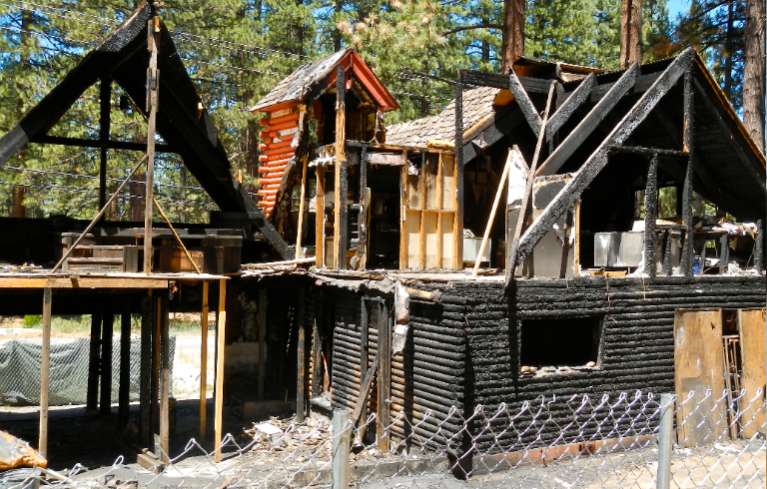
In September 2012, Darvas’ sprawling house on Pioneer Trail and April Drive was destroyed by fire. Flames also engulfed the house next door on April.

Today the neighbors have a foundation poured. This new construction is in stark contrast to the destruction left by the fire that is so evident at the Darvas site.

Darvas told Lake Tahoe News that on Tuesday he was going to submit plans to the city for how he wants to resurrect his home and studio.

A 6-foot cyclone fence surrounds the remains of Peter Darvas' house that was destroyed by fire in September 2012. Photo/LTN

A 6-foot cyclone fence surrounds the remains of Peter Darvas’ house that was destroyed by fire in September 2012. Photo/LTN

“I believe a large percentage of the structure can be salvaged,” Darvas said.

He has been slowly taking down some of the structure. Another dumpster was dropped off Tuesday afternoon.

The city has sent him letters wanting more to come down faster.

The South Lake Tahoe artist was before the City Council on July 16 asking for leniency in regards to his delinquent South Tahoe Refuse bill. He owes $2,700.

Mayor Tom Davis begged his colleagues to give the man 45 more days. When they voted against him, Davis called it “sad.” Councilman Hal Cole abstained because he lives across the street from Darvas. Councilwomen Angela Swanson, JoAnn Conner and Brooke Laine voted to proceed with the filing with the county tax office that the Planning Commission had already approved on a 4-0 vote.

The money isn’t just from the past 10 months. As STR President Jeff Tillman told the council July 16, this total is the accumulation of years of unpaid garbage bills. That is why the majority on the council could not grant an exception or extension to Darvas.

Darvas told Lake Tahoe News, “I’m not the most timely or responsible person when it comes to crossing T’s and dotting I’s. I operate in a different reality.”

Darvas told the council he has retained an attorney to go after his insurance company to get cash. Until that happens, he said he has no money to pay his debts. He thought 30 days would be enough time to get the insurance issue worked out.

He has not created enough new art at the studio near Nepheles to pay his bills.

Darvas and the city have had run-ins for years regarding the clutter at his place. In January 2012, he was sparring with the council regarding an abatement fine.

With the vote by the council, the county can place a lien against his property so STR gets what it is owed.


Backlash to Calif. digital license plate plan

By Melody Gutierrez, Sacramento Bee

California license plates could get a high-tech makeover with a digital screen and wireless capabilities as part of a Senate bill making its way through the Legislature.

Senate Bill 806 authorizes the Department of Motor Vehicles to create a pilot program at no cost to the state with as many as 160,000 cars testing the digital plates patented by San Francisco-based Smart Plate Mobile. The state hopes the technology will improve efficiencies in vehicle registrations and potentially save the DMV some of the $20 million spent each year in postage for renewals.

Read the whole story


12 states challenge EPA over ‘sue and settle’ practices

By Fox News

Oklahoma Attorney General Scott Pruitt and the attorneys general of 11 other states sued the Environmental Protection Agency Tuesday, demanding that the agency turn over documents the states allege will show the agency cooperates with environmental groups as part of a “sue and settle” legal strategy to develop regulations.

The lawsuit, filed in U.S. District Court in Oklahoma City, alleges that binding consent decrees between the EPA and environmental groups that have sued the agency over the years have led to new rules and regulations for states without allowing their attorneys general to defend their interests and those of its businesses and consumers.

“The EPA is picking winners and losers, exhibiting favoritism, at the expense of due process and transparency,” Pruitt said in a statement. “They are manipulating our legal system to achieve what they cannot through our representative democracy. The outcomes of their actions affect every one of us by sticking states with the bill and unnecessarily raising utility rates by as much as 20 percent.”

Besides Oklahoma, the attorney generals of Alabama, Arizona, Georgia, Kansas, Michigan, Nebraska, North Dakota, South Carolina, Texas, Utah and Wyoming are parties to the lawsuit.

EPA’s press secretary in Washington, D.C., Alisha Johnson, denied allegations that the agency cooperates with environmental groups to develop regulations.

“We have no input or control over what parties sue us or what issues they focus on,” Johnson said.

Pruitt said as many as 40 lawsuits have been filed against EPA over the years by such environmental groups as Greenpeace, Defenders of Wildlife, WildEarth Guardians and the Sierra Club that have led to consent decrees, “sometimes on the same day the lawsuit is filed,” that include terms and conditions that go beyond statutory guidelines approved by Congress.

“I would look at that very suspect and say: ‘What’s going on?'” Pruitt said. “The EPA is picking winners and losers. These cases affect Oklahoma’s ability to do its job.”

Johnson said EPA does not enter into legal settlements that give the agency new or additional authority.

“An outside entity cannot compel us to take action we were not already compelled to take by law,” she said.

The states’ lawsuit seeks to enforce federal Freedom of Information Act guidelines involving the states’ request for letters, emails and any other correspondence between the EPA and environmental organizations before they sue the agency. The attorney generals want to analyze the documents to determine the nature of EPA’s legal strategy concerning environmental groups.

In one instance, the lawsuit says the states made a FOIA request to EPA in February seeking records about the agency’s negotiations with environmental groups that led to binding consent decrees concerning state implementation plans for the EPA’s regional haze guidelines under the Clean Air Act.

Pruitt is challenging regional haze guidelines for Oklahoma in federal court. Utility officials have said the regulations could cause electricity rates to rise 13 percent to 20 percent in three years.

“It’s a regulation-through-litigation type of initiative,” Pruitt said. “And we are not even a party to that litigation. That’s a troublesome thing.”

The states also asked the agency to waive any fees for collecting the information, a request the agency denied. In a May 31 letter to Pruitt’s office, the agency said the states’ FOIA request “fails to adequately describe the records sought.”

“EPA’s denial of the states’ FOIA request is consistent with their apparent protocol to avoid compliance with FOIA by telling requesters that their FOIA request is overbroad,” the lawsuit alleges.

“Ninety-two percent of the time EPA grants fee waiver requests from noncommercial requesters who are supportive of EPA’s policies and agendas, but denies a majority of fee waiver requests from noncommercial requesters who are critical of EPA,” the complaint states.

Pruitt said a majority of the states’ requests for information have been rejected.

“We are deserving of information from the EPA,” the attorney general said. “They’ve routinely said no, period.”

Johnson said FOIA rules require that requesters describe the records they want so they can be located with a reasonable amount of effort.

The Associated Press contributed to this report.


Adult diseases becoming common in kids

By Alexandra Sifferlin, Time

Diabetes, obesity and elevated blood pressure typically emerge in middle-age, but more young children are showing signs of chronic conditions that may take a toll on their health.

The latest report on the trend, from researchers at Harvard Medical School found that children and adolescents are increasingly suffering from elevated blood pressure. Published in the American Heart Association journal Hypertension, the study showed a 27% increase in the proportion of children aged 8 years to 17 years with elevated blood pressure over a thirteen-year period.

The scientists compared over 3,200 children involved in the National Health and Nutrition Examination Survey (NHANES) III in 1988-94 to over 8,300 who participated in NHANES in 1999-2008. The national survey records health, eating and lifestyle behaviors of the volunteers. More kids in the recent survey were overweight, with larger waistlines than those in the previous cohort. And the children with body mass index (BMI) readings in the top 25 percent of their age group were two times more likely to have elevated blood pressure than the kids in the bottom 25 percent.

The kids did not have diagnosed hypertension, which requires a threshold of 140-90, but elevated blood pressure — anything above 120-80 — at such young ages could prime them for hypertension later. “High blood pressure is dangerous in part because many people don’t know they have it,” said lead study author Bernard Rosner, a professor of medicine at Harvard Medical School in a statement.

The results are only the latest to reveal the first signs of chronic conditions that normally don’t occur until middle-age, in children and teens.

Earlier this year, the American Academy of Pediatrics released its first guidelines for type 2 diabetes, sometimes called adult-onset diabetes, among kids. Pediatricians are not typically trained to treat this form of the disease; they are more familiar with type 1.

What’s driving today’s children to develop these diseases before their time? Obesity may be play a major role in many of these conditions, from diabetes to blood pressure and joint problems, says experts. “When I was in residency we didn’t learn too much about obesity or type 2 diabetes. Type 2 diabetes happened to adults. Every once in a while you had a type 2 diabetes case. Now, those are the norm. We see type 2 diabetes happening in children and teenagers all the time now,” says Dr. Dyan Hes, a New York City pediatrician and obesity specialist and founder of Gramercy Pediatrics. Hes is unaffiliated with the Hypertension study.

The list of symptoms and diseases that Hes now sees among her young patients could just as easily apply to patients who are decades older — high blood pressure, type 2 diabetes, pre-diabetes, worsening asthma symptoms, sleep apnea, joint pain, and swelling in the brain caused from being morbidly obese.

And to treat these conditions, more young children are taking medications for longer periods of time, so the long term health consequences of that trend is starting to worry many pediatricians. “It is creating youth who are disabled or medicated. They can’t participate in regular sports that other kids do. They are taking medicine at such young ages. So many of these medicines have bad side effects,” says Hes. “Medicines are expensive so it is a huge burden to the health care system. You have kids going to cardiologists or orthopedic doctors for joint pain.”

Dr. Pamela Singer of the division of pediatric nephrology at the Children’s Hospital at Montefiore Medical Center in New York says an estimated 60% of referrals to her division are for elevated blood pressure. “In the past, children with hypertension tended to be those with underlying conditions such as renal disease, or those with specific vascular or genetic abnormalities,” she says. “However, now the vast majority of hypertension that we are seeing is “adult-type” hypertension, related in large part to diet and lifestyle. That’s not just true for hypertension, but also for other diseases classically thought of as “adult diseases,” such as type 2 diabetes, which are becoming more common in the pediatric population. These conditions may all be interrelated – obesity, elevated blood pressure, high cholesterol, insulin resistance – and physicians and researchers are trying to elucidate those relationships.”

Eating a healthy diet, for example, is not just about food itself but the food environment, which is constructed around cultural, social and economic factors that determine the diversity of food choices and the accessibility of these options. In the recent study, the researchers found that kids with the highest sodium intake were 36% more likely than kids who consumed less salt to have elevated blood pressure, and over 80 percent of the kids ate more than 2,300 milligrams of sodium a day. The American Heart Association currently recommends people consume 1,500 milligrams of sodium a day, but that may be a challenge for those who don’t have access to fresh fruits and produce and rely on processed or fast food, which tend to be higher in salt.

Hes is hopeful that recent efforts by the USDA to make school lunches and food environments healthier will have some effect on worrisome health trends among students. In June, the agency announced that by next school year, schools nationwide will provide healthier snacks in vending machines that are low in fat, sodium and salt.

“I wish they would have a soda tax, but they don’t. They made tobacco prohibitively expensive and that’s why smoking has gone down. The need to make sugary drinks and snacks more expensive too,” she says. Hopefully the next cohort of children won’t show the same increase in adult diseases, and more youngsters can enjoy a childhood free of medications and disease symptoms.


Dry California sends state into drought

By Brian Hickey, KCRA-TV

Record dry and warm weather across California has put the state in a severe drought, according to the National Weather Service.

Earlier this week the California State Water Resources Board issued a “Notice of Surface Water Shortage for 2013.”

The document warned that some water rights holders may see their diversion cut off by late summer and fall.

If dry conditions continue, piers in Tahoe may not have water them like what happened in 2009. Photo/LTN file

If dry conditions continue, piers in Tahoe may not have water under them like what happened in 2009. Photo/LTN file

The dire warning comes after California saw its driest winter in nearly 90 years.

The dry weather marks the second year in a row the state saw below-average precipitation.

Reservoirs across the state are at 80 percent of average for the time of year.

The State Water Resources Control Board warned that the lowest priority water rights holders may face restrictions by the end of the summer.

Some water rights holders in the Sacramento River watershed are already facing restrictions because flows in the river are from stored water and not natural sources.

The water board issued the notice to warn farmers of possible shortages as they begin planning what and how many winter crops they will plant.

Along with the notice, an attached two-page document offered water conservation tips for growers including recycling irrigation water, minimizing the length of planted rows, and using sprinkler systems when winds are calm.