Calif. drought — worries, conservation increase

By Adam Nagourney, New York Times

LOS ANGELES — The rainy season drove into California in December with wet and windy promise: soaking rain, snow, dark gray skies and a flash of hope that the drought that has scorched this region had run its course. And then came January — with record high temperatures and record low rainfall.

And now, as the end of the official rainy season approaches — this state gets 90 percent of its water from December through April, most of it in December and January — California is facing a punishing fourth year of drought. Temperatures in Southern California soared to record-high levels over the weekend, approaching 100 degrees in some places. Reservoirs are low. Landscapes are parched and blighted with fields of dead or dormant orange trees. And the Sierra Nevada snowpack, which is counted on to provide 30 percent of the state’s water supply as it melts through early summer, is at its second-lowest level on record.

The federal government has warned farmers for the second year in a row that it would not be providing any water from its Central Valley Project reservoir system. Any hope climatologists had that California would be rescued again by a wet El Niño winter weather system is fading with the arrival of spring.

State regulators voted Tuesday to impose a new round of water conservation rules, including sharp restrictions on landscape watering and orders to restaurants not to serve water to customers unless asked. Farmers said they anticipated leaving as much as one million acres fallow, nearly twice the area that went unplanted last year.

Read the whole story


Trial of ex-LTBMU chief’s accused murderer begins

By Peter Hecht, Sacramento Bee

In 1990, when his father was about to remarry, Andy Harris’ grandmother took him aside and told him there was something he should know about his stepmother-to-be.

Four years earlier, the grandmother told him, Colleen Ann Batten had been tried for murder in the shotgun killing of her first husband, James Batten. It was a sensational murder mystery, played out in 1986 in a Placerville courtroom as a trial headline in the local Mountain Democrat asked the question, “Colleen Batten – murderess or martyr?”

The jury found her not guilty. Andy Harris, now 51 and an attorney in Grass Valley, said he questioned his father, Robert Edward “Bob” Harris, a U.S. Forest Service supervisor, avid baseball umpire, traveler and conservationist. He said his dad had known Colleen as a high school teenager in Oakland and that they had reunited decades later.

Bob Harris told his son that Colleen had a “hard life,” that the shooting of her husband was “unfortunate.” But he said he cherished her and was determined to marry her. “He said, ‘I love her, and I want to provide for her.’ That was basically his response,” Andy Harris said. “That was about as much as he wanted to talk about it.”

Now Colleen Ann Harris – the former Colleen Batten – is facing a second murder trial for the shotgun killing of another husband.

Read the whole story


SLT solidifies end of commercial air service

By Kathryn Reed

A significant chapter in Lake Tahoe Airport’s history came to a close Tuesday when the City Council unanimously agreed to give up the FAA certificate that allows commercial air service.

Aircraft carrying high rollers and celebrities for the annual golf tournament will still be regular fixtures at Lake Tahoe Airport – and some of those planes are substantial in size. The decision also isn’t likely to be noticeable to pilots or the general public.

Formally called the Federal Aviation Regulation Part 139 Certificate, this is what the feds require for commercial service to be allowed at airports. Inspections are done annually to ensure an airport meets the specifications. Files and logs kept by the fixed based operator are looked at; the runway and taxiways have to be the correct slope; the pavement must be in a certain condition, as well as markings, lighting, and signage; rescue and firefighting equipment are analyzed, as are personnel training records. The fuel farm and mobile fueler’s fire suppression equipment is also checked.

And while no one from the FAA is going to continue to do these inspections, the city intends to maintain the airport as if it had the 139 certificate. According to Michael Golden, who runs Mountain West Aviation – the fixed base operation, this is something pilots like because it means the airport is run at a higher standard than other facilities.

If the day comes that the city wants to have commercial service, it still could. It means filling out FAA paperwork and having an airline lined up. More significantly it could mean a $15 million investment – in today’s dollars – to bring the runway up to specifications for certain types of aircraft. It’s also possible that depending on the airline and plane used, that type of capital outlay would not be needed.

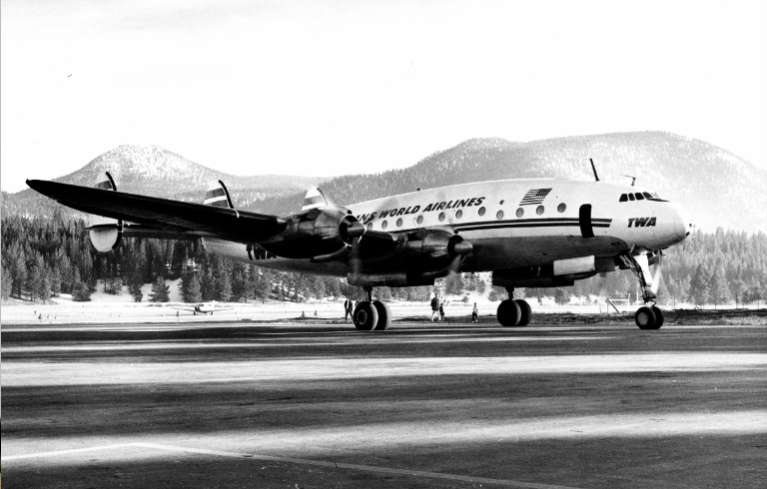
TWA was one of several airlines that used to fly into Lake Tahoe Airport. Photo/Del Laine

TWA was one of several airlines that used to fly into Lake Tahoe Airport. Photo/Del Laine

It was pointed out that rules can change and there is no guarantee the city would have the means or ability to jump through whatever new hoops the FAA erects.

And the figure above doesn’t include the couple million dollars the terminal would likely need to bring it up to national Transportation Security Administration (TSA) regs.

The city’s certificate has been in the inactive status because no commercial flights have come in for 14 years.

The reality the elected were faced with on March 17 was that the last commercial flight in and out of the South Lake Tahoe airport was in 2001. This was long after the peak in 1978 of almost 300,000 enplanements. When the city embarked on updating the master plan, which was required after a settlement agreement expired in 2012, the future of the airport had to be decided.

Last summer the council at the time voted to have the airport become a general aviation facility without commercial service. This week’s vote solidified that decision. It also will keep the airport subsidy to $354,000 a year. It was expected to increase nearly another $120,000 based on changes to the training for firefighters. (At the peak, the city was subsidizing the airport with $600,000 a year from the general fund.)

Fire Chief Jeff Meston told the council training will still occur – but onsite, instead of offsite as the feds now mandate.

Another issue the city will have to tackle is replacing the 30-plus-year-old vehicle used specifically for fighting an airplane fire. They cost almost $1 million.

The staff report says, “Without a letter of intent from an air carrier, it’s unlikely that the FAA would participate in funding a new (Aircraft Rescue and Fire Fighting) vehicle.”


Study: SBA loans going to luxury retailers, resorts

By Bruce Parker, Fox News

The Small Business Administration is the federal agency that helps “little guy” businesses get loans they couldn’t get through traditional lenders. Or so the story goes.

According to a 2014 federal oversight report from public research group American Transparency, taxpayer-backed SBA loans are popular with businesses serving “wealthy lifestyles.”

Found among the list of borrowers were Rolex and Lamborghini dealers, Napa Valley wineries, Sears and State Farm affiliates, Jackson Hole and Lake Tahoe resorts, and Levine Leichtman Capital Partners in Beverly Hills — not your typical mom-and-pop shops.

Read the whole story


Moose head stolen from Sunnyside

There is a moose on the loose. And this is no ordinary moose.

Thieves entered the lobby of Sunnyside and made off with the resort’s pet of sorts.

A mounted moose head was stolen from the Tahoe City restaurant-hotel between midnight and 7am Jan. 22. Placer County sheriff’s deputies are just now getting around to telling the public.

Anyone with information regarding the burglary or the whereabouts of the moose head are asked to call Detective John Lasagna at 530.581.6323 or remain anonymous by calling Placer County Crime Stoppers at 800.923.8191.

— Lake Tahoe News staff report


Businesses dissecting Sandoval’s revenue plan

By Kyle Roerink, Las Vegas Sun

Talk of tax season is ripe in the Nevada Legislature, but the chatter has nothing to do with April 15.

Gov. Brian Sandoval will lobby for his business license fee on Wednesday in the Senate’s revenue committee. The fee, an existing tax the Sandoval administration has reconfigured, would levy the key fiscal component of his $1.1 billion tax plan aiming to bolster the state’s public education system.

Sandoval is breaking with traditional conservative ideologies in the name of offering $438 million to boost new programs and opportunities for the state’s students, teachers and parents in the next two years. He is one of at least 10 Republican governors calling for tax hikes across the country and says he is determined to cement the 2015 session as the foundation for revamping Nevada’s bottom-rung education system.

Sandoval’s education-driven gusto has politicians and special interests singing his praises and willing to write checks.

Read the whole story


March Madness a drain on businesses

By Jonathan Berr, MoneyWatch

It’s called “March Madness” for a reason. About 70 million people will likely try their hands at picking the winner of the NCAA Men’s Basketball Tournament, wagering more than $2 billion. That’s roughly twice what was bet on the Super Bowl, according to data from the American Gaming Association, a trade group that’s pushing to legalize sports betting.

Unfortunately, many wannabe soothsayers will try their hands at prognostication at work, which creates problems for businesses. Challenger, Grey & Christmas, a provider of executive outplacement search services, pegs the productivity loss at $1.9 billion.

“That figure may be on the conservative side, considering this year could garner a lot more interest from even casual basketball fans eager to see if Kentucky can continue its undefeated season through the tournament,” said John A. Challenger, chief executive officer of Challenger, Gray & Christmas.

Read the whole story


Future of Lake Tahoe Airport being solidified

By Kathryn Reed

Keep the airfield as it is while providing flexibility for other uses at the airport was the consensus Monday night of the nearly 60 people who attended a meeting about the Lake Tahoe Airport master plan.

This was the third and final meeting before preferred alternatives are defined. Those will then be studied in environmental documents. Comments on all alternatives will be solicited for another month.

It’s possible the whole process could be completed in summer 2016.

It has been about 23 years since the city did a master plan for the airport. The goal is to define what it will look like for the next 20 years.

Last year the City Council said the airport will be a general aviation facility and commercial air service will be a thing of the past. However, it’s possible those priorities could change in the future. And the City Council at its last meeting approved an economic study be done for the airport. This will be incorporated into the business plan for the facility.

Lake Tahoe Airport's future is being decided by  the public and South Lake Tahoe officials. Photo/LTN file

Lake Tahoe Airport’s future is being decided by the public and South Lake Tahoe officials. Photo/LTN file

Michael Hotaling, the consultant preparing the master plan, on March 16 said the FAA – which is picking up 90 percent of the costs to prepare the plan – focuses on safety, security, sustainability and capacity. The city may have other priorities, but the feds’ desires by virtue of being the banker, so to speak, carry more weight.

With this being Lake Tahoe, environmental factors also play a role. So, while it might be a good idea to cut down trees for safety reasons, the Tahoe Regional Planning Agency gets to weigh in if they should be removed or some other mitigation done.

Air quality, compatible land use and stream environmental zones are potential constraints for any future development at the airport.

Some of the 14 people who spoke Monday night brought up:

• How the airport has virtually no services; that it requires flying somewhere else to get the bugs off the plane because they cannot be washed at this airport.

• The need to lower the rent on hangars.

• The desire for new instrument approaches.

• The idea to create an airport district like what Truckee has.

• The savings of giving up the FAA certificate that allows commercial service. (The 139 certificate is on today’s City Council agenda.)

The city’s subsidy to operate the airport has dropped 43 percent from 2010-11 to 2013-14, with the cost at $352,000. That could drop about another $120,000 by giving up the 139 certificate. Most of the certificate’s expenses are related to training firefighters to deal with a commercial airliner crash.

At this week’s meeting everyone had the opportunity to vote on the plans they liked best. Most want to keep the runway, tarmac and apron as they are.

Hotaling brought up reasons the city might want to consider lengthening or widening the runway – mostly to keep up with changing airplanes and specifications. But it was also noted that even though the Gulfstream V and planes like it are likely to be more common in coming years, pilots could land and take off at their own discretion.

The current 8,541-foot runway is not optimal for a Gulfstream in the heat of summer. Optimal conditions are for an 11,000-foot runway.

But no one has come forward advocating to lengthen the runway, nor do they want to shorten it.

Based on the alternatives being voted on Monday people are behind improving other amenities like adding a self-fueling station – which could lower the price per gallon of jet fuel, creating hangars to accommodate larger aircraft, and designating a swath of land east of the airport as non-aeronautical (this would allow for a potential concert venue).

More information about the master plan may be found online.


California poised to tighten watering restrictions

By Matt Weiser, Sacramento Bee

Millions of Californians soon may be forced to adjust their lives around a crucial timekeeping device in their homes. Not their alarm clocks, but their irrigation timers.

The State Water Resources Control Board on Tuesday is poised to get even tougher on water conservation as California now seems assured of a fourth year of drought. The main focus of the proposal set for a board vote is landscape watering, responsible for about 70 percent of all urban water consumption in California.

The board is expected to order every urban water agency in California to limit outdoor watering to specific days of the week – for both residential and business customers. In many cases, this would mean only two days per week.

Read the whole story


Nevada a hotbed for geothermal activity

By Jackie Valley, Las Vegas Sun

Humans have been using geothermal energy for more than 10,000 years, since American Paleo-Indians used hot springs for cooking, bathing and cleaning. But it wasn’t until 1904 that the first geothermal electric power plant was invented to generate electricity, when Italian scientist Piero Ginori Conti figured out how to turn steam into power.

The amount of heat in the top 33,000 feet of the Earth’s surface contains 50,000 times more energy than all of the oil and natural gas resources in the world.

Worldwide, geothermal power plants produced more than 11,700 megawatts of electricity, enough to meet the annual needs of more than 6 million typical U.S. households. The first geothermal plant in the United States debuted in 1992, and now, two decades later, 69 geothermal plants operate nationally. Several are in Nevada, and more are coming.

Read the whole story