Lawsuit: Hard Rock owners stiff contractor

David and Jon Park, owners of the Lake Tahoe  Hard Rock, are being sued for $10 million by one of the contractors. Photo/Denise Haerr

David and Jon Park, owners of the Lake Tahoe Hard Rock, are being sued for $10 million by one of the contractors. Photo/Denise Haerr

By Kathryn Reed

A contractor who did millions of dollars worth of work at Lake Tahoe Hard Rock is suing the owners for lack of payment.

“There are a lot of good people out of a lot of money right now. We are fighting for all of them,” Joe Stewart with SMC Contracting told Lake Tahoe News. “They haven’t given us a legitimate reason why they won’t pay us. They have used a lot of stall tactics.”

SMC did most of the work on the ground level – meaning the casino floor and restaurants.

The original contract was for $9.6 million. It ballooned to more than $19 million. To date SMC has been paid about $10 million and has about that much more to collect.

“We worked with them on a daily basis, almost hourly,” Stewart said. “They signed change orders they have not paid us on.”

Stewart said the owners were well aware of what the costs were as they requested changes.

Brothers David and Jon Park own the property. In October 2013 it was announced that the Park family, which has a number of holdings on the South Shore and in the Carson Valley, would be dividing their assets. The brothers got possession of what was the Horizon at the time.

These two have nothing to do with the Edgewood Lodge that will break ground in August – which SMC is working on – nor Edgewood Tahoe Golf Course.

When the lease was about to expire at the Horizon they initially were going to create what was going to be called the Park Tahoe, which is what MontBleu was named when it first opened. Then last summer it was announced the brothers were infusing $60 million into what would become the Hard Rock hotel-casino.

Rumors had been swirling even before the Jan. 28 opening that there were cost overruns and not all of the improvements originally planned would be developed.

Neither of the Park brothers returned calls.

According to the lawsuit that was filed last week, the owners submitted revised drawings in November – this was listed as revision No. 9. But the changes didn’t stop there, they just weren’t numbered after that.

“… the fact that eight revisions beyond that were contracted for were provided during the course of construction, the value of work performed more than doubling the original contracted contemplation by the contractor, all demonstrates the bad faith and unscrupulous practices of Neva, its agents and its representatives,” the court documents states.

Neva is the name of the company the Park brothers started for the Hard Rock project.

Many of those who are owed money are subcontractors from the Lake Tahoe and Reno area, with a few from Sacramento. SMC has paid a few of the smaller ones out its pocket.

“The short story is the owners made an incredible amount of changes to the project after it started and they demanded it get open by Jan. 28, but that came at a big cost,” Stewart said. “Once the building opened, they said they won’t pay us.”



Calif. bottled-water business grows despite drought

By Associated Press

SAN FRANCISCO – A new Crystal Geyser Water Co. plant opening at the foot of Mount Shasta is adding to criticism of companies that are bottling water in California’s drought.

Crystal Geyser plans to eventually tap up to 365,000 gallons a day from groundwater in Northern California’s Siskiyou County, the San Francisco Chronicle reported Sunday.

Converted from an old Coca-Cola bottling plant, the facility will become the latest of 108 bottling operations by various companies in the state, the Chronicle reported. Operations are due to start this fall.

Crystal Geyser executive vice president Judy Yee said Crystal Geyser officials are in contact with local residents to ensure its groundwater pumping “will not impact the environment in any detrimental way.”

Resident Raven Stevens, however, says she fears groundwater pumping by the bottled-water plant will use up the water that she and her neighbors depend on for their households.

“Crystal Geyser in one day plans to pump more water than any three of my neighbors will use in an entire year,” Stevens said.

California law in general places no limits on the amount of groundwater that property owners can pump, although legislation passed last year will start phasing in regulation of the most endangered aquifers after 2020.

Grass-roots objections to bottled water companies tapping and selling groundwater are increasing as California’s drought moves deeper into its fourth year. Bottled-water companies tapping into groundwater on their own property are exempted from the 25-percent mandatory water cutbacks that Gov. Jerry Brown ordered for cities and towns earlier this spring.

“Bottling water is a legal use of water under the law,” said Nancy Vogel, spokeswoman of the California Department of Water Resources.

While local officials say the water bottling operation will bring jobs, some residents object to the heavy water use.

Joyce Kyle, 77, told the Los Angeles Times that she and her family have lost grazing business because local water authorities have restricted use of her property’s water.

In the drought, “everybody’s suffering, not just the people in the lower half of the state,” Kyle said. “Letting Crystal Geyser come in and draw down groundwater, it’s not right.”


Airlines not tolerant of passengers with cameras

By Christopher Elliott, Washington Post

Next time you’re tempted to take a snapshot of an interesting cloud formation or your seatmate sprawling into your personal space on a plane, remember Arash Shirazi and Steven Leslie.

Both of them are law-abiding citizens and air travelers. And both recently ran afoul of the airline industry’s confusing photography rules.

With only days before the busy summer travel season unleashes millions of shutterbugs on America’s airports, it’s helpful to know about the airline industry’s little problem with cameras, so that your own camera doesn’t become hung up on it.

Read the whole story


STPUD encouraging residents to remove sod

By Kathryn Reed

More than 270,000-square-feet of grass have been eliminated in the six years since South Tahoe Public Utility District has had the turf buyback program. This equates to a savings of approximately 3.5 million gallons of water.

Last week the board agreed to put in $300,000 of district money into the program to be split between this season and next for residential customers and another $75,000 for businesses.

“We are committing our own resources to run the program irrespective of if the grant is approved,” General Manager Richard Solbrig told Lake Tahoe News.

To date the district has spent $400,000 on the program, with 95 percent of the money coming from grants. More grants have been applied for, but it’s not known yet if those dollars will be forthcoming.

The district is mandated by the state to reduce its water consumption by 28 percent. Turf buyback is a step toward meeting that requirement.

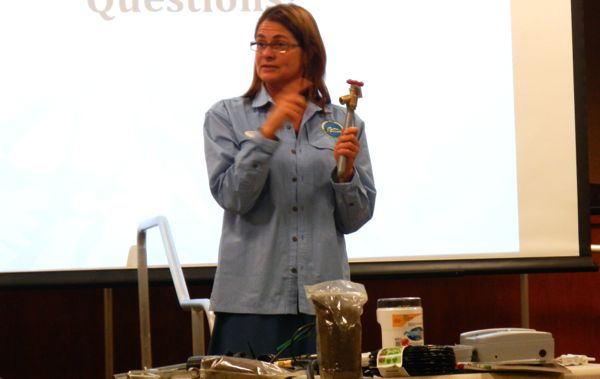
Jennifer Cressy with Tahoe Resource Conservation District explains various irrigation methods that don't use much water. Photo/LTN

Jennifer Cressy with Tahoe Resource Conservation District explains various irrigation methods that don’t use much water. Photo/LTN

The board on May 7 also agreed to keep the number of watering days to three, though that could change to two. The time to irrigate has been changed to between 6pm and 6am, with a maximum of 20 minutes per zone.

“The rebate program is an incentive to remove water intensive lawns with natural or adapted vegetation,” Donielle Morse explained at a turf buyback meeting last week. Morse is in charge of the district’s water conservation program.

She and Jennifer Cressy with Tahoe Resource Conservation District spent a couple hours telling about 20 people how the program works.

It is open to any STPUD water customer. It may be open to sewer customers if more money is available. About 200 households have participated going into this season.

It starts with getting your name on the list and then having Morse do a site visit. In years past the district insisted people have a living yard to be dug up. Because of the drought the district doesn’t want people watering something that will be removed, so dead lawns can be part of the program.

“We don’t want you to water your lawn. You will quality even if the lawn is brown. If it’s dirt, you won’t qualify,” Morse explained.

Another requirement is that at least 400-square-feet of turf must be removed. Residents don’t have to take all of their grass out, though. And it cannot be relocated to another area of the yard.

While the district doesn’t say exactly how people must fill in what will be a bare area, there are some requirements. The plot must be covered with 35 percent living plants at maturity. This is down from past years when it was 50 percent.

“When you remove the lawn you need to revegetate,” Morse said. “There needs to be efficient irrigation.”

A new watering system is usually in the form of drip irrigation. Sprinkler heads can be capped or retrofitted to comply.

Final inspections require having names of the plants that were used and the water capacity of the irrigation system.

Any dirt areas must be covered with a permeable mulch or ground cover like thyme or strawberries. Artificial turf is not an option. Rock, bark and woodchips are good choices.

While the district won’t be looking at Tahoe Regional Planning Agency best management practice rules or defensible space regulations, those policies should be followed, Morse said.

Rebate checks are not issued until STPUD verifies the lawn is out, and the new plants and irrigation system are in place. The rebate is $1.50 per square foot of turf that is removed, with a maximum of 2,000 square feet being eligible or $3,000.

Because of the uncertainty of cash flow for the program, it’s possible some people won’t receive checks until 2016. This also means people have two summers to complete the program, whereas previously it had to be done in one season.


Liberty making progress on solar facilities

Liberty Utilities is looking for permission from the California Public Utilities Commission to build two solar projects in Nevada; one in Minden, the other in Mineral County.

The renewable energy would be transmitted to Liberty’s California customers, which includes the Lake Tahoe Basin and Truckee, via NV Energy’s transmission lines. Liberty buys most of its energy from NV. The solar plants would make it less dependent on NV Energy and help meet future mandates from California in regards to renewables.

The Minden Sunrise Solar Project would be a 20 MW solar photovoltaic project at 760 Muller Lane.  The site is adjacent a wastewater treatment facility.

The Luning Solar Energy Center would be a 40 MW solar photovoltaic project located near Luning in Mineral County on Bureau of Land Management land.

Pending CPUC approval, Liberty intends to enter a contract with Greenstone and SunPower for the Minden project, and Invenergy for the Luning project.  Construction is expected to begin in early 2016 and operational by end of that year.

— Lake Tahoe News staff report


Calif. environmentalists sue over oil industry water practices

By Rory Carroll, Reuters

California environmental groups filed a lawsuit on Thursday that seeks to halt oil industry injections of drilling wastewater into nearly 500 wells, a practice they say threatens fresh water supplies and is particularly critical in light of a prolonged drought.

The lawsuit was filed in state court against California’s oil drilling regulator, the Division of Oil, Gas and Geothermal Resources (DOGGR), by the Center for Biological Diversity, the Sierra Club and Earthjustice.

Oil drilling in California produces far more water than oil, most of which is not suitable for drinking. The wastewater is typically injected back underground.

The lawsuit also wants the DOGGR to stop allowing oil companies to pump steam into about 2,000 additional wells injecting into aquifers, which they say are protected under federal law. Oil drilling companies inject water and steam to increase the flow of oil to the surface.

Read the whole story


Douglas deputies to launch new patrol boat

Nearly a year after Douglas County Sheriff’s Department’s patrol boat sank at Lake Tahoe, the new one will be plying the waters.

It should be in service by Memorial Day weekend.

The old boat sank in June 2014 when a weld failed on the hull. This was attributed to normal wear and tear.

The $245,000 boat is being paid for from the sheriff’s department’s drug seizure fund and savings in salaries.

— Lake Tahoe News staff report


Animals in drought-stricken West dying for water

By Darryl Fears, Washington Post

For the giant kangaroo rat, death by nature is normally swift and dramatic: a hopeless dash for safety followed by a blood-curdling squeak as their bellies are torn open by eagles, foxes, bobcats and owls.

They’re not supposed to die the way they are today — emaciated and starved, their once abundant population dwindling to near nothing on California’s sprawling Carrizo Plain, about 100 miles northwest of Los Angeles, where the drought is turning hundreds of thousands of acres of grassland into desert.

Without grass, long-legged kangaroo rats cannot eat. And as they go, so go a variety of threatened animals that depend on the keystone species to live. “That whole ecosystem changes without the giant kangaroo rat,” said Justin Bra­shares, an associate professor of wildlife ecology and conservation at UC Berkeley.

Endangered kangaroo rats are just one falling tile in the drought’s domino effect on wildlife in the lower Western states. Large fish kills are happening in several states as waters heated by higher temperatures drain and lose oxygen. In Northern California, salmon eggs have virtually disappeared as water levels fall. Thousands of migrating birds are crowding into wetlands shrunk by drought, risking the spread of disease that can cause huge die-offs.

As the baking Western landscape becomes hotter and drier, land animals are being forced to seek water and food far outside their normal range. Herbivores such as deer and rabbits searching for a meal in urban gardens in Reno are sometimes pursued by hawks, bobcats and mountain lions. In Arizona, rattlesnakes have come to Flagstaff, joining bears and other animals in search of food that no longer exists in their habitat.

“You think about it. In our urban environments, we have artificial water. We’re not relying on creeks,” said David Catalano, a supervisory biologist for the Nevada Department of Wildlife.

A Tahoe coyote. Photo/LTN file

A Tahoe coyote. Photo/LTN file


Saints’ owners family feud includes Tahoe house

By Katherine Sayre, Times-Picayune

The co-receivers in Texas who temporarily replaced Tom Benson in controlling some of the feuding family’s assets are asking a judge to approve several payments, including a $109,000 renovation on a house in Lake Tahoe.

A Bexar County probate judge earlier this year appointed former San Antonio Mayor Phil Hardberger and estate lawyer Art Bayern as co-receivers over the Shirley Benson estate trust, replacing Saints and Pelicans owner Tom Benson as trustee.

The trust, formed after Benson’s first wife died in 1980, holds interests in real estate, Lone Star Capital Bank and auto dealerships.

The 87-year-old’s daughter, Renee Benson, is seeking to have her father permanently removed as trustee, one of several legal conflicts playing out in Texas and Louisiana courts over the billionaire’s amassed wealth.

Read the whole story


USFS chief: Expect ‘above average’ fire season

By Kevin Freking, AP

WASHINGTON — The head of the U.S. Forest Service warned Tuesday of an “above average” fire season that could cost the agency more than $1 billion and require shifting funds from programs designed to prevent wildfires.

Tom Tidwell testified before the Senate Energy and Natural Resource Committee that the fire season is 60 to 80 days longer than it was just 15 years ago, and he didn’t expect any falloff. “These are the fire seasons we’re going to continue to have,” he said.

California and several other Western states are battling severe drought, increasing the risk of wildfires.

Tidwell estimated that the agency’s cost of fighting wildfires this year would be in the range of $800 million to $1.7 billion.

The Forest Service and the Department of Interior can transfer money from other programs once their fire suppressions accounts have been depleted. But Tidwell called that process self-defeating because it requires the agencies to delay work designed to limit the threat of wildfires.

Lawmakers agreed that changes are needed, but they differ on key details that could make consensus difficult. There’s some bipartisan support for the administration’s efforts to make the biggest forest fires eligible for disaster funding. Two Republican members of the committee, Jeff Flake of Arizona and John Barrasso of Wyoming favor an approach that places more emphasis on forest management projects to prevent wildfires, including a speedier environmental review process for those projects.

Republican Sen. Lisa Murkowski of Alaska, the committee’s chairman, said residents in her state are worried about the coming fire season. She said she visited Fairbanks recently and couldn’t remember another beginning of May with no snow on the ground.

The ranking Democrat on the committee, Sen. Maria Cantwell of Washington, called for Tidwell to work with other agencies to improve communications services during a forest fire. Last year’s Carlton Complex fire in her home state left many residents without power and the ability to communicate for weeks due to downed power lines. Police had to drive from town to town and use megaphones to spread word of the threat, she said.