Hard Rock helps Stateline casino core revenue

Lake Tahoe Hard Rock’s impact on the Stateline gaming numbers was evident with revenues jumping 59.91 percent to $14.5 million in April compared to the previous year.

The former Horizon was closed at the end of March 2014. No gaming existed in the building until the end of January when the property reopened as the Hard Rock.

Revenue throughout the state was on the upswing last month, according to figures released May 29 by Nevada Gaming Control Board. Gamblers left $897.9 million at casinos in April, an increase of 5.39 percent from 2014.

North Shore casinos were off by 16.47 percent, to $1.33 million.

— Lake Tahoe News staff report


Tolerance diminishes for letting bears eat trash

By Kathryn Reed

Bear boxes on the South Shore may become more common because of potential enforcement of those who leave trash out for critters and a loan program that is being contemplated.

The Waste Management Joint Powers Authority on Thursday ironed out some details about the ordinance that this summer is expected to be voted on by the jurisdictions that make up that body – South Lake Tahoe, El Dorado County and Douglas County. The ordinance would only affect the South Shore area of the counties that is serviced by South Tahoe Refuse.

The ordinance the JPA is putting together mimics much of what the counties have on the books. One major difference still to be resolved is El Dorado County requires bear boxes be installed during new construction or a major remodel, while the other entities don’t have this rule.

“The city doesn’t want to punish people who aren’t doing anything wrong,” JoAnn Conner, South Lake Tahoe’s rep on the JPA board, said in regards to not wanting a blanket mandate for residents to have bear containers.

Conner wants there to be an appeal process in case a neighbor ran over the trash can or something like that where the resident with the violation didn’t actually create the problem.

Not always is a bear box big enough for all the garbage. Photo/LTN

Not always is a bear box big enough for all the garbage. Photo/LTN

New regulations would likely require a homeowner who has a second violation in a two-year period be required to have a bear-resistant receptacle. That won’t necessarily mean a bear box.

STR officials are tasked with coming up with a list of containers that would deter bears from getting into the garbage.

“We think many times people don’t know they have a problem because we clean it up,” Jeff Tillman, president of STR, said May 28. “We need an education component.”

The refuse company is going to devise a flyer that it will send to all of its customers about the consequences of bears in trash. The JPA board will review it before it is mailed.

Any fines levied will be tied to the property, with liens placed on it.

STR employees have the ability to photograph a problem residence. That information can then be forwarded to officials in that city or county, with the jurisdiction then responsible for issuing a warning on the first violation and mandate a container after the second infraction.

Clean Tahoe is also cleaning up the streets on the California side where critters have gotten into trash. In March there were 38 such cases in the city and six in El Dorado County.

Catherine Cecchi, who runs Clean Tahoe, said she believes an ordinance like the one being drafted will help to drastically reduce the number of calls her workers respond to. When it comes to who the culprits are Cecchi said it’s a mixed bag of offenders – locals, tourists, second homeowners.

The JPA agreed to alter how those offenders are billed so Clean Tahoe can recoup what it is charged by STR to dump the “bear” trash it picks up.

For those residents serviced by STR who want a bear box it may be possible to buy one through a loan program. Tom Bruen, counsel for the JPA, is looking at the program Placer County adopted earlier this spring that allows residents to buy a bear box for about $1,200, pay it back over five years, with a one-time administrative fee of $120, but zero interest.

The JPA board likes this idea and directed Bruen to come back with a more concrete plan.

While board member Conner said she hears people don’t want bear boxes all over town, Sue Novasel, representing El Dorado County and the president of the Lake Tahoe Wildlife Care board, said her constituents tell her the opposite. She said personally she is an advocate of the containers. Nancy McDermid, Douglas County’s rep on the JPA, concurred with Novasel.

Novasel called the whole bear in trash issue a people problem.


Nev. lawmakers unveil plan to close entertainment tax loopholes

By Associated Press

CARSON CITY — Lawmakers are unveiling changes to Nevada’s live entertainment tax that they say will capture revenue from an evolving entertainment landscape and close confusing loopholes.

Republican Sen. Mark Lipparelli presented the much-anticipated changes on Thursday as an amendment to SB266.

The bill proposes a 9 percent tax on live entertainment and an 8 percent rate for boxing matches. The existing system imposes a 5 percent or 10 percent tax depending on the size of the venue.

The measure would include escorts but not prostitutes, and also clarifies that outdoor entertainment events such as festivals would be taxed.

Lipparelli said the existing law is confusing and full of exemptions. He said SB266 would clear up ambiguities and help broaden the tax base.

The bill is expected to get a committee vote Friday.


Calif. may make it easier to vote

By John Wildermuth, San Francisco Chronicle

Alex Padilla is looking beyond the state’s borders for programs that could dramatically change the way Californians vote.

Among the ideas that California’s new secretary of state hopes will boost anemic turnout: automatically registering people through the Department of Motor Vehicles and mailing a ballot to every registered voter.

“It will take two big steps to tackle the problem,” said Padilla, a former Democratic legislator from the San Fernando Valley who replaced the termed-out Debra Bowen after winning election in November.

“First we have to register the estimated 6.7 million Californians who are eligible to vote but not registered,” he said. “Then we need to have them actually cast ballots.”

Voting officials across the state agree that something has to be done to get more people to the polls. The 42 percent turnout in November’s general election and the 25 percent for the June primary were both record lows for California.

Read the whole story


‘Right to try’ bills would provide dying with unapproved drugs

By Victoria Colliver, San Francisco Chronicle

At the same time “right to die” legislation is working its way through the California Legislature, another patient issue is gaining momentum: the “right to try.”

Two bills would give terminally ill Californians who have exhausted their treatment options the right to try unapproved medications. Both have received bipartisan support, with one already heading to the state Senate after making it out of the Assembly last week.

Seventeen states have approved similar laws, while California is among as many as 15 states that have proposed legislation. Governors in Florida, Nevada and Illinois have right-to-try bills on their desks, and Arizona voters have approved a ballot measure to give patients the option.

Read the whole story


Path through forest to be cleared for Hwy. 89

By Kathryn Reed

KINGS BEACH – By fall 2017, getting through Tahoe City at the Y is predicted to be a lot easier.

This is because the nearly $30 million Fanny Bridge project received unanimous approval Wednesday by the Tahoe Regional Planning Agency Governing Board.

Doing something with this congested intersection has been talked about for near a quarter century. A sense of urgency developed when it was revealed the 87-year-old bridge that crosses the Truckee River has structural issues. However, last summer a Caltrans assessment showed the bridge was not in as dire condition as people had been led to believe. But by this time the environmental documents were being worked on and plans were being drawn.

For those who have spoken out against the project, most agree with proponents that something needs to be done to the bridge. What they disagree about is the rerouting of Highway 89 through the 64 acres near the Tahoe City transit center. The bypass will start just south of the transit center. It will not affected any designated trails.

“When you take something that is in need of help and create something new, that is not revitalization. That is damaging to the entire area,” Tahoe City resident Christina Anderson told the board.

Of the 17 people who spoke at the May 27 meeting at the North Tahoe Events Center about half were for the preferred alternative and the other half in favor of just fixing the bridge. And most of those who wanted the reroute represented an agency of some sort, with only one resident voicing his support.

Another two-lane bridge similar in size to the current Fanny Bridge will be built. This then becomes a city street that Placer County will be tasked with maintaining. The theory is with less vehicle traffic it will make for a better biking and walking experience. Creating a complete street is the goal.

The reroute will add 4 acres of coverage to what is now a forest. There will be a roundabout at the Y and then one at both ends of the realignment.

Fire and other emergency personnel believe having two routes connecting the West and North shores will provide an increased level of safety for residents and businesses in an emergency. Several people commented on how public safety vehicles have been stuck in traffic as have the buses.

Opponents, though, fear realignment will take people away from Tahoe City at a time when the North Shore city is still on economically unsound footing.

Carl Hasty, executive director of the Tahoe Transportation District, said the public would be able to have more input this summer as final designs are drawn. The project is about 30 percent done in terms of design.

In October 2013, Tahoe Transportation District – the lead agency on the project – received $25.5 million from the Federal Lands Access Program for this project as well as Meeks Bay Bike Path and Dollar Creek Shared Use Path.


Turning sewage into drinking water gains appeal

By Monte Morin, Los Angeles Times

As the drought drags on, water managers and environmentalists advocate turning sewage into drinking water
It’s a technology with the potential to ease California’s colossal thirst and insulate millions from the parched whims of Mother Nature, experts say.

But there’s just one problem — the “yuck factor.”

As a fourth year of drought continues to drain aquifers and reservoirs, California water managers and environmentalists are urging adoption of a polarizing water recycling policy known as direct potable reuse.

Unlike nonpotable reuse — in which treated sewage is used to irrigate crops, parks or golf courses — direct potable reuse takes treated sewage effluent and purifies it so it can be used as drinking water.

Read the whole story


USFS concerned nasty fire season approaching

By Kathryn Reed

Despite the rains this month, it’s dry out there and will just get worse now that 70-degree days have returned. This has agencies on heightened alert in what is expected to be a dangerous fire season.

U.S. Forest Service firefighters are reporting to work three weeks earlier than normal.

“Every day we get a reprieve with the weather, it buys us more time. It also delays the inevitable,” Kit Bailey, the Lake Tahoe Basin Management Unit’s chief firefighter, told Lake Tahoe News. “It gives us more time to prepare and train.”

While the Forest Service is the main body dealing with wildland fires, it works in conjunction with the other fire districts in the basin, including CalFire. The mantra this season is “one less spark, one less wildfire.”

Illegal campfires are something the USFS is going to have zero tolerance for.
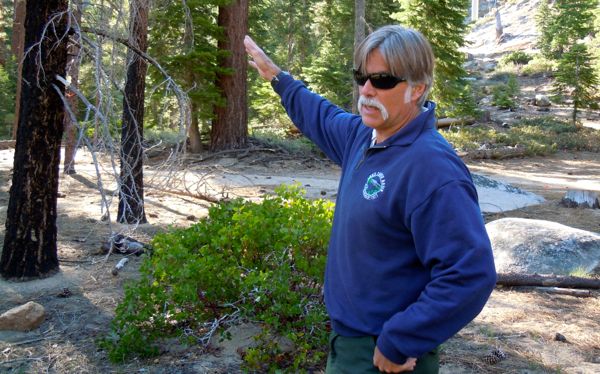
Kit Bailey with the U.S. Forest Service has been in the firefighting business for 36 years. Photo/Kathryn Reed

Kit Bailey with the U.S. Forest Service has been in the firefighting business for 36 years. Photo/Kathryn Reed

“Ninety-five percent of the fires here are human caused and most are from abandoned campfires,” Bailey said. “I don’t understand it. It’s frustrating. I’ve seen numerous times where there really wasn’t an effort to put it out.”

He said building, maintaining and extinguishing a campfire is a lost art. That is why his agency puts on a program at Taylor Creek to educate people about campfires.

It was an illegal abandoned campfire that started the devastating 2007 Angora Fire, which reduced 254 houses on the outskirts of South Lake Tahoe to ash.

The unfortunate thing is people who have left the smoldering campfires are seldom caught and even when they are it’s a hard case to prosecute.

While the entire Western United States is in a drought, California is at the “exceptional” level – making it at the top of the chart. Nevada isn’t much better off.

While staffing is always an issue, the agency has more people on the ground enforcing the rules, and will have access to numerous people to patrol the basin and backcountry during Fourth of July weekend.

Bailey is concerned, though, that there will be multiple fires at once that will stretch the firefighting ranks to the point that a fire will not be well staffed. Locally, the USFS has a cadre of on-call firefighters to call. Plus, there are the local government agency crews who have wildland experience. They were all used during Angora. The Forest Service is also training California Conservation Corps members to be a type two hand crew.

“The best way to fight a fire is to prevent it,” Bailey said. Education is one form of prevention. All fire agencies are doing their part to get the message out about the need to be diligent when it comes to all things fire related. The problem, as Bailey points out, is that often the people who need to hear the message most aren’t listening.

He said homeowners can start by making their residences less susceptible to fire. The Living with Fire website provides a wealth of information. Bailey believes the built zone – using flame resistant materials – is more important than defensible space.

When people see smoke, it’s imperative they call 911. The theory is that it’s better to get multiple calls than no call.

The fire cameras that are gradually being installed around the basin are another tool agencies can use.

It’s possible fire restrictions will go in place earlier than most years. June 15 is the likely date. The rules impact campfires, smoking and off roading. (The 2002 Gondola Fire was started from a cigarette being thrown from the Heavenly gondola.)

The forest is being stressed with the lack of moisture, which makes it more susceptible to a wildfire. The trees haven’t had enough to drink since this is year four of the drought.

“We are seeing a significant amount of tree mortality in the southern Sierra. It’s doubling every year,” Bailey said. A dead tree is more fuel for a wildfire.

The Forest Service has models to measure the fuel moisture content of trees. It should be in the 20s now, but it’s only in the teens.

“It’s a good indicator of what the season will look like,” Bailey said – hot, dry and prone to fire.


Covered California to cap price on drugs

By April Dembosky, NPR

In recent years, expensive specialty medicines used to treat cancer and chronic illnesses have forced some very ill Americans to choose between getting proper treatment and paying their rent.

To ease the financial burden, the California agency that governs the state’s Obamacare plans issued landmark rules Thursday that will put a lid on the amount anyone enrolled in one of those plans can be charged each month for high-end medicine.

The agency says its rules, set to take effect in 2016, “strike a balance between ensuring Covered California consumers can afford the medication they need to treat chronic and life-threatening conditions while keeping premiums affordable for all.”

Read the whole story


Calif. lawmakers grapple with gas tax hike

By Jessica Calefati, Bay Area News Group 

SACRAMENTO — Since taking office in 2011, Gov. Jerry Brown has helped to resolve some of California’s toughest fiscal challenges — mainly huge structural deficits and old, forgotten debts.

But this year he appears ready to take on Mission Impossible — getting Democrats and Republicans to agree to increase the state’s gas tax to fix California’s crumbling roads and bridges.

Hiking the gas tax has always been politically risky, especially in a state where cars are still king and that -gave birth to the anti-tax revolution in the late ’70s.

But hell might be about to freeze over: For the first time in decades, even anti-tax Republicans are open to raising prices at the pump to start cutting into the state’s $59 billion backlog of roadway maintenance.

Brown had telegraphed his intention to take up the issue in his January inaugural address when he asked Democrats and Republicans to do the “impossible” and craft an agreement to improve transportation infrastructure.

Read the whole story