Money, leadership stall Kahle Drive’s future

By Kathryn Reed

STATELINE – Kahle Drive is an auto repair shop’s dream. It’s that bad.

Douglas County owns this Stateline road, but it’s Oliver Park General Improvement District that is responsible for maintaining it and the other neighborhood streets.

The five-member board that operates the GID plans to fix the potholes, but the problem is the entire road needs to be overhauled. Like so many streets that were created in the basin decades ago, they were never designed to a high caliber or intended to be used year-round with the level of today’s traffic.

About a dozen residents attended an OPGID board meeting June 21 to voice their frustration. Some believe all the trucks going down the road to build the lakefront Tahoe Beach Club, the multi-million-dollar luxury housing development, have contributed to the road degradation because they drive through the potholes, which makes them larger.

Tom Castaneda and Bob Mecay bought the 19-acre parcel in 2002 for about $12.6 million. At that time 155 mobile homes occupied most of the land that sits between Rabe Meadow and the University of Nevada 4-H Camp.

They have a vested interest in wanting the road to be nice; it would help sales. After all, the goal is for people to move into the first 46 units in about a year.
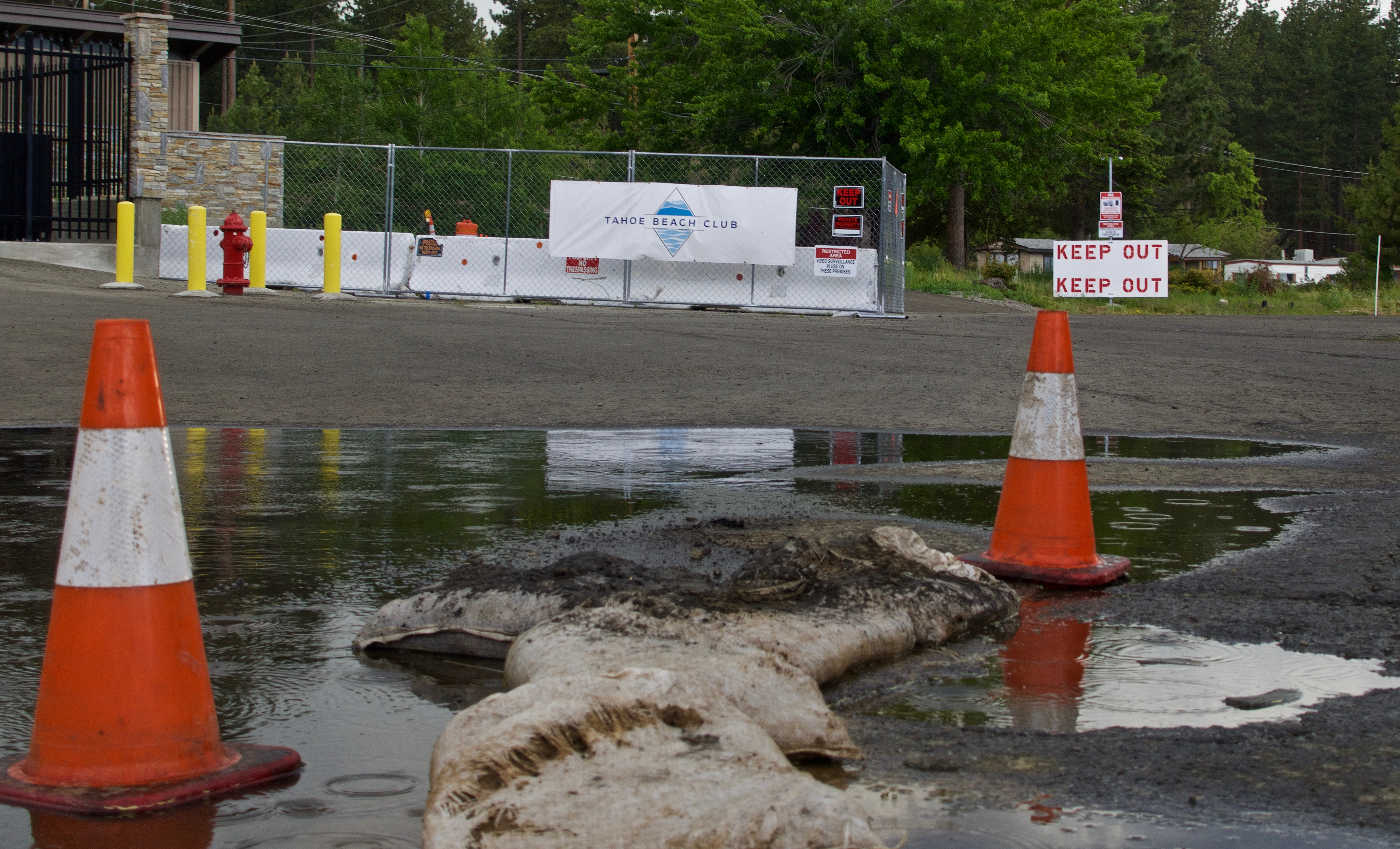
Potholes mar the entrance to the Tahoe Beach Club construction site on Kahle Drive. Photo/Kathryn Reed

Tahoe Beach Club was part of a group in 2014 that had Design Workshop come up with preliminary plans to make Kahle Drive a complete street. This would include sidewalks, curbs, gutters, undergrounding the utilities (electric, cable, telephone), lighting and bike lanes.

Tahoe Beach Club is not a member of the OPGID, however, the owners help pay for the maintenance of Kahle Drive. Along with Lakeside Inn, they are the largest contributors. Mecay and Castenada own a 39-unit apartment complex in the area that is part of OPGID.

Leadership and money are missing from the equation in order to move the complete street idea forward. While Oliver Park was part of the discussions about redesigning the entire street, the board members are all new since then and don’t have any institutional knowledge.

Mecay and Castenada brought consultant Steve Teshara to the meeting to talk about the complete street proposal. He repeatedly urged the OPGID board to have a bigger community meeting to get other players involved to move the project forward, and added that the district needs to decide if it wants to be the lead agency on this.

Most residents at the meeting just wanted the potholes fixed. The board at its July meeting is expected to have an agenda item regarding a future meeting to discuss the bigger road project.

The only enthusiasm for the larger project was from Teshara, Mecay and Castenada. It’s obvious why Mecay and Castenda want a beautiful gateway to their lakefront development.

For Lakeside Inn, the plan is to redevelop the corner of Highway 50 and Kahle Drive. (The current building is the sales office for Tahoe Beach Club.) The hotel-casino wants that intersection to be a gateway to Stateline with expansion of their holdings going there.

For the residents, they may get squeezed into paying for a nice road that benefits two commercial entities. Though, they would have a nice road to drive on.

Oliver Park GID’s responsibility is just roads; maintenance includes snow removal. Other than Kahle Drive, no one at Wednesday’s meeting had any complaints about the streets. And if the road becomes more than it is today, all that improved infrastructure would be OPGID’s responsibility — at least as things stand now. It is assessments to property owners that pay for the road maintenance.

Kahle Drive shows up in the five-year transportation plan for Douglas County that was approved by the commissioners in March. It’s under the Rehabilitation and Reconstruction Program. The estimated cost to turn it into a complete street is $2.283 million. No time line was given and the county’s share was listed as “undetermined.”

Under comments in the document, it says, “Reconstruct road with cost sharing from the Beach Club project. Redevelopement (sic) District area may be a source of funding. Chairperson [Nancy] McDermid to write a letter to assistant DA Zach Wadle about desolving (sic) Oliver Park GID.”

Dissolution was not discussed this week.

“This is not our road to maintain. Oliver Park GID is responsible but to our knowledge they have not been able to come up with a funding source. The county has met with the Beach Club and Oliver Park to discuss options last year, but that is about as far as it has gotten at this time,” Melissa Blosser, spokeswoman for Douglas County, told Lake Tahoe News.

No one from the county was at the meeting.

In January 2016, the county created a redevelopment area that includes Kahle. The hope is that some of the money collected through tax increment could be used to fund the Kahle Drive project. However, that cash will take years to accumulate and right now the powers that be want to spend it on the Stateline entertainment venue. Estimates are the redevelopment agency through the tax increment would collect $47.2 million in 30 years.

With how things move in the basin, this complete street could be a decade away at best.


SNC faculty may not have a job this fall

By Carole Jablon-Bernardi

INCLINE VILLAGE – When a college is competing to maintain enrollment, even grow it, and is faced with rising tuition costs to offset expenses, faculty can become the target.

Such is the case at Sierra Nevada College.

The administration of the four-year liberal arts institution in Incline Village announced to faculty members that no contracts would be renewed for the 2017-18 school year. SNC intends to award faculty agreements by August, but urged instructors that “no reliance should be made on this time line nor should the statement of the intended dates create an expectation or guarantee of future employment with SNC.”

For several years there has been a downward enrollment pressure on small, private liberal arts-oriented colleges that survive on small endowments. While SNC has experienced steady, modest enrollment growth over the last several years (primarily due to its graduate programs in teacher education which are primarily delivered in Reno, Henderson and online) the main SNC Tahoe campus and its undergraduate programs have been subject to this pattern being felt by many colleges across the country.

Changing demographics and less general demand for traditional liberal arts programs around the country, as well as competition for students, has intensified. SNC Tahoe competes with many better resourced liberal arts colleges for what has been identified as a “shrinking pool of students.”

“These are challenging times,” Atam Lalchandani, chair of the SNC board of trustees, told Lake Tahoe News. “Higher education in our country is undergoing a seismic shift. Many institutions like SNC Tahoe are finding ways to reduce the cost of higher education and improve accessibility.”

The college is aligning its annual contracting procedure to time better with its enrollment calendar. Historically, the college has become contractually obligated to a major expense before having good visibility of its revenues for the coming year. The change for 2017 is intended to be more fiscally responsible because it allows the college to budget, and spend, in line with enrollment.

A significant portion of the entering class at SNC Tahoe comes in later than other institutions (beyond the traditional May-early June period). This year, registrations are coming in at a slower rate than usual. SNC Tahoe is still in the process of gauging the most likely level of enrollment that can be expected for the 2017-18 academic year. The fall semester starts Aug. 21

SNC Tahoe anticipates growth in its enrollments at its Lake Tahoe Community College location, which was launched last fall. It’s even expanding offerings.

As of June 9, the board of regents for the Nevada State System of Higher Education approved a partnership between SNC Tahoe and Truckee Meadows Community College for this coming fall, similar to the SNC center in South Lake Tahoe.

These expansions help the long-term sustainability of the college by optimizing enrollment with options.

The shift in contract renewal timing does not suspend faculty pay or benefits. Faculty will continue to be paid during the summer. Many of the faculty work in summer and the college is proceeding business as usual as it relates to summer. No rehiring, or interviewing process applies to this shift and there are no unions involved. The college is shifting faculty contract renewals (some faculty are on 12-month contracts and others nine-month) from May to August.

When Rick Parsons, associate professor of art at SNC received his letter from President Alan Walker on May 24, he read the words “to provide written notice of non-renewal per Section 11 of the Handbook,” and admits it caused concern. Although the announcement also included a statement from Walker saying, “SNC is taking this action in order to have more time to better gauge the level of enrollment that can be expected for the 2017-18 academic year and the impact on the college’s ability to develop a balanced budget based on this decision, and other budget factors,” Parsons says it makes sense, but does little to alleviate the anxiety.

“SNC is a tuition driven Institution. The faculty understands this, but it’s not easy being put in this situation. As a faculty member, I believe admissions and recruitment should be the No. 1 priority for SNC,” Parsons told Lake Tahoe News. “Students are the heartbeat of this institution and they are the critical component that makes the college run on many levels. The highly qualified dedicated faculty and an active engaging curriculum, coupled with the location of the institution, is what attracts students. I think all members of SNC’s faculty, staff and administration should focus on enrollment to help stabilize the institution.”

Contract non-renewal comes on the heels of more than $2.1 million in budget cuts at SNC Tahoe since August 2015. That doesn’t stall the vision of Walker.

“A prosperous future awaits SNC Tahoe and to realize the promise of such a future it will need to be re-imagined, and reinvented, as a comprehensive university that is skilled at embedding the fundamental skills and knowledge areas at the heart of the liberal arts programs. We are well on the way to that vision,” Walker told Lake Tahoe News.

Some would argue that taking free or inexpensive courses online offers the same value. But others would argue being in a room with a teacher, and students is a much richer experience.


Fencing at Nev. waterfront properties still an issue

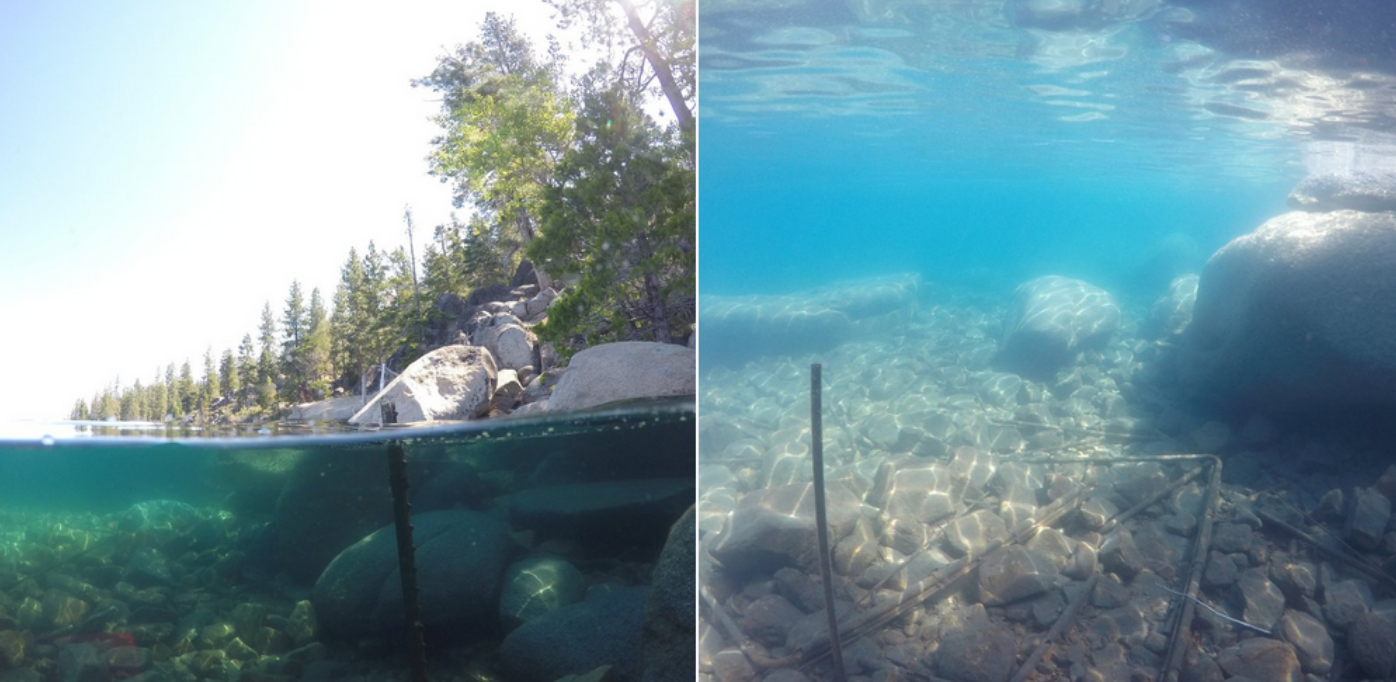
Debris from fences on June 21 at a property near Cave Rock. Photos/Anthony Spatucci

By Kathryn Reed

Fences in the water and along the beach on the Nevada side of Lake Tahoe continue to be an issue.

The Tahoe Regional Planning Agency was able to get the Tahoe Beach Club to remove its temporary fence, as well as the illegal fence at a property north of Cave Rock and at a home in Elks Point Country Club.

No fines were issued.

TRPA spokesman Tom Lotshaw told Lake Tahoe News this was “because they were cooperative and agreed to do the right thing and remove the fences.”

However, remnants of the Cave Rock fencing still could be seen this week. Debris was underwater on June 21. TRPA compliance folks were notified and headed back out to the site.

Tahoe Beach Club, the high-end development going in at the end of Kahle Drive where the mobile home park used to be, wants to put in a permanent fence.

Owners Tom Castaneda and Bob Mecay said historically a fence has been at that location, but others would continually tear it down. They told Lake Tahoe News the plan is to have the barrier look like the fence on the other side of the property separating the 4-H camp.

TRPA code allows fencing on private property that abuts public access sites. It must be lakeward of the high water line. A hearing officer would review it, which is a public meeting of sorts.


Nev. tourism leaders’ trip part of effort Trump wants to eliminate

By Richard N. Velotta, Las Vegas Review-Journal

Representatives of the Nevada Commission on Tourism plan to join a trade mission to India in September that’s part of a program President Trump wants to eliminate.

Lt. Gov. Mark Hutchison, who chairs the commission, told the board Wednesday that he would be participating in a Brand USA mission Sept. 10-15 to Mumbai, Chennai and New Delhi.

Hutchison views India as a market to generate tourism to Nevada the same way the state viewed China in the early 2000s and was an early entrant to that market.

Read the whole story


TAUs secured for Tahoe City Lodge

By Kathryn Reed

KINGS BEACH – Despite an ongoing lawsuit that could upend the Tahoe City Lodge project, more pieces of the development were secured last week at the California Tahoe Conservancy meeting.

The state board on June 15 agreed to sell 16 residential and tourist accommodation units that would equate to 61 usable units based on a bonus formula. The TRPA still needs to certify the transaction.

The Tahoe Regional Planning Agency has created commodities out of these units as well as commercial floor area, so know they have a monetary value. The initial goal was to limit development. The policy now restricts redevelopment and adds significantly to the cost of a project. It puts a cog in the wheel of the free market.

The bi-state regulatory agency subsequently came up with “bonus units” if the commodities came from a stream environmental zone. So, the overall amount of potential development is somewhat arbitrary.

Placer County was the one doing the purchasing at the CTC meeting.

The hotel is 118 units. It will be 78 condos and 40 traditional hotel rooms. The four-story structure will front Highway 28 and replace a dilapidated structure. The condos can be put into the rental pool as hotel rooms.

Some, though, questions how tourist accommodation units are being used for the condos.

Ann Nichols with the North Tahoe Preservation Alliance is worried the CTC is becoming a development agency and told the board as much. (Board member Larry Sevison was absent.)

The mission of the CTC “is to lead California’s efforts to restore and enhance the extraordinary natural and recreational resources of the Lake Tahoe Basin.”

Having the bank of commodities helps ensure the CTC’s solvency, especially as state bond money dwindles.

CTC and Placer had been negotiating a price of $12,000 per unit. When the state got wind the city of South Lake Tahoe was selling TAUs to Placer at $12,500, they inflated their price last month. That 64-unit transaction, though, with the city and Placer is not complete and is not expected to be until the Knights Inn in the city is demolished this summer. The $12,500 figure was agreed to about three years ago.

Jennifer Merchant, deputy CEO for Placer, told the board that changing the price at the last minute was not fair. Ultimately the board agreed to a per unit price of $12,250, for a total of $747,250.


Recreational sales of marijuana in Nev. in limbo

By Scott Sonner, AP

Recreational sales of marijuana in Nevada may not begin next month after all.

A judge added to the uncertainty Tuesday when he extended a temporary order barring the state from issuing pot distribution licenses to existing medical marijuana dispensaries so they can begin recreational sales July 1.

Carson City District Judge James Wilson said in a 11-page ruling that the ballot measure voters approved in November dictates that licensed alcohol wholesalers have the exclusive rights to pot distribution licenses for 18 months.

Read the whole story


Power out in parts of Tahoe City

An underground utility problem has hundreds of people in Tahoe City without power.

The outage was first reported at 11am June 21. At that time 1,500 customers had no electricity.

Liberty Utilities has no estimate on when power will be full restored.

— Lake Tahoe News staff report


Bill aims to help California save water

By Anshu Siripurapu, McClatchy

After years of drought, the state of California is bracing for water. Lots of it. Maybe even a rerun of the havoc caused by the failure of the Oroville Dam this winter.

As the record snows in the Sierra Nevada mountains begin to melt, there’s concern this spring and summer that the state will have more water than it can handle.

Earlier this year, heavy winter rains forced evacuations near the Oroville Dam, where repairs are now underway on the damaged flood-control spillway.

Congress is trying to help manage such drastic shifts in California’s water levels. Thursday, the House plans a vote on legislation sponsored by Rep. Tom McClintock, R-Garden Valley, that aims to help the state capture more of that water to save for a future dry season. The bill is expected to pass the House. Sen. John Barrasso, R-Wyo., is pushing a similar bill in the Senate.

Read the whole story


Set back for Truckee affordable housing

The Truckee Artist Lofts suffered another funding setback, but the town leaders are not giving up on the affordable housing project.

Twice now the project has failed to receive the 9 percent California Low-Income Housing Tax Credit.

The proposal is for 77 apartments in a four-story building ranging from studios to three bedrooms, with a monthly rent of $402 to $1,600. Ten would be at market rate.

The housing project is part of the larger Truckee Railyard Mixed-Use Development Master Plan.

— Lake Tahoe News staff report


Data: Visitors clogging Lake Tahoe roads

By Kathryn Reed

The time it takes to get from point A to point B all depends on the time year. Construction and snow are variables, but the real impact is tourists.

There are two main reasons they are staying in their vehicles. One, there isn’t reliable transit for them to use once they are in Tahoe; two, most are coming just for the day.

July and February are the two busiest months of the summer and winter seasons. During those respective months 42 percent of visitors to the Lake Tahoe Basin are here just for one day. About 20 percent stay for two days, less than 15 percent stay for three days, and less than 10 percent stay for four days. The percentages are about equal for July and February.

This data was presented to the South Lake Tahoe City Council on June 20 by Carl Hasty, leader of the Tahoe Transportation District.

Most of these people are coming from Northern California and Northern Nevada.

TTD a couple years ago paid a company for data that is collected from cell phone users. Through various apps people have on their phones companies are able to track where the person entered the basin, how long they stayed and which portal they left from.

The data also shows cell phones that were at a particular airport and then in the basin on the same day. Reno is by far the preferred airport with more than 58 percent using that airport in February, 50 percent in July. Other airports: Sacramento (13 percent both months), San Francisco (11 percent February, 22 percent July), Oakland (9 percent February, 6 percent July) and San Jose (9 percent both months).

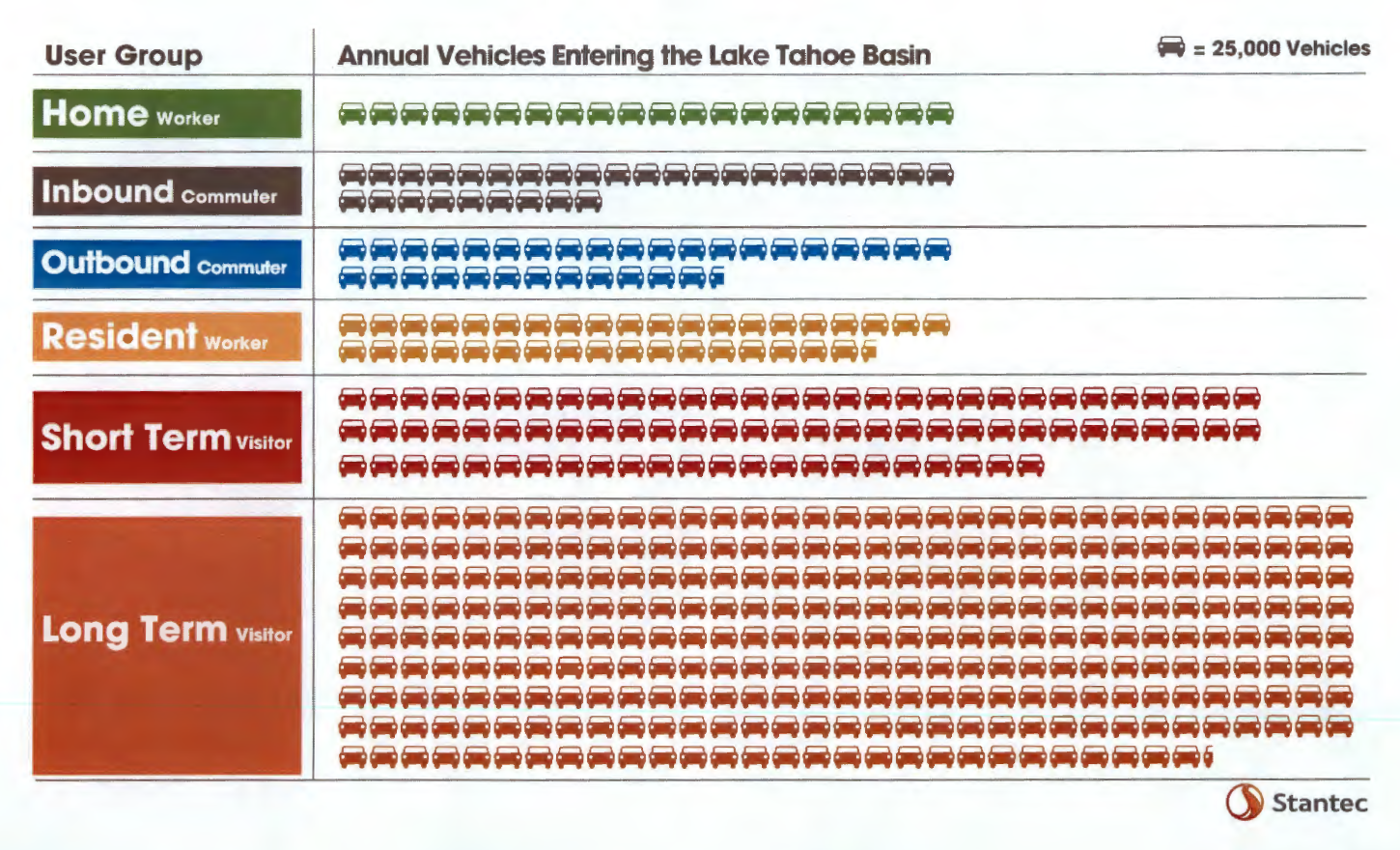
The above graphic shows the annualized vehicle trips by different groups in 2014. Visitors are making up more than twice the number of local trips. The South Shore is the No. 1 place they are traveling to.

“Visitors are pushing us over the edge when it comes to traffic,” Hasty said.

Of the 80 million person trips a year, only 1.4 percent use transit.

Hasty attributes that low number to the fact that the focus of transit is on locals or commuters, and not tourists. The exception is during the winter with the ski resort shuttles.

At the TTD meeting last week the board agreed to an aggressive plan to make transit a higher priority. This includes a high-speed cross lake ferry and more boat taxis on each end of the lake.

The goal is to get those tourists off the roads and into reliable public transit. With 20 percent of visitors using transit, that would mean more than 7 million vehicle trips removed.