Poll: Californians put high priority on environment

By Kurtis Alexander, San Francisco Chronicle
 
As California emerges as a force on climate change and a counterweight to President Donald Trump, residents of the green-minded state widely support environmental actions taken by leaders in Sacramento, according to a survey released Wednesday.

Fifty-one percent of California adults approve of the way Gov. Jerry Brown and the Legislature are handling environmental issues, the Public Policy Institute of California survey shows, even as state climate policies threaten to raise gasoline and electricity prices.

According to the survey, approval for Brown’s handling of the environment is up 16 points since he took office in 2011, while the state Senate and Assembly have seen a 20-point spike in their approval over the same period. Just 28 percent of people frown on Brown’s environmental performance, while only 33 percent disapprove of the Legislature’s record.

Read the whole story


Man drowns at Sand Harbor

A man swimming at Sand Harbor on Saturday drowned.

He had been swimming near the rocks. Lifeguards quickly pulled him out of the water on July 29 at about 5pm, but life-saving measures were not successful. He was taken to the hospital in Incline Village where he died.

His name, age and hometown were not immediately available. Officers said they believe he was in his late 20s.

“People need to use caution. The water is still very cold,” Washoe County sheriff’s spokesman Bob Harmon told Lake Tahoe News.

— Lake Tahoe News staff report


California advocates of foam packaging ban go local

By Laurel Rosenhall, San Francisco Chronicle

SACRAMENTO — Foam burger boxes and ice cream cups could eventually go the way of the flimsy plastic shopping bag — banned throughout California.

It’s not likely to happen this year. Environmentalists who push for the bans lost a big fight last month when the Legislature voted down a bill that would have banned foam takeout containers statewide. But growing pressure from communities that are passing the bans could eventually lead to changes on the state level.

With inaction in the state Capitol, environmentalists are concentrating their efforts on cities and counties.

Read the whole story


Calif. June 2018 ballot starting to take shape

By Phil Willon, Los Angeles Times

While a bevy of political hopefuls have jumped into the 2018 races for governor and lieutenant governor, most of California’s other premiere statewide political posts aren’t exactly drawing a crowd.

Aside from governor, California has seven constitutional officers chosen by the statewide electorate — all of which will be on the 2018 ballot.

Two Democratic incumbents, Controller Betty Yee and Secretary of State Alex Padilla, have yet to get challengers. And the state treasurer and insurance commissioner posts, usually catnip to the politically ambitious, have just a single candidate apiece.

Most striking is the dearth of Republican candidates, a possible symptom of the party’s decline in California and dismal prospects for victory. The last time a Republican won a statewide race was 2006.

Read the whole story


Investigation into Congero’s exploits expands

By Kathryn Reed

The investigation into former Lake Tahoe Humane Society leader Niki Congero is not limited to embezzlement allegations.

Congero, who was fired this spring from her job in South Lake Tahoe, had sought unemployment benefits. The nonprofit denied them. She appealed that decision. To do so meant giving testimony under oath.

Lake Tahoe News sought a transcript of that hearing from the state Employment Development Department.

“The EDD has declined to provide access to the records you requested,” was the email response. They said the information was privileged and not subject to the Public Records Act.

If Congero were to have lied to the judge about her circumstances, she could face perjury charges.

Congero is accused by the Humane Society of taking more than $100,000 from the agency. The Humane Society no longer responds to LTN’s calls or emails.

Congero left Tahoe earlier this summer reportedly for the Midwest. Because she is a native of New Zealand there is speculation she will try to leave the country. To obtain a no-fly hold on a person is a cumbersome process, and the crimes she may have committed may not rise to the level of federal intervention.

Local police officers have served several search warrants. More evidence leads to more questions, which could lead to charges beyond stealing money that was earmarked for dogs and cats. Detectives want to create an air tight case that will ensure the District Attorney’s Office presses charges. Until everything is in place, Congero remains free and to this day has not been charged with any crime.


Interior secretary to be in Nevada next week

By Henry Brean, Las Vegas Review-Journal

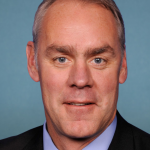
Ryan Zinke

Interior Secretary Ryan Zinke will be in Nevada on Monday as part of his review of national monuments in the Silver State, according to a rural county commissioner who said he has been invited to meet with the Trump Cabinet member.

The Interior Department has not yet announced the visit, but Nye County Commission Chairman Dan Schinhofen said he and other local officials are scheduled to meet with Zinke at 11 a.m. Monday at the community center in Overton, 65 miles northeast of Las Vegas.

Zinke is in the midst of reviewing 22 national monuments and five marine national monuments created by presidential decree since Jan. 1, 1996, to determine if the designations should be scaled back or eliminated. The Interior Department announced Wednesday that Zinke will be in New Mexico for three days starting Thursday to tour the Organ Mountains-Desert Peaks National Monument near Las Cruces.

Read the whole story


Burke Creek project to be completed in mid-August

The Lake Tahoe Basin Management Unit will begin the final phase of the Burke Creek project begins Monday.

Restoring the Burke Creek channel and adjacent marsh aims to decrease the amount of sediment that flows into Lake Tahoe and reduce the potential for flooding on Highway 50. 

During this final phase, the LTBMU will use heavy equipment and ground crews to decommission approximately 500 feet of the old channel and connect the new channel to the culvert, which conveys Burke Creek under the highway and was installed in 2016. 

Work is expected to be complete by mid-August.


Amodei: Trump can’t pardon himself

By Ray Hagar, Nevada Newsmakers

The congressman who served as head of Nevada’s Trump-for-president campaign said Wednesday on Nevada Newsmakers that Trump should not have the power to pardon himself. 

Nevada’s 1st U.S. House District Rep. Mark Amodei, R-Carson City, gave his opinion in response to President Trump’s recent statement on Twitter that the U.S. president has the “complete power to pardon.”

“Would a governor commute his own sentence?” Amodei said. “I mean, the self dealing. I mean we’ve got rules about nepotism, I mean, this is nepotism on steroids. It is total self interest.”

Read the whole story


Fresh Ketch to reopen; water on at Keys Marina

After more than two weeks, the water is flowing again at the Tahoe Keys Marina in South Lake Tahoe.

It has been shut off because of a dispute over unpaid bills.

The Fresh Ketch restaurant intends to reopen on July 29.

Donna and Robert Krilich and their son, Robert Krilich Jr., own the restaurant and Tahoe Keys Marina. They have been in a constant battle with the Tahoe Keys Property Owners Association. TKPOA operates the Tahoe Keys Water District, which supplies water to all of the homeowners as well as commercial entities in this South Shore enclave.

Even though the water is flowing, there has not been resolution regarding the $80,000 bill.

— Lake Tahoe News staff report


Climate change taking toll on Lake Tahoe

By Linda Fine Conaboy

INCLINE VILLAGE – Despite all its beauty, Lake Tahoe is sick.

Climate change is the overriding factor for warming water, dying trees and the proliferation of invasive species. It’s an uphill battle for scientists trying to keep the balance or even tip the scale into the healthy realm.

Geoff Schladow, director of the Tahoe Environmental Research Center, on July 27 presented the annual State of the Lake, touching on factors vital to Lake Tahoe’s clarity.

Schladow gave a snapshot of the lake’s health in 2016 using just-released data from TERC and the Tahoe Regional Planning Agency. He added humor to a fairly dismal look back, interjecting some of Shakespeare’s droller quotes and riffing off the Bard’s more waggish side.

Although the audience appreciated a nod to the humor of Shakespeare, Schladow’s talk was a serious one not dissimilar from his 2015 review.
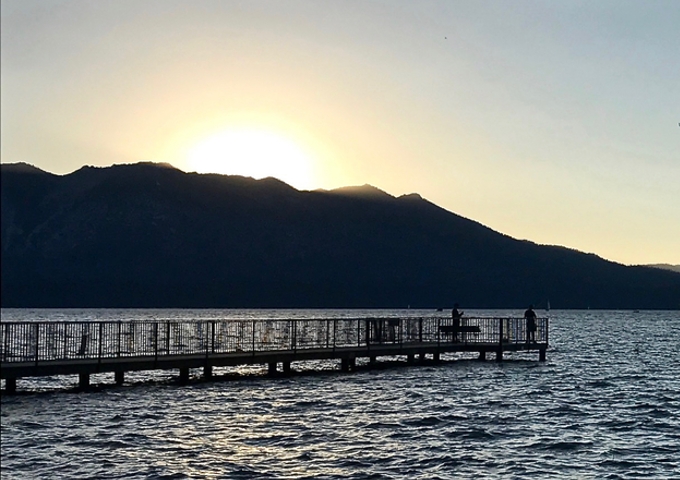
Scientists hope the sun has not set on their ability to combat the impact of climate change on Lake Tahoe. Photo/Kathryn Reed

Water temperatures continue marching upward, not good for a pristine high-elevation lake, he said. “This is climate change. Since 1968, the days of stratified water (warm water above cold water) has increased by 26 days.”

In layman’s terms, this stratification precludes the normal deep mixing of the lake’s waters, a process vital to Lake Tahoe—it’s the way the lake renews itself. The absence of a deep mixing of nutrients leads to warming water, contributing to a build-up of nutrients at the lake’s bottom. According to Schladow, deep mixing has not taken place for at least six years.

“Normally the deep mix occurs in March, but it’s still not happening. The nutrient levels are going up, nothing is moving them. Every day, the bottom of the lake is losing air,” he said.

Some organisms find this state of the lake favorable; these, Schladow calls bad hombres. For example, cyclotella gordensis is flourishing, cloning itself in vast numbers, especially in 2016.

“As soon as it starts increasing, algae starts growing and clarity goes down. This is not the first time this has happened,” Schladow said. However, he added, the good news is for many years there have been no new destructive species introduced to the waters of Tahoe.

However, those that are here now are not good, he said, citing an invasion of Asian clams in Marla Bay, discovered by what he calls, “citizen scientists.”

Asian clams can relocate themselves to other areas via circulation cells within the lake, and are now located in Zephyr Cove and even Sand Harbor, where the thinking is that they arrived there by boat.

Schladow posed the questions: Is it a big deal to have clams in Lake Tahoe? What will happen if nothing is done?

Clams will reproduce, laying at the lake’s bottom, causing algae to grow, which litters the shore. Clams then eat the algae, sluffing off nutrients in their waste, which causes more algae to grow, causing the lake to turn green instead remaining blue.

Asian clams are succumbing in large numbers due to rubber mats placed on the lake’s sandy bottom. These are incredibly effective, Schladow said. In areas overtaken by destructive milfoil weeds, herbicide usage is under discussion and ultraviolet light is being tested as a means of eradication.

“The collaboration that exists between the science community and the various Tahoe agencies is probably at an all-time high. This is important at this point in time when we are entering a period when we can no longer rely on what has worked in the past,” Schladow told Lake Tahoe News. “The past is in the past, and the future as far as climate, hydrology and ecology are concerned is far from understood. Scientists are helping to keep agencies informed, and at the same time the agencies are letting the science community know what their major questions are.”

A never-ending circle of destruction it seems, Schladow said, adding that Lake Baikal in Russia currently is facing its own algae invasion with huge amounts of the stuff on its shoreline. Baikal and Tahoe are like twin lakes in many ways.

“Suffice it to say, water temperatures are warming at the bottom of the lake, because of a lack of mixing,” he said.

On Tahoe’s shores, Schladow said tree mortality has doubled from 35,000 dead trees in the basin in 2015 to more than 72,000 in 2016. Drought and beetles are vying for first and second place as the leading causes for the die off.

In an effort to combat this situation, TERC and NASA are collaborating to measure plant stress from space at different times of the day, while helicopters and drones are surveying the entire shoreline to glean data.

There is some good news. While average water temperatures have continued to warm, in July 2016, they fell by 2.9 degrees due to increased winds and cooler than usual temperatures.

“The improvement in winter clarity was very encouraging of the agency efforts, and helps justify the expenditures that have been made to date,” he said.

In addition, the lake level rose by more than 20 inches, bringing it back above its natural rim and allowing it to flow into the Truckee River during the epic 2016-17 winter. And the Upper Truckee River floodplain is doing what it should be doing now by effectively accommodating the huge runoff from the recent blockbuster winter.

“We have come a long way in the last 15 years in instrumenting the lake. What this means is that we have made a lot of the investments needed to ensure that the right types of data are being collected,” Schladow told LTN. “These are critical to understanding how the lake is changing.”