Reno man kills neighborhood bear

By Jeff Delong, Reno Gazette-Journal

A west Reno resident shot and killed a black bear that was raiding garbage cans in his neighborhood, Nevada wildlife officials report.

The shooting occurred shortly after 11 p.m. Tuesday on Boulder Court in the Skyline Drive area, officials said.

Read they whole story


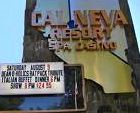
Sinatra’s old Cal Neva to suspend casino operations

cal nevaBy Dale Kasler, Sacramento Bee

Cal Neva, the legendary but faded Lake Tahoe resort once owned by Frank Sinatra, is closing its casino temporarily.

Canyon Capital Realty Advisors, the firm that has owned the Cal Neva since last spring, said Wednesday that the casino will close Wednesday. Canyon said it is in discussions with several licensed gambling operators, and the plan is to reopen the casino by year’s end.

The rest of the property, including restaurants and a showroom named for Sinatra, will remain open.

Read the whole story


Yosemite area project would challenge Tahoe for visitors

By John Holland, Modesto Bee

BIG OAK FLAT — This tiny town on the way to Yosemite National Park could get two large hotels, an indoor water park, an IMAX theater and other attractions.

The project, planned for a long-barren site on Highway 120 that local residents refer to as “the scar,” would be the biggest commercial development in southern Tuolumne County.

The plans have been discussed for several years and reached a milestone this month with the launch of an environmental study.

Developer Morgan Burkett said the highway, one of three major routes into the park, is ripe for the $60 million project.

Read the whole story


Whittell principal calling it quits

By Kathryn Reed

Sue Shannon will in essence be graduating with the class she welcomed as freshmen to Whittell High School.

The principal is retiring at the end of the school after being at the helm for four years and in education for 39 years.

The Zephyr Cove 7-12 school is a much different place compared to when she started. For starters, it was a 9-12 school. Classes were taught five days instead of the current four. The disconnect between the school and community was enormous.

One thing the next principal will have in common with Shannon is starting the school year with a new superintendent prowling the offices in Minden. The board now has two major vacancies to fill.

But beyond the obvious changes to an outsider, Shannon altered the culture of the school. She took over from Janie Gray, who was not well received by staff, parents or students. In fact, teachers walked out in protest while she was there.

Shannon, though, won’t take full credit for the changes.

“A lot of it was modeling, being clear about what I expected,” Shannon said. “And it was identifying student leaders to make those changes.”

She credits the staff, parents and community for being part of the change as well.

When declining enrollment forced Kingsbury Middle School to close and Whittell to add two grade levels, Shannon formed a consolidation committee made up of students. She renamed it the Student Issues Committee when the transition was completed. This was to allow a free flow of ideas between her and students.

“I believe there is a very solid foundation,” Shannon said of Whittell.

Coming from Los Angeles, Shannon anticipated the smallness of the school and the good and bad that might come with that.

“I didn’t anticipate the phenomenal community and parent support,” Shannon said.

She says the job of an educator is never done. Even though academic achievement is high at Whittell, she said a goal would be to rise to the next level.

“I’m always wanting more students to take ownership of the functioning of the school. I would like to increase the percentage of students in that matter,” she said.

In terms of education as a whole, after nearly four decades in the business, Shannon says the system is better and worse off than when she started.

“No Child Left Behind did raise the expectations of every child, not just the strong students. Conversely, I hope at some point No Child Left Behind will go to a growth model instead of just criteria because it doesn’t reward and recognize schools which maybe haven’t met the bar, but made tremendous growth,” Shannon said.

Shannon can’t imagine not working, but what she might do for part-time work after retirement remains to be seen. Traveling and exploring Tahoe are definitely on the 61-year-old’s to-do list.

“For one thing, I want to try cross country skiing and snowshoeing,”Shannon said. “I live in beautiful Lake Tahoe and there is so much I want to experience.”

Starting her day by being on campus before 7am, attending several night events each week and busy weekends have not allowed the Stateline resident to see much of Lake Tahoe.

“I have thoroughly enjoyed working at this school. This is a fabulous way to end my career,” Shannon said.


El Dorado County charter issues may be on November ballot

By Cathy Locke, Sacramento Bee

El Dorado County voters may be asked to decide three county charter-related issues in November, including whether to repeal the charter.

Following a special meeting last week to discuss recommendations of the charter review committee, the county supervisors directed staff members to further investigate issues and prepare language for three potential ballot measures, said Mike Applegarth, a spokesman for the county chief administrator’s office.

The first, in keeping with recommendations of the charter review committee and the 2008-09 grand jury, would allow voters to decide whether to repeal the charter.

Read the whole story


Tahoe Tallac Association fires executive director

tallacBy Kathryn Reed

When the 2010 season opens for the Tahoe Tallac Association in five weeks, it will be under the direction of new leadership.

Steve Farnsley, who had been executive director for a little more than two years, was let go earlier this month. In his place on an interim basis is Lori Cramer. Cramer gave up her role as a board member, which she has had on and off for about five years, in order to take the helm.

The association runs festivals and theater performances at the Tallac Site near Camp Richardson off Highway 89 on the South Shore from spring through fall.

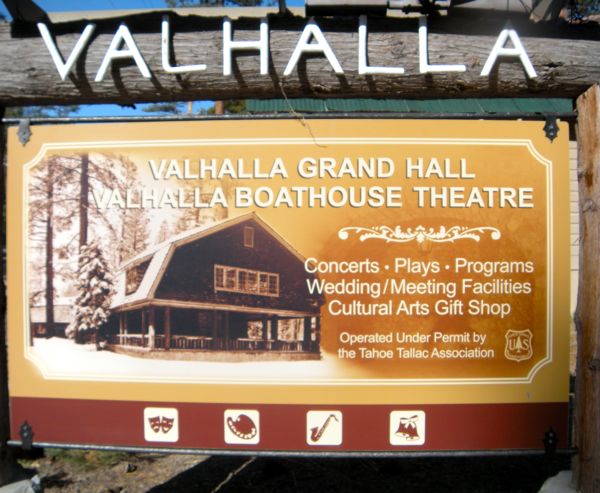
The entire Tallac Historic Site is 74 acres. The Valhalla Grand Hall, Boathouse Theatre, and twin cabins that house the gift shop and artists in residence are leased by the association from the U.S. Forest Service. The agreement calls for 20 percent of the association’s gross going toward restoration of the site.

At times the association and Forest Service have been at odds. Cramer said she met this week with the federal agency.

“It’s a brand new day,” she said of the relationship. “We all agreed to act as a team.”

Cramer has been spending the last few days making sure everything is in order — which so far it is. She’s familiarizing herself with the contracts and festival list. This will be the 31st year of the Valhalla Arts and Music Festival.

“I already know everybody so I don’t have to learn the ins and outs of a new community. Hopefully, that will help,” Cramer said. “I don’t know if you will notice big changes except my goal is to get more community exposure.”

One thing she wants to do is have the Valhalla building open when events aren’t going on. She would like tours led by volunteers.

The other thing the new director wants to do is secure more members. She wants so create a sense of ownership for locals of this site and the events.

For the past 15 years Cramer has run Sierra Weddings. She will continue to that for now.

“I’m always trolling for new opportunities out there. I don’t see this as a complete change. I see it as an expansion of events,” Cramer said.

Cramer is the fifth executive director in the association’s history. Carol Spain and a handful of others are credited with making the Tahoe Tallac Association a reality. Spain left for the Bay Area in 2002.

“There’s definitely been a hole since Carol Spain. She was a tremendous woman. To be sitting in her shoes is a huge honor for me,” Cramer said.

Board President Eric Taxer said the board would take a close look this summer at what it wants from an executive director, restructure job duties, look at the salary and seek to hire someone permanently when the season is over in the fall.

Taxer would not elaborate on what led the board to sever relations with Farnsley.

For the Tahoe Tallac Association’s 2010 list of events, click here.


TRPA chairman stepping down; retiring from state job

Nevada Department of Conservation and Natural resources Director Allen Biaggi will retire April 30 after more than 30 years of state service.

Biaggi is also chairman of the Tahoe Regional Planning Agency Governing Board. He will continue in that capacity until his term expires at the end of December.

Allen Biaggi at the August 2009 Environmental Summit. Photo/Kathryn Reed

Allen Biaggi at the August 2009 Environmental Summit. Photo/Kathryn Reed

Biaggi was appointed director in July 2004 by Gov. Kenny Guinn. His tenure in the position was continued under Gov. Jim Gibbons.

Previous to his appointment as director, he was the administrator of the Nevada Division of Environmental Protection, appointed by Gov. Bob Miller in 1998. Prior to that he served in various staff and management positions within the agency.

“I look forward to this new chapter in my life and the opportunities and challenges it brings,” Biaggi said in a press release. “I want to thank the three governors I have served under in appointed positions, Governors Miller, Guinn and Gibbons. I appreciate them for their trust, confidence and support.”


Transit infrastructure upgrades planned for basin

By Kathryn Reed

STATELINE — Transportation planners realize not everyone wants to abandon their vehicle. Easing congestion through better driving routes, providing alternatives to passenger vehicles, and creating better connections for walkers and cyclists are the goals.

The idea is the infrastructure improvements will also make walking and cycling a more pleasant experience in the region.

Tahoe Transportation District, which has been around since 1980, is in the business of securing money for the plans various jurisdictions have and helping with the implementation. Because the basin has multiple layers of government and bureaucracy, it’s the TTD’s job to be the umbrella agency to get things done.
Carl Hastly looks over the map of Lake Tahoe Basin transit plans. Photo/Kathryn Reed

Carl Hasty looks over the map of Lake Tahoe Basin transit plans. Photo/Kathryn Reed

TTD, though it never went away, had been dormant in many ways for many years. Carl Hasty now manages the district and Alfred Knotts is the transportation projects manager. They work for an 11-member board comprised of representatives from throughout the region, including both state transportation departments.

“We look at system needs for basin transportation,” Hasty said. “This board is focused on implementation and getting things done.”

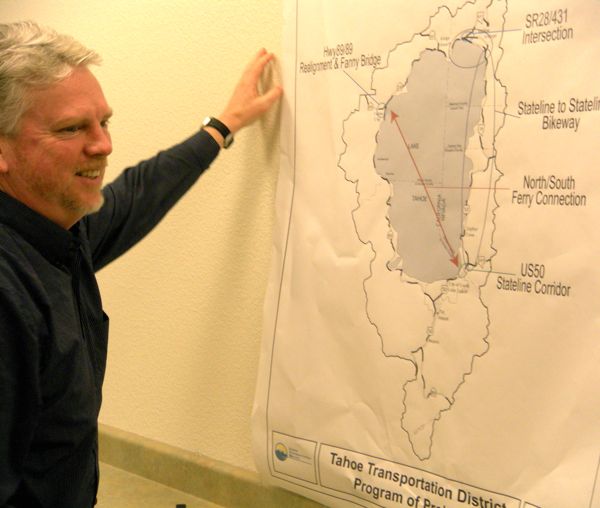
A map in the conference room of their Stateline offices shows the five projects the TTD is working on.

One is the Loop Road on the South Shore that involves California and Nevada. For decades people have talked about diverting traffic behind the Stateline casinos to make the corridor more pedestrian friendly.

“Right now the concept is not to eliminate all traffic on Highway 50,” Hasty said. “Maybe it will be three lanes with one being for transit and bikes.”

Knotts said the environmental review is the next stage, and working with Caltrans and the Nevada Department of Transportation to development alternatives for the loop road.

With the Heavenly Village project completed in 2002 and the so-called convention center project still on the books, the idea for years has been to divert vehicle traffic so pedestrians would be more comfortable frolicking in the area.

“Stateline is where the bed base is. It is where the congestion is,” Knotts said.

Planners and developers of infrastructure are taking an approach that hasn’t often been done at the lake — looking at the big picture instead of solely on an individual project-by-project basis.

As the Loop Road goes forward, those involved are aware Edgewood Companies wants to develop a hotel on its golf course, that Horizon casino may evolve into something besides a gaming venue when the lease expires, that the Greenway Bike Trail from Meyers will empty at Stateline, that the Van Sickle Bi-State Park has broken ground under the Heavenly Gondola, and that the Stateline-to-Stateline bike trail is well on its way to being a reality.

“They all support getting around by linking places,” Hasty said. “We are looking at building a network that offers choices to get from one place to another.”

All of this is for locals as well as tourists.

The goal is have all future transportation projects be interrelated and not isolated. The car isn’t going away, but the idea is people will have more choices.

The Tahoe Transportation District is also involved in the Stateline-to-Stateline bike trail. Work on the South Shore end should begin next year.

(Click here for more details.)

Another TTD project involves South Lake Tahoe and Tahoe City — water transit. The goal is connecting the North and South shores via transit. By the end of the year the federal transit analysis should be finished. Out of that will come a recommendation if water transit is viable or not.

Another project in Tahoe City is figuring out what to do with the Fanny Bridge that crosses the Truckee River. The bridge is seismically challenged and could be deemed unusable for certain weight vehicles by 2013.

“It’s a lifeline bridge,” Knotts said, meaning no other crossing exists to keep commerce rolling in that area of Highway 89.

Six options have been proposed. It’s possible Fanny Bridge could become a pedestrian-bike only structure. Vehicles might be routed across the river farther up Highway 89, a bit closer to Truckee.

“It would remove a choke point and improve the flow,” Hasty said. “Then you design for the character of the place you want.”

Not having traffic in that Y intersection could make the area more walkable.

The other project in the basin the Tahoe Transportation District has a hand in is at the junction of highways 431 and 28 in Incline Village.

“It’s a scenic byway so we want to improve the aesthetics,” Knotts said.

Safety and efficiency of the Mount Rose Highway are also factors. NDOT is designing and building the project, with construction likely to begin in 2011.

A roundabout is being talked about. The plan, which is still in the works, is likely to tie into bike trails and address water quality concerns.

“I think these projects bring needed change and opportunity to the lake,” Hasty said.


Court ruling puts 911 fee in jeopardy for California cities

By Kathryn Reed

Conflicting court rulings have South Lake Tahoe officials trying to figure out if the nearly $500,000 it collects each year from the 911 fee on phone bills is legal.

“Clearly the existing 911 fee is important in our ability to provide emergency dispatch services to the community and to visitors. The dollars derived go exclusively to operate the city’s emergency dispatch center and are an essential part of our city’s emergency delivery system,” City Manager Dave Jinkens said.

However, the state Supreme Court refused to hear an Appellate Court’s decision out of Union City regarding the matter. This means that ruling which deemed the fee to be a tax is the law. But a case out of Santa Cruz says it is a fee, not a tax.

It’s up to individual cities to figure out what it is.

Why the distinction between the assessments being a tax versus a fee is important is because a city can impose a fee, but voters must approve a tax.

City Attorney Patrick Enright said he expects to bring a recommendation to the City Council in April. It will be up the council to decide if it believes what is collected is a fee or a tax.

If it’s ruled a tax, then the council would have to decide to eliminate it or ask the voters in November to continue with it.

If the half million dollars disappears, it’s not known how the dispatch services would be funded.


14 Tahoe forest fuels projects approved by state agency

By Kathryn Reed

Nearly $1 million was allocated by the California Tahoe Conservancy board to reduce forest fuels, improve habitat and forest restoration.

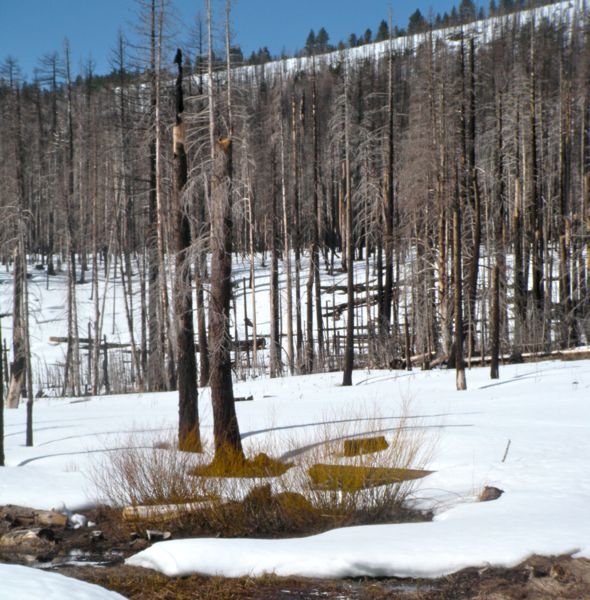
In that dollar amount is $200,000 to finish work in the Angora Fire area on CTC land. This includes the urban lots as well as 30 acres the state owns. Many of the trees that were planted after the devastating June 2007 fire have died.

Work in the Angora burn area will take place this summer. Photo/Kathryn Reed

Work in the Angora burn area will take place this summer. Photo/Kathryn Reed

More trees will be planted, plus the money will pay for two years of monitoring the revegetation project.

When it comes to thinning of the forest, the CTC has seven areas targeted on the South Shore, four on the West Shore and three on the North Shore that will be treated this year. More than 400 acres will be treated.

It costs about $3,500 to treat one acre.

The projects that were approved on Thursday by the Conservancy board will be paid for with federal and state money that has already been secured.

The objectives of the plane are to: enhance the health of forest resources, preserve water quality, enhance wildlife habitat, and provide for public safety and protection of property.

“Fire frequency, intensity, severity, and seasonality have a great impact on forest vegetation,” the staff report says. “Studies of fire frequency dating back hundreds of years, known as the fire return interval, have shown that each acre of conifer and ponderosa pine forest burns on an average of every 11 to 15 years. In contra, it may now be almost 200 years before each acre of this forest type burns as a result of fire suppression causing forest fuels to continue to accumulate.”

The Conservancy is hoping the Lake Tahoe Restoration Act, which is percolating in Washington for reauthorization by Congress, will be approved. In it is millions of dollars dedicated to forest fuels reduction throughout the basin in both states.

The Conservancy has spent about $1 million on average per year during the last decade on forest fuels management.