Highway 50 may be routed through neighborhoods

By Kathryn Reed

STATELINE – Turning Highway 50 near and through the casino corridor into a city street and the roads from Pioneer Trail behind Raley’s at the state line into a state highway may one day be a reality.

Known locally as the Loop Road project, officials are now trying to get people to call it the Highway 50 South Shore Community Revitalization Project.

Highway 50 going east beyond Pioneer Trail near the state line could become a city street. Photo/LTN

Highway 50 going east beyond Pioneer Trail near the state line could become a city street. Photo/LTN

There was a time when the highway was to be rerouted behind all of the main Stateline casinos. Now the project only involves the mountainside of the loop road – what goes behind Harrah’s and MontBleu.

The thinking is it would not be wise to keep the state highway between the lake and casinos; that’s why it is not taking a western loop.

Also originally talked about was starting the realignment at Heavenly Village Way/Park Avenue. That has been scrapped to now start at the intersection of Highway 50 and Pioneer Trail. The alignment would somewhat follow the shortcut locals take to avoid driving through the casino corridor.

This would mean turning what are now city streets into a five-lane highway – two lanes in each direction, with a middle turn lane. The casino area would be three lanes – one in each direction with a middle turn lane.

Where Lake Parkway hooks up with Highway 50 near MontBleu could become a roundabout.

Reasons for the change

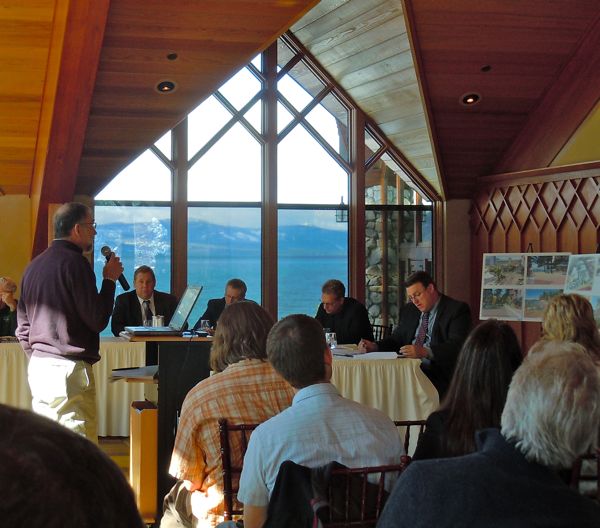
Highlights of the project were touched on by Carl Hasty, executive director for Tahoe Transportation District – lead agency on the project, at the Nov. 4 joint South Lake Tahoe City Council-Douglas County Commission meeting at Edgewood Tahoe.

Hasty told that group one advantage to the preferred alternative is the street in front of the casinos could more easily be closed off for special events. This would avoid nightmares like a few years ago when Highway 50 was shutdown for Opening Days Lake Tahoe.

Michael Olson, chairman of the county commission, said he likes the idea. “It would create a Tahoe experience.”

Hasty said studies show two-thirds of the highway traffic has a destination other than the casinos or Heavenly Village, so rerouting them would not take them away from their end point.

People would still be able to access the casinos as they do now – on either side of the structures.

While three alternatives are proposed (one is to do nothing), the above scenario is what transportation officials’ support.

Meetings begin this week to gather input from the public. Written comments will be taken until Dec. 16. The scoping document provides more details.

All of this ties into the South Shore Vision Plan – making the area from Ski Run Boulevard to Kahle Drive more user friendly. But the Loop Road project has been talked about for decades, while the former is a new concept.

Eliminating people’s homes

To do what proponents want would mean displacing a number of people, along with businesses at the corner of the highway and Pioneer Trail. It’s a residential community on the back roads that would become a state highway.

Hasty said when the time comes property owners would be offered fair market value.

When asked about how South Lake Tahoe’s eminent domain policy plays into their thinking, he told Lake Tahoe News, “It could stop the project.”

He also added, “Do you pay more than market value or do you not do the project?”

The City Council in 2007 passed a resolution, with an addendum added in March 2008, that essentially bans eminent domain from being used in the city limits. While there was talk of requiring the issue be taken to the voters for the policy to be overturned, that never got written into the resolution. But the council could still make it be a contingency factor for the project to go forward.

Mayor Hal Cole told Lake Tahoe News when Hasty made a presentation a year ago to the council, the eminent domain issue came up.

“They know how the city feels,” Cole said of project proponents.

The city resolution specifically talks about not using eminent domain to displace low- and moderate-income residents living in any type of dwelling.

Property owners have been mailed information about the project. Tenants are expected to receive a flyer this week. But that is just days from the Nov. 10 TTD board meeting – not giving people much time to rearrange their schedule if they were wanting to attend.

Relocation law demands people displaced via eminent domain be relocated. Hasty said that is the plan. Specifics have not been detailed, but Hasty said housing would be found for people in the general area. After all, many of those people have limited incomes and walk to work.

Hasty also said the project is still a long way from being a reality.

It’s estimated to cost close to $70 million. That price tag includes acquisition and relocation expenses. TTD would like to apply for federal grants in a year if the project is shovel ready by then. That would mean having the environmental documents completed.

Besides getting the city to agree to the project, Douglas County will have to say yes. So will Caltrans and the Nevada Department of Transportation.

Hasty said the two state transportation agencies have been approached and have participated in discussions. But this is a local project, not something either state is spearheading.

Dates to know:

• Nov. 10 at 1pm, Tahoe Transportation District board meeting at the Tahoe Regional Planning Agency board room, 128 Market St., Stateline.

• Dec. 7 at 9:30am, TRPA Advisory Planning Commission meeting at the TRPA board room, 128 Market St., Stateline.

• Dec. 16 is the last day to submit comments on the scoping document.



Fluoride in water becoming less common

By Lizette Alvarez, New York Times

MIAMI — A growing number of communities are choosing to stop adding fluoride to their water systems, even though the federal government and federal health officials maintain their full support for a measure they say provides a 25 percent reduction in tooth decay nationwide.

Earlier this month, Pinellas County, on Florida’s west coast, voted to stop adding fluoride to its public water supply after starting the program seven years ago. The county joins about 200 jurisdictions from Georgia to Alaska that have chosen to end the practice in the last four years, motivated both by tight budgets and by skepticism about its benefits.

Eleven small cities or towns have opted out of fluoridating their water this year, including Fairbanks, Alaska, which acted after much deliberation and a comprehensive evaluation by a panel of scientists, doctors and dentists. The panel concluded that in Fairbanks, which has relatively high concentrations of naturally occurring fluoride, the extra dose no longer provided the help it once did and may, in fact, be harmful.

It is a view that also was shared by four out of seven commissioners in Pinellas County who first raised the proposal as a cost cutting measure.

“I’m in opposition to putting a medical treatment into the public drinking water supply without a vote of the people who drink that water,” said Norm Roche, a newly elected Republican county commissioner who spent 10 years doing policy research for the county Water Department and who led the turnaround effort. “We had a dozen to 15 doctors, dentists, dental hygienists and chemists here who want us to continue this practice but who could not agree themselves on how best to use fluoride.”

Some 700,000 people — 75 percent of the county — will be affected by the vote. The rest receive water from a different source.

Read the whole story


Water districts raise rates as consumption declines

By Loretta Kalb, Sacramento Bee

It doesn’t seem fair – and to some it doesn’t make sense.

If you’re worried about water bills and you use less water, you should get a lower bill, right?

But that’s not happening in the Carmichael Water District.

The district has announced it wants to raise water rates 18 percent starting Jan. 1 – on top of an even bigger rate hike already imposed through mid-2014.

The reason: Water use in the district has fallen below historical average by an astonishing 25 percent, thanks to a mild and wet weather year, foreclosed homes and ratepayers using less water because of rising water bills.

With the cut in use, the water district’s revenue has dropped sharply.

It’s a curious turnabout in an industry long worried about having sufficient water supply for a growing population.

The state is requiring water suppliers to achieve a 20 percent reduction in urban per capita water use by 2020, a goal established in 2009 that has received plenty of public attention.

Not so well known outside water circles, however, is what it means for the finances of California’s water districts, which traditionally have high fixed costs.

“It really wasn’t until 2009 that we said, ‘OK, everybody is going to try to conserve,’ ” said Chris Brown, executive director of the California Urban Water Conservation Council, a group that includes about 130 of California’s largest water suppliers.

Read the whole story


Report: Nevada pension liabilities vastly understated

By Sean Whaley, Nevada News Bureau

CARSON CITY — Nevada’s public employee pension system is one of the better funded plans around the country, but its financial health is far poorer than taxpayers may realize because of the way the long-term liabilities are calculated, a new analysis released this month says.

The report by Andrew Biggs, a resident scholar at the American Enterprise Institute in Washington, D.C., was prepared for the Nevada Policy Research Institute, a conservative think tank.

Titled “Reforming Nevada’s Public Employees Pension Plan” the analysis says that when the long-term unfunded liabilities of the plan are calculated using a “market-based” valuation, a measure endorsed my most professional economists, the shortfall is actually closer to $41 billion than the $10 billion cited by Public Employees’ Retirement System (PERS) and its actuary.

The funding ratio of the plan falls from 70.5 percent to about 34 percent, Biggs said in his analysis.

“Nevada PERS is far from the worst-funded or worst-managed public-sector pension system in the country,” Biggs concludes in his report. “However, this merely highlights the worrying state of public-pension financing around the nation. Using market-valuation methods – which are consistent with economic theory, the practice of financial markets and the rules under which private-sector pensions must operate and which have recently been endorsed by the Congressional Budget Office – PERS is very poorly funded.”

In a telephone interview, Biggs said: “Whether you agree or disagree with the angle I took on it, I think it is helpful for people to know how the financial health of their pensions is being calculated. What they don’t know is how much of their plan’s funding rides on market risk.

“So there is a lot being staked on winning in the market here,” he said. “And whether you think the government can do that or you think the government can’t do it, it’s good to know exactly what’s at stake.”

Report could be issue for policymakers

Geoffrey Lawrence, deputy policy director for NPRI, said the report should encourage Nevada policymakers to take a serious look at making major reforms to the state public pension plan.

“We really felt that his expertise could lend a lot to the debate here in Nevada, where, as in most states, we have kind of a major pension liability,” he said.

The huge differences in the unfunded liability are due to the method used to make the calculation.

Nevada PERS, which covers nearly all state and local government public employees in the state, uses an accepted accounting method based on the actuarial value of its assets, valued at $24.7 billion as of June 2010, according to Biggs’ analysis. With liabilities of $35.1 billion, the retirement system reports its unfunded liability at about $10 billion. This figure will be updated later this month through June 30, 2011.

This long-term unfunded liability relies on an estimated rate of return on its assets, which are invested mainly in stocks and bonds.

Biggs acknowledges that the valuation under this approach is consistent with rules set out by the Governmental Accounting Standards Board (GASB), which sets nonbinding disclosure rules for public pensions.

But Biggs argues the actuarial valuation masks the true liabilities that taxpayers could ultimately end up having to cover because it does not factor in the risk of achieving an 8 percent return, a rate PERS officials note has been exceeded over the past 28 years.

Using a market-based valuation, which assesses the liabilities based on the much lower interest rate paid on government bonds, provides a more accurate assessment of the long-term unfunded liability, he said.

Lawrence said the report by Biggs shows what is at stake for public pension plans and taxpayers.

“Because under the actuarial approach you are allowed to understate your liabilities, it allows politicians to make bigger promises than they can afford, and then to underfund the pension account at the same time,” he said. “So in the long run they accrue this unfunded liability, which officially here in Nevada is reported at $10 billion, but of course Andrew is showing that it is really closer to $40 billion. So that is a huge gap.”

Nevada PERS officials say the plan is actuarially sound, and that the unfunded liability will be covered over time. They also note that the contribution rates required to keep the plan healthy are set by an independent actuary and are fully funded by the Legislature.

Biggs said the current housing crisis was a decade in the making and was the result of taking on too much risk. Public pension plans, with trillions of dollars at stake, are also taking on a lot of risk to deliver on their promises, he said.

Biggs published a similar analysis for public pension plans nationwide in 2010, concluding that the shortfalls facing the plans are much larger than most people realize.

In commenting on that report last year, Dana Bilyeu, executive officer of PERS, did not dispute Biggs’ method of calculating the shortfall, but said the actuarial method now being used is the accepted practice for public pension plans.

Possible reporting changes

The Governmental Accounting Standards Board has been evaluating some changes to the way public pension liabilities are calculated, but Biggs said he does not expect to see it embrace the market-based approach he and other economists advocate.

“To be honest I think they just don’t get it,” he said. “I don’t think they’re willing to make the kinds of changes that would be needed to bring pension valuation in line with what economists think makes sense and in line with what financial markets think makes sense. It would be such a drastic change I just don’t think they’re capable institutionally of doing it.”

GASB said in July it had approved the proposed standards, dubbed exposure drafts, which would lead to “significant improvements” in the usefulness of pension information. The latest guidance would require governments to report the unfunded portion of their retirement plans as a liability on their balance sheets, among other changes.

There has been a growing call nationally to move public pension plans to a state to a defined contribution plan, similar to a 401(k)-type plan, from the current defined benefit plan, where retirees are paid a set amount per month based on salary and years of service.

Gov. Brian Sandoval has advocated such a position, although the concept did not see any serious discussion in the 2011 legislative session.

Lawrence said an issue with making such a change is the big upfront cost of fully funding the current defined benefit pension plan in an accelerated fashion. But Utah got around that challenge last year by crafting a modified plan that allows employees to choose whether to participate in a defined benefit or defined contribution plan. It could be a good model for Nevada, he said.

Lawrence said one often overlooked benefit of such a plan is that it is portable, allowing public sector workers to move into the private sector if they wish and not remain trapped in jobs they no longer want.

The PERS board has not endorsed any such major change to the state public pension plan.


El Dorado leads coalition to make overseas absentee voting easier

By Cathy Locke, Sacramento Bee

A $1.8 million grant to enhance the absentee voting process for military personnel and other U.S. citizens living overseas has been awarded to a coalition of 13 California counties led by El Dorado County.

The California coalition was among the first six recipients of the Electronic Absentee Systems for Elections grants awarded by the Federal Voting Assistance Program. The coalition will begin transmitting ballots electronically to up to 20,000 American voters stationed or living overseas in time for the June 2012 primary election, according to a news release from El Dorado County Registrar of Voters William Schultz.

Read the whole story


Colleagues challenge climate change scientist

By David Rose, Daily Mail

It was hailed as the scientific study that ended the global warming debate once and for all – the research that, in the words of its director, “proved you should not be a sceptic, at least not any longer”.

Professor Richard Muller of UC Berkeley and his colleagues from the Berkeley Earth Surface Temperatures project team (BEST) claimed to have shown that the planet has warmed by almost a degree centigrade since 1950 and is warming continually.

Published last month ahead of a major United Nations climate summit in Durban, South Africa, this month, their work was cited around the world as irrefutable evidence that only the most stringent measures to reduce carbon dioxide emissions can save civilization as we know it.

It was cited uncritically by, among others, reporters and commentators from the BBC, the Independent, the Guardian, the Economist and numerous media outlets in America.

The Washington Post said the BEST study had “settled the climate change debate” and showed that anyone who remained a skeptic was committing a “cynical fraud”.

But the Mail can reveal that a leading member of Muller’s team has accused him of trying to mislead the public by hiding the fact that BEST’s research shows global warming has stopped.

Read the whole story


MontBleu’s owners post quarterly profit

By Steve Green, Las Vegas Sun

Hotel-casino operator Tropicana Entertainment Inc. of Las Vegas on Wednesday posted a third quarter profit, even as its Nevada properties continued to struggle through the recession.

Tropicana Entertainment, which has two properties in Laughlin and one in Lake Tahoe, among other properties around the country, said it earned $14.9 million in the quarter ended Sept. 30 vs. a profit in the year-ago quarter of $1.5 million.

montbleuNet revenue of $175.4 million was down from $176.15 million.

The profit increased as operating costs fell from $161 million to $148 million.

The company, controlled by investor Carl Icahn, said its Nevada properties generated net revenue in the quarter of $33.2 million, down from $34.7 million in the 2010 quarter.

The company’s Nevada properties are the Tropicana Laughlin, River Palms in Laughlin and the MontBleu in Lake Tahoe. (The Las Vegas Tropicana is owned by a different investor group).

Read the whole story


South Tahoe sets record low; more snow coming

Not only do the shovels need to be ready based on the forecast, but warm clothing will also be needed this weekend.

weatherSouth Lake Tahoe on Saturday set a record low at 13 degrees, breaking the previous record of 16 from 2002.

Tahoe City and Truckee are equally as cold, but not setting records. The National Weather Service in Reno said this is likely because the cloud cover is not letting the temps on the North Shore drop to record lows.

“South Lake Tahoe for the first four days (of November) has been running a tab cooler. (Friday) it was 15 degrees cooler than average,” Jessica Kielhorn, meteorologist technician in Reno, said.

Don’t expect the highs to be out of the 30s this weekend, with an overnight low of 12 degrees forecast for Sunday in South Lake Tahoe.

A winter weather advisory is in effect for the greater Lake Tahoe area from 5pm Saturday to 10am Sunday.

Snow accumulation is expected to be 4-8 inches at lake level and 6-12 inches above 7,000 feet.

With it already cold out, the snow should hit lower elevations – and will likely start falling before the advisory takes effect.

— Kathryn Reed


Round Hill Shopping Center owners’ revenue grows

Retail Opportunity Investments Corp., owners of the Round Hill Square Shopping Center, posted its quarterly earnings report this week showing net income attributable to common stockholders for the quarter ending Sept. 30 at $2.5 million, or $0.06 per diluted share.

Revenue for the quarter came in at $13.56 million, compared to $4.84 million this time last year.

ROIC bought the Nevada center in August for $22 million in a foreclosure deal. The 117,000-square-foot center anchored by Safeway is 79.3 percent occupied.

As of Sept. 30, ROIC had total assets of $650.7 million with $200.6 million of debt outstanding, including $110 million outstanding on its unsecured term loan and $29.9 million on its unsecured revolving credit lines.

A cash dividend of $0.12 per share of common stock will be paid to investors Nov. 30.

— Lake Tahoe News staff report


South Shore officials attempting to erase state line

By Kathryn Reed

STATELINE – Land capability is being redefined on the South Shore.

Mostly it has to do with using what exists to its maximum potential. A presentation Nov. 4 by Richard Shaw, principal planner with Design Workshop in Aspen, pointed out what is lacking on the South Shore and what could be changed.

“One of the fundamental problems is recreation is not close to the bed base,” Shaw said during the inaugural joint meeting of the South Lake Tahoe City Council and Douglas County Commission.

Richard Shaw presents the South Shore Vision Plan on Nov. 4 to South Tahoe and Douglas County officials. Photo/Kathryn Reed

Richard Shaw presents the South Shore Vision Plan on Nov. 4 to South Tahoe and Douglas County officials. Photo/Kathryn Reed

The South Shore Vision Plan if implemented, would aesthetically and functionally transform the area of Highway 50 from Ski Run Boulevard to Kahle Drive.

It’s about creating an area that appeals to locals and tourists. It’s also about making the built environment as pleasing as the natural landscape, recognizing gaming is not going to be the driving economic force it was, and that the environment could benefit from redevelopment instead of the status quo.

While Shaw talked about providing more public beach access in the Stateline area if and when Edgewood Lodge is built and via a future water borne transit terminal at Lakeside Marina, South Tahoe Mayor Hal Cole took issue with whether the plan really provides more beach access when people might have to get on a boat to get to some strip of sand.

The casinos are a seven-minute walk to Lake Tahoe, but there is no signage in the casino corridor saying where any recreation entity is.

The financial feasibility of the project is going forward, with the South Tahoe Alliance of Resorts having sought request for proposals. Mike Bradford, CEO of Lakeside Inn and a driving force behind the South Shore Vision Plan, said Carl Ribaudo’s company Strategic Marketing Group is likely to be selected for the job.

All that is holding back the financial analysis is South Lake Tahoe agreeing to put in $10,000. STAR, Douglas County and Lake Tahoe Visitors Authority have contributed to the pot.

Once the feasibility study is done, the next major component is environmental analysis.

The LTVA board will hear a presentation about the RFP candidates at its Nov. 10 3pm meeting in Stateline.

Other items

• The two elected bodies also discussed looking at ways to better share resources, perhaps even combining things to reduce redundancy. While no decisions were made at the gathering at Edgewood Tahoe – libraries, police, fire, recreation, special events, transportation – all were broached.

• John Hester with the Tahoe Regional Planning Agency gave a brief update on the Regional Plan, saying the idea is to give more control to local jurisdictions.

• Nevada Senate Bill 271, which could alter how TRPA functions, was touched on. All agreed it seems to have been a stimulus for igniting dialog in the basin about what really needs to happen.

• The electeds agreed more joint meetings need to occur. This was the first time many of them had met each other.