S. Tahoe backpedals on some vacation rental policies

By Kathryn Reed

Google “South Lake Tahoe vacation rentals” and about 319,000 results show up. While there are nowhere near that many residences of any kind in the city limits, it proves this is big business.

And in some ways it has not been a tightly regulated market, with some people suggesting the city is losing six figures a year on uncollected transient occupancy tax from owners renting their property as lodging.

sltA meeting Wednesday morning geared toward property management companies was said to be the first time the city had asked them to a meeting other than when the contentious vacation home rental ordinance was written about seven years ago and any tweaking to it since then.

Earlier this year the council divided the responsibilities of vacation rentals between the police and finance departments. Prior to that the finance department had sole jurisdiction. Now the police oversee everything but TOT.

Community service officers Bob Albertazzi, Dannelle Spaeth and Janet Inglis led the 90-minute meeting Nov. 9.

“We want to see if there are things we can do to make it more efficient,” Albertazzi told the more than dozen people at the meeting.

Jim Morris with Lake Tahoe Accommodations is a regular at meetings concerning vacation rentals and often vocal. Wednesday was no different, as he did the most talking by those in attendance.

“I think we are embarking on a whole new era,” Morris said. “I think all of us want to see taxes collected. We need permit numbers posted on websites. I think maybe 10 percent are on there.”

The point of the permit number on the website is then city staff can track TOT that comes in. Calendars on rental sites are an indicator of when a property was rented. However, it was said loud and clear that blocked dates could mean the house was occupied by the owners or their friends.

Spaeth said she recently checked on 10 vacation rentals by owners that someone believed were operating illegally. Eight had valid permits, and the other two have come into compliance.

“We have collected more than $1,000 in fines from people who were not permitted or (had a closed account) and were still renting,” Spaeth said. That’s just in the few months the PD has taken things over.

Albertazzi said they are trying to figure out how to get back taxes from people who are found to be renting without paying TOT. He said one person just paid about four months worth of TOT.

But if a person is not reporting the income to the IRS, it would be hard to prove a paying customer had been there on which nights.

MaryAnne Brand, accounting manager with the city, said the law is the city could only collect three years worth of delinquent TOT. She said the city deals with between 600 and 700 vacation home rentals each quarter. (Vacation homes pay TOT quarterly, while hotels/motels pay monthly.)

While suggestions were made and emotions escalated at times, by the end of the workday, long after the meeting had ended, city staff met among themselves. Change, as a result of what was said at that meeting and letters sent to staff, is coming.

To counter the outrage expressed by vacation rental owners to report to the city all of the names and contact information of renters, the city is doing away with that requirement. That will be evident on the monthly forms that go out in December.

Also erased from the form is the line that says, “Under penalty of perjury I swear that all the information supplied in this form is true and accurate.”

Morris bragged at the meeting about having a role in getting that language on the form. He was instrumental in the added paperwork being asked of vacation rental homeowners to fill out. But no individual renter was ever at the meetings orchestrated by the finance department that created the policy changes.

“We could have done a better job reaching out to the vacation home rental group,” Nancy Kerry, spokeswoman for the city, told Lake Tahoe News. “We are getting input after the fact. Next time we will reach out ahead of time.”

Kerry said the form has been modified to achieve the original goals – to allow the finance department to do quick audits.

Julie Lucksinger with Lake Valley Properties at the morning meeting said many of her clients believe the information being sought would be a violation of privacy. She was not alone in that sentiment.

Brand said hotels collect private information that can be reviewed at any time the city wants and she at the time saw this as no different. But the difference would have been having to turn guest information over each month to the city and to sign the disclaimer.

No one at the city could recall a time when a hotel’s guest list was reviewed.

Kerry said going forward “confidential” can be written as who the occupant is. She added, what’s important is the number of nights the property was rented, not who was in it. Changes do not negate the property owners from maintaining records outlined in the ordinance that city staff could review with 10 days notice.

An item that may bring the group back together is on the Nov. 15 City Council agenda. The five are slated to discuss raising the $144 annual vacation rental permit by 40 percent. The meeting starts at 9am at Lake Tahoe Airport. This will not be an action item.

Delinquent permit payments were part of Wednesday’s discussion. Spaeth, with the city, said since her department has taken over, those numbers have decreased and more people are complying.

To keep better track and avoid double or no payment, a property agent suggested putting on the form whether it’s the owner or property manager responsible for paying the permit fee. Albertazzi said they’d look into that.



Cause of S. Tahoe woman’s death remains unknown

By Barbara LaBoe, Daily News

Skamania County authorities say they may never be able determine what killed the California woman who disappeared during the Rainbow Family gathering this summer east of Mount St. Helens.

An autopsy conducted by the Clark County Coroner’s Office on the mostly skeletal remains failed to determine a cause of death for Marie Hanson, 54. Officials still are awaiting some toxicology reports, but Undersheriff Dave Cox said Thursday that it’s possible they’ll never know for sure how Hanson died. And that will severely hamper the rest of the investigation into what happened to Hanson, who disappeared during July in the Skookum Meadow area of the Gifford Pinchot National Forest.

“There’s not a whole lot you can do if you don’t have the evidence to work with,” Cox said. “And with just the skeletal remains we don’t have the ability to say it was an accident or that she died from exposure or something else.”

Cox said officials don’t like leaving a case unresolved, adding he knows there have been rumors and questions about what happened to Hanson. “But without forensic evidence those answers are probably hard to come by,” he said.

Hanson, from South Lake Tahoe, attended the gathering on whim and never returned to her family.

Read the whole story


Officials have handle on Zephyr Cove fuel leak

By Kathryn Reed

ZEPHYR COVE – A hum almost like a refrigerator emanates from the parking lot near Zephyr Cove Lodge and just before the pavement that leads to the cabins.

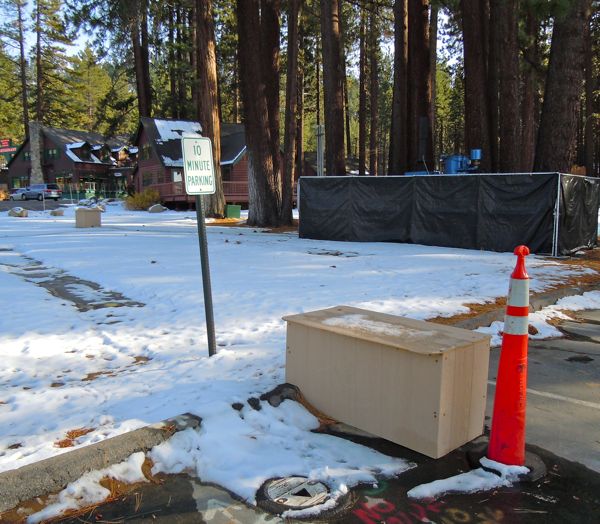
It’s an air sparge unit, which pulls the fumes from the fuel spill area at the resort that then cycles through a charcoal filter.

A sparge unit near the underground tanks at Zephyr Cove Resort. Photos/Kathryn Reed

A sparge unit near the underground tanks at Zephyr Cove Resort. Photos/Kathryn Reed

To the left of it, if looking toward Highway 50, are three strips of concrete. Buried below are three tanks, each able to hold about 10,000 gallons of fuel.

“We are looking at pulling those tanks out of the ground in the next month,” Mike Gabor, U.S. Forest Service engineer, said at the site Nov. 9.

The Forest Service owns the land where the fuel leak was detected in late June. Aramark is the concessionaire and the entity responsible for cleaning up the mess. The Forest Service and Nevada Division of Environmental Protection are overseeing the cleanup.

Until no contaminated soil is detected, cleanup continues. Several holes or wells in about a half-acre area have been drilled in order to determine if the gasoline is spreading. They will continue to be drilled until evidence of the fuel is completely gone.

Locking toward the lodge from the lake, the round item at the bottom of the photo is where a hole was drilled, the concrete behind and to the left of the sign is an underground tank, and the fenced off area to the right is the sparge unit.

Looking toward the lodge from the lake, the round item at the bottom of the photo is where a hole was drilled, the concrete behind and to the left of the sign is an underground tank, and the fenced off area to the right is the sparge unit.

Weekly conference calls are made between the property owner, concessionaire, state and the firm hired to do the cleanup so everyone knows the status of the operation.

While unleaded gasoline is moving via the groundwater toward Lake Tahoe and in other directions at a trickle of a pace, the lake has never tested positive for contaminants, nor has the stream on the north side of the property.

“It was a very slow leak over a very long time,” is how Gabor described it.

The leak was noticed during maintenance – a fitting was not sealing properly. Those tanks have been in the ground since the 1980s.

Some time before the summer boating season Aramark will replace the tanks with above ground containers, which is more common at marinas.

“They will go somewhere in the parking lot,” Jamie Hodgson, Aramark district manager, said pointing north.

This will allow the resort to resume regular operations. This past season it did not have enough fuel to fill private boats; only its fleet of watercraft and the M.S. Dixie II.


Legality of Fallen Leaf Lake board members still murky

By Jessie Marchesseau

Even though no votes were actually cast, Tom Barber, Wanda Kownacki, David Stumbos and Stephanie Neidig will be sworn into their seats on the Fallen Leaf Lake Community Services District board of directors next month.

But there is still a question as to whether any of them can legitimately hold the positions.

The candidates did not appear on any ballots because all four ran unopposed. Barber, Kownacki and Stumbos will maintain their positions as directors, while Neidig is stepping into the vacant seat.

Fallen Leaf Lake CSD directors Tom Bacchetti and Wanda Kownacki will continue to sit on the board. Photo/Jessie Marchesseau

Fallen Leaf Lake CSD directors Tom Bacchetti and Wanda Kownacki will continue to sit on the board. Photo/Jessie Marchesseau

The question of legitimacy, however, has nothing to do with the election. Rather, it stems from the voter fraud issues Fallen Leaf Lake residents have been plagued with for more than a year.

Some area homeowners are doubtful whether any of these candidates can actually legally register to vote within the district. If not, they could be ineligible to hold office. Article II, Section A of the Fallen Leaf Lake CSD bylaws states: “The District shall be governed by a Board of Directors of five (5) members. Each Director shall be registered to vote within the district.”

Fallen Leaf Lake CSD director and president, Tom Bacchetti, said he and all of the other directors are currently registered to vote within the district. However, El Dorado County Assistant District Attorney Hans Uthe expressed that simply being registered does not necessarily make it legal.

“Someone can register, and that makes them eligible until the court tells them they’re not,” Uthe told Lake Tahoe News.

So even though they may be currently registered to vote within the district, the question remains as to whether or not that registration is legal.

While some community members have expressed their concern over the issue to the El Dorado County Elections Department and District Attorney’s Office, both entities state that it is not their place to determine eligibility of candidates or to remove them from office.

Uthe said he has made it clear to everyone who has contacted him regarding this issue that they have two remedies to the solution. They can seek a civil remedy by bringing the issue before a civil court, or they can file a complaint with the California Secretary of State.

For now, the District Attorney’s Office has completed its investigation and is offering no further insight about the issue. However, a complaint to the Secretary of State could trigger another investigation and possible criminal charges.

Meanwhile, there still seems to be some misinformation circulating within the Fallen Leaf Lake community.

At the board of directors’ meeting Nov. 5, Bacchetti announced the District Attorney’s Office would accept letters from residents declaring Fallen Leaf Lake their domicile in order to rectify any question regarding legal voter registration within the district.

Uthe, on the other hand, said that his office has not solicited any such letters or made any such agreement. A letter, he said, cannot determine the issue of legal domicile.

“That someone would claim to be abiding by the law doesn’t necessarily mean they are,” Uthe said.

The idea of domicile can be somewhat complicated, he said, but what it basically comes down to is where a person actually lives.

With so many second homeowners in Fallen Leaf Lake, that still leaves them with the issue of residents being able to vote on key issue within the district.

“The only way that this is going to get solved is legislation,” Bill Schultz, El Dorado County registrar of voters said. “Fallen Leaf Lake is not the only CSD with this problem.”

So a group of Fallen Leaf Lake homeowners is taking it upon themselves to get just such a bill passed. Mike Cathcart is one of these homeowners. He said the group has agreed on language for their proposal and met with individuals in Sacramento to take the necessary steps to get the proposal introduced and hopefully passed by the Legislature.

Cathcart and the rest of the group have focused their proposal specifically toward voters in Fallen Leaf Lake. However, Schultz believes statewide legislation would be the key to clearing up similar voting issues in CSDs across the state.

But for now, Fallen Leaf Lake residents are left to make their own determinations as to whether or not they are legally able to register to vote within the district and trust their board of directors to do the same.


Stateline gaming results bring down entire state

Gamblers did better than the casinos in September compared to a year ago.

Throughout Nevada the winnings were 5.9 percent below 2010 figures.

casinosThe Nevada Gaming Control Board on Nov. 9 said casinos took in $864 million from gamblers, $53.8 million less than the previous September.

One of the worst regions was Stateline, which saw a decline of 14.3 percent year over year. The Carson Valley-Carson City area fared better, but still fell 2.5 percent. Reno, though, came through with 2.6 percent increase.

— Lake Tahoe News staff report


Unintended consequences come with outsourcing government jobs, services

By Motoko Rich, New York Times

GRAND RAPIDS, Mich. — Like many states and local governments struggling to cut costs, Michigan hopes to replace some government employees with contract workers who will do the same job for less.

Ginny Townsend, 41, took a job in January as a nursing assistant in the state-run home for veterans here. Technically, she works for a private company that supplies some employees to the veterans home under a state contract. She makes $10 an hour, about half the wage of the public employees working at the facility.

“I love my job, and I appreciate the opportunity to be here,” Ms. Townsend, a former home health care aide, said on a recent afternoon as she cheerfully delivered fruit and a newspaper to an 85-year-old resident in a sun-drenched solarium.

With the national unemployment rate at roughly 9 percent, Ms. Townsend says she feels lucky just to have a job. But on her low wages, she is barely scraping by. She said she was raising four grandchildren under 11 with her unemployed sister and could not support them without the $300 in food stamps she collects every month.

Now, the state wants to dismiss 170 nursing assistants on the public payroll at the veterans home and replace them with more contract workers like Ms. Townsend, prompting a legal dispute and much personal anguish.

The legal battle highlights the potential pitfalls in such decisions. Outsourcing, usually intended to ease strained public budgets, tends to most directly affect people like Ms. Townsend and her co-workers. But there can be other drawbacks. The quality of services provided by contract workers, for example, may not be as consistent as that of experienced government employees. And taxpayers can end up paying for the cuts in more indirect ways.

What governments save in salaries and benefits often “ends up on the government books through all sorts of programs,” said Paul C. Light, a professor at the Wagner School of Public Service at New York University, referring to unemployment insurance, Medicaid and other public assistance for workers earning low incomes.

Outsourcing becomes more popular during tough economic times as states and municipalities transfer the operations of facilities like prisons, school cafeterias and sanitation departments to private contractors. Governors or legislatures in Arizona, Louisiana, New Jersey and Pennsylvania have all proposed reviews of state agencies in search of opportunities to privatize operations.

Many local governments like Anaheim, Calif., and Luzerne County, Pa., have contracted out services including park maintenance, graffiti removal and tax claims. Mayor Rahm Emanuel of Chicago recently outsourced recycling collection in parts of the city.

Read the whole story


Ownership change at Timber Cove closes restaurants

By Kathryn Reed

Owners of the Timber Cove Pier did not renew the lease with Blue Water Bistro, forcing the restaurant to close.

The lease with Mama’s Red Tomato also expired.

Both restaurant locations will be operated by the family trust that has taken over operation of the South Lake Tahoe pier as well as the Best Western Timber Cove Lodge. Bob Maloff, who had owned the property for years, died in June. His sons control the trust.

Blue Water Bistro is closed. Photo/LTN file

Blue Water Bistro is closed. Photo/LTN file

Peter Evenhuis, general manager at the lodge, said the location where the bistro was would be remodeled, with a new restaurant opening by spring.

“There is no way we can expand anything. That is too complicated,” Evenhuis told Lake Tahoe News.

But no final plans have been devised for what type of restaurant it will be or what it will look like.

“This was an intimate, smallish, boutiquish restaurant that was probably perfect for that location. I’m sure we’ll not stray,” Evenhuis said.

Mama’s is no longer open to the public, with no immediate intent to change that status. For now a full breakfast is served to guests of the hotel in what is being called the cafe.

Evenhuis said the other businesses operating on the pier would remain.


Lodging industry optimistic about 2012

By Barbara De Lollis, USA Today

Travelers in the coming year should prepare to pay higher rates and compete for the best rooms, a new analysis of future hotel bookings suggests.

Occupancy nationwide is expected to increase by about 5 percent and rates by about 4 percent, according to industry tracker TravelClick’s analysis of North American hotel bookings for the 12 months ending Sept. 30, 2012.

“While there is much uncertainty regarding where the overall economy is headed, hotel industry performance over the remainder of 2011 and heading into 2012 continues to look strong,” said Tim Hart, a TravelClick executive vice president.

The gains should please hotel owners, who endured steep drops in occupancy and room rates in the recession. Revenue per available room, the industry’s key financial measure, is expected to increase by almost 7 percent, the analysis said.

But the recovery will not be across the board.

Read the whole story


Shakeup on STPUD board, Measure R passes soundly

By Kathryn Reed

Two new faces will be on the South Tahoe Public Utility District board, incumbents are returning to Lake Tahoe Unified and Lake Tahoe Community College boards, and the recreation measure on the South Shore is officially R.

Kelly Sheehan came out of the gate with 65.13 percent of the vote compared to incumbent Dale Rise’s 34.4 percent.

A clearly emotional Sheehan was cautiously optimistic with the initial results. But others near her wondered if it was mathematically possible for her to even lose at that point. She wasn’t ready to claim victory at that point no matter what others said to her.

Randy Vogelgesang and Kelly Sheehan celebrate their victory Nov. 8 at Steamers. Photo/Kathryn Reed

Randy Vogelgesang and Kelly Sheehan celebrate their victory Nov. 8 at Steamers. Photo/Kathryn Reed

Sheehan had invited all of the utility district candidates to her bar-restaurant, Steamers. Rise was the only one not to show up Election Night. Nor did he return a call for comment.

Sheehan and Randy Vogelgesang spent part of the night huddled together – the voters’ top choices. Neither had run for any political office before being on the Nov. 8 ballot.

Vogelgesang replaces Marylou Mosbacher who did not seek re-election.

He said he is humbled by the win.

Vogelgesang held on to the lead absentee voters gave him. With numbers coming out just after polls closed at 8pm, Vogelgesang led with 37.71 percent, Claude Gunsch 28.55 percent, John Runnels 20.9 percent, and Mary Kortge 12.63 percent.

With absentees accounting for the 18.9 percent turnout in early returns, El Dorado County Registrar of Voters Bill Schultz was not surprised. This, despite the county’s growth in absentee voting for each election.

“With this election, everything’s gonna be low,” he told Lake Tahoe News at 10:05pm, about 15 minutes after the votes from the lake showed up at the county offices in Placerville.

By the time the final vote was tallied at 11:11pm, the numbers are below with the winners in bold:

STPUD Seat 3:

Vogelgesang – 37.18 percent, 1,128 votes

Gunsch – 28.54 percent, 866 votes

Runnels – 21.29 percent, 646 votes

Kortge – 12.82 percent, 389 votes

STPUD Seat 4:

Sheehan – 66.39 percent, 1,989 votes

Rise – 33.24 percent, 996 votes

LTUSD:

Sue Novasel – 32.73 percent, 2,283 votes

Larry Green – 29.23 percent, 2,039 votes

Michael Doyle – 27.69 percent, 1,932 votes

Michael Bischoff – 9.91 percent, 691 votes

LTCC:

Karen Borges – 49.47 percent, 2,524 votes

Fritz Wenck – 37.36 percent, 1,906 votes

Michael Bischoff – 12.54 percent, 640 votes.

All of these numbers are unofficial until certified, which can take up to 30 days. Board members will take their seats in December.

Schultz pointed out that the turnout could have been even lower if not for measures that get out the vote among a community’s most motivated citizens.

“In an off year, I really think it’s the passion behind whatever initiative there happens to be,” he said. “I think it’s whatever’s personal.”

In the South Shore’s case, Measure R — a rewrite of the recreation initiative Measure S of 2000 — made the ballot.

R needed a two-thirds majority to pass – which it more than achieved with 70.19 percent or 2,234 votes compared to the opposition that had 949 votes for 29.81 percent.

For Schultz, it has been difficult losing Assistant Registrar Norma Gray, a 31-year county employee who became a fixture in the Elections Department. A picture of her hangs in the kitchen as a “jewel of her memory,” Schultz said. She died in December.

— Susan Wood contributed to this story.


Conservation groups oppose South Shore fuel reduction project

Waiting until just before the comment period ended, opponents to the U.S. Forest Service’s plans to thin about 10,000 acres on the South Shore submitted letters questioning the validity of the environmental document.

The South Shore Fuel Reduction and Healthy Forest Restoration Project would treat 10,112 acres; the intent being to target the wildland urban interface and prevent another Angora Fire.

As reported on Lake Tahoe News a month ago, an objection to the final EIS by the Oct. 28 deadline would trigger a 30-day resolution period. It’s been triggered by Earth Island Justice’s John Muir Project, and Echo Lakes Association. Anyone or any entity which had commented on the original environmental impact statement had the right to comment on the latest document.

The conservation groups want the Forest Service to do more analysis. The same woodpecker species that Earth Island said should prevent thinning of the Angora burn area is being cited as a concern with the larger project. With Angora, a judge sided with the Forest Service.

The Forest Service has until the end of the month to respond to the comments it received. Lake Tahoe Basin Management Unit Forest Supervisor Nancy Gibson will be the one decide to approve the project or not. If she signs the record of decision, it could end up in court. If she doesn’t sign it, the projects future is murky.

— Kathryn Reed