TRPA air mitigation fees delay opening of businesses

By Kathryn Reed

Christian Strobel closed escrow on the former Block hotel near Stateline in May 2011. He paid $450,000 for the 51-room rundown lodging property.

In the past year he has spent about $1.5 million to turn it into a functioning facility, which included removing asbestos, replacing all the doors and windows, kicking out the gangs living there who were smoking various illegal drugs, putting in new furniture, adding green elements like recycled wood and low-flow toilets, all with the desire to market the hotel to an outdoor clientele.

On Tuesday, he found out he owes the Tahoe Regional Planning Agency $163,021.01. It’s called an air mitigation fee. It was the city of South Lake Tahoe that told him the news – not the TRPA. This fee is about one-third the price he paid for the structure.

The Block for years sat empty, boarded up and painted with graffiti. TRPA says it is working with the new owners to overcome the air mitigation fees. Photo/LTN file

“I fell off my chair. We have a loan that is secured by my house. If I have to pay the fee, I won’t go into business,” Strobel told Lake Tahoe News on Thursday. “If that happens, we go into bankruptcy and I lose my home.”

Before buying the hotel on Cedar Avenue he checked with the TRPA about the validity of the tourist accommodation units. Those were in check. So, TRPA knew his intent to reopen the facility as another hotel but never mentioned the air mitigation fee.

No one at anytime disclosed the air mitigation fee, Strobel said.

TRPA calculates the fee based on an international engineering survey that says a hotel of this type will generate 9.81vehicle trips per day, per room. For Lake Tahoe Basecamp Hotel that fee is $163,021.01.

The problem Strobel and even South Tahoe officials have is why people must pay the fee on a building – especially when the use hasn’t changed – when the previous owner already did so.

TRPA rules state that if a building is not used for two years, the air mitigation fee must be paid again.

When asked by Lake Tahoe News if this is actually a double fee, TRPA spokesman Jeff Cowen said, “We’ve all been talking about that. The only information I have is it’s in our code.”

In the Regional Plan update, alternative 4 (not the preferred alternative) would increase the vacancy to five years.

Asked why TRPA doesn’t issue an air mitigation refund when a business stops existing – the premise being then it wouldn’t be having customers polluting the air with emissions – Cowen said the funds can’t be refunded because they have been spent.

That’s the point property owners and others are trying to make — the fees have been spent to mitigate air quality issues. Why pay for the same thing twice is what TRPA can’t answer.

Hilary Roverud, director of development services for South Lake Tahoe, said the city would not comment on whether this is a double fee.

“The fee applies to any change. The previous use is not recognized,” Roverud said of how TRPA looks at things.

Roverud and Cowen said they are trying to come up with a solution for Strobel so he can open as planned on June 20. But neither would say what the possibilities are to mitigate the mitigation fee.

“It’s a legal issue,” Cowen said.

Not an isolated case

Strobel is not the only business caught in this quagmire. Down the street from his property is the Cedar Lodge that has new owners.

Judy Finn, planner with the city, said the owners have received a permit to do interior changes and have been told about the TRPA’s air mitigation fee.

According to City Attorney Patrick Enright, the air mitigation fee at the Cedar Lodge will also be more than $100,000.

Part of the issue with the Garfinkle building – aka Miller’s Outpost-TJ Maxx — is the $35,000 air mitigation fee. A lease between the property owners and clothing store has not been signed.

“I can’t speculate on what people choose to do based on these fees. But it would be logical if someone is trying to do a project and they figure out the finances, this would be a factor,” Roverud said of the air mitigation fee. “It does seem to be more of an issues because we are in a period of a lot of vacant commercial property.”

The old Dixon’s restaurant on Emerald Bay Road has suitors. It, too, will face the air mitigation fee issue.

Why have a fee?

The fee is used to combat air pollution that presumably a business’ customers is creating.

But the TRPA also doesn’t provide incentives for businesses that might attract hybrids or electric vehicles or even more than two people per vehicle.

The business may pay the fee, which most do, or pay directly for bus shelters, bike trails or other projects that would be considered a use that ultimately decreases vehicle miles traveled.

The mitigation fee is then put in a pot for the jurisdiction where the business is located.

According to TRPA, the city has used $1.3 million in air mitigation funds in the last 10 years on bus shelters, street sweepers, transit buses and intersection improvements.

“The south Y intersection pedestrian and level-of-service improvement project cost $2.5 million in 2007, $500,000 came from air mitigation fees collected in the city,” Cowen said.

As of April, the city had $180,000 in its air mitigation account at TRPA.



Deputies looking for 2 men in connection with jewelry theft

Placer County sheriff’s detectives need help finding two people of interest in a Tahoe City jewelry store burglary.

The Blue Stone Jewelry Store at 495 N. Lake Blvd. was burglarized April 17 at 9:23pm. Detectives believe there were at least two people responsible.

Law enforcement is looking for these two men.

The two men who in the photograph were in the jewelry store earlier that day. Deputies are trying to locate these individuals.

Anyone with information is asked to call Detective Sage Bourassa at (530) 581.6322 or Detective Rick Wroobel at (530) 581.6324.

Anyone wishing to remain anonymous and be eligible for a cash reward of up to $1,000 may call Placer County Crime Stoppers at 800.923.8191.


Man sentenced in El Dorado County tribal mail diversion case

By Denny Walsh, Sacramento Bee

An El Dorado County man was sentenced Monday to three months in federal prison for diverting to his own address mail meant for the Shingle Springs Band of Miwok Indians.

The band is a tribe made up of Miwok, Maidu and Nisenan Indians that governs the Shingle Springs Rancheria, a 160-acre reservation in El Dorado County, and owns and operates the Red Hawk Casino.

Cesar Caballero, 42, contests the tribe’s use of the name, claiming a tribe with which he is affiliated is the real Shingle Springs Band of Miwoks. In August 2010 he submitted three change-of-address orders at the Shingle Springs post office routing mail addressed to the Shingle Springs Rancheria to Caballero’s address in the community of El Dorado.

On Aug. 30, after a 2 1/2-hour non-jury trial, U.S. Magistrate Judge Edmund F. Brennan found Caballero guilty on three misdemeanor counts of obstructing the mail.

Read the whole story


Obesity-diabetes in children getting harder to treat

By Denise Grady, New York Times

Obesity and the form of diabetes linked to it are taking an even worse toll on America’s youths than medical experts had realized. As obesity rates in children have climbed, so has the incidence of Type 2 diabetes, and a new study adds another worry: the disease progresses more rapidly in children than in adults and is harder to treat.

“It’s frightening how severe this metabolic disease is in children,” said Dr. David M. Nathan, an author of the study and director of the diabetes center at Massachusetts General Hospital. “It’s really got a hold on them, and it’s hard to turn around.”

Before the 1990s, this form of diabetes was hardly ever seen in children. It is still uncommon, but experts say any increase in such a serious disease is troubling. There were about 3,600 new cases a year from 2002 to 2005, the latest years for which data is available.

The research is the first large study of Type 2 diabetes in children, “because this didn’t used to exist,” said Dr. Robin Goland, a member of the research team and co-director of the Naomi Berrie Diabetes Center at Columbia University Medical Center in New York. She added, “These are people who are struggling with something that shouldn’t happen in kids who are this young.”

Read the whole story


S. Tahoe resident still not able to evade officers

By Kathryn Reed

Apparently Christopher Wadstein has a penchant for driving fast and trying to avoid the police.

Again, he was caught.

This time the 23-year-old South Lake Tahoe resident was booked into jail May 2 about 7pm.

Officers said they tried to stop Wadstein about 5:40pm on Glenwood Way. The suspect allegedly took off at a high-rate of speed. Officers said speeds hit 70 mph at times.

The Jeep Cherokee that Wadstein was seen driving was located about 30 minutes later near Pine Hill and Timber Lane. The suspect was found in a storage shed on Timber Lane.

Officers said they also confiscated two handguns.

Wadstein faces charges of felony evading a police officer and a felon in possession of firearms.

In June 2010, Wadstein was arrested after a chase that reached 80 mph through town and resulted in his Ford Mustang GT going airborne into the Upper Truckee Marsh at the end of Creekwood Drive.

A couple months later he pleaded guilty in the case and faced prison time. It is not known how long Wadstein has been back in town.


Union prepares for possible strike at Raley’s

By Dale Kasler, Sacramento Bee

Raley’s unionized workforce today began preparing for a possible strike against the West Sacramento supermarket chain.

The United Food and Commercial Workers announced early today that Raley’s refused to extend its contracts and was preparing to give workers its “last, best and final offer.”

The presidents of UFCW Locals 8 and 5, representing thousands of workers in greater Sacramento and across Northern California, said they would schedule meetings with membership to decide whether to authorize a strike.

It would be the first strike in Raley’s history. The company wasn’t immediately available for comment.

Read the whole story


Tahoe-Truckee back on radar of second home buyers

By Hudson Sangree and Phillip Reese, Sacramento Bee

Like a lot of vacationers, Rick and Kristie Santos would return from trips to Lake Tahoe during the housing boom wondering what it would take to own a second home there.

They were always disappointed when they looked at the listings. “You’d jump online and never could afford it,” Kristie Santos said. “It was out of reach.”

Lately, however, with interest rates dipping below 4 percent and home prices seeking bottom, the Fair Oaks couple started thinking differently. The Santoses recently joined a growing number of would-be buyers scouting the Tahoe area for second homes.

On Saturday, the couple went on their first trip with a real estate agent to look at vacation properties in the sprawling, wooded Tahoe Donner subdivision near Truckee. Most were listed in the $300,000 to $400,000 range, a big drop from the peak.

The outdoor enthusiasts came away feeling their long-held dream of owning a mountain getaway might be attainable.

“It’s a compelling time to buy for families that a few years back thought, ‘There’s no way we can do this,’ ” said Alison Elder, a top agent in the Truckee area who showed the couple a half dozen homes.

In fact, the real estate market around Lake Tahoe has been hopping lately, with buyers scooping up relative bargains.

Read the whole story


Summer construction on Kingsbury Grade up in the air

By Kathryn Reed

Nevada Department of Transportation officials expected Peek Construction to resume work on Kingsbury Grade on May 1.

The Las Vegas-based company which, according to its website, has an office on the same road it’s supposed to be finishing work on did not return a phone call.

Work on this main artery between Stateline and the Carson Valley started in 2009 with the original bid being $6.8 million. NDOT extended the contract by 87 days, which increased the bill by another $2.5 million.

Left on the contract is 20 days worth of work.

“If they don’t do it, they will be in default,” according to Scott MacGruder with NDOT. “They were supposed to start May 1.”

The state and contractor are trying to work things out in court regarding the cost overruns, but MacGruder said it was his understanding the work was still to be finished.

MacGruder said his agency, if the contractor doesn’t return to the job, would assess whether it’s satisfied the erosion issues have been taken care of. If not, plan B would need to be found.

The water quality project has been painfully slow for commuters caught in the traffic jam for the past three summers.

But MacGruder also told Lake Tahoe News that the road needs resurfacing – which would not start this year. When it does, it will mean further delays for motorists.


S. Tahoe council questions need for 20-year ice rink deal

By Kathryn Reed

If questionable decorum at a City Council meeting should come with consequences, then the operators of the South Lake Tahoe Ice Arena could probably find a penalty box for them.

While Van Oleson and Chris Cefalu were before the council on May 1 asking to formalize their contract with the city, Councilwoman Angela Swanson and City Manager Tony O’Rourke verbally checked one another. Councilman Tom Davis took his swipes, alluding to how he knew best how to run a business and was in support of the city manager’s proposal.

The entire discussion was a rare demonstration of hostility between the electeds and city manager.

Tongues were as sharp as ice skates during the May 1 South Lake Tahoe City Council meeting. Photo/LTN

Swanson was not alone in questioning O’Rourke’s insistence on doubling the length of the contract from 10 years to 20.

All O’Rourke said to Lake Tahoe News as to why the need for the change was, “We have been discussing this for six months.”

It appeared no one had been discussing it with the council.

Oleson and Cefalu, owners of Tahoe Sports Entertainment, walked out of the meeting Tuesday afternoon without a contract.

Councilman Hal Cole said, “We want to see what you are going to do (before extending the contract).”

Swanson echoed that sentiment, “Why should the city enter a 20-year agreement unless there is an assurance of a plan?”

But the TSE duo wasn’t prepared to show its hand without a contract.

Mayor Claire Fortier said, “This is a community asset. We need to strike a balance between the community and profits.”

Cefalu responded, “I agree it is a community asset. But the local community will not sustain it.”

The city knows this. In some years the city lost $100,000 a year on the rink. That is why South Tahoe went looking for a private operator. TSE is bringing in tournaments to help sustain the business.

TSE last summer was awarded a 10-year contract to run the city ice rink. A month later, in August, that contract was revised because it was discovered a for-profit organization could not make money on an entity being paid for with non-taxable bonds.

A side letter – essentially a new contract – was put in place as the city worked through changing the bonds to taxable. The bonds were resold as taxable and in turn financed at a lower rate earlier this year.

However, that new contract expired Feb. 1. That is why TSE was before the council this week.

But it’s not the same contract as to what the council had agreed to 10 months ago.

TSE wants a 20-year contract. What was never articulated well was why the company needed to double the time frame.

After the meeting, Cefalu told Lake Tahoe News that to do the capital improvements – like another sheet of ice – and to finance it, a 20-year agreement is needed to get financing and recoup expenses. That second sheet of ice was talked about last year, too.

Other changes in the contract that were proposed include changing the fee structure. The monthly fee would go from $3,000 to $2,000. However, the percentage of gross revenue in excess of $600,000 TSE would pay the city would max out at 10 percent, while the original contract had a 5 percent maximum.

Another proposed change is that TSE would be entitled to reimbursement at a depreciated rate for improvements made to and items bought for the facility if the city terminates the contract. However, all of those potential improvements would have to be cleared by the council before the capital investment were made.

Councilman Bruce Grego had a problem with the prospect of the city having to come up with a lump some if that were to occur.

Staff was told to come up with another plan and bring it to the council June 5.

City Attorney Patrick Enright told Lake Tahoe News the agreement that expired three months ago will stay in effect until the council votes on an ice rink contract.

In other council action:

• On a 4-1 vote, with Davis in the minority, garbage rates as of May 1 are 4.97 percent higher.

• Tahoe Bear Box was awarded a bid to put in containers on city property to be paid for from a state recycling grant. It was a 4-1 vote with Grego voting no.


Papers filed to protect rare woodpecker living in Angora burn

By Scott Sonner, AP

RENO — Smokey Bear has done such a good job stamping out forest fires the past half-century that a woodpecker that’s survived for millions of years by eating beetle larvae in burned trees is in danger of going extinct in parts of the West, according to conservationists seeking U.S. protection for the bird.

Four conservation groups filed a petition with the U.S. Interior Department on Wednesday to list the black-backed woodpecker under the Endangered Species Act in the Sierra Nevada, Oregon’s Eastern Cascades and the Black Hills of eastern Wyoming and western South Dakota.

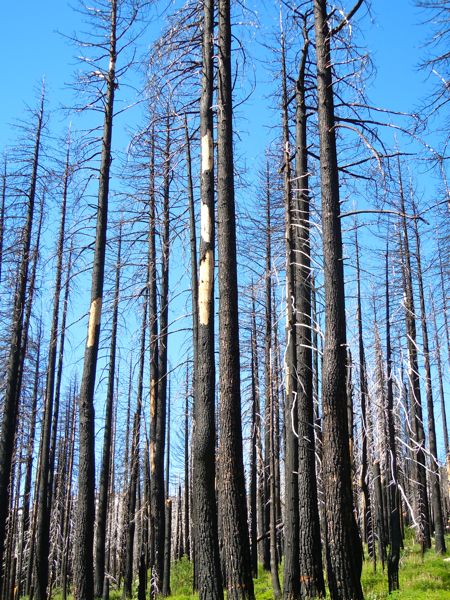
Dead trees like these from the Angora Fire are habitat for a rare woodpecker. Photo/LTN file

It is the first federal petition to recognize the ecological significance and seek protection of post-fire habitat, an expert said.

In addition to fire suppression, the groups contend post-fire salvage logging combined with commercial thinning of green forests is eliminating what little remains of the bird’s habitat, mostly in national forests where it has no legal protection.

“Intensely burned forest habitat not only has no legal protection, but standard practice on private and public lands is to actively eliminate it,” the petition said. “When fire and insect outbreaks create excellent woodpecker habitat, salvage logging promptly destroys it.”

Chad Hanson, executive director the Earth Island’s John Muir Project based in Cedar Ridge, filed the petition Wednesday with the Interior Department’s U.S. Fish and Wildlife Service in Sacramento. Co-petitioners are the

Center for Biological Diversity based in Tucson, Ariz., the Blue Mountains Biodiversity Project in Fossil, Ore., and the Biodiversity Conservation Alliance in Laramie, Wyo.

Hanson, a wildlife ecologist at the University of California, Davis, said the black-backed woodpecker has been eating beetles in fire-killed stands of conifer forests for millions of years and specifically in North American forests for “many thousand years—since the last Ice Age.”

“Now, it’s very rare,” he said.

The best science suggests there are fewer than 1,000 pairs in Oregon and California, and fewer than 500 pairs in the Black Hills, the petition said.

“Such small populations are at significant risk of extinction, especially when their habitat is mostly unprotected and is currently under threat of destruction and degradation,” the document said.

The three-toed, black-backed woodpecker is a specialist at digging out wood-boring insect larvae. The bird’s sooty black dorsal plumage serves to camouflage it against the deeply black, charred bark of burned trees.

Richard Hutto, a biology professor and director of the Avian Science Center at the University of Montana, has been doing post-fire research since the early 1990s. He said it would be difficult to find a forest-bird species more restricted to a single vegetation cover type than the black-backed woodpecker is to early post-fire conditions.

Hanson believes the federal petition is the first to seek protection of post-fire habitat and recognize it as “distinct and ecologically significant.”

“While it may come as a surprise to some, burned forests, and the dead trees associated with them, are essential to the survival of many wildlife species,” said Justin Augustine, a San Francisco-based staff attorney for the Center for Biological Diversity.

Over the past five years, the two have been pressing for protection of the bird through legal challenges to U.S. Forest Service logging projects, primarily in burned forests in the Sierra north and south of Lake Tahoe.

A May 14 hearing is set before the 9th U.S. Circuit Court of Appeals in an ongoing legal battle between the Forest Service and the John Muir Project over salvage logging in woodpecker habitat where 254 homes burned in the 2007 Angora Fire at South Lake Tahoe.

Read the whole story