Pedestrian from Ohio dies from injuries

The 71-year-old Ohio woman who was struck by a vehicle while crossing Highway 50 in South Lake Tahoe on Sept. 15 has died.

Washoe County coroner’s officials told Lake Tahoe News that Betty Petrick died Sept. 18 at Renown Medical Center in Reno.

South Lake Tahoe Police Chief Brian Uhler said no charges are expected to be filed against the Butte County man who hit her.

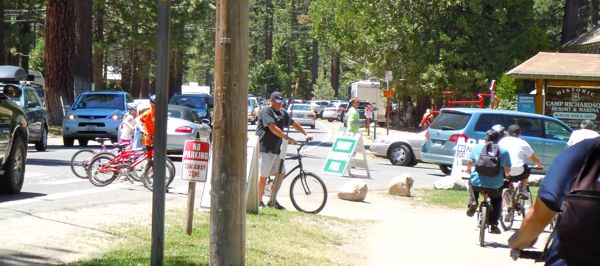
“Unfortunately in our city we have too many bicycle and pedestrian accidents,” Uhler said.

— Lake Tahoe News staff report


Appellate court sides with USFS regarding Angora project

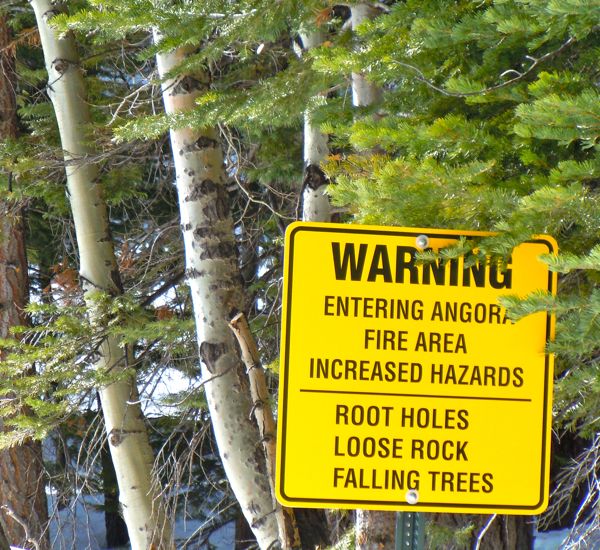
The Ninth Circuit Court of Appeals on Sept. 20 unanimously upheld a U.S. District Court ruling saying the U.S. Forest Service’s environmental analysis for the Angora Restoration Project was valid.

The John Muir Project had found flaws with the project because it encroached into habitat for the black-backed woodpecker. The environmental group, which is a subsidiary of the Earth Island Institute, filed a lawsuit to stop the logging-restoration efforts.

This species of bird likes to live in burn areas. The Forest Service is owner of most of the nearly 3,100 acres that burned in the 2007 Angora Fire on the South Shore.

In early June the Forest Service agreed to move its logging operations away from the nests. Since then the mechanical and hand thinning of trees on approximately 1,441 acres in the burn area have been completed.

The Forest Service left approximately 1,168 acres of the fire area untreated for species such as the black-backed woodpecker that use burned forests as habitat.

 — Lake Tahoe News staff report


Labor Department says no to Nevada consolidation plan

By Sean Whaley, Nevada News Bureau

CARSON CITY – The U.S. Department of Labor has rejected Nevada’s request for a waiver to consolidate its three workforce investment boards into one, due largely to opposition to the plan by the Southern Nevada panel.

Frank Woodbeck, director of the state Department of Employment, Training and Rehabilitation had proposed the plan to consolidate the three separate boards that oversee workforce development, which was expected to reduce administrative expenses by $5 million.

“The waiver request was submitted in July, and we received a response in August to our request and that request was denied,” he told the governor’s Workforce Investment Board at its meeting last week. “The denial was based on the fact that the members of the southern board were in opposition to the waiver and the consolidation.”

The Northern Nevada and state boards supported the consolidation effort.

But Woodbeck noted that the consolidation effort has produced some positive results, including a significant reduction in administrative expenses incurred by the southern Nevada board, called Workforce Connections, under the leadership of Executive Director Ardell Galbreth.

Galbreth, who took over initially as interim director in April, reduced several top six-figure salaries and the size of the agency’s staff by more than half.

Woodbeck said the effort at consolidation has improved communications between his agency and the two local boards.

“So the work at trying to do board consolidation, etc., has not gone for naught,” he said. “It has been successful to a great degree in that we have a much greater line of communication with the directors of the two local boards, and I think we’ll make progress as time goes on.”

Woodbeck, with Gov. Brian Sandoval’s support, had sought the consolidation in part because of excessive administrative costs identified in audits of Workforce Connections.

The most recent audit, performed by the state Division of Internal Audits and released in May, found that Workforce Connections spent nearly twice as much on administration and monitoring of its programs than its northern counterpart.

More than $27 million in federal job training funds were awarded to the two local workforce development boards by the Board of Examiners in August, before the decision on the waiver had been made by the U.S. Department of Labor. The Southern Nevada board received more than $19 million in funding for the coming two years.


Camp Rich parking issues stall Forest Service’s plans

By Kathryn Reed

Parking along the road that leads to the Beacon restaurant has brought the U.S. Forest Service’s renovation plans for the area to a halt.

The federal agency has to go back to the drawing board on this particular aspect of the larger plan because people who live along Jameson Beach appealed the USFS decision from June 14. That decision was withdrawn this month, with letters going out last week to everyone on the project list.

“Although the project is billed as a BMP retrofit, it actually was the beginning of a wide-scale expansion of the Camp Richardson resort intended to maximize parking revenues at the cost of safety, the visitors’ enjoyment, the residents’ rights and most significantly the environment,” attorney Jacqueline Mittelstadt told Lake Tahoe News. “We see the project as ‘Disneyland on the South Shore’.”

Parking in the Camp Richardson area will be further studied by the U.S. Forest Service. Photo/LTN file

A dispute that still has not been resolved is who owns Jameson Road.

“Our project moves forward with the assumption it is a Forest Service road,” USFS spokeswoman Cheva Heck told Lake Tahoe News. For decades the feds have maintained and assumed liability for the road that is the access point for Camp Richardson Resort.

But that road also winds behind the marina to private residences. That is why they care what goes on with this road.

The Forest Service late this fall will release another environmental assessment for public comment, with the hope a decision can be made this winter.

“What we are going to do is more fully develop an alternative that addresses their concerns,” Heck said.

Inadequate traffic studies and lack of free parking are concerns of the opponents.

“Though the Highway 89 corridor involves some of the highest accident rates on the South Shore, the non-local traffic engineer for this project stated there was ‘no evidence’ of any traffic accidents, so no changes to the Camp Rich entry area were required,” Mittelstadt said.

More information about the project may be found online.


Darvas expected to leave hospital today

Peter Darvas is expected to be released from Barton Memorial Hospital today.

The South Lake Tahoe artist has no home to return to. His house on April Drive and Pioneer Trail is a total loss after flames ripped through it Tuesday evening.

Firefighters from multiple agencies attack the flames Sept. 18 that destroyed two houses in South Lake Tahoe. Photo/Kathryn Reed

The cause of the Sept . 18 fire remains under investigation and may not be known for another day or two, according to South Lake Tahoe Fire Chief Brian Uhler. Lake Valley Fire Protection District is handling the investigation per an agreement between the departments.

Gareth Harris with Lake Valley did not respond to an email inquiring about the cause and dollar amount of damage.

The fire completely destroyed Darvis’ house as well as house next door on April Drive.

“I visited him (Wednesday) in Barton’s ICU, and though in pain from burns to his face and hands, he will recover …,” Robert Schimmel said in an email of his friend Darvas. “… his voice/throat is healing as are his eyes and communication is somewhat painful.”

— Lake Tahoe News staff report


Access to trails, parking lots dominate Fallen Leaf talks

By Kathryn Reed

While no decisions have been made as to what the trail system at Fallen Leaf Lake will look like in the future, four additional alternatives have been added to the mix to reflect what the public desires.

Nearly 40 people attended a workshop Wednesday night at the U.S. Forest Service office in South Lake Tahoe to learn about the changes that have been made since the discussions started earlier this year as well as to offer more input. The original preferred alternative – No. 2 – remains on the table. Alternatives 3-6 incorporate the more than 150 responses the feds received. Alternative 1 would be to keep the status quo.

Jacob Quinn of the U.S. Forest Service talks about alternatives to the Fallen Leaf Lake plan. Photo/Kathryn Reed

When the final document comes out in the first quarter of 2013 it’s possible a combo of the alternatives could be selected instead of one as it is written in draft form.

The goal is to address this section of the South Shore that is on the north side of Camp Richardson and captures the entire Fallen Leaf Lake area trail system. Trails, parking and public access are all part of what is being studied.

One person at the Sept. 19 meeting asked if all the improvements would mean more people re-creating in this area.

Jacob Quinn, who led the bulk of the meeting for the Forest Service, said with the increase in use in this area in the last 10 years it has meant overuse of some trails and that people tend to create their own trails when the ones they’ve been on become overcrowded. The idea is even if more people come, the trail system will be better to disperse the various users.

The goal is to decommission most of the user-created trails, while improving others. At the same, trails in the backcountry will remain designed for less use, while trails closer to population bases will be able to handle more people.

Parking is an issue, as was expressed regarding the Glen-Alpine area at the far end of Fallen Leaf Lake. But Quinn pointed out it’s a fine balance between providing enough parking spaces and not wanting to draw the masses to an area than can’t sustain that many people if they were to all arrive.

All of the new alternatives have the bridge at the dam at Fallen Leaf Lake being 4- to 6-feet wide. Originally the Forest Service wanted to widen it up to 14 feet.

Another thing the new alternative has in common is retaining the trail along the west side of Taylor Creek that runs north and south. The Clark and Church trails would also stay.

The polo field parking lot near the entrance to Valhalla has been scrapped and instead will be incorporated into the Tallac Site plans. Improvements to the Pope Baldwin Bike Path, better known as the Camp Richardson paved trail, are out of this study and instead will be part of the Camp Rich plans.

Accessing public lands during the winter and at other times was discussed at the Sept. 19 meeting. Liana Zambresky asked why parking lots need gates.

Garrett Villanueva, trails guru with the Forest Service, said part of the reason is because concessionaires run some Forest Service land and when they are not on site there is no one to monitor activity going on. He said his agency doesn’t have the staff to manage sites in the off-season.

However, he said solutions are being worked on to provide more access. But snow removal and year-round access are not being considered.

Bill Connolly brought up the issue of the gate at the entrance to Valhalla/Tahoe Tallac Site being closed so often which creates an access issue for the handicapped because this is one of the easiest places for the disabled to access Lake Tahoe.

Brenda Knox with the Tallac Association told the group it’s a tricky balance between accommodating the public and needing the spaces for events – whether it’s a show or a wedding. But she added that the gate issue is something her colleagues are working on.

More information about the project is online. The Forest Service will accept comments through Oct. 12.


Donner Lake trees to remain for now

By Ed Fletcher, Sacramento Bee

The neighborhood association behind a proposal to remove more than 20 trees near Donner Lake pulled the plan before it faced a vote Tuesday.

No date for a Truckee Planning Commission review of the plan has been rescheduled, according to Truckee officials. Some residents of the neighborhood and some environmental groups had issues with the proposal.

The plan from the Tahoe Donner subdivision called for removing 23 Jeffrey pine trees near the lake shore to make way for marina improvement and a walking path compliant with the American with Disabilities Act.


Teacher expectations impact how students learn

By Alix Spiegel, NPR

In a recent “Morning Edition” story, I look at expectations — specifically, how teacher expectations can affect the performance of the children they teach.

The first psychologist to systematically study this was a Harvard professor named Robert Rosenthal, who in 1964, did a wonderful experiment at an elementary school south of San Francisco.

The idea was to figure out what would happen if teachers were told that certain kids in their class were destined to succeed, and so Rosenthal took a normal I.Q. test and dressed it up as a different test.

“It was a standardized I.Q. Test,” he says, “Flanagan’s Test of General Ability, but the cover we put on it, we had printed on every test booklet, said ‘Harvard Test of Inflected Acquisition.'”

Rosenthal told the teachers that this very special test from Harvard had the very special ability to predict which kids were about to be very special — that is, which kids were about to experience a dramatic growth in their I.Q.

After the kids took the test, he then chose from every class several children totally at random. There was nothing at all to distinguish these kids from the other kids, but he told their teachers that the test predicted the kids were on the verge of an intense intellectual bloom.

As he followed the children over the next two years, Rosenthal discovered that the teachers’ expectations of these kids really did affect the students. “If teachers had been led to expect greater gains in I.Q., then increasingly, those kids gained more I.Q.,” he says.

But just how do expectations influence I.Q.?

As Rosenthal did more research, he found that expectations effect teachers’ moment-to-moment interactions with the children they teach in a thousand almost invisible ways. Teachers give the students that they expect to succeed more time to answer questions, more specific feedback, and more approval: They consistently touch, nod and smile at those kids more.

Read the whole story


Nevada seat belt use tops 90%

According to a study, seat belt use in Nevada is at 90.5 percent rate.

The Day Time Seat Belt Use Observational Survey is conducted annually to determine Nevada’s statewide seat belt use and other related demographics. This year’s survey was May 21-June 3.

The 2011 seat belt use in Nevada was measured at 94.1 percent. The difference in rate may be attributable to the different survey methodologies used in 2011 compared to 2012, where the methodology was changed to meet new federal requirements. Specifically, the selection of survey counties changed from a population-based to a fatality-based criterion.

High-visibility enforcement such as the Click It or Ticket mobilization has contributed to increasing the national belt usage rate from 58 percent in 1994 to an observed usage rate of 84 percent in 2011, according to the U.S. Department of Transportation’s National Highway Traffic Safety Administration. Similarly, Nevada’s seat belt usage has increased from 74 percent in 2002 to the current 90 percent since it implemented its statewide Click it or Ticket campaign.

Last year 62 people in Nevada died in motor vehicle crashes where occupants were not buckled up.


Union political money at stake with Prop. 32

By Jon Ortiz, Sacramento Bee

Labor unions argue that a campaign-finance measure on California’s November ballot would unfairly hobble their political pull, but behind that lies a tacit admission: If given an easy choice, many of their members would keep the dues money that helps power union clout.

By banning payroll-deducted money from California politics, Proposition 32 would undoubtedly boost the number of political “free riders” in employee unions.

Although labor leaders universally oppose the measure, some union members support it as a way to make their representatives more responsive. Some, pressed by wage and benefit cuts, wonder what they’re getting for their money. And some just want to hang on to a little more cash.

“Certainly getting the money back would be a help,” said Tobin Brinker, a furloughed teacher and former San Bernardino city councilman who works at Frisbie Middle School in Rialto. “But this is also about representation. I’m a conservative, and I wish our union represented conservatives better.”

Proposition 32 expressly forbids “unions and corporations” from making direct contributions to state and local candidates or causes, although they could still fund independent political campaigns and contribute to candidates for federal office.

Especially loathsome to labor is the proposed ban on using payroll-deducted money to fund political efforts. Any money collected via that method would have to go to such activities as communicating with members, bargaining and other job-related representation.

Business interests are less likely to notice the impact of that provision because they receive most of their political funds through executive contributions or by tapping company treasuries. But the set-it-and-forget-it payroll collection method has been a union fundraising staple for decades.

Unions aren’t required to publicly disclose their collections or budgets, but public payroll figures provide a window into the hundreds of millions of dollars at stake in the Proposition 32 battle.

State payroll data show that 75 percent of unionized state workers paid full dues in December 2011, the latest monthly information available. All but a handful of the rest opted to pay “fair share” fees that fund the nonpolitical benefits of union representation, such as contract negotiations. The figures don’t include California’s university system employees.

Between dues and fees in December, unions representing roughly 170,000 state workers received $10.5 million for the month. Annually, that could amount to $126 million. About half went to the state’s largest labor group, Service Employees International Union Local 1000.

It’s not clear how much of that money was earmarked for politics, but if voters pass Proposition 32, all of it would be out of bounds for political activities.

Labor groups would have to find new ways to raise political cash – or perhaps return to old methods.

Early in the organized labor movement, unions used shop stewards as “walking delegates” who collected dues, sometimes by coaxing and occasionally by confronting members.

“They walked right up to you, every pay period,” said Bob Bruno, who studies labor relations at the University of Illinois at Urbana-Champaign. “It was incredibly time-consuming and expensive for the unions. Sometimes you’d have fights.”

Manufacturing unions started collecting dues through voluntary payroll deductions in the 1940s, which cut costs and curbed the face-to-face squabbles that damaged solidarity.

“If you had to hand the money over, it seemed like a loss,” Bruno said. “But if it came out of a paycheck, you didn’t feel it.”

Automating collections also curbed the number of free riders, workers who didn’t pay dues but received the benefits of union coverage, Bruno said. Union revenues stabilized and helped fuel the growth of organized labor for 30 years.

Beyond making political collections a hassle, public- and private-sector labor leaders contend that Proposition 32 is the tip of a political ax hacking away at the political influence of the middle class.

“It’s an attack on unions and working people,” said Teamsters Joint Council 42 President Randy Cammack in an interview with the Bee last month.

Some state workers, however, say a change might make unions more accountable.

Ken Hamidi, a state employee and vocal critic of his union, SEIU Local 1000, argues that payroll deductions for political activities distance labor leaders from the rank and file. Ending the practice, he said, would close the gap.

“It would keep the unions more honest and responsive, at least,” said Hamidi, who for five years has led a dissident group seeking to split from Local 1000. “They couldn’t take the money for granted.”

Local 1000 leaders declined to comment.

Only full dues-paying members can vote on contracts and officers, so fair-share fee payers can’t fully engage in their union’s internal politics.

That’s coercive, said Ernest Feliciano, a tax auditor who has worked for the state for more than 20 years: “It’s like forcing someone to belong to Costco.”

Still, 94 percent of California workers covered by a union contract identify themselves as full members. The 2011 federal data sifted by researchers Barry Hirsch of Georgia State University and Trinity University’s David Macpherson on their website unionstats.com show the percentage was essentially the same for public- and private-sector employees.

With so much money at stake, unions have made defeating Proposition 32 a priority. They’ve poured nearly $36.5 million into campaign efforts to defeat the measure, with more expected in the run-up to the Nov. 6 vote.

Nearly half the money, $16.3 million, has come from the California Teachers Association. SEIU has put up another $6.1 million.

The measure’s supporters have raised about $8 million, half of it from a single donation last week by an organization with ties to billionaire conservative activists Charles and David Koch.

Pepperdine political scientist Michael Shires said he expects the Yes on 32 campaign will continue to pick up speed between now and November, but he stopped short of predicting the outcome.

“I think,” Shires said, “this thing is going to be close all the way to the end.”