Tahoe Tails — Adoptable Pets in South Lake Tahoe

Chester

Chester

Chester is a mastiff mix puppy who is 6 months old.

He has been at the shelter for two months. He is the only dog in the shelter right now who is quiet even when all the other dogs are barking. He just sits silently at the door waiting for his walk.

Chester loves other dogs, but we would prefer to adopt him to a home without children under 12, as he is a mouthy puppy. In addition, Chester is going to be a very large adult, and will require the commitment of an experienced owner, plus extensive training and socialization to be a well-behaved pet.

Chester is neutered, microchipped, tested for heart worm, and vaccinated. He is at the El Dorado County Animal Services shelter in Meyers, along with many other dogs and cats who are waiting for their new homes. Go to the Tahoe animal shelter’s Facebook page to see photos and descriptions of all pets at the shelter.

Call 530.573.7925 for directions, hours, and other information on adopting a pet. For spay-neuter assistance for South Tahoe residents, go online.

— Karen Kuentz


Doc: We’re lucky if we get to be old

By Tara Bahrampour, Washington Post

“I have a confession to make,” Bill Thomas announced several months ago at a conference on aging in Oregon. “I am an old man.”

“No, you’re not!” an audience member called out. It was meant, no doubt, as a compliment: Despite his gray-streaked beard and crow’s feet, the 56-year-old geriatrician-cum-thespian crackles with high-octane energy. And isn’t that what we all want to hear as we age? That we don’t look old? That we seem younger than we are?

It’s not what Thomas wants to hear. After more than 20 years of trying to make life better for old people, he believes the correct message is the opposite: That we are lucky if we get to grow old. That there is a “third” phase of life beyond adulthood that can be as rich as either of the phases that came before.

The Harvard Medical School-trained physician and professor at the University of Maryland Baltimore County’s Erickson School of Aging is known for sparking explosive new ideas in elder care. He is particularly well-known for pioneering “The Eden Alternative” — a radical system of humanizing nursing homes by introducing live animals and plants.

Read the whole story


Unraveling the ties of altitude, oxygen and lung cancer

By George Johnson, New York Times

Epidemiologists have long been puzzled by a strange pattern in their data: People living at higher altitudes appear less likely to get lung cancer.

Associations like these can be notoriously misleading. Slice and dice the profusion of data, and there is no end to the coincidences that can arise.

A paper published last year in the journal PeerJ plumbed the question to new depths and arrived at an intriguing explanation. The higher you live, the thinner the air, so maybe oxygen is a cause of lung cancer.

Oxygen cannot compete with cigarettes, of course, but the study suggests that if everyone in the United States moved to the alpine heights of San Juan County, Colo. (population: 700), there would be 65,496 fewer cases of lung cancer each year.

Read the whole story


Nostalgia-craving baby boomers driving tourism

By Jon Marcus, Boston Globe

ALBUQUERQUE — If there’s a place that symbolizes pre-interstate America, it’s Route 66, built to connect Chicago with Los Angeles, which John Steinbeck dubbed “the mother road.”

From Depression-era migrants to returning GIs to family vacationers, motorists on Route 66 rolled past Vegas-style neon hovering over low-rise diners, motor courts, and gas stations in designs so distinctive they gave rise to the term “roadside architecture.” They’re also known as pueblo-deco, art nouveau lite, and, simply, kitsch.

Now these structures — many of them long vacant — are reopening as trendy hotels, restaurants, microbreweries, and bars along a part of Route 66 through Albuquerque called EDo, or East Downtown, that fill with patrons far too young to remember the onetime allure of the highway as a frontier of the freedom of the open road.

It’s a small but significant example of the way nostalgia increasingly is driving travel, as visitors seek to recapture their own childhoods — or at least a world they recall as, or assume to have been, simpler, safer, and an escape from the conformity of modern-day chain hotels and restaurants.

Read the whole story


Marjorie Springmeyer — 1922-2016

Marjorie Springmeyer

Marjorie Springmeyer

By Kathryn Reed

Marjorie Johnson Springmeyer, pioneer, activist, environmentalist and vocal advocate for justice, died Jan. 28, 2016. She was 93.

Mrs. Springmeyer had been ill for a number of years.

She was born July 23, 1922, in Gardnerville.

Her mother, Stella Van Dyke, moved to the Carson Valley from Ohio to teach at Douglas High School. Her father, Knox Johnson, came to the United States from Denmark.

Mrs. Springmeyer spent her summers in Tahoe during the era when the basin had more cattle than people.

“We ran around all the time with our shoes off,” Springmeyer told this reporter.

The family owned a large swath of land in the basin – and still does. When her dad died Mrs. Springmeyer’s mother retained the land in the Bijou area of South Lake Tahoe. The family had already sold the land where the Truckee River goes under Highway 50 for $1,000 so the main thoroughfare through town could be built. The land where Safeway is has been owned for years by Mrs. Springmeyer and her brothers. Her estate also owns the property on Al Tahoe Boulevard where Lake Tahoe Wildlife Care is being built.

After World War II, she married Buzz Springmeyer on the family’s ranch in the Carson Valley. He had a garage in South Lake Tahoe where Auto Zone now exists.

Mrs. Springmeyer was the godmother to South Lake Tahoe City Councilman Hal Cole’s daughter. Cole wrote this article about Mrs. Springmeyer in 2012.

One of Mrs. Springmeyer’s biggest issues was having never seen the realization a city hall in South Lake Tahoe even though her family gave the land for this to be a reality.

She was a wealth of information about the history of the South Shore. She had volumes of documents; often which she kept in her vehicle when she would travel to City Council meetings.

The death of her daughter is how Happy Homestead Cemetery was created. Mrs. Springmeyer’s mother, Stella Johnson, provided the land for the cemetery. Since then the family has donated more acreage and some has been bought for the cemetery’s expansion.

She is preceded in death by her husband, Buzz Springmeyer; daughter Connie; and sons Jon Springmeyer and Fred Springmeyer.

Mrs. Springmeyer is survived by her brothers, Knox and Bill Johnson, and several grandchildren.

Services are expected to be in February.


Free 3-day film festival in Carson City

The second annual Carson City International Film Weekend featuring award-winning international and independently made films is Feb. 18-20. All events are free.

The Carson Community Center will host international films each evening, and Western Nevada College will show 10 independent films in the afternoons, Thursday-Saturday.

International films include “Cherry Blossoms” on Feb. 18, followed by “Children of Heaven” on Feb. 19 and “A Royal Affair” on Feb. 20. All three films will be shown at 7pm in Bob Boldrick Theater at the Carson City Community Center, 851 E. William St. Each film will be followed by an optional open forum discussion.

Shorter independent films will show from 2-5pm each day at WNC, located at 2201 West College Parkway, in Cedar Building, Room 100.

Thursday’s films include “Blue Eyed Boy” from an Iranian filmmaker and “Our Father,” a film that portrays a son’s struggle with his father’s dementia and belligerence. “Our Father” includes nudity and mature content.

Friday’s short films, produced by UNR student filmmakers, cover a wide range of topics, including the Truckee River, a bicycle cross event, child abuse, aging, and taxidermy.

To top off the independent films, Saturday features two music themed documentaries and a harmonica jam session. Films include “Virtual Harmony” where a Reno Carmelite nun organizes a worldwide online choir, and “A Pocket Full of Soul:  The Harmonica Documentary” which explores the culture, the players, the politics and the music.

For more information, email internationalfilmweekend@gmail.com.


Malcolm Pribyl — 1946-2016

Malcolm Pribyl

Malcolm Pribyl

Longtime Lake Tahoe resident Malcolm Pribyl died Jan. 19, 2016. He was 69.

Pribyl graduated from Tracy High School and UC Davis.

After serving in the military he move to South Lake Tahoe. During his years in Tahoe he worked as a casino employee, an executive with the Lake Tahoe Visitors Authority, and as an independent insurance agent.

He is survived by three siblings, brother in-laws, sister in-law, and numerous nieces and nephews.

He was preceded in death by his wife, Cindy.

A celebration of life is planned for this summer.

In lieu of flowers, donations in Pribyl’s name may be made to the Alzheimer’s Association, 2290 North First St., Suite 101, San Jose, CA 95131 or the charity of choice.


10 dancers set to compete in TAP fundraiser

Amateur dancers have five weeks to prepare for the annal Dancing with the Tahoe Stars fundraiser for Tahoe Arts Project.

Much like the TV show, the locals are paired with professionals. The event is March 5 at 6:30pm at MontBleu in Stateline.


The dancers are:

  • Physician Kelly Shanahan and Rainer Herm — disco.
  • CrossFit trainer Iris Kamm with Jorge Favio Orozco — salsa.
  • Retired UPS worker Michelle Ludiker and Wolfgang Reichstine — fox trot.
  • Physician Mandi Weavil and Gerzon Chaves — cumbia.
  • Whittell High School teacher Lindsay Wines and Bob Truesdale — two step.
  • South Tahoe High School Principal Chad Houck and Robyn Lindner — swing.
  • TechTastic owner Zion Fink and Rhonda Keen — Broadway.
  • South Lake Tahoe police Sgt. Travis Cabral with Rebecca Lincoln — ChaCha.
  • OneTrust Home Loans owner David Greco with Anjela Zajic — hip hop.
  • Lakeland Village Resort’s Jerry Bindel and Angela Smith — waltz.

Tickets will be available online starting Feb. 1.


Tahoe travel company focuses on creating experiences beyond typical tourist attractions

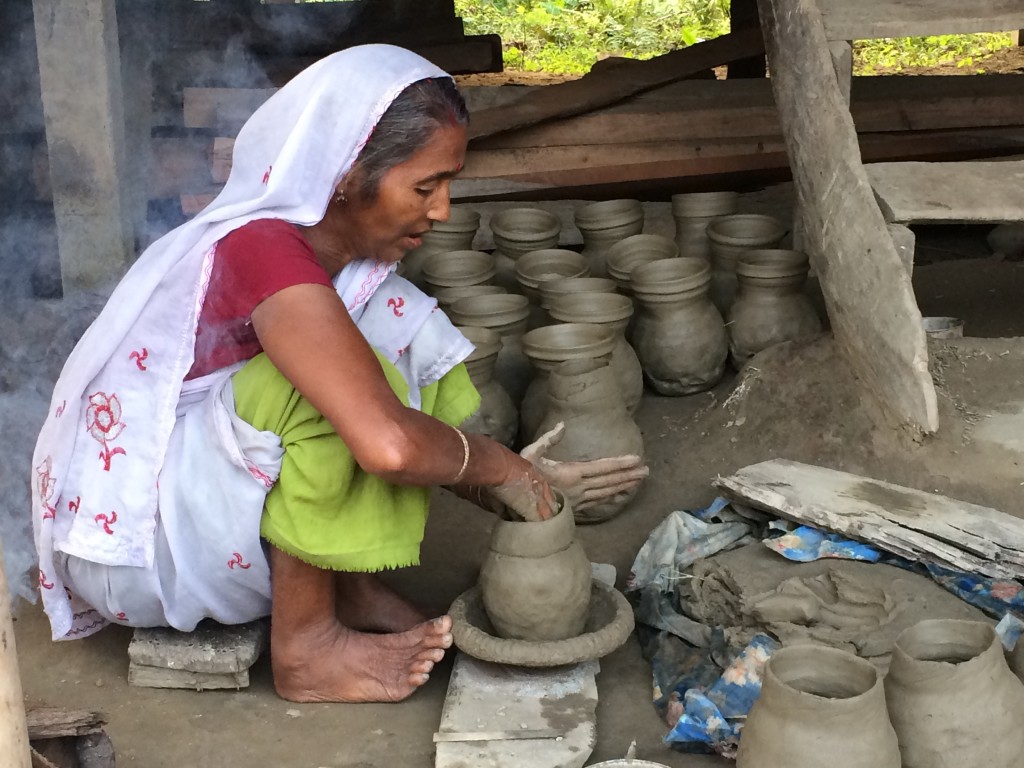
A woman spends her day making pottery on Majuli Island in northeast India. Photo/Toni Neubauer

By Jessie Marchesseau

A World War II memorial would never have made the list of places Jan Potter wanted to see while visiting India. It probably wouldn’t have even made the list of things she knew existed in India. But it does, and when she visited it in the small northeastern village, she was surprisingly intrigued.

“We all have different backgrounds and different cultures, but they are more interwoven than we think,” she said.

The memorial was just one of many new and unexpected experiences on Potter’s four-week trip to northeastern India and Bhutan. Potter, a retired school teacher, and her husband, Gil, made the trip last November along with a photographer from Texas and the founder of Incline Village-based adventure travel company Myths and Mountains, Antonia “Toni” Neubauer.
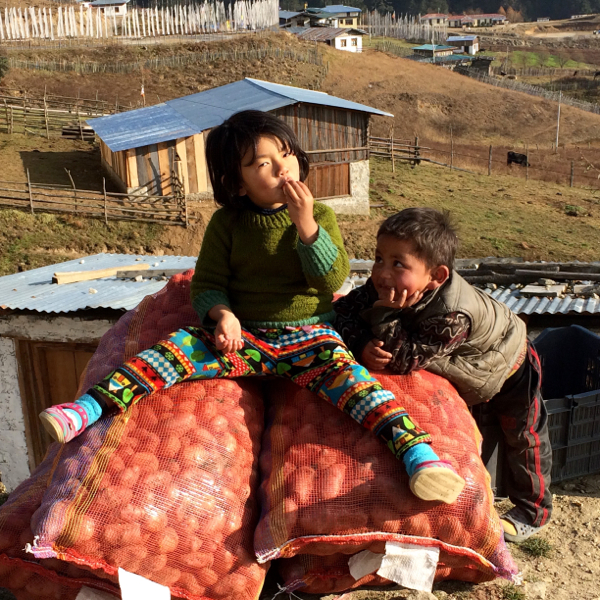
 2.Bhutanese children from the eastern part of the country sitting on the local farm produce. Photo/Toni Neubauer

Bhutanese children from the eastern part of the country sit on the local farm produce. Photo/Toni Neubauer

“In northeast India, I really knew nothing about it, and now my mind is so interested in learning about the background of that area,” Potter said of her trip.

The group traveled in private cars with local drivers who were adept at avoiding the never-ending procession of cars, buses, people, elephants and cows clogging up the roadways as well as rattling off the history of nearly every small village they came to. They visited a town in the middle of a river, slept in bamboo beds, ate authentic cuisine and visited community libraries.

They didn’t hit a single tourist attraction and saw less than a dozen American or European people in the entire four weeks.

The trip was designed and booked through Myths and Mountains. The itineraries the company offers travelers are not just about snapping pictures; they’re about interaction. Rather than hitting up the common tourist attractions and booking people in Holiday Inns, Myths and Mountains takes people inside the true culture of a country. Travelers have the opportunity to visit small communities, sit with local artisans, tour area businesses, and stay in boutique hotels or even the homes of local residents.
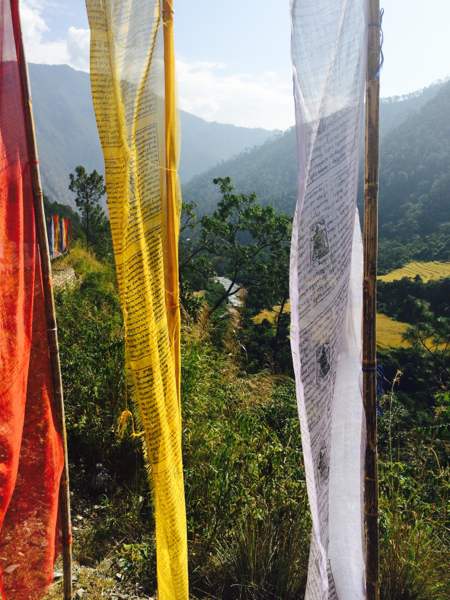
Bhutanese prayer flags flutter in the wind. Photo/Toni Neubauer

Bhutanese prayer flags flutter in the wind. Photo/Toni Neubauer

Neubauer calls Myths and Mountains more than an adventure travel company; it’s also an educational travel company.

“We live in a world today where people don’t understand each other; they’re afraid of each other,” she told Lake Tahoe News. “Travel provides that understanding we so desperately need.”

The company books pre-designed and custom trips featuring nearly a hundred itineraries in Asia, Southeast Asia and South America that can be divided into four categories: cultures and crafts, religion and pilgrimage sites, environment and natural history, and natural healing and traditional medicine.

If you would rather learn the finer points of Guatemalan cooking than take photos of the Eiffel Tower or make a mandala with monks instead of joining the throngs of tourists at the Vatican, then Myths and Mountains may have just what you’re looking for.

Neubauer says for Myths and Mountains there is no such thing as a “typical trip.” They have designed numerous custom trips over the years including one for a couple who wished to explore the art of puppetry in Vietnam and another focused on shamanism in Ecuador for the students of Emory University.

Neubauer’s passion for educating doesn’t end with travelers. Her background in education, a doctorate in educational administration to be exact, inspired her to form READ Global in 1991, just three years after she founded Myths and Mountains. An acronym for Rural Education and Development, READ was Neubauer’s way to give back to the rural communities in her travel destinations.

A dancer at the Trashigang Tsechu Festival in Bhutan. Photo/Toni Neubauer

A dancer at the Trashigang Tsechu Festival in Bhutan. Photo/Toni Neubauer

She saw how tourism could create a village of beggars, how schools and hospitals built with the best intentions would fail because the villages hadn’t the means or the knowledge to manage and maintain them once the organizers were gone. Instead, READ builds rural library community centers and helps form for-profit local businesses to sustain them, along with providing training to local residents so the centers can be maintained long after READ leaves. Since its inception, the organization has built 85 rural library centers.

READ has since branched off from Myths and Mountains, though Neubauer is still on the board. However, it still receives a great deal of support from Myths and Mountains and its clients.

It’s this way of giving back which recently earned Myths and Mountains the 2015 Tourism Cares Legacy in Travel Philanthropy award. The award recognizes travel companies with outstanding philanthropic efforts which have had a positive impact for more than 15 years.

However, it’s their outstanding knowledge of the regions they travel that earned Myths and Mountains numerous other awards and designations including being named a Trusted Travel Expert on Wendy Perrin’s 2015 WOW List for five different countries, a Conde Nast Nepal Top Travel Specialist and one of National Geographic Traveler’s 50 Tours of a Lifetime among others.

But the Potters didn’t choose their Myths and Mountains trip because of an award or something they read in a magazine. They chose it because they believe in the READ program and because this particular trip enabled them to visit READ libraries in India and Bhutan while exploring a new country in an intimate way.

“My favorite part,” Potter told Lake Tahoe News, “is how it makes you want to learn more about the world.”


Exercise key to preventing back pain

By Gretchen Reynolds, New York Times

Lower back pain is an almost universal if unwelcome experience. About 80 percent of those of us in the Western world can expect to suffer from disruptive lower back pain at some point in our lives. But if we begin and stick with the right type of exercise program, we might avoid a recurrence, according to a comprehensive new scientific review of back pain prevention.

Lower back pain develops for many reasons, including lifestyle, genetics, ergonomics, sports injuries, snow shoveling or just bad luck. Most often, in fact, the underlying cause is unknown.

For most people, a first episode of back pain will go away within a week or so.

However, back pain recurs with distressing frequency. By most estimates about 75 percent of people who have had one debilitating episode of lower back pain will have another within a year.

Read the whole story