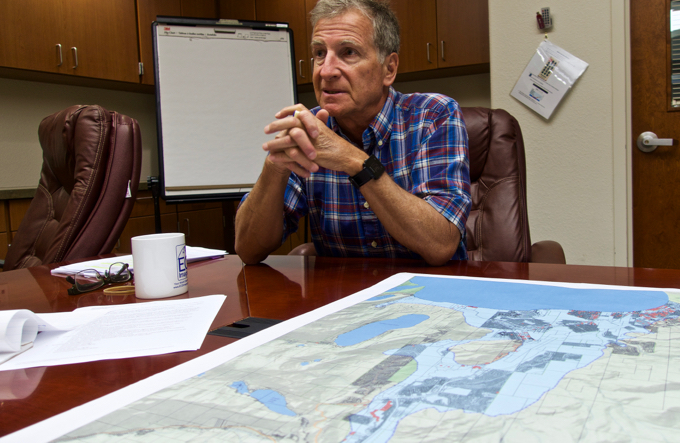
UNR working to stop mosquitoes’ spread of disease
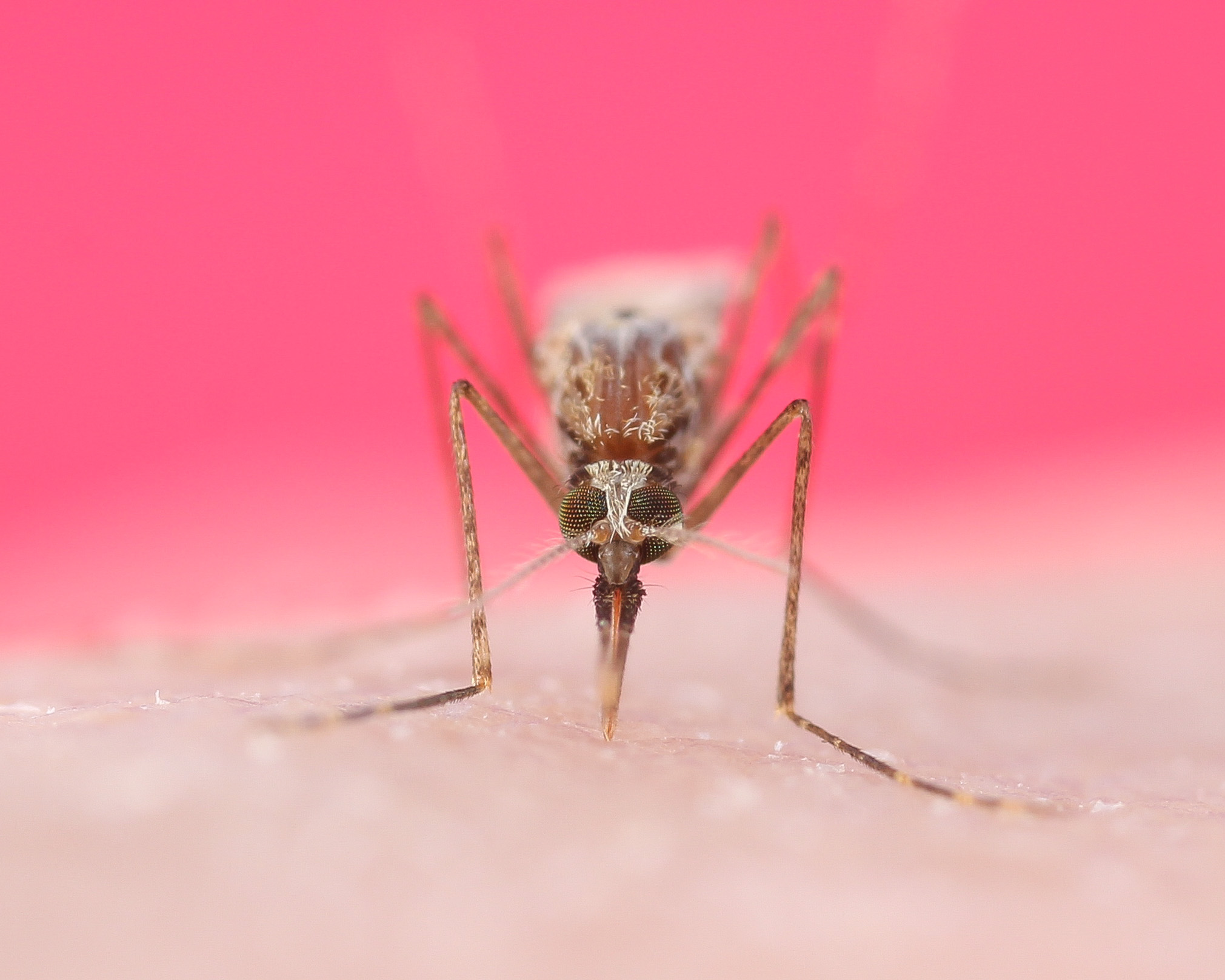
A gambiae, also known as a mosquito, feeds on a human. Photo/Andrew Nuss

By Mike Wolterbeek

UNR entomologist Andrew Nuss and biologist Dennis Mathew are looking for a way to stop the spread of mosquito-borne disease. The goal of their research is to identify key mosquito odorant receptors that govern mosquito host-preference for humans and to genetically modify those genes in order to create mosquito strains that avoid biting humans.

“Mosquitoes are a big problem in transmitting disease,” Nuss said. “Malaria is foremost among these, resulting in more than 400,000 deaths worldwide every year and millions infected. Not all of these infections are fatal, but this illness contributes to other diseases, the ability to work and quality of life.”

Nuss is an assistant professor in the university’s Department of Agriculture, Nutrition and Veterinary Science, whose research proposal was recently awarded a $500,000 grant by the Defense Advanced Research Projects Agency, an agency within the U.S. Department of Defense.

By taking a closer look at the issue, Nuss noted key problems in the way mosquitoes are controlled now, and he came up with his new approach.

“Killing mosquitoes is one way of preventing the spread of disease, and others are trying to develop malaria vaccines, which has been difficult,” Nuss said. “By and large, we have been using vector control as a way to prevent the spread of disease, and primarily that has been through the use of insecticides. While that works pretty well for a while, eventually the mosquitoes can become resistant, then you’re left with a chemical you can’t use, and sometimes they become resistant to entire chemical classes.”

Nuss decided to approach the mosquito problem by studying their sense of smell. The mosquitoes that are most important when it comes to transmitting diseases are the ones that have become highly attuned to feeding on humans, facilitating rapid human-mosquito-human disease transfer.

“They have become co-adapted to us because we live in these nice, concentrated cities where they can find lots of people to feed on,” Nuss said. “They preferentially feed on humans, and their odorant receptors may be attuned to human odors, specifically. So, we want to tweak that system by either knocking out the receptors that are responsible for human feeding, or replacing them with receptors from other mosquito species that feed on other animals in the environment.”

If these human-seeking mosquito species can be modified to avoid feeding on humans and instead on other animals, this could break the human-mosquito-human transmission cycle. Unlike insecticide-based vector control strategies, this would also ensure that mosquitoes could still feed on other animals in the environment to complete their life cycle without pressure to develop resistance.

Nuss continues his research with the help of collaborator Dennis Mathew, an assistant professor with the Department of Biology whose lab focuses on the neuroscience of smell, specifically in fruit flies. Together, Nuss and Mathew have combined their labs to work on understanding the olfactory makeup of mosquitoes.

“In my lab, we have a system where we can measure what the smell receptors of fruit flies – or other insects – can sense,” Mathew said. “So, Andrew and I talked about taking advantage of this system and in this project we are going to identify those mosquito smell receptors that we suspect smell human odors and put them in the fruit flies. We will then use the fruit fly system in my lab to figure out which receptors are most sensitive to human smells.”

Mathew’s research looks at understanding how fruit fly neurons that express smell receptors sense environmental odorants and translate these olfactory inputs into the insect’s behavioral output.

The fruit fly larva, which is the Mathew lab’s favorite model system, has a very simple smell system compared to mammals or even other insects. It has only 21 smell receptors and 21 pairs of neurons expressing them. In contrast, a human nose has approximately 400 smell receptors and approximately 10 million neurons. The numerical simplicity of the fruit fly system enables elegance and simplicity in the scientific approach.

While most scientists who work in this field are developing repellents, Nuss and Mathew are taking a bioinformatics approach to truly understand and change the common receptors found in mosquitoes.

Nuss and Mathew are working on the project together, along with Nuss’s Research Associate Rana Pooraiiouby. With the recent grant from the Department of Defense, they are able to continue their research in what is considered a relatively new field. The $500,000 grant covers the first two years of their research, with a possible extension period of one year for an additional $470,000.

“Insect mitigated disease is a tremendous problem and we have been hammering away at it with a number of different approaches, with most of them involving chemical insecticides for years and years, but the problem remains,” Nuss said. “So, we need new strategies, and our research is an approach where the mosquitoes still get to survive in an environment just as long as they are not biting humans. Preventing the spread of disease is the ultimate goal.”

Mike Wolterbeek works for UNR.


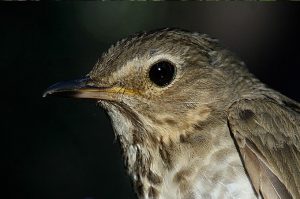
Tahoe scientists studying secret travels of thrush

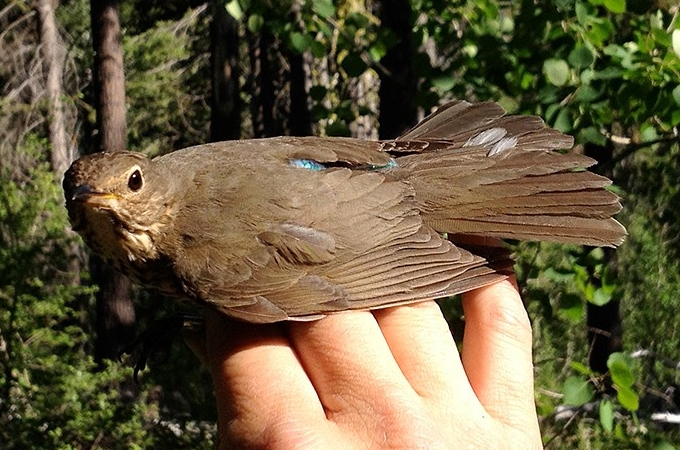
A rare Swainson’s thrush before being outfitted with a tracking device. Photo/TINS

By Jim Sloan

In 2009, Will Richardson was doing some summertime bird-monitoring research in aspen stands in Ward Canyon near Lake Tahoe when he heard an unexpected birdsong.

It was a high, pleasing, spiraling song, like a flute, and he recognized it right away as the song of a Swainson’s thrush, a bird that had all but disappeared from Tahoe and the Sierra south of Yuba Pass.

He heard one bird singing and then he heard others responding. To his astonishment, he realized that there was a small colony of the elusive bird.

“It floored me,” said Richardson, executive director of Tahoe Institute for Natural Science. “I always expected to see them and always wondered why they were never there. So, it was pretty thrilling to find a pocket of survivors.”

Richardson had studied thrushes in Vermont and Canada years before and had earned his doctorate in ecology, evolution and conservation biology from the UNR by studying bird communities in Sierra aspen habitats. He knew that Swainson’s thrushes had been common at Tahoe years ago and that their disappearance from Tahoe and other areas of the Sierra was considered “one of the unresolved mysteries of Sierra Nevada ornithology.”

He decided to investigate. He wanted to find out if the birds were declining, stabilizing, or rebounding in the Tahoe region.

He knew that Tahoe had plenty of habitat to attract the bird, which favors aspen forests and dense, riparian thickets. So, to explain its small numbers, he reasoned that he would need to learn if the bird’s wintertime habitat had changed in a way that affected its resiliency. That meant capturing birds twice.

First he had to catch some and attach a tiny tracking device. Then, the next year, he had to catch the banded birds a second time to retrieve the data. Not a simple proposition.

Secret to scientific success: Know how to pick a fight
To capture Swainson’s thrushes for his study, Will Richardson of the Tahoe Institute of Natural Science said he “basically picks a fight with the bird.”
He sets up nets in a bird’s known territory and plants decoy thrush in a tree. Then he sneaks off a short distance and plays a sound of the Swainson’s thrush’s spiraling woodwind song. Other thrushes, intent on protecting their territory, swoop in to drive off the invaders. Some get caught in the net.
Richardson removes them, takes measurements, attaches leg bands and the tracking device, and
releases them. The next summer he plays the same trick and tries to recapture the same birds.
“You basically need to catch the same bird twice, and that’s not easy when you consider how few birds there are to begin with,” Richardson said.
While he’s not sharing the location of his Ward Canyon site, Richardson said birdwatchers can find Swainson’s thrushes along Strawberry Creek just below the Lover’s Leap trailhead (off Highway 50 west of Strawberry Lodge), along General Creek at Sugar Pine Point State Park, and along the Upper Truckee River near Hawley Grade south of Christmas Valley.
Swainson’s thrushes are more likely to be heard than seen. Their song has a “ventriloquial quality” that makes them difficult to track. They also fly around quickly, and sometimes they use a quiet song that sounds like it’s farther away than it actually is. — Jim Sloan

Although Swainson’s thrush has an estimated global breeding population of 100 million birds, the species has lost 38 percent of its numbers since 1966, according to the Cornell Lab of Ornithology.

The bird breeds in the north and migrates in fall to Mexico, Central America, and northern South

America. Birds from the majority of the United States and Canada winter in South America while the

Pacific Coast population migrates to Mexico and Central America.

According to researchers at Cornell, Swainson’s thrush is particularly sensitive to such breeding habitat problems as grazing, development, human activity, and nonnative invasive plants.

Migrating Swainson’s thrushes are killed — in greater numbers than any other bird species — by collisions with windows, radio and cellphone towers, and tall buildings.

In 2014 and 2015, with financial support from the Sierra Foothill and Sacramento Audubon Society chapters, TINS and colleagues at the Point Reyes Bird Observatory captured more than three dozen thrushes from Ward Canyon, Strawberry Creek, and Plumas County locations and equipped them with one of two tracking devices.

In subsequent summers, the team recaptured 15 of the 46 originally tagged birds. What they have learned has surprised them.

The Tahoe birds from Ward Canyon and Strawberry Creek were not migrating to Mexico, as Richardson

had theorized, but were joining eastern birds for a trip to northern South America. The Plumas County birds, meanwhile, were “bopping all over the place,” with some making their way to Central America.

One Swainson’s thrush from the Quincy area spent the winter in balmy Panama.

The conclusion? It’s too early for solid theories yet, Richardson said. His colleagues are still breaking down the data collected from the tracking devices, and another colleague from UC Santa Cruz is doing genetic tests on feathers from the captured birds.

Richardson hopes that additional data will shed some light on the habits of the Swainson’s thrushes spending their summers at Tahoe. He also plans to monitor the thrushes’ nests to determine how many young they produce at places like Ward Canyon. It will be a few more years before any solid theories emerge.

In the meantime, he’s encouraged. “It’s great to know these birds are coming back to the same location each year,” he said. “They are producing young here, and that’s also encouraging. We know babies are produced, but whether there are enough young to sustain the population still isn’t clear.”

This article is republished from the summer 2017 edition of Tahoe In Depth.


With bankruptcy nearly over, Caesars exec talks up growth

By Richard N. Velotta, Las Vegas Review-Journal
 
Now that Caesars Entertainment Corp. is well on its way toward emerging from bankruptcy, company officials have affirmed significant growth plans are in the works.

Speaking Wednesday to members of the state Gaming Control Board in Carson City, President and CEO Mark Frissora said the new Caesars not only would be growing in Las Vegas, but at Lake Tahoe and Laughlin as well.

Caesars is the parent company of Harrah’s Lake Tahoe and Harveys at Stateline.

The board voted unanimously to recommend approval of the registration of subsidiary companies and LLCs and the licensing and suitability of several corporate officers, executives and key employees.

Read the whole story


Writers have become a community at Squaw Valley

By Stephanie Taylor, Sacramento Bee
 
There’s something infectious about 150 or so creative people, all chattering at once. This is a weeklong annual conference of writers, established and aspiring, who come from all over to Squaw Valley, some every summer, year after year. If ideas and genius are tangible molecules floating in the air, I can only hope they’ll land on me.

The operative word is “community,” chosen on purpose by the founders in 1969, when the novelists Oakley Hall and Blair Fuller gathered to build an institution that’s thrived ever since. Some of the writers have passed – sort of. I say sort of because their spirits linger. Some are declining gently into old age. Their children carry on, and their children’s children. It’s an honor to be here, to be included in what has evolved as a family.

It’s also difficult not to be intimidated by those who have been here before, studying and discussing the craft of poetry, fiction, nonfiction and screenwriting: Peter Matthiessen, Richard Ford, Michael Chabon, Robert Hass and Ann Rice, to name a few. In 1985, Amy Tan arrived with stories that became “The Joy Luck Club.” This year, Janet Fitch’s novel “Paint It Black” is her second movie. Anne Lamott’s “Bird by Bird” is every writer’s classic.

Read the whole story


STPUD getting better grasp on all well use

By Kathryn Reed

Red dots fill a map; with most being located in Christmas Valley and near the state line. They represent the more than 600 private wells within South Tahoe Public Utility District’s boundaries.

Most are at residences, while others are at campgrounds, a school, trailer parks and other commercial entities.

Per state requirements South Tahoe PUD is trying to get a firm understanding on how many are operational, exact locations and if people have any issues.

Ivo Bergsohn, a hydrogeologist with the district, is tasked with overseeing all of this. A survey with 19 questions is being sent out to the well owners this month to gather some basic data, see if they have questions, and let them know the district can help where appropriate.

“The information we gather will be used to help guide the groundwater management plan,” Bergsohn told Lake Tahoe News.

Ivo Bergsohn with STPUD is overseeing the groundwater program. Photo/Kathryn Reed

During the drought California thought it would be a good idea to start regulating groundwater. It was one of the last states to do so. With laws that were passed in 2014, different jurisdictions had to create groundwater management plans. STPUD is in charge of that mandate for much of the basin on the South Shore, though El Dorado County has oversight in some areas.

Groundwater management pertains to the water level, storage, quality, land capability, and ensuring there are no adverse effects to surface water from pumping.

In 2016, per state mandate the district performed a stress test to determine how much water it had. At that time – which was before last year’s record snowfall and at the height of the drought – there was enough water in the aquifer for 31 years.

This figure is based on the demand from 2013, 2014 and 2015 which averaged 6,173 acre-feet per year.

The district is not looking for new customers or even to tell people how to use their well or regulate the use in any way.

What employees can do is provide tips about maintenance, share how to properly disinfect a well and other related information.

“If we have a properly managed well, there is potentially one less conduit of contaminate into the aquifer,” Bergsohn said.

People keep their wells for various reasons – for historical purposes, not wanting to pay a water bill, not wanting anything added to their water, and staying off the grid, so to speak.

STPUD was well ahead of the state in monitoring groundwater issues. It has been doing so since about 2000, three years after the gasoline additive MTBE (methyl tertiary butyl ether) was found in wells. The district won a multi-million-dollar lawsuit against several gas companies as a result of that contamination.

Contamination, though, remains the No. 1 threat to the district’s water supply, according to Bergsohn. PCE (tetrachloroethylene) is an issue today with wells in the Tahoe Keys and Lukins Brothers water districts being contaminated. STPUD is providing those two entities with water.

Arsenic is a naturally occurring contaminate, for which public districts regularly test.


Underwater robot measures Lake Tahoe climate change

By Vicki Gonzalez, KCRA-TV

UC Davis is using an underwater robot with the hopes of understanding how climate change is affecting Lake Tahoe.

Tahoe Environmental Research Center deployed the autonomous underwater vehicle earlier this month.

More commonly known as a glider, the autonomous vehicle will coast 150 meters under Lake Tahoe’s surface, going back-and-forth taking measurements.

The robot will continuously measure the lake’s temperature, salinity, dissolved oxygen, chlorophyll, among other data, broadcasting the information back to researchers.

Read the whole story


Stuart Merrill — 1923-2017

Stuart Merrill

Former Alpine County Sheriff and Supervisor Stu Merrill died Aug. 1, 2017, at his home in Woodfords.. He was 94.

Stuart was born to Grant Perry Merrill and Angie Tibbetts Merrill in Gardnerville in January 1923. He was raised in Woodfords, the third generation of the pioneer Merrill family.

He spent his later grade school and high school years in Mojave after his father was transferred there to serve as the state highway superintendent. Stu always returned to Alpine County during the summers and school vacations.

After high school he attended Sacramento Junior College. He divided his time between studies, ski racing and ski instructing at Sugar Bowl.

College was interrupted when Stu served in the Air Force in the European theater during WWII. After the war he enrolled at San Jose State, pledged Delta Sigma fraternity, continued his intercollegiate ski racing. He met Eileen Hunter, who he declared to be “the girl he would marry.” They were married on Sept. 11, 1948.

After graduation the couple moved to Woodfords where they assumed management of the family’s Woodfords Store & Resort. In 1958 Stu was elected sheriff of Alpine County. He served five terms until his retirement in 1978. Stu continued his public service for several years serving as an Alpine County supervisor.

In retirement Stu rekindled his passion for ski racing (senior division). He joined Eileen golfing. Together they traveled and went on reunion adventures with close friends. He was an avid fisherman (he always kept his fly rod in the trunk of the car), knowing every fishing hole in the Eastern Sierra but never divulged his favorites. In later years he would teach his three grandchildren to fish, how to drive the golf cart and use the stick shift in the old truck.

Stu was a people person known for his sociability, admired for his compassion, generosity and willingness to help others. He was a member of the Veterans of Foreign Wars, California Peace Officers Association, Carson Valley Freemasons, Sirs and the Alpine County Historic Society.

He was preceded in death by his brothers Austin and Robert Merrill.

Stu is survived by his wife, Eileen; children, Eric (Michele) and Cathy; grandchildren, Grant, Ian and Hanna; nephews and nieces, Greg Merrill, Linda Merrill, Sandra Merrill, Warren Merrill, Barbara Merrill Moore and their children.

The memorial service will be Aug. 27 at 11am at Turtle Rock Park Community Center in Markleeville. Burial will be private.

The family requests that in lieu of flowers or sympathy gifts, memorial contributions may be made in his name to the Alpine County Historic Society, PO Box 517, Markleeville, CA  96120.


Slew of activities to replace South Shore fireworks

By Kathryn Reed

STATELINE – Fireworks are out, lasers are in. A single event on one night has been traded for multiple activities on four days.

Labor Day Lake Tahoe is being reinvented.

Earlier this year the Tahoe Douglas Visitors Authority decided to scrap the annual fireworks show on the Sunday of Labor Day weekend. This is because lodging establishments said it had become a non-starter.

While plenty of locals are disappointed the sky won’t be lighting up in a couple weeks, the TDVA is about driving tourism, not entertaining locals.

At the board’s meeting this week it was revealed that the TDVA is allocating almost $58,000 on a four-day carnival, art, and music festival at Heavenly Village, along with an event at Lakeview Commons that Sunday afternoon and evening.

This expenditure is less than 50 percent of what the 20-minute fireworks show cost.

Mike Frye, who handles events for TDVA, gave the board an overview of what to expect. The goal is to provide easy, fun, free events for people.

The fun will start that Friday at Heavenly Village. The carnival will go from 6-9:30pm. It will include all the usual rides except for a Ferris wheel. Games, stilt walkers, jugglers, caricaturists and the standard fair food will be offered.

On that Saturday and Sunday the events go from 1-9:30pm. The headliner music acts start at 6pm both days, though there will be music in the afternoon. Bands include Hit Parade, Steele Breeze, 3 Musicole, Failure Machine, Merry Gold, Dead Winter Carpenters, Jelly Bread, Shanda and the Howlers, Cameron Calloway, and Grace Hayes.

Art and classic car exhibits will be part of the mix.

Over at Lakeview Commons on Sept. 3 the activities go from 4:30-9pm. A disc jockey will be spinning tunes, while various vendors peddle their wares, people imbibe at the beer garden, get something to eat from the food trucks, and hang out in the hammock lounge.

UV99, the same group that does the laser events for Burning Man, will be coming to put on a show from 8:30-9pm. This will be something boaters will be able to see from the water.

TDVA has some “extra” cash to devote to luring people to the South Shore for these events.

“We paused some of our summer advertising in Northern California,” TDVA Executive Director Carol Chaplin told the board. She said the weather combined with July 4 and the celebrity golf tournament were bringing people without any sales pitch. “We put some of that into Labor Day specific advertising; about $40,000 was shifted.”

This isn’t all that will be going on that weekend. There’s always the Heavenly tent sale, Eric Church has two shows slated to wrap up the Harveys Outdoor Concert Series, Tahoe Beach Retreat is having a luau on Sept. 1 and the usual outdoor fun Tahoe has to offer including TAMBA’s Rose to Toads bike ride on Sept. 2.


Housing inventory at a 20-year low

By Roger Yu, USA Today

Good luck looking for a house to buy. 

The number of residential houses available to buy is at a 20-year low as the appeal of McMansions wanes and a growing reluctance by Baby Boomers to trade up or down from their current homes, according to a report by Realtor.com. 

More than half of its survey respondents, or 59 percent, said they are not planning to sell their houses in the next year. 

Read the whole story


State fines Squaw Valley in ski patroller’s death

By Kaleb Roedel, KRNV-TV

Following an investigation into the January death of a Squaw Valley ski patroller, California’s Division of Occupational Safety and Health has cited and fined Squaw Valley Ski Holdings for violating two workplace safety codes, according to documents obtained by News 4-Fox 11.

On Jan. 24, Joe Zuiches, a 42-year-old Squaw Valley ski patroller, was killed during avalanche control activities at the top of Gold Coast Ridge at Squaw Valley Ski Resort.

Six months later, Cal/OSHA has cited Squaw Valley for “failing to correct an identified unsafe working condition by implementing a procedure for protection against the workplace hazards associated with hang cord entanglement during hang cord blasting operations” for a fine of $11,250.

Read the whole story