Efforts to control Calif. housing costs go to guv

By Alexei Koseff and Taryn Luna, Sacramento Bee

A multi-bill package aimed at addressing California’s housing affordability crisis headed to Gov. Jerry Brown Friday as lawmakers prepared to draw the curtain on the 2017 legislative year.

Legislative leaders had previously reached agreement with Gov. Jerry Brown over measures to generate money for low-income housing development, fund housing programs and streamline the approval process for new projects, and he is expected to sign them.

“It’s a crisis and we want to act like it,” Sen. Toni Atkins, D-San Diego, said of her measure to impose a real estate transaction fee.

Read the whole story


Lawsuit aims to end commercial fur trapping in Calif.

By Louis Sahagun, Los Angeles Times
 
Conservation groups, aiming to end California’s dwindling fur trade, filed a lawsuit Wednesday that would force state wildlife authorities to raise license fees to levels required by law to cover the full costs of regulating the trapping, killing and skinning of wild animals.

That would drive the fees so high it would effectively kill off the trade introduced centuries ago by California’s first explorers and settlers, said Camilla Fox, executive director of Project Coyote, one of the plaintiffs.

The lawsuit, filed against the California Department of Fish and Wildlife and the state Fish and Game Commission, alleges that revenue generated from the 200 commercial trapping licenses purchased in 2016 for about $117 covered only a fraction of the state trapping program’s total costs.

Read the whole story


Students at the core of LTCC’s improvement plan

By Kathryn Reed

Every decision made at Lake Tahoe Community College is done so with the same common denominator – students.

There was a time when the philosophy in higher education was that students had the right to fail. After all, they are adults and can make decisions that may not allow them to succeed.

LTCC President Jeff DeFranco wants none of that. He believes in a student-first scenario where the mantra is students have the right to succeed and that it is those working at the college who must ensure the resources are in place for that to happen.

“We are doing everything we can to make sure they succeed,” DeFranco said. Success means getting them to move onto a four-year university, or graduating with an associate’s degree, or having the skills to find gainful employment.

DeFranco was speaking Sept. 14 to a full house at the Duke Theatre. This was his inaugural convocation where he gave the state of college address. With fall quarter slated to start Monday, this was an opportunity for faculty, staff and the community to hear where the college has been and is going in the short and long term.

DeFranco took over the presidency earlier this year. And while the groundwork was already laid for some of what he spoke about, he is also eager to break new ground and set goals that will define his time in office.

“Public education is a great equalizer,” he said. He spoke of his roots; his great-grandparents moving to the United States from Italy. A great-uncle was the first in his family to attend higher education – which was at a community college. This paved the path for his mom to go to UC Davis.

The university center at LTCC will help to redefine the South Lake Tahoe college. Photo/LTN

While higher education may be the norm for many families, it is still a novelty for others, while some think it is out of reach.

In 2012-13, 29.1 percent of LTCC’s student population was comprised of first generation college students. Last school year that percentage was 34.9 percent. Many are Hispanic; a reflection of the community at large.

LTCC supports Deferred Arrival for Childhood Arrivals (DACA) and has students who are threatened by potential changes to the federal law.

While getting more students is always on the agenda, ensuring the ones who are enrolled complete their studies and on time are major goals.

Community college enrollment is dropping across the country, and LTCC is not immune to this trend.

One focus is to get more local high school students to attend LTCC. Right now about 35 percent of South Tahoe High grads go to LTCC. The goal is to capture 50 percent. The college also is making a concerted effort to lure Whittell, North Tahoe and Incline high school students, too.

DeFranco talked about “promise grants” – something that was brought up in March at a board meeting. Local students would receive one year free at LTCC. Funding for it, though, is still not in place. However, the president wants to launch it in fall 2019.

“If we don’t do this, we will not be serving our community and we will be left behind,” DeFranco said.

Physically, the college is going through a bit of a renaissance thanks to Measure F, the $55 million bond approved by voters in November 2014. The university center, where students will be able obtain four-year degrees via partnerships with other institutions, is going up rapidly next to where DeFranco was speaking. The plaza outside the library is a new gathering spot – and one with heated walkways. The parking lot is no longer dilapidated; plus, it conforms to ADA regulations.

Upgrades to classrooms are coming.

WiFi throughout campus is much improved, with cellphone boosters in the budget.

Transportation is seen as a barrier to college, and was made more pronounced by last winter’s epic snowfall. Starting in October, LTCC students will be provided free passes for the local bus. This is a product of ADVANCE, a collaborative network of local organizations, government offices, and employers that work together to support adults in meeting education, career, and other personal goals. Tahoe Transportation District wants to make the college a hub. A bus shelter on campus is on the drawing board.

By 2022, LTCC intends to have housing on campus available for students.

LTCC wants to be a partner with other entities in town. Revamping how the theater is used in one way. TedX South Lake Tahoe will be at the college at the end of the month and Valhalla is putting on the play “Joint Chiefs” this year at the theater.

Besides starting a new school year, the most immediate concern of the college’s is to retain its accreditation. The review committee from the Western Association of Schools and Colleges will be on campus Oct. 9-12.

While there are plenty of plans in place for LTCC, the last major strategic planning session was in 2011. DeFranco plans to have a fresh look at the college’s goals in January.


Creativity helps bring companies to Nevada

By Nicole Raz, Las Vegas Review-Journal

What actually happens when businesses look to relocate to Nevada?

It usually starts with a phone call, which leads to a series of other phone calls to coordinate the process, said Ryan Smith, business development manager with the Governor’s Office of Economic Development.

He said the call either comes from somebody working within a company — usually from a tax incentive division or real estate division, or even an executive-level decision maker, depending on company size — or from a third-party site selector working on behalf of a company.

Everything after that call just depends, Smith said, because each company is looking for something different.

Read the whole story


Zinke directs more aggressive approach to prevent wildfires

By Associated Press

WASHINGTON — Interior Secretary Ryan Zinke on Tuesday directed all land managers and park superintendents to be more aggressive in cutting down small trees and underbrush to prevent wildfires as the smoke-choked West faces one of the worst fire seasons in a decade.

In a memo, Zinke said the Trump administration will take a new approach and work proactively to prevent fires “through aggressive and scientific fuels reduction management” to save lives, homes and wildlife habitat.

Wildfires are chewing across dried-out Western forests and grassland. To date, 47,700 wildfires have burned more than 8 million acres across the country, with much of the devastation in California, Oregon and Montana, Zinke said.

Read the whole story


Report: Capt. fell from truck because of coat issue

Updated Sept. 14:

By Kathryn Reed

An internal investigation by Lake Valley Fire Protection District revealed the captain who fell out of a moving engine was taking off his coat and his gear got hung up on the door lever.

The firefighter, whose name has not been made public, had to be airlifted to a hospital after the Aug. 27 incident. While he was released a couple days later, he has not returned to work. He sustained a concussion, and injuries to his head, face and hands.

Lake Valley isn’t saying if he isn’t at work because of the injuries or if he was placed on leave.

The crew was on their way home after being at a vehicle accident near Strawberry that afternoon. The truck was going about 25 mph. The engineer who was driving was able to pull over about 54 yards from where the captain landed.

Fire Chief Tim Alameda would not answer questions. He merely said read the online report.

That report says, “Fire district personnel tested numerous scenarios related to how the passenger door opened. Based on a series of scene reconstructions, it is likely the movement of the fire captain in the seat resulted in the protective cargo pant covering to catch on the outer lip of the passenger door handle. This caused the handle to unlatch the passenger door, ejecting the fire captain.”

The state has not made a finding yet. The Occupational Safety and Health Administration has six months to each a ruling. “This is still an open investigation,” Jeanne-Mairie Duval with CalOSHA told Lake Tahoe News.

The Lake Valley report states the captain had taken his seat belt off. This violates local and state law. It must be fastened at all times when a fire truck is moving.

Because Alameda isn’t talking, it’s not known if the captain or either of the two other firefighters who were in the engine were disciplined. The captain had the most seniority of the three.


Calif.’s poverty rate remains nation’s highest

By Jim Miller, Sacramento Bee

One in five Californians lives in poverty, the highest rate in the country, according to new data from the U.S. Census Bureau.

The “Supplemental Poverty Measure,” factors in cost of living and shows a stubbornly high share of Golden State residents in poverty even as the national rate has dropped slightly.

Under the methodology, an estimated 20.4 percent of Californians lived below the poverty line in a three-year average of 2014, 2015 and 2016. That is virtually unchanged from the 20.6 percent average for 2013, 2014 and 2015, according to Tuesday’s release.

Read the whole story


Nev. may be home to pot motels, bars, clubs

By Jenny Kane, Reno Gazette-Journal

Nevada’s local governments have the green light to license certain businesses that want to allow marijuana consumption on-site, according to an opinion released Sunday by the Legislative Counsel Bureau. 

Businesses may establish lounges at which patrons can consume marijuana, and municipalities may create ordinances that require those businesses to purchase a license to do so. The privilege would also extend to events and concerts. 

The opinion, requested by state Sen. Tick Segerblom, D-Las Vegas, noted that marijuana consumption must be in compliance with the state law, which limits the possession amount to an ounce of marijuana or an eighth-ounce of concentrate. Consumption within the facility cannot be visible to the public, nor can it be open to anyone under the age of 21. 

Read the whole story


State fines Kirkwood $750K in contamination case

By Susan Wood

Kirkwood Mountain Resort has agreed to pay more than $750,000 to settle a wetlands contamination case brought against the ski resort by the Central Valley Regional Water Quality Control Board and California Department of Fish and Wildlife.

The water board found through a complaint in April 2016 that the ski resort used asphalt grindings “for dust mitigation” in its unpaved parking lots. 

The approximately 3-inch petroleum-based grindings measuring up to 1,840 cubic yards collectively were spread into sensitive zones in the Timber Creek, Nordic Center and Red Cliffs areas – which could have jeopardized Kirkwood Creek. Although petroleum hydrocarbons were found in samples from the creek, no fish kills were reported in the agencies’ inspections.

The following month after the complaint was filed the state issued a notice of violation to the “Heavenly Valley Limited Partnership dba Kirkwood Mountain Resort” for violating water codes. Kirkwood Creek, a tributary to Caples Creek, flows to the South Fork of the American River upstream of Placerville.

The flows may affect the municipal water supply, along with hydropower generation, water recreation and wildlife habitat downstream.   

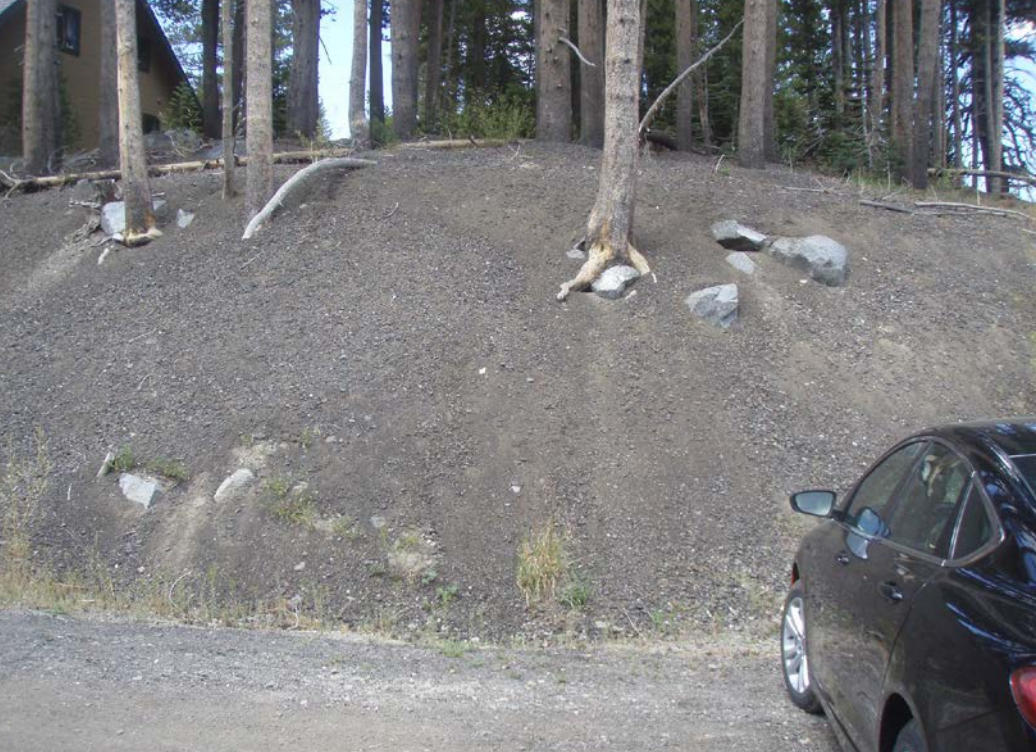
The slope north of the cross country ski area parking lot covered with asphalt grindings blown
during snow removal operations in 2015-16. Photo/Provided

As recently as last October, parent company Vail Resorts may have been facing a $4.44 million fine in civil liabilities for a violation of the Federal Clean Water Act and the California Water Code. Ski resort staff worked last fall until winter hit to clean up the sensitive wetlands. Last season’s phenomenal snowfall delayed further cleanup.

The penalty was reduced to $754,732 as a result of the ski resort’s progress. There’s more to do in five areas: Nordic Center, Red Cliffs Lodge, Kirkwood Meadows Drive, chair 9’s Timber Creek lot and Kirkwood Creek near Snowkirk’s chair 1 – which awaits the Army Corps of Engineers to supervise that part of the work plan.

The proposed settlement signed off by the water board last week is due to become final in 30 days following a public comment period.

Water board Assistant Executive Officer Andrew Altevogt told Lake Tahoe News comments would be taken into account when the settlement becomes final.

“They’ve done most of the work required,” Altevogt said of the administrative order signed off a few weeks ago by Kirkwood General Manager Doug Pierini, who came on board a few months after the complaint was made. 

“I don’t think they knowingly spread this stuff around (the streambed),” Altevogt said, adding it was the first time he had encountered a ski resort subject to this type of violation. Kirkwood has pledged to continue to work closely with the agencies involved to “remediate impacts to the environment” as well as conduct ongoing site assessments of the areas affected.

“Notably, third party test samplings that the agencies asked us to conduct did not demonstrate any impact on the surrounding groundwater,” Kirkwood said in a statement issued through spokesman Kevin Cooper.

“Kirkwood Mountain Resort takes seriously our role in responsibly stewarding the environment and the public land in which we are entrusted. We have already altered our snow removal procedures and will seek opportunities for our employees and contractors to learn from this,” the statement reads. 

The contamination case, which in one area was referred to as “a black snow field,” has served as a black eye to Vail Resorts – a giant in the ski industry.


NDOT close to resolving stormwater runoff violations

By Art Marroquin, Las Vegas Review-Journal
 
 The Nevada Department of Transportation is abiding by the terms of a federal consent decree aimed at resolving stormwater runoff violations, with only one unfulfilled requirement that must be met by the end of this year, officials said Monday.

A comprehensive stormwater management plan must be completed by Dec. 31 in order to fully comply with a settlement reached last year with the U.S. Environmental Protection Agency, said David Gaskin, head of NDOT’s Stormwater Management Program.

EPA spokeswoman Margot Perez-Sullivan confirmed Monday that NDOT “fully complied” with the consent decree and the two agencies are working together to fulfill the final stipulation.

Read the whole story