Buildings, programs turning STHS into center of education

By Kathryn Reed

Meandering through the classrooms during the open house of the Stadium View building, an excitement permeated the walls. Students were excited – this from youth not accustomed to going to school before Labor Day; teachers giddy; administrators joyful; school board members relieved; and the public appreciative and awed by the transformation.

Realtor Deb Howard knows the upgrades to facilities and programs at the campus will in turn help her business. Families moving anywhere almost always inquire about schools. She said on Thursday that the campus, which she has seldom visited since her last child graduated in 1999, will be a selling point for her.

South Tahoe Middle School Principal Beth Delacour couldn’t stop smiling. Even though she doesn’t want to change schools, she’s excited about sending her kids to STHS with all the changes that have and will continue to occur during the next few years.
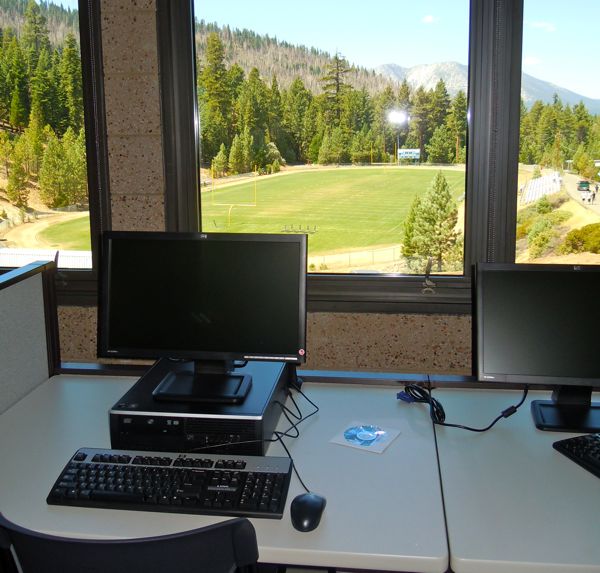
Proving why the STHS building is called Stadium View. Photos/Kathryn Reed

Proving why the STHS building is called Stadium View. Photos/Kathryn Reed

The $64.5 million facilities bond passed by voters in 2008 has been supplemented with $30 million in matching funds from the state. The bulk of the money is being spent at the high school, though every campus will see upgrades.

Blight is how the City Council views South Lake Tahoe, but it’s not how what’s happening on Gardner Mountain can be described.

When South Tahoe High School students start classes Monday, the second new building in four months will be theirs to learn in.

Thursday was a day to have a tour from a student of the two-story Stadium View building – appropriately named for the views to the football field; as well as the Career and Technical building that opened in April.

Superintendent Jim Tarwater and Principal Ivone Larson both spoke of how the programs being offered in the new facilities will prepare students for whatever they want to do after high school, be it college or work.

Math is one of the main subjects that will be taught in the Stadium View building. Da Vinci Algebra is a course the faculty created to blend math and art, and taught by instructors in both disciplines. The first in the nation course was just approved by the University of California as an accredited class.

“We want to make it exciting for kids,” Larson said of math as she gave a handful of people a tour of the building.

In the future, math and construction will be woven together.

The point is this generation should never have to ask, “When I will I use this?” when it comes to math principles. They will learn practical applications in high school.

Jamie Greenough, who teaches environmental science, couldn’t stop talking about what she will be able to do with her classroom, the greenhouse that is in the back of the room, the 3-D television that allows students to experience things like a tsunami, and the groundwater filtration system that still needed to be installed.

Connie Hunt was busy that day organizing her room. In the back are two dental chairs just waiting for someone to open wide. The dental program has been integrated with what Lake Tahoe Community College offers to make the transition seamless for those pursuing dental hygiene or dentistry.

What might seem like little touches are throughout. Windows open to provide fresh air. Tables in some rooms are really three put together to make one round table – which gives instructors more options. The AVID room can be one big room or two smaller rooms.

“Counselors were working up to 5 (Thursday) morning on the master schedule. As more students see this, they want in,” Larson said, going from room to room. No two seem a like. Each seems to be specialized. And that’s just how it was designed to be – unique and functional.

ngg_shortcode_0_placeholder (Click on photos to enlarge.)



LT Golf Course, river’s futures wrapped in EIR/EIS

By Kathryn Reed

MEYERS — With $6.1 million pumped into the greater South Shore economy each year from the Lake Tahoe Golf Course, officials are doing what they can to make sure those 18 holes exist when it comes time to restore the 1.5 miles of the Upper Truckee River that meanders through the greens.

“The revenues vary annually. In the economic study completed in 2008, the average was $981,000 per year, $139,000 of which was reinvested as capital improvements,” according to the website.

State parks generally lose money. This is the only one in the Sierra District to make money, and it is in the top five for the entire state.

American Golf is the concessionaire. It’s a month-to-month lease until a decision is made about what will happen on the South Shore course along Highway 50.

Lake Tahoe Golf Course and the eroding Upper Truckee River in Meyers. Photos/Kathryn Reed

Lake Tahoe Golf Course and the eroding Upper Truckee River in Meyers. Photos/Kathryn Reed

Although California State Parks, which owns the land the course and river are on, did not select a preferred alternative in the EIR/EIS that came out Aug. 26, much of the discussion Thursday during the media tour was on Alternative 2.

This would move seven full holes and three half holes from what is now known as Lake Valley Recreation Area to Washoe Meadow State Park. About 37 acres of stream environmental zone would be restored.

Groups like Washoe Meadows Community have long been against moving holes into the 700-plus acre state park. These people and others believe it will take-away from the biking, hiking and cross country ski experience.

Though this undeveloped state park is unknown to many longtime locals, it’s popular every season with those who do use it.

Park officials say there would be a trade-off with acres taken from the state park for the golf course being exchanged for accessible terrain along the river. As it stands now, the river through the golf course is essentially off-limits except to golfers and youth who wander in in search of errant golf balls to later sell.

The five short bridges crossing the Truckee are considered in areas of play. In more than one proposal they would be replaced by one bridge, 120- to 150-feet long that would be accessible to everyone.

South Shore media reps were given a tour of part of the property on Aug. 26. Like previous tours, the decaying banks were pointed out, a short walk taken to the old sand and gravel quarry pit. But what is hard to envision is just how close the golf course might come to the old Celio barn or the popular trails accessed from various sides of the park.

If the course were moved, then the lines of the recreation area and state park would be redrawn to reflect the golf course being in the former.

The environmental documents study 520 acres of the park. The federal document was required because the Bureau of Reclamation has contributed money to the process.

As with most reaches of the Upper Truckee River, which is the largest tributary to Lake Tahoe and biggest conveyor of fine sediment, the channel was straightened out years ago to accommodate the uses at the time. The problem is at the time no one was paying attention to erosion.

“What straightening the river means is it eats at the banks. As it ate its banks, it got larger so it had more power to erode,” explained Cyndie Walck, the state parks lone hydrologist.

She started monitoring erosion at the site in 1994.

The riverbank is obviously eroding. It is also evident stopgap measures to shore-up the banks have been unsuccessful.

The dispute rests in what may happen next.

The alternatives are:

1. Do nothing.

2. Restore the river and reconfigure the golf course to keep it an 18-hole facility.

3. Restore the river and reduce the course to nine holes

4. Leave everything intact, but stabilize the banks.

5. Restore the river and remove the golf course.

With 30,000 rounds of golf played at the course each year, officials looked at moving the golf course somewhere else on the South Shore, but no suitable land was found.

If the course is reconfigured, it will not affect winter snowmobiling.

Comments on the EIR/EIS will be taken until Nov. 4. The Tahoe Regional Planning Agency Governing Board is expected to discuss the documents in October. The documents are expected to be certified by state parks officials in the spring. At that time a more formal cost estimate will be available, though now $5 million is the amount talked about that is needed for river restoration. The soonest work would begin in 2012.

Walck says a project like this would likely rise to the top as her agency goes after grant money to fund it.

If golf course holes are moved, that will be part of a bid package for the next long-term concessionaire. In other words, it won’t be taxpayer dollars building the course.

More information:

Restore the Upper Truckee River

Washoe Meadow State Park

• EIR/EIS executive summary

Washoe Meadows Community

Future meetings:

• Public Site Tour

Sept. 8, 2-4pm

Lake Tahoe Golf Course

• Public Site Tour

Sept. 22, 4:30-6:30pm

Lake Tahoe Golf Course

• Public Open House

Sept. 29, 6-8pm

Lake Tahoe Golf Course

ngg_shortcode_1_placeholder (Click on photos to enlarge.)



Kindertown day care wins case against state

By Kathryn Reed

Kindertown is staying open.

The Kindertown bus will keep rolling.

The Kindertown bus will keep rolling.

It was Sept. 23, 2009, that Maria Barrows-Crist told the parents of her South Lake Tahoe day care the state would be shutting the facility down the next month.

It didn’t happen then and it’s not going to happen now. Judge Stephen Bailey ruled Aug. 26 the state Department of Social Services had no basis to close the center that has been operating for more than 30 years.

“This court holds this bias against the licensee constitutes an abuse of discretion and constitutes cause to set aside the decision,” the 26-page ruling says.

Through tears on Thursday night, Barrows-Crist felt vindicated – but not 100 percent relieved.

“They almost forced me to bankruptcy,” she said. “Look what they have done to my family. Since October 2007 they started harassing me. I really feel like I have been harassed. How about the people who don’t fight for their rights.”

Crist v. the state of California cost the plaintiff $85,000 in attorney fees. Mike McLaughlin replaced her first attorney last fall and went the distance for Barrows-Crist. Another $300,000 in income was lost in the last nine months, she said.

It’s come down to needing to have a yard sale on Aug. 27-28 at 2241 Idaho St., South Tahoe to help raise the money needed to pay the bills.

Through it all, 35 families remained with her – never taking their children out of the center. She has 100 children now. The general childcare is full, and people are calling to get in.

If the state would pass a budget, cash for the state preschool would roll in.

The ruling backs what McLaughlin presented in court and discounted what the state’s attorney had to say. The decision says there is no proof Barrows-Crist’s daughter was using drugs at the work place or under the influence while there. It backs other decisions by the center that the state took issue with.

Barrows-Crist wants to celebrate, to throw a party, but the dollars aren’t in her bank account to do so right now. For now, she sends thanks through Lake Tahoe News to the city, lawmakers, friends, families and people she doesn’t know who supported her through the ordeal.


1 year after 18-year ordeal Dugard tries to regain her life

By Kathryn Reed

One year ago today Jaycee Lee Dugard was released from the horror she had known for the previous 18 years. Those formative years from age 11 to 29 were spent cloistered in a ramshackle backyard compound in the Bay Area. After being kidnapped from her school bus stop in Meyers, she was repeatedly raped, bore two children to the man accused of raping her and was unable to tell her children what their father had done to her.

Dugard is free now. At least to some extent.

Normal as most people define it is not likely to be something Dugard, her daughters or even her mother, Terry Probyn, will ever know. For now, the four are living in an undisclosed location in California.

“We have an agent in the area where they are living now,” FBI agent Chris Campion told Lake Tahoe News this week. He worked the case when Dugard was snatched from the street in 1991. He was there a year ago as news was coming from the Bay Area that she had been found.

Jaycee Lee Dugard and her mom, Terry Probyn.

Jaycee Lee Dugard and her mom, Terry Probyn. Photo/ABC-20/20

The agent in the vicinity of the Dugards speaks to them weekly, if not more. How long the FBI will be involved is anyone’s guess.

“We take the needs of the victims and witnesses very seriously, especially in these kinds of cases where there is uncharted territory,” Campion said. “We don’t know what their needs are going to be over the years. There are a just a ton of things you don’t think about.”

One thing the FBI helped sort out was obtaining birth certificates for the girls. The older one turns 16 this month, while the younger will be 13 in November.

The two didn’t attend school, though reports are they are bright despite no formal education. Dugard was days from finishing fifth grade when she was kidnapped.

This is reportedly the longest time a child has been held captive and found alive. There is no precedent for knowing the psychological ramifications Dugard might endure the rest of her life, let alone her children coming to grips with who their father is and his sordid past.

As for the exact help they are getting, Campion said that is up to the Dugard clan to tell the world.

Probyn had planned to speak to Soroptimist International of South Lake Tahoe on Wednesday, but canceled days before when it came out that a tabloid had bought pictures of Dugard and her daughters. That unwanted publicity has her rethinking being in public.

Instead, Campion and Lt. Les Lovell of the El Dorado County Sheriff’s Department spoke to the private, no-guests invited lunch.

Both spoke with Lake Tahoe News earlier in the week. District Attorney Vern Pierson, who is in the middle of a penalty phase of a murder trial, said through his secretary he is not making any comments about the Dugard case at this time.

Law enforcement changes

Campion doesn’t think anything could have been done differently on June 10, 1991. He doesn’t believe setting up roadblocks sooner would have made a difference, nor the fact that it was the next day before 20 FBI agents swarmed the town. The FBI had a permanent presence on the South Shore at that time and still does.

“In this case, I don’t think it would have prevented them from getting out of the basin,” Campion said. “It is a good idea to have a roadblock system in place. That is probably one thing we do better now.”

At the time of Dugard’s kidnapping the FBI was already doing away with the old school policy of waiting 24 to 48 hours for a ransom call. Sexual predators were on their radar screen.

In the time since Dugard was taken, the response to child abductions has been even faster by all branches of law enforcement.

Being proactive is another change. This means getting people off the streets who have a thirst to commit sexual crimes. This is done with nabbing people with child pornography, those distributing it, and people traveling to meet unsuspecting young people they may have met on the Internet.

The local sheriff’s department implemented a number of changes, some of which are detailed in this story.

The California parole system has taken a beating for not having found Dugard sooner. The incompetence resulted in a $20 million payout by the state to the Dugards. Had that aspect gone to trial, speculation is the award would have been much higher.

Whether the family will be able to live a life of normalcy before or after the criminal trial remains to be seen. Again, it’s that word, normal.

Not knowing where they are living or the type of help they are getting, it’s unknown if the $20 million will be enough for them to live on for their lifetimes. It’s unknown if the teens would want to go to college or be able to even cope in that atmosphere.

A community reacts

Between Soroptimist and the sheriff’s department, the program a Fighting Chance was developed. This teaches youngsters to fend off would-be attackers or kidnappers. It even goes into what to do if you are taken.

Even though Dugard, her mom, step-dad and half-sister had only lived on the South Shore a short time before the kidnapping, it rocked the community. The “it can’t happen here” syndrome was shattered.

South Lake Tahoe embraced the Probyns as they struggled to carry on with their lives. Years later they would move and divorce.

On Sept. 6, 2009, more than 2,500 walked down Highway 50 in South Lake Tahoe to rejoice in Dugard’s release. The parade was cathartic for so many who were here in 1991.

The accused

Phillip and Nancy Garrido are sitting in jail cells in Placerville, both accused of kidnapping Dugard; Phillip Garrido faces rape charges. It came out last week that attorneys in the case are questioning his competency.

The next court hearing is scheduled for Oct. 1.


STHS grad makes a difference through Peace Corps

By Michelle Aguilar

As the orange trees start to bear fruit once again, I am reminded that I have been in country through a full harvest cycle. Aug. 11, 2009, I said goodbye to the world I knew and all the comforts of an American lifestyle to embark on a journey known as Peace Corps.

It is amazing how much your life can change in one year. Before arriving in Panama, I definitely was not measuring calendar days based on the harvest cycle of a citrus tree. To be honest, I had no idea what I was getting myself into when I joined the Peace Corps. Typically, I find there is a sort of thrill in the unknown. But this was the first time in my life where one decision had so many unknown factors, each with such life changing gravity. Thus, diminishing the usual thrill and making me question myself. Had I taken on too much? Could I truly handle this? Twenty-seven months is a big commitment.

Michelle Aguilar

Michelle Aguilar

What if I don’t have electricity? Won’t I be lonely? I don’t even speak Spanish. Am I even qualified to help these people? Am I going to have to eat meat? I can’t live without my Mom’s cooking. What happens if I get sick? Who is going to kill the spiders? With the support of my family and friends, coupled with a positive and adventurous attitude, I surrender to the unknown.

Now, 365 days after a tearful goodbye, I am experiencing my version of what is named “The toughest job you will ever love.” If you speak with any prior Peace Corps volunteer, you are likely to hear they either loved their experience or they hated it.

Just like fingerprints or snowflakes — more appropriate for Tahoe — no two volunteer experiences are the same. So far, I am in the “love it” group. I am experiencing what one would call the more traditional Peace Corps experience, in the setting of a small indigenous community on the Caribbean side of Panama. I am a Community Economic Development volunteer and the first volunteer in my community. I live, work, serve and share cultures daily with the 257 Ngobes Indians in my community.

In Panama there is a huge financial disparity between the rich and the poor. My community is among the poorest. Of the 257 people, only six of the men have jobs, and they make less in one day than you make in one hour. The average household has eight children. Transportation is all via dugout canoes. Most children do not continue their education past the sixth grade. This is grass-roots development in every sense of the word.

As with most things, time is the only thing that could answer all my questions. And time did just that. I have found the answers to some of the questions I had a year ago. It turns out, yes, I can live without electricity, and without running water, too. Apparently. I can learn a language in a year, and spiders are not so much of a worry when you have scorpions to deal with. The loneliness, lack of Mom’s cooking and sickness can de endured with a “this too shall pass” mentality and a cup of hot chocolate with cocoa that was harvested that very day. I am 12 months in, with 15 more to go, and yes, I think I can handle it.

Pretty soon I am going to be asking myself whether I can handle going back.

Twelve months ago, I saw Peace Corps as a journey. True, it has proved to be a journey so far, but not the sort of journey where you have a road map or GPS. And surely not the type of journey where you know there is always a gas station or a fast food drive-through close by. I would describe my Peace Corps experience more as the type of journey one would have riding a rollercoaster ride. There are ups and downs and moments when you question whether you’re going to make it out alive, every turn is different and unforeseen. The speed at which the ride passes is fast, and when it is all over you can only hope for no regrets for the time you spent waiting in that long line, and that it was all worth it. I think you all know what this feels like … this is just life.

That is why Peace Corps asks in its recruiting campaigns, “Life is calling, how far will you go?” Life took me 3,000 miles south of Lake Tahoe, the place where I grew up and my comfort zone, to the distant and unfamiliar country of Panama. And in one year, my Peace Corps Panama experiences have been the most intense and life changing part of my rollercoaster ride so far. I look forward to seeing what the next year has in store.

If you would like to ride along, you can check out my blog or check Lake Tahoe News for frequent updates.

Michelle Aguilar graduated from South Tahoe High School in 2005. In 2009, she graduated from Cal Poly, San Luis Obispo with a business administration degree, with a concentration in nonprofit studies and an emphasis in marketing.

ngg_shortcode_2_placeholder (Click on photos to enlarge.)

(Photos provided and some taken by Michelle Aguilar.)


Overhaul at South Tahoe rec center will save city millions

By Kathryn Reed

Unbeknown to swimmers, those at the front counter, people working out on the gym equipment and employees, the boiler which heats the facility was replaced Monday with one that makes the old one look like a relic from the Dark Ages of technology.

The new one weights 750 pounds; the old one 8,000 pounds. The new one is about one-fifth the size of the old one. It will be up and running in a couple weeks.

Jim Fisher, left, and Duc Le begin installing the rec center boiler Aug. 23. Photos/Kathryn Reed

Jim Fisher, left, and Duc Le begin installing the rec center boiler Aug. 23. Photos/Kathryn Reed

Two boilers date to when the South Lake Tahoe complex opened in the 1970s. One will remain as a backup to the spiffy new one.

“We are going to save $1.6 million over a 24-year period,” explained Gary Moore, director of the city’s Parks and Recreation Department, of the retrofit at entire facility. That is a net savings.

The total savings is $2.4 million. The cost of the equipment is $850,000. The money to pay for this comes from a 15-year 3 percent loan from the California Energy Commission.

With the retrofit to the center that houses the community pool and the neighboring ice rink, a savings of $65,000 is expected in the first year.

Aircon Energy out of Sacramento is doing the bulk of the work, with local contractors being used when possible. On Aug. 23 it was a truck from local contractor Dale Rise that was hauling away the old boiler. It will be recycled.

The new blue boiler is a fraction of the size of the old white boiler.

The new blue boiler is a fraction of the size of the old white boiler.

Next up is digging the trench between the pool and ice rink. The turbine being installed to heat the pool will create electricity. That electricity will then be used to operate the ice rink.

The air handler for the pool bubble will be installed this fall.

All the lighting changes were done earlier this summer. New fluorescent bulbs and sensor devices were installed.

“We spent $60,000 for lighting to retrofit this site. The payback is $18,000 a year, so it doesn’t make sense not to do it,” Moore said. “The lighting is cool. It is brighter in the gymnasium, but it’s using half the wattage.”

Savings from the entire project will be used to pay off the loan.

“Once the equipment is paid off, whoever is sitting at this desk should lobby hard to keep it in this department,” Moore said. He is retiring Oct. 1.


Taylor Creek Visitor Center may be torn down, rebuilt

By Kathryn Reed

It was never meant to be a visitor center. And, yet, what was supposed to be the bathroom and storage facility at Taylor Creek have been a visitor center for more than 40 years.

All of that is about to change.

Taylor Creek Visitor Center may be completely overhauled. Photos/Kathryn Reed

Taylor Creek Visitor Center may be overhauled. Photos/Kathryn Reed

This seasonal South Shore outpost on Highway 89 run by the U.S. Forest Service could be demolished in the next couple years and replaced with a 3,800-square-foot facility that is designed to provide a better experience.

“We want to make it more functional and organized,” Jackie King, USFS interpretive program manager, said of the proposed center.

What is there now was designed in the 1960s. Bats and mice infested the upstairs (it’s been taken care of) – but the area cannot be used.

The originally planned visitor center was not built because funding never came through. The Forest Service adapted. The center is small. With five people it feels crowded.

Making it a better experience just walking from the parking lot is part the plans. It’s not welcoming how it is currently situated, nor from the outer parking area do visitors know a center even exists.

The current Taylor Creek center was built for storage.

The current Taylor Creek center was built for storage.

A handful of years ago the idea was to construct a 10,000-square-foot center with classrooms and exhibit halls. The public nixed that idea, saying it would overwhelm the site.

Now out for public comment until mid-September is the smaller visitor center proposal. The idea is what’s standing now would be torn down, the trailers would be hauled away and the new structure put up. The cement walkways with the animal tracks would have to be torn out, but King said they are such a talking point with guests that they would be replaced.

“What we’ve heard from the public is make sure you don’t make it an architectural monument that overwhelms the site,” King said.

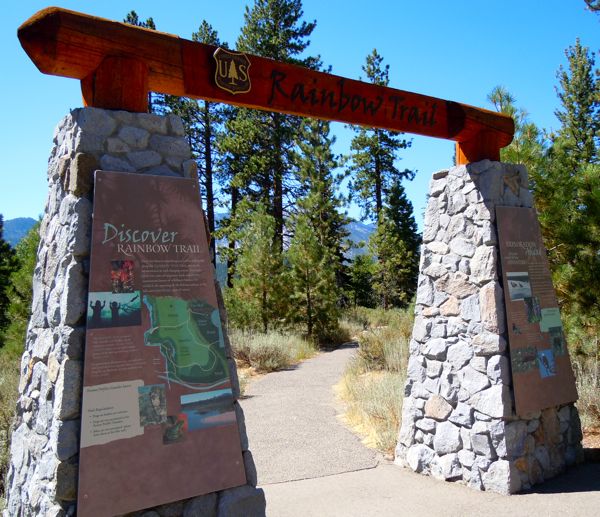
The idea is for the center to beckon people to come in, to ask questions, to thumb through books. Then it will act as a gateway, much like it does now, to the Rainbow Trail, Lake Tahoe and the amphitheater.

Interpretive information will remain outside near the visitor center.

Interpretive information will remain outside near the visitor center.

Interpretative exhibits will remain outdoors.

It’s the environmental analysis that is in circulation. It’s online and hard copies are at the Forest Service office in South Lake Tahoe and at Taylor Creek. Once comments have been scrutinized, it will be up to the forest supervisor how to proceed. If it’s signed off, at that point the agency will go after funding.

The project is estimated to cost just less than $3 million. It everything goes according to plan, the new center could be running in four to five years.

It would remain a seasonal facility – operating seven days a week from mid-May through October.

Click here for more information and ways to comment.


Sample the Sierra sells out — surpasses expectations

By Kathryn Reed

South Lake Tahoe suddenly became walkable Saturday.

“I’m at a wine walk,” one guy said to the person on the other end of his cell phone.

A block of Ski Run Boulevard was closed off for the inaugural Sample the Sierra. It was all about blending wine and food together to make a feast of sorts for much of the afternoon Aug. 21. Art and jewelry were for sale. Other local businesses had booths as well.

A mix of locals and out-of-towners enjoy Sample the Sierra on Aug. 21. Photos/Kathryn Reed

A mix of locals and out-of-towners enjoy Sample the Sierra on Aug. 21. Photos/Kathryn Reed

It far exceeded most people’s expectations. With the 500 $20 wristbands selling out, it left some without the opportunity to Sample the Sierra. Another 200-plus food-only tickets were sold. Organizers are hoping to break even.

For the South Shore, this was a unique event because so few are outdoors unless it’s an athletic competition. Most are indoors at one of the casinos.

People could ride their bikes. Even the intermittent rain and brief hail didn’t send people away. Restaurants along the route were doing a brisk business from people who wanted a more complete meal.

Music filled the air. People worked off their food and wine indulgence by dancing to the various musical groups. Stages at both ends of the food booths kept people entertained as they ate and drank.

Lake Tahoe South Shore Chamber of Commerce, Lake Tahoe Visitors Authority and El Dorado Community Foundation are the forces behind the event, along with a slew of other sponsors.

“It was better than we expected. It will be bigger next year,” Isabella Mill with the chamber said.

Booths with nothing to consume formed the perimeter, while the food and wine were in the center of the boulevard. Wineries were paired with restaurants, while growers were paired with restaurants to make the sampling complete. Mt. Tallac Brewery was the lone beer purveyor.

Alex Elsaesser from the Black Bear Inn was using blueberries in his dessert that were supplied by an El Dorado County farmer. The dessert was paired with port from Latcham Vineyards in Fair Play.

People were going back for seconds and thirds at the various booths, the food and wine were that yummy.

“The layout will definitely be different next year, “said Tina Bruess with the chamber. This will be to spread the consumption lines out a bit.

Already organizers are considering expanding the venue beyond one block. With more than 700 wristbands given out, that would be understandable. It was free to walk the street. It only cost money to eat and drink.

“An informal survey of vendors says they will be back next year,” Bruess said.

ngg_shortcode_3_placeholder (Click on photos to enlarge.)



Green lodging conference embraces eco-capitalism

By Joann Eisenbrandt

Composting. Recycling. Energy-efficient lighting. Everyone knows these are good for the environment. Organizers of the West Coast Green Lodging Conference taking place Aug. 22-25 at Embassy Suites in South Lake Tahoe are convinced they’re good for a hotel’s bottom line as well.

Embassy Suites, the conference host, has been in the forefront of environmental sustainability at the lake, implementing over the last several years a number of green initiatives that have significantly reduced the hotel’s carbon footprint and shown a profit for the property.

David Hansen, Embassy’s director of engineering, has been a driving force in this effort. Terming himself an “eco-geek,” Hansen emphasizes, “Lodging uses 25 percent of all the energy in the U.S. If we can attack this sector of the economy, think how much energy we could save.”

David Hansen is the leader of green lodging in Lake Tahoe.

David Hansen is the leader of green lodging in Lake Tahoe.

He “got the green bug” while working for Robert Redford as director of facilities at the Sundance Ski Resort, where he built a totally-sustainable day spa. “I was addicted,” he said. When he came to Tahoe to work at Embassy Suites Lake Tahoe Hotel & Ski Resort, he was determined to turn it into a sustainable property.

The four-day Green Lodging conference brings together hotel general managers, chief engineers, innkeepers and owners to share ideas on sustainability as it specifically relates to hotel operations. Tahoe was an obvious venue. The Lake Tahoe South Shore Chamber of Commerce website lists 82 member entries under the “accommodations” category.

“The Lake Tahoe Basin should rightfully be the world’s sustainability leader,” Hansen believes.

Conference speakers, including Hansen and chamber President B Gorman, will address why and how to go green and the benefits it affords the individual property and its community. Participants will also have the opportunity to take a “back-of-the-house” tour of Embassy Suites’ Green Program in action.

The conference keynote speaker is Glenn Hasek, publisher of the Cleveland-based Green

Glenn Hasek is the keynot speaker at the Green Lodging Conference.

Glenn Hasek is the keynote speaker at the Green Lodging Conference.

Lodging News, an online portal for the lodging industry offering a potpourri of green information and links. A former managing editor at Hotel & Motel Management Magazine, Hasek is sold on the wisdom of Green Lodging. As he told Lake Tahoe News, “Green lodging is synonymous with smart lodging. It’s running your business in the most efficient manner possible, using green technology and green teamwork.”

But after all, business is business, so green lodging advocates are quick to point out that going green isn’t synonymous with going broke. Given the right planning and management, the additional costs of some changes, like replacing Styrofoam serving ware with compostable plates, cups and utensils, can be more than offset by cost savings gained elsewhere by boosting income from recycling and greatly-reduced power and water bills.

“For corporate America,” Hansen believes, “environmental sustainability might not be a driving factor, but saving money is. It’s eco-capitalism — saving money and saving the planet at the same time.”

Eco-capitalism is putting down roots in the lodging industry. Creation of a nationwide Green Lodging Association to represent the industry is being seriously talked about. Twenty states, including California, now have Green Lodging programs. The state’s website offers information on building, buying, traveling and working green, a listing of 200 green hotels in California as well as some convincing statistics on the impacts lodging properties have on the environment. For example, average-sized hotels purchase more products in a week than 100 families do in a year and use 218 gallons of water per day per occupied room.

Locally, a visible “green-mindedness” has emerged. Aramark’s Zephyr Cove Resort and Fire & Ice at Marriott Vacation Rentals have joined Embassy Suites in South Tahoe Refuse’s pilot commercial composting program. STR picks up the properties’ compostables (plates, cups, utensils and food waste) and transports them to Full Circle Compost in Minden. Compostables, unlike biodegradable materials, break down completely into soil, water and carbon dioxide.

Jeanne Lear, human resources manager at STR, says of the innovative pilot program, “We’re hoping the costs and benefits of these sustainable practices will be able to be expanded to other commercial properties.”

Compost Tahoe, a grassroots organization of community sustainability advocates, offers composting education, including a program in which volunteers go to local food service establishments and train employees in sustainable food waste practices. South Lake Tahoe is developing its own Green Building Program, and has added a Sustainability Commission to its roster of community advisory groups. The Lake Tahoe South Shore Chamber of Commerce initiated a Sustainability Measures Project, is holding green forums for businesses and formed a Green Business Cooperative, where local businesses can share ideas and get support for implementing sustainability practices.

Why this spike in interest now?

“The economy has tanked,” Hansen explains. “Tahoe isn’t drawing the gaming crowd as in the past. What we are about is this pristine lake, the environment; we should be showcasing that. We should be purchasing locally, reinventing our own area. Business is what allows us to live here.”

But green lodging won’t work if the traveling public doesn’t buy in. Hasek’s blog has a posting seeking participants for a Green Traveler Survey conducted by CMI Green of San Francisco, which will gather information about lodging purchasing practices and how much they are impacted by a property’s green policies. Last year’s survey showed travelers are embracing the “green” changes.

Hasek and Hansen agree. Hansen says at least 50 percent of their guests are “ecstatic” about the hotel’s sustainability program. For the rest, the changes are so subtle they’ve gotten no complaints. For the most part, they’ve been so well-integrated into hotel operations that they go unnoticed.

Registration for the West Coast Green Lodging Conference is from $300/person with room rates from $149/person. A conference program and registration information are available here.


Pot advocates win right to help write cultivation law

By Kathryn Reed

A throng of citizens demonstrated Thursday that getting involved in the government process can bring change.

It took most of the morning session and until 3 that afternoon, but in the end the South Lake Tahoe City Council unanimously agreed to form a committee to help create an ordinance regarding marijuana cultivation for medicinal purposes.

More than two dozen people, mostly against the ordinance that was before the council, gave a range of reasons why the legislation as written was bad. Most called for it to be pulled from the agenda.

It was standing room only, with people in listening to the pot discussion on the TV in the lobby on Aug. 19. Photo/Kathryn Reed

It was standing room only, with people listening to the pot discussion on the TV in the lobby on Aug. 19. Photo/Kathryn Reed

Representatives of the three medicinal marijuana collectives in town will be on the committee, along with Councilmen Bruce Grego and Bill Crawford; the city attorney; city manager; fire, police and building department reps; homeowner; and planning commissioner. In the coming weeks they will meet to hash out their differences and ideally find consensus so an ordinance is brought back to the current council to vote on.

Health and safety issues are what the council wants to address.

Jan McCarthy, who will be the homeowners’ voice on the panel, told the council she has spent more than $30,000 to rehab a home that has been used as a grow-house. She is going to have a clause written into future rental agreements not allowing pot to be grown.

“Black mold is such a problem for insurance companies they will tear a house down before they remediate it,” Fire Marshal Ray Zachau told Lake Tahoe News.

It’s the high moisture content that causes the nasty mold. One house was so bad a few years ago on Walkup Road that the entire structure was demolished.

Holes are cut in floors and walls to move air around. The aroma of pot plants permeates the night air when the grow-houses use fans to circulate the air in the house – and subsequently push it outdoors.

Another concern of fire officials is if there were a fire at the grow houses with all the air circulating, it unknowingly puts firefighters at risk. Fire loves oxygen.

Several people who spoke wondered why no outdoor plants are allowed. The answer was the Planning Commission proposed that rule.

The city wants to restrict those who are allowed to grow marijuana per rules in the 1996 voter approved Proposition 215 to inside the house or the garage. Zachau said the garage is better for fire prevention reasons.

“It’s responsible growers who are speaking today, not the ones doing damage,” said Matt Lonardo. He works at Mt. Tallac High School and pointed out the students he is around have a lot more serious issues to deal with than medicinal marijuana.

It’s felony vandalism that the District Attorney’s Office has charged people who have recently been arrested with large indoor grows. With the state and federal laws about marijuana being out of alignment, this is a better legal route to pursue with less chance of an appeal or acquittal.

There is disagreement about how much space plants need as well as the wattage, or amps, needed to keep them thriving. Those are some of the issues that will be discussed by the committee.

It was said over and over that experts should be helping write the ordinance.

It’s legal for growers to sell what they don’t use to the collectives. But it’s only supposed to be at the price that it cost them to grow it. This is not supposed to be a revenue source for the growers, per state law.

A concern of city officials is these small growers with medicinal marijuana permits are deriving income from the sale of the end product. That was not the intent of the proposition.

Regulating whatever ordinance is approved is another concern. Pot advocates on Aug. 19 said they didn’t want the police to be the ones knocking on their door to enforce compliance. Medical privacy – HIPPA – was brought up.

Most in the room supported regulating the industry. What they want is for it to be fair, logical, relevant and to have a say in the rules they will have to follow.

“You can’t change the law just because of your personal opinions,” Leanne Aalmo told the council.