Avoiding Echo Summit — scenic, but definitely longer

By Kathryn Reed

Scenic – definitely. An hour longer – without a doubt. More windy – no avoiding it. Tiresome – if you have to do it more than once.

That’s the report on having driven the Highway 50 scenic detour – so named by local officials. Road closure is not the phrase they want to use even though that is exactly what is going on.
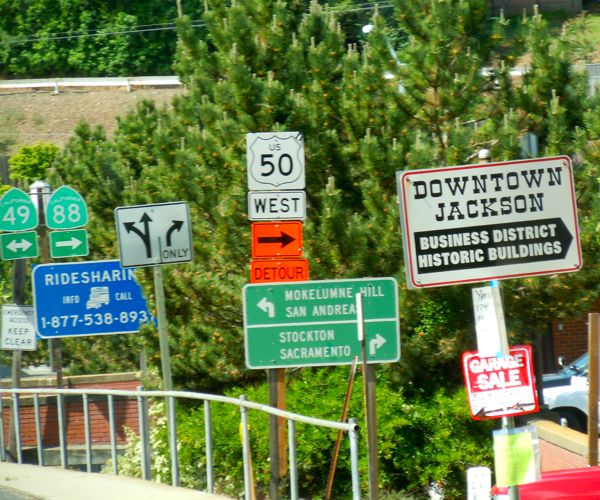
Detour signs are throughout the route. Photos/Kathryn Reed

Detour signs are throughout the route. Photos/Kathryn Reed

Echo Summit shutdown May 11 for 10 to 14 days while a construction firm hired by Caltrans fixes the deteriorated rock wall that links the South Shore with points west. Of course if the work isn’t done, it will be more than a two-week closure.

Although the work was interrupted for more than 24 hours because of snow, Caltrans said the gang was back at work Monday. But that could be short-lived with the winter weather advisory that is in effect until 10 this morning – which is calling for more than a half foot of white stuff above 7,000 feet. Echo Summit is at 7,382 feet.

Road well traveled

Making the trek from Contra Costa County to Kirkwood Mountain Resort via back roads, and mostly highways 4 and 88 was commonplace growing up because that’s where my dad liked to ski. In many ways it’s still easier than dealing with Highway 50 or Interstate 80.

But it’s not the way most people choose to come all the way to the South Shore. That’s because 50 is faster, shorter – and, actually, more scenic. Something about that American River Canyon never gets tiring.

Still, headed for San Francisco on Saturday we had few options for getting there. We opted to follow (for the most part) the Caltrans route over Highway 88.

It was a good thing the Amgen Tour de California never intended Luther Pass to be part of the route because the debris on the west side looked treacherous and the water coming off the opposite side onto the road was no better. Of course then there are the numerous potholes, but cyclists in the Lake Tahoe Basin are accustomed to those on highways and city streets.

More traffic than usual for a Saturday in May is headed to Hope Valley.

Watching the Carson River gush it’s hard to tell where its bank is – the water is that high.

Atop Carson Pass the lots are full. Backcountry skiers are eager to get in some runs. With the amount of snow the season – and it still dumping – wildflower season is something to only dream about.

Ice is melting on Caples Lake, with shades of blue piercing the surface like an iceberg. By Monday, the blue is gone – covered with a fresh layer of snow.

A group of snowmobilers is gathered at the 8,000-foot mark. Winter is not over for them. Spots near the Carson Spur have drifts of snow 20-feet high.

Farther along is the Bear River Reservoir, which may have part of the Kirkwood Mountain Resort power line going through it.

Panther Creek is off to the left. Back in a ways reportedly is a waterfall worth seeing. But the road was closed a few weeks back when we were thinking about scouting it out.

Dirt roads continuously connect with Highway 88. It looks like a mountain bike and ATV haven.

Snow is getting spotty at 6,000 feet and is gone at 5,000 – at least on May 14.

Omo Ranch Road is on the right. This is the back way to Fair Play wineries. Get on those roads and you can find your way to Placerville. Just have plenty of time.

Finally, the road is improving at about 4,000 feet, just past Cooks Station. The terrain is changing. Not so many pine trees. More filler trees that are too hard to name whizzing by.

New signs to read – like, “Owl and Bat Houses”, bars touting karaoke, Saturday prime rib, “Food, Gas, Sporting Goods,” “Haircuts $12” – and all those fruit and vegetable stands.

A little more pro-active marketing by these folks might get people to stop.

Jackson Rancheria seems out in the middle of nowhere. Maybe because it is. But just driving by it is more inviting than any gaming venue on the South Shore.

Making our own detour

We zip through Jackson. On the outskirts is the Highway 50 detour sign that we ignore. It leads people to Highway 49. Instead, we stay on Highway 88. Going back to the childhood route.

As we leave Jackson the terrain flattens out. Definitely ag land. Hills are turning golden, with only faint hints of green lingering.

Homes near Ione are selling for $159,900. Don’t want to know if our house in Tahoe is worth more.

Sign for Pardee Reservoir brings back memories of a camping trip a few years back when we were in search of warmer weather and just started driving.

Tasteful sign says, “Thank you for visiting Amador County.” El Dorado, Placer, Douglas – are you listening?

Cows cover the grasslands.

Lake Camanche is another refuge for Tahoans looking for warmth.

At the intersection of highway 88 and 12 we go right.

Vineyards, apple trees, cherry trees and row crops cover the landscape.

Most of the small towns we hit have gas prices similar to Lake Tahoe.

The scenic trip to agriculture land turns urban on the outskirts of Stockton.

From Highway 88 we take Highway 99 south, then quickly onto Highway 4 west, which merges with Interstate 5.

We pass a sign for Highway 120 at Manteca. For now, this is the main road into Yosemite National Park because Tioga Pass isn’t likely to open until July.

Off I-5 we merge onto Interstate 205, which leads us to Interstate 580, then to Interstate 80 over the Bay Bridge.

It took 208 miles and four hours.

Headed back to Tahoe

With about the same miles driven, the route we took May 16 back to South Lake Tahoe seemed faster. But with stopping at a winery and for lunch, we’re not really sure of the exact time.

We left The City, and in Sacramento took Power Inn Road. This leads to Highway 16 toward Jackson.

Allow your passenger to sleep through this section of road.

As the golden hills full of oak trees emerge it becomes that scenic route people keep touting.

Up ahead is Highway 49, where we turned right. Not far up is Drytown Cellars. It’s the only winery actually on the detour that doesn’t require turning off on a non-designated road. Business is picking up, according to Jon.

Jon is pouring us sips of red. He tells us this area at about 2,300 feet had several inches of snow over the weekend. We recommend the house red for 10 bucks a bottle.

Fresh snow covers the green grass in Pioneer at 3,000 feet. It wasn’t there two days before.

Clouds are forming. Sky darkening. Trees at 6,000 feet are full of snow.

Flurries are falling at the Kirkwood Inn. We stop for a bite and to decompress in front of the roaring wood fire. Built in 1864, the dark wood interior looks like it has stories to tell.

Our waitress says it’s the weather that is keeping people away. Thursday and Friday business had picked up, but by Monday it was so-so. Such are the hazards with snow in the parking lot and no plow to clear it.

Sue raves about the chicken tortilla soup. Their portabella mushroom sandwich is one of the better ones I’ve had.

Back on the road, back over Luther, back into South Lake.

Fingers crossed Echo Summit opens soon.

AAA’s Sierra Nevada map is good one to carry while traveling this scenic route.

Susan Wood contributed to this story.

ngg_shortcode_0_placeholder (Click on photos to enlarge.)


Amgen totally bypasses Tahoe; cycling fans left in cold

Updated May 16, 2011, 7:10am:

Due to uncertain weather and road conditions, race organizers have determined that the best way to ensure a complete course for Stage 2 of the 2011 Amgen Tour de California is to move the official start to 12:15pm starting on Broad Street in Nevada City.

Today’s start was originally scheduled to take place in Squaw Valley. This means Lake Tahoe totally missed out on the race.

Riders will finish 61 miles later in Sacramento.

———————

By Jessie Marchesseau, Stephen Ward and Brenda Knox

Sunday morning’s snowstorm had cycling enthusiasts bundling up in their down jackets and winter beanies to cheer on racers on what was supposed to be Day 1 of the Amgen Tour de California.

They were at the would-be start in Stateline, the scheduled finish at Northstar-at-Tahoe, at the Y in South Lake Tahoe and other locations around the lake.

Even though first stage of the Amgen Tour de California was canceled May 15, cyclists ride to Cave Rock. Photos/Lisa J. Tolda

Even though the first stage of the Amgen Tour de California was canceled May 15, some elite cyclists ride to Cave Rock. Photos/Lisa J. Tolda

Dozens of fans lined the curb at the intersection of highways 50 and 89 about 1:15 pm, the scheduled start time after a morning snow delay that had also altered the course from 118 miles to 50. With flakes still coming down, little girls with painted faces, babies in strollers, parents, grandparents and all-around bicycle enthusiasts waited not-so-patiently for the first riders to arrive.

Every time a car with the word Amgen or the name of another sponsor drove by, cowbells were rung, cheers erupted and arms were raised. But soon, a wave of disappointment moved through the crowd as news spread the race was canceled at the last-minute.

Across town, at the start line, cowbells rang out and the crowd along the casino corridor started to cheer as they saw the racers turn onto Highway 50, but seconds later “race canceled” was announced.

Disappointed fans headed into the warmth of the casinos and back to their cars. After waiting for hours as the snow showers came and went, listening to South Lake Tahoe Mayor Hal Cole describe Lake Tahoe as a year-round playground, and hearing cyclist Dave Zabriskie describe the day as “unbelievable”, the first stage of the 2011 Amgen Tour de California was officially canceled.

While the expos at Stateline and Northstar went on as planned, the delay in the start that never happened and wicked weather had fewer people turn out than originally expected or organizers had hoped for.

Eager to root on riders

Much of the South Shore was a bit like a ghost town during a mid-winter blizzard.

Driving down Lake Tahoe Boulevard from Stateline to the Y, South Lake Tahoe seemed eerily quiet Sunday. Hotel parking lots were mostly empty and traffic was sparse. Many of the spectators gathered at the Y were locals.

“I didn’t think it would be quite so cold,” commented Meyers resident Skye Schumaker.

“Oh well, it’s Tahoe,” his wife Kristie Schumaker said. “We’re used to it.”

The Schumakers, along with their daughters Jazmyn and Juniper, had pulled out their winter attire to come watch the day’s festivities. None of them had ever seen a bike race in person and were looking forward to it.

The hardy from near and far had gathered to watch the start of the United States’ most prestigious road race. The crowd wore heavy jackets and gloves, beanie caps and smiles.

Maria Laudau, Greg Stevenson, and 3-year-old Sophia Landau, who was dressed in a warm, pink snuggly suit, waited at the start at Stateline. Laudau’s excitement at having this “amazing event” in our backyard was apparent.

Kelly Barber and her 5-year-old twins were waiting to see their favorite team, the Jelly Bellies. This was the third year the Reno threesome had followed the tour.

Steven Castelletto and Jeannette Montgomery of Fresno had no trouble getting to the South Shore despite Echo Summit being closed. They enthusiastically called the event “fun, and loving it.” Castelletto will be working security for the event in Sacramento during Stage 2, where it ends after starting in Squaw Valley today.

They aren’t the only ones headed onto the next stage.

Mike and Trish Hallman and their two kids, Shayna, 12, and Hayden, 13, from Seattle, are avid fans, having been to all the Tour de California races. Last year they watched the finish in Thousand Oaks. Hallman called her husband “the biggest race fan” and said “we always bring our own cowbells with us.” Saturday, they were excited to see the Italians practicing and said at other venues they had never been able to get so close to the racers.

Having never been to Lake Tahoe, they drove around the lake scoping out good spots to watch the racers. Now they are headed to Sacramento to see the Stage 2 finish today.

One business doing well on Sunday was Starbucks – on both ends of the lake.

Scott Trevithick and his family had come from Reno on Saturday to watch the race for the first time. Instead, they kept warm at the coffee house at the Horizon.

Trevithick said, “We just couldn’t miss this world-class event in our own backyard.”

They had hoped to go to Brockway Summit to watch the racers head into Northstar. That obviously didn’t happen.

After hearing about the race being canceled, Ryan Emery, 27, of Nevada City settled at the Starbucks coffee shop at the Village at Northstar.

“I have no idea what I’m going to do now, but I have coffee and banana bread, so I’m good,” Emery said, shrugging his shoulders.

Disappointment lingers

“Well, it’s snowing so it’s probably a high risk to the riders … so I guess it’s understandable,” Emery said.

Sid Forman, a 71-year-old, self-described avid biker from Incline Village, came to the event with his wife, June. Although he knows the decision was correct, Forman saw the cancellation as a lost opportunity for the region.

“I think it’s sad for the area. This would’ve been a great boon for the retailers here, hotels here, and the community at large that loves cycling,” Forman said from the Village at Northstar.

Lauren Lindley, manager of the Pearl Izumi store at the Y in South Tahoe, was disappointed in the cancellation, but said the store had been “shockingly” busy the last few days.

“If it had been sunny and amazing and the pass was open, it would have been crazy in town,” she said.

Adding to the day’s disappointment was the cancellation of the BMX exhibition by Olympic medalists Donny Robinson and Mike Day. It was the wind, not the snow that put a damper on their riding. A lake wind advisory by the National Weather Service predicted gusts up to 40 mph over the lake.

“If we had snow and no wind, they’d be riding right now,” Lauren Thomaselli, one of the BMX event’s organizers, said.

But with wind in the air, and snow coming down, organizers of both events had little choice but to cancel for the safety of the riders.

With the economic impact to Tahoe from the race predicted to be down the road from media images of picturesque Lake Tahoe luring people to travel to the region, images of substantial snow in May could backfire.

“We chose the West Shore of Lake Tahoe because, in an ideal world, you look at the lake and our broadcast coverage would have been able to include Emerald Bay, and the decent into Northstar would paint an incredible view of Tahoe,” race director Jim Birrell said.

Time, though, will be needed to see if picking Lake Tahoe was a bad financial decision for all involved.

As for tour operators, they have already picked Santa Rosa as the 2012 start city. That’s not to say the route will not take a sharp turn east to hit the Sierra again. But considering their desire to move the race from February to May was so Tahoe could be part of it backfired, they too may not want to make that investment.

“When deciding to have Lake Tahoe host the start of the 2011 Amgen Tour of California, we looked carefully at weather patterns up here in May as part of the decision-making process with the local organizing committee,” said Andrew Messick, president of AEG, which owns the race. “The likelihood of severe winter weather in May was statistically low – we thought it might be cold, rainy and maybe windy, but we didn’t contemplate that it would be snowing, cold and windy. Our team and the athletes arrived here in the middle of the week and the weather was fantastic. We would consider Lake Tahoe again to host the race in the future.”

Too treacherous to cycle

Amgen officials cited rider safety as the reason for the cancellation of this first stage of the largest cycling event in the Unite States.

“At this point in time, it’s probably better for cycling in general to play it safe,” said Allison Oliver, one of Sunday’s spectators and a former rider for the UC Davis bicycle team.

Less than a week earlier, 26-year-old cyclist Wouter Weylandt was killed in a bicycle crash during the third stage of the Giro D’Italia in Italy.

“I think it’s always better to err on the side of caution,” Oliver said as she waited in the snow at the Y. “No one wants to see anyone get hurt.”

Oliver was on the sidelines with friend and coworker, Lindley, waving a cardboard sign reading “Go Paul Mach.” Mach, one of the races’ participants, was one of the Oliver’s former teammates at UC Davis.

“Safety is paramount,” Birrell said. “We do everything in our power to provide the best chances of success on the road. Our team and course directors spend countless hours identifying any danger out there. We really take it to heart.”

ngg_shortcode_1_placeholder (Click on photos to enlarge.)


Snow wins, Tahoe loses with cancellation of bike race

Updated: May 15, 2011, 7:27pm

By Lake Tahoe News staff

Riders’ concerns played a role in the decision to cancel Stage 1 of Amgen Tour de California on Sunday.

“This morning, when there was so much snow, everyone knew we wouldn’t be racing,” said Alan Gallopin with Team Radio Shack. “Riders are worried about their safety in light of what happened last week (in Italy) . Nobody wants to race unsafe. We came in on Monday and experienced nice weather. Friday was good, but with today’s weather, the riders didn’t feel comfortable racing.”

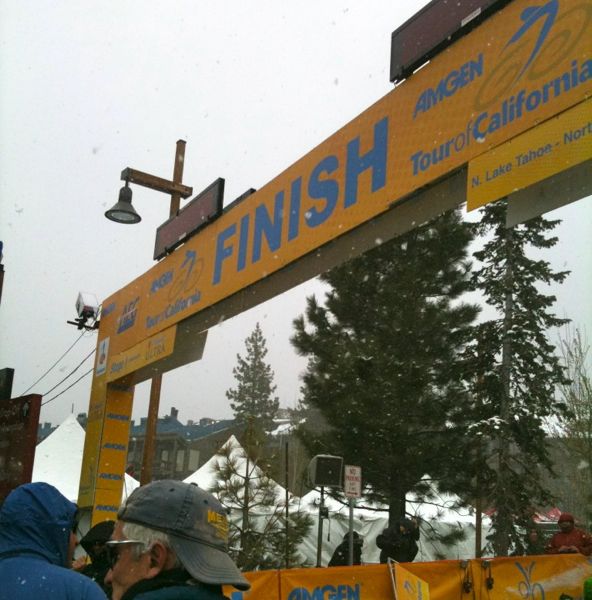
This sign at Northstar-at-Tahoe will never be crossed by Tour de California riders.

This sign at Northstar-at-Tahoe will never be crossed by Tour de California riders.

Andrew Messick, president of AEG, at a press conference May 15 said not riding was the smart move.

“Five miles of the course had substantial accumulated snow and we made the right decision. We are disappointed. You can make the right decision and still be disappointed in the outcome,” he said. “We expected from weather forecasts that it would get warmer, the roads would be clear and the conditions for racing would improve. We believed that right until the very end. It was only in the last 15 minutes that it really became clear that weather conditions were not improving and in fact were getting worse.”

Plus, during the delay when everyone thought the race would be starting in the afternoon, six photo motos crashed on their way to Northstar. No one was hurt in the incident.

Most of the concentration was on what the weather was like going down from the summits and high spots along the route that was to have gone from Stateline, around Lake Tahoe 1.5 times, and into Northstar-at-Tahoe. The afternoon route was to go from Stateline directly to Northstar in Truckee.

“We started to receive reports from our team about bad weather on the descents, with the final decent being the most critical. After two and a half hours of riding in inclement weather the cyclists are tired and cold and they don’t have the ability to apply their breaks, especially with the carbon bikes. These are elements they have to deal with,” race director Jim Birrell said. “The rain really helped us cement our decision. Had the race started, we would have had to cancel the race in the middle.”

——————————

Updated: May 15, 2011, 2:12pm

By Lake Tahoe News staff

The weather finally won the first stage of Amgen Tour de California.

Riders are supposed to leave from Squaw Valley on Monday at 10:30am for what would have been the original start of stage two, but concerns about weather over Donner Summit still persist.

When the race was called before 1:30pm Sunday the weather had been a mix of snow and sun. Finally, though, it was decided that it was too dangerous to leave from the South Shore. This, despite the cyclists on their bikes near the start line and ready to go.

“We the riders are disappointed about not racing for the fans but we agreed it was too risky in the ever changing weather,” tour favorite Levi Leipheimer said in a Tweet. “We all hope the fans understand.”

This is the first time a stage has been canceled, but the fourth year weather

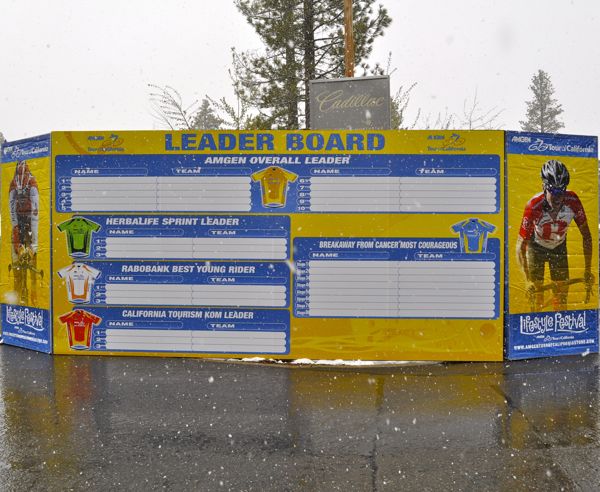
Mother Nature should top the leader board. Photos/Stephen Ward

Mother Nature should top the leader board. Photos/Stephen Ward

has been factor.

“We were monitoring weather conditions up until the predicted 1:15pm start time, and we just couldn’t safely put the riders out on the course with the current forecast,” Andrew Messick, president of AEG Sports, said in a statement. “We appreciate the support of all the fans that came out to the start line in South Lake Tahoe, and we hope they understand and respect our decision, but when the safety of riders and fans is involved, there is no leeway. We are looking forward to seeing everyone at the start (Monday) in Squaw Valley.”

As the race was being canceled, three-time Tour de California champion Leipheimer addressed the crowd from the sign-in stage and said: “The riders discussed as a group and we just don’t feel comfortable riding knowing what can happen, especially in light of what happened last Monday. We still have a full week of racing ahead of us, so we want to make sure everyone is healthy. With the weather conditions the way they are, racing today is just not possible. On behalf of all the riders, we apologize and appreciate everyone’s support and understanding.”

——————

By Jessie Marchesseau

Riders and organizers of the 2011 Amgen Tour of California bicycle race woke up to snow this morning. The National Weather Service had predicted that up to 4 inches would fall in the Lake Tahoe area Saturday night into Sunday, and Mother Nature delivered.

With the safety of the athletes the number one concern, contingency plans in case of inclement weather were put into place earlier this week.

As a result of the winter weather conditions and the dangers that riding on snow-covered roads could pose to the riders, the official start of Stage 1 has been delayed until 1:15pm. The leg is also expected to be shortened. Originally planned to be one and a half laps around the lake, 118.7 miles, the new route from Stateline, up the west shore, ending at Northstar-At-Tahoe would be approximately 50 miles.

The race will follow the second half of the original route and feature highlights including:
•    King of the Mountains (KOM) competition at Emerald Bay at approximately mile 13
•    Sprint line at Tahoe City at approximately mile 31
•    KOM competition at Brockway summit at approximately mile 43

The projected finish timing, which was to be between 3:15 and 4pm PT will remain unchanged.

Jim Birrell, race director, addressed the possible weather issues at last Friday’s press conference, stating “Our concern is going to be what’s on the road.  If it’s just wet, it will be all systems go. We have the brightest and most experienced individuals on our team to help render the best decision given the circumstances.  We’ll work with the Lake Tahoe local organizing committee to determine where there will be the most accumulation. Our partners will be able to guide us in the decision making process and we’ll figure out how to negate it. We’ll look at all the variables we can to make the decision that’s safest for these riders.”

This statement was issued May 15 at 7:39am:

Due to current weather and road conditions, the Amgen Tour of California bicycle race will have a delayed start. The race will start at 1:15pm and will travel from the South Shore Casino corridor on Highway 50 and then turn north along Highway 89 to North Star at Tahoe. The highway closure will start at 12:45pm and is expected to be open by 1:40pm. — Sgt. Shannon Laney of the South Lake Tahoe Police Department.


Watching a road bike race is worth the few seconds

By Heidi Hill Drum

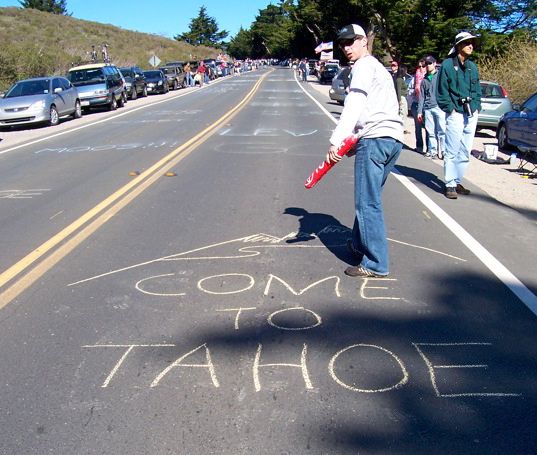
Finally it is here! The photo was taken several years back at the Amgen Tour stage leaving Sausalito and heading up to Santa Rosa. We waited in the back of our car on the side of a super steep, windy hill in Marin County. Drawing pictures on the closed road kept Dalton entertained (he was only 3 and now 9.)

We thought this would be the best place to see the riders going slow. Well, the peloton (the riders all together in the main pack) don’t really go slow. It is either fast or really fast. They sped up that hill with amazing speed.

It took several years, but John Drum's message finally got heard. Photos/Heidi Hill Drum

It took several years, but John Drum's message finally got heard. Photos/Heidi Hill Drum

It was too early in the day for a breakaway group, so within about two minutes the entire peloton passed us by. Yes, Dalton asked, “Is that it?”

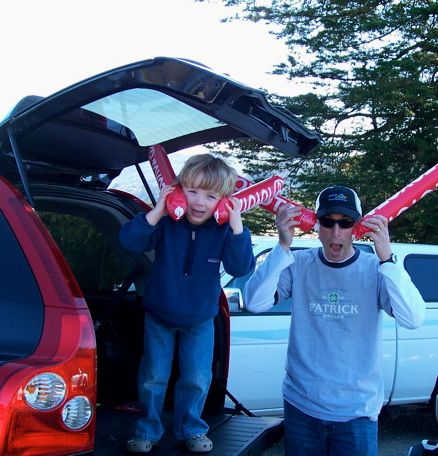
Our souvenir that day was a cowbell handed out by the folks at Toyota, one of the early sponsors, so he left happy.

We have been to at least a couple of stages of every Amgen Tour de California and its predecessor, the San Francisco Gran Prix. When it was in February it usually coincided with Dalton’s break from school, so we managed to get in a few stages fairly easily. Now, since it is in May we have a few more logistics to work out, but it is all worth it. When Lance rode in it last year we saw him in Sacramento. The year before we watched in the rain in Santa Cruz as Levi rode strong in one of his winning years.

Last summer we were fortunate to be able to see the real deal in France. Le Tour de France is so special and an incredible economic benefit to the towns that host a stage. In our opinion, this Amgen Tour is on track to be very similar for our state. We can’t thank those enough who worked tirelessly behind the scenes for all they did to bring these first two stages to Tahoe (but thank you Carol and Andy).

We realized last week when we started volunteering that it isn’t just a one-day event for our town. Riders, staff, mechanics, and others have been arriving all week. They are staying in our hotels, eating at our restaurants, and likely will be buying lots of hats and gloves in our local shops for today’s cold race.

Dalton and John Drum at one of the early Amgen races. The South Shore guys will be routing on the riders today.

Dalton and John Drum at one of the early Amgen races. The South Shore guys will be watching the the riders today from their home town.

Highway 50 closing Wednesday before the race instead of the Monday after is unfortunate, as it is likely more visitors will choose to go to the North Shore to see the finish. However, our entire community is still benefiting.

We have been volunteering to drive riders and staff from the Reno airport to their hotels here and those of us who live here sometimes forget how spectacular a sight Lake Tahoe is the first time you come up the hill. Every one of the folks who are a part of this tour have been inspired as they see the lake for the first time. Let’s take advantage of this amazing opportunity to open our doors, make everyone feel especially welcome and thank them for their participation in this event. Let’s also hope we can show enough Tahoe spirit to encourage Amgen to consider Lake Tahoe as another host city in a future Tour de California.


Tahoe tourism officials hope spinning wheels turn into cash

By Kathryn Reed

While there is no guarantee of making money from the Amgen Tour de California race, making money is the reason to be part of it.

“California’s majestic scenery, thrilling sporting events, world-class museums and art galleries attract millions of visitors to our state each year. Last year visitors spent nearly $90 billion in our local communities. This money has an enormous impact on employment and can serve as a catalyst to grow our economy,” Gov. Jerry Brown said in a statement.

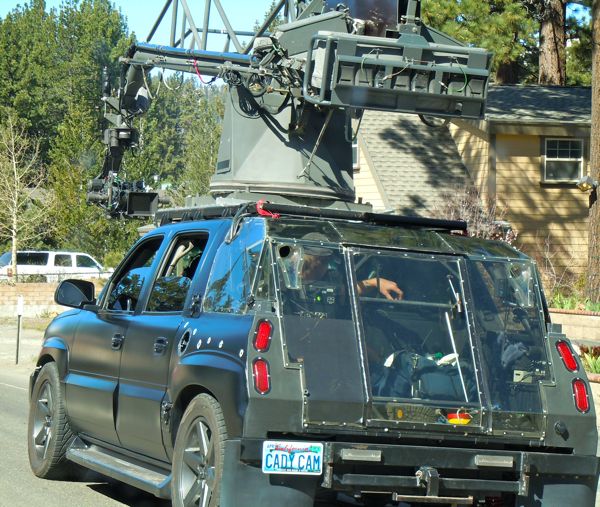
Tricked out vehicles with TV cameras are already cruising the streets of South Lake Tahoe. Photos/Kathryn Reed

Tricked out vehicles with TV cameras are already cruising the streets of South Lake Tahoe. Photos/Kathryn Reed

As the premier cycling event in the United States takes off from the South Shore on Sunday, it coincides with the final day of National Travel and Tourism Week.

May 15 begins a two-day affair for Lake Tahoe to show the world what it has to offer to cyclists and to those who would want to visit for other reasons.

“Ninety countries will be broadcasting this event to a global audience who may not even have heard of Tahoe. We can likely assume that this is millions of dollars worth of media for these impressions coupled with the incredible regional and national impressions,” explained B Gorman, president of the Lake Tahoe South Shore Chamber of Commerce. “We will never be able to track this value in terms of visitors who have the brand reinforced or begin to think about our piece of heaven as a destination they might visit in the future.”

There will be 27 hours of television coverage during the eight-day race that ends May 22 in Thousand Oaks.

Most of the economic impact to the South Shore, Truckee and Squaw Valley will come down the road when people travel here after being teased by the media with the allure of the Jewel of the Sierra.

That’s not to say hotels, restaurants and retail won’t benefit this weekend while people are in town for the start in South Tahoe, the end of stage one at Northstar-at-Tahoe, and the stage two start May 16 in Squaw.

Hotel and sales taxes, which are reported several months later, will be an indicator of how big of a boon this event was for the area. Considering May is one of deadest times in the basin, having an event of this magnitude is likely to be a bonus for some businesses.

“This event will be well followed in the European market and helps to define Lake Tahoe as a destination. The board of commissioners view this as a tremendous economic opportunity for Douglas County during a historically slow time of the year,” said Lisa Granahan, Douglas County Economic Vitality manager.

Some concerns

Several business people on the route of the race have expressed apprehension about customers being able to access their businesses during the road closures.

“To be honest, if I’m a citizen trying to run a business, I’m going to guess there is a cost,” said Truckee police Sgt. Robert Womack.

Despite what appears to be an unusual influx of travelers to Tahoe this time of year, not everyone has heads in beds.

“I haven’t heard of anyone exceedingly benefitting from this. It is creating less demand than we had hoped for,” Matt Fenn, president of the South Lake Tahoe Lodging Association said. “But there were never any promises made.”

Part of this may have to do with LTVA’s lodging partners giving away 1,700 room nights – mostly at MontBleu and Harveys. Another 700 rooms were donated on the North Shore.

That’s one of the issues with something like this, host cities are asked to give a lot in return for the recognition and prestige that is associated with being involved with this caliber of an event. Food is part of the package, too.

LTVA budgeted $250,000 to bring the event to South Lake Tahoe. What has actually been spent is not known.

North Lake Tahoe Resort Association officials would not disclose what their share is.

Money in the bank

“Hosting the Amgen Tour de California has already paid for itself in media coverage generated. The exposure prior to the stage one start is estimated at $260,000 in advertising equivalency — what it would cost to purchase the same amount of editorial space — and a reach of 96 million in circulation/listenership,” according to LTVA literature.

In addition, local tourism officials have a robust social media campaign, including the LTVA’s iPhone app Tahoe South that has tons of race information.

LTVA also expects to generate about $50,000 in revenue from retail, sponsorships, last night’s gala and today’s Legends Ride.

In the long term, LTVA told Lake Tahoe News it anticipates the local impact of the actual race and events leading up to it could bring $5 million to $10 million to the area.

Previous Tour de California races have brought an estimated $100 million to the state.

North Lake Tahoe Resort Association officials, who have partnered with LTVA, wouldn’t make projections about the fiscal impact of the race on the region or North Shore in particular. Though they also see money to be reaped down the road.

“This type of affiliation will go a long way in the promotion and awareness of this region as a bike mecca — both road and mountain,” Andy Chapman, NLTRA tourism director, said.

Even though a large number of out of town plates have been zipping along the local roads, it’s hard to know if they are here for the race.

“We have an opportunity to showcase ourselves as a destination for various types of recreational activities for individuals, families, groups, amateur, elite and professional athletes,” Gorman said. “The visitor who travels to a destination to participate in sports, activities and hobbies such as hiking, cycling, kayaking, art, culture, history etc. stay longer, use public transportation and spend more.”

It also seems like a larger number of adult beverage trucks were making deliveries on the South Shore on Friday.

Businesses have signs welcoming the riders and spectators, with some having displays out already. Highway 50 from Stateline to the Y is expected to be one big party scene, with much of the same atmosphere when the riders complete stage one at the Northstar Village.

Part of the Mikasa parking lot at Y in South Lake is already barricaded off so people can gather there to watch. The cyclists will pass that location twice. Plus, there will be a BMX demo at that site.

Cooperative effort

To put on something like this requires a great deal of cooperation with law enforcement. They will be everywhere. A California Highway Patrol SUV was speeding behind a supped up camera-mobile Friday morning as a practice run of sorts through South Lake Tahoe.

CHP did not release what this costs them or if they charge the race promoters for the added manpower.

The Nevada Highway Patrol is putting extra people on duty while the race comes through the Silver State for the first time. They are billing the folks at Amgen.

For Truckee police, no added cost is involved, though more officers will be out and about. Womack said instead of having a training day this month, officers are working the bike ride.

South Lake Tahoe is spending about $27,000 on the event — $7,000 on the BMX expo; $8,500 on community services, staffing and support, event coordination, tents along the route for nonprofits, street barricades from Stateline through the city; and $11,500 on public safety overtime. Overtime is built into the budget with the expectation of special events coming up throughout the year.

Added personnel include a combined extra 21 police and fire, five public works employees, and parks and recreation staff working the event.

“As for revenue, I understand hotels have reservations above the average occupancy for this time period, which will provide an increase in TOT if bookings hold up. More visitors would also provide an increase in sales tax,” Nancy Kerry, city spokeswoman said.

Douglas County will have 35 sworn deputies, about 10 citizen patrol officers, 15 on horseback, and 30 search and rescue.

All jurisdictions have a wealth of volunteers helping.

The Douglas County commissioners approved $9,000 in overtime costs for the sheriff’s department.

“The action sheet states that the economic impact from the Amgen tour to Lake Tahoe’s South Shore is estimated at $3 million to $6 million over a several day period,” Douglas County’s Granahan said. “That is based on information from other cities’ experiences with Amgen in the past. We expect much of that to be in room tax and sales tax regionwide. Obviously, it is also good for local merchants, catering companies, marketing/advertising, art, and flower companies to name a few who have been engaged in contracts by LTVA.”

ngg_shortcode_2_placeholder (Click on photos to enlarge.)


Douglas County’s master plan not waiting for TRPA

By Kathryn Reed

STATELINE – Douglas County is tired of waiting for the Tahoe Regional Planning Agency to update its Regional Plan, so it is revising its master plan to reflect what citizens want – not necessarily what the bi-state regulatory agency dictates.

“Everyone is worried the Regional Plan won’t get updated or it will take too long so we are pushing now for this transect planning,” Brandy McMahon, the county’s senior planner, said.

TRPA officials are saying the plan that was supposed to come out in 2007 will be released late 2012.

Douglas County is making plans for how to improve Statelin. Photo/LTN

Douglas County is making plans for how to improve Stateline. Photo/LTN

Although the county is not proposing any major projects, it does want the community’s input in regards to vision for the future.

At a meeting Thursday night at Kahle Community Center, nine people turned out to give McMahon ideas about what they want to see going forward.

Steve Teshara, who has his hands in all things transportation related in the Lake Tahoe Basin, sees this as “a chance for the county to take some leadership.”

Douglas County reviews its master plan annually and more substantially every fifth year. The original plan was adopted in 1996, with a 10-year update done in 2006.

“With TRPA’s rules, it’s hard to put something together that is economically viable,” Gary Midkiff of Midkiff and Associates said. He pointed to density and height issues.

These are some of the same issues being brought up in South Lake Tahoe in regards to its General Plan update, which is likely to be voted on May 17. South Tahoe also wants to be a leader and not just do what the bi-state regulatory agency says.

Although no one from the League to Save Lake Tahoe was at the May 12 meeting, this advocacy group has threatened the city if it approves a plan that does not comply with the Regional Plan.

“People need to understand when they put money into the League to Save Lake Tahoe, that is not money to save the lake,” Midkiff said. “Their sole function is to block everything.”

He particularly singled out the Sierra Colina project that is proposed to be built in Stateline but has been in litigation for nearly two years because the League has filed a lawsuit.

“If we keep doing nothing, we will have a worse situation than we have, which is hard to imagine,” Midkiff said.

Recently the South Tahoe Alliance of Resorts was formed to create a vision for the Stateline area. This group wants to cooperate with South Lake Tahoe so there is continuity between Ski Run Boulevard on the California side down to the Kahle Road area and up Kingsbury Grade.

This group, along with the master plan, will keep working on what reconfiguring Loop Road around the casinos might entail and how the casino corridor could be more pedestrian friendly.

With the transportation component last revised in 2007, Teshara intimated most of his comments would be transit related.

It was also brought up that the Van Sickle Bi-State Park, that is still proposed to open this summer, is not in the county’s master plan and will need to be added.

Recreation components are part of the plan – like the Stateline-to-Stateline bike trail. It’s still possible the demo site on the South Shore could break ground this summer, though the original May 15 start date is off the books.

McMahon also said the county, which owns the old Kingsbury Grade, is looking at turning that route into a mountain biking area. She also touched on how the Carson Valley Trails Association wants to put in a trail along Foothill Road, and how there will be a trail built from Walley’s Hot Springs to Genoa.

Comments will be accepted until Sept. 1. Send them to bmcmahon@co.doglas.nv.us. More information can be found online.

The next public meeting is May 25 to discuss the Carson Valley and Pinenut planning areas. It is from 9am-5pm at 1602 Esmeralda Ave., Minden.

The goal is to have the Planning Commission review the master plan in October and have commissioners take action in November.


Release of state budget has LTUSD, S. Tahoe on edge

By Kathryn Reed

The $15 million question is: What will Gov. Jerry Brown’s 2011-12 budget look like when it’s unveiled Monday?

budgetSome people in the 325,000-member California Teachers Association have been in Sacramento all week lobbying lawmakers to not further slash the education budget. Lake Tahoe Unified School District personnel are there, with more going down today for Friday’s rally at the Capitol.

(The CTA website has more information.)

Not knowing if the state will abolish redevelopment agencies, South Lake Tahoe on May 17 has scheduled a public hearing during the City Council meeting that would move most of the city’s Redevelopment Agency’s assets to the city proper. This is a pre-emptive strike to protect what belongs to the city. (The meeting starts at 9am at Lake Tahoe Airport with a workshop about the General Plan.)

While LTUSD and the city won’t go unscathed in whatever the governor comes out with, they are not alone. Lake Tahoe Community College is likely to take a hit, as are social service programs throughout the area.

The compounded ripple effect to the South Shore and throughout the Lake Tahoe Basin is hard to pinpoint because of the moving parts, potential spike to the already 17 percent unemployment rate in South Lake Tahoe, and the unknowns of what voters would do if the tax extension makes the ballot.

And what comes out May 16 is not likely to be the final budget because the Legislature needs to go through it with a red pen adding and deleting what it believes are necessary components.

One piece of good news is when Brown took office the deficit was at $26 billion and making cuts and other financial moves has eliminated about $11 million of that.

Another bright spot is the state controller reported revenue from July 1 (the start of the fiscal year) through April 30 is up $1.3 billion, or 1.9 percent, from Brown’s initial budget.

Gains are attributed to personal income taxes being on the rise.

“Personal income taxes continue to lead the charge — rising 8 percent over estimates and 13 percent over last fiscal year,” Controller John Chiang said in a statement.

Although the state budget is supposed to take effect July 1, for years the Legislature and governor have not done their jobs in the specified time line. This will be Brown’s first budget as governor this term.

LTUSD concerns

“CTA/STEA in conjunction with the Education Coalition and the support of the LTUSD school board is participating in a Week of Action to bring awareness to the public regarding the budget crisis that our public schools continue to face,” said Jodi Dayberry, South Tahoe Educators Association president.

At the May 10 LTUSD board meeting district officials, including the elected body, and many in the audience wore buttons showing solidarity.

Teachers handed out informational flyers at schools this week asking parents and others to contact lawmakers to encourage them to pass the governor’s tax extension proposal.

With fewer employees than anticipated taking early retirement and LTCC not renting classroom space from LTUSD, the K-12 district has immediate budget revisions without the state even taking action.

However, Lake Tahoe Unified is in better shape than many districts.

Deb Yates, CFO for LTUSD, told the board, “Thirty percent of the students in the state are in a district that is negative or qualified.”

This means the districts are near bankrupt status. Four California districts, with the nearest being Natomas, are without cash. This means they won’t make payroll.

If the tax extension is not approved, it could be a $3 million hit for LTUSD.

“We can’t handle that,” Superintendent Jim Tarwater said.

South Tahoe’s dilemma

Across town, South Tahoe officials are doing what they can protect assets that are under the purview of the Redevelopment Agency. Even though the five members of the City Council also oversee the Redevelopment Agency, they are two distinctly different organizations. There was a time when the city had notable different meetings for the two and the RDA chief has not always been the mayor as is the case now. Those days allowed transactions to be more transparent and easier for the public to understand what was going on.

A redevelopment agency has to be approved by the state, that is why the state can dissolve the agencies and in turn try to grab the money in the accounts.

South Lake created its RDA in the 1980s, while the state Redevelopment Act was adopted in 1945, changed to the Community Redevelopment Act in 1951, with tax increment financing added in 1952. Assembly Bill 1290 made further changes to the legislation in 1993.

What the council will be asked to do on Tuesday is to transfer all redevelopment assets except for the parking garage and Heavenly Village amenities to the city.

City officials are not anticipating the redevelopment component being in the proposed budget that will be released Monday, but it could be.

“The state is trying to take everything and sell-off everything, and pay off the debt with the sale and keep the remaining cash,” explained Nancy Kerry, the city’s spokeswoman who used to be No. 2 in the city’s Redevelopment Agency. “They didn’t think about all the agencies with the debt.”

Many locations, including South Lake Tahoe, are paying for redevelopment through the sale of bonds. The people who own those bonds would have a right to be paid their money. That’s part of the issue the state did not think through when it initially proposed dissolving RDAs and taking assets. Many assets aren’t worth much throughout the state because of what is still owed on them.

As of Sept. 30, 2010, the most current figures Finance Director Christine Vuletich provided, the principal balance outstanding on debt for RDA is $106 million, plus another $8 million for the parking garage.

Of the $7.2 million the RDA pilfered from the general fund per council approval to pay for Heavenly Village, half has been paid back. That comes in $500,000 annual payments.

Kerry said the city’s argument to the state would be that the remaining $3.6 million owed to the general fund is a continuing obligation the state cannot wipe off the books.

The land/projects the city is proposing to transfer are these RDA properties. The value of them was not available because they have not all been recently assessed.

In RDA law is also a component for moderate and low-income housing cities must build. South Tahoe has committed a total of $2.5 million to the Aspens project near the fire station at Ski Run Boulevard and Pioneer Trail. That would be something the city would fight for, Kerry said, adding that $1 million of that total will come from tax increment.

Even if the state decides to eliminate the nearly 400 redevelopment agencies, it’s likely millions of taxpayer dollars will end up going to attorneys to fight it.


Barton 1 of 2 hospitals offering hydro preps for colonoscopies

By Kathryn Reed

Air vs. water. Super bad tasting liquid vs. tablets in water. Spending the night in the bathroom vs. sleeping.

Those are some of the differences between the traditional prep for a colonoscopy and using hydrotherapy.

Hydrotherapy has been around for a number of years, but used mostly in the wellness community as a cleansing mechanism for the intestinal system.

Susan Frailey and Dan Norman of Barton Health explain how the hydrotherapy machine works. Photos/Kathryn Reed

Susan Frailey and Dan Norman of Barton Health explain how the hydrotherapy machine works. Photos/Kathryn Reed

Barton Memorial Hospital this spring became the second hospital in the country to offer this procedure. The other is in Connecticut. And there are four freestanding endoscopy centers that use is.

“It’s a standard colonoscopy with a better prep,” explained Susan Frailey, registered nurse at Barton.

While the procedure is new to Barton, Frailey has performed more than 2,000 of them – mostly through a business she used to have in Meyers. Her clients were going to her for digestive health.

One day Barton anticipates the wellness components of hydrotherapy to be part of a larger program it envisions developing.

For now, Dan Norman is the only doctor at Barton using this method. Of the three docs who do colonoscopies Norman is the main guy, having performed more than 40,000 endoscopic procedures in the last 30 years. The two others do a few colonoscopies each month.

Besides having the testimony of Frailey, a study presented to the annual American College of Gastroenterology in 2006 convinced Norman offering an alternative to the Golytely and Fleets Phosphasoda preparations made sense. The latter has recently been pulled from use because of patient deaths.

Anyone who has ingested Golytely knows the taste and subsequent flushing of the colon makes for a long, horrible night that entails being near a bathroom.

Randy Watson, one of the first people to have the hydro prep at Barton, is a believer in it. His first colonoscopy was with the drinks and air prep.

“With the hydrotherapy I really didn’t feel too much. You get a feeling of fullness,” the Zephyr Cove resident told Lake Tahoe News. “It was nothing like you would imagine. It was a very sterile, clean situation.”

The hydrotherapy machine.

The hydrotherapy machine.

And no smell involved.

A little at-home prep is required, but nothing like the horrible gallons of mix of Golytely. People may eat a light breakfast the day before, drink three packets of the Miralax to loosen the stool, and sleep through the night.

What the hydro part entails is arriving at the hospital about two hours before the colonoscopy. The water cleansing is about 45 minutes – the rest is paperwork, admitting and sitting around.

A tube is inserted into the rectum, warm controlled water is put in, and the colon is massaged to release the contents. The flushing is done three to four times to make sure the colon is clean.

A clear panel on the machine that is attached to a wall allows Frailey to know if another flushing is needed.

Then the regular colonoscopy is done, where the interior of the small and large bowels are examined for polyps.

Norman, in his limited use of the hydrotherapy, said it’s producing as clean of a colon as the air prep. He foresees doing a blind study at Barton to measure one procedure against the other so more clinical documentation can be added for the medical community to get educated about the procedure.

Norman said it’s the lack of knowledge about this option that is keeping people from doing it. It costs the patient about $100, whereas the Golytely is a little more than $60. Neither is covered by insurance even though one is needed before a colonoscopy can be performed.

Norman is hoping the hydrotherapy method will get more people thinking about colonoscopies – a procedure that should be done starting at age 50 and then every 10 years for the average person.

This preventative procedure is the main test for colon cancer. Each year about 100,000 people in the United States are diagnosed with colon cancer and another 40,000 with rectal cancer.


Lake Valley fire chief hanging up turnouts for good

By Kathryn Reed

Jeff Michael is leaving home.

The Lake Valley fire chief is retiring after 32 years with the department. It’s a place he calls home. A place where the 59-year-old says he grew up and grew old.

He will be leaving June 24 – the fourth anniversary of the devastating Angora Fire. But that’s not why he picked that date. It just happens to be the end of a pay period.

Jeff Michael

Jeff Michael

Still, it was that fire of 2007 that Michael gets choked up about.

“To this day I still have nightmares about it,” Michael said. “That was my fire. That was my back yard. The heroic and valiant efforts of all the firefighting agencies was incredible. We saved a lot of homes, but we lost a lot of homes.”

Some of those 254 homes belonged to people who call him boss.

While the fire was fought by many jurisdictions, what wasn’t on U.S. Forest Service property, was within the boundaries of Lake Valley Fire Protection District in El Dorado County.

Michael’s voice changes tone as he talks about the complacency that has set in over time. he points fingers at individual homeowners and agencies operating in the Lake Tahoe Basin.

“I still hear people not wanting to do defensible space. If we had all the homes treated with defensible space, we would have probably saved who knows how many homes,” Michael said.

He’s frustrated he’ll be leaving before the Forest Service begins the 10,000-acre South Shore Fuels Reduction Project.

“People are not allowing the South Shore Plan to go through. Some environmentalists think it should not go through. And the treatment of the burn area. Let’s get that dead wood out,” Michael says with conviction. (A lawsuit has been filed against the Forest Service to prevent the removal of the dead standing trees in the burn area.) “From a firefighting standpoint you need to get that out of there. It’s how you protect the homes there.”

The job has its good and bad moments – like all careers.

“You live for the moment, but you remember the good you do,” Michael said. “I’ve seen some of the faces of kids where their dad or mom was hurt at a car accident. You take them in your arms and you feel their pain. You can’t help but feel the pain and suffering you see.”

Defining the chief

Michael, who became chief in September 2005, is not just a crusader for his district, but an advocate of fire prevention throughout the basin.

“His leadership post-Angora would be the defining moment in Jeff’s career as fire chief,” said Guy LeFever, fire chief with Tahoe-Douglas Fire Protection District. “Replacing him will be very difficult. I hope they have someone locally who understands the political environment that Lake Valley resides in. The Angora Fire was an eye-opener. A tremendous amount of action has taken place since then. He was on the edge of that change.”

Being the top guy has not meant staying in an office all day.

“He leads by example. These guys would follow him anywhere,” Leona Allen, spokeswoman for the department, said. “One of the things I like about him is he is a chief that doesn’t wear a white shirt all the time. He will drive an ambulance. He will drive a truck. He will come in on his day off.”

Andy Kauffer, battalion chief for Lake Valley, doesn’t even remember how or when he met the chief – but before he started as a volunteer in 1992.

“He is extremely approachable. This district is his passion. These guys and gals here are his passion. He has a huge heart, but also a firm hand,” Kauffer said.

Kauffer remembers a call when he was a firefighter and Michael was a captain. They were at a structure fire, in the kitchen area of the two-story house. As they were going forward all of a sudden a bed falls through the ceiling, inches from them.

“We almost got taken out by a bed. We still can crack up about it to this day,” Kauffer said.

Changing times

Michael has seen many changes in his career that has solely been with Lake Valley. The 1970 South Tahoe High School graduate started at the department in 1975 as a volunteer. Four years later he was hired full time. In all that time he never called in sick.

First aid equipment was left over from World War II when he started – which was 30 years after the war ended. It was in the mid-1980s that firefighters per California law became emergency medical technicians

One thing he would do differently is become a paramedic.

“They are quite spectacular out there in the field when you see them with the life-saving abilities they have at their fingertips,” Michael said.

He points to the agreement Lake Valley and South Lake Tahoe have with the county to provide ambulance service as something to be proud of. He is excited telemetry units in ambulances that link right to doctors at Barton Memorial Hospital are being tested. That should all be permanent within six months.

Another thing Michael points to when it comes to patient care is the creation of the backcountry bags. It allows his men and women to go off trail with a small amount of meds, a heart monitor and be able to set up an IV for someone injured in the woods.

One legacy he leaves behind is being an integral part in developing the fire academy at Lake Tahoe Community College. He points to Virginia Boyar at the college as the person who deserves the bulk of the credit.

However, Michael is not a big believer in the need to consolidate fire agencies on the South Shore or shut stations. A lot of that has to do with Lake Valley, South Lake Tahoe and Tahoe-Douglas operating with two people to an engine. The only way to get more personnel to the scene is to have another engine arrive.

Mutual aid is huge between agencies in the basin.

“We have always had consolidation talks. It has to be done for a reason besides money; it has to be because of better service. It has to be because taxpayers in the long run will make out on this. I don’t see it being at that point right now,” Michael said.

What’s next?

Michael and his wife plan to spend the bulk of their time on their 40-acre ranch near Markleeville. He’ll be tending to the chickens, crops and fruit trees. Retirement will also give him more time to spend with his three grandchildren.

As for his replacement, the five-member board that governs the fire district will go over the applications at the May 12 meeting. This is the first time the board has opened the position to applicants outside of the department.

“It’s bittersweet,” Michael says of leaving. “I’m always a proponent that change is good. They can get someone new in there, with new ideas.”


Argo keeps proving he’s one of the guys on police force

By Kathryn Reed

Pacing back and forth, head out the window trying to sniff out trouble.

Argo is ready to respond.

He is one of the newest officers in the South Lake Tahoe Police Department. In March, this German shepherd marked his first year working to patrol the streets with Officer Mark Hounsell.

In some ways it would be hard to know Argo is a police dog if it weren’t for him being in the back of a vehicle that says K9 unit. Like most dogs this time of year, he’s shedding his winter coat. His tail wags as he’s petted, looking up at the person with soft brown eyes asking why they took their hand away. Swimming in Lake Tahoe is one of his favorite things to do. Same with chasing the ball and playing tug-o-war with dad. And he’ll bark at other dogs.

Argo and Officer Mark Hounsell drive around looking to diffuse trouble. Photos/Kathryn Reed

Argo and Officer Mark Hounsell drive around looking to defuse trouble. Photos/Kathryn Reed

But Argo, like all police dogs, is not ordinary based on having a job outside being a family pet – though that’s also a big component of his life. (Hounsell and his wife have four children – newborn to 10 years.)

“He knows his place in the family. He listens to my wife,” Hounsell says. “When it’s time to work, he only listens to me.”

Riding around with Argo and Hounsell, they get a lot of smiles. Hounsell admits Argo can defuse situations in many ways. In some instances having a dog around makes the officer with a gun seem less threatening. Other times, people are more fearful of the dog than a man with a badge and bullets.

From March-December 2010 Argo has responded to:

• Alarms: 49

• Perimeter security: 7

• Public and school demonstrations: 12

• Building, area and article Searches: 4

• Major crimes (robberies/burglaries/fleeing felons/wanted suspects/ high-risk car stops): 13

• Other offenses: 5.

“He can clear a building more quickly than three or four officers,” Hounsell explained. “He’s a tool and he’s my partner.”

Argo has followed a scent for 2 miles, has been clocked running 17 mph, and sniffed out a rifle buried in a couple feet of snow. The latter was on his first day on the job.

“Dogs aren’t trained to tear apart a person. They are trained to hold,” Hounsell. Puncture wounds is all a suspect should sustain if a dog catches them. Now, if they try to free themselves from the canine, a different outcome is likely to ensue.

Hounsell calls Argo the people’s dog – after all it was $8,000 in donations and drug forfeiture money that paid for him. The city and South Lake Tahoe Police Canine Association own Argo. And it’s the city that pays for his food and vet bills.

Argo has a vest that will deflect a bullet and at least slow the blade of a knife. But he only has to wear the heavy armor when they are facing a known threat.

It’s Hounsell who brushes, bathes and feeds Argo.

Don’t worry about Argo getting too hot on a warm Tahoe day. The back of the vehicle is temperature controlled just in case it gets hot back there. All that seems to be missing is a comfy pillow for him to lie on. Instead, he wears a path on the rubber flooring as he goes from window to window.

Like Duke, who is partners with Officer Tony Broadfoot, Argo will be a narcotics dog one day. He’s in training for it now.

Training is a big part of Hounsell and Argo’s lives. Argo is POST certified for patrol through Adlerhorst International K9 Academy in Riverside. On a weekly basis he works with Jim Barnes, a retired El Dorado County deputy K9 handler. Barnes’ expertise has a large part to do with why Argo passed the three-day POST course.

Having come from the Czech Republic, Argo is multilingual. Hounsell is now, too. Argo responds to hand and verbal commands.

Bad guys shouldn’t feel safe with Hounsell out of the vehicle and Argo in the back. Argo knows how and when to provide backup.

The K9 trials are returning to South Lake Tahoe for the fourth year, Sept. 23-24. This is an opportunity for the public to see police dogs from multiple agencies compete. More information is online.

ngg_shortcode_3_placeholder (Click on photos to enlarge.)