Paddling between watering holes on the shore of Tahoe

By Kathryn Reed

First paddles of the season can be problematic. Launching, having all the gear, syncing strokes, using muscles that aren’t used to that motion – and white caps.

Luckily, everything went smoothly last Sunday except for the water as we headed back to port. Lake Tahoe has been windy for what seems like all of 2011, with the National Weather Service in Reno constantly issuing wind advisories.

No body of water should be navigated with human power when high winds are howling. Lake Tahoe, though, seems to be particularly precarious because it’s in a basin and can create its own weather. Plus, the water is so dang cold.

Human powered watercraft are growing in popularity on Lake Tahoe. Photos/Kathryn Reeed

Human powered watercraft are growing in popularity on Lake Tahoe. Photos/Kathryn Reeed

We wear our lifejackets no matter how close we are to shore and no matter if we can see the bottom.

Wanting to stay close to home, we opted to go out on Tahoe instead of another Sierra lake. And with wild stories told to each of us about kayak trips down the Upper Truckee River this year, we didn’t want to attempt taking the 17-foot canoe on the fast moving, icy waters. (We have a hard enough time on it in calmer waters.)

Launching at the beach of Edgewood Tahoe Golf Course was easy. This weekend it would be impossible to even drive to the clubhouse because of the American Century Celebrity Golf Tournament. But doing the reverse route of what we did would be an option for anyone not wanting to pay to see a little white ball being whacked about.

Our original destination was Lakeland Village because the South Lake Tahoe police boat guys had told me there is food served on shore close to the beach. Silly me thought that would mean alcohol, too. After all, we needed one last day of research for the summer libation story.

No alcohol was available, so back in the canoe we went. Not far up is Timber Cove Marina – home of Blue Water Bistro.

Lots of people are playing near shore in rented paddleboats, on standup paddleboards and in kayaks.

Others are doing what we want to do – getting a bite to eat and something to drink. This is one of the few places on the South Shore that has lakeside dining.

Last year we were able to paddle under the pier. Not so this year. Lake Tahoe is more full than it has been in recent years.

Beaches are scarce throughout the basin because of the snowpack that has yet to completely melt. But for the last three days the lake level has been pretty consistent at 6,228.35 feet, according to the National Weather Service in Reno. (For comparison, on June 1 the lake was at 6,226.78 feet.)

The legal limit is 6,229.1, which is when water must be released from the dam in Truckee that sends water to Reno and points east. The natural rim, though, is 6,223 feet.

Water officials say the lake won’t hit the legal limit and that the numbers will start heading down soon.

We take our time going back. It’s a bit of an architectural tour going past lakefront hotels, then the gated community of Tahoe Meadows, then back into Nevada.

Lakeshore Lodge looks like the place to be. If only the “private party” signs weren’t on the beach facing us.

For years Discount Tire has rented out the lodging property for its employees. The economy doesn’t seem to be affecting the tire guys. Three volleyball courts are set up, multiple bars, a stage, and flags from several countries are on the water’s edge.

Most boaters are friendly– letting us cross the channel as they are going in. We do have the right-of-way, but not everyone knows the rules of the water.

However, the guys at Ski Run ferrying people to and from the marina and private boats could slow it down a bit. A wave of the hand doesn’t negate the large wake created from going more than 5 mph.

Houses of varying sizes dot the shoreline. Some are cabins, several are larger – but no mansions on this stretch. But they all have incredible views.

The cross in Mount Tallac is striking with the amount of snow this time of year. White stuff dots other peaks, too.

Passing Lakeside Marina I pay attention to the waves hitting both sides of the canoe. So much for hitting the wake head-on. The breaker protects the boats in the marina, but is a bit disconcerting when in a canoe. Paddle harder, I tell Sue. That was the only part of the voyage that wasn’t fun. But it’s not a long stretch by any means.

The odd shaped roofline of Edgewood’s clubhouse is visible. We paddle on. We know mojitos are in our future.

ngg_shortcode_0_placeholder (Click on photos to enlarge.)



Lane wants to stay involved with bankrupt S. Tahoe project

By Kathryn Reed

Randy Lane is not giving up on being an integral part of whatever the rebar and concrete near the state line in South Lake Tahoe eventually becomes.

His firm, Lake Tahoe Development Company, this month asked the bankruptcy judge in Sacramento for more time to come up with a plan. South Lake Tahoe and the creditors have until Aug. 16 to file with the court their views on Lane’s plan.

City Attorney Patrick Enright told Lake Tahoe News the city has no desire to allow Lane more time to figure out what to do with the 11 acres.

Debris covers parts of the rebar-concrete bankrupt construction site in South Lake Tahoe. Photo/Kathryn Reed

Debris covers parts of the rebar-concrete bankrupt construction site in South Lake Tahoe. Photo/Kathryn Reed

“It’s the same thing he has been saying for the last two years,” Enright said.

That site was supposed to be a $400 million convention center, with two boutique hotels, retail and open space.

The idea is it would have complemented the Heavenly Village development on the other side of Highway 50.

Without all the parties foreclosing, Lane still has ownership of nine of the 29 parcels. Owens Financial is owed the most – about $25 million.

Lane admits something different than originally planned is what the market now dictates.

“The units will be smaller so you can be more competitive from a pricing standpoint. The market doesn’t want $2 million units,” Lane said.

Several entities have looked at the project, though all turned out to be false starts. Since the foreclosures started Vail Resorts has revisited the possibility of having a roll in the project. Initially the Colorado company was the hotelier. Vail backed out long before LTDC filed for bankruptcy.

Heavenly Mountain Resort is Vail’s only ski resort without a high-end hotel nearby.

JMA Ventures out of San Francisco, which owns Alpine and Homewood ski resorts, also studied the possibility of taking over the project.

“Every week there seems to be more interest than the previous week,” Lane told Lake Tahoe News. “The solution is not filling in the hole and starting over again.”

For now, though, there is no serious investor.

City officials allowed construction to start without the Zephyr Cove developer having financing definitively in place. Lane was also allowed to go forward without a consolidated map being filed. That is why the bankruptcy process that started in October 2009 and subsequent foreclosures in December 2010 are convoluted.

The site continues to look more rundown by the day, with graffiti on fences, no passable sidewalks for pedestrians and debris inside the compound.

Lane would like to change some of that by October.

“I want to clean the place up, maybe fix the sidewalks,” Lane said.

Asked who would pay for that, Lane said, “Us, and a couple of the creditors and maybe the city.”

It’s possible at the early September court hearing the judge will put an end to Lane’s continuous pleas for more time. The judge could dismiss the case, which means the bankruptcy goes away. This could create a mess with property owners

The judge could also turn it into a Chapter 7 bankruptcy. This would mean liquidating the assets.


USFS wins court battle to remove Angora’s dead trees

By Kathryn Reed

The U.S. Forest Service is about to remove the trees that are a constant reminder of the June 2007 inferno that reduced 254 houses to ash.

This is because a federal judge on July 13 sided with the federal agency.

Earlier this year Earth Island Institute and the Center for Biological Diversity filed a lawsuit in U.S. District Court in Sacramento contending habitat for the rare black-backed woodpecker would be destroyed if the 1,398 acres were logged.

The Forest Service said that is not the case and maintains not clearing the trees will increase the threat of another catastrophic fire.

Judge Garland Burrrell granted a summary judgment on all counts in the Forest Service’s favor.

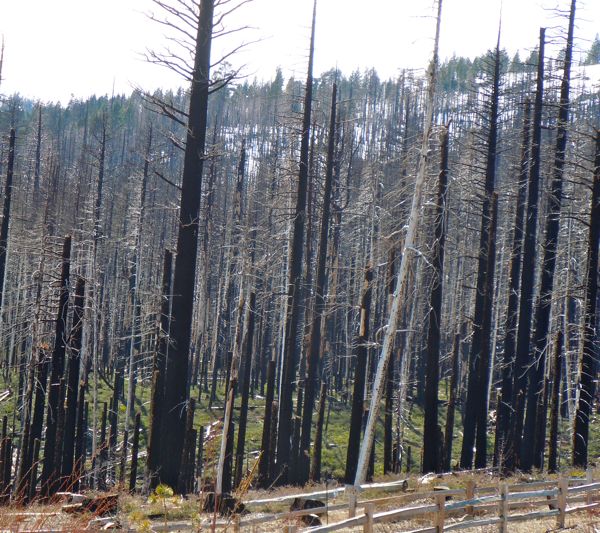
Remains of the Angora Fire in April 2011. Photo/LTN

Remains of the Angora Fire in April 2011. Photo/LTN

Restoration work could begin as early as July 26.

“Work to control harmful invasive plant species, improvements to the road and trail system, and mechanical and hand-thinning of dead and some live trees to reduce the future risk of wildfire and improve forest health will begin this summer,” the Forest Service said in a press release. “Planning and design for stream channel, wetland and meadow restoration projects continues, and some field work will begin next summer.”

More than 3,000 acres, mostly USFS land, burned during the multi-day fire that started June 24, 2007, when a campfire that wasn’t completely extinguished became a raging wildland fire on the outskirts of South Lake Tahoe.

A substantial number of trees had been removed in the last four years prior to the lawsuit being filed. Health and safety reasons were the reasons given for felling them.

A number of seedlings have also been planted.

With the lack of alive trees in the area and the abundance of moisture this winter and spring, water is everywhere in the burn area. Fresh vegetation and an array of wild flowers are sprouting in some areas. This will begin to stabilize the soil and absorb the water, but can’t take the place of the thousands of trees that were lost in the inferno.


South Shore rec measure headed for Nov. ballot

By Kathryn Reed

Righteous, ridiculous, right-on, responsible. Plenty of people have a special way of defining the R in Measure R. The board that on Wednesday voted to put it on the November ballot believes R stands for recreation.

The R is replacing Measure S – which stood for sports when South Shore voters approved it in 2000.

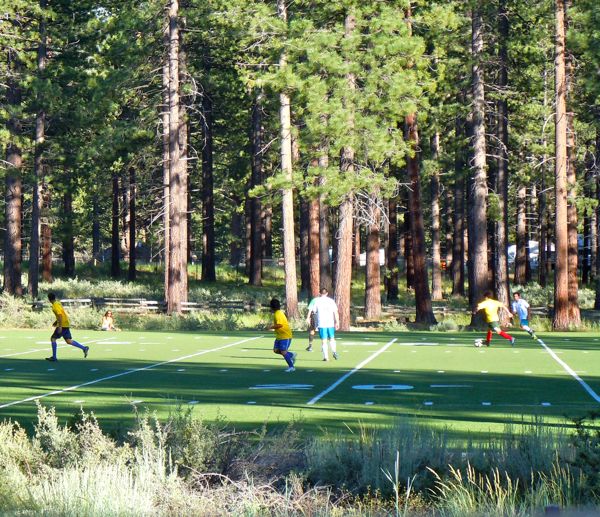
Youths play on the soccer field built with Measure S money. Photo/Kathryn Reed

Youths play on the soccer field built with Measure S money. Photo/Kathryn Reed

The problem with Measure S is that the money collected — $18 from single-family residences until 2030 – was never going be enough to build all the things outlined in it. It calls for an ice rink, three ball fields and maintenance of bike trails built after 2000.

The ice rink is in, a soccer field by Lake Tahoe Community College is done and the few miles of bike trails that have been built have money for future maintenance.

The other issue with Measure S is a land’s capability assessment was not done. Even if there were money to build fields, the land doesn’t exist to do so.

Proponents say Measure S is being tweaked to better address today’s needs. That means using money to upgrade established ball fields, and improving bike trails developed pre-2000.

Opponents say the measure is taking the growing pot of money for bike trail maintenance and diverting it to ball fields. Some of these people would like the measure written so all bike trails could use the money – with no money for ball field maintenance per the original language of Measure S.

Fifteen people gave heartfelt, emotional and factual testimony – some twice – during the 2½-hour meeting July 13 of the joint powers authority board at Lake Tahoe Community College.

The board had spent 150 minutes meeting July 1 as well.

Apparently, that’s how long it takes for these three to essentially vote on one item. While most boards don’t spend the public’s time tirelessly going over typos in a document, this one does.

El Dorado County Supervisor Norma Santiago, South Lake Tahoe City Councilman Hal Cole and Tahoe Paradise Park board member Deborah Henderson make up the JPA board.

The substantive changes made to the resolution that had been in circulation include:

• Eliminating specific dates regarding when the ball field or bike entities get money via R.

• Having the ball field and bike advisory committees that will be appointed by the JPA board, if R passes, be made up of three to seven individuals.

This is the Measure R resolution the board adopted. This is what will appear in ballot documents. Eleven years ago the full resolution of S was not in the ballot document, though it did exist and is known as Resolution 06.

The JPA board will meet July 29 at 9am at Lake Tahoe Airport to work out language for the ballot argument. This is the board’s annual meeting as well. Criteria for the advisory commissions will be discussed, too.

Pro and con statements for the ballot must be submitted to the county election’s department by Aug. 1. This is why the board has a meeting set for Aug. 10 in case it wants to submit a rebuttal by the Aug. 11 deadline if anyone opposes the measure.

To be on the email list regarding Measure R, send an email to rkupton@aol.com asking to be added.

The board also at one of the next two meetings could decide to not go forward with Measure R. The overriding reason not to go forward would be the cost of the election. While the board has allocated $35,000 for the election, that amount could go up depending on what other entities are on the ballot. People can start pulling papers July 18 for offices in El Dorado County.


South Tahoe gives ice rink keys to private operator

By Kathryn Reed

Skating on financial thin ice is exactly what South Lake Tahoe hopes to stop doing by turning over operation of the city’s ice arena to private operators.

The City Council on July 12 awarded Tahoe Sports and Entertainment, a private corporation run by Chris Cefalu of South Lake Tahoe and Van Oleson of Stateline, a 10-year contract to operate the 9-year-old facility.

South Tahoe's ice rink will be operate by a private firm starting Aug. 1. Photo/LTN file

South Tahoe's ice rink will be operated by a private firm starting Aug. 1. Photo/LTN file

The city recently has been losing about $100,000 a year on the slab of ice that was built with taxpayer money through the 2000 voter-approved Measure S. It’s estimated during the life of the initial contract the city will save $1.5 million.

The contract begins Aug. 1. This is the first time the city has turned one of its assets over to a private concessionaire. But it is something that goes on in government all the time. Just look at the U.S. Forest Service using California Land Management to operate some of its venues in the Lake Tahoe Basin.

The ice rink agreement calls for Tahoe Sports and Entertainment to pay the city $2,000 a month for the first year; $3,000 month after that. Beginning Oct. 1, 2012, 3 percent of gross revenue above $600,000 will be the city’s; with it capping at 5 percent starting Oct. 1, 2014.

The $600,000 figure came about because that is what the city has grossed in the past few years, City Manager Tony O’Rourke said.

The operators will also pay all utilities.

Cefalu and Oleson use the rink regularly as hockey players. Their key investor is Shelly Zimbler, a former executive with Procter & Gamble. His wife, Naomi, is involved in the figure skating world.

Oleson told the council what is missing is creating the Tahoe identity when it comes to the ice. The new operators intend to boost all aspects of the rink – hockey, figure skating, and public skate.

“You have a jewel. It just needs to be shined up a bit,” Cefalu said.

Oleson pointed to how Lake Placid capitalized on its Olympic miracle on ice. He pointed out how Squaw Valley had the first miracle in 1960. That hockey spirit is what they intend to bring to the South Shore, noting that ice hockey participation in California has grown by 240 percent since the Anaheim Ducks and San Jose Sharks became part of the NHL.

South Tahoe’s sheet of ice meets NHL requirements. One day there will likely be another sheet of ice. That addition is in the operators’ long-term plans.

Initially, about $300,000 is intended to be infused into the facility to upgrade the concession stand – which includes having a beer and wine license — and to buy a conversion kit, according to Zimbler.

The kit would allow another surface to be put on the ice so the arena could be used for more than ice sports. Indoor soccer is what company officials envision being a big draw.

Soccer is a big sport on the South Shore. Ice hockey is not something Hispanics tend to play, as evidenced by the NHL only having two Hispanic players. Cefalu said he’d like to see soccer players take an interest in hockey.

The length of the contract had some council members squirming, but in the end they all agreed to the deal. One caveat is the city can get out of the deal in 90 days, while the operators must give six months notice.

Part of the reason for the decade-long contract is so the group can make some money and then perhaps midway through start thinking about building another sheet of ice. This is part of the bigger plan for what was originally known as the 56-acre project – which is what Lakeview Commons on the other side of Highway 50 is part of.

The project is likely to cost more than $4 million. Zimbler was honest with the council in when that might get built.

“We would not build it under the current agreement. We would come back in year four or five before we spend $4 million,” he said, “because if the lease expires, it’s technically yours.”

With the contract just being signed, immediate changes are not known. However, increasing fees will not be one of them. In fact, to increase use fees, the city must first review, though not approve, them. Cefalu said he could see some rates coming down as a way to get people in the doors.

Before this transaction occurred, city officials said ice areana employees would have other jobs within the city. It is not known how many people Tahoe Sport and Entertainment will hire or for what positions.

Other things from the council meeting:

• Expect the Aug. 2 meeting to be long – the marijuana cultivation ordinance, discussion about being a charter city, and the possibility of asking voters to decide the pension issue – are all slated to be on the agenda.

• Councilmembers Angela Swanson and Claire Fortier are working behind the scenes for the city to have more of a presence at the annual environmental summit next month in Homewood.

• The Aug. 16 meeting was moved to Aug. 23 so councilmembers may attend the summit.

• Two lobbyist firms were hired to give the city more political clout.

• More than 140 properties will have liens put on them to collect nearly $90,000 in unpaid South Tahoe Refuse fees.


Tournament pairs golf with plenty of food for players, fans

By Kathryn Reed

Oh, to dine like a celebrity.

It’s possible at the American Century Celebrity Golf Tournament.

Although not everything that is available to the players is available to their admirers, some of it is.

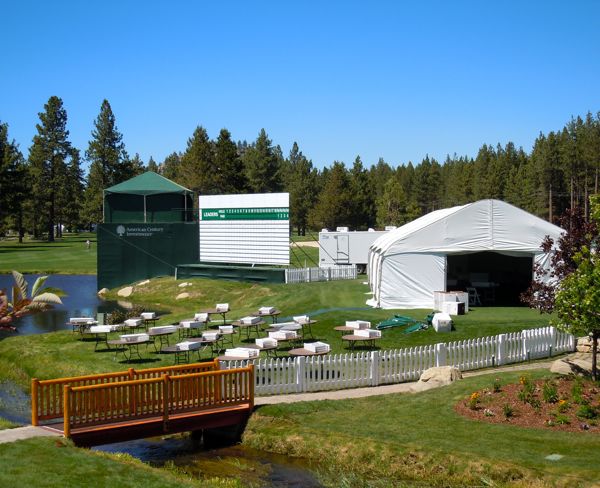
The American Century credentialed-only tent two days before the start of the 2011 tournament. Photos/Kathryn Reed

The American Century credentialed-only tent two days before the start of the 2011 tournament. Photos/Kathryn Reed

During the six-day event that begins today at Edgewood Tahoe in Stateline, a lot of food is consumed. In stock at the golf course for just this event are:

• 2,400 hamburgers

• 4,000 hot dogs

• 1,200 pounds of chicken

• 400 pounds of tomatoes

• 250 pounds of onions

• 400 pounds of a variety of seafood

• 50 kegs of beer.

The Edgewood restaurant is closed during the tournament, but Brooks’ Bar & Deck is open to the public.

“We always get one midweek Michael Jordan visit,” Bryan Davis of Edgewood told Lake Tahoe News. “He comes in for an hour or two. It’s a nice surprise for the guests.”

Other players come by the sports bar as well.

Players mostly dine in the clubhouse – which is off-limits to the public. Each day something different is served. It could be fajitas one day, burgers the next and usually a more elaborate seafood spread on the final day.

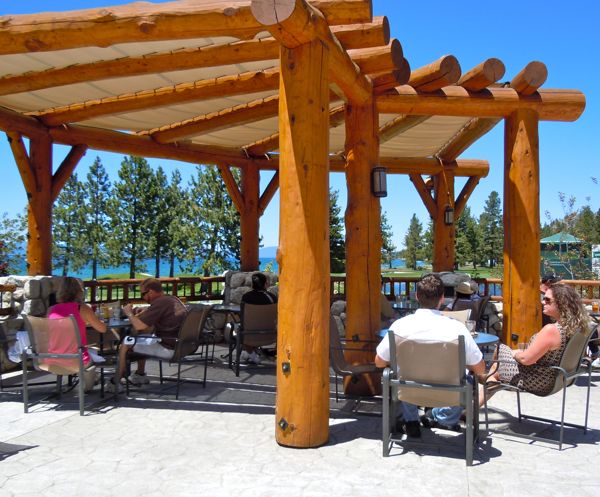
Views of Lake Tahoe and the links can be had from Brooks'.

Views of Lake Tahoe and the links can be had from Brooks'.

Most of the players are eating at the American Century tent the first three days because the clubhouse is not open until Thursday.

The public can get a taste of what the celebs are chowing on by going to the Soroptimist International South Lake Tahoe booth. Edgewood provides the burgers, dogs and sandwiches, while the women provide the labor. Proceeds are split 50-50.

The snack bar between the 9th green and 10th tee is open. It has a grill, but not the caliber of food of Brooks’.

New this year is a concession on the 17th hole, where the party crowd tends to gather along the sandy beach. Food and alcohol will be served there.

Guy Fieri is coming back – but just for a few hours on Saturday. The Food Network star was creating pork sandwiches in 2009. Pizza is what he will be assembling this year on the 17th hole.

If eating at the golf course is on your itinerary, be warned Thursday and Saturday are usually the two most crowded days. Thursday because of the family and friends tagging along during the celebrity-amateur event; Saturday with the public out en masse.

Over at Harveys and Harrah’s, the host hotels for the 22-year-old tournament for the past handful of years, various events involving food are geared toward the celebs with no one from the public invited.

A big dinner is put on Thursday to recognize the celebrity-amateur winners. NBC and American Century Investments, which own and sponsor the tournament, respectively, also put on a pairings dinner for everyone.

These events are elaborate buffets with food stations featuring cuisine from around the world.

John Packer, spokesman for the casinos, would not divulge names of players who request gluten-free food, vegetarian fare or other dietary requests.

There is no mandate they must stay in the casino corridor, but many do because of the convenience.

“A lot of times celebrities like to go out on their own. For instance, Marcus Allen likes 19 (Kitchen-Bar),” Packer said.

For the players partaking in casino games, food is always available in the Diamond Lounge.

“I don’t think any of them are underfed. There is plenty of opportunity for them to have great food,” Packer said.


Plan to reduce congestion, upgrade Camp Rich campsites

By Kathryn Reed

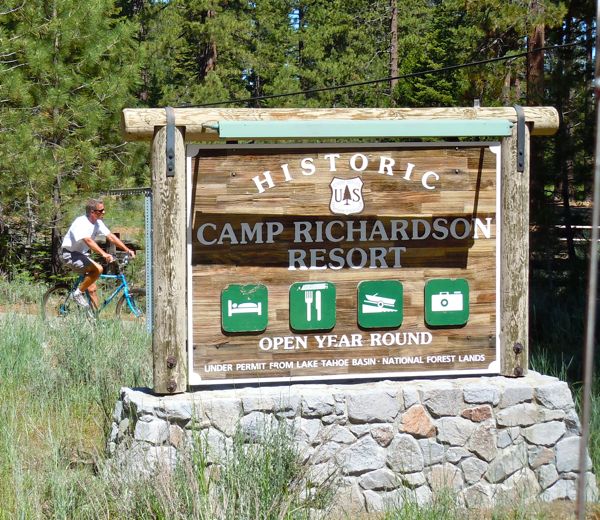
Reconfiguring the three sections of the Camp Richardson Campground, making the road leading to the Beacon Restaurant more efficient, reducing congestion in the area, and removing parking from dirt areas along Highway 89 are the major components of a multi-million dollar, multi-year project the U.S. Forest Service wants to undertake.

The federal agency is taking public comment on the 79-acre project until Aug. 8.

Camp sites at Camp Rich are slated to be improved by the USFS. Photos/Kathryn Reed

Campsites at Camp Rich are slated to be improved by the USFS. Photos/Kathryn Reed

But the homeowners on Jameson Beach Road are not happy with the proposal because some believe their needs are not being met. This is the road that goes from Highway 89 by the cabins to the Beacon and then turns right to the residences.

Daniel Cressy, who is in charge of the project for the Forest Service, said the last meeting regarding the Jameson Road issue was Thursday, but there is still uncertainty over who owns the road. He told Lake Tahoe News his agency is looking into the issue.

Jameson Beach Road residents are doing research, too.

At issue is whether the residents own the road or have an easement or right-of-way to use it to get to their property. The houses were there long before the Forest Service acquired the land in the 1960s. There also used to be another route to get to the houses, which the USFS has closed off. That was next to the general store.

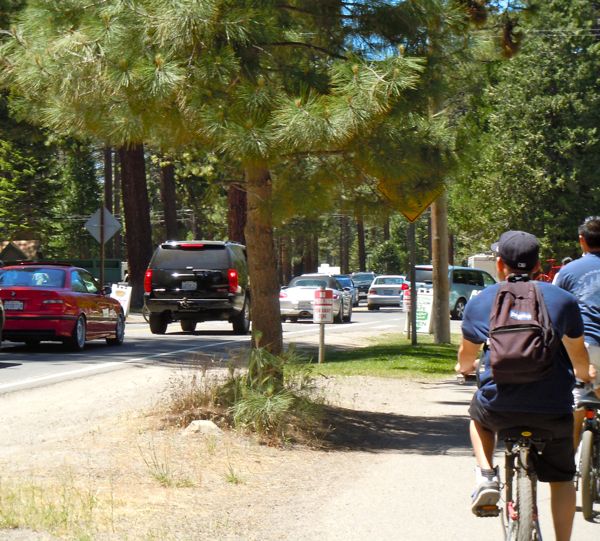
Both sides agree congestion is horrible in that area.

Cressy said the proposal calls for having homeowners have an ID that would allow them to get home without enduring the backup at the parking kiosk. This would also entail widening the road to legally allow for cars to pass to the right.

A bike-pedestrian trail will be put in along Jameson Beach Road with easy access for people parking on the road so people and vehicles are not using the same strip of asphalt, as is the case now.

Four alternatives are being proposed in the environmental assessment. One is the standard to do nothing. Alternative 2 is the one the agency would like adopted.

With the campgrounds, all alternatives call for a reduction in sites from the 325 that are now available.

“As we redevelop the campsite to meet modern accessibility standards and vehicle radius turning, the campsites take more space (based on) how campsites are currently configured,” Cressy explained. “Now they are tucked in wherever they can fit.”

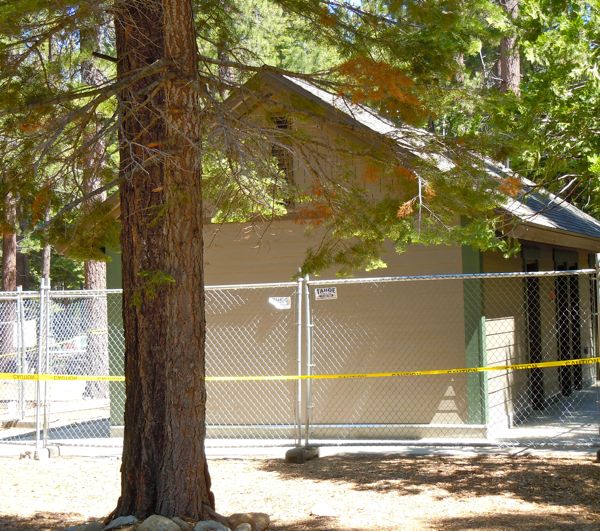
New bathrooms will be available this summer.

New bathrooms will be available this summer.

Alternative 2 calls for 253 campsites. Up to 170 of those would have sewer-water hook-ups. The majority would accommodate six people, with some designed for 12 and others for groups of 24.

Cressy said feedback from users reflects a changing demographic for camping – bigger groups, more RVs.

Moving the check-in for the campgrounds out of the main commercial area is designed to reduce congestion.

Work on the campgrounds could begin next summer. Without specific engineering and design work, it’s unknown today if this would take two seasons.

Instead of needing a four-wheel drive to pull into the campground, the road will be improved, defined routes (instead of driving through the forest), and identifiable spurs for campers will be installed.

To accomplish this and other components of the proposal about 1,000 trees are slated to be felled – with about 40 of those being more than 30-inches in diameter.

Cressy acknowledges this sounds like a lot, but said to make the campground function – which includes having a fire truck be able to come and go – trees need to come out. He also said the density of some areas makes this no different than a thinning project.

Millions of dollars in improvements are proposed by the USFS.

Millions of dollars in improvements are proposed by the USFS.

Having more transit stops and ones off the highway to allow the flow of traffic to continue are being proposed.

Restrooms are part of the project, too. Those are in addition to the two facilities that will be open later this summer. (They replace ones built in the 1960s.)

One will be by the beach to replace the port-a-potty near the cabins.

Funding initially will come from Southern Nevada Public Land Management Act money. Cressy roughly estimates about $2 million worth of work could take place in 2012, with another $1.5 million in work the following year.

The entire project could cost between $10 million and $15 million. Cressy stressed this is not a hard figure by any means. He also said funding for the project is not secured. Oftentimes dollars are not available until the environmental review is finished.

Once the public weighs-in, the agency assesses the comments to see if more work is needed. The forest supervisor has ultimate authority in signing off on the document.

Components of the proposed action plan that will affect the masses who use or drive through the Camp Rich area – which is about three miles north of the Y in South Lake Tahoe on Highway 89 – include eliminating the free parking in the dirt along the highway.

More defined parking areas on Jameson Beach Road will be installed.

With all of this will come better filtration of stormwater runoff to reduce sediment flowing into nearby Lake Tahoe.

Other parking areas will be built.

Congestion like this on Juy 9 may be reduced.

Congestion like this on July 9 may be reduced.

The bike trail that crosses Jameson Beach Road close to the highway will remain because it acts as a sidewalk as well. But cyclists will be directed to a new path that will go behind the general store on one side of the beach road and behind the lodge on the other side.

User-created trails in the Pope Marsh area will be decommissioned, with the most logical ones being revamped to encourage they be the only ones used.

The trail design is being worked on with the Forest Service employees who are involved in the larger bike-pedestrian plan being formulated for the area that goes to Fallen Leaf Lake Road. (That document is slated to be released in the fall for public review.)

The current document is online as well as at the USFS office at 35 College Drive, South Lake Tahoe. Questions may be directed to Cressy at (530) 544.2857 or dcressy@fs.fed.us.


Dugard speaks about 18 years as sex slave, life after release

By Martha Groves, Los Angeles Times

As 14-year-old Jaycee Dugard struggled in a crude backyard shed to deliver her baby daughter, the serial predator who had abducted and raped her stepped in to unwrap the umbilical cord that trapped the infant.

“She was beautiful,” Dugard said of the child she birthed three years into her captivity in Northern California. “I felt like I wasn’t alone anymore. I knew I could never let anything happen to her.”

ABC News' Diane Sawyer, left, speaks with Jaycee Lee Dugard in her first interview. Photo/Jill Belsley-ABC News

ABC News' Diane Sawyer, left, speaks with Jaycee Lee Dugard in her first interview. Photo/Jill Belsley-ABC News

In an exclusive interview with Diane Sawyer broadcast Sunday on ABC, Dugard, displaying remarkable poise and smiling often, provided chilling details about the 18-year ordeal she endured at the hands of her captors, an increasingly deranged parolee named Phillip Garrido and his wife, Nancy, who aided the abduction and condoned his rapes.

Dugard’s memoir, “A Stolen Life,” to be released Tuesday, tells how the Garridos informed her she was pregnant when she was 13. At the time, she knew she was putting on weight and waddling, but she didn’t know why.

A naive, toothy-grinned blond when she was taken captive at age 11 in 1991, Dugard is now 31 with brown, shoulder-length hair and impossibly young skin — the result, she said, of years spent with little exposure to the sun. Around her neck she wears a pine cone on a chain.

A pine cone, she told Sawyer, was the last thing she grabbed after Phillip Garrido shocked her with a stun gun and Nancy Garrido dragged her into the car as she walked toward the school bus on the street in front of her South Lake Tahoe home.

Read the whole story


CalFire: Planning for a fire could save life and property

Publisher’s note: This is the second of three articles from the Amador-El Dorado Unit of CalFire regarding the “Ready-Set-Go!” fire and life safety campaign.

By Teri Mizuhara

CAMINO – Making sure your family and your home is set for an approaching wildfire and a possible evacuation is the second part of CalFire’s Ready-Set-Go fire safety program.

“Right now is a good time to review your evacuation plan (Wildfire Action Plan) with your family. Don’t wait until the smoke is swirling around your home because by then it is too late,” Kelly Keenan, CalFire’s Amador-El Dorado unit chief, says. “Practicing your evacuation plan now if you have one or creating an evacuation plan and practicing it now will ensure a much smoother departure in the face of a wildfire or other major emergency. Failing to plan is planning to fail. Are you willing to risk the health and welfare of your family?”

calfireIf an evacuation is imminent, have your evacuation kit(s) and other valuables in your car. Have your car backed into your driveway with your doors and windows closed (this way you can drive forward out of your driveway). Keep your family and pets close by. Dress in appropriate clothing (natural fibers versus man-made fabrics), have goggles and a mask to protect you from the smoke. Alert your family and neighbors. Drink plenty of water and stay tuned to your local television/radio stations and news websites for updated news.

If time allows, prepare the interior of your home by doing the following:

• Shut off gas at the meter and turn off all pilot lights.

• Leave your lights on in the house so firefighters can see your home through the smoke.

• Shut all your windows and doors; be sure to leave the doors unlocked.

• Remove flammable curtains and window shades. Close metal shutters.

• Move furniture to the middle of the room, away from window and doors.

• Shut off your air conditioning.

Then prepare the exterior of your home:

• Move flammable items such as patio furniture, door mats, and children’s toys inside the house or far away from the side of your house.

• Shut off your propane tank.

• Do not leave your sprinklers on; they deplete the local water pressure.

• Leave your exterior lights on.

• Seal exterior vents if time permits.

Survival tips if you are trapped:

• Stay calm, do not panic. Focus on what you need to do to survive.

• Shelter yourself and your family members away from outside walls.

• Wear long sleeves and long pants made of natural fibers.

• Stay hydrated. Fill sinks and tubs for an emergency water supply.

• Place wet towels under doors to keep embers and smoke out.

• Make sure you can exit your home if it catches fire but remember that it will be four to five times hotter outside than inside your home.

“It is always best to leave your home well ahead of the wildfire. Roads quickly become clogged with vehicles (people evacuating and emergency service equipment responding to the fire) and the smoked filled air can cause people to become disoriented and panic. Protect your loved ones and get set today and rest easy tonight because it is not a matter of if a wildfire will happen but when a wildfire will occur,” warns Keenan.

For more detailed information on what you have read, visit CalFire’s website www.readyforwildfire.org or call (530) 644.2345 to receive a free brochure on the Ready-Set-Go program and evacuation tips for your family and pets.


Great stage performances belie reality of Tallac Assoc.

By Kathryn Reed

CAMP RICHARDSON – The Tahoe Tallac Association board and staff could take some pointers from the characters on stage at the Boathouse Theatre.

The five woman starring in the play “Dixie Swim Club” are fabulous in how they capture the nuances of a friendship born in college that lasts into their 70s when there are only four of them left.

Sheree Hollinger (Teri Leve), right, consoles Jeri Neal McFelley (Amy Sando) who is the least likely of the friends to become pregnant. Photo/Kathryn Reed

Sheree Hollinger (Teri Leve), right, consoles Jeri Neal McFelley (Amy Sando) who is the least likely of the friends to become pregnant. Photo/Kathryn Reed

They laugh, they yell, they console, they cry, they endure – they find a way to make their lives work as individuals and as a team.

The behind the scenes maneuverings of the Tahoe Tallac Association – the 30-plus-year-old organization that oversees the annual Valhalla Music and Arts Festival – does not resemble a team.

Lake Tahoe News in September reported the financial difficulties the South Shore organization was having.

It’s only gotten worse. Grants have not been secured – which is the major source of income to pay the acts, employees and keep the lights on. Marketing seems to be a foreign word to the group. Press releases are sent by the acts coming, if at all, not the association – which makes for a lack of cohesive message or no message.

A once robust volunteer corps was not to be seen July 8 on the second night of “Dixie Swim Club.” Instead it was Executive Director Lori Cramer selling tickets. Volunteers used to receive regular emails about when to sign up for work detail. That hasn’t happened this year.

Unfortunately the realities of TTA sound more like the ingredients board member and theatrical director Dave Hamilton could write into a script. Instead, he and those left behind must figure out a way to dig themselves out of financial hole that seems to keep sucking them under.

On July 7, Eric Taxer resigned from the board. Last month the board met without the executive director – a highly unusual move. The next meeting, presumably with the board and staff, is July 11 at 5:30pm – most likely in the Twin Cabins in front of the Valhalla Grand Hall.

In Taxer’s letter to the board that was obtained by Lake Tahoe News he writes, “We will be starting our new Fiscal Year with approximately $38,000 of debt. The only immediate source of income with the new fiscal year will be the holiday faire and gala, expected to generate $12,000 in income. But, we will have snow removal expenses, winterization expenses, continued insurance, utilities, and payroll. I have repeated in prior meetings for over a year the importance of fundraisers. I have stepped up to the plate and organized such. Other members who have committed to do so have basically bailed on their responsibility.”

If the workings of the nonprofit, which is run by a volunteer board and an executive director who is owed thousands of dollars is back pay, were near the caliber of the programs put on at the various venues near the shore of Lake Tahoe, it would have coffers overflowing with greenbacks.

Cramer is the TTA’s fifth executive director. She was a board member before taking over for Steve Farnsley, whose services the board said it no longer needed. Before Farnsley it was Kathy Farrell at the helm. She embezzled from the organization, though the board chose not to press charges.

Hamilton and Taxer have loaned the association thousands of dollars that have yet to be repaid.

The remaining board members, according the TTA website, are: Norm Glenn, Hamilton, Ginger Nicolay-Davis (who is worth catching in one of the remaining six performances of “Dixie Swim Club”), Bruce Rettig, Frank Riley (catch him with Tahoe Improv Players on Aug. 2), Pam Taylor and Kim Wyatt.

Nicolay-Davis and Cramer were sent an email last week by Lake Tahoe News asking some general questions – nothing about the financial situation. That day, July 1, Nicolay-Davis responded, “We will get info over to you shortly.” The deadline to answer was July 7. Lake Tahoe News never received answers to its basic questions – Like what is new this year?

One thing LTN knows is new is greater access to the lawn area – including free concerts on select dates.

Another new thing is better dialogue with the U.S. Forest Service, which owns the land just beyond Camp Richardson. Taxer deserves a great deal of credit for being tenacious in researching documents and getting the appropriate people to listen. When Deputy Forest Supervisor Jeff Marsolais was hired he helped foster an atmosphere of cooperation between landlord and tenant.

While the board figures out how to function more effectively, the shows will go on. Here is this year’s festival schedule.