Sheehan: Balance economics with infrastructure needs

Publisher’s note: Lake Tahoe News is profiling the six candidates who will be on the Nov. 8 ballot for the South Tahoe Public Utility District board. They are being published in the order they were submitted. Kelly Sheehan is challenging the incumbent.

Name: Kelly Sheehan

Age: 53

How long have you lived on the South Shore?: 30 years

What water company supplies your home? Your work?: STPUD supplies my residence, two rental properties and my business — Steamers Bar & Grill.

Kelly Sheehan

Kelly Sheehan

Job/profession?: Owner-manager of Steamers Bar & Grill since 2008. Previously a branch manager of a locally owned savings bank for 25 years.

What stands out to you in the 2011-12 budget?: That STPUD does not pay lifetime medical insurance for its retired employees. This is a huge cost that is causing huge financial deficits for many states, counties, cities, and special districts.

What boards, commissions, or other experience, including volunteering, do you have?: I have served two terms on the St. Theresa school board, two terms on the St. Theresa’s Pastoral Council and I am currently on St. Theresa’s finance committee.

Is there any individual, group or organization you would not take campaign money from? Why?: I will take campaign donations from any group or constituent as long as long as they do not expect any “special favors” in return.

What is the No. 1 reason someone should vote for you over another candidate?: I am a fresh set of eyes and ears. I have no special agenda and will base my decisions on fact and what is best for the district and its customers.

California law mandates water meters be installed. What is your solution to make the fee equitable for those on meters and those without one?: California law created a situation that is simply unfair. The only way to be fair and remain within the law is to install the remaining meters in the shortest period of time. There just isn’t a magic formula that will make the flat rates and the metered rates the same.

To get the remaining 60 percent of South Tahoe PUD customers on meters it will cost $15 million. As a board member, where will you get the money to pay for the meters?: They are really only two ways to fund it. One, borrow and raise rates or two, be successful in securing state grants or low interest loans.

Do you believe the district should spend money on lobbying efforts in Sacramento and/or Washington, D.C.? Why or why not?: The district no longer employs a state lobbyist, as membership in the Association of California Water Agencies provides that benefit. The district’s lobbying firm in Washington, D.C., has since 2009, secured $6.5 million in federal funding for STPUD at a cost of approximately $304,000 for the same time period. These dollars are matched 50/50 with local funds, this lessens the burden on the district’s customers.

What do you know about STPUD getting money from the Lake Tahoe Restoration Act?: It is my understanding that LTRA contains language that reimburses one-third of the costs public water and wastewater agencies incur for relocating underground utilities in erosion control projects. In addition, the district, as lead agency in the Lake Tahoe Community Fire Protection Partnership, has received federal dollars for infrastructure improvement projects that relate to fire protection. Both of these were authorized under the act, and are therefore appropriate.

How do you balance the economic situation of the community with the infrastructure needs of the district?: It is very difficult to be sensitive to the high unemployment within our community and still replace aging infrastructure. But it is unfair to just ignore the problem and pass it on to our children and grandchildren.

With 38 percent of a customer’s sewer bill going to meet the needs of the Porter-Cologne Water Quality Act and $100 million already invested in Alpine County to take STPUD’s wastewater, would you leave things as they are? If yes, why? If no, what would you change and how do expect to accomplish those changes?: The district’s requirements to export its wastewater is another example of an unfunded state mandate, but the district’s investment in Alpine County may be able to pay benefits as the possibility of hydropower generation and increased uses of recycled water in California and Nevada. With proper foresight, the Alpine County operations could well become a revenue source for the district in the future.

What should be done with the land STPUD owns where the old post office was on Black Bart?: It is my understanding that due to the absence of sewer and water to the property, it has little value as a residential lot. Due to restrictions placed on that lot, the best and most economical solution would be to demolish the existing structure and restore the property to its more natural state. I believe any coverage could be banked for future district needs.

There has been a three-year wage freeze for employees. What are your thoughts on employee raises and benefits?: We are all being asked to do more with less and our local economy has taken a hard hit. It would be pretty difficult to justify wage or benefit increases until the local economy shows some real signs of improvement. As a local business owner, I believe I will know when that happens.

When would you vote for a hike on water and sewer rates and why?: Again, there is a balancing act between sensitivity to the local economy and realizing the infrastructure continues to age regardless of the economy. It would be foolish to ignore the infrastructure, which makes it that much more important to seek additional funding sources, such as state and federal grants, that would allow projects to move forward and still keep rates reasonable.

Lukins Brothers Water District – any comments?: It’s a good example of what happens without reinvestment into infrastructure. The board has stated in the absence of outside funding it would be unfair to burden the district’s current customers with over $20 million in necessary upgrades to bring the system up snuff.

What should be the main priority of South Tahoe PUD?: To continue to provide clean and safe drinking water and environmentally responsible wastewater collection, treatment, and export for the community in a financially responsible manner.

What should be the main priority of a South Tahoe PUD board member?: Listen to facts and make decisions on the basis of what benefits the greatest number of district customers.





Rise: Implement a freeze on water, sewer rates

Publisher’s note: Lake Tahoe News is profiling the six candidates who will be on the Nov. 8 ballot for the South Tahoe Public Utility District board. They are being published in the order they were submitted. Dale Rise is the incumbent.

Name: Dale Rise

Age: 59

How long have you lived on the South Shore?: 37 years

What water company supplies your home? Your work?: STPUD

dale rise

Dale Rise

Job/profession?: General engineering contractor, general contractor, and own a retail ice cream store — Aloha Ice Cream.

What stands out to you in the 2011-12 budget?: The 2011-12 budget was a balanced budget, with operations and maintenance taking a cut of 16 percent.

What boards, commissions, or other experience, including volunteering, do you have?: Four years on STPUD board, two years president, two years vice president, one year finance committee, three years operations committee; two terms city of South Lake Tahoe Building Board of Appeal; California Special Districts Association training.

Is there any individual, group or organization you would not take campaign money from? Why?: I have never taken — nor will ever accept funds from any group. I believe that a candidate that receives funds from union or management lobbyists should be questioned regarding their agenda.

What is the No. 1 reason someone should vote for you over another candidate?: I am not afraid to make difficult decisions. I have and will continue to put the public back in South Lake Tahoe Public Utility District. I will remain open, transparent, accountable to the public.

California law mandates water meters be installed. What is your solution to make the fee equitable for those on meters and those without one?: I feel that the rate we have in place today is fare to metered and unmetered customers. The off balance is past board members could have started installing water meters years ago, and we would have more meters in the ground today — evening the balance between metered and unmetered customers.

To get the remaining 60 percent of South Tahoe PUD customers on meters it will cost $15 million. As a board member, where will you get the money to pay for the meters?: District crews will be installing 200-300 meters out of regular budget. I would like to see a rebate, or incentive program that would enable the homeowner to hire a contractor to install the meter. Hope for more grant funding.

Do you believe the district should spend money on lobbying efforts in Sacramento and/or Washington, D.C.? Why or why not?: In the past four years STPUD has spent approximately $280,000 on federal lobbyists, and approximately $90,000 on California lobbyists. During the last year the district did not renew the contract (at approximately $30,000 per year) with our California lobbyist. I feel there is no value to the district. I do not feel currently there is value to the district in continuing the contract with federal lobbyist company ENS. To me they are more like tour guides or activity directors for board members and staff visiting Washington, D.C. At one time, there was a need for a full time lobbyist — however in today’s economic climate, with no money coming from the federal government. In the event that a single item comes up, the district can hire a lobbyist to address the item on a one-item basis.

What do you know about STPUD getting money from the Lake Tahoe Restoration Act?: The district has received funds in the past to improve water infrastructure for water line replacement, improving the ability to fight forest fires. I believe these funds will be limited in the future.

How do you balance the economic situation of the community with the infrastructure needs of the district?: STPUD must live and work within its own budget. The EPA guideline recommendation is that the district budget approximately $7 million per year on infrastructure. In the last two years the district has spent approximately $13 million per year. I think that we can slow down capital improvement projects and still stay ahead of our aging infrastructure needs without raising rates.

With 38 percent of a customer’s sewer bill going to meet the needs of the Porter-Cologne Water Quality Act and $100 million already invested in Alpine County to take STPUD’s wastewater, would you leave things as they are? If yes, why? If no, what would you change and how do expect to accomplish those changes?: The Porter Cologne Act was the most important act for water clarity in Lake Tahoe’s history. It is what we do with the water in Alpine County is very important today. Four million gallons per day is received by nine ranches in Alpine County at no charge. The water is transported through a 24-inch gravity fed pipeline. STPUD is in the final planning to install turbines in the system to generate green power to sell to Liberty Energy.

What should be done with the land STPUD owns where the old post office was on Black Bart?: The old post office site has no water, sewer, or gas service. It would cost over $100,000 to bring the building up to current code for any use. TRPA zoning limits what type of use. I feel that the building should be demolished, and the property restored to natural.

There has been a three-year wage freeze for employees. What are your thoughts on employee raises and benefits?: The union and management contract is up for negotiation this [fiscal] year. I look forward to sitting down with both parties in order to negotiate a contract that is fair to rate payers

When would you vote for a hike on water and sewer rates and why?: I am in favor of a rate freeze.

Lukins Brothers Water District – any comments?: The acquisition of Lukins will not come at the expense of existing ratepayers.

What should be the main priority of South Tahoe PUD?: Furnish our customers with reliable water and wastewater services, safely, efficiently, and cost effective.

What should be the main priority of a South Tahoe PUD board member?: It is the duty of the board of directors to establish procedure and formulate policy. It is also responsible for adopting all policies, set budget and number of employees.

Tell readers something about yourself that most people don’t know: I believe that if you want to do something well, you must be dedicated and willing to sacrifice. People might doubt what you say, but they always believe what you do.


Kortge: Time to replace aging infrastructure is now

Publisher’s note: Lake Tahoe News is profiling the six candidates who will be on the Nov. 8 ballot for the South Tahoe Public Utility District board. They are being published in the order they were submitted. Mary Kortge is running for the seat vacated by Marylou Mosbacher.

Name: Mary Kortge

Age: As of Oct. 15 I will be 54.

How long have you lived on the South Shore?: 22 years

What water company supplies your home? Your work?: South Tahoe Public Utility District

Mary Kortge

Mary Kortge

Job/profession?: Homemaker/manage my rental property

What stands out to you in the 2011-12 budget?: The significant amount of proposed construction planned for this year since the construction cost are lower now. Also, that more money goes toward capital expenditures (40 percent) than wages and salaries (30 percent) and operations and maintenance (30 percent).

What boards, commissions, or other experience, including volunteering, do you have?: College degree in accounting/computer science, Zilwaukee Township clerk in Saginaw, Mich., School Site Councils for eight years, PTA boards for nine years, managed at AT&T phone centers, National Ski Patrol host at Sierra-at-Tahoe, the experience I’ve learned being married to my husband of 25 years in the engineering field from building bridges, dams and water treatment plants.

Is there any individual, group or organization you would not take campaign money from? Why?: I’m paying for my own campaign.

What is the No. 1 reason someone should vote for you over another candidate?: I know I am qualified for the position. I have reviewed the board’s past minutes, with a range of experience from the field to the boardroom, I will listen to your concerns and be your representation on the board. If elected, especially during these tough economic times, I will work hard to ensure that budgets are spent wisely and effectively.

California law mandates water meters be installed. What is your solution to make the fee equitable for those on meters and those without one?: It’s sad things couldn’t have remained the same as they were in the past, but state law mandated the water meters. In a perfect world no residents would be charged until all the meters have been installed, however, state law has dictated that owners be charged once the meters are in place. There is no way for it to be fair for everyone until all the meters are installed. The district needs to continue their efforts to find grants to pay for the rest of the water meters.

To get the remaining 60 percent of South Tahoe PUD customers on meters it will cost $15 million. As a board member, where will you get the money to pay for the meters?: We have a wonderful grant writer at STPUD and hopefully we will get more grant money to pay for the meters so we don’t have to pass it on to the public.

Do you believe the district should spend money on lobbying efforts in Sacramento and/or Washington, D.C.? Why or why not?: Yes, we should pay for lobbying in Washington, D.C. The water district spends about $70,000 a year for our lobbyist, which in turn since 2009 we’ve received about $6.5 million in grants from the federal government appropriated for water system improvements . Dennis Cocking who works for STPUD does the Sacramento lobbying, is very well known with the state and can accomplish any lobbying that has to be done at the state level.

What do you know about STPUD getting money from the Lake Tahoe Restoration Act?: The district has benefited from the act and if the money is to be spent in Lake Tahoe we might as well benefit. The money from the act was used to improve infrastructure including installation of fire hydrants. Due to the federal funding of the act, these improvements were made without increasing our water rates.

How do you balance the economic situation of the community with the infrastructure needs of the district?: In the lean economic down turn it is the best time to do public works projects. It’s time now to replace or repair our ailing infrastructure. We should continue to improve the infrastructure of the firefighting system. We should take advantage of the competitive construction bidding now since bids are coming in below our estimates. Minimizing the cost helps keep our rates low.

With 38 percent of a customer’s sewer bill going to meet the needs of the Porter-Cologne Water Quality Act and $100 million already invested in Alpine County to take STPUD’s wastewater, would you leave things as they are? If yes, why? If no, what would you change and how do expect to accomplish those changes?: Leave things the way they are since the infrastructure we have today is the result of federal and state laws. STPUD is working on energy self-production to keep our expenses down.

What should be done with the land STPUD owns where the old post office was on Black Bart?: Since the old post office does not have water or sewer there is not much you can do with the building except storage. Possibly remove the building, reclaim the coverage to bank for future construction, and revegetate the land. If an interested buyer could be found, it would have to be rezoned at some expense, making this a poor alternative.

There has been a three-year wage freeze for employees. What are your thoughts on employee raises and benefits?: The economy would have to change before I could consider a change in the employees’ wages. The water district is a very distinguished employer in our basin. I think the employees are happy to be working for our water district.

When would you vote for a hike on water and sewer rates and why?: At this time I could not vote for an increase given the current economy.

Lukins Brothers Water District – any comments?: Lukins system is old and in need of upgrades. It is a complicated issue that affects many South Lake Tahoe residents, so I will weigh the benefits and burdens of the different alternatives to make a fair and economically sound decision.

What should be the main priority of South Tahoe PUD?: To provide clean drinking water and sewage removal for the public at the lowest rate they can. Continue to improve the infrastructure for firefighting in the basin.

What should be the main priority of a South Tahoe PUD board member?: To make the best decision on the best information you can get to benefit the greatest number of the district customers.

Tell readers something about yourself that most people don’t know: I’m in the process of becoming a member of the United States Coast Guard Auxiliary. I also will be proud to have people call me STPUD.


Runnels: District needs to shrink, reevaluate its budget

Publisher’s note: Lake Tahoe News is profiling the six candidates who will be on the Nov. 8 ballot for the South Tahoe Public Utility District board. They are being published in the order they were submitted. John Runnels is running for the seat vacated by Marylou Mosbacher.

Name: John Wright Runnels

Age: 61

How long have you lived on the South Shore?: 40 years in August 2012

What water company supplies your home? Your work?: STPUD

John Runnels Photo/Ernie Claudio

John Runnels Photo/Ernie Claudio

Job/profession?: Business owner

What stands out to you in the 2011-12 budget?: The need to make internal adjustments to offset raising rates. Capital improvement projects need to be slowed down and departments that due to a lack of grant funding or fewer projects need to be eliminated or to have their budgets decreased. Also the funds allocated from lobbyists and consultants need to be carefully scrutinized for their effectiveness and decreased or eliminated accordingly.

What boards, commissions, or other experience, including volunteering, do you have?: Since I came to the South Shore in the early ’70s I have been involved in many city and county organizations working to improve our community. I have listed a few: Citizens Alliance for Responsible Government, president (SLT B.I.D. Elimination, “Fight The Blight” (keeping redevelopment in check), Lake Tahoe Boulevard 4 Lanes Not 2, Lake Tahoe Crime Watch, (past president) South Shore Lions Club, South Lake Tahoe Steering Committee for Police and Fire Salaries, Bicentennial for the U.S. Bill of Rights Citizens for Tahoe County (secretary), Supporters for the Protection of Individual Rights in Tahoe (S.P.I.R.I.T.) (past president).

Is there any individual, group or organization you would not take campaign money from?: I run a low dollar campaign, preferring to meet and talk with locals to find out their feelings on issues and any problems or areas that they feel need addressing, rather than spending a large amounts of money for ineffectual mailers, or advertising. I really don’t think I will need to accept or deny contributions.

What is the No. 1 reason someone should vote for you over another candidate?: I am the best-educated and informed candidate. I have been preparing for this position since I applied to the district board to fill a board vacancy. I ran in 2007 and was narrowly defeated by the incumbent. In 2009, I ran again against another incumbent and again came in second out of four candidates. Since 2006, I have committed myself to learning as much about the district and its operations as I can. I have attended board meetings, committee meetings, workshops, public meetings, field trips, PUC meetings, Lukins Water Company meetings, El Dorado County Water Agency meetings and much more. I know the district and when elected I will step into the position with a background of knowledge and familiarity with the task at hand.

California law mandates water meters be installed. What is your solution to make the fee equitable for those on meters and those without one?: I do not think that an equitable or what feels like a fair fee is obtainable. I think that someone getting unlimited water for a fixed fee is always going to irritate those trying to conserve and paying for every cubic foot. I think the only solution is to use the figure arrived at by the consultants hired by the district in the interim and use every possible method short of rate increases to install the remainder of water meters ASAP to ensure equality among ratepayers.

To get the remaining 60 percent of South Tahoe PUD customers on meters it will cost $15 million. As a board member, where will you get the money to pay for the meters?: I will give the installation of the remaining water meters priority, pursuing all federal and state funds when they become available again, slowing other capital improvement projects, and increasing efficiency within the water and sewer operations to free the maximum amount of dollars to accomplish this project in the shortest period of time without raising rates.

Do you believe the district should spend money on lobbying efforts in Sacramento and/or Washington, D.C.? Why or why not?: I believe that the STPUD’s annual trips to Washington, D.C., to meet with aides that they could speak to by driving 100 miles to Sacramento has to stop. The same thing is accomplished in Sacramento and the savings to ratepayers is substantial. In the interest of transparency the district’s travel and education expenses need to be examined to see if the costs incurred justify the costs to ratepayers. I also think that the expenditures on the district credit cards should be submitted in a listing of individual expenditures per card per user and open to the public on the payment of claims submitted at each board meeting.

What do you know about STPUD getting money from the Lake Tahoe Restoration Act?: The district has been receiving funds from the Tahoe Restoration Act since the act was first passed following the Angora Fire. The funds have allowed, with the decreased cost of construction, for a great deal of infrastructure renewal and improvement with in the district. However, due to the economy the funding has gone from $2 million last year to $500,000 this year and no further funds are anticipated until the economy improves or a new stimulus bill provides new funding. Also STPUD’s ability to provide matching funds required by the majority of grants has been severely curtailed by the exhaustion of the MTBE settlement funds used in the past decade.

How do you balance the economic situation of the community with the infrastructure needs of the district?: STPUD exists to “serve” the ratepayers with clean water and removal of sewage. It has become used to a rate increase averaging 3-4 percent per year. This is a burden upon users, unfair, and unsustainable in this economy. The district has been living off the $43 million settlement of the MTBE lawsuit which is all gone. This means that the district needs to shrink and reevaluate its budget. My knowledge of the district will allow me to immediately work with other Board members to improve efficiency, while maintaining existing infrastructure and holding rates at a reasonable level.

With 38 percent of a customer’s sewer bill going to meet the needs of the Porter-Cologne Water Quality Act and $100 million already invested in Alpine County to take STPUD’s wastewater, would you leave things as they are? If yes, why? If no, what would you change and how do expect to accomplish those changes?: As the Porter-Cologne Act is here to stay for the foreseeable future, every opportunity needs to be taken to recover more of the costs of exporting the recycled water. Already plans are under way for a hydroelectric generation plant on the downhill run to the district’s Diamond Valley Ranch, which will produce electricity to be sold to Liberty Energy recovering some of the costs. Water is the single most valuable resource in the Western states, its value and price are rising dramatically. In 2012, a provision in the contract the district has with the sox Alpine county ranches which currently use STPUD recycled water allows for renegotiation of the fees charged. As the value of water rises so should fees. I would also arbitrate for the construction of a pipeline to provide the option of the sale of this water to Nevada ranchers who have need of it and are willing to purchase it.

What should be done with the land STPUD owns where the old post office was on Black Bart?: Tear it down and transfer the coverage to the sewer plant. The cost of upgrading the structure to render it usable since it needs water and sewer service, insulation, etc., far exceeds the benefits it would return

There has been a three-year wage freeze for employees. What are your thoughts on employee raises and benefits?: I believe that employee salaries and benefits have been driven up beyond those of the community and ratepayers who pay the bills by consultants and salary comparison studies. I would find away to tie employee salaries and benefits to those received in our community.

When would you vote for a hike on water and sewer rates and why?: I will not categorically declare that I will not vote for rate increases, but I will promise that I will not vote for a rate increase unless the benefit to the ratepayers far exceeds the costs.

Lukins Brothers Water District – any comments?: Only get involved with it if it can be done with no cost to the ratepayers. Projected costs to upgrade the Lukins system to the current district and fire flow standards are $20-25 million as a board member I could not in good conscience vote that kind of a burden on district ratepayers.

What should be the main priority of South Tahoe PUD?: To provide sewage removal and clean water to ratepayers at a reasonable price.

What should be the main priority of a South Tahoe PUD board member?: To always remember the “Public” in STPUD. To operate for the ratepayers, considering the impact that the costs of services have upon them and strive to deliver quality services at the fairest price by maintaining efficiency and controlling expenditures.

Tell readers something about yourself that most people don’t know: I love animals.


Gunsch: Pay as you go is better than getting into debt

Publisher’s note: Lake Tahoe News is profiling the six candidates who will be on the Nov. 8 ballot for the South Tahoe Public Utility District board. They are being published in the order they were submitted. Claude Gunsch is running for the seat vacated by Marylou Mosbacher.

Name: Claude Gunsch

Age: 62

How long have you lived on the South Shore?: 38 years

What water company supplies your home? Your work?: STPUD supplies both.

Claude Gunsch

Claude Gunsch

Job/profession?: Retired South Tahoe Public Utility District employee

What stands out to you in the 2011-12 budget?: In my opinion, the outstanding issues on the 2011-2012 budget are water meters and the ability to obtain grants should the district decide to purchase the Lukins water system.

What boards, commissions, or other experience, including volunteering, do you have?: I am a member of the volunteer fire department at Fallen Leaf Lake. I have taught youth soccer as well as served as an assistant for the high school ski team. I have participated in a short-term mission trip to Guatemala for Church Family Missions.

Is there any individual, group or organization you would not take campaign money from? Why?: Currently, nothing comes to mind. However, if a company or individual had a large project up for review, I would most likely decline.

What is the No. 1 reason someone should vote for you over another candidate?: I think the biggest asset I would bring to the board is my 34 years of experience as a water and sewer treatment employee. Additionally, I am honest and fair and would put the community’s needs first, as well as try to keep rates down.

California law mandates water meters be installed. What is your solution to make the fee equitable for those on meters and those without one?: I believe it would be most equitable if all meters were installed concurrently. Unfortunately, we don’t have the time or money to install them all at the same time. I don’t have a solution at this time, but will do my best to find creative ways to make it as fair and equitable as possible to all customers under the guidelines that are mandated by the state.

To get the remaining 60 percent of South Tahoe PUD customers on meters it will cost $15 million. As a board member, where will you get the money to pay for the meters?: I will work with district staff seeking grants and/or low interest loans. With the cost of borrowing so low at this time, acquiring a loan could negate the necessity to raise rates.

Do you believe the district should spend money on lobbying efforts in Sacramento and/or Washington, D.C.? Why or why not?: Yes, I believe the district should spend money on lobbying efforts. Changing legislation saves the district dollars that are not passed on to the ratepayers. We have saved $34 million through lobbying. To date, according to my study of the budget, the return of money to the district is millions more than the amount the district spends on lobbying.

What do you know about STPUD getting money from the Lake Tahoe Restoration Act?: I need to do more research on this subject.

How do you balance the economic situation of the community with the infrastructure needs of the district?: We need to move forward to continue the high standards of clean water and support for fire protection. We also need to protect the environment from sewer spills. Receiving grant money helps alleviate raising the rates for upcoming projects. I believe in the policy of ‘paying as you go’ rather than being in debt. The cost of taking out small loans may eliminate the need to pass the cost on to the customer.

With 38 percent of a customer’s sewer bill going to meet the needs of the Porter-Cologne Water Quality Act and $100 million already invested in Alpine County to take STPUD’s wastewater, would you leave things as they are? If yes, why? If no, what would you change and how do expect to accomplish those changes?: Yes. Because it is a state law and we need a place to put treated water for irrigation, I would leave things as they are. If we no longer had a place for our irrigation water to be held, the district could be fined millions.

What should be done with the land STPUD owns where the old post office was on Black Bart?: It stands to reason that the district should evaluate all the property it has. If some property could be sold without jeopardizing operations, I would support that decision.

There has been a three-year wage freeze for employees. What are your thoughts on employee raises and benefits?: The district needs to keep an eye on the economy and see what happens over the coming years. I would like to see our current employees keep their jobs, rather than give raises and as a result have to lay off valuable employees. I believe there must be a balance in terms of what is the best interest of the customers and what is good for valuable employees.

When would you vote for a hike on water and sewer rates and why?: Obtaining a grant is one way to keep rate hikes to a minimum and through that money continue to protect the environment and meet water standards. The ideal situation is to work diligently on applying for grants which is basically free money to do a project. If we did not have grant money to pay for a proposed project, the benefit to the community would have to be very substantial before I would consider a rate hike of any kind.

Lukins Brothers Water District – any comments?: I don’t believe it would be ethically right for STPUD to pass the burden on to the rate payers to bring Lukins Water up to the level of standards that is mandated by us. Perhaps the answer is in diligently working to obtain a grant with which to purchase this company.

What should be the main priority of South Tahoe PUD?: South Tahoe PUD’s main priority should be to maintain a reliable water system that provides clean drinking water and fire protection to the community, as well as waste water system that protects the environment at a cost efficient rate.

What should be the main priority of a South Tahoe PUD board member?: I believe the main priority of a South Tahoe PUD board member is to set policy and to be a liaison between the community and the employees while keeping costs at a minimal.

Tell readers something about yourself that most people don’t know: I am a straight shooter. I am honest and fair. If I cannot answer a question, I will search to find the answer. I am not a politician. My desire is to give back to the community that has supported me and my family over the years. I have extensive knowledge about the utility district which could help save the district money.


Vogelgesang: ‘The key word in STPUD is public’

Publisher’s note: Lake Tahoe News is profiling the six candidates who will be on the Nov. 8 ballot for the South Tahoe Public Utility District board. They are being published in the order they were submitted. Randy Vogelgesang is running for the seat vacated by Marylou Mosbacher.

Name: Randy Vogelgesang

Age: 54

How long have you lived on the South Shore?: 25 years

What water company supplies your home? Your work?: South Tahoe Public Utility District

Randy Vogelgesang

Randy Vogelgesang

Job/profession?: Civil and structural engineer

What stands out to you in the 2011-12 budget?: The thing that stands out the most is the decrease in revenues from rates, taxes and grants. The district will have the difficult task of prioritizing expenditures, looking for increased sources of revenues and cutting expenses without raising rates.

What boards, commissions, or other experience, including volunteering, do you have?: I have been a longtime member of the Building Board of Appeals for the city of South Lake Tahoe and the Tahoe Engineers, Architects & Surveyors organization.

Is there any individual, group or organization you would not take campaign money from? Why?: I would evaluate all campaign donations on an individual basis and would not accept from any group or individual that would create the appearance of a conflict of interest.

What is the No. 1 reason someone should vote for you over another candidate?: When making decisions on behalf of the ratepayers I plan on using the same common sense, fiscally conservative, approach that has worked well for my business.

California law mandates water meters be installed. What is your solution to make the fee equitable for those on meters and those without one?: We need to take a closer look at the metered rate structure. I don’t think it is acceptable to have customers using the same volume of water paying very different amounts for the next dozen years. The current metering amounts are based on average usages in order to remain revenue neutral to the district. However, the district is composed of full-time and part-time residents, neither of which fit the average. Until all customers are metered, I would like to lower the metered rate portion of the bill as much as possible without jeopardizing future grants. The meter installations need to be done at a more accelerated pace to minimize these inequities.

To get the remaining 60 percent of South Tahoe PUD customers on meters it will cost $15 million. As a board member, where will you get the money to pay for the meters?: Grant money has helped and of course should still be sought, but the installation of meters needs to be treated like all other infrastructure upgrades and budgeted for. It has been known for many years that meters were coming, but inaction has caused this fiscal problem.

Do you believe the district should spend money on lobbying efforts in Sacramento and/or Washington, D.C.? Why or why not?: Only if it can be shown that the results of the lobbying have financial value.

What do you know about STPUD getting money from the Lake Tahoe Restoration Act?: The money from the Lake Tahoe Restoration Act helps with water line upgrades for fire suppression. Unfortunately, like most government money in these tight times, the amount will decrease.

How do you balance the economic situation of the community with the infrastructure needs of the district?: It is important to make sure the infrastructure is maintained and upgraded, a poorly maintained system can be more costly in the long run. However, each project considered needs to be evaluated based on its necessity, and less expensive options should be considered given the state of our economy.

With 38 percent of a customer’s sewer bill going to meet the needs of the Porter-Cologne Water Quality Act and $100 million already invested in Alpine County to take STPUD’s wastewater, would you leave things as they are? If yes, why? If no, what would you change and how do expect to accomplish those changes?: The district is required to pump its recycled water out of the basin; this water is used by Alpine County ranchers for irrigation. The treated water is valuable for agricultural uses and could be used to generate revenue. We should also actively pursue hydroelectric power generated by the export C-line. The district’s purchase of Diamond Valley Ranch appears to have been a good long-term strategic decision because it ensures uses for our export water.

What should be done with the land STPUD owns where the old post office was on Black Bart?: The district should consider demolition of the building on this property. The building has little value as there are zoning issues and there is no water and sewer service. However, if any opportunity that makes fiscal presents itself, it should be considered.

There has been a three-year wage freeze for employees. What are your thoughts on employee raises and benefits?: Most of the ratepayers that I know have had their income decrease in the past three years. Wages and benefits for the districts employees should be comparable to the private sector.

When would you vote for a hike on water and sewer rates and why?: In this current economic environment we will need to prioritize our spending and cut costs wherever possible. I see no reason to justify a rate hike in these tough economic times.

Lukins Brothers Water District – any comments?: The Lukins Brothers Water District has some serious infrastructure problems which would be very expensive to bring up to even minimum standards. It would not be in our best interest to even consider absorbing this district unless it, and all of the anticipated upgrades, is completely funded by grants.

What should be the main priority of South Tahoe PUD?: The priority of the district is to serve the public. I think the district and its employees provide an excellent product and we should strive to continue this high level of service while keeping a constant eye on spending.

What should be the main priority of a South Tahoe PUD board member?: The priority of the board is to represent the public and oversee how the district spends our money. The key word in STPUD is public and I will always keep that in mind when making decisions.

Tell readers something about yourself that most people don’t know: My wife, Cathy, and I have lived in South Lake Tahoe for more than 25 years and have two kids now in college. Before moving to Tahoe I worked for several years for a large public utility company in Southern California. When I first came to town I was in the ski business at Heavenly, then Kirkwood and more recently I was on the board of the South Tahoe Amateur Hockey Association.


Squaw-Alpine join forces to become one ski company

By Kathryn Reed

The owners of Squaw Valley and Alpine Meadows are forming a company that will own and operate the two legendary North Shore resorts.

KSL Capital Partners bought the 1960 Olympic venue in November 2010, while JMA Ventures took over the neighboring resort in 2007.

With the Tahoe-Reno area going after the 2022 Winter Olympics, this combined force could add to the region’s solid foundation to prove it is worthy of hosting the Games again.

Looking toward Squaw Valley from Alpine Meadows. Photo/LTN file

Looking toward Squaw Valley from Alpine Meadows. Photo/LTN file

Rumors have circulated for years that Squaw and Alpine would become one resort in some fashion, with the latest chatter about it coming in June. It was officially announced today Squaw Valley Ski Holdings Inc. is operating both resorts.

Officials say the resorts will retain their unique brand and that the terrain will remain separate. But with one owner, those who have skied both resorts and kept an eye on all of the changes in the industry know that linking the resorts with something like the Peak-2-Peak Gondola that combines Whistler and Blackcomb mountains would be ideal in the Sierra.

Combined, Squaw and Alpine have 6,000 skiable acres, with more than 3,600 of them at Squaw. That terrain encompasses eight peaks.

KSL of Colorado will be the majority owner of the combined company, though it was not disclosed what the actual split is of the resorts that are just a 10-minute drive from one another. Nor has is been disclosed how the operations will be structured other than Andy Wirth, who was brought in as CEO of Squaw after CNL bought the resort, will be CEO and president of the new company.

The U.S. Forest Service and California Tahoe Conservancy must approve the transaction because both government entities own the land where the resorts operate.

Homewood Mountain Resort on the West Shore of Tahoe will remain solely owned and operated by JMA. The San Francisco-based company is in the process of trying to turn that small resort into a destination with hotel, condos, on-mountain upgrades and a new base lodge.

KSL already pledged $50 million in improvements to Squaw. The first $15 million will still be spent on upgrades for this season that is just two months away.

Wirth sent a letter this morning to Squaw guests that says, “Like many of you, I have stood at the top of KT-22 and looked at Alpine Meadows thinking how incredible it would be if the two resorts were combined. The idea of combining Squaw Valley and Alpine Meadows is a long time coming, but the actual transaction originated, very fittingly, on a chairlift.

“It was on a spectacular California bluebird day when I happened to be riding a chairlift with Todd Chapman, President and CEO of JMA (the owners of Alpine Meadows). We were talking about what an amazing winter we were all enjoying and lamenting that we didn’t have more time to get out and enjoy the snow.

“As the chairlift ride came to an end the talk turned to the obvious concerning our two mountain resorts. In the end, this was an effort forged in a passion for the mountains, snow, skiing, and riding.”

The first noticeable change for skiers is a joint pass for the two resorts called the Tahoe Super Pass.

With this merger, it ups the stakes a bit in the Lake Tahoe Basin to be the talk of the industry. After all, it was just a year ago Vail Resorts acquired Northstar-at-Tahoe. With Heavenly Mountain Resort being in its stable of resorts since 2002, it gives the Colorado company a presence on the North and South shore.

How the Alpine-Squaw merger will change the skiing community in Tahoe remains to be seen.


Human trafficking — a concern for girls on the streets

By Kathryn Reed

While people coming across the border illegally in the back of truck, then sold for slave labor is often the image people conjure when they hear the phrase “human trafficking,” it is not the only kind.

Young girls lured into prostitution to be part of a stable for some pimp are also victims of human trafficking.

traffickingJanice Dean, victims’ rights advocate with the FBI, and Minerva Shelton, an FBI agent, spent 90 minutes last week talking to a group of about 40 people about this issue. While they are out of the Sacramento office, their jurisdiction covers Lake Tahoe.

Girls as young as 11 have been found on the streets turning tricks. The average age is 14.

While the problem is more acute in Sacramento, South Lake Tahoe is not immune from this type of crime.

Frustration, though, from those sitting in the El Dorado County courtroom in South Lake was vented at the end of the talk. Lawyers, CASA volunteers, law enforcement, assistant district attorneys – all lamented that the system is failing the girls.

The FBI’s solution is to lock them up. The two speakers said this is the only choice because the girls tend to run when placed in a home. A group home far from civilization – the streets – is the only alternative, and those are rare.

“We know the perps are bringing the girls here,” Shelton said.

Hotel managers sometimes turn the other way, choosing to accept the cash for a room instead of calling the cops if they see young girls with guys clearly not their father.

An officer in the back of the room asked the FBI if there was a database where they could enter information about a suspicious stop – when there is no legal reason to detain the adult driver, but something seems fishy. The FBI said nothing is being used by everyone, but the officer could contact them.

“What I’ve seen in Sacramento is we are not talking to each other. We say we’re on the same team, but we don’t talk,” Shelton said.

Wendy David, a CASA volunteer, vented her frustration with no one doing anything to help these girls become responsible, functioning adults.

“My experience is these girls are sexually exploited at a young age and then they are treated like a criminal,” David said.

Judge Suzanne Kingsbury relayed how she’s had cases where the girls said the allure of the lifestyle got them started in the dead-end business.

Dean said statistics show many of the girls who end up on the streets have run from home where they had been sexually abused. They may end up in a foster home or group home, but run again — back to their “daddy” — what they call their pimp.

“We need to focus on the runaways. We need to focus on why they are running away; then we might be able to prevent them from being lured into prostitution,” Shelton said. “Once they are into prostitution, it’s very hard to get them out.”

More information about human trafficking is on the FBI’s website.


Heavenly taking strides to overhaul Cal Base Lodge

By Kathryn Reed

Heavenly Mountain Resort is in the process of having the soil composition for the California Base Lodge and parking lots be reclassified.

This is because a soil report the resort had done a year ago came back with a different analysis compared to what was recorded in the mid-1970s. Besides the soil difference, the latest study says the stream environmental zone at the resort is smaller than originally indicated.

The South Shore resort has long planned to revamp that area. A new lodge and other changes to the acreage are part of the master plan that was approved in 2007 by the Tahoe Regional Planning Agency and the U.S. Forest Service. Because this lodge and parking are not on Forest Service land that agency is not involved in the current talks.

Heavenly is inching forward with plans invovling the lodge at the base of Gunbarrel. Photo/LTN file

Heavenly is inching forward with plans invovling the lodge and land at the base of Gunbarrel. Photo/LTN file

TRPA, though, is the agency tasked with reclassifying land designations. A hearing about Heavenly’s desires to change things is slated for Sept. 29 at 2pm at TRPA’s Stateline headquarters. This is done before a hearings officer.

Mike Cavanaugh, the TRPA planner handling this situation, did not return multiple phone calls.

He is the one who signed the letter dated Sept. 15 that was sent to neighbors alerting them to the hearing about Heavenly’s request.

The staff report, which doesn’t have a name on it, recommends the hearing officer make the changes Heavenly is asking for.

“This is a step in the process, in the TRPA review process so we can move forward with future planning,” Russ Pecoraro, Heavenly’s spokesman, told Lake Tahoe News. “There may be some mitigation we need to plan for. We want to know what we are dealing with.”

He would not say if a time line exists for redeveloping the outdated lodge and making that entrance to the resort visually more appealing.

“Since it is a scientific prediction and not a verification, TRPA requires all land capability classes be verified on a parcel before a project is permitted. A land capability challenge is one of TRPA’s administrative mechanisms for correcting the land capability maps, which are based on the 1972 soil survey,” TRPA spokesman Jeff Cowen said. “Heavenly’s master plan is an approval of long range concepts, but not of the individual projects. Each project contained in Heavenly’s master plan needs to be permitted and fully reviewed as they come forward. Master plan areas don’t necessarily have all their land coverage verified prior to proposing a master plan.

“The California Base Lodge parcel never had its land capability verified and the applicant predicted they would need substantial soil testing and expert review, so they chose to forego the verification step and go directly to a land capability challenge, which includes soil boring, test pits, expert review and a public hearing.”

Since its creation in 1974 by the TRPA and USFS, the Bailey Land-Capability Classification is the system used to determine what can be built where in the Lake Tahoe Basin based on the soil.

The extensive document says, “For purposes of this study, land tolerance is used as the principal measure of capability. Land capability is in turn defined as the level of use an area can tolerate without sustaining permanent damage through erosion and other causes. Although capability classes are expressed as levels of tolerance, they are estimated by the degree to which potential hazards arising from improper use are absent. (The lower erosion hazard a soil has, the higher its capability rating for development.)”

In April 2008, Heavenly put more than 400 filters under the 15-acre California Base Lodge parking lot through manhole covers to reduce sediment from flowing into Bijou Creek. They are rated to handle a peak flow of 1-inch of runoff or rain per hour.


‘Back yard’ camping trip opens up new terrain

By Kathryn Reed

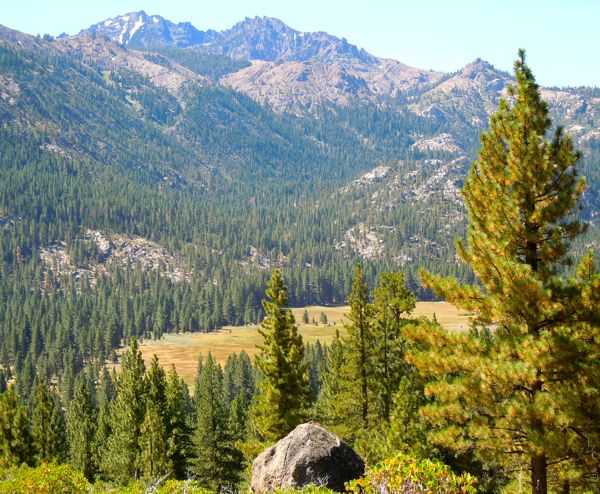
MARKLEEVILLE – Hiking into Thornburg Canyon I kept wondering why it had taken me so long to even know this area about an hour from South Lake Tahoe even exists.

Thank goodness for the recommendation from the Grover Hot Springs State Park employee that we explore this gorgeous area with its expansive view into Pleasant Valley and foreboding rock structure above it.

Pleasant Valley from the Marleeville side. Photos/Kathryn Reed

Pleasant Valley from the Markleeville side. Photos/Kathryn Reed

Discovering new territory and revisiting a favorite waterfall were part of our annual girls’ camping weekend in August. With the nights spent at the campground neighboring the hot springs, we spent our days on foot seeing what Mother Nature had in store for us.

Sue and I arrived first. With our campsite occupied, we drove around checking out the other 75 campsites until we stumbled upon a U.S. Forest Service presentation about fire safety that involved Smokey Bear and the advice not to try to run from a bear.

That afternoon the four of us stretched our legs along the nature trail. Unfortunately it’s one of those trails the state park plans to do away with, but you don’t that while you’re on it. You just keep wondering what the 26 numbers mean and why it leads you into a marshy area.

On Sunday we head for the waterfalls.

Instead of stopping at the pools above the first falls, Darla leads us farther up the path. That is, if you can call crossing the stream multiple times, following the trail.

Despite our circuitous route, it was beautiful. Less than a handful of people were seen this whole hike – adding to the tranquility of the day.

Even a month ago the water was flowing rapidly – a reminder of the abundance of snow the Sierra received last winter.

Later that day we soak in the hot springs that are walking distance from the campground. We get in free because they are closing early since no lifeguard is on duty. (With the state parks’ financial situation a bit precarious, I’d call before making the trek for a day at the springs.)

Something about camping makes things like spaghetti, a taco bar, pancakes, and eggs all taste better. Maybe it’s all that fresh air mixed in instead of the normal stale indoor air.

Fortunately, we brought plenty of wood with us – at 5,800 feet this area cools off at night and stays that way well into the morning.

On Monday we hop in Pam’s truck for a short ride to the trailhead the parks employee recommended. We head toward the town of Markleeville, turn right on Pleasant Valley Road and make another right on Sawmill Road. We park before we need four-wheel drive, but before the gate for the trail.

A steady climb along what is clearly a road takes us to the trailhead for Thornburg Canyon.

This is all part of the Mokelumne Wilderness. Had we completed the entire 7-plus miles, we would have ended up in the Blue Lakes area. We didn’t know that at the time.

It’s a forest of mostly pine and hemlock. Beyond the overlook into Pleasant Valley it’s a single-track trail that is some places has waist-high Manzanita on either side.

Sagebrush and tall grass consume other portions of the trail.

Looking into that valley it seemed like cattle and cowboys should be rustling there. Trails go through there, making me want to explore the area again and find out a little history about this land.

In the distance the peaks still have snow – which at this rate is likely to be there until the white stuff starts falling again.

We trek up farther, thinking we’ll reach the rock formations we had seen from the overlook. But they are never around the next bend. Instead, with no markers on the trail telling us how far we’ve gone or how far we have to go, we decide cocktail hour is approaching.

It’s time to enjoy the campsite.

ngg_shortcode_0_placeholder (Click on photos to enlarge.)