Grand jury out of money, takes county to court for more

By Kathryn Reed

El Dorado County’s civil grand jury has spent all of the money allocated to it – $40,442 – and now wants a judge to tell the Board of Supervisors to keep paying any bill that comes in through June 30 – the end of the fiscal year.

The county doesn’t want to give any entity a blank check.

The money issue is now tied up in court. Interpretation of the Penal Code is one of the controversies.

Penal Code Section 890.1 states: The per diem and mileage of grand jurors where allowed by law shall be paid by the treasurer of the county out of the general fund of the county upon warrants drawn by the county auditor upon the written order of the judge of the superior court of the county.

Penal Code Section 914.5 states: The grand jury shall not spend money or incur obligations in excess of the amount budgeted for its investigative activities pursuant to this chapter by the county board of supervisors unless the proposed expenditure is approved in advance by the presiding judge of the superior court after the board of supervisors has been advised of the request.

El Dorado County Superior Court Judge Steve Bailey is expected to make a ruling Feb. 15 based on the testimony that was given in January.

But Bailey in a July 2011 court order outlined how payments should be structured for this grand jury. It’s possible the ruling later this month will change that protocol.

Foreman Ted Long is allowed to sign all paperwork for members to get paid without anyone double checking his numbers or validating the work was done. Long is a former South Lake Tahoe city councilman who ran into controversy regarding finances while he served as president of the Clean Tahoe board. A nearly year-long police investigation that started in 2006 resulted in no criminal charges being filed against anyone. (Clean Tahoe was part of the 2007-08 grand jury report.)

The 19-member grand jury is entitled to $15 per day worked and the IRS mileage rate, which is currently 55.5 cents per mile, according to the Penal Code. But the county also gives it a fixed budget – like any body whose budget it oversees.

With six members residing in the Lake Tahoe Basin, it means more miles driven than most years because weekly meetings are in Placerville, as are other points of business for this oversight body. In previous years there have been one or two Tahoe residents on the grand jury, so mileage was less of an issue.

“The El Dorado civil grand jury is an investigatory body created for the protection of society and the enforcement of the law. It is an arm of the court and a representative of the public. Although it is an arm of the court, it operates independently of direct court supervision. It is a check against governmental authority. It is not a branch of the county, nor is it answerable to the district attorney,” the county’s website says in explaining what the grand jury is.

Still, it is the county that pays the grand jury’s bills, it is the District Attorney’s Office representing it in court, and it is Judge Bailey who is overseeing everything.

“The question is what to do when the grand jury thinks it needs more money,” Ed Knapp, county counsel, told Lake Tahoe News. “The board can augment the budget or it can express to the court why it doesn’t want to do it.”

All county department budgets keep being slashed. The grand jury’s was cut in half for this fiscal year.

Knapp said with the county looking at an $8.5 million gap to close by July 1, all entities in the county would keep being pinched.

But Long, who is on his third stint on the grand jury – having served last year and eight years ago, says the grand jury should not sustain across-the -board cuts like other departments because members need the latitude to do their job and shouldn’t have to ask the people they may be investigating to fund the operation.

Last week he sent a settlement proposal to Knapp and others about how to resolve the situation.

He told Lake Tahoe News fixed costs like the copy machine and phone are a known quantity, but sometimes there are outside expenses like eight years ago when an auditor was hired by the grand jury to look at South Lake Tahoe’s Redevelopment Agency. Long would like a reserve of $10,000 set aside each year for those surprise expenses. He’d also like an average of the last few years’ worth of budgets to help determine what should be allocated going forward for mileage.

The meeting room in Placerville is not set up for teleconferencing, but that could change.

Supervisor Norma Santiago said, “This would save the grand jury on their traveling expenses, which is one of the primary causes for the increase in expenses.”

She said other departments could also use the technology.

What’s being investigated?

While the grand jury investigations are somewhat secretive in that the members may not talk about what they are working on, but those being investigated may.

In fact, the Feb. 2 South Tahoe Public Utility District meeting has an agenda item that is for the board to be brought up to speed about what staff has been telling the grand jury.

Water meters are a big part of what the grand jury is asking about, according Dennis Cocking, spokesman for the district.

South Lake Tahoe is also under scrutiny. City Manager Tony O’Rourke said he has been questioned about refinancing the city-owned ice rink and “whether the city should be swallowed by the county.”

While O’Rourke believes in the function of the grand jury, he told Lake Tahoe News he would hope it would investigate corruption and more valid complaints.

Long said this year about one-third of the 12 active investigations are centered in the basin.

The report will come out in late June or early July.



Lake Tahoe News wins 4 awards for travel writing

Lake Tahoe News on Tuesday received four awards from the North American Travel Journalists Association.

The 2011 NATJA Awards Competition, now in its 20th year, honors the “best of the best” of travel writing, photography and promotion that cover all aspects of the travel industry worldwide.

“This year’s entries were outstanding, both in quality of the journalism, excellence and range of coverage,” Helen Hernandez, CEO of the organization, said in a statement. “The number of entries continues to grow. The creativity is reflective of the vibrancy of the travel journalists’ community. This year’s entry pool is an indicative of the economic recovery and its positive effect on the travel industry.”

Pandas in China earned Lake Tahoe News a first place travel writing award. Photo/Kathryn Reed

One first place (Gold) winner is chosen in each of the 59 categories along with 2nd (Silver) and 3rd place (Bronze) runners up.

Lake Tahoe News submitted five entries for the online division and won in four of those categories.

The winners are:

• Eco, Environmental or Special Purpose Travel:

Gold: Kathryn Reed, Taking a walk on the wild side with panda paradise

• Sports and Recreation:

Silver: Susan Wood, Pedaling back in time through the hills of Vermont

• Resorts:

Silver: Susan Wood, Woodstock Inn – a landmark for the season and the ages

• Intergenerational and Family Travel:

Bronze: Kathryn Reed, South Dakota, a land of family history.

“Being recognized by your peers is always a humbling experience,” Lake Tahoe News Publisher Kathryn Reed said. “For Lake Tahoe News to do so well in its first competition is extremely gratifying. We know Lake Tahoe is a wonderful place to live, work and play, but we will continue to share with our readers the other magnificent places the world has to offer and hope that you enjoy reading those articles as much as we enjoy bringing them to you.”

The mission of NATJA is to foster high quality journalism by supporting the professional development of its members, providing exceptional benefits and valuable resources, honoring the excellence of journalism throughout the world, and promoting travel and leisure activities to the public at large.


Redevelopment’s demise a mixed bag in South Tahoe

Updated Jan. 31, 2012, 3:45pm: The bill allowing cities to use redevelopment funds for affordable housing projects passed the state Senate today, however, it won’t be implemented immediately. This is causing further confusion for cities throughout the state.

By Kathryn Reed

It’s over. Redevelopment is dead.

With six 4-0 votes Monday night (Angela Swanson was absent), the South Lake Tahoe City Council dissolved the Redevelopment Agency, re-created the South Lake Tahoe Housing Authority, and as the successor agency put in the necessary parameters for it to function.

All cities with redevelopment agencies must dismantle them by the end of the day Jan. 31 per state regulations. After all, it was the state that created redevelopment in the mid-1900s.

The Jan. 30 meeting was a continuation of the Jan. 17 council meeting.

The one unknown remains the vote in the Legislature that would allow cities to transfer their housing money from redevelopment to newly created housing authorities, like the one South Tahoe created Monday. The state Senate on Tuesday is expected to vote on SB654. Indicators are it will pass both houses.

Creating the housing entity in South Tahoe means keeping $1.5 million that is in that pot for housing. It was revealed Monday night that the city will be able to keep all of its lead paint grant funding from the feds and not have to come up with the match as was the requirement when the money came to it via the Redevelopment Agency.

If the Legislature votes not to create housing agencies, that money cannot be used for housing and would instead be used to pay down the redevelopment debt.

It was agreed Councilman Hal Cole will be the city’s rep on the oversight agency board, with Councilman Bruce Grego the alternate. (More about redevelopment and what happens is detailed in this Jan. 18 Lake Tahoe News story.)

One thing that bothered Councilman Tom Davis (who was participating via telephone) was the remainder of the $7 million that the Redevelopment Agency owes the general fund will technically not be repaid. This is because the state says it is not an enforceable obligation. The state wiped out all loans between agencies and cities.

This is because in many ways it was all a shell game – taking money from one pot, to fill another, to eventually fill the first one. It’s really all the same money being shuffled from one account to another. While legal, the ethics of it are certainly questionable.

The $7 million in question was taken from the general fund to pay off the bills from the Heavenly Village project. But how those bills were presented to councils at the time was not transparent. The reality of the situation did not come to light until the checks had long been cashed. And then it was a couple years before a repayment plan was put in place.

But really, it was always the city just paying itself. It was never the Redevelopment Agency paying the city. This is because the only money exclusive to the agency was tax increment – which is property tax dollars. That had to go to bond debt.

The $7 million loan – of which half has been “repaid” on paper – is really transient occupancy dollars. That money has always gone directly into the general fund. From there some would go to the Redevelopment Agency. And then it would go back to the general fund as the loan payment.

With redevelopment agencies abolished, it should make for cleaner books, at least in South Lake Tahoe.


South Tahoe parceling out fire marshal responsibilities

By Kathryn Reed

South Lake Tahoe Fire Department is the only agency in the Lake Tahoe Basin without a fire marshal. And there is no plan to have one again anytime soon.

This was the City Council’s doing when the five approved the budget last fall that came with reorganization plans in the department. The reorg eliminated the three battalion chief positions, one of whom doubled as fire marshal.

When Lake Tahoe News asked the city to provide a job description of the fire marshal position, the response was, “We’ve never had a fire marshal job description.”

The next time there is a fire in South Lake Tahoe, neither Ray Zachau, right, nor any staff fire marshal will be available for Chief Brian Uhler to call. Photo/LTN file

Even though Ray Zachau has not been fire marshal since the end of 2011, his photo and job are still on the city’s website. (Though it’s possible the city will take it down when people read this.) No one has the job. That page says the fire marshal’s job includes:

• Engine Company Occupancy Inspection Program

• Fire Investigation / Team Leader

• New Construction Inspections

• Occupancy Inspections

• Ordinance Development

• Permitting

• Plan Review

• Revenue Development

• School Curriculum

• State Inspections

• Wildland Fuel Reduction.

“We do not have an officially designated fire marshal,” Fire Chief Brian Uhler said. “There are lower levels of certification that allow people to do business inspections and planned inspections. It doesn’t require a full-blown fire marshal to do those inspections.”

Uhler contends the residents of South Lake Tahoe are safe, that necessary inspections can be done by people in the department who have specific certifications that are recognized by the state, that others will be trained and that negotiations are under way with Lake Valley Fire Protection District to handle the majority of South Tahoe’s fire marshal needs.

Even though the elimination of the fire marshal position has been talked about for months and was known for months after the council voted to do so, a memorandum of understanding has yet to be drawn up between the two agencies.

Once the powers that be work out the language and terms, it will need to be approved by the South Lake Tahoe City Council and the Lake Valley board of directors.

Investigating fires is a large component of a fire marshal’s job – something these lower level certifications don’t empower an ordinary firefighter to do. This is why the MOU between the departments is necessary.

Lake Valley Fire Chief Gareth Harris is that department’s former fire marshal. John Poell, who has been in the fire business for 20 years, is now Lake Valley’s fire marshal.

“It’s occurring frequently in our business, the consolidation of services,” Harris told Lake Tahoe News. “The bottom line is we are all in this together to ensure the safety of our community.”

Harris and Uhler are confident an agreement for Lake Valley to provide fire marshal services at a yet-to-be released level for a yet to be released price will be in place in the coming months.

“There is nothing that says a department has to have a fire marshal,” Daniel Berlant told Lake Tahoe News. He works for CalFire – the state fire department that has some jurisdiction over local agencies. “The law says the fire chief will enforce fire and life safety codes. Then the fire chief can appoint a fire marshal or battalion chief to carry out those duties.”

Berlant would not comment on the specifics of South Lake Tahoe Fire Department having one person who has the title of fire chief and police chief (Uhler has no fire experience), a department with no battalion chiefs, and a department with no fire marshal.

Uhler is working with City Manager Tony O’Rourke on how best to structure the department. Uhler has also been getting input from the firefighters’ union.

Uhler told Lake Tahoe News, “I received a letter (last week) from the association that there is a willingness to hire firefighters rather than a higher level administrative position. Maybe we will have two firefighters instead of an administrator to fill in the shifts that are short now. That negotiation process is under way.”


Fitz and the Tantrums keep music fans on their feet

By Susan Wood

STATELINE – Don’t let their name fool you. Fitz and the Tantrums provided a mixed generation of concert-goers who rocked the Harrah’s Lake Tahoe South Shore Room Saturday night with an adult-sized performance.

The packed crowd rewarded the high-energy band with hours of screaming, clapping, dancing, partying and encroaching on the stage to get close to the Los Angeles-based band that has captivated many who follow the music scene.

Fitz and the Tantrums had most of the Harrah's Lake Tahoe audience on its feet Jan. 28. Photos/Kathryn Reed

Harrah’s cleared a large dance floor next to the stage. Many fans started there on their feet for the opening act of Dale Earnhardt Jr. The alternative, synthesizer-driven singing duo Daniel Zott and Josh Epstein, with their custom painted plaid jackets, could have crossed as retro male Talking Heads or B-52s. Zott led the twosome for its “We Almost Lost Detroit” but rounded out the funk-rock experience with a near Beatle-like sound and even included Whitney Houston’s smash hit “I Want to Dance With Somebody”.

That’s what warm-up bands are designed to do — get the crowd going. The dance floor soon filled up in anticipation of Fitz.

“Hey, Lake Tahoe — wanna party?” asked 38-year-old lead singer Michael Fitzgerald, aka “Fitz,” who told Lake Tahoe News in an earlier interview he was named by his childhood friends because “there were too many Michaels in the world.”

One thing is abundantly clear – fans have an original in Fitz and the Tantrums. Since the soulful Fitz found an organ on a curb and was consequently discovered by Adam Levine of hit band Maroon 5 the group has not looked back. In three years, they have made a name for themselves well beyond Southern California.

Take the inventive quality of a Phil Specter sound, a pure dance-hall atmosphere, lyrics of the romantically tortured and seductive chemistry between Fitz and co-lead singer Noelle Scaggs, and you have the Tantrums. (Incidentally, albeit a stage act to the contrary, Fitz and Scaggs – who uses a tambourine in conjunction with her towering vocal chords — are not a romantic item.)

With precision and passion, the six-member band consisting of Fitz, Scaggs, saxophonist James King, drummer John Wicks, bassist Joseph Karnes and keyboardist Jeremy Ruzumna cut through all their songs released on its lone album “Pickin Up the Pieces”. The song list included the breakthrough tune “Breaking the Chains of Love,” lovelorn ballad “Tighter” and chart climber “Money Grabber” as the encore. And yet, the band even added an Annie Lennox top hit “Sweet Dreams” for good measure.

The band ended a near monthlong tour at Harrah’s in time to go home to work on another album.

Throughout the save-the-best-for-last concert, the audience was on its feet – a testament to the electric energy on stage. Wicks sometimes pounded the drums as quickly as a camera motor drive. Without missing a beat, King rotated his flute and sax. Fitz stomped his feet to the beat when he wasn’t caressing the mic. Multi-tasking, Scaggs exercised her tambourine wrist and vocal chords so intensely, she often dropped the instrument at the end of the songs in apparent exhaustion.

She resumed with a smile and acknowledgement to the fans: “Are your lungs warmed up yet?

The band only rested long enough for Ruzumna to leave his keyboards for a birthday cake wheeled out on stage.

“I so wanted to put his face in it,” Fitz joked.

Fun, frolic and lyrics as a bit of a war of the sexes made up the norm for the show, along with audience participation. Some concert-goers, who were of all ages, crowded the stage when Fitz sat close to the edge on a speaker. One male fan standing up front, who kept reaching for Scaggs, even impressed her when she allowed him to sing into the mic.

“That was awesome,” she said, seemingly surprised.

This was the operative word of the high-energy concert from a band that has exuded a perfect mix of soul, independent, Motown and rock-pop rhythms in an uncommonly short period of time for a punishing industry.

To this day, Fitz told Lake Tahoe News he’s still surprised by the band’s cult-like popularity. The band ended the concert with a genuine thank you to the fans, which included taking photos with fans and signing anything put in front of them.

“With the amount of time we’ve put into this, it seems more like five or six years (have gone by). It’s a journey that’s felt like the longest marathon any of us ever have gone through,” he said during the interview.

Fitz labeled the last three years as going “to the moon and back.” The Tantrums have appeared on cooking guru and music lover Rachael Ray’s show, played to thousands in the acoustically-superior Red Rocks Amphitheatre in Boulder, Colo., and shared the stage with Maroon 5.

Maroon 5, the popular, contemporary band that has sold 17 million albums with hits from “She Will Be Loved” to today’s “Moves Like Jagger” — will make a July 21 showing during the weekend of the American Century Championship played at Edgewood Tahoe Golf Course for Harveys Outdoor Summer Concert Series. Tickets go on sale Feb. 24.

Harrah’s fills out the winter season at the South Shore Room with the longtime soul favorite Tower of Power on Feb. 4, rock band Los Lonely Boys Feb. 11, pop singer Kenny Loggins on Feb. 18 and the youthful ensemble of G. Love & Special Sauce on Feb. 25.

ngg_shortcode_0_placeholder (Click on photos to enlarge.)


Ma Nature, lack of publicity hurt El Dorado wineries

By Kathryn Reed

FAIR PLAY – Not a cloud in the sky, not many people in the wineries. From a consumer standpoint the first day of the El Dorado County barrel tasting event was great. From the viewpoint of some of the 27 wineries that are part of the event, Saturday was disappointing.

Coming off a harvest that was bizarre by most definitions, having a special event that is less than successful is not welcome. The event continues today. But at $35 for the weekend, it is more money than 2011.

Barrel tasting continues today at designated El Dorado County wineries. Photos/Kathryn Reed

Some industry officials who spoke to Lake Tahoe News off the record on Jan. 28 attributed the less than stellar turn out to the public relations-marketing firm that is in its first year for El Dorado Winery Association.

The latest stats on the website are from March 2011. The latest press release is from February 2009.

Twenty-seven wineries were on the list this year as participants in the barrel tasting event – one more than 2011. In 2010, 1,200 tickets were sold, while 2,000 were sold in 2011. Ticket sales for this year have not been released.

An increase in price during a recession could be a contributing factor to the decline of participants in this event that started in 2007. This year the weekend pass is $35 (tickets still available for today), compared to $20 or $25 for the two days in 2011. No Sunday-only tickets were for sale, as was the case last year for a price less than the weekend rate.

A Fair Play winery said the barrel tasting event in 2011 attracted about 1,400 visitors. About 10 were at this particular winery midday Saturday. Usually people are flowing out of the tasting area – even when the weather has been less than ideal.

Lake Tahoe News reporters are used to having to struggle to get to the counter to get a pour. Of the five wineries visited Saturday, the opposite was the case.

Vines are dormant -- but it's still dry, as evidenced by the brown at Skinner vineyard.

Besides the lack of people, the lack of rain is everywhere. Brown terrain proves moisture has been scarce. Cows are munching on grass in fields that are normally green and several inches tall.

John Latcham, who manages the vineyards for Latcham Winery, says he knows of people who have already started to irrigate.

“If this continues, we’ll be irrigating soon,” Latcham said. “The water table is way down.”

The irony about this dry winter is last year was extraordinarily wet – setting records for moisture totals in so many parts of Northern California.

But growing grapes is farming. And farmers and Mother Nature have a love-hate relationship. The love seems to be lukewarm based on the inconsistencies.

Last year at this time Single Leaf Vineyards had 70 inches if rain. This year 10 inches have been recorded. Pam Miller, who owns the winery with her husband, said someplace in between would be ideal.

“Don’t tell me there is not climate change,” Miller told Lake Tahoe News. “There is no doubt Northern California is changing.”

With the abundance of moisture a year ago, which kept coming during the fall harvest of grapes, it meant Latcham lost 40 percent of its harvest. The white grapes were off the vine before the problems arose, but the reds – especially the tender Zinfandel grapes – were hit hard.

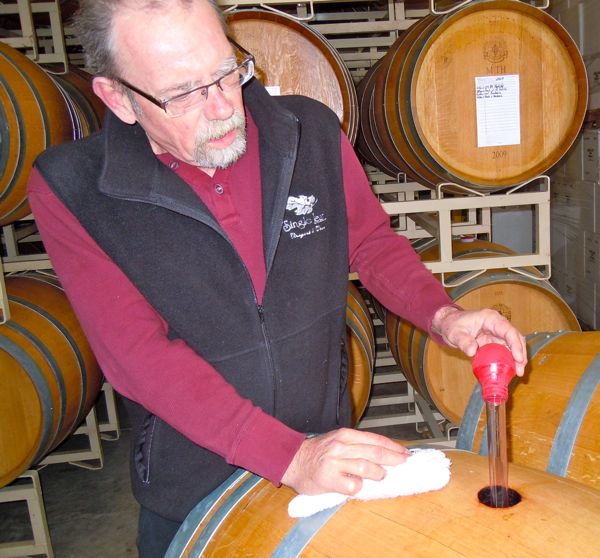
Scott Miller is about to pour from the barrel Jan. 28 at Single Leaf.

The rain drops the sugar content of the grapes.

“Not only was it a difficult harvest, it was expensive,” Latcham said.

Bunch rot was a problem for some wineries.

Still, winemakers believe the 2011 vintage will be good.

“We’re optimistic about 2011,” said Greg Baiocchi, winemaker at Miraflores.

What will come of 2012 remains to be seen. This is the normal dormant season for the vines. Every place is below normal for rainfall, but there is still time for that to be made up.


State upholds decision to reclassify Washoe Meadows park, alter river-golf course

By Kathryn Reed

BRENTWOOD – It was almost like the California State Park and Recreation commissioners had split personalities at the Jan. 27 meeting. The morning was jovial and jocular when it came to approving the general plan and EIR for a new state park in the Bay Area, as well as the naming of it. The afternoon was rushed and seemed like commissioners would rather go to lunch than hear what people had to say about Washoe Meadows State Park.

Norma Santiago addresses the State Parks commission Jan. 27 as staff listens. Photo/Kathryn Reed

In fact, the Lake Tahoe state park’s name wasn’t even listed on the agenda.

The board, after seven people spoke, voted 5-0 to maintain the decision made Oct. 20 to accept the final EIR for the Upper Truckee River restoration project, and to swap land between the park and Lake Valley Recreation Area to allow Lake Tahoe Golf Course be reconfigured.

Kathryn Tobias, legal counsel for State Parks, before comments and the vote were taken said the matter before the commission was procedural. State Parks employees had earlier said the rehearing was necessary to make sure everything was in order now that the project is tied up in a lawsuit.

It would be hard to know what the commissioners truly thought beyond their body language because they voted without discussion. Commission Chairwoman Caryl Hart cut people off and only gave people representing an organization three minutes to speak instead of the customary five minutes. She also said the commission had heard everything they needed to hear.

El Dorado County Supervisor Norma Santiago was the first of the seven to speak. All believed the commission should either overturn its original vote or delay Friday’s vote. Santiago asked for three months to prove the information she provided is correct.

“Page 5 of your Draft Resolution 3-2012 states: ‘Resolved: That the legal, social, economic, technological and other benefits of the Project described herein outweigh the unavoidable short-term environmental risks, as described in the Statement of Overriding Considerations adopted by the director of State Parks at the time of project approval, and so the unavoidable significant environmental impacts are overridden by these factors and are, therefore, acceptable’,” Santiago read to the commission.

“I submit to you that there is significant scientific documentation that does not support this statement. Andrew Simon, who did most of the analysis on stream channel erosion for the [Lake] Tahoe Basin TMDL, clearly documents that 90 percent of the problem resultant from this type of erosion can be resolved by addressing 14percent of the toe slope issues. Additionally, in this case, the channeling of parts of this river that currently show no evidence of erosion now and in the future will take 10 to15 years to recover. At the time of recovery, the benefit generated from this channeling is incremental at best. In the meantime, the return on the economic, social, technological, legal and environmental investment are disastrous.”

Besides being the elected official for the area of the South Shore where the project is located, Santiago is also chairwoman of the Tahoe Regional Planning Agency. The TRPA must still approve the project.

Brian Judge, a principal planner with TRPA, was at the meeting, but did not speak on the record. After the meeting he told Lake Tahoe News how important it is to fix this reach of the river and that it’s a critical piece of the environmental improvement program.

Bob Anderson with the Sierra Club’s Lake Tahoe chapter was one of the speakers. After the meeting he told Lake Tahoe News he believes the issue will be “dead in the water” when it reaches the TRPA Governing Board.

The Sierra Club wants the river to be restored, but believes the alternative chosen to do so is not achievable and therefore the status quo will remain, Anderson told the commission.

“Financially, it does not pencil out,” Anderson said.

Restoring the river is not the issue that has people up in arms. It’s how it will be done and the impacts to Washoe Meadows State Park that concerns people. It’s biased tours of the area that don’t show pristine locations that will be disturbed, it’s a precedent-setting ruling that allows a state park to be reclassified to a lower status, it’s putting golf before other recreation, it’s putting money before the environment that have people upset.

And as was stated at the meeting at the Brentwood Community Center in the East Bay, they are tired of the condescending reference to being a neighborhood group when members of the Friends of Washoe Meadow reach well beyond the perimeter of the park and basin.

“It was hard to listen to the meeting, especially at the end when so many false statements were made. But the meeting process doesn’t allow us to make any more comments. The word of parks staff is accepted,” Lynne Paulson told Lake Tahoe News after the meeting. “For example, it was completely incorrect that the findings were available at the last commission meeting. Our attorney was there, as was I and others. We picked up all information available in the back of the room and our attorney specifically asked about the findings, but was told they were not available. “

Paulson is part of the group that is suing to stop the project. The suit in large part is based on perceived inadequacies with the California Environmental Quality Act.

“Also, when they said that they had already considered everything public speakers said, it wasn’t true. For example, we were proposing that they use several different methods of river restoration, not just one type,” Paulson said.

Cyndie Walck, hydrologist with State Parks, told Lake Tahoe News after the meeting she is confident the commissioners made the correct decision and that it will benefit the South Shore environmentally and economically.

“It will open up a public park to the public,” she said. More than a mile along the Upper Truckee River that is now only accessible by golfers will be developed into a hiking trail.

Keeping the golf course 18-holes by moving up to nine holes into what today is the state park, but when the project is done will be recreation area, is more economically viable, according to Walck.

The TCW economic analysis that was done after the October decision challenges the state’s assertions. However, the commissioners made no comment on this fact despite being presented with information Friday.

For now, the project is tied up in court, with the next hearing date set for March.

Walck is waiting to be told she can move forward.

“I have the funding to go to the design level of the river restoration,” Walck said.

———

The new state park that was OK’d is near the town of Brentwood, where the meeting was. The name will be Marsh Creek State Park and will be operated as a historic park.


South Shore chamber making strides after 5-plus years

By Kathryn Reed

Five years. It’s been that long since the Lake Tahoe South Shore Chamber of Commerce came into being. While the beginning was rocky – as most mergers are – solid ground has been found.

B Gorman has been at the helm since Day 1 when this chamber, which is the culmination of merging Tahoe Douglas Chamber of Commerce and South Lake Tahoe Chamber of Commerce, came to be.

B Gorman on Jan. 26 talks about what Lake Tahoe South Shore Chamber of Commerce is doing. Photo/Kathryn Reed

At the beginning it was Gorman doing almost everything, along with the board. Staff and board members have come and gone. Today there are three full-time employees reporting directly to Gorman and another who is shared with the Lake Tahoe Visitors Authority.

Gorman in a 90-minute presentation gave a recap Thursday of how things are and what the chamber is doing. About 50 people attended the Jan. 26 breakfast meeting at Inn by the Lake. The past and the future, though, were not topics of the meeting.

Afterward, Gorman spoke with Lake Tahoe News about where the nearly 650-member strong chamber is going. (About 70 percent of members are located in California and 30 percent in Nevada, with a mix of sizes.)

Growing membership is always a goal. The CEO-president also envisions the chamber taking on more environmental causes, or at least having a seat at the table when those issues are being discussed.

Chambers and politics have historically been bed partners. But this chamber has not been as politically minded as the former South Lake Tahoe chamber was or others are. That could change, according to Gorman. It’s a direction she would like to take the organization, but said ultimately that will be a decision of the 21-member board.

Relationship building, promoting the community, growing the local economy and representing businesses with government are the main goals of the chamber.

With South Lake Tahoe presumably done with moving people out of and within the government organization, Gorman is forming relationships with those left behind to better serve the business community.

History:                                                                    • 2005 – Serious talks are under way about merging the Tahoe Douglas Chamber of Commerce with the South Lake Tahoe Chamber of Commerce. • March 2006 — In a 13-0 vote, the Tahoe Douglas Chamber of Commerce agrees to merge with the South Lake Tahoe Chamber of Commerce. Three board members were absent and one abstained. The South Lake chamber board voted 18-6 to combine resources. At that time the South Lake chamber had 950 members, and Tahoe Douglas 640, with 350 belonging to both chambers. • Fall 2006 – B Gorman hired to run merged chamber. • November 2006 – merger takes place. Eighteen-year lease signed on Stateline building owned by Primm Ventures. • January 2007 – Public disharmony is evident; members of former South Lake chamber begin forming South Tahoe Chamber of Commerce. Issues with the lease, finances and offices being in Nevada contributed to the problems. • Today – Bitterness is gone for some, remains for others. Another merger is not in the works.

The chamber through a formal bid process was awarded the contract with the city that uses grant funds to provide a business-coaching program called the Tahoe Tactical Team. Forty-five small businesses have gone or are going through the program.

Putting on workshops and forums are a big part of the chamber. Some are open to just chamber members or might cost more for non-chamber members.

Key events the chamber puts on are the Business Expo (March 30 at Harrah’s Lake Tahoe) and Sample the Sierra (Sept. 2 on Ski Run Boulevard).

One member asked why the food and wine event is Labor Day weekend and not at a time when the area is less crowded. Gorman said the harvest of food and wine help dictate when it can be, as do room nights.

“Labor Day weekend is soft. Visitors drop off in mid-August,” Gorman said. “Our hope is to build Labor Day weekend.”

When schools started after Labor Day, Lake Tahoe was busy through that weekend. Not so anymore. Gorman said hotel occupancy has been between 50 percent and 60 percent for nearly a decade on Labor Day weekend.

Another member asked about SnowGlobe, the three-day music festival over New Year’s Eve weekend.

“It’s safe to say if it were not for SnowGlobe, it would have been weaker over New Year’s,” Gorman said. That was based on a survey the chamber sent out to members asking how the event affected business.

But she also said if the city intends to bring the event back, the chamber wants more info that could be shared with members – like suggesting to a coffeehouse it stay open until 2am to warm up the concert-goers on their way back to their lodging establishments.

More information about the chamber may be found online.


N. Nevada developing plan to promote sports-recreation

By Anne Knowles

CARSON CITY – Northern Nevada is looking at sports and recreation from every angle to boost its economy.

The bid for the 2022 Winter Olympics, the Reno Bighorns minor league basketball team, the UNR Wolf Pack athletic program, even makers of outdoor gear, all figure into plans to capitalize on sports.

Nevada Lt. Gov. Brian Krolicki and Jon Killoran, the chairman and CEO, respectively, of the Reno Tahoe Winter Games Coalition, and others talked about the various efforts during a breakfast meeting at the governor’s mansion Wednesday hosted by the Northern Nevada Development Authority.

Northern Nevada officials want people to think of the area for sports that go way beyond betting on games at a casino.

“We’re here to talk about sports and the passion of athleticism, but also about business,” Krolicki said.

Krolicki said the coalition of California and Nevada interests are in “hot pursuit” of the 2022 Winter Olympics. He said bids to bring the games to Lake Tahoe are due next summer to the International Olympic Committee, which will decide on the location in 2015, giving the winner seven years to build up the needed infrastructure to host the two-week event.

Killoran said the 2002 Winter Games had a $100 million economic impact on Salt Lake City, which expanded its airport and overhauled Interstate 80 in preparation, and raised the city’s profile internationally.

In the Lake Tahoe Basin, he said, public transportation would be expanded to include high-speed water ferries and to reduce personal vehicle traffic. Krolicki promised the Olympics would be a boon, not a burden, to the basin environment. Money generated by the event, for example, could help fund efforts to improve lake clarity.

Lisa Granahan, Douglas County’s economic vitality manager, said the county has identified suppliers of outdoor gear, particularly soft goods like tents and backpacks, as an industry to attract to the region.

She said the county is already home to four such businesses: North Sails, Aviso Surfboards, Sierra 4×4 Trailers and TechSpec.

“Our goal is to have 700 new jobs by 2022 in new businesses and to develop the services to attract them,” she said.

To that end, the county is planning a cut-and-sew center to make soft goods. Granahan said suppliers are interested in relocating manufacturing to the United States from China, where costs are now rising. A $70,000 grant from the U.S. Department of Agriculture funded start up of the center, which is being housed in space at the Carson Valley Business Park donated for a year rent-free by its owner, Bill Miles, owner of Miles Construction.

Granahan said she would be presenting an update on the county’s economic vitality plan, which comprises 12 areas, including Tahoe revitalization and the South Shore Vision Plan, and trails development, to the Douglas County Board of Commissioners at the commission’s Feb. 10 meeting.

Mike Samuels, assistant athletic director of Nevada Wolf Pack Athletics, described the economic impact of the Wolf Pack moving from the Western Athletic Conference to the Mountain West Conference, which is expected to happen this summer. He said the UNR program, which now receives $500,000 annually from the WAC, will get $2.1 million from the Mountain West. He said the program is working with the Reno Sparks Convention and Visitors Authority to develop tourism packages around the program’s football and basketball schedules.

John Kinkella, director of the Reno Bighorns, talked about the team’s place in the D League, which acts as a minor league to the National Basketball Association, and the money it brings to the region, including 1,200 room nights during this month’s weeklong D League Showcase at the Reno Events Center. The team is now locally owned after being purchased in August 2011 by Reno attorney Herb Santos, and Stephen and Jeffrey Adams.

While no one from the Reno Aces was at the Jan. 25 event, the minor league baseball team will bring money to the area when it hosts the Triple-A All-Star Game in 2013.


State take-aways could deplete LTUSD’s reserves

By Kathryn Reed

Cutting the school year by 15 days. Bigger class sizes. High school teachers moving to the elementary level. Using all of the reserves. Bus drivers looking for work; students without a ride. Early retirements.

Some or all of those statements are likely to be a reality for Lake Tahoe Unified School District. Depending on the state budget and what the local board decides to do, all of the statements could come to fruition.

The school board on Tuesday night adopted the proposed budget reductions affecting this school year and for next as presented by CFO Deb Yates. More specifics will be forthcoming in future meetings.

“We’ve pledged to STEA and CSEA not to do a (reduction in force),” Superintendent Jim Tarwater said at the beginning of the discussion that brought out an unusually large crowd for an LTUSD meeting.

The teacher and classified unions are working with the district to keep jobs, which keeps programs, which provides students a broader education. But with the busing situation, at least today, it looks near impossible to keep that department at the current staffing level.

LTUSD must fill a $424,000 hole the state just created by eliminating busing for special education and home to school transportation. Yates doesn’t know how the state can legally eliminate the spec ed busing when it’s a mandate. But state agencies (think Lahontan Water board) are known for unfunded mandates (think TMDL) to local jurisdictions (think South Lake Tahoe, El Dorado and Placer counties).

Reserves will be used to fill this year’s transportation take-away. With the state doling out those dollars on a monthly basis, it’s easy for the state controller to not write that check.

The transportation hit for 2012-13 is expected to be $834,000. To pay for the combined loss of more than $1.2 million it would cost each student $347. Students already pay to ride. But many on those yellow machines get a free ride – the same ones (about 60 percent) who qualify for a reduced or free lunch.

Not being touched is money to pay for athletic teams to travel.

The irony, as Yates pointed out Jan. 24, is if 200 students were not to go to school because the bus is the only way they could get there, that would be about a $700,000 loss in average daily attendance dollars.

“So it doesn’t behoove us to lose transportation,” Yates told the board. “First and foremost we are here to educate kids. We need to get them there to participate in their classes.”

Egregious, irresponsible and heartless are among the words she used to describe what the governor has brought forward.

A projected $9.2 billion shortfall in Sacramento is being foisted upon local jurisdictions to bear. Gov. Jerry Brown has two proposals on the table to deal with the deficit. The better of the two for K-14 education is for voters in November to agree to raise the sales tax by one-half cent and raising personal income tax for those who make more than $250,000 a year.

Because the outcome of that ballot measure won’t be known until late on the night of Nov. 6 – if not for days after the election – school districts are planning their 2012-13 budgets for the worst case scenario.

“While we feel that there is a sense of urgency, we, as a district, cannot make hasty decisions that could affect education in the years to come,” Jodi Dayberry, South Tahoe Educators Association president, told Lake Tahoe News after the board meeting.

She said a collaborative approach is what the two unions in LTUSD want from district staff. Tarwater at the start of the night said it was going to take everyone working together to get through the financial crisis.

Dayberry went on to say, “STEA and CTA encourage voters to become informed and show and vote for tax fairness and restore the sales tax one-half percent in November. Californians have to prioritize and put education first.”

LTUSD is looking at a $1.836 million shortfall for 2012-13. Three furlough days, early retirements, moving three teachers each from the middle school and high school to the elementary level, cutting the athletic director’s hours in half, and increasing class size would help close that gap. That’s what the board on a 5-0 voted OK’d Tuesday.

With a March 15 contractual deadline to let certificated employees know if they have a job for 2012-13, specifics need to be worked out before then, even though the state’s numbers won’t be solidified.