Police making effort to cleanup South Lake Tahoe

By Kathryn Reed

Taking possession of a rundown house in the city limits may provide funding to better enhance the look of areas throughout South Lake Tahoe.

That is the goal of Police Chief Brian Uhler.

Code enforcement and graffiti eradication in large part fall under his department’s purview. But time and money are limited. And the problems keep increasing.
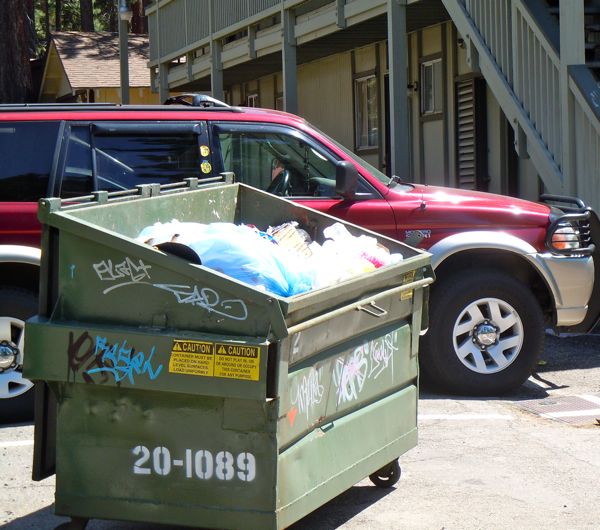
An open dumpster and one with graffiti on it sits outside the Forest Manor apartments in South Lake Tahoe. Photo/LTN

A surge in graffiti is typical this time of year. Those who tag don’t like being in the snow and cold. They seem to hibernate a bit in the winter.

Uhler says much of what is showing up on buildings and other locations is not gang related. An area on Ski Run Boulevard and Pioneer Trail was hit a few weeks ago that resulted in the arrest of two teenagers and four others who may be behind bars soon, he said.

“F— the cops” has been seen on both ends of town – near the would-be convention center and on the might-be TJ Maxx.

“We have someone who has some dislike for us,” Uhler said of those tags. “Someone out there feels the need to express that.”

Profanity gets covered up the quickest.

But what Uhler hopes to do is take the property on Chris Drive that the owner gave to the city, sell it and use the money to hire a full-time code enforcement officer who would be driving a vehicle bought with the property proceeds that is fully equipped to abate graffiti.

A few things need to happen first.

Firefighters plan to use the structure to train on after asbestos and any other hazards are removed. Then the debris will be hauled away and the lot put on the market.

Plus, the council needs to approve of how the money would be spent.

At one time city officials talked about turning this lot into a pocket park, but upon further discussion it was deemed not to be the best location for open space and would be more beneficial to the city to sell it – which also means getting property taxes.

A part-time code enforcement officer is in the process of being hired, with the idea that person’s work will pay for his job. The same would be true if Uhler is able to convince higher ups to hire a full time enforcer.

Uhler wants to take each of the five councilmembers on a tour of the city so they see firsthand what officers see. Then he wants consensus on what they want done.

The city has ordinances on the books about signs, trash, graffiti and other items that would fall under code enforcement, but the council recently has been a bit wishy-washy and tends to side with people who appeal the decisions made by staff.

“There are interpretations as they relate to aesthetics, but trash and debris piled up and loose are clearly violations of our ordinance,” Uhler said. “We will go after general piles of trash, junk, boxes. There are things piled up in places all along the Highway 50 corridor. Then we’ll go into neighborhoods. Our effort is to make our town more closely be aligned with the beauty of our natural environment.”



CTA president tells Tahoe educators it’s time to unify

By Kathryn Reed

When those in education take a stance against colleagues – as in administrators vs. unions, K-12 v. community colleges, classified vs. certificated – the message the public hears is disenfranchisement among the ranks.

“We are more defined by what separates us than what binds us,” Dean Vogel told a group of educators Monday night at Lake Tahoe Community College.

Vogel, who has been president of the California Teachers Association for nearly a year, was invited to speak by the college’s Classified Employees Union and Faculty Association. The former just unionized and joined the CTA.

CTA President Dean Vogel speaks May 7 at Lake Tahoe Community College. Photo/Kathryn Reed

“What we don’t do enough of is coming together and talking in groups like this,” Vogel said.

An array of people was in the college theater – from K-12 teachers to LTCC’s president to a college board member.

Vogel said it’s time people in the profession start having conversations with parents and the community as a whole so they know what is going on, so they understand what is happening in the classroom, the impact of decisions by people who are far removed from the classroom, and what funding cuts mean.

“I’ve yet to meet a teacher who says all this testing stuff makes good sense,” Vogel said.

But he says when he meets with Arne Duncan, U.S. secretary of Education, and others in Washington the talk is all about testing.

“They don’t understand they have the capacity to stop this,” Vogel said of the nonstop testing of students. “The argument always is you have to assess kids. They don’t understand what that means.”

Computer based assessment of students could be a federal mandate in 2015. But the technology is not there for everyone.

Vogel added that policymakers have talked about funding universities based on how students test out. He touched on how a degree from a CSU or UC used to be within reach for a middle class family. Now it can be $35,000 – what Stanford used to cost.

Money and testing are the two words that permeate discussions about education. Students and learning seem to have been lost in the conversation.

That may not change as another election season gets under way.

Vogel said it’s critical the education community tap into the 73 percent of voters who are happy with their schools. Vogel said it’s important to look at people who have voted in the past five elections. Those are solid voters.

With Gov. Jerry Brown expected to release the May revised budget for 2012-13 next week, all eyes are on Sacramento. But already those in education know the coffers will be diminished if voters say nay to the governor’s proposal on the November ballot. That is money to keep funding levels – not something to add to the bottom line.


Survey: Drug Store Project makes a difference with kids

By Kathryn Reed

“I am concerned about kids my age (12) to be taking drugs and that they can cause death, lung problems, liver problems, and to make you look older than you are.”

That is what a sixth-grader on the South Shore said after attending the Drug Store Project this spring.

While plenty of people believe drug and alcohol education should be the responsibility of parents, the reality is that is not happening.

Students learn about gateway drugs in the Drug Store Project. Photo/LTN file

More than half the students at South Tahoe Middle, Zephyr Cove and St. Theresa schools said they get most of their information about drugs at school. About 20 percent get the info from their parents, while the next largest “educator” is TV, movies and books.

“The comments for me are the most important. You can tell from those they are not getting drug prevention in the schools,” Lisa Huard, who puts on the Drug Store project each year, told Lake Tahoe News. “They should know what gateway drugs are. They should know them by name. They should have that before they ever get to sixth grade.”

Huard was the safety coordinator for Lake Tahoe Unified School District until the position was eliminated a handful of years ago. She continues to do that work on a contract basis for Tahoe Truckee Unified.

Tahoe Youth & Family Services is now the lead agency for Drug Store Project.

These are the LTUSD drug and alcohol curriculum guidelines provided by the district. Superintendent Jim Tarwater was not available to talk about what is actually being taught in the classroom now that the emphasis is on ensuring students test well to meet state and federal requirements.

However, South Tahoe Middle School Principal Beth Delacour said, “What Lisa (Huard) does is amazing. It changes kids lives and it makes them think. I think Drug Store Project is really valuable. It gives them a glimpse of reality and helps them think.”

“One thing I learned was that one minute you’re trying to be cool, the next minute your parents are called to come to the hospital and the doctors have to tell your parent ‘we’re sorry, but your child’s gone’ and then your parents don’t know what to do. So my point is don’t do drugs. Never ever. One try could kill you.” – South Shore sixth-grader

The daylong event talks about how tobacco, alcohol and marijuana can lead to the use of stronger, more dangerous drugs. But it also talks about the danger of these three drugs are.

“The concern I have in the last two years has been the increase of kids with the acceptability of pot and saying it is not a bad thing,” Huard said. “People don’t want to see our kids drinking, but they don’t seem to be alarmed with marijuana because they smoke it.”

At an age when children are not mature enough to fully understand the consequences of their actions, they are getting conflicting information about what is OK to put in their bodies. They want to emulate the adults in their lives. They may see the marijuana shops dispensing medicinal marijuana, so youngsters see pot solely as a legal drug.

On the student survey one of the biggest differences in pre- and post-event answers was with the response to: Prescription drugs from someone’s doctor are safe to take. Almost half thought this was true before Drug Store Project, while more than three-quarters knew afterward that taking drugs prescribed for someone else could be lethal.

“I learned that most likely seven people in my class will be addicted to drugs by the time they graduate from high school.” – South Shore sixth-grader

Huard said, “It all centers around destructive behavior. They need to know what it does to their body. They need to be provided the opportunity to make better decisions. The majority of our kids, who if they knew more, they would make different choices.”


Recreation in S. Lake Tahoe — a game of partnerships

By Kathryn Reed

South Lake Tahoe’s recreation facilities are old and need to be overhauled.

That was the message delivered at this month’s City Council meeting by Stan Sherer, community services director.

When asked if the ball fields or rec center should be the priority, he told the council the 37-year-old recreation center needs attention first.

South Lake Tahoe is recruiting partners to keep its recreation programs viable. Photo/LTN file

In his staff report, Sherer wrote, “The major items that need to be addressed include: The locker rooms need to be remodeled, the weight room needs to be expanded and new equipment needs to be purchased. It could be an asset to the efforts to attract high altitude training camps. The gym floor needs to be replaced.”

However, there is no capital improvement program for these facilities. And these facilities, while tourists use them, are a huge draw for locals.

Those in the tourism sector beating the recreation drum as a reason to visit the South Shore don’t seem to have looked at all the facilities to know that what tourists are likely to find are in many ways substandard entities from what they are used to.

In his report to the council, Sherer said he would like to see, “A multiuse athletic complex that could host large athletic events at one location (to) enhance our ability to secure future events. When coupled with the attraction of our natural environment and the other recreation opportunities in the area, the complex would become a regional-national draw for athletic tournaments and special events. Obviously, the complex would also enhance the recreational opportunities for our local community.”

Community field

Sherer predicts the community ball field by Lake Tahoe Community College will need to be replaced in two years. That field was dedicated June 23, 2005.

Steve Weiss, former director of the city’s parks department and current member of the Measure R ball fields committee, said at the committee meeting last week that the seams coming up at that field are a result of how much action the artificial turf is subjected to.

Sherer said part of the problem with the seams is they were never properly glued. The manufacturer was out of business two years after it was put in.

That field has endured an unusual amount of scrutiny in the last few months because it is where the three-day SnowGlobe music festival was staged and people believe that contributed to the degradation of the field.

Recreation officials say otherwise – that the lifespan of the field is nearing its natural end.

While Weiss said he was at the field April 19 when a truckload of debris was sucked out of the carpet, Sherer told the council this is the first time the field has had such a cleaning since it was laid down.

Weiss also said, “I would deem it a playable field.”

To replace the field, Sherer estimates it will cost between $700,000 and $900,000.

From Measure S/R the city receives $50,000 to maintain that field and will continue to until the bond expires in 2030.

Each year the three jurisdictions that are part of the recreation bond report their Measure S/R expenditures to the oversight board. In July 2011, when the last report was made, it was noted the city had received $300,000 for the field, of which $162,059.11 had been spent.

It’s possible those remaining funds would go toward replacement costs.

According to John Upton, staff member for the recreation JPA, “The original bond had not been sufficient to construct the restroom/concession building at the site. In addition, the JPA has disbursed $202,500 to the city for that purpose, of which $187,484.99 had been spent.”

Any revenues generated from that field go into the city’s coffers.

Lake Tahoe News in an email dated April 29 asked:

Who makes money off this field? What is the revenue to public entities — and what are those amounts — and the entities? And what is the revenue to private and/or nonprofit entities — and what are those amounts — and what are the entities?

Sherer and Upton were on that email. Upton deferred to Sherer because the JPA has nothing to do with revenue from the field. Sherer never responded.

Other recreation items

The city will see some new revenue this summer from various contracts it will have with vendors that didn’t exist before. StandUp Paddle will rent equipment and store non-motorized watercraft at Lakeview Commons.

A food vendor is being sought for Regan Beach and Lakeview Commons, the latter being a new revenue stream.

In the last year with budget cuts, the rec department has lost five of its six staff members. To keep services going partnerships have been formed.

Lake Tahoe Boys & Girls Club is helping with youth programs. The senior center is sharing facilities with El Dorado County. A master’s swim class through Lake Tahoe Community College has been added. The Red Cross is handling lifeguard training and certification.

“Our goal is to create partnerships in an effort to avoid duplication of services provide by local agencies and identify new programming opportunities to increase the diversity in what is offered,” Sherer wrote in the staff report.


75-minute bus ride home possible for LTUSD students

By Kathryn Reed

School has been out for more than an hour. Do you know where your child is?

The answer next school year might be: “on the school bus”.

Lake Tahoe Unified School District board of education members on Tuesday heard two proposals of what the bus schedule could be for the 2012-13 school year. They didn’t like either and asked staff to come up with something else.

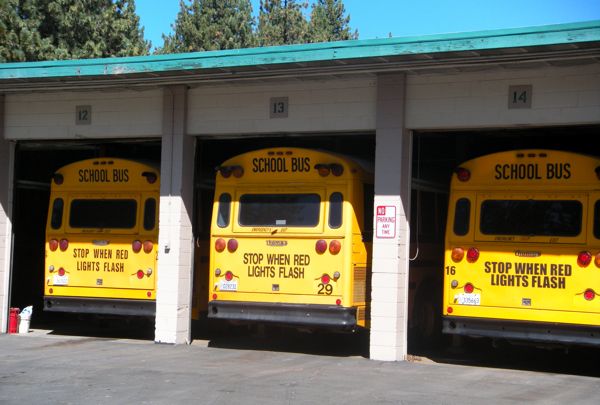
LTUSD buses may be in the barn more than on the streets in the fall. Photo/LTN file

One scenario had some students riding a bus home for 75 minutes. The longest route now is about 45 minutes. Considering it’s 12 miles from Meyers to Stateline, that’s one long trip to get from school to a bus stop.

Students in the Tahoe Keys could be faced with a longer walk because buses for students in grades 6-12 might be eliminated. They would have to walk to Eloise or Washington to find a school bus.

Board members were adamant that having students arrive at South Tahoe Middle School 20 minutes before classes start is a horrible idea.

The district has been subsidizing the bus program for years. It costs $1.2 million to bus about 1,900 students a day. The state reimburses LTUSD $830,000.

The district has an ongoing deficit of $1.2 million to deal with what could grow to $2.5 million if voters say no to a measure on the November ballot that would fund education in California.

So, the cuts to LTUSD transportation are for two reasons – to deal with the current shortfall, and plan for a possible take-away by the state.

Because the district accepts state transportation dollars it must provide busing for K-8.

Twelve of the 16 bus drivers the district employs were at the May 1 meeting.

“It looks like six may be cut,” Steve Morales, facilities director, told Lake Tahoe News.

Parents who have the means already pay a fee for their child that starts at $150 a year. About $60,000 is collected each year in bus fees, according to Morales.

“I think parents would be open to a sliding scale or paying more,” parent Karen Fink told the board.

Asked by Lake Tahoe News about using BlueGo as a means to transport students, Morales said there is “no appetite” to do that. He added that school buses are designed differently than municipal buses and that drivers having different training.

“A lot of students ride the bus who wouldn’t have another way to get to school,” parent Alice Jones told the board. “Not only do they make it to school, but they are there early enough to get the free or reduced breakfast.”

Jones also brought up the adverse environmental impacts of having more vehicles on the road if fewer buses are rolling.

The district runs 12 full size buses that can seat 84 and four smaller buses with a capacity of 20. The smaller buses are used for special education students. Federal law mandates public schools accommodate these students, often not having them co-mingle with the larger student population. The district cannot save money with spec ed even if it wanted to. Districts must provide for spec ed students even at the expense of the majority.


TRPA air mitigation fees delay opening of businesses

By Kathryn Reed

Christian Strobel closed escrow on the former Block hotel near Stateline in May 2011. He paid $450,000 for the 51-room rundown lodging property.

In the past year he has spent about $1.5 million to turn it into a functioning facility, which included removing asbestos, replacing all the doors and windows, kicking out the gangs living there who were smoking various illegal drugs, putting in new furniture, adding green elements like recycled wood and low-flow toilets, all with the desire to market the hotel to an outdoor clientele.

On Tuesday, he found out he owes the Tahoe Regional Planning Agency $163,021.01. It’s called an air mitigation fee. It was the city of South Lake Tahoe that told him the news – not the TRPA. This fee is about one-third the price he paid for the structure.

The Block for years sat empty, boarded up and painted with graffiti. TRPA says it is working with the new owners to overcome the air mitigation fees. Photo/LTN file

“I fell off my chair. We have a loan that is secured by my house. If I have to pay the fee, I won’t go into business,” Strobel told Lake Tahoe News on Thursday. “If that happens, we go into bankruptcy and I lose my home.”

Before buying the hotel on Cedar Avenue he checked with the TRPA about the validity of the tourist accommodation units. Those were in check. So, TRPA knew his intent to reopen the facility as another hotel but never mentioned the air mitigation fee.

No one at anytime disclosed the air mitigation fee, Strobel said.

TRPA calculates the fee based on an international engineering survey that says a hotel of this type will generate 9.81vehicle trips per day, per room. For Lake Tahoe Basecamp Hotel that fee is $163,021.01.

The problem Strobel and even South Tahoe officials have is why people must pay the fee on a building – especially when the use hasn’t changed – when the previous owner already did so.

TRPA rules state that if a building is not used for two years, the air mitigation fee must be paid again.

When asked by Lake Tahoe News if this is actually a double fee, TRPA spokesman Jeff Cowen said, “We’ve all been talking about that. The only information I have is it’s in our code.”

In the Regional Plan update, alternative 4 (not the preferred alternative) would increase the vacancy to five years.

Asked why TRPA doesn’t issue an air mitigation refund when a business stops existing – the premise being then it wouldn’t be having customers polluting the air with emissions – Cowen said the funds can’t be refunded because they have been spent.

That’s the point property owners and others are trying to make — the fees have been spent to mitigate air quality issues. Why pay for the same thing twice is what TRPA can’t answer.

Hilary Roverud, director of development services for South Lake Tahoe, said the city would not comment on whether this is a double fee.

“The fee applies to any change. The previous use is not recognized,” Roverud said of how TRPA looks at things.

Roverud and Cowen said they are trying to come up with a solution for Strobel so he can open as planned on June 20. But neither would say what the possibilities are to mitigate the mitigation fee.

“It’s a legal issue,” Cowen said.

Not an isolated case

Strobel is not the only business caught in this quagmire. Down the street from his property is the Cedar Lodge that has new owners.

Judy Finn, planner with the city, said the owners have received a permit to do interior changes and have been told about the TRPA’s air mitigation fee.

According to City Attorney Patrick Enright, the air mitigation fee at the Cedar Lodge will also be more than $100,000.

Part of the issue with the Garfinkle building – aka Miller’s Outpost-TJ Maxx — is the $35,000 air mitigation fee. A lease between the property owners and clothing store has not been signed.

“I can’t speculate on what people choose to do based on these fees. But it would be logical if someone is trying to do a project and they figure out the finances, this would be a factor,” Roverud said of the air mitigation fee. “It does seem to be more of an issues because we are in a period of a lot of vacant commercial property.”

The old Dixon’s restaurant on Emerald Bay Road has suitors. It, too, will face the air mitigation fee issue.

Why have a fee?

The fee is used to combat air pollution that presumably a business’ customers is creating.

But the TRPA also doesn’t provide incentives for businesses that might attract hybrids or electric vehicles or even more than two people per vehicle.

The business may pay the fee, which most do, or pay directly for bus shelters, bike trails or other projects that would be considered a use that ultimately decreases vehicle miles traveled.

The mitigation fee is then put in a pot for the jurisdiction where the business is located.

According to TRPA, the city has used $1.3 million in air mitigation funds in the last 10 years on bus shelters, street sweepers, transit buses and intersection improvements.

“The south Y intersection pedestrian and level-of-service improvement project cost $2.5 million in 2007, $500,000 came from air mitigation fees collected in the city,” Cowen said.

As of April, the city had $180,000 in its air mitigation account at TRPA.


S. Tahoe council questions need for 20-year ice rink deal

By Kathryn Reed

If questionable decorum at a City Council meeting should come with consequences, then the operators of the South Lake Tahoe Ice Arena could probably find a penalty box for them.

While Van Oleson and Chris Cefalu were before the council on May 1 asking to formalize their contract with the city, Councilwoman Angela Swanson and City Manager Tony O’Rourke verbally checked one another. Councilman Tom Davis took his swipes, alluding to how he knew best how to run a business and was in support of the city manager’s proposal.

The entire discussion was a rare demonstration of hostility between the electeds and city manager.

Tongues were as sharp as ice skates during the May 1 South Lake Tahoe City Council meeting. Photo/LTN

Swanson was not alone in questioning O’Rourke’s insistence on doubling the length of the contract from 10 years to 20.

All O’Rourke said to Lake Tahoe News as to why the need for the change was, “We have been discussing this for six months.”

It appeared no one had been discussing it with the council.

Oleson and Cefalu, owners of Tahoe Sports Entertainment, walked out of the meeting Tuesday afternoon without a contract.

Councilman Hal Cole said, “We want to see what you are going to do (before extending the contract).”

Swanson echoed that sentiment, “Why should the city enter a 20-year agreement unless there is an assurance of a plan?”

But the TSE duo wasn’t prepared to show its hand without a contract.

Mayor Claire Fortier said, “This is a community asset. We need to strike a balance between the community and profits.”

Cefalu responded, “I agree it is a community asset. But the local community will not sustain it.”

The city knows this. In some years the city lost $100,000 a year on the rink. That is why South Tahoe went looking for a private operator. TSE is bringing in tournaments to help sustain the business.

TSE last summer was awarded a 10-year contract to run the city ice rink. A month later, in August, that contract was revised because it was discovered a for-profit organization could not make money on an entity being paid for with non-taxable bonds.

A side letter – essentially a new contract – was put in place as the city worked through changing the bonds to taxable. The bonds were resold as taxable and in turn financed at a lower rate earlier this year.

However, that new contract expired Feb. 1. That is why TSE was before the council this week.

But it’s not the same contract as to what the council had agreed to 10 months ago.

TSE wants a 20-year contract. What was never articulated well was why the company needed to double the time frame.

After the meeting, Cefalu told Lake Tahoe News that to do the capital improvements – like another sheet of ice – and to finance it, a 20-year agreement is needed to get financing and recoup expenses. That second sheet of ice was talked about last year, too.

Other changes in the contract that were proposed include changing the fee structure. The monthly fee would go from $3,000 to $2,000. However, the percentage of gross revenue in excess of $600,000 TSE would pay the city would max out at 10 percent, while the original contract had a 5 percent maximum.

Another proposed change is that TSE would be entitled to reimbursement at a depreciated rate for improvements made to and items bought for the facility if the city terminates the contract. However, all of those potential improvements would have to be cleared by the council before the capital investment were made.

Councilman Bruce Grego had a problem with the prospect of the city having to come up with a lump some if that were to occur.

Staff was told to come up with another plan and bring it to the council June 5.

City Attorney Patrick Enright told Lake Tahoe News the agreement that expired three months ago will stay in effect until the council votes on an ice rink contract.

In other council action:

• On a 4-1 vote, with Davis in the minority, garbage rates as of May 1 are 4.97 percent higher.

• Tahoe Bear Box was awarded a bid to put in containers on city property to be paid for from a state recycling grant. It was a 4-1 vote with Grego voting no.


No snow to measure at Echo Summit; reservoir storage OK

By Kathryn Reed

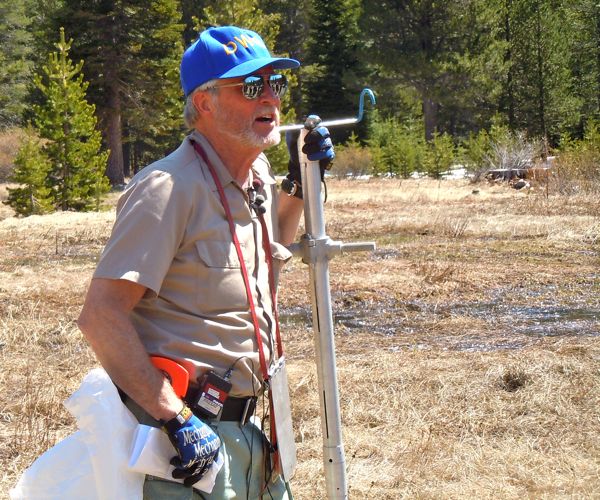
PHILLIPS STATION – Frank Gehrke with the Department of Water Resources did not need his instruments Tuesday as he walked through a barren field. Snowmelt was more in evidence on the final snow survey of the season than the actual white stuff.

“With climate change, we’ll definitely see more of these extremes,” Gehrke said comparing the abundance of snowfall a year ago to the dismal showing this season.

The May 1 reading in 2011 had 5 feet of snow with 3 feet of water content in the open area near the entrance to Sierra-at-Tahoe off Highway 50. This week the evidence of snow was the runoff at the far end of the field that was puddling and the patches on the higher peaks.

No snow for Frank Gehrke of the Department of Water Resources to measure on May 1. Photo/Kathryn Reed

Statewide, the snowpack water content is at 40 percent of average for this time of year.

According to the National Weather Service in Reno, the streams in the Lake Tahoe area have already hit their high water mark.

“Some of the smaller creeks had decent rises this year, but nothing to warrant an advisory or flood warning,” meteorologist Scott McGuire told Lake Tahoe News. He said the minimal snowpack this year meant no flooding, unlike a year ago.

While a small weather system is expected to settle over the basin this week, scattered showers and cooler temps are all that’s expected. No big weather events are on the horizon.

But McGuire did caution that while flooding is not an issue, rivers and creeks are running fast and are extremely cold.

“It doesn’t take a whole lot of water to sweep someone off their feet,” McGuire said.

It’s all that water in California reservoirs that is keeping the nerves of farmers and municipal water purveyors calm. Last year’s deluge and the late storms this season have kept the water levels at serviceable levels.

“Overall, our water supply is OK this year,” Gehrke said.

Lake Oroville is at 97 percent capacity.

Source: Department of Water Resources

Location

Elevation

Snow Depth

Water Content

% of Long Term Average

Alpha

7,600 feet

26.5  inches

12  inches

45

Phillips Station

6,800 feet

0  inches

0  inches

 0

Lyons Creek

6,700 feet

37  inches

15  inches

66


Law breakers force all dogs from Upper Truckee Marsh

By Kathryn Reed

Poop bags have been replaced with pamphlets about why dogs are no longer allowed in the Upper Truckee Marsh.

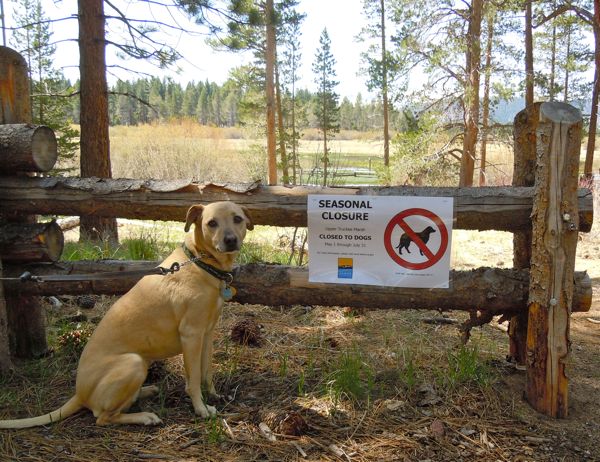
Today begins the second annual three-month ban of canines – even ones on leash – from this popular South Lake Tahoe meadow that leads to Lake Tahoe.

While those who like to take their best friend for a walk in this area won’t be able to until Aug. 1, neighborhood lore has it that this also happened when the land was privately owned.

No more walking in the Upper Truckee Marsh for AJ. Photos/Kathryn Reed

Before the California Tahoe Conservancy took ownership several years ago longtime Tahoe families owned the land. It was known as the Barton Meadow before the CTC called it the Upper Truckee Marsh. On maps, the sandy area is called Hartoonian Beach.

Cattle used to roam this acreage. And when they were being rounded up, even the locals stayed out of the meadow for about three months a year for fear of being trampled in a stampede by the herd. Plus, the cowboys shot dogs caught off leash.

By comparison, the $150 potential fine levied in this modern day era pales by comparison.

The whole point of the CTC closure is to preserve the marsh that provides critical habitat for wildlife – in particular a variety of birds. This marsh is the largest wetland habitat in the Lake Tahoe Basin.

“It’s the public’s responsibility to respond to and honor the objectives by which we are trying to manage that property,” Dana Dapolito, CTC associate environmental planner, told Lake Tahoe News. “We are providing the information. They need to take that step to comply.”

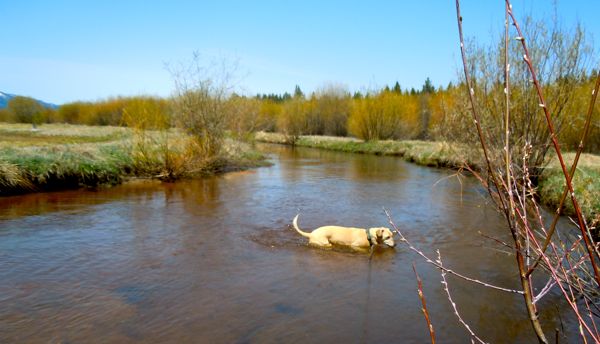
Even on leash, AJ is forbidden from swimming in Trout Creek where it meanders through the Upper Truckee Marsh.

For the first 24 days of April sheriff’s deputies wrote 18 citations. However, the CTC does not know how many of those were people with dogs off leash or people drinking alcohol or campfires or some other unpermitted activity.

What the landowners do know is compliance of the leash law, according to their land steward, is at 65 percent this year. This compares to late last summer-early fall when it was at 80 percent when dogs were let back into the marsh.

With an average of 400 dogs a week being seen by the steward this spring because of the extremely temperate conditions and lack of snow, that equates to 140 dogs running around off leash. They could be trampling on sensitive habitat and scaring wildlife.

Even when the closure is not in effect, the leash law has been – and always has been the rule since the Conservancy has owned the land. And prior to it becoming public property, no one was ever supposed to be in this area without permission by the private landholder.

Had people followed the leash law rule, those who do what they are told would not be punished. Instead, the majority of dog owners are paying the price for the minority — that one-third of dog walkers seen without a leash.

“Our goal is not to levy fines,” CTC Deputy Director Ray Lacey told Lake Tahoe News. “The citations are for flagrant disobedience.”

Of the nearly 5,000 CTC properties in the basin, this is the only one with this type of closure.


Concerts, kayaks, food — all part of Lakeview Commons

By Kathryn Reed

It will neither be Julie Andrews making the hills come alive with the sound of music nor the bass of bands from SnowGlobe. Instead, a mix of jazz, reggae and blues are expected to resonate from Lakeview Commons this summer.

OnCourse Events has been granted a permit to bring music to the South Lake Tahoe venue. Every Thursday starting June 28 through Sept. 6 from 4-8:30pm a different band will perform on a temporary stage that will be built in the sand. Spectators can sit – for free – on the terraced area or up top where there are picnic tables.

“I want to introduce locals to different music,” Rob Giustina, with OnCourse Events, told Lake Tahoe News. He expects most acts will be from out of the area. However, the first band is likely to be Jump Start, though local, they don’t often play in the basin.

Free concerts on Thursdays are coming to Lakeview Commons starting in late June. Photos/Kathryn Reed

Giustina is more often associated with competition event productions. But as someone who was born and raised here, he wants to help the town resurrect itself in terms of fun and economics.

“I wanted to be proactive in saving our community,” Giustina said.

He expects to make money on the summer concert series selling booth space at $75 a pop for a 10-foot-by-10-foot spot. Artists, nonprofits – he will consider them all. Vendors will be at the top of the commons area.

Until the city votes on who will be operating the food part of the Lakeview Commons, Giustina is holding off on deciding what type of food will be sold. He doesn’t want to compete with the concessionaire, but instead complement or have his vendors be completely different. But he also hopes to have a beer garden.

Bids for the food concessionaire closed April 27. It’s possible the City Council could make a decision at its May 17 meeting.

For people wanting to be part of Giustina’s Live at Lakeview Commons Concert Series, email him at rob@oncourseevents.com.

Giustina is encouraging people arrive by bike. A valet will be operating for storage purposes during the concert.

As for what the city plans to do at Lakeview Commons, the rest rooms and drinking fountain should be in operation any day. Bathrooms will always be a seasonal operation based on demand, and the water will operate when the threat of frozen pipes is eliminated.

On the May 1 council agenda is an item to award the nonmotorized concessionaire to Standup Paddle, which has a shop on Harrison Avenue.

“Whoever gets the contract will have to do their own tenant improvements,” Stan Sherer, community services director, told Lake Tahoe News. The city will take a percentage of the gross profits, with it topping out at 12 percent.

In addition to the rental of paddleboards, kayaks and canoes will also be available.

Per the original plans when the $6.5 million Lakeview Commons project was conceived, people will also be able to store their nonmotorized craft at the boathouse for a fee.

Right now garbage cans without lids are scattered about Lakeview Commons. Sherer said those will be converted to bear-proof containers soon. A bid on the project is on Tuesday’s council agenda.

Landscapers will be back out there this week to finish the plantings.

Sherer told Lake Tahoe News his intent is to make the area accessible to dogs – legally. Plenty of people take their dogs to the commons and El Dorado Beach, but that is violating the current law.

Something that perplexes Sherer is why in the original plans there was no place to dump ashes from the barbecues.

“It’s not just having a facility to empty the briquettes, it’s will they use them or will they try to dispose of them someplace else,” Sherer said people who are barbecuing. The fear of someplace is it could cause a fire or contaminate Lake Tahoe.

A solution as of last week had not been found. And they are being used. Smoke has been seen wafting from the grounds on the unseasonably warm days.

While the area has been transformed and looks nothing like it once did, all the boulders on the north end mean beachgoers can no longer walk very far. It used to be people could walk to Ski Run Marina and beyond.

A pipe on El Dorado Beach that used to be ghastly, especially as water drained directly into Lake Tahoe, is still there. Only now sand covers part of the upper part of the metal, and boulders and branches cover the lower section. Gunk, well, it still flows into the lake from Highway 50.

On June 20 at 2pm there will be a grand opening – again – of Lakeview Commons. This time Secretary of Natural Resources John Laird is supposed to attend the dedication, as will members of the California Tahoe Conservancy and its board. It was CTC money that funded the project.

What name it will be dedicated as, well, that remains to be seen.

A beach party will follow at 3pm.

ngg_shortcode_0_placeholder (Click on photos to enlarge.)