Tahoe City visionaries talking about overhauling the town

By Kathryn Reed

TAHOE CITY – A hotel where Safeway is as well as one along the golf course. Residences above street level businesses. Side streets with commercial offerings instead of just along the highway. Expanded recreation. Improved public transit.

Those are some of the visions a group of business owners and others have for Tahoe City. Their vision was unveiled at a standing-room-only meeting of more than 80 people on Sept. 27 at Granlibakken resort.

“For me, things have changed a lot,” Douglas Dale, who has owned Wolfdale’s restaurant for 34 years, said. Mostly the change is in the winter. “I can barely break even, if I do. The mousetraps of Squaw Valley and Northstar have done us in.”

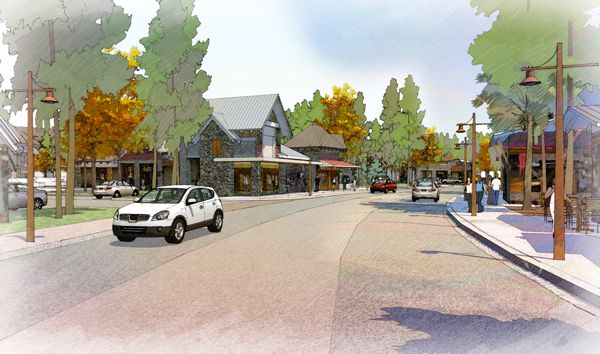
This is one vision for a section of Tahoe City. Rendering/Design Workshop

Skiers are staying at those resorts in the winter and no longer venture into Tahoe City.

It also didn’t help that when the villages opened they lured Tahoe City businesses to their locations with the promise of free rent – some for a year. Then when the rents were established they kept going up and many of those original Tahoe City businesses are nowhere to be found. But what can be found are empty storefronts in the villages and in town.

Some of the visuals that were presented on easels Thursday night portrayed a Tahoe City larger and more developed than what exists now. A connectivity, though, between the sectors, with more open space and access to Lake Tahoe were also illustrated.

One of the goals would be to tap into what is expected to be an overhaul of the Tahoe Regional Planning Agency’s Regional Plan – which is expected to be adopted later this year – to allow for mixed uses and increased building height.

“What gets our dander up is high-rises on the lake. That is the difference between us and the South Shore,” Mary Cushing said.

Sue Daniels, a Realtor in Tahoe City, told the group, “There is a myth in society that bigger is better. It’s important to keep that in mind. Our population is much, much larger than it was in the 1960s. Yes, it’s gone down since the 1980s. This has happened across the nation. We can fix this town without five stories on the lake.”

She was one of several people who took issue with the speakers saying more lake access is crucial, but then said it might be for the tourists via a hotel room.

Richard Shaw, who works out of the Aspen office of Design Workshop, was at the meeting to explain some of the concepts that have been developed. (He is also the main man at Design Workshop behind the South Shore vision process. )

He said the primary challenges facing Tahoe City are:

• Almost the whole downtown is built on a stream environmental zone;

• Decline in full-time residents;

• No hotel rooms in the prime areas where tourists want to be;

• Decline in market share;

• Small parcels have multiple owners.

Dale, along with Roger Kahn whose family ran Porters Sports for years, Brendan Madigan of Alpenglow Sports, Gary Davis of Gary Davis Engineers, Wally Auerbach of Auerbach Engineers and Steve Hoch, executive director of the Tahoe City Downtown Association, were the primary speakers during the more than two-hour high-energy gathering.

Business owners, TCDA, Tahoe City Public Utility District and North Lake Tahoe Resort Association hired Design Workshop for about $35,000 to help develop a vision for the North Shore community.

Business reps pointed to the large amount of public money spent on improving aspects of town – like Commons Beach, bike trails and other infrastructure, but admitted the private sector has not done its part to reinvest in the community.

It was said many times at the Thursday meeting how Tahoe City does not want to resemble present day South Shore, or either of the villages at Squaw or Northstar. But it was also clear that a consensus on what the future of this town of 1,557 should look like was not going to be decided at one meeting. (The population, according the U.S. Census Bureau dropped 11. 6 percent from the 1,761 in 2000 to the 2010 figure.)

It was also stressed that what was being talked about was a vision, not a plan. And it was reiterated that more meetings, discussions, input and other visions are being sought.

The North Lake Tahoe Resort Association expects to have information about the vision on its website.


3 Tahoe half marathons help runner complete 52 in a year

By Jessie Marchesseau

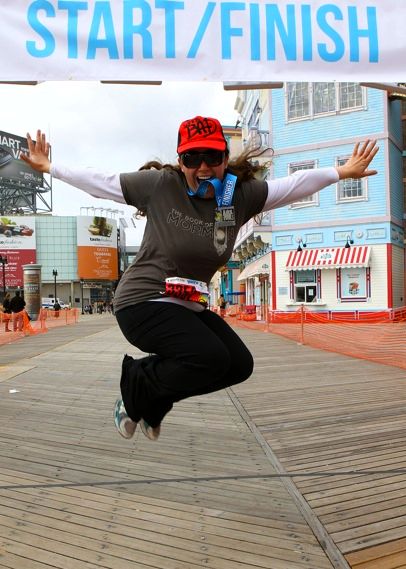
Aurora De Lucia will be running the Tahoe Trifecta starting today. That is three different half marathons in three days.

What makes De Lucia different than the dozens of other people she will be running with this weekend? Oh, just that she is 22, had open heart surgery 2½ years ago, is on a quest to run 52 half marathons in 52 weeks and is raising money for the charity Broadway Impact in the process.

Aurora De Lucia will run three half marathons in Lake Tahoe on Sept. 28-30. Photo/Provided

Bubbly, giggly, talkative and undeniably motivated, De Lucia originally came up with this challenge just to prove to herself that she could do it. She ran her first half marathon in 2009 and calls it “pretty much one of the most amazing day of my life.”

That was before she got sick.

Until about three years ago, De Lucia had no idea she suffered from a congenital heart condition known as Wolff-Parkinson-White syndrome. Essentially, her heart had an extra electrical pathway, something that can lead to an excessively rapid heart rate.

Doctors said she was lucky they found it. Usually it’s something they find in an autopsy.

During the next six months the Los Angeles resident had four failed ablation procedures on her heart, complications caused by the procedures and finally, open heart surgery. Then in June 2010, the extra pathway was declared gone, and De Lucia was set free.

After a year of getting her life back together, she decided it was time to focus on her goal of running another half marathon or 13.1 miles. But it was no easy task. She could not go very far or very fast. On a whim, De Lucia signed up for a 5K as a way to encourage herself. Then she signed up for one the next weekend, and the next, and the next, progressing up to the 10K. That’s when she got the idea: she could do one race every week, 52 half marathons in 52 weeks.

“Fifty-two should be pretty sufficient to prove to me that I can do it,” she said of her plan.

So in January 2012, the challenge began. Along the way she has seen old friends, made new friends, travelled all over the U.S. and even ran a half-marathon with her father – the highlight of the year so far.

This weekend’s races will be numbers 31, 32 and 33; putting her well past the half way mark. Today is the Emerald Bay Marathon (Emerald Bay to Lakeside Beach), Saturday is the Tahoe Nevada Half Marathon (Spooner Summit to Incline Village), and Sunday is the Lake Tahoe Half Marathon (Rubicon to Pope Beach).

“I’m a marathon runner myself, and I can’t see how she’s going to do it,” John Bernard, a long-time friend of De Lucia’s, said, “but I know she’s going to do it.”

Bernard will be joining her in the Columbus, Ohio, race next month, as will her father.

Part way through the year, De Lucia decided that running for herself was not enough, she wanted to do it for a cause. Choosing Broadway Impact, a national organization supporting marriage equality, was a no-brainer for her.

“I couldn’t think of anything that was more important to me than human beings and treating human beings equally,” she said.

Jenny Kanelos, executive director of Broadway Impact, said they are proud to have De Lucia representing their cause because she embodies everything they hope people will get out of their foundation.

“What she’s doing is exactly what our organization was founded on: get inspired, and take action,” Kanelos said.

She also added, “I think anyone who takes on 52 marathons in 52 weeks has got to be pretty incredible.”

If you happen by one of the half marathons this weekend, look for De Lucia in her trademark red “Who’s Bad” baseball cap, or follow her on her quest online.

Notes: Expect traffic delays Sept. 28-30 during the Lake Tahoe Marathon events. This website has more details.


Scotts Lake provides a variety of recreation options

By Kathryn Reed

HOPE VALLEY – Tree trunks stand like centurions from an era long ago. It’s as though they are keeping secrets – possibly the stories of explorers from another century.

With each day that passes, the water level at Scotts Lake is receding. At an elevation 8,012, the conditions look more like spreading drought conditions at sea level than an alpine lake.

The edge of the lake is muddy, with cracks in it where it has dried. Grasses that are normally under water almost don’t look real. The tree trunks that are showing are well below the high water mark.

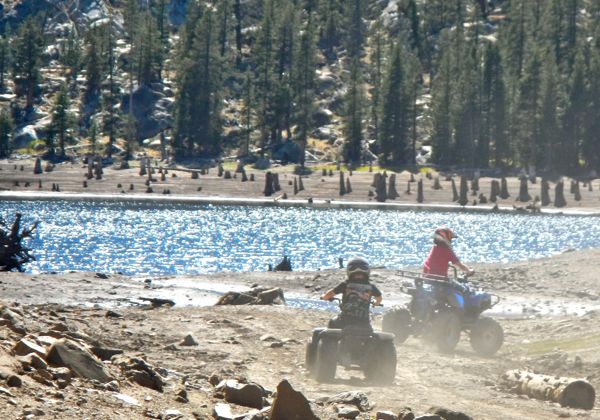
All-terrain enthusiasts romp near Scotts Lake. Photos/Kathryn Reed

A pipe almost blends in with the rocks. Presumably this would take water to the west fork of the Carson River.

Balls of lichen grow on downed wood and are stuck to the mud. They look like loofa sponges. We don’t touch them.

Friends come here to fish. It doesn’t look like much of a fishing spot – at least not on this September Saturday. And the road there isn’t one I would have wanted to drive with trailer in tow.

There are two main ways into Scotts Lake. One is to hike in from the Big Meadow trailhead off Luther Pass. We met a few people at the lake who did this.

It was Frank Riley’s description in “Tahoe Blues” about hiking to Scotts Lake and his encounter with a bear that made me want to know where it was. It’s in Alpine County on the edge of El Dorado County. Waterhouse Peak is nearby.

We opted for the route that involved a lot less work.

We drove in. The Jeep needed to get some 4-wheel drive action other than when white stuff is on the ground. It’s not a particularly challenging route, but at one spot on an offshoot from the main trail to the lake Sue thought she and AJ should get out of the vehicle.

The topo map describes this as a dirt road or bike path, possible 4-wheel drive needed. I would not take my bike up this road.

We are not the only ones who opted to use gas-powered means to get to our destination. Campers who are in RVs close to Highway 88 are playing on their four-wheelers.

They move on and we have the lake to ourselves. It’s quiet, desolate and tranquil as the sunlight shimmers on the lake. A gentle breeze sends little ripples toward the shore.

A few aspens are turning yellow. Fall is definitely in the air.

—–

Getting there:

From South Lake Tahoe, go west on Highway 50. Turn left onto Highway 89. Go until it dead-ends in Hope Valley. Turn right onto Highway 88. Make a right onto an unnamed road that has a cattle guard. (If you hit Blue Lakes Road, you went too far.) Veer to the right. Keep veering to the right and then start the climb.

ngg_shortcode_0_placeholder (Click on photos to enlarge.)


Ritz-Carlton drives Placer County economic needle up

By Susan Wood

TRUCKEE – After logging almost three years on the slopes of Northstar, the Ritz-Carlton, Lake Tahoe has shown how easy it is to mix business with pleasure.

That’s because some may say the only AAA five-diamond hotel in the Tahoe region has been good for guests, village retailers and even Placer County by contributing to local government coffers.

Per Placer County records, transient occupancy tax collected from the Ritz guests and about 500 other condo and single-family units in and around Northstar and Martis Valley (situated east of the mountain) almost tripled to $1.1 million from the quarter ending in December 2009 to the next that wrapped up March 31.

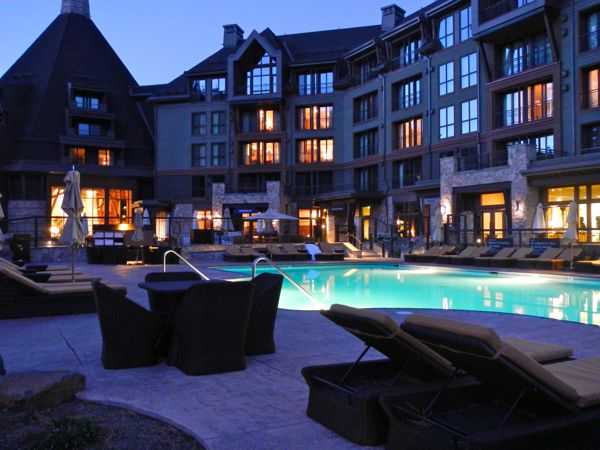
Ritz-Carlton, Lake Tahoe is helping Placer County's economy when it comes to hotel and sales taxes. Photos/Kathryn Reed

Of course, the winter season is always strongest. But more telling, tax revenue collected in that same quarter in 2011 at the height of the ski season went up yet again by almost $150,000. Granted, the ski resort had much help from Mother Nature, who provided a banner winter. Still, this is all despite a pesky recession that officially started two years before the resort opened in December 2009.

Sales tax figures almost doubled to $98,989 in the first quarter since the Ritz-Carlton came onto the Sierra Nevada scene. (This statistic also includes the primary retail sales hub of the Northstar Village.)

“(The hotel) has definitely had an impact on our business,” said Kelsey Tedrini, manager of Helly Hansen.

Tedrini said her Northstar Village store fields calls from the Ritz-Carlton concierge staff helping guests get “last minute things” like a pair of socks. In one instance, a staffer retrieved the item for the guest.

“It’s a snowball effect. At least it gets people in the store,” she said. “Of course, last year was a little slower, but I think it’s been best for business. It’s the Ritz Carlton. It’s totally professional.”

A hospitality business must use all its resources and advantages to get its share of the tourism dollar, which has seen more and more competition around the world (even with brands like the Ritz-Carlton recently expanding to opening its first hotel in Austria).

Income levels of the wealthy have gone up, making travel attainable. But a recession can make all markets more frugal.

With North Lake Tahoe occupancy rate percentages averaging in the mid-40s in 2012, according to Mountain Travel Research, some hoteliers have found it necessary to lower daily rates despite a decade of growth year after year. The average between 2011 and 2012 for the period ending in July went down 1.5 percent to $209 in North Lake Tahoe. By comparison, Ritz-Carlton rooms start at $239 per night for advance purchases on an October weekend and climb to $4,500 for the Sugar Pine Suite.

Hotels that offer more amenities and host or participate in more regional events that appeal to markets ranging from the recreational warrior to the supreme foodie will come out on top in the long haul.

“Certainly, over the last few years, all segments (of our business) have been impacted (with the recession), but we continue to be optimistic that we’ve turned the corner and travel has turned the corner,” Ritz-Carlton, Lake Tahoe Market Director Steven Holt told Lake Tahoe News on a recent meeting in the Ritz Destination Club lounge during the Lake Tahoe Autumn Food and Wine Festival.

Holt, who oversees the public relations for all Northern California properties of the global company, added Lake Tahoe’s efforts remain in making the resort more four-season by “connecting the lake” to the mountain between the hotel concierge staff and managers of activity and recreation outlets.

For example, guests lounging in any of the Ritz-Carlton’s plentiful seating areas in and out of the hotel are likely to catch hikers taking a jaunt across the mountain (some with their dogs because the hotel is pet friendly), or are alongside gnarly mountain bikers screaming straight down the slopes. Swimmers may take laps in one of the hotel’s three pools on the massive, split-level patio. Gym rats can enjoy a view of all this on one of the numerous exercise machines.

Windows are big on Tahoe’s Ritz-Carlton property – with 170 hotel rooms, 23 private residences and 25 Destination Club lodging facilities. The warm sun provides enough heat to three-quarters of the building, making it energy efficient enough to qualify as a first-level LEED-certified benefit. The $300 million resort hotel earned the prestigious distinction from the U.S. Green Business Council a year after it opened by recycling more than 16,000 tons of construction waste, installing treatment basins to capture stormwater runoff, putting in bicycle racks and lockers for employees and using the massive onsite boulders in its retaining wall that climbs up the mountain next to the new road. That effort – along with about two dozen others such as the mere building of a special gondola – showed the difficulty and resulting success of the project that took three years to build.

“It took a year and a half just to build the road,” Holt recalled.

But no one said living and staying in Tahoe is easy. The destination has its own distinct charm and character, as Holt pointed out in comparing the style to the Ritz hotel at Bachelor Gulch at Beaver Creek ski resort in Avon, Colo.

“We want to see the experience (of the hotel) be specific to the place. Here, California has its own style,” Holt said, as a few Club guests sauntered in and out of the special, fifth-floor room in their shorts and T-shirts for the breakfast buffet. Cookies were neatly stacked in drawers to munch on later in the day.

Guests of the Ritz-Carlton should not go hungry with the hotel’s eatery options and planned events. There’s even a rooftop garden created by Guest Relations Manager Mitch Penning, who plants a plethora of various vegetables including six types of lettuce and edible flowers that may be found all over the property, right down to floating in a cocktail glass.

“Culinary is extremely strong now,” Holt said, when asked what role food-oriented events play in spurring occupancy.

Nine specialty events in September were scheduled. They range in taste from Pints and Pies at the Manzanita fine-dining restaurant where James Beard Award-winning chef Traci Des Jardins provides her magic touch. “Beer and a Burger” is offered at the casual MountainBlue café. Master cooking classes are slated there on the weekends. “The Art of the Cocktail” educates the amateur libation maker in the Living Room. This dining offering is just like that – where falling asleep in one of cushy chairs or chaise lounges at the pool would be understandable in a land that brings new meaning to relaxing and rejuvenating.

(Note: From the Living Room menu, ordering the roasted vegetable wrap at the pool hits the spot.)

If you’re into s’mores for dessert, there’s a fire pit calling your name on the expansive patio area.

“This is awesome,” said one woman as she discovered the lower-level hot tub and fire pit. The small hidden cove is inviting enough after soaking in the tub to lounge in a robe and sandals in front of the fire while listening to the slopeside night sounds.

If that type of lounging isn’t enough for utter relaxation, a 17,000-square-foot spa serves up a full page of treatments and services – including an herbal milk bath and massage running $185 for 50 minutes. Every little whim of the guest is considered.

A testament to finishing touches at the luxury resort, even the artwork in the rooms and in the common areas adds to the experience of the place. For instance, a trio of paintings featuring pup tents in one of the hallways makes one feel at home in the Sierra Nevada.

Albeit modern, the rooms offer a mountain motif décor, with a full set of bathroom and hall closet supplies to answer the occasional whims of the guests. (Note: One thing missing – an electrical outlet at the desk.)

Around the property, water dispensers keep guests hydrated during warm days – especially for the multitude of guests who come up from the flatlands of Sacramento and the San Francisco Bay Area and need to acclimate.

Then, there’s the staff – who make courteous customer service such a mantra that one forgets being in the Lake Tahoe region. It must be due to how the hotel chain starts its days. Holt claims that the 45,000-plus people who work for the chain share in a half-hour session designed to point out “service stories” highlighting where staff members went out of their way to help a guest.

“The high quality and elevated level of service the Ritz-Carlton is known for delivering to its guests makes it a good match for Northstar,” said Jessica VanPernis, spokeswoman for Northstar. She mentioned that since Vail bought the ski resort two years ago the hotelier makes a good fit for the ski resort giant.

Northstar has long evolved into a destination village with various lodging options most notably through East West Partners condo projects. They include: the Northstar Lodge – a Hyatt timeshare; Tahoe Mountain Resorts and One Village Place – both ownership properties that may go into a rental pool.

The hotel provides an elegant, non-ownership place for guests to take part in the Tahoe, California lifestyle.

—-

Details:

Directions: From South Lake Tahoe, take Highway 50 east. Take Highway 28 at the top of Spooner Summit. Turn right onto Highway 267 in Kings Beach. Turn left onto Highlands View Road. (This is the street before the main entrance for Northstar.) Wind around until you see the hotel on your left.

Phone: (530) 562.3000

Website

ngg_shortcode_1_placeholder (Click on photos to enlarge.)


Crew creating Tahoe holiday tradition sworn to secrecy

By Kathryn Reed

Orders are already being placed – even from doctors who know this is not health food. It’s quite the opposite.

But there seems to be something therapeutic about this once-a-year specialty item. While they can’t actually be bought until November, a gang of aficionados gathered on a September Sunday morning in a back corner of Barton Memorial Hospital to start the process.

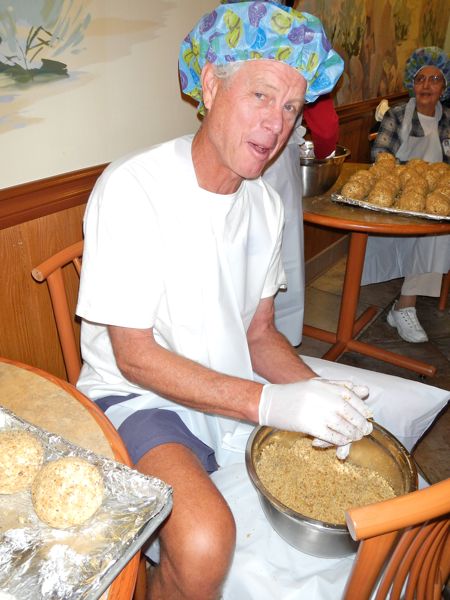
Bob Harms is at the walnut station during the September assembly of cheeseballs. Photos/Kathryn Reed

It was like it was their religion – the reverence with which they spoke of these cheeseballs, the dedication they have year in and year out to assemble them.

Lake Tahoe News was not allowed in until the secret ingredient was well out of sight.

“The secret ingredient comes in bulk. We can get it in smaller amounts, but it’s cost prohibitive,” Pearl Parks explains.

All of this secrecy and early assembly is for the more than 1,000 cheeseballs the Barton Auxiliary sells each year. And each year they sell out.

Parks rallies the troops to make sure the cheeseballs are ready for the masses to buy at the holiday fair on Nov. 4 from 9am-3pm at St. Theresa’s. It all started in June with the ribbon being cut, bags bought and tags set to go.

When the fundraiser first started in 1988 all the mixing was done by hand. At that time the cheeseballs were not a big seller.

But through the years it has become a tradition. Some people place their order a year in advance. It’s not uncommon for people to order a dozen.

Parks is pretty sure these cheeseballs have shown up as hors d’oeuvres at the same party.

The base is cream cheese and butter. Then there is a secret ingredient. Parks says people have guessed it. A tiny taste on a cracker was not enough for this reporter to figure it out. (Time to make a cheeseball order.)

Big mixers in the kitchen at Barton churn for 3½ hours. Half were made this particular day, the other half will be made on a Sunday in October.

Each ball is measured before the nuts are put on. Each is 10 ounces.

Then the balls are rolled in walnuts. There was a time when the walnuts were cracked and hulled – not anymore. But they are chopped up fine before the ball is rolled in them. Other nuts have been used, but it got to be too expensive.

Another station is responsible for putting them in the bags. All are tied with a gold ribbon and have a little tag with a blurb about the cheeseballs.

All are frozen – in a locked freezer. And they aren’t at the hospital.

Parks said people have found the balls in their freezer years later and they still taste good. They can be refrozen. Some people have melted them over fettuccine or turned them into a dip.

For the first time in 12 years the price is going up – to $8. This is an increase of 50 cents. To place an order, call (530) 573.1416 or (530) 577.0328. Besides the holiday fair, cheeseballs will also be available at Barton Hospital on Nov. 7 from 10am-1pm, Carson Valley Medical Center on Nov. 15 from 10am-2pm, and during the Festival of Trees and Lights at MontBleu Nov. 30-Dec. 2. The money raised goes to the Barton Auxiliary, which in turn uses the money on various Barton Health projects.

ngg_shortcode_2_placeholder (Click on photos to enlarge.)


Schue: Streamline processes, business experience, elect a new generation

Publisher’s note: This is the third of five Q&A profiles of a South Lake Tahoe City Council candidate running in the Nov. 6 election.

Name: Clinton Schue

Age: 35

How long have you lived in South Lake Tahoe?: My family has been in Tahoe for over 40 years. My grandparents owned a motel and I spent most of my childhood visiting on weekends, holidays and summers. I have been a permanent resident since 1992; 20 years.

Clinton Schue

Work/volunteer experience: I worked for COO West Coast Cable managing over 1,000 employees. I started my own business at age 25 — CJS Development. I have developed many homes in South Lake Tahoe. I since have owned and operated CJS Ventures Dba: Brothers Bar & Grill in South Lake Tahoe for five years. I am very familiar with development in Tahoe and understand the difficulties of running a seasonal Tahoe business.

Why are you running for City Council?: To ensure a thriving economy to pass down to our children.

What is your vision for South Lake Tahoe, the South Shore and the entire Lake Tahoe Basin?: I would like to see business growth, more jobs for generations to come and financial stability, while retaining the beauty of Tahoe.

What are the three best things about South Lake Tahoe?: To limit to just three is almost impossible. I love the seasons, the recreation and the community.

What three things would you like to change in South Lake Tahoe and how will you go about changing them?: I would like to see an increase in new businesses by offering different incentives to help spur employment for our city. I would also like to see a faster decision-making process implemented with all agencies by working with the public and agencies to see what we can do to streamline the processes.

What would you do to balance the budget?: I would like to implement incentive programs to bring new business, which will generate more revenue for the city. There are many ways the city can generate more revenue without raising taxes.

What would you like to see in a recreation master plan?: I would like to see more recreation available for our children and adults by working with the city to plan more activities that can also generate income to the city.

Promoting recreation was touted two years as a means to stimulate the local economy. Nothing has been done in that time. What will you do so that same sentence can’t be said two years from now?: I would create marketing and advertising campaigns to get more visitors to see what South Lake Tahoe has to offer.

What types of recreation do you enjoy in Lake Tahoe?: Boating, wakeboarding, skiing, snowboarding, snowmobiling, paddleboarding, hiking, walking, biking, dirt biking, golfing. Did I miss anything?

How will South Lake Tahoe be different in four years after the end of your term?: At the end of my term in four years I would like to see a rebounded economy with a surplus budget and a bunch of happy voters.

Being on the council requires working with four others. Give readers an example of how you work well others in difficult situations with differing opinions: In construction and the restaurant industry every day you are faced with new challenges in how you deal with many opinions and peoples differences. I have always been one to step back and analyze issues subjectively in order to diplomatically implement needed changes that work best for everyone.

What are your opinions about the following issues and/or entities?:

• Loop road – I’d like to see more of a study done on how it will impact our residents. I would like to review options on how not to relocate business and residents.

• Hole at Stateline – I would like to see a convention center come to town.

• Tahoe Valley Plan – I would like to see more public input.

• Giving money to any chamber or tourism bureau – Important to business and tourism.

• Benefits, including pensions, for city staff – I believe they are entitled.

• Tahoe Regional Planning Agency – Needs more voter interaction on regulations that effect homeowners and business owners in our community.

• Lahontan Regional Water Quality Control Board

• South Shore Vision Plan – Need more public input.

• Lake Tahoe Airport – I would like to see more use of our airport.

Why should voters vote for you over someone else?: I am an active member of the business community. I see the problems we face on a day-to-day basis and we need new leadership. It is time for a change.

Is there a person or business you would not take a campaign contribution from?: Not that I can think of.

Tell readers something about yourself that they may not already know: I was asked by several of my peers who are local and business owners to run for City Council because they believe that our generation needs to start making change and they think I am the right candidate for it. I have been told that I am a person that gets things done.


Tahoe authors snare readers with evocative readings

By Kathryn Reed

CAMP RICHARDSON – The outdoors and sex. Those are the overriding themes of people in Lake Tahoe want to hear about.

Seven books were featured during the annual Celebration of Writers earlier this month at the Valhalla Grand Hall. Tahoe Writers Works each fall brings together a group of authors who either live in the Lake Tahoe area or write about the region.

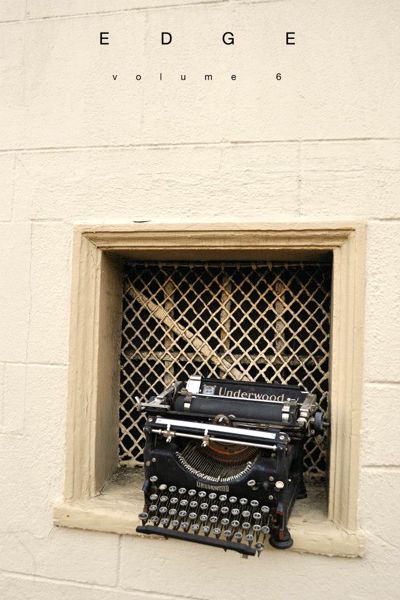
"Edge" -- now in its sixth volume -- is put out annually by Tahoe Writers Works.

It gives people a chance to hear the words – and then be inspired to pick up a copy of the book to read it in its entirety. One of the great things about the reading is the inflection of the writer’s voice is real as opposed to what the reader might hear in her mind. And then there is the back-story to the passage being read that is only available during a reading like this one.

Frank Riley and Joan Douglas started the evening by reading their essays that are captured in “Tahoe Blues” – which is 60 micro-essays and flash fiction all about Tahoe. Bona Fide Books in Meyers published the book earlier this year.

Riley takes people on a hiking escapade that involves getting close enough to know what a bear’s breath smells like.

Douglas’ was a bit eerie to read – not to mention disturbing. Hearing it was even more ominous. Living in the lake after dying. The sounds of people on shore, but unable to make any noise. All the children she is surrounded by. It is haunting. While it’s well written, it’s just not a Tahoe I want to even think about.

A much happier take involving the outdoors was next. Tim Hauserman spoke from his cross country skiing book about all the types of snow – from boilerplate to butter to mash potatoes.

Suzanne Roberts was able to combine sex appeal and the outdoors as she read a chapter out of “Almost Somewhere” – a book about hiking the John Muir Trail. This vignette is about how three recent female college graduates go about getting a quarreling couple to leave their campsite.

Roberts and Scott Lukas, who was the next reader, teach at Lake Tahoe Community College. Roberts is in the English department, while Lukas is a professor of anthropology and sociology. Their books clearly reflect their different specialties.

Lukas read from “The Immersive Worlds Handbook: Designing Theme Parks and Consumer Spaces”.

Steve Robinson’s delivery is so refreshing it makes me want to read “Why Stevie Can’t Date”. He describes the book as a collection of autobiographical short stories that are not all connected. The section he read this particular Friday evening was about when he was a 17-year-old who looked older than 21 working at the Sahara in Stateline and what a second date in the showroom meant. This was the time when Tahoe had its A-game when it came to attracting entertainment.

Author Stefanie Freele offered the audience a choice of topics – sex, revenge and Tahoe. The listeners picked sex and revenge. These were part of her collection of short stories in “Surrounded by Water”.

Last up for the evening was Jared Manninen who read segments from his book about his experience on the Appalachian Trail.

It was an evening that proved Tahoe is rich with writers.


Tough Mudder — where adults pay to play in the mud

By Jessie Marchesseau

TRUCKEE – I was more excited than nervous driving up to Northstar on Friday morning to preview this year’s Tough Mudder course and try my hand at some of the obstacles.

Tough Mudder calls their events, not a race, but a challenge, and uses the tagline: Probably the Toughest Event on the Planet.

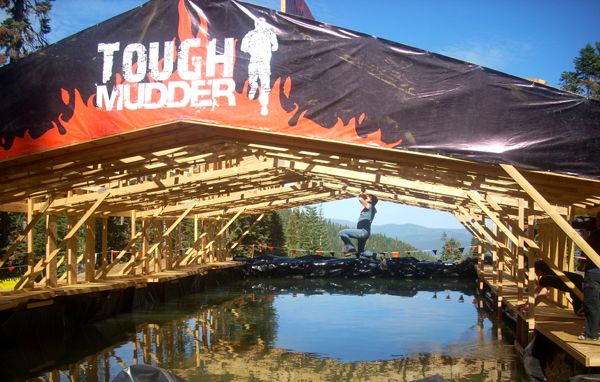
Nolan Kombol, head of course design for Tough Mudder, scales the Funky Monkey without dropping into the water. Photos/Jessie Marchesseau

I had taken their online Are You Tough Enough Quiz the night before and only scored a 75. “Maybe Mudder” it said. Had I chosen the wrong mustache on Question 4? Whatever the reason, I was apparently only questionably prepared.

The 11.3 mile course includes a nearly 2,000 foot elevation gain, 22 manmade obstacles, frigid water, barbed wire and mud, lots of mud.

Participants start their Tough Mudder adventure with the Kiss of Mud: crawling through a mud pit on their bellies underneath barbed wire strung just 8 inches off the ground. They then work their way through a series of other obstacles with names like Arctic Enema, Funky Monkey, Spider’s Web, Electric Eel, Everest and finally, the Electroshock Therapy.

These obstacles take them through icy water, across greasy, muddy monkey bars, over rope nets, into electrified waters, up, down, in and out. And did I mention there’s mud?

For participants starting to feel weary during the event, motivational signs are placed throughout the course with encouraging messages such as “Don’t panic, but if you do, keep running” and “Remember you signed a death waiver.”

If all of this sounds like your cup of tea, then you are not alone. Today’s event sold-out with 15,000 people signed up to participate, and though Sunday still has some openings, organizers are expecting to be close to the 5,000-person limit.

With numbers like that, Nadia Guerriero, general manager of the Village at Northstar, said it would be the biggest single-day event the mountain has ever seen.

With Northern California events held at Squaw Valley last year, and Bear Valley in 2010, Tough Mudder appears to be growing by leaps and bounds. The company started with three events in 2010 and approximately 20,000 participants. This year, they have 35 events scheduled around the globe with nearly half a million people signed up.

This is the first time the event has been at Northstar. Nearly a year of preparation has gone into this weekend, with three weeks of on-mountain construction. This was apparent when stepping off the gondola to find numerous banners, tents, a stage, semi-truck trailers with built-in beer taps, a corral of sani-huts and a 15-foot high quarter pipe named Everest.

Though Everest is actually near the end of the course, it was our first challenge of the day. The object: run up it. I was wearing my hiking shoes, so I was totally prepared for this one. As it turns out, running up a quarter pipe is about as impossible as you would expect it to be. However, sliding back down on your rear is a pretty fun way to fail. I did it several times, not minding the dirt smearing up my back.

We had the advantage of attempting to climb Everest on a dry surface with dry shoes, enabling me and my media cohorts to get within inches of reaching the top. However, by the time participants hit this one, they will likely be wet and muddy, to say the least. The key for this one: teamwork, which is something Tough Mudder encourages. Once they reach the top, people help lift others that last little bit. Some will make human pyramids, climbing over each other to the top.

After giving up on summiting Everest for the day, we piled into Rangers which are essentially four-wheelers that seat five people, and headed uphill for a visit to the Funky Monkey. As we rounded the corner, a 2-foot-by-6-foot structure resembling the framing stage of a garage appeared. The orange sign above indicated it was, indeed, the Funky Monkey.

This obstacle gets its name from the monkey bars that span between what would be the roof rafters. I remember being an expert at the monkey bars in elementary school, but am pretty sure I have not laid a hand on one in a couple decades. Like everything in the Tough Mudder, these monkey bars have a twist, quite literally: some of the bars spin. Top it off with a 5-foot-deep pool of chilly water below and now you’ve got a challenge.

Nolan Kombol, head of course design for Tough Mudder, hopped right up and showed us how it’s done. Then he did it again for a photo op. Still no takers from the group. I stepped to the edge and peered down. The water was green and murky, definitely not Lake Tahoe.

“How deep is it?” I asked.

Five feet. Almost as tall as me. Do I really want to get that wet? Maybe if it were 3 feet.

I reminded myself, “I’m here to have fun,” and grabbed hold of the metal bar overhead. I swung my other arm to the next bar and I was committed. The first half of the bars are on an incline as they travel up the roof line. I swung from one to the next, some of them turning slightly as I grabbed on. The group was shouting words of encouragement from the sideline and I kicked my legs as instructed.

Up the roof, then back down. My hands were getting a little tired, but I really did not feel like swimming. As I reached the other side, it took an extra swing to get my feet once again over solid ground, and I was done. Happy to be dry, my heart was beating a little fast, and I felt a definite sense of accomplishment. This could be addicting.

Next up for the challenge was Lindsay “with an A” Romack, the morning show host on 101.5 Truckee Tahoe Radio. She put forth a valiant effort, but did not come out nearly as dry as I did. The gasp she let out as she hit the water indicated that it was surely not a heated pool.

There were no other takers for the Funky Monkey, leaving Romack and me feeling just a touch braver than the boys as we headed back to the gondola.

So what is it about these strange, messy events that is so appealing to thousands of people?

“I think it’s really a way for people to challenge themselves without worrying about winning,” said Kombol. “It’s a way to get out and kind of act like a kid again.”

And plenty of people are willing to pay for the chance to act like a kid again, forking out registration fees of $90-$200 per person, a portion of which Tough Mudder donates to the Wounded Warrior Project.

It may sound like a lot, but after having the chance to play a little on the course, I have a feeling I may find myself joining the masses next year. After all, the quiz did say “maybe Mudder”… next time I will choose a cooler mustache.

—–

Note: More information about the Sept. 22-23 event at Northstar is online.

ngg_shortcode_3_placeholder (Click on photos to enlarge.)


LTCC students learning the impact of gender bias in ads

By Susan Wood

While politicians declare war on women’s issues, the battleground actually started long ago in the media world.

This is what longtime Lake Tahoe Community College sociology Professor Scott Lukas has discovered.

A decade ago, Lukas focused on gender bias in advertising for one of his sociology classes. His students became so widely interested they asked him for the PowerPoint presentation. The topic became so intriguing, Lukas took the 50 images he gathered depicting women in compromising, denigrating positions and installed them with analysis into a website.

The exploitation of women in ads is the subject of a class at LTCC. Photo/Provided

The site has grown to more than 3,000 images. Lukas still calls it “a work in progress” despite having worldwide readership.

The topic that now features television shows has morphed into its own class – and started this week at LTCC called Gender. (It’s under the Sociology Department.)

Lukas, who has made presentations on the project, including one before the LTCC board, went on a sabbatical from teaching last year to complete the project. This enabled him to delve deeply into how simple images may spur sexism, violence, child abuse, homophobia and even torture.

Noting a curious situation, the project’s report asks: “Why should we accept the association of a product, such as a stereo system or a table and a sexualized woman?”

So why should we care and why can’t we tune out what we don’t want to hear or see?

“Everyone is impacted by gender issues because the effects can be tragic,” Lukas told Lake Tahoe News, further citing the Jerry Sandusky case as an example. The former Penn State assistant football coach was convicted of severe child abuse charges, including rape.

A major concern is in a society where the population picks up a barrage of images that show women and children being abused, objectified or sexualized (even in the mildest form) desensitizing effects take place. One exhibit on the website highlighted a television show called “Toddlers and Tiaras” in which a young girl is dressed up as the prostitute character in the hit movie “Pretty Women”. And in an episode of “America’s Top Model,” models were asked to pose as crime victims.

These images are prevalent in “Big Daddy” ads with professional racecar driver Danica Patrick breaking the mold for women in the workplace resorts to her looks to sell the product.

“In a sense, ads have gone backward,” Lukas said of the pendulum swinging for women’s equality.

“We laugh at it all the time,” South Shore veteran ad man Bruce Rettig said of the times he and his wife watch ads on television.

In the big picture, Rettig called objectifying women as the “Barbie syndrome” in which girls want to obtain the body of a perfect model and that if you look at the demographic the ad is reaching, one might find that “maybe a large segment” looks to the images to tell them who to look up to or aspire to be. Then, there’s the obvious – sex sells.

“It seems that way as a part of human nature. It’s a shame,” Rettig said.

Even a small town like South Lake Tahoe cannot escape stereotypes that perpetuate the images – no matter how innocent they seem. Take the casino ads that show women in tight-fitting outfits wildly dancing and partying. Sure, they look fun. But they represent something larger going on at a societal level.

“Everyone is impacted by gender issues because the effects can be tragic.”          — Scott Lukas

“We have nothing to the level of Las Vegas or Los Angeles, but it’s still there,” Lukas said, referring to male-dominated sexism. “Awareness is key. We should be aware we’re under the influence of these ads.”

When Lukas first brought the topic to his classroom, he encountered a mixed reaction from students.

“The men felt more threatened. They learned the material, but they thought of it as propaganda,” he said. Their behavioral theory was: “If you have differences in the sexes, men are perceived as weaker. That’s part of their resistance,” Lukas added.

The professor especially witnessed resistance when the class discussed how former President George W. Bush brought back the “macho president” after the 9/11 terrorist attacks.

The subject of machismo hit close to home for one of Lukas’ male students, Jose Pena.

The origin of “machismo” comes from Spain, however its influence as an exaggerated display of male dominance over women spans many nations.

The conversation struck a chord with Pena because of his Hispanic background. Although he said he didn’t witness these types of relationships in his family, Pena has seen the behavior in some of his male friends when it comes to how they view their mates.

“This kind of goes hand-in-hand with the aspect of treating women as second-class citizens,” Pena said, citing the lack of equal pay for women and few breaking the glass ceiling. “I guess this would be the American equivalent of machismo.”

Nonetheless, Pena said he’s optimistic about what the future brings, but agrees it’s “an uphill battle” for society to accept the notion of “all totally equal in this land of opportunity.”

Progress may start with one person.

“I am a male that will forever recognize the hardships that females face on a daily basis. Like my mom always said: ‘For every bad person out there, let’s just hope that there (are) two more good ones to replace the bad one.’”


Lake Tahoe Wildlife Care busy with birds, bobcats and bears

By Tom Millham

As some of you may be aware, we now have five bobcats in house. We have had a total of six this year, which is the most we have ever had.

The one we got in about a month ago was just with us for about three days after being hit by a car in the Woodfords area. We got her back so she could – hopefully – take care of her babies.

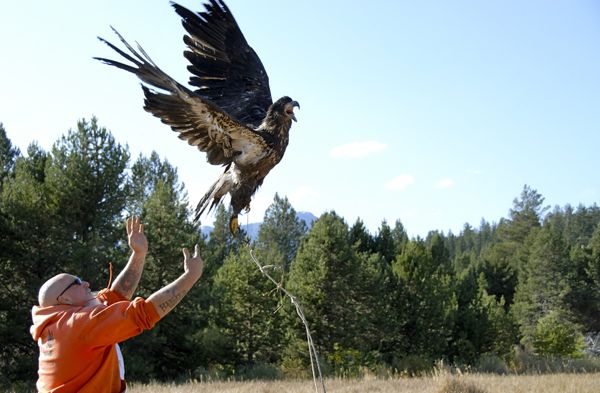
LTWC volunteer Wayne McKnight throws a golden eagle into the air as a way to exercise it. Photo/John Adamski

Of the five we have left, three of them came in on May 20, the second day of our annual training seminar. About three weeks ago, one of those original three was limping in our bobcat cage. As it turned out, she somehow broke her right front leg.

Dr. Kevin Willitts took an X-ray and determined the exact damage, then took her down to Reno for a specialist to perform the surgery, which was successful. However, for the next three weeks, our instructions were to leave her alone as much as possible to allow her to heal.

Willitts took a follow up X-ray Sept. 20 and determined that she has healed about as much as she is going to. So, after she woke up from her sedative, we let her out of her pet carrier to be with her two siblings. The three of them have been getting used to each other and so far no fur is flying.

For more than 25 years, Willitts has been there to volunteer his time for the betterment of the wildlife entrusted to LTWC.

Yes, we still have Chips and, now, Sierra. Chips came to us from the Chips Fire near Lake Almanor about 2½ weeks ago and Sierra came to us from the Sierra Army Depot near Herlong (just south of Susanville) where he got separated from his mother. He is about one week older than Chips.

After we clear up Chips’ problem with Coccidia, we will be able to put the two together. Other than the Coccidia, Chips is doing very well and growing every day. Since we now have two cats, almost the same age, we will most likely raise them here at LTWC and then release them in a suitable environment early in the new year. We will keep you updated on all five bobcats.

On another note, we will be releasing another golden eagle Sept. 23. We plan to meet at LTWC at 10am, then caravan up toward old Highway 40, west of Donner Lake. The exact location will be determined Friday. Anyone who would like to join us is welcome. We anticipate the release to take place at or around 11:30am.

Tom Millham is secretary-treasurer for Lake Tahoe Wildlife Care.

Riley Rettig shot this video of the Lake Tahoe Wildlife Care eagle release earlier this summer near Carson Pass: