Fabrication business to add jobs at Zephyr Photonics
By Northern Nevada Business Weekly
Zephyr Photonics Inc., a manufacturer of highly sophisticated optical devices, said last week it’s offering manufacturing services at its plant at Lake Tahoe to outside customers.
The upshot may be increased employment over the next couple of years for the company, which has employed about 30 people in recent years.
The company previously handled only its own work at the 17,000-square-foot Zephyr Cove facility which includes a 10,000-square-foot clean room.
Tom Steding, chief executive officer of Zephyr Photonics, said the company’s new semiconductor fabrication and foundry services unit was created to meet the needs of companies that design and sell semiconductors but outsource the actual manufacturing to businesses known as semiconductor foundries.
The production services are an outgrowth of development and testing that Zephyr Photonics has provided under contract with customers in the technology sector, Steding said.
Zephyr has developed and manufactured optical-interconnection equipment that’s used in harsh environments. Its customers include the U.S. Defense Department and industrial companies in the aerospace and energy sectors.
Tim McAllister, Zephyr Photonics’ vice president of business development, said the company believes that the standards established for defense and intelligence contracts will help it win private work as well.
McCallister said the company expects to ramp up the contract manufacturing through 2013 and 2014, hiring at first to cover additional shifts within its current facilities.
Zephyr Photonics plans to further increase its production capacity with new facilities and new equipment next year, he said.
The new business unit marks another step in the repositioning of the company under new ownership.
The company was launched more than 25 years ago as Opticomp, and it operated as a small, stealth research firm that handled more than 60 research grants for federal agencies and defense contractors.
Torch Hill Investment Partners of Washington, D.C., bought the Lake Tahoe company in 2011 with a plan to move its work into the light of product-oriented commercial operations.
Since then, it’s been developing contracts with companies such as Teledyne Microelectronic Technologies of Los Angeles to move its technology into commercial applications.
From humble start, largest U.S. ski resort turns 50
By Susan Wood
VAIL — With just a passing glance of the sweeping views off the Mountaintop Express chairlift at 11,250 feet, it’s difficult not to get naturally sentimental about how a vision of a mountaineering soldier turned into Colorado’s premier ski resort and the flagship for a corporate empire running nine ski area properties. Heavenly, Northstar and Kirkwood are among them.
That’s because Vail Mountain Resort had modest beginnings.
In 1957, rancher and engineer Earl Eaton and Pete Seibert – who was a member of the U.S. Army’s 10th Mountain Division in World War II – climbed to the top of Vail’s distinct ridge that divides the front side and its massive back bowl area that stretches seven-miles across. The founding duo was seeking an adventure that would keep their feet in the mountains professionally and personally.
The One gondola opened in November at Vail. Photos/Kathryn Reed
Five years later in December, Vail opened with one gondola and two chairlifts – two-person seats with wooden slats, fewer than 50 employees and two bowls to frolic in, Sunup and Sundown. A lift ticket cost $5.
“It was small,” Pete Seibert Jr. told Lake Tahoe News.
Sometimes he remembers those days like they were yesterday. His late father was engrossed in getting the ski area off the ground, but had fun in the process.
“(Dad) used to say that if you’re doing it right, you don’t need a vacation. He never complained about what was going on. He loved the whole process. I think it was because he saw how each day’s progress fit into his ultimate dream. His stories were about the characters working on the mountain or the next ‘big thing’,” said Seibert, one of three children. “(Dad) passed on the ‘mountain’ side to me.”
The 57-year-old Vail real estate executive, who has worked for Slifer Smith & Frampton Real Estate for 20 years, grew to love skiing through his father.
“I would get out of school every day at 1 and skied every day, and that’s what my childhood was like,” he said.
What were his favorite runs?
This depends on the snow conditions. But the protégé has a fondness for China Bowl, especially in the spring with its grainy corn snow. The Genghis Khan run serviced by the Tea Cup Express chairlift provides wide-open, steep terrain that looks like something straight out of a Warren Miller film.
Then again, Seibert Jr. was influenced by the legends of the sport.
“Of all the runs we skied, I’d have to say Riva Ridge was my favorite. I learned to love big sweeping turns from following (dad),” he said. “The other part to skiing Riva is to roll right into Tourist Trap without stopping.”
The 4-mile run that starts between the Mountaintop Express and Northwoods chairlifts empties into the Vail Village. At the time, the Village, as it has become to be known, was a small collective of shops the neighborhood children roamed in until it was time for supper at home.
“(The kids) always skied with friends and visited the shopkeepers.
“Everybody knew us. We would go to the deli and if a parent was looking for us, they’d say: ‘He was here 15 minutes ago.’ In the summer, it was real (Huckleberry) Finn stuff,” Seibert said.
Vail has embedded itself into Seibert’s life.
“In the beginning, everybody was in it for the success of the area. It took teamwork to survive – from the (ski area) employees to the shopkeepers,” he said. “(Dad) was convinced it would be successful from the start.”
Seibert left Vail to attend Middlebury College. He returned to Vail to work on the ski patrol, followed his father to Snowbasin, Utah, then moved on to Sun Valley, Idaho, working at Bald Mountain. He came home to Vail 26 years ago, and now with children of his own, is dug in to his home base.
A lot has happened along the way to this gigantic ski mountain that lives up to its tagline: “Like nothing on Earth.”
The skiable terrain amounts to 5,289 acres. Almost 200 runs are blanketed with an average of 366 inches of snow per year. Vail’s staff members provide complimentary tours including those reaching Blue Sky Basin – the farthest back bowl that provides some of the most fun one can have outside. It opened a dozen years ago. Two years after, Seibert Sr. died of cancer at age 77.
Today, express chairlifts line the multi-mountain resort and spread the million skiers and snowboarders out. By California’s standards, it’s hardly crowded – even on the weekend.
“While the technology has given us faster lifts and better equipment, the best part is we get more runs in, and there is more to ski,” Seibert said.
In honor of its 50th anniversary, Vail replaced the Vista Bahn chairlift and unveiled in November the One Gondola based at the village. The 10-seater cars (probably six-to-eight comfortably) comes equipped with WiFi capability for the technology crowd and heated, padded seats for when it’s chilly. It ends at the mid-Vail area.
Much has changed in chairlift technology.
So to appreciate what it had in the past, the largest ski resort in the United States placed an original Bell Gondola car at the village base where the new one is located.
On a recent run, the new gondola stopped for what seemed like half a minute. As passengers relished the quiet scene, a Denver man noted: “This doesn’t usually stop this long.”
The ride time is just less than eight minutes, traveling 1,200 feet per minute.
“One” – named as a tribute to Colorado’s first “Bell” gondola — is swift, comfortable and apparently reliable.
Of the 111 cars, the 50th is painted gold as a reminder that the lift represents an integral part of Vail’s celebrations honoring its heritage.
Along with its returning events such as the Taste of Vail and Vail Film Festival, Vail has scheduled a few new ones for its big occasion. They started last December and span the ski season into April.
In February, the ski area switched its attention from the downhill skiing exploits of mega host athlete Lindsey Vonn to snowboarding. The ski area introduced a 22-foot halfpipe in order to host the Burton U.S. Open Snowboarding Championships, which was staged in Vermont for the last 30 years.
Vail plans to cap off its 50th birthday season with Ski Heritage Week. The April 8-15 event will feature the U.S. Ski and Snowboard Hall of Fame Annual Induction Ceremony. Seibert was inducted in 1980.
Fitting indeed, considering that steps away from ground zero for Vail Mountain lies the Colorado Ski Museum. Inside, the historic site plays a DVD featuring the founding of the resort as a sentimental, passionate tribute to Seibert and company.
One could almost imagine what Eaton and Seibert were thinking when they hiked to the top.
“It’s a once in a lifetime opportunity for me to be a part of something that has significantly contributed to who I am and how I feel about skiing and snowboarding, the mountain, the town and my home,” Vail Senior Vice President and Chief Operating Officer Chris Jarnot told Lake Tahoe News.
One can visit a small plaza called Seibert Circle off Bridge Street built in Seibert’s honor. Riders may also feel his spirit in Pete’s Bowl off Blue Sky Basin. Others may experience the late Eaton’s by dropping into Earl’s Bowl on the perimeter right alongside Pete’s.
ngg_shortcode_0_placeholder (Click on photos to enlarge.)
2 groups sue to stop implementation of TRPA Regional Plan
By Kathryn Reed
The Sierra Club and Friends of the West Shore filed a lawsuit Monday in U.S. District Court in Sacramento to stop the Tahoe Regional Planning Agency’s Regional Plan from taking effect in its entirety.
“We hope to achieve a reconciliation with the TRPA over their plan and get it strengthened,” Laurel Ames with the Tahoe Area Sierra Club told Lake Tahoe News. Feb. 11 was the deadline to file such a lawsuit.
Those two conservation groups had been vocal at most of the meetings leading up to the adoption of the Regional Plan in December. The new plan replaced the 1987 document.
Politics at Lake Tahoe can be as turbulent at the lake itself. Photo/LTN file
Water quality, air quality, local delegation, appeals process and coverage are some of the main issues the two groups have problems with in the latest Regional Plan.
“This lawsuit shows just how out of touch the Sierra Club is with the realities that face Lake Tahoe today,” TRPA Executive Director Joanne Marchetta said in a statement.
It will be up to the court to decide if an injunction is put in place, which the groups are seeking. For now, though, the bi-state regulatory agency is acting on the belief the 2-month-old plan is the law of the land.
“It is in effect until a judge or some other process tells us it is not,” Jeff Cowen, spokesman with the TRPA, told Lake Tahoe News.
The League to Save Lake Tahoe, often a lead agency when comes to suing the TRPA, is not a party of the lawsuit. In a prepared statement Executive Director Darcie Goodman Collins condemned the suit.
“The League is disappointed that litigation has been filed on the Regional Plan. This is the wrong move for Lake Tahoe. While litigation is a useful tool of last resort, in this case, it will only delay the implementation of any positive environmental benefits contained in Tahoe’s new Regional Plan. While the plan is not perfect, it is a product of community collaboration and compromise, and is designed to be adaptive,” Goodman said.
An unknown is what the state of Nevada will do in regards to Senate Bill 271. That remains in place with the threat of the Silver State pulling out of the bi-state Compact in 2015. Passage of a Regional Plan is part of what SB271 was about. But if the Regional Plan unravels, so might the plans of some Nevada lawmakers to repeal SB271.
“Any litigation will likely result in the dissolution of this Compact and no Compact means no regional environmental standards for Lake Tahoe. Preserving the Compact and implementing the (Regional Plan update) will provide the greatest long-term benefit to the lake and its communities,” Goodman said.
S. Tahoe council votes to challenge property owner
By Kathryn Reed
The South Lake Tahoe City Council is ready to fight.
“I believe our rules have purpose and when they are broken knowingly, we should not settle,” Councilwoman Brooke Laine said.
The four met Feb. 11 to continue last week’s discussion of whether to take the City Attorney’s Office recommendation to settle the dispute over the property at 1348 Wildwood Ave. or let the court decide. It was a 4-0 vote to litigate. (Councilman Hal Cole recused himself because he owns property in the vicinity.)
South Lake Tahoe is going to court to make the owner of the parcel at 1348 Wildwood Ave. adhere to the easement tied to the property. Photo/LTN
Councilwoman Angela Swanson said she could not reward someone who started construction knowing there was an easement on the property precluding such action.
Today the parcel has a foundation poured, and plywood up with openings for a garage, front door and windows. The court will decide if a full house is erected or if it returns to open space like the U.S. Forest Service lot next door.
A case management meeting will likely take place in March, with a trial beginning six months to a year from now.
Attorney Paul Gumina spoke on behalf of his client Thang Vu. Vu and his now ex-wife Jennifer Khuu bought the property in 2002, were issued a building permit in 2007, had that revoked in 2008 when the easement blocking the building surfaced, and sued the city in 2009. Khuu now owns the property, but Vu based on court records, is the plaintiff, according to Gumina.
“They knew they could not build on the lot,” Gumina told the council Tuesday morning. “Then they embarked on the long process to turn it from unbuildable to buildable.”
They did this, in their belief, by securing a building allocation and building permit. But the easement restricting developing the parcel was never altered. While Gumina told the council Vu had the allocation from the Tahoe Regional Planning Agency before obtaining the building permit, the opposite is what happened.
In addition to that, Vu and Khuu falsified their application to the city, as noted at the meeting by City Attorney Patrick Enright.
“On the building application it says there are no restrictions,” Enright said, in reference to what the applicants wrote.
But Gumina had already admitted to the council that his client was well aware of the easement.
El Dorado County public defender retiring
By Kathryn Reed
When Rick Meyer wakes up a week from today he won’t be getting dressed for court, or even the office. And while his days as a criminal defense attorney will not be over, they will be when it comes to working for El Dorado County.
On Feb. 15, he retires as chief public defender, a position he has had since 1999. Meyer, 59, started working in the El Dorado County Office of Public Defender on Sept. 12, 1983.
Rick Meyer, El Dorado County public defender, will retire on Feb. 15. Photo/Provided
He has had his share of notorious clients through the years, pointing to the Coddington and Platz cases as two of the more memorable. Meyers described them both as challenging, and ones that consumed numerous hours.
Herbert James Coddington, who was in his 20s at the time, murdered two women at his residence in the Tahoe Verde Mobile Home Park on May 16, 1987, and kidnapped and sexually assaulted a 14-year-old and 12-year-old girl. He is sitting on death row.
In 2003, Lisa Platz was found guilty of the 2001 murder of her 9-year-old daughter, Rebbeca Aramburo. The child was found with her throat slashed inside a tent at Campground by the Lake. Platz was sentenced to life in prison. Her boyfriend James Csucsai hanged himself in jail.
“The public doesn’t always understand the intricacies of these things, how when you get these clients they are real live human beings you develop relationships with,” Meyer told Lake Tahoe News. “We are defending the constitutional rights of these people. Ninety-nine percent are good people who have done something wrong.”
While the number of residents and tourists in town has declined in the nearly 30 years Meyer has been a public defender, the caseload has remained fairly steady. A change is that in the 1980s and 1990s he said there were more drug cases than there are now.
Meyer started his professional career with a private law firm in Placerville after graduating from law school in 1978. He was recruited to join the Public Defender Office in 1983. He started off in South Lake Tahoe. When he was offered the top job in the department he said he’d take it as long as he could stay in Tahoe.
(Meyer is the only county department head based in South Lake Tahoe. When a replacement is named that person will be working out of Placerville.)
El Dorado County Superior Court Judge Suzanne Kingsbury first knew Meyer as a colleague. Meyer hired Kingsbury to work for him in the early 1990s.
“It was Rick that encouraged me to run for an open seat on the Superior Court that became available when Judge Terry Finney retired. I was not, nor am I now a political person, and the thought of running for office was abhorrent to me. I wasn’t sure that I could do it, or that it was the job for me,” Kingsbury told Lake Tahoe News. “Rick’s harping, hectoring and cajoling eventually wore me down. Those same persuasive powers have served him well during his legal career.”
Meyer, now that he is leaving and has nothing to gain by going on the record, spoke of his mutual respect for Kingsbury and the other jurists who are or have been on the local bench.
“We are very blessed in this community to have really fine judges. They all care about people and are uncommonly willing to go out of their way to do the right thing,” Meyer said.
Meyer has long been a champion for those who don’t always have a loud voice.
Beyond the courtroom, Meyer has been on the Family Resource Center board since 1999. Currently, he is president.
“He really works for the underdog. He has always been very conscious of the fact that the Latino population doesn’t get what the rest of the community gets,” Delicia Spees, executive director of the Family Resource Center said.
“I’m amazed how many times when he calls when his clients need to do community service, need a counselor. I don’t see a lot of attorneys do that. They let their secretaries do that,” Spees added.
He doesn’t just talk a good game, but is also a man of action.
Meyer with then Judge Finney was able to turn hard dirt that wasn’t being used for anything into a soccer field next to the center. This allowed the kids at the center to have a respectable play area.
While Meyer has a job that brings him into contact with people who are accused of a variety of crimes, he sees the good in most of them.
“Rick is a tireless advocate for the less fortunate members of our community. In particular, he is a champion for our Latino residents, especially the youth,” Kingsbury said. “He is not afraid to take on an unpopular cause if he believes it to be worthy. I don’t always agree with his positions, but respect what he has to say.”
Meyer will continue to work as Alpine County’s public defender. For the last two years it had been contracted out through El Dorado County, but will change next week to Meyer doing the work as a private individual on a contractual basis with Alpine.
But what Meyer really wants is to be hired full time by Lake Tahoe Community College to teach political science. He is an adjunct faculty member now. About five years ago he went back to school to obtain his master’s just for this purpose.
He also expects to be spending more time with his wife at their Echo Lake cabin, traveling and perhaps teaching abroad.
“It’s been interesting, challenging and very rewarding,” Meyer said of his time with El Dorado County. “All of us who do defense work love our work. It’s very gratifying to stand up for somebody.”
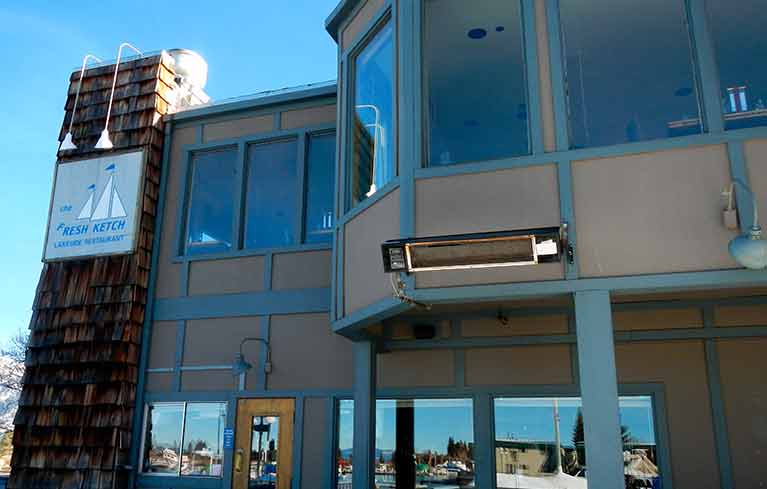
Fresh Ketch under new ownership
The Fresh Ketch in South Lake Tahoe has new owners. Photo/LTN
The Fresh Ketch in South Lake Tahoe has new owners.
Longtime owner Bob Hassett has sold the restaurant to the majority owners of the Tahoe Keys Marina – Donna and Robert Krilich of Illinois.
Details of the transaction that closed in January have not been disclosed. Neither Hassett nor Donna Krilich returned calls. This means it is not known if there will be changes coming to the waterfront eatery.
The El Dorado Count Assessor’s Office lists the value of the property and business at $1,224,913.
The Krilichs bought the Tahoe Keys Marina in early 2009 for more than $20 million. South Shore real estate agent Jean Merkelbach has a minority interest in the marina, but is not part of the restaurant deal.
Robert Krilich has an extensive criminal history.
According to court documents, “(Robert Krilich) has been convicted of racketeering and other offenses related to a scheme that included bribery of public officials in order to obtain assistance in the approval and financing of construction projects.”
He was also convicted of drunken driving in South Lake Tahoe in 2009.
— Lake Tahoe News staff report
Factory Stores at the Y going under
This South Lake Tahoe center used to be bustling.
By Kathryn Reed
One by one businesses at the Factory Stores at the Y have been closing. Now the whole center is on the auction block.
While the notice of default was filed in June 2012, the trustee sale is scheduled for Feb. 27 in Placerville.
Sisters Shannon Casteel and Nancy Irmer, who own the center at the corner of highways 89 and 50 in South Lake Tahoe, use the business name Two Sisters LP. They are based in Genoa. Neither could be reached for comment. Their property manager, Chad Coons, did not return a call.
The sisters bought the center from their brother Gary Casteel in 2004. He still operates the Heavenly Village.
The sisters owe more than $8 million, according to documents.
At one time Casteel also operated Blue Willow Lingerie in the center with her daughter-in-law Lori McKinney.
The last anchor tenant, Adidas, left in December 2011.
Much of the 51,811-square-feet of leasable space has sat empty for years.
Another business is leaving – Fragrance Outlet. Doors will probably be locked for good in April.
Gary Campbell who has operated the store for the last 18 years told Lake Tahoe News he just couldn’t make it anymore. He has significantly slashed prices to get rid of the inventory before he closes shop and moves out of South Lake Tahoe.
“It was pretty obvious when the mall was emptying out that they were in trouble. But they never told us they were in trouble. But when 70 percent of the stores are vacant, they had to be,” Campbell said.
There was a time when it was difficult to find a parking spot at the outlet stores. Locals and tourists would shop there. After the Outdoorsman closed, the factory stores offered one of the few places in town to be able to buy reasonably priced clothes, gifts and other goods.
Campbell said the decline at the factory stores has been combination of things – “Indian casinos, poor economy and poor management for the mall.”
He added, “I just think the whole town is struggling.”
Outdoors provides author solace from abuse
By Kathryn Reed
Tracy Ross reads from “The Source of All Things” at LTCC on Feb. 7. Photo/Kathryn Reed
With raw honesty, Tracy Ross has confronted her demons in a poetic, thoughtful manner that makes listeners want more and yet has them feeling a bit voyeuristic because of that desire.
Ross was at Lake Tahoe Community College on Feb. 7 as part of the Writers’ Series. She was reading from “The Source of All Things”, which came out in 2011 and in paperback last year.
The accomplished magazine writer left her comfort zone of being a journalist to write this memoir. While the story is new to readers, it has been Ross’ reality since 1978. That’s when the abuse began. She was 8.
It was in 1985 that she first wrote a poem about what was going on. She continued writing in college.
Then Backpacker magazine paid for her to return to the Sawtooth Mountains of her youth. It was time to ask her father four questions. It was 2007 and Ross was 35 years old.
(During the talk she didn’t reveal the questions or answers, just that it took another meeting to get her dad to answer the fourth question.)
Not knowing if she wanted her story in print, her editor encouraged her to write the essay and they’d evaluate it and decide from there. It was published in Backpacker in December 2007. It won the National Magazine Award in 2009 – the highest award for a magazine writer.
And then she flushed it out to make it the book that people were lining up to buy Thursday night.
At LTCC she read three passages – interrupting each to add more detail for the more than 50 people listening.
With her forte being outdoor writing, Ross weaves in the splendor of nature in the book.
It’s a complicated tale. And she says to this day her relationship with her parents is complicated. They remained together through the strife. She still calls him dad. (Her biological dad died of an aneurysm while hiking in the Sierra. Ross was an infant at the time. Her mom remarried when Ross was 4.)
Ross says her relationship with her mom is the hardest.
“She was weak. She was so unprotective,” Ross said. “She has tried to apologize.”
Ross tried telling her mom, friends, others about the abuse and no one listened. Finally, a friend’s mom called the police. But this was the 1980s and in Idaho they didn’t know what to do with such a case. Her dad confessed to touching her once. (The abuse started when she was 8 and ended at age 14.) He had to stay away from her for a year and then the family was put back together.
Ross left. She found a boarding school in Michigan. There she reconnected with the outdoors. And finally, after college, she spent time in Alaska. That, she said, is where she was able to come to terms with what happened as a child.
But she also told the Lake Tahoe audience that hers is an evolving story. She’s married with children. And one day Ross knows her kids will read the book and that their relationship with their grandfather is bound to change.
Clock ticking on South Shore loop road time line
By Kathryn Reed
STATELINE – In two months the Tahoe Transportation District board expects to know which alternatives for the loop road will be studied in the environmental documents, what businesses in the affected area think about the economic analysis, and it hopes to have finally appeased the South Lake Tahoe City Council with a nighttime airing of the issue.
Much of Friday’s TTD board meeting centered on what the newly created U.S. 50 South Shore Community Revitalization Project Business Review Committee should actually do.
This group has been tasked with reviewing the economic analysis that has been prepared. While it was stated they would perform a “peer review” of the financial document, that phrase was loosely used with acknowledgement it has many meanings.
They will determine the pros and cons of the economic analysis.
Their exact tasks will be outlined in a letter still to be written.
The area that would be impacted by the loop road. Photo/TTD
The following people will be on the committee, with those with an asterisk having until Feb. 15 to complete their form. Next to their name is the business or property they represent and classification/criteria they meet, according to TTD. Parenthetical information is from LTN.
• 986 Park Hotel, Chris Minnes, small local owned tourist accommodation. (Minnes manages the property. The owners are from Southern California.)
• Heavenly Mountain Resort, Pete Sonntag, large corporate recreation provider.
• Lake Tahoe South Shore Chamber of Commerce, B Gorman, local collective business representative.
• Tahoe Prosperity Center-Carson City rep, Lee Plemel, regional collective business representative. (TTD employee Alfred Knotts called the TPC a neutral party.)
• Sidestreet Boutique, Barbara Parina or Tara Parina, local small retail.
• Tahoe Beach Club, Bob Mecay, large tourist accommodation. (Their project is undeveloped at the end of Kahle Drive in Stateline where the trailer park is.)
• Naked Fish landlord, Mike McKeen, small commercial property owner.
• Village Center landlord, Terry Hackett, large commercial property owner.* (TTD calls it Crescent V Center.)
• Dog Dog Cat, George Richter, local small retail owner.*
• Duck Tours, Shawn Kerney, small local recreation provider.*
• Holiday Inn Express, Pete MacRoberts, large corporate tourist accommodation.
• Raley’s, TBD, large corporate retail.*
• Stateline Brewery, Debbie Brown, local restaurant-dining.*
• Pacific Crest Gallery, Rosemary Wool, local small retail.
• MontBleu, Jack Fisher, large corporate tourist accommodation.
• 7-Eleven-Subway landlord, Glyn Burge, small commercial property owner.
The board agreed to see if someone from the commercial real estate industry wants to be on the committee.
McKeen suggested Kathay Lovell, who owns the Bottle Shop, and Dave Jinkens, a consultant to opponents of the loop road, be added.
The economic analysis, according to TTD Executive Director Carl Hasty, will also undergo independent review by HDR consulting, which he said has expertise in resort finance.
While the TTD board will consider the committee’s recommendations, they are only that. Nothing that group suggests is binding. The committee is expected to meet Feb. 27, March 6 and March 20. Meetings will be open to the public. The facilitator has yet to be named.
Mark Rayback with Wood Rodgers, the firm hired by TTD to do work on the loop road project, will be the project engineer going forward.
The loop road is a proposal to make Highway 50 near Heavenly Village and then beyond the Stateline casinos into a city street and turn the city street behind Harrah’s-MontBleu into a state highway.
There will be a meeting in a month before the South Lake Tahoe City Council to discuss all things loop road. The expectation is a bit of history will be told, why the loop road is being considered and the alternatives still being considered.
Norma Santiago, El Dorado County’s TTD board member, wants the public to understand “no decision has been made.”
“This is just the kickoff for land use and economic vitality choices for that area,” Angela Swanson, who is the city’s rep to the TTD board, said. The city will begin working on its Stateline area plan in March, too.
Dates to know:
• March 12, 6pm South Lake Tahoe City Council meeting to discuss loop road; Lake Tahoe Airport.
• March 22, 9:30am Tahoe Transportation District meeting to receive progress report from Business Review Committee; Market Street office in Stateline.
• April 12, Tahoe Transportation District meeting to hear final report from Business Review Committee. (Time, location forthcoming.) Board likely to decide what should be studied in environmental documents.
Lack of oxygen in Lake Tahoe could adversely affect people who have heart conditions
By Kathryn Reed
Living at higher elevations has health benefits and drawbacks.
Thin air means an increase in red blood cells, which is one reason athletes like to train at high altitudes. They tend to perform better when they return to sea level. But mountain sickness hits some who gain too much elevation or do so too fast. Then there is the issue with the inability to get enough oxygen.
David Young with Barton Cardiology spoke before a crowd of more than 80 people Wednesday night at Lake Tahoe Community College about issues of the heart when it comes to living at 6,200 feet and higher.
The South Lake Tahoe doctor said he started seeing signs of sleep apnea with many of his patients. But these weren’t overweight people who would be more prone to that condition. These were fit Tahoe-ites.
David Young with Barton Cardiology talks Feb. 6 about how sleep apnea affects the heart. Photo/Kathryn Reed
“Clearly there was something happening to their respiration at night,” Young said.
Signs of central sleep apnea include:
• Restless sleep
• Poor concentration
• Nocturnal angina
• Frequent urination at night
• Awakening with sensation of gasping-choking
• Mood swings.
Not getting adequate oxygen can affect people who have a heart condition. People with severe sleep apnea are nearly three times more likely to have hypertension, Young said.
“Treatment of sleep apnea abolishes bradyeardia and asystole,” Young said. These are two types of heart conditions.
Atrial fibrillation is the most common malfunction with the heart. Between 32 and 82 percent with it also have sleep apnea.
“There’s a high rate in particular with what we see in Lake Tahoe,” Young said. “If I don’t correct the apnea, there is an 82 percent likely recurrence of the atrial fibrillation.”
He went on to say, “Sleep apnea is present in 76 percent of the patients with heart failure.”
It used to be that overnight sleep studies were the only way to deal with sleep apnea. Now people can use at-home monitors that are strapped to a finger and include being hooked to oxygen.
Young said the sure-fire ways to stay healthy living at higher elevations are to not be overweight, don’t smoke because that puts even more stress on the lungs, stay hydrated, limit alcohol and caffeine intake, and get a CalStar membership just in case.
—-
Note: Young will be repeating this lecture Feb. 13 at Sierra Nevada College in Incline from 6-7pm.
 The company previously handled only its own work at the 17,000-square-foot Zephyr Cove facility which includes a 10,000-square-foot clean room.