Drugs, mental health, no access to care = South Lake Tahoe’s key medical problems
By Kathryn Reed
South Lake Tahoe has more people per capita dying from Alzheimer’s compared to the nation. South Lake Tahoe’s suicide rate is higher than California and the country’s. More people smoke in South Lake Tahoe compared to the state.
Those were some of the stats dispersed to the South Lake Tahoe City Council on Feb. 19 by Barton Health officials.
In 2012, the South Lake Tahoe health organization completed a community health needs assessment. All nonprofit hospitals will be required to do these studies every three years as part of the Patient Protection and Affordable Care Act in the health care reform passed by Congress.
Nine main issues came up in the local study:
• Access to healthcare services
• Cancer
• Dementias, including Alzheimer’s disease
• Housing
• Immunization and infectious diseases
• Injury and violence prevention
• Mental health and mental disorder
• Substance abuse
• Tobacco use.
While Barton will address all of them, the three that will be the main focus are substance abuse, access to care and mental health.
Drug use in South Tahoe on a per capita basis is about four times what it is nationally.
“The study reaffirms what we are seeing in the emergency room,” Cline Purvance, Barton’s chief medical officer, told the council. “This started in the late 1990s when pain became the fifth vital sign. Assessing and treating pain became a big priority. We have swung too far.”
He said it’s time health care providers look at what they are doing. With online medical records becoming a reality, medical personnel will better be able to know who has prescribed what for each patient.
In addition to prescription drugs being a problem, marijuana, heroin, opiates, synthetic drugs and alcohol are all local issues.
The report shows a steady trend of local drug-induced deaths since 1999.
There is also a high rate of suicides in this area.
Health officials recognize drugs-mental illness-lack of health care can be tied together.
A psychiatrist was added to the payroll last year. And when the community clinic’s expansion is done this summer a psychologist will be hired.
Police Chief Brian Uhler said his officers see the drug and mental health issues every day. He pointed out how the area does not have a long-term care facility for those with mental issues.
More information about the report may be found online.
S. Tahoe policymakers stall on Lakeview Commons rules
By Kathryn Reed
Lakeview Commons is described as a success beyond anyone’s imagination. But it’s not a moneymaker. Not yet, any way.
Most events take a few years before they operate in the black. But the city of South Lake Tahoe can’t be in the business of subsidizing businesses. That would be called a gift of public funds.
Last year the music and standup paddleboard vendors were able to operate at Lakeview Commons for free. No other city owned venue allows private businesses to operate without paying a rental fee.
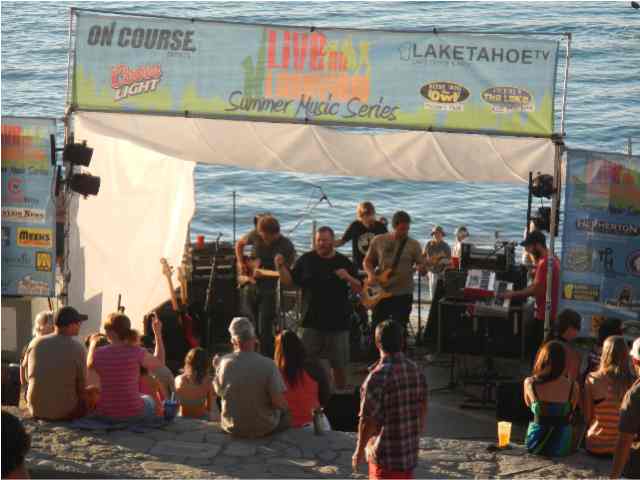
Thursday night Live at Lakeview concerts brought out hundreds of people each week. Photo/LTN file
While the events brought locals and tourists to the waterfront location, the city lost money by having to provide personnel for upkeep to the area. That was unbudgeted money.
On Tuesday, the council had before it an item that would have set guidelines for renting Lakeview Commons. Instead of acting as the policymakers they were elected to be, they put off making a decision until the March 19 meeting.
“We received a lot of input. We cannot write a policy that favors one business or person over another,” City Manager Nancy Kerry said at the Feb. 19 meeting. “My job is to protect the city.”
Rob Giustina, who owns On Course Events and put on the free Thursday night Live at Lakeview concerts, said he lost $30,000 in 2012. Chris Brackett with South Tahoe Standup Paddle, said he operated the Wednesday night races in the red — $18,700.
Both men agreed a fee is reasonable. What they take issue with is the proposed amount — $500 to $1,000 each day/night. The range depends on the day of the week and the number of people expected. It’s estimated these events might just need to pay the half-day rental price of $325. However, Giustina mentioned how he needs time for set up and clean up, so he could be tying up the site the better part of the day. How this would affect an event going on at the site earlier in day was not discussed.
The staff report says, “Fees are calculated based on cost of maintaining the facility as a result of events during the inaugural season 2012. Rates are reduced by 35 percent of midweek rental. Private parties or weddings will be charged hourly per approved master fee schedule.”
One of Giustina’s biggest issues was the proposal to not close Lakeview Avenue to vehicle traffic. He said his insurance rates would skyrocket without that provision.
Brackett said his projection for this summer is that the standup paddle races will again be a money-losing event.
“In the future we see it as being sustainable,” he told the council.
What he said the city is not taking into consideration is how the races bring in money to the whole town because it’s not just locals participating. Plus the Race the Lake of the Sky event in June has attracted international attention for South Lake Tahoe. Brackett said his events brought in $26,000 in hotel taxes for the city last year.
Also at the March 19 meeting the council is expected to award the concessionaire contract for Lakeview Commons as well as Regan Beach and Bijou Community Park. Those entities operate seasonally and pay the city a percentage of gross revenue.
This differs from the standup paddle and concerts that at least in 2012 didn’t directly pay the city a dime, but had free access to put on events at a $6 million taxpayer funded venue.
Tahoe Prosperity Center funding divides City Council
By Kathryn Reed
The majority of the South Lake Tahoe City Council on Tuesday decided to spend $10,000 in taxpayer money on the Tahoe Prosperity Center without knowing what it will be spent on.
Councilmembers Tom Davis, Hal Cole and Angela Swanson think increasing the city’s allocation to this nonprofit is a good idea. The city has now contributed $30,000 to the group.
Center officials have 60 or 90 days, whatever works for them the majority of the council said, to come back with a clear business plan.
“I would rather see the plan before we give them money,” Councilwoman JoAnn Connor said at the Feb. 19 meeting. And she’s the city’s rep to the center’s board.
Councilwoman Brooke Laine took issue with giving one nonprofit cash when the process has not been opened up to others as was done years ago.
Laine went on to say of the center, “It just feels like an additional layer of bureaucracy.”
Usually staff makes a recommendation to the council about the action to take. In this case, none was offered. It’s also not in the budget. The staff report from City Manager Nancy Kerry says, “If approved, funding would need to come from unassigned excess reserves for 2013.”
The Tahoe Prosperity Center’s website says this about itself, “Promoting regional sustainability through economic vitality, environmental stewardship and healthy communities in and around the Lake Tahoe Basin.”
Tom Greene, chairman of the center, presented to council, along with Christina Proctor. She called herself the interim executive director, while just a month ago she sent out a press release saying she was the flak for the group. There are no employees now – just people working as independent contractors. And there is nothing in the current budget, which operates on a calendar year, for projects – just staff.
“What this comes down to is this is an investment,” Greene told the council. “Our desire is not to come here every year.”
B Gorman, who is on the TPC board and as leader of the Lake Tahoe South Shore Chamber of Commerce was instrumental in developing the Tahoe Prosperity Plan, said, “Capital generation will be a 10-year project when we dive into that.”
What the center has been spending the bulk of its time on is trying to bring broadband to the basin.
Working regionally, the center proponents say, is how best to attract outside capital to get things done. The idea is broadband capability would open doors to potential businesses or entrepreneurs who would relocate to the Lake Tahoe Basin.
In Greene’s letter to the council asking for the money, he wrote, “The TPC is also working in coordination with the Tahoe Transportation District to facilitate productive Basin-wide dialogue aimed at fostering regional transportation initiatives.”
That and the mention by Proctor of a TTD meeting last week that Swanson attended unbeknownst to her colleagues nearly cost the center the city’s contribution. And then it was unearthed that the TPC is going to be the facilitator, while at the same time being a member, of the business group meeting to analyze the fiscal analysis of the loop road.
Cole was clearly unaware there was an analysis going on despite its being mentioned at several meetings and being written about.
In the end, though, it was the belief in broadband that swayed the majority of the council, even though they didn’t know how their $10,000 was going to help accomplish that.
In other action:
• The council made appointments to various commissions. Parks and Recreation – Rebecca Bryson, Peter Fink, Steven Noll, Bonnie Turnbull and Scott Valentine; Clean Tahoe – George Alm; TRPA Advisory Planning – Joy Curry; and El Dorado Commission on Aging – Gerry Grego.
• No longer can the council use any electronic device while the meeting is in session – only at breaks. This has to do with adhering to the Fourteenth Amendment and due process.
• People speaking to the council will be given three minutes. No letters will be read into the record.
• Expenses by councilmembers must be preapproved by the other four electeds. The city manager’s expenses are OK’d by the mayor.
‘Buddy system’ — the legacy of Alyssa Byrne
By Mary Callahan, Press Democrat
Friends and relatives of a young Petaluma woman who perished in the snow after attending an outdoor New Year’s Eve concert in South Lake Tahoe are trying to use their grief to help others avert tragedy.
Using funds donated in memory of their daughter, Alyssa Marie Byrne, 19, Kim and Kevin Byrne and others have launched a public service campaign promoting the buddy system to help keep teens and young people out of danger.
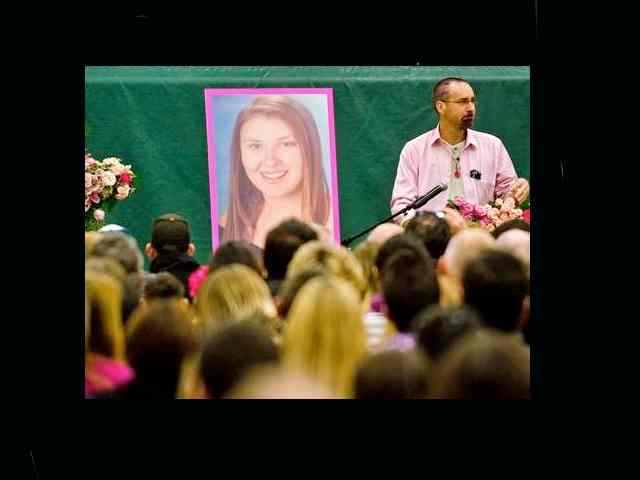
Kevin Byrne, Alyssa Byrne’s father, welcomes family, friends and supporters to a memorial service for Alyssa in January. Photo/Alvin Jornada/Press Democrat
They’re targeting middle and high school children, asking them to pledge to seek safety in numbers, and encouraging them to call a trusted adult at the first sign of trouble.
Assigning buddies is a tradition for outings involving young children, who customarily double up and holds hands so all can be accounted for in a group.
But even older children need to stick together, and beyond that know to get help and who to call if a buddy is at risk, Kevin Byrne said.
A key piece of advice offered through the campaign, dubbed “Always Buddy,” is that kids whose cellphones are packed with friends’ phone numbers should make sure they also have contact numbers for their friends’ parents or other family members.
“It’s your responsibility to reach out, talk to your buddy, have a contact list of who to go to if you think something is going wrong,” Kevin Byrne said. “They need to buddy more than just being there.”
The effort is born of lessons learned from Alyssa Byrne’s death and a desire for something positive to come out of it. But it’s also steeped in the love the Byrnes have both received and cultivated in its wake.
“Kevin and I and Greg (their son) count ourselves so fortunate to live in this town that has been nothing but loving and supportive,” Kim Miller-Byrne said. “We definitely want to pay it forward in any way we can.”
The Byrnes’ daughter, a 2011 Casa Grande High School graduate, disappeared New Year’s Eve and died alone — her body frozen in the snow for three days before a utility worker peered over a snow bank and discovered it.
Byrne had gone to Tahoe with three friends, shared a room with them at a hotel in Stateline, and attended the three-day SnowGlobe Music Festival in their company, as well as hanging out with many other friends from Petaluma who drove up for the event.
But the last night of the concert, Byrne was walking ahead of her friends when she apparently decided to go back to the hotel before the last show was over. She left without a word, though she later told one of them by phone that she was on a shuttle bus heading back to Stateline. Authorities now believe Byrne decided to walk to the hotel, frustrated like many other concertgoers by the long wait for a bus.
They presume from the location of her body that she turned the wrong way on a main road back to Stateline. The temperature dropped below freezing that night, and friends said she had been drinking.
Kevin Byrne has been leading the buddy campaign in conjunction with several younger friends, including one who decided at Alyssa’s memorial service that those in attendance should take a pledge to stay together when they’re out and about in an unfamiliar place.
Taylor Derby, 19, one of those who initiated the pledge, said she was inspired in part by her recollection of a 2-year-old Rohnert Park girl who was struck and killed by a texting college student in December 2010. In the aftermath, some students signed pledges never to text behind the wheel.
“Alyssa was one of my best friends,” Derby said last week, “and I don’t ever want to lose somebody so close to me again.”
Kevin Byrne said he and his wife decided the pledge would be a good way to use donations supporters began making when their daughter disappeared.
Derby ordered 300 hot-pink bracelets printed in memory of her friend and sold them for $3 apiece while she, the Byrnes and others worked out ideas for a larger campaign.
Casa Grande senior Sara Frazier is working with Kevin Byrne to develop a program for middle school students as part of her senior project. “I knew I wanted to do something for Alyssa,” she said.
Frazier plans to visit schools and deliver bracelets and pamphlets that extol the virtues of staying safe in numbers. The pamphlets have a section where kids can fill in their friends’ phone numbers or others they could call for help.
Friends have organized a benefit hip-hop concert Feb. 23 at The Phoenix Theater in Petaluma to raise funds toward the program.
“I know the word is all over the place,” said concert promoter Jay Donnellan. “We’re hoping for a sellout.”
“It gives me a great feeling to see these kids and talk to them and (see) how they’ve rallied around this,” Kevin Byrne said. “It’s a shame it takes this kind of tragic situation, but the kids are all responding to it in a very positive way, and they’re trying to learn something from it.
“And, again, they’re trying to make sure this doesn’t happen to anybody else.”
USFS reissues Camp Rich upgrade proposal
By Kathryn Reed
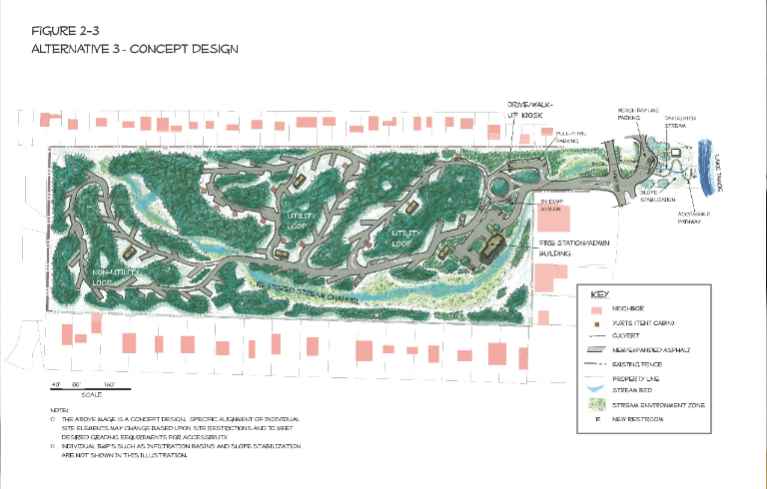
Parking on the road leading to the Beacon restaurant is no longer part of the U.S. Forest Service’s plans when it overhauls the Camp Richardson area.
A group of homeowners along Jameson Road had protested the original proposal, which brought a halt to the process, withdrawal of the earlier decision and forced the Forest Service to reconvene.
Alleviating congestion at Camp Rich is a goal of the Forest Service. Photo/LTN file
The houses are beyond the marina, but the way to access them is via the same road one uses for the restaurant. There is also a question as to who owns that road.
Another environmental analysis is back on the street for a 30-day comment period that ends March 15.
“Based on subsequent discussions and analysis, the Forest Service has concluded that resolving concerns surrounding day use parking along Jameson Beach Road is important and that these actions need to be considered in more detail and in a broader scope. Appropriately addressing the retrofit of these resort areas and the 75 parking spaces for day use beach users will need to consider the reconfiguration of the area west of Jameson Beach Road,” Daniel Cressy, USFS landscape architect and recreation planner, told Lake Tahoe News. “The retrofit of circulation and day use parking along Jameson Beach Road is outside of the scope of the current project and is not considered in detail at this time.”
The residents are not completely thrilled with what the Forest Service is doing by not including Jameson Road in the revised plan.
“In a message to me, a USFS representative indicated that the U.S. Forest Service has ‘scaled back’ the project to only address BMP campground issues thereby ‘allowing further time to discuss residents’ concerns regarding Jameson Beach Road.’ This too overlooks that the residents have been not only willing, but trying to engage the USFS in discussions for at least three years in hopes of amicably resolving the issues, yet to date the USFS has failed to engage in any meaningful discussions,” Jacqueline Mittelstadt, attorney for the Jameson Beach Association, told Lake Tahoe News. “We will scrutinize carefully the new proposed project and EA. Hopefully, their second try is a better try.”
The project’s goals for these three South Shore campgrounds that are on both sides of Highway 89 include substantial upgrades for overnight guests, improved traffic flow for all motorists, installation of erosion control measures, and better access for those with disabilities.
Improvements include replacing the four bathrooms with seven ADA accessible facilities, adding bear-proof dumpsters and food lockers, upgrading utilities, installing barbecues at all campsites, and adding fire hydrants for the area.
The total area to be addressed is 79 acres.
Other proposed improvements include more paved bike trails, a restroom near the beach, and replacing fencing between Camp Richardson Resort and Pope Beach Road.
Four alternatives are in the environmental document. The preferred alternative includes the possible remove of 40 trees with a 30-inch diameter and 910 trees smaller than that.
Work could be begin this building season. All the work is estimated to take five years. As work is being done, the public won’t have access to certain areas.
Comments may be submitted electronically to comments-pacificsouthwest-ltbmu@fs.fed.us. For more information, contact Daniel Cressy or Matt Dickinson at (530) 543.2694, or go online.
Tahoe City area campground to be modernized
By Kathryn Reed
When the William Kent Campground near Tahoe City was created in 1924 there wasn’t much else around. Now it’s a bit like urban camping, as is the case with most developed campsites in the Lake Tahoe Basin.
But not many upgrades have been made in the last 89 years either. It’s still a bit rustic when it comes to amenities even though residences surround it. The road and camping spur design was implemented in 1963, flush toilets came in 1969, and a bathroom at the day use beach was built in 2004.
Proposed changes for William Kent Campground. Rendering/USFS
A range of changes is in store for the campground as well as the Meeks Bay Fire Station that is manned by the Forest Service.
The USFS has allocated $1 million to improve the campground and day-use beach area. (This is the only public camping facility on the West Shore.)
Work on the 22-acre site that is about one mile south of Sunnyside and adjacent to Meeks Bay Resort could start in May 2014. The forest supervisor signed off on the environmental assessment on Feb. 8, which started a 45-day appeal period.
“The Forest Service recognizes that trends in recreation interests are changing. One of the changes we have observed is that many campground visitors are interested in experiences other than traditional tent camping. One such experience that has become popular is camping in a yurt,” Ashley Sommer with the U.S. Forest Service told Lake Tahoe News.
These tent-like cabins have a permanent platform. A wood or metal frame is erected on a seasonal basis.
“Yurts vary in their amenities, but generally have a heated sleeping area and eating area at a minimum,” Sommer said. “We have seen success with the yurts at Fallen Leaf Campground on the South Shore. The proposed yurts would be purchased and owned by the concessionaire that operates the campground.”
Moving the fire station is designed to reduce response time by firefighters because most of that station’s calls are north of Meeks Bay.
“The Meeks Bay fire station is currently the only fire station responsible for wildland fire response and wildland‐urban‐interface (WUI) fire response on the West and North shores of Lake Tahoe,” Sommer said. “The Meeks Bay Fire Station is also no longer adequate for the size and mission of the fire engine module. The Meeks Bay site is too small, which does not allow enough space for a new building that meets current standards, as well as adequate parking for station employees. Furthermore, the site does not have a year‐round water source, which would limit the use of a new facility during the winter months.”
The new building will be about 3,500-square-feet and look much like the facility on Spooner Summit.
For more information about the project, contact Ashley Sommer at (530) 543.2615 or go online.
Beaver Creek — the pinnacle of customer service
By Susan Wood
BEAVER CREEK – This service-oriented resort does everything but ski it for you.
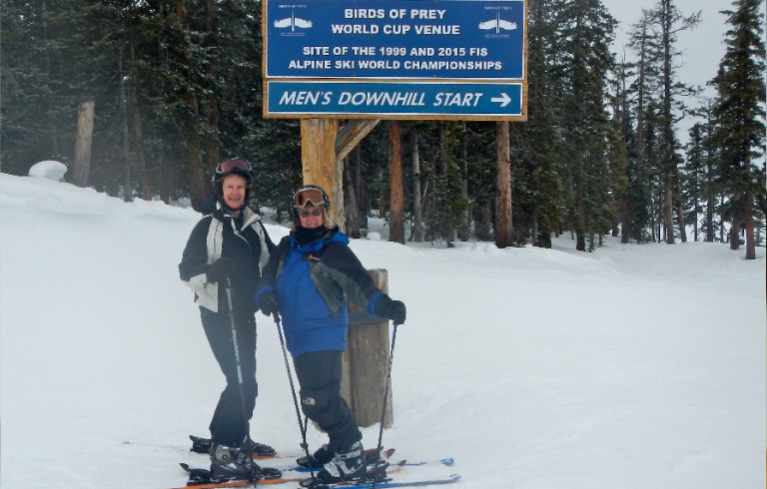
And one could argue that sometimes they do. At least that’s how Kae would describe her experience negotiating the famed Colorado resort’s gnarliest run off the Birds of Prey chairlift. The double black diamond Golden Eagle run starts the Men’s Downhill Course, home to the Alpine World Ski Championships set for 2015.
Kae, who identifies herself as more of an intermediate skier, had help on one of the world’s three toughest downhill racing runs with a guide she felt at home with. Beaver Creek ski guide John “J.B.” Bell, who hails from Truckee, is familiar with the terrain and the reality of feeling like he’s skiing over his head. He recalled on our recent visit to the area how he skied at an amazing speed on the men’s downhill run at Snowbasin outside Salt Lake City, home of the 2002 Winter Games. At the time, the run was labeled as the steepest racing run ever.
Kae only smiles before she sees the run; Sue smiles the whole time. Photo/J.B.
“I thought: ‘J.B., you’re going too fast’,” he described as if he was flying. So he knew what an apprehensive Kae was going through.
“I’ve been a bodyguard on the slopes. So I hope they trust me enough that I’m there for them,” Bell said, using an example of a client who calls him every year to get that kind of assistance. He added that working in the beginning ski school hones a Beaver Creek employee’s patience.
It’s a good thing Bell was there as the guide and not me, otherwise Kae wouldn’t have spoken to me for the rest of the ski, food and wine trip.
It’s like this. Upon cruising down the run called Golden Eagle of the downhill course, a skier approaches an area called The Brink, a seemingly bottom-less lip where the grade tilts about 50 degrees and the entire valley below opens up miles away. Of course, there’s a right turn the racers will need to negotiate, rather than tangle with the trees.
“(The racers) fly off here at 80 mph,” Bell said.
The terrain was hard-packed with limited clumps of snow to use to turn. Most downhill runs are designed that way – hard and fast.
Bell proceeded by skiing in front of Kae, as if he would hurl his body on top of her if she fell and started sliding. She skidded over a challenging spot to a safe place, and I waited as the backup sweep.
I must admit. It was fun. I felt the adrenaline I haven’t experienced since skiing the Dave Murray Men’s Downhill run at Whistler-Blackcomb, home to the 2010 Winter Games.
Afterward, the three of us looked up at the steep grade, sighed and continued toward the Larkspur Express chair. Along the way, Bell pointed out how the Women’s Downhill Run starting at Peregrine meets the men’s course at the Kestrel run. It took 700 days of dedication to carve out the women’s racing run.
It dawned at me that Bell is in the right job at the right place. And not just because he was the most qualified person to safely and confidently get Kae down the slick double-black racing run. I witnessed his poise all morning during last month’s Food and Wine Festival ski day. He helped two 5-year-old children on and off the chairlift, stayed friendly with everyone he met and provided pointers for us.
Upon skiing the superior snow of the Rose Bowl chairlift area, Bell talked us into taking a leap of faith and ski with our two poles suspended in front of us like a platter. The exercise was intended to keep our upper body level and hands in front. If the poles tilted, “you dropped your wine glasses,” he joked.
Beaver Creek’s attentive experience goes way beyond ski instruction and guidance from a coach with a 30-year background. The mantra of providing excellent service is engrained in every practice, every product, every employee. That’s why its advertising tagline “Not exactly roughing it” seems so fitting. Even Mamie’s Cabin for the casual-faire declares on a sign “only slightly roughing it.”
There are the warm chocolate chip cookies handed out at the base at 3:30pm, gourmet hot chocolate given away at the top of the Centennial Express Chairlift and a variety of cabins where residents have access to these isolated culinary hideaways.
And beyond those offerings, Beaver Creek operates with an overriding service program in which the employees provide suggestions to improve a guest experience. The program is extensive and serious.
The staffers at Beaver Creek may strike the guests as a little older than the more-common, young, ski-bum types living between high school and college or career path.
“We want to be the industry leader in guest service. And that means being proactive,” Beaver Creek spokeswoman Jen Brown told Lake Tahoe News. “We have a little more of a mature audience serviced by mature employees.”
Take Beaver Creek shuttle bus driver Ned Weiss, a single senior from Ohio who comes up to Colorado for the winter to work.
“I came here for the great benefits,” he said. Of course, as with all age groups, access to superior skiing conditions tops the list of benefits. He’s friendly, helpful and forthright.
Despite all the pampering, one cannot reduce Beaver Creek to a ski bunny hill where riders spend more time having every whim addressed than carving serious turns. Much of the terrain, like the Birds of Prey area, is not for the faint of heart. Eight high-speed chairlifts service more than 30 black diamond runs, adding up to a 4,000-plus foot vertical drop. Then, there’s the Stone Creek Chutes on the backside. And that’s just the advanced terrain.
Whatever the territory, the mountain stretching to 11,400 feet with 1,815 acres of ski terrain comes with skiing ambassadors who roam the grounds.
The ski resort is even kind to the resident elk herds who also meander through the landscape by providing tree “islands” consisting of clusters of trees on Bachelor Gulch side of the resort. At its base, a Ritz-Carlton stands to further the extraordinary guest-service experience. (Note: more on that in this article.)
History
• Beaver Creek opened Dec. 15,1980, with six chairlifts and a temporary base lodge. Development costs ran $300 million.
• The decade brought much growth to the resort with the opening of the Larkspur Bowl and the unveiling of the Centennial Express chairlift from the village base.
• In 1989, the World Ski Championship came to Beaver Creek.
• In the following decade, Grouse Mountain at Beaver Creek opened. In the later years, the Arrowhead Ski Area was connected to the resort.
• The Birds of Prey area was developed and included an express chairlift in 2003 to accommodate the resort’s quest to be a dominant force in hosting the World Alpine Ski Championships.
• In 2004, the town lift that crosses Highway 6 was put in to take skiers from the Lower Beaver Creek area to the upper side.
ngg_shortcode_0_placeholder (Click on photos to enlarge.)
Kings Beach face-lift set to begin in summer
By Barbara Barte Osborn, Sacramento Bee
Construction on a long-awaited project to revitalize a popular north Lake Tahoe community’s downtown and make it safer for pedestrians is expected to begin this summer.
The Kings Beach Commercial Core Improvement Project, estimated to cost $48 million, is aimed at improving pedestrian access, water quality and aesthetics for residents and visitors.
Last week, Placer County supervisors approved a financing and construction plan for the project’s first phase, which will begin the reconfiguration of Highway 28 through the downtown core.
Improvements to Kings Beach are set to begin in May.
It also will address traffic management in neighborhoods north of the highway. Other downtown improvements will be detailed in a second, final phase.
A Feb. 19 open house from 5:30-8pm at the North Tahoe Event Center has been scheduled to answer questions from the public, said county spokesman Robert Miller.
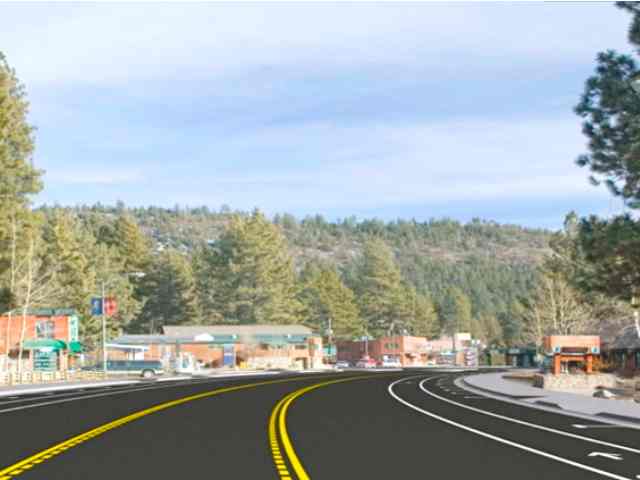
In the planning stages for decades, the project will reconfigure 1.1 miles of Highway 28 into three lanes with two roundabouts. It currently is a four-lane highway with a traffic signal at Coon Street.
The wide road is flanked by very few sidewalks, making pedestrian access to shops, restaurants and beaches difficult and sometimes dangerous.
Sidewalks, bike lanes, bus shelters, water-quality improvements and landscaping in the downtown area are included in the project.
The stretch of highway through Kings Beach is one of the last remaining four-lane sections of road on Lake Tahoe’s North Shore, said Dan LaPlante, a county associate engineer and the project’s manager.
Because concerns have been expressed that some drivers may cut through neighborhoods once the highway is narrowed, sidewalks and traffic-calming devices, including 29 speed humps, will be installed in neighborhoods north of downtown.
Eight humps already have been installed. Speed-radar signs and neighborhood entrance features will also be used to slow traffic.
County supervisors in January approved the formation of a benefit assessment district to maintain the improvements, saying the district was favored by a majority of ballots from affected property owners.
The $166,000 annual assessment will be divided among 296 property owners whose property is fronted by the planned improvements, based on the amount of frontage, lot size, square footage and zoning, LaPlante said.
Most of the assessment will be used for the removal, hauling and storage of snow. The remainder will go toward the repair, replacement and power washing of sidewalks, emptying trash receptacles and maintaining landscaping.
LaPlante said the project’s $48 million cost will come from a combination of federal, state and local funding. Still needed is about $10 million, he said.
The first phase of the two-phase project is expected to take up to three construction seasons, Miller said, noting that “in the Tahoe basin, construction can take place only between May and October.”
No estimate is available for completion of the second, final phase.
“It’s funding-dependent,” LaPlante said. “We don’t know where the remaining $10 million will come from, but we’re committed to doing the entire project and are working on finding funding sources every day.”
Ice sculptors take over Northstar Village
By Nathan Hurst, Wired
Last weekend at Northstar was beautiful, sunny, and in the 30s. For eight teams of snow carvers from around the world, though, it’s terrible — the melty snow is sloppy, hard to carve, and even dangerous.
Teams of three from Finland, Japan, Germany, Canada, and the U.S. were selected from more than 40 applicants for the inaugural Carve Tahoe, a five-day competition to hew works of art from 14-foot-high, 20-ton blocks of snow. But despite the bad snow, the teams rely on decades of experience, handcrafted tools, and creative techniques to fashion their massive sculptures. The team members are sculptors and artists and designers, but also doctors and lawyers. Though they spend weeks each year carving, nobody makes a living doing it.
“Everyone seems to have their own method of doing things,” says Team Wisconsin’s Mark Hargarten. “It’s amazing how different they are.”
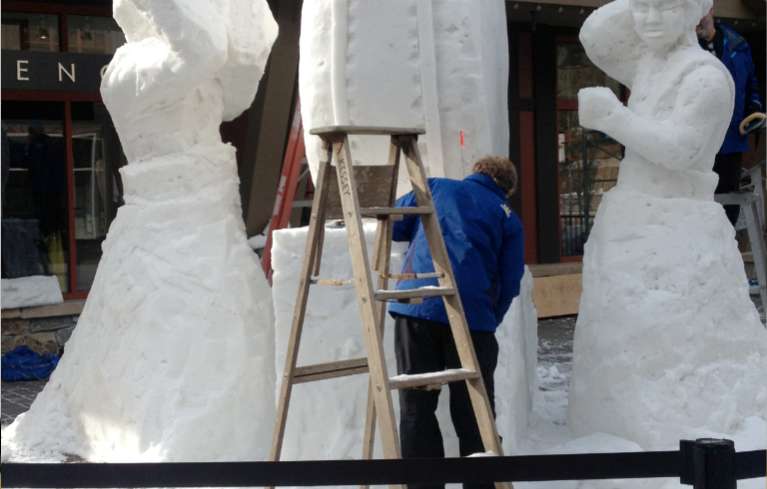
Sculpting at Northstar. Photo/Kathleen Jay
The Wisconsin team uses a grid system for their carving — a Native American wearing an eagle costume, its feathers turning to flames, called “Dance of the Firebird.” The polyurethane model they built is scaled so one-half inch equals one foot on the finished snow sculpture. They cut a copy of the model in four, and covered each section with clay, sectioned in half-inch increments. They etch corresponding lines in the snow, one foot to a side, and they peel off one piece of clay, carve the part of the sculpture they can see, and move on to the next.
“You never get lost using the method,” says Dan Ingebrigtson, a professional sculptor from Milwaukee. “Three or four guys can work from different angles, and meet in the middle.”
Wisconsin’s got several other strategies behind their carving as well. From the south, it looks like they haven’t even started; they left the southern side of the block intact to protect the rest of it from the sun, and the wall has been decimated by the heat. More than 20 percent of its thickness has melted by Sunday night, three days in. After the sun goes down, the team is hollowing out the interior of the structure, so it will freeze faster overnight.
Other teams are relying on nighttime freezing as well. A team partly from the U.S. and partly from Canada carves spires from blocks they removed from the sculpture, and plans to attach them to the top of their sculpture, “The Stand,” which incorporates four interwoven trees. They’ll use melty snow pulled from the middle of the block right when the sun goes down to cement the tops onto the trees, says team member Bob Fulks from the top of a stepladder as he cuts away at the sculpture with an ice chisel.
Fulks’ team is leaving Tahoe after the competition to go straight to Whitehorse, in the Yukon, for another competition, where he anticipates no problems with warm weather.
“It’s a good gig, you can travel all over the world doing it,” he says. “You go around and see the same people.”
Many of the carvers know each other from previous competitions.
“We’ve sculpted with almost everybody here before,” says Team Idaho-Dunham’s Mariah Dunham, who is working on “Sweet House (of Madness)” with her mother, Barb. The creation is a beehive, with the south side as the exterior, and the north side (intentionally placed out of the sun) as a representation of the comb, including hexagonal holds that perforate all the way to the hollow interior.
Though Carve Tahoe is new, snow carving is not. Many of the sculptors have been at it for more than 20 years, traveling around the world and meeting and competing against many of the same people — though each competition demands unique new designs from all the sculptors. Kathryn Keown discovered snow carving while Googling something completely different, and decided she wanted to host an international event.
“First we fell in love with the sculptures, then we fell in love with the sculptors,” says Keown, who founded the competition with Hub Strategy, the ad agency where she works.
Keown contacted several ski areas before Northstar, but the resort was on board right away; its owner, Vail Resorts also owns Breckenridge, where one of the biggest and most prestigious snow carving competitions is held.
But Keown wanted to commit to the design of the competition, not just the sculptures. Applicants submitted their designs last summer, and Keown enlisted Lawrence Noble, chair of the School of Fine Art at the Academy of Art University to help choose modern, complex, realist designs. She wanted no artsy, kitschy snowmen.
Then she chose a design-friendly logo and judges. In addition to Noble, the panel of judges features a sushi chef from Northstar, two interior designers, a photographer from nearby Squaw Valley, and Bryan Hyneck, vice president of design at Speck, which makes cases for mobile devices and was one of the event’s sponsors.
“The level of complexity and sophistication in this type of sculpture is just amazing,” says Hyneck, who has judged industrial and graphic design competitions, but never snow carving. “It’s amazing how organic some of the shapes can be.”
As a judge, Hyneck says he’ll focus on the craft and the execution of the sculptures, and how the sculptors use particular techniques to take advantage of the snow’s properties. But he adds that subject matter, point of view, message, and relationship to a theme are all important points as well.
“Anybody that is really going to push the limits of the capabilities of the media is going to get a lot of my attention,” he says.
For some, like the Germans, that means suspending massive structures made completely of snow. Their sculpture, titled “Four Elements”, features four large spires encircled by a tilted disc. Despite a trickle of melted snow dripping off the bottom edge, one — or even two — of the German carvers frequently stand atop the sculpture, using saws or chisels to shape the towers.
Sunday evening, after the sun has gone down and the temperature dropped, Josh Knaggs, bearded, with a cigarette in his mouth, is sitting in the curve made by the largest bear from the Team Idaho-Bonner’s Ferry sculpture, “Endangered Bears.” Wearing a blue event-issued jacket, he’s brushing out the hollow loop made by mama and papa bear.
Three days later, the judges award Knaggs and his team third prize, with Japan’s modern work, “Heart to Heart” coming in second and Germany’s gravity-defying “Four Elements” taking first. The teams disperse, and after a few more sunny days, Northstar tears down the structures before they get too soft and fall — all except the German piece, which can’t bear its own weight and collapses after judging is complete. But the ephemeral nature of the snow is part of what attracts the competitors.
“It’s for the moment, and it’s a beauty all in itself, creating something that’s gonna be disappearing, you know, it’s okay that it disappears,” says Team Truckee’s Ira Kessler. “We are making it for the moment.”
Tahoe Trail Bar goes gluten free, vegan
By Kathryn Reed
Eating one won’t necessarily have you skiing like Julia Mancuso, climbing like Todd Offenbacher, or even paddling the circumference of Lake Tahoe in a day, or setting cycling records on the Flume Trail – but it could give you a little more oomph to finish the athletic endeavor you set out on.
Offenbacher, Tahoe’s legendary climbing guru, was munching on Tahoe Trail Bars on several expeditions last year.
“Why I do what I do is so people will have food they enjoy while enjoying the outdoors,” Wes King told Lake Tahoe News.
But the Tahoe Trail Bar isn’t just for athletic types. King, who owns the company, says they are ideal to throw into kids’ lunches or have for an afternoon pick-me-up.
And they are bigger than most bars. The Tahoe Trail Bar is almost 4 ounces, while a Clif Bar is a little more than 2 ounces. (And the price is not double.)
While the brand has been around for 10 years, King has owned the company for the last three years. On Friday, he debuted a revamped bar that is now gluten free and vegan. Plus, the packaging is all new.
“I tried as much as I could to maintain the profile flavor,” King said of the change to the recipe. “Everyone who has tasted it says it tastes better. Most people think it’s not as dry as a lot of bars.”
Tahoe Trail Bar’s package as of Feb. 15.
One thing he uses that other bars don’t is brown rice syrup. This, King says, means energy levels will not spike. The milk chocolate was replaced with dark chocolate to make it vegan.
The high caloric value – about 400 – is designed to keep people active. But these are the good calories compared to eating just chocolate, which would be the bad calories.
The bars are manufactured in Northern California – but beyond that, King would not reveal specifics.
The Mylar paper the bar is in will allow it to have a longer shelf life. This in turn means the big grocery stores will entertain carrying it. The goal is for the bar to be sold outside of the Lake Tahoe Basin.
With the packaging behind him, now it’s time to focus on growing distribution and creating more flavors.
Within two months he anticipates Whole Foods and Raley’s will carry the Tahoe Trail Bar. Right now the only flavor is peanut butter.
More info about the Tahoe Trail Bar may be found online.
 In 2012, the South Lake Tahoe health organization completed a community health needs assessment. All nonprofit hospitals will be required to do these studies every three years as part of the Patient Protection and Affordable Care Act in the health care reform passed by Congress.