Calif. unemployment rate drops, but many jobs are part time

By Shan Li and Ricardo Lopez, Los Angeles Times

California continued its economic recovery in June as its unemployment rate slid to 8.5 percent, the lowest it has been in nearly five years.

Employers’ payrolls grew by 30,200 jobs, helping push down the jobless rate from 8.6 percent in May, according to data released Thursday by the state’s Employment Development Department.

The Golden State has outpaced the overall U.S. in job creation over much of the last year, and its turnaround has been swift. Since June 2012, the state’s nonfarm employment has grown 1.8 percent, adding nearly 254,000 jobs.

“The numbers are moving in the right direction,” said Esmael Adibi, director of Chapman University’s A. Gary Anderson Center for Economic Research. “It should get even better as we get through the year.”

Job gains were notched across six sectors. The trade, transportation and utilities sector led hiring last month, adding 13,200 jobs. That sector includes wholesale and retail trade, indicating that consumers have been driving the recent economic expansion.

That supports the recent consumer confidence report issued by the Conference Board. Consumer sentiment in June jumped to its highest level since January 2008. Shoppers have been splurging again as housing prices rise and the labor market improves, economists said.

But the recovery wasn’t across the board.

Five sectors shed jobs in June. Among them was the professional and business services sector, which lost 3,300 jobs. That industry includes high-paying occupations such as architects and lawyers. The construction and financial activities sector also showed small declines, losing 1,700 and 2,500 jobs respectively.

The California jobs report, though positive, showed that a large number of positions created in June were in low-paying industries, many of them part-time jobs. The leisure and hospitality industry, one of the fastest-growing segments of the economy, added 9,700 jobs last month.

Michael Bernick, former director of California’s Employment Development Department, said the sharp rise in part-time workers bodes poorly for the economy because of reduced spending power. Job seekers are facing a labor market where companies are reluctant to hire full-time employees.

“The intense competition out there for jobs hasn’t decreased at all, unless you are a highly skilled computer programmer,” Bernick said. “One explanation is a sharp national growth in part-time employment.”

Cary Campagna, 59, of Rancho Santa Margarita is among those struggling to find gainful employment.

He has been sending out resumes, responding to job ads on Craigslist and networking, with no luck so far. To make a little money, Campagna drives a limousine part-time. He earns about $50 driving clients to Los Angeles International Airport and $25 to Orange County’s John Wayne Airport.

“There’s a lot of jobs out there, but a lot of them pay in the $8- to $10-per-hour range,” he said. “Even if I worked 40 hours a week, I couldn’t live on that.”

The long-term unemployed, those who have been without work for 26 weeks or longer, also face another challenge. On Tuesday, California officials warned that the final tier of federal unemployment extension benefits would be cut if the state’s jobless rate falls below a three-month average of 9%.

The state said it expects to hear the final decision Friday from the U.S. Department of Labor. If that tier is eliminated, an estimated 100,000 Californians will lose up to 10 weeks of benefits.

An improving economy brings with it “more winners but also more losers,” said Sung Won Sohn, an economist at Cal State Channel Islands. Those who find jobs gain, he said, but the long-term unemployed may lose jobless benefits and be worse off.

Changes in unemployment rates were mixed across Southern California. Some counties saw their rates rise even as they added jobs.

Los Angeles County added 200 nonfarm jobs, and its unemployment rate edged up to 9.7 percent in June from 9.6 percent in May. The leisure and hospitality industry gained the most positions in the county, adding 7,000 jobs last month.

San Diego County added 7,500 positions but still saw its jobless rate tick up to 7.3 percent in June from 6.8 percent the month before. Orange County added 8,500 jobs, and its unemployment rate similarly jumped to 6.1 percent from 5.5 percent the month before.

The Inland Empire, which covers Riverside and San Bernardino counties, shed 6,700 jobs, and its unemployment rate jumped to 10.2 percent in June from 9.3 percent the month before. Losses were concentrated in the government sector, which shed 2,900 jobs.

In the Bay Area, San Francisco, San Mateo and Marin counties combined added 4,100 positions. Unemployment ticked up to 5.5 percent last month from a revised 5 percent in May.

The statewide and Los Angeles County unemployment rates are seasonally adjusted; the other counties’ are not.

The employment report normally is issued early Friday. However, the Bureau of Labor Statistics accidentally released the data prematurely on Thursday.


A lesson in cooking via the farmers’ market

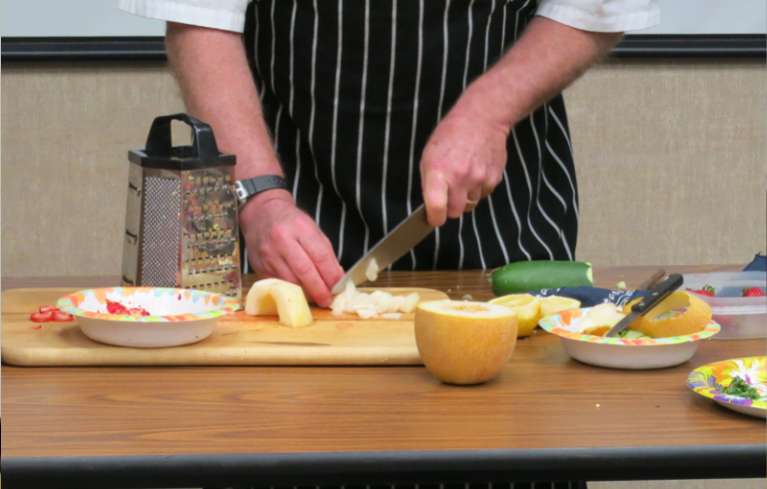
Chef Steve Fernald demonstrates cooking with food from the farmers' market. Photos/Jessie Marchesseau

Chef Steve Fernald demonstrates cooking with food from the farmers’ market. Photos/Jessie Marchesseau

By Jessie Marchesseau

Bright red tomatoes, dark green zucchini, sunshine yellow squash and purple sweet peppers were among the fresh produce adorning the table at chef Steve Fernald’s fresh cooking demonstration at the South Lake Tahoe Library on Tuesday.

“They say you eat with your eyes first. People either accept or reject a meal based on how it looks,” said Fernald, culinary arts instructor at Lake Tahoe Community College.

The demonstration was designed to show people how to create simple, tasty summer dishes with fresh ingredients from local farmers’ markets. Fernald suggests starting out by choosing the most colorful options at the market and practicing what he calls “cooking on the fly,” meaning creating dishes in your head as you shop for ingredients. He also described how he took the time to talk to the vendors, learning the differences between varieties of tomatoes and peppers, even discovering new items like melons he had never heard of before.

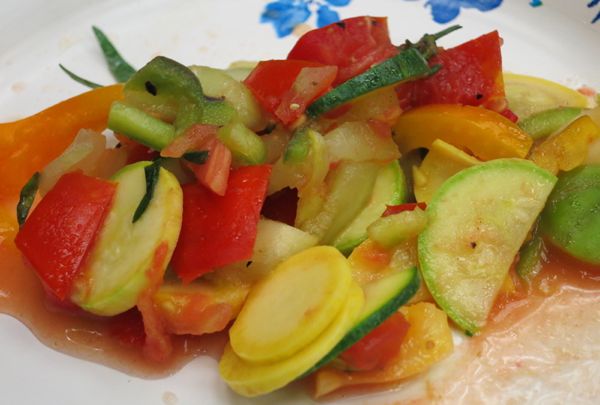
Mediterranean salad

Mediterranean salad

In addition to the fresh produce, Fernald purchased at the farmers’ market earlier that day, the table also displayed a selection of vinegars, olive oil, salts, fresh herbs and dried spices. From this arsenal, Fernald created two dishes: a savory Mediterranean salad and a sweet strawberry chili salsa which he served with homemade crunchy almond cookies.

Starting with the basics, the chef explained the importance of having a variety of textures and tastes in each dish. For example, a combination of crunchy and chewy or sweet and salty is more interesting to the palate than one solitary flavor or texture.

Another essential aspect of cooking, especially in uncooked dishes such as these, is often overlooked: cutting. He explained how size and shape should be considered for the specific preparation, and for uncooked food, small or thin pieces create the most surface area for flavor in your mouth.

Since the event was sponsored by the Barton Foundation, Fernald wanted to create dishes that maximized the flavor while keeping fat content low. One of the ways he achieved this was by using high-quality, high-flavor ingredients. Fernald explained how the gourmet apple cider vinegar, 18-year-old balsamic vinegar and rich olive oil on the table have bolder flavors – meaning you don’t have to use as much of them.

After the quick culinary lesson, the chef began his preparation. First was the Mediterranean salad for which he thinly sliced zucchini and summer squashes, then lightly salted them just enough to bring out the flavor, but not break down the tissues. Then he carefully cut sweet peppers and cucumbers, removing the seeds from both. All of this was tossed with a splash of rice vinegar and a light sprinkle of sugar, not for sweetness, but to encourage the vegetables to release their juices. Next came the chopped tomatoes with seeds left in for added texture, a drizzle of olive oil and, finally, a handful of freshly torn thyme.

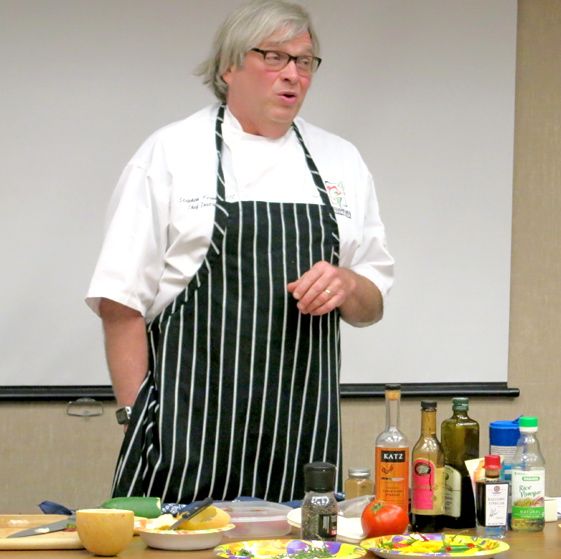
Steve Fernald leaves the LTCC classroom to give a public cooking demo.

Steve Fernald leaves the LTCC classroom to give a public cooking demo.

The result was a simple dish exploiting the bright flavors of a summer harvest. Crunchy sweet peppers contrasted with soft ripe tomatoes and the fresh thyme left me thinking of my own little herb garden at home.

The next dish Fernald dreamed up was a little more off the beaten path, but no less delicious. Tiny little chili peppers were diced and tossed with a sweet apple cider vinegar. Then in went ripe red strawberries from Watsonville, sliced as thin as he could possibly get them, a sprinkle of sugar and just a pinch of salt. Next were tiny cubes of a melon Fernald discovered at the market just that morning (which he could not even remember the name of), fresh lemon juice and lemon rind. A quick drizzle of balsamic vinegar finished off this sweet and spicy combination.

To balance the heat of the dish, Fernald served it piled on crunchy almond cookies. The result was what one of the tasters in the room called “a party in your mouth.” The sweet flavor of strawberries gave way to a heat that notably cooled your face and urged you to take another bite. This dish had several people, myself included, going back for seconds.

Fernald also took the opportunity to pay homage to renowned chef and restaurateur Alice Waters of Chez Panisse in Berkeley. Waters and Chez Panisse are credited with pioneering the farm to table movement in the early 1970s by serving entirely locally sourced food.

Waters’ vision helped define American cuisine and is a large-scale example of what chef Fernald demonstrated: creating delicious, healthy food using fresh, local ingredients.

“You can tell the difference in not just the tomatoes,” Fernald said of the food from the local farmers’ market, “but in pretty much everything.”


Nevada lacking in wildfire prevention funds

By Andrew Doughman, Las Vegas Sun

Call it the Jerry Maguire theory of budgeting.

At a time when large wildfires have charred wide swathes of land in both Northern and Southern Nevada, the state’s forestry division faces millions of dollars of cuts in federal fire prevention grants and has little recourse but to go to Congress and repeat the line from the famous Hollywood movie: Show me the money!

Nevada’s ability to prevent wildfires faces further pressure as the federal agencies that control nearly 90 percent of the land in Nevada prepare to cut their fire prevention budgets and as a state nonprofit agency that once informed communities about fire safety and brought millions of dollars into the state for fire prevention has gone bankrupt.

For now, the state forestry division’s budget dropped from $18.8 million during the last fiscal year to $6.9 million for the fiscal year that started this month.

The state largely relies on U.S. Forest Service grants to mitigate fire risks, but much of the mitigation money technically doesn’t exist without a federal budget, which Congress may approve in September.

The pages of the state budget literally show blank white space where the grant dollars should be. No federal budget means no money for Nevada.

The threat of a potential federal government shutdown over disagreements about what the nation should spend in 2014 leaves state officials without a clear idea of what they can spend on fire mitigation.

“We don’t know if our budget has been reduced,” said David Prather, a deputy administrator at the Nevada Division of Forestry. “As long as they’re having their budget battles in the Capitol, we just have to wait and see what the fallout is. Really, that’s one of those things that’s beyond our control.”

Senate Majority Leader Harry Reid, D-Nev., indicated Wednesday that he’d support more money for fire prevention, perhaps allaying concerns that federal budgets for fire prevention will decrease in the coming years.

Reid said climate change is to blame for the increasing severity and prevalence of Western wildfires.

“I mean you can’t deny it, it’s here,” he said. “Why do you think we’re having all these fires? … We should be spending a lot more on prevention, and that means thinning some of these forests.”

In addition to the uncertainty around prevention funds, a statewide nonprofit agency that brought millions of dollars to the state for fire prevention and helped study wildland fire risks and mitigations has filed for bankruptcy amid findings that it misspent federal stimulus money.

It was the Nevada Fire Safe Council that first alerted Nevada to the “extreme” fire risks in the Spring Mountains around Mount Charleston, where the Carpenter 1 fire has burned more than 28,000 acres to date.

“It was an organization that promoted fire-safe planning in local communities, kind of at the local level,” said Sheila Anderson, senior research specialist at Resource Concepts, Inc., a consulting company that the Nevada Fire Safe Council retained to study fire risks in Nevada communities a decade ago. “They formed chapters all over the state.”

After the council’s demise, no other organization has stepped forward to bring in the millions of dollars of grants, partner with communities to promote fire-prevention education, and fund risk studies.

Read the whole story


Questioning if plastic bag ban reduces litter

By Paul Gabrielsen, Santa Cruz Sentinel

An employee gathering carts from a sunny parking lot of a Santa Cruz Safeway said shoppers are warming up to the city’s new ban on single-use plastic bags. But some still miss the bags’ convenience.

“Wrong thing to do,” said a middle-aged man of the ban.

“But they’re killing the innocent turtles,” his wife said, adding that in Europe, reusable bags are a way of life.

The couple’s disagreement is typical of the strong feelings evoked by plastic bag bans, which seem to delight environmentalists but aggravate many retailers and consumers. While there is some evidence that the bans have reduced litter on city streets and beaches, ambiguities in the data seem certain to fuel further heated debate.

San Francisco led California’s war on plastic, banning bags at large grocery stores and chain drugstores in 2007. But litter surveys in the city, covering the first two years after the ban went into effect, painted a foggy picture.

Surveyors assessed more than 100 randomly selected sites in the city each year, counting every piece of litter in an area half the length of a city block. In 2007, before the ban was introduced, plastic bags amounted to 0.5 percent of large litter. By 2009, the percentage climbed to about 1.5 percent. And during the same period, the average amount of litter stayed about the same.

The city hasn’t collected any litter data since the 2009 survey, said Guillermo Rodriguez, a spokesman for the city’s environment department.

The ban was expanded to all retailers in July 2012 and will continue to expand to all restaurants this year. San Francisco plans to do another litter survey to see whether the new scope of the ban makes a measurable impact.

San Jose has already seen that impact. The city’s 2012 bag ban immediately covered all retailers. Last December, San Jose presented results of litter surveys in city creeks, streets and storm drains. Surveys after the bag ban in 2012 found 89 percent fewer bags in storm drains, 60 percent fewer in creeks and 59 percent fewer on city streets, compared with surveys before the bag ban. Plastic bags made up 8 percent of total creek litter in 2011 and 4 percent in 2012.

A 2012 survey of Bay Area storm drains found that “other plastics,” not including plastic bags, made up about 50 percent of storm drain trash. Paper, Styrofoam and drink containers together made up another 30 percent.

But the bags also show up in marine litter, making up about 15 percent of trash in the deep reaches of Monterey Bay. The Monterey Bay Aquarium Research Institute reported finding plastic bags in water nearly 2½ miles deep, according to a paper published online in May in the journal Deep Sea Research.

Closer to the ocean surface, concern for the bags’ impact on marine life stems from the fact that ocean-borne plastic bags look similar to jellyfish, which sea turtles love to eat.

Whether the bans are preventing bags from reaching the ocean is hard to measure, but surveys of litter on Monterey Bay beaches provide the best available picture.

Santa Cruz-based Save Our Shores promotes weekly cleanups around Santa Cruz and Monterey counties and collects trash data from many of these events. On average, volunteers pick up only six bags at each event, down from a high of 65 in 2008.

The number of bags collected per cleanup has dropped in the past two years because of four bans that took effect in 2012, said Save Our Shores executive director Laura Kasa. The four bans covered unincorporated Santa Cruz County and the cities of Watsonville, Monterey and San Jose.

The latter ban matters because of the volume of tourist traffic coming “over the hill” to Santa Cruz beaches, said Kasa, who also credits the shift in public perception toward plastic bags in the region. “In Santa Cruz it’s become the trend to be green and to bring your own reusable bags and not use plastic bags,” she said.

Save Our Shores program manager Brad Hunt pointed out that Monterey County has not yet implemented a bag ban, which affects Save Our Shores’ average cleanup numbers. “It could go down to one bag per cleanup after Monterey County implements theirs,” Hunt said, “but we won’t know that until a year or two down the road.”

Opponents of plastic bag bans point out that bags make up a small fraction of litter. “You’re talking about such a small amount to begin with that you wouldn’t notice any change,” said Stephen Joseph of the Save the Plastic Bag Coalition, whose members include plastic-bag manufacturers and retailers.

Joseph said political leaders have exaggerated the problem. He disputes claims by Oakland-based Save the Bay that a million plastic bags enter San Francisco Bay each year. In 16 years of living in the city, Joseph said, he never saw one bag in the bay.

“It’s a hoax,” he said, adding:

“There’s obviously plastic bag litter. Anyone who’s never seen a plastic bag flying around is blind. But that does not justify all the exaggeration.”


Artist’s troubles grow as he tries to rebuild

By Kathryn Reed

South Lake Tahoe would like Peter Darvas to start with a new canvas. Darvas would rather work with the outline he has.

In September 2012, Darvas’ sprawling house on Pioneer Trail and April Drive was destroyed by fire. Flames also engulfed the house next door on April.

Today the neighbors have a foundation poured. This new construction is in stark contrast to the destruction left by the fire that is so evident at the Darvas site.

Darvas told Lake Tahoe News that on Tuesday he was going to submit plans to the city for how he wants to resurrect his home and studio.

A 6-foot cyclone fence surrounds the remains of Peter Darvas' house that was destroyed by fire in September 2012. Photo/LTN

A 6-foot cyclone fence surrounds the remains of Peter Darvas’ house that was destroyed by fire in September 2012. Photo/LTN

“I believe a large percentage of the structure can be salvaged,” Darvas said.

He has been slowly taking down some of the structure. Another dumpster was dropped off Tuesday afternoon.

The city has sent him letters wanting more to come down faster.

The South Lake Tahoe artist was before the City Council on July 16 asking for leniency in regards to his delinquent South Tahoe Refuse bill. He owes $2,700.

Mayor Tom Davis begged his colleagues to give the man 45 more days. When they voted against him, Davis called it “sad.” Councilman Hal Cole abstained because he lives across the street from Darvas. Councilwomen Angela Swanson, JoAnn Conner and Brooke Laine voted to proceed with the filing with the county tax office that the Planning Commission had already approved on a 4-0 vote.

The money isn’t just from the past 10 months. As STR President Jeff Tillman told the council July 16, this total is the accumulation of years of unpaid garbage bills. That is why the majority on the council could not grant an exception or extension to Darvas.

Darvas told Lake Tahoe News, “I’m not the most timely or responsible person when it comes to crossing T’s and dotting I’s. I operate in a different reality.”

Darvas told the council he has retained an attorney to go after his insurance company to get cash. Until that happens, he said he has no money to pay his debts. He thought 30 days would be enough time to get the insurance issue worked out.

He has not created enough new art at the studio near Nepheles to pay his bills.

Darvas and the city have had run-ins for years regarding the clutter at his place. In January 2012, he was sparring with the council regarding an abatement fine.

With the vote by the council, the county can place a lien against his property so STR gets what it is owed.


Champagne cork popping — another celebrity sport

Korbel Champagne owner Gary Heck watched a lot of bubbly get sprayed July 17 at the media cork popping contest. Photo/Kathryn Reed

Korbel Champagne owner Gary Heck watched a lot of bubbly get sprayed July 17 at the media cork popping contest. Photo/Kathryn Reed

By Kathryn Reed

STATELINE — Celebrity golfers will be able to put down their clubs briefly on Thursday and trade them for a bottle of Champagne.

Between the 17th and 18th holes they can test their ability at how far they can shoot a Champagne cork. The one who wins will be able to select a charity for Korbel Champagne to write a $5,000 check to.

Shane Battier with the Miami Heat on Wednesday demonstrated how it is done by hitting the fence. The contenders from the media who followed him didn’t fare as well. However, Tom Selissero with USA Today popped his cork 81 feet to win the Korbel golf bag and a couple clubs.

Korbel owner Gary Heck advised me to keep my thumb on the cork as I shook the bottle. He said I could shake it as long as I wanted. Then he told me at what angle to shoot. As a rookie to this sport, I came in seventh out of 33 with a 65-foot shot.

Heck was taking the wire off the all the bottles and giving pointers to whomever asked.

The Sonoma County sparkling wine company has created two drinks that it will be serving at the various concession stands throughout the American Century Championship golf tournament at Edgewood Tahoe from now through Sunday.

Having only sampled one – the Korbel Sparkling Eagle – I can recommend it. The melon flavor comes through without being too overpowering.

Korbel Sparkling Eagle

4 ounces Korbel Brut

1 ounce melon liqueur

1 ounce lemonade

Mix all ingredients in a rocks glass. Garnish with one jumbo cherry.

Korbel Long Drive

3 ounces Korbel Brut or Extra Dry

2 ounces lemonade

1 ounce blue Curacao

Into a tall glass, pour Korbel Brut or Extra Dry. Add lemonade, blue Curacao and ice.


Adult diseases becoming common in kids

By Alexandra Sifferlin, Time

Diabetes, obesity and elevated blood pressure typically emerge in middle-age, but more young children are showing signs of chronic conditions that may take a toll on their health.

The latest report on the trend, from researchers at Harvard Medical School found that children and adolescents are increasingly suffering from elevated blood pressure. Published in the American Heart Association journal Hypertension, the study showed a 27% increase in the proportion of children aged 8 years to 17 years with elevated blood pressure over a thirteen-year period.

The scientists compared over 3,200 children involved in the National Health and Nutrition Examination Survey (NHANES) III in 1988-94 to over 8,300 who participated in NHANES in 1999-2008. The national survey records health, eating and lifestyle behaviors of the volunteers. More kids in the recent survey were overweight, with larger waistlines than those in the previous cohort. And the children with body mass index (BMI) readings in the top 25 percent of their age group were two times more likely to have elevated blood pressure than the kids in the bottom 25 percent.

The kids did not have diagnosed hypertension, which requires a threshold of 140-90, but elevated blood pressure — anything above 120-80 — at such young ages could prime them for hypertension later. “High blood pressure is dangerous in part because many people don’t know they have it,” said lead study author Bernard Rosner, a professor of medicine at Harvard Medical School in a statement.

The results are only the latest to reveal the first signs of chronic conditions that normally don’t occur until middle-age, in children and teens.

Earlier this year, the American Academy of Pediatrics released its first guidelines for type 2 diabetes, sometimes called adult-onset diabetes, among kids. Pediatricians are not typically trained to treat this form of the disease; they are more familiar with type 1.

What’s driving today’s children to develop these diseases before their time? Obesity may be play a major role in many of these conditions, from diabetes to blood pressure and joint problems, says experts. “When I was in residency we didn’t learn too much about obesity or type 2 diabetes. Type 2 diabetes happened to adults. Every once in a while you had a type 2 diabetes case. Now, those are the norm. We see type 2 diabetes happening in children and teenagers all the time now,” says Dr. Dyan Hes, a New York City pediatrician and obesity specialist and founder of Gramercy Pediatrics. Hes is unaffiliated with the Hypertension study.

The list of symptoms and diseases that Hes now sees among her young patients could just as easily apply to patients who are decades older — high blood pressure, type 2 diabetes, pre-diabetes, worsening asthma symptoms, sleep apnea, joint pain, and swelling in the brain caused from being morbidly obese.

And to treat these conditions, more young children are taking medications for longer periods of time, so the long term health consequences of that trend is starting to worry many pediatricians. “It is creating youth who are disabled or medicated. They can’t participate in regular sports that other kids do. They are taking medicine at such young ages. So many of these medicines have bad side effects,” says Hes. “Medicines are expensive so it is a huge burden to the health care system. You have kids going to cardiologists or orthopedic doctors for joint pain.”

Dr. Pamela Singer of the division of pediatric nephrology at the Children’s Hospital at Montefiore Medical Center in New York says an estimated 60% of referrals to her division are for elevated blood pressure. “In the past, children with hypertension tended to be those with underlying conditions such as renal disease, or those with specific vascular or genetic abnormalities,” she says. “However, now the vast majority of hypertension that we are seeing is “adult-type” hypertension, related in large part to diet and lifestyle. That’s not just true for hypertension, but also for other diseases classically thought of as “adult diseases,” such as type 2 diabetes, which are becoming more common in the pediatric population. These conditions may all be interrelated – obesity, elevated blood pressure, high cholesterol, insulin resistance – and physicians and researchers are trying to elucidate those relationships.”

Eating a healthy diet, for example, is not just about food itself but the food environment, which is constructed around cultural, social and economic factors that determine the diversity of food choices and the accessibility of these options. In the recent study, the researchers found that kids with the highest sodium intake were 36% more likely than kids who consumed less salt to have elevated blood pressure, and over 80 percent of the kids ate more than 2,300 milligrams of sodium a day. The American Heart Association currently recommends people consume 1,500 milligrams of sodium a day, but that may be a challenge for those who don’t have access to fresh fruits and produce and rely on processed or fast food, which tend to be higher in salt.

Hes is hopeful that recent efforts by the USDA to make school lunches and food environments healthier will have some effect on worrisome health trends among students. In June, the agency announced that by next school year, schools nationwide will provide healthier snacks in vending machines that are low in fat, sodium and salt.

“I wish they would have a soda tax, but they don’t. They made tobacco prohibitively expensive and that’s why smoking has gone down. The need to make sugary drinks and snacks more expensive too,” she says. Hopefully the next cohort of children won’t show the same increase in adult diseases, and more youngsters can enjoy a childhood free of medications and disease symptoms.


McGraw flexes his music muscle in Tahoe

Tm McGraw belts out a hit during his July 16 show at Harveys. Photos/Kathryn Reed

Tm McGraw belts out a hit during his July 16 show at Harveys. Photos/Kathryn Reed

By Kathryn Reed

STATELINE – Tim McGraw knows how to get women to scream – and he doesn’t even have to sing. Tight jeans, biceps flexing and that smile are all it takes.

He was showing off his muscles at Anytime Fitness in Zephyr Cove before his concert Tuesday night at Harvey’s outdoor arena. But he clearly didn’t use up all of his energy.

Oh, and there were plenty of hoots and hollers for his music as well.

Tim McGraw walks through an aisle to get to the stage.

Tim McGraw walks through an aisle to get to the stage.

McGraw knows this stage well – with July 16 being his third time to the Lake Tahoe venue. He played here in 2002 – the inaugural year of the concert series – and in 2010.

With a nearly nonstop two-hour-plus show, the three-time Grammy winner did not disappoint.

Country music has long been a favorite among fans in and around Lake Tahoe. Merle Haggard, Johnny Cash, Loretta Lynn and others used to easily fill Harrah’s South Shore Room.

“In the last 15 years country has crossed over to rock. It’s the new rock in a way because there is so much production involved and so many electric guitars. It veered away from traditional country,” Harveys-Harrah’s entertainment guru John Packer told Lake Tahoe News.

McGraw’s stage set up proved this to be true. The video playing behind him at times was of the audience, other times of him larger than life, sometimes scenery, or special effects to go with the music. The eight-member band, while featured in solos, blended in well in what looked like glass cubicles for the grand piano, keyboard and drums.

Each year the Harveys Outdoor Concert Series tries to have three country acts. Packer said with the right show, the series could handle four, but he doesn’t want it to become a country-only venue.

On a few songs, Tim McGraw plays guitar.

On a few songs, Tim McGraw plays guitar.

“Over the years the venue has developed a reputation to be a great place to play and really good audiences, which any artist responds to a good crowd,” Packer said.

Tuesday was no exception. Much of the audience was singing right along with McGraw. This is more typical of country fans than those of other genres. They even know the B side.

As one fan put it, most country is pretty easy to memorize.

McGraw held the mic into the audience during several songs because they knew the lyrics as well as he did.

Packer said in the 1960s and ’70s country had a more regional following, whereas now it’s widespread with American country being an international sensation.

Country fans are loyal and will travel great distances to see someone they like.

McGraw showed his appreciation from the start by walking through the audience to get to the stage. Then he sat down on the stage, singing to the swooning women. Mostly, though, he was a bundle of energy who rarely paused for a sip of water.

“What is fun about the country acts is they bring up-and-coming bands. If they are really strong, they end up the following year or two as the headliner,” Packer said.

Kip Moore, who opened for McGraw, had plenty of fans in the audience and likely gained some new ones. The Georgia-native said he doesn’t get to the West often, so he promised to sign autographs after McGraw was done until the last person left. The line was long as he was starting.

Tim McGraw has no problem connecting with the Lake Tahoe audience.

Tim McGraw has no problem connecting with the crowd.

In 2010, Lady Antebellum opened for Tim McGraw – the same year the trio took home several Grammys. Last year Lady Antebellum headlined in Tahoe.

Sugar Land and Miranda Lambert used to be opening acts, too, but have both headlined at Harveys.

The Band Perry opens for Rascal Flatts on Friday and that group is already the lead act at some venues.

But the venue, while popular, isn’t going to get the artist who only wants a stadium-size crowd to play to. The Harveys venue seats about 7,000, depending on how it’s configured. For a general admission show with no chairs it can hold about 10,000 people.

—-

Upcoming country concerts:

• July 19 – Rascal Flatts with The Band Perry

• Aug. 30 – Brad Paisley with Chris Young, Lee Brice

• More information may be found online.


Is ingesting sugar like consuming a toxin?

By Ferris Jabr, Scientific American

Our very first experience of exceptional sweetness — a dollop of butter cream frosting on a parent’s finger; a spoonful of strawberry ice cream instead of the usual puréed carrots — is a gustatory revelation that generally slips into the lacuna of early childhood. Sometimes, however, the moment of original sweetness is preserved.

A YouTube video from February 2011 begins with baby Olivia staring at the camera, her face fixed in rapture and a trickle of vanilla ice cream on her cheek. When her brother Daniel brings the ice cream cone near her once more, she flaps her arms and arches her whole body to reach it.

Considering that our cells depend on sugar for energy, it makes sense that we evolved an innate love for sweetness. How much sugar we consume, however — as well as how it enters the body and where we get it from in the first place — has changed dramatically over time. Before agriculture, our ancestors presumably did not have much control over the sugars in their diet, which must have come from whatever plants and animals were available in a given place and season.

Around 6,000 BC, people in New Guinea began to grow sugarcane, chewing and sucking on the stalks to drink the sweet juice within. Sugarcane cultivation spread to India, where by 500 BC people had learned to turn bowls of the tropical grass’s juice into crude crystals. From there sugar traveled with migrants and monks to China, Persia, northern Africa and eventually to Europe in the 11th century.

For more than 400 years, sugar remained a luxury in Europe — an exotic spice — until manufacturing became efficient enough to make “white gold” much more affordable. Christopher Columbus brought sugarcane to the New World in 1493 and in the 16th and 17th centuries European powers established sugarcane plantations in the West Indies and South America.

Sugar consumption in England increased by 1,500 percent between the 18th and 19th centuries. By the mid-19th century, Europeans and Americans had come to regard refined sugar as a necessity. Today, we add sugar in one form or another to the majority of processed foods we eat — everything from bread, cereals, crunchy snacks and desserts to soft drinks, juices, salad dressings and sauces—and we are not too stingy about using it to sweeten many raw and whole foods as well.

By consuming so much sugar we are not just demonstrating weak willpower and indulging our sweet tooth — we are in fact poisoning ourselves according to a group of doctors, nutritionists and biologists, one of the most prominent members of which is Robert Lustig of UC San Francisco, famous for his viral YouTube video “Sugar: The Bitter Truth.”

A few journalists, such as Gary Taubes and Mark Bittman, have reached similar conclusions. Sugar, they argue, poses far greater dangers than cavities and love handles; it is a toxin that harms our organs and disrupts the body’s usual hormonal cycles. Excessive consumption of sugar, they say, is one of the primary causes of the obesity epidemic and metabolic disorders like diabetes, as well as a culprit of cardiovascular disease. More than one-third of American adults and approximately 12.5 million children and adolescents in the U.S. are obese. In 1980, 5.6 million Americans were diagnosed with diabetes; in 2011 more than 20 million Americans had the illness.

The argument that sugar is a toxin depends on some technical details about the different ways the human body gets energy from different types of sugar. Today, Americans eat most of their sugar in two main forms: table sugar and high-fructose corn syrup. A molecule of table sugar, or sucrose, is a bond between one glucose molecule and one fructose molecule — two simple sugars with the same chemical formula, but slightly different atomic structures. In the 1960s, new technology allowed the U.S. corn industry to cheaply convert corn-derived glucose intro fructose and produce high fructose corn syrup, which despite its name is almost equal parts free-floating fructose and glucose: 55 percent fructose, 42 percent glucose and three percent other sugars. Because fructose is about twice as sweet as glucose, an inexpensive syrup mixing the two was an appealing alternative to sucrose from sugarcane and beets.

Regardless of where the sugar we eat comes from, our cells are interested in dealing with fructose and glucose, not the bulkier sucrose. Enzymes in the intestine split sucrose into fructose and glucose within seconds, so as far as the human body is concerned sucrose and high-fructose corn syrup are equivalent. The same is not true for their constituent molecules. Glucose travels through the bloodstream to all of our tissues, because every cell readily converts glucose into energy. In contrast, liver cells are one of the few types of cells that can convert fructose to energy, which puts the onus of metabolizing fructose almost entirely on one organ. The liver accomplishes this primarily by turning fructose into glucose and lactate. Eating exceptionally large amounts of fructose taxes the liver: it spends so much energy turning fructose into other molecules that it may not have much energy left for all its other functions. A consequence of this energy depletion is production of uric acid, which research has linked to gout, kidney stones and high blood pressure.

The human body strictly regulates the amount of glucose in the blood. Glucose stimulates the pancreas to secrete the hormone insulin, which helps remove excess glucose from blood, and bolsters production of the hormone leptin, which suppresses hunger. Fructose does not trigger insulin production and appears to raise levels of the hormone grehlin, which keeps us hungry. Some researchers have suggested that large amounts of fructose encourage people to eat more than they need. In studies with animals and people by Kimber Stanhope of UC Davis and other researchers, excess fructose consumption has increased fat production, especially in the liver, and raised levels of circulating triglycerides, which are a risk factor for clogged arteries and cardiovascular disease. Some research has linked a fatty liver to insulin resistance—a condition in which cells become far less responsive to insulin than usual, exhausting the pancreas until it loses the ability to properly regulate blood glucose levels. Richard Johnson of the University of Colorado Denver has proposed that uric acid produced by fructose metabolism also promotes insulin resistance. In turn insulin resistance is thought to be a major contributor to obesity and Type 2 diabetes; the three disorders often occur together.

Because fructose metabolism seems to kick off a chain reaction of potentially harmful chemical changes inside the body, Lustig, Taubes and others have singled out fructose as the rotten apple of the sugar family. When they talk about sugar as a toxin, they mean fructose specifically. In the last few years, however, prominent biochemists and nutrition experts have challenged the idea that fructose is a threat to our health and have argued that replacing fructose with glucose or other sugars would solve nothing. First, as fructose expert John White points out, fructose consumption has been declining for more than a decade, but rates of obesity continued to rise during the same period. Of course, coinciding trends alone do not definitively demonstrate anything. A more compelling criticism is that concern about fructose is based primarily on studies in which rodents and people consumed huge amounts of the molecule — up to 300 grams of fructose each day, which is nearly equivalent to the total sugar in eight cans of Coke — or a diet in which the vast majority of sugars were pure fructose. The reality is that most people consume far less fructose than used in such studies and rarely eat fructose without glucose.

On average, people in America and Europe eat between 100 and 150 grams of sugar each day, about half of which is fructose. It’s difficult to find a regional diet or individual food that contains only glucose or only fructose. Virtually all plants have glucose, fructose and sucrose — not just one or another of these sugars. Although some fruits, such as apples and pears, have three times as much fructose as glucose, most of the fruits and veggies we eat are more balanced. Pineapples, blueberries, peaches, carrots, corn and cabbage, for example, all have about a 1:1 ratio of the two sugars. In his New York Times magazine article, Taubes claims that “fructose … is what distinguishes sugar from other carbohydrate – rich foods like bread or potatoes that break down upon digestion to glucose alone.”

This is not really true. Although potatoes and white bread are full of starch — long chains of glucose molecules — they also have fructose and sucrose. Similarly, Lustig has claimed that the Japanese diet promotes weight loss because it is fructose-free, but the Japanese consume plenty of sugar — about 83 grams a day on average — including fructose in fruit, sweetened beverages and the country’s many meticulously crafted confectioneries. High-fructose corn syrup was developed and patented in part by Japanese researcher Yoshiyuki Takasaki in the 1960s and ’70s.

Not only do many worrying fructose studies use unrealistic doses of the sugar unaccompanied by glucose, it also turns out that the rodents researchers have studied metabolize fructose in a very different way than people do — far more different than originally anticipated. Studies that have traced fructose’s fantastic voyage through the human body suggest that the liver converts as much as 50 percent of fructose into glucose, around 30 percent of fructose into lactate and less than one percent into fats. In contrast, mice and rats turn more than 50 percent of fructose into fats, so experiments with these animals would exaggerate the significance of fructose’s proposed detriments for humans, especially clogged arteries, fatty livers and insulin resistance.

In a series of meta-analyses examining dozens of human studies, John Sievenpiper of St. Michael’s Hospital in Toronto and his colleagues found no harmful effects of typical fructose consumption on body weight, blood pressure or uric acid production. In a 2011 study, Sam Sun—a nutrition scientist at Archer Daniels Midland, a major food processing corporation—and his colleagues analyzed data about sugar consumption collected from more than 25,000 Americans between 1999 and 2006. Their analysis confirmed that people almost never eat fructose by itself and that for more than 97 percent of people fructose contributes less daily energy than other sugars. They did not find any positive associations between fructose consumption and levels of trigylcerides, cholesterol or uric acid, nor any significant link to waist circumference or body mass index (BMI).

And in a recent BMC Biology Q&A, renowned sugar expert Luc Tappy of the University of Lausanne writes: “Given the substantial consumption of fructose in our diet, mainly from sweetened beverages, sweet snacks, and cereal products with added sugar, and the fact that fructose is an entirely dispensable nutrient, it appears sound to limit consumption of sugar as part of any weight loss program and in individuals at high risk of developing metabolic diseases. There is no evidence, however, that fructose is the sole, or even the main factor in the development of these diseases, nor that it is deleterious to everybody.”

To properly understand fructose metabolism, we must also consider in what form we consume the sugar, as explained in a recent paper by David Ludwig, Director of the New Balance Foundation Obesity Prevention Center of Boston Children’s Hospital and a professor at Harvard. Drinking a soda or binging on ice cream floods our intestines and liver with large amounts of loose fructose. In contrast, the fructose in an apple does not reach the liver all at once. All the fiber in the fruit—such as cellulose that only our gut bacteria can break down—considerably slows digestion. Our enzymes must first tear apart the apple’s cells to reach the sugars sequestered within.

“It’s not just about the fiber in food, but also its very structure,” Ludwig says. “You could add Metamucil to Coca Cola and not get any benefit.”

In a small but intriguing study, 17 adults in South Africa ate primarily fruit—about 20 servings with approximately 200 grams of total fructose each day—for 24 weeks and did not gain weight, develop high blood pressure or imbalance their insulin and lipid levels.

To strengthen his argument, Ludwig turns to the glycemic index, a measure of how quickly food raises levels of glucose in the blood. Pure glucose and starchy foods such as Taubes’s example of the potato have a high glycemix index; fructose has a very low one. If fructose is uniquely responsible for obesity and diabetes and glucose is benign, then high glycemic index diets should not be associated with metabolic disorders—yet they are. A small percentage of the world population may in fact consume so much fructose that they endanger their health because of the difficulties the body encounters in converting the molecule to energy. But the available evidence to date suggests that, for most people, typical amounts of dietary fructose are not toxic.

Even if Lustig is wrong to call fructose poisonous and saddle it with all the blame for obesity and diabetes, his most fundamental directive is sound: eat less sugar. Why? Because super sugary, energy-dense foods with little nutritional value are one of the main ways we consume more calories than we need, albeit not the only way. It might be hard to swallow, but the fact is that many of our favorite desserts, snacks, cereals and especially our beloved sweet beverages inundate the body with far more sugar than it can efficiently metabolize. Milkshakes, smoothies, sodas, energy drinks and even unsweetened fruit juices all contain large amounts of free-floating sugars instantly absorbed by our digestive system.

Avoiding sugar is not a panacea, though. A healthy diet is about so much more than refusing that second sugar cube and keeping the cookies out of reach or hidden in the cupboard. What about all the excess fat in our diet, so much of which is paired with sugar and contributes to heart disease? What about bad cholesterol and salt? “If someone is gaining weight, they should look to sugars as a place to cut back,” says Sievenpiper, “but there’s a misguided belief that if we just go after sugars we will fix obesity — obesity is more complex than that. Clinically, there are some people who come in drinking way too much soda and sweet beverages, but most people are just overconsuming in general.” Then there’s all the stuff we really should eat more of: whole grains; fruits and veggies; fish; lean protein. But wait, we can’t stop there: a balanced diet is only one component of a healthy lifestyle. We need to exercise too — to get our hearts pumping, strengthen our muscles and bones and maintain flexibility. Exercising, favoring whole foods over processed ones and eating less overall sounds too obvious, too simplistic, but it is actually a far more nuanced approach to good health than vilifying a single molecule in our diet—an approach that fits the data. Americans have continued to consume more and more total calories each year — average daily intake increased by 530 calories between 1970 and 2000 — while simultaneously becoming less and less physically active.

Here’s the true bitter truth: Yes, most of us should make an effort to eat less sugar — but if we are really committed to staying healthy, we’ll have to do a lot more than that.


Some people are mosquito magnets

By Lisa Collier Cool, Healthline

If you feel as if every mosquito in a 50-mile radius has you locked in its sights, while your friends are rarely bitten, you could be right. Up to 20 percent of us are highly alluring to mosquitoes—and scientists have discovered some surprising reasons.

“Both your metabolism and your unique body chemistry — which is as distinctive as a fingerprint — play an important role in determining whether or not you’re a mosquito magnet,” says University of Florida entomology professor Phil Koehler. “Also, there’s evidence that your degree of attractiveness to mosquitoes can change over time.”

Here are some intriguing discoveries about why some of us are particularly tasty targets for the tiny vampires:

In their quest for a meal, mosquitoes are nearly twice as likely to land on people with type 0 blood than those with type A, according to a Japanese study. Indeed, the biting pests consider type 0 more delectable than any other blood type, the researchers reported. Most people secrete substances that allow mosquitoes to identify blood type before they bite.

Swigging just one bottle of beer can significantly boost your risk of being bitten, according to a study published in Journal of the American Mosquito Control Association. The researchers reported that, “Mosquito landing on volunteers significantly increased after beer ingestion compared with before ingestion.”

The tiny bloodsuckers are 500 times more active when the moon is full, reports the American Mosquito Control Association (AMCA). Overall, the highest risk times for mosquito bites are dusk and dawn, with the females of some species migrating up to 40 miles in pursuit of a meal. (Male mosquitoes don’t bite.)

The pungent aroma of dirty feet is apparently irresistible to mosquitoes, as a brave scientist, Bart Knols, discovered when he sat in a lab in his underwear to find out which parts of the body the pests are most likely to target. He found that 75 percent of the bugs homed in on his feet, but after he washed them with deodorant soap, the mosquitoes bit randomly. His team also reported that stinky cheeses, such as Limburger — which has the same odoriferous compound responsible for foot odor—also draws mosquitoes.

Moms-to-be get bitten about twice as often as women who aren’t pregnant, increasing their risk for bug-borne diseases, according to a study conducted in Gambia. The researchers hypothesized that since women in the later stages of pregnancy exhale 21 percent more volume, mosquitoes were drawn in by the moisture and carbon dioxide in their breath. They also found that pregnant women’s abdomens are nearly 1 degree warmer, which may cause more volatile substances — released in sweat and attractive to mosquitos—to be present on their skin. Not only do several other studies have similar findings, says Koehler, but “there’s also evidence that women are more attractive to mosquitoes during certain phases of the ovulation cycle.” Studies have mixed results as to whether men or women are more likely to get bitten, he adds.

Both the carbon dioxide we exhale and substances in sweat, such as lactic acid, help mosquitoes home in on their prey. As a result, Koehler reports, “You’re more likely to be bitten if you’re running or exercising than when you’re at rest, since you’re breathing harder and sweating more.” In fact, physical activity ups risk for bites by as much as 50 percent, according to AMCA.

Dark-colored clothing can increase your risk of falling victim to the little bloodsuckers, compared to lighter-colored garments, says Koehler. In one study comparing the appeal of various hues to mosquitoes, the researchers reported the following results: black (most attractive); red (very attractive); grey and blue (neutral); khaki, green, light khaki, and yellow (less attractive).