Feds, states want to track drivers’ mileage

By Evan Halper, Los Angeles Times

WASHINGTON — As America’s road planners struggle to find the cash to mend a crumbling highway system, many are beginning to see a solution in a little black box that fits neatly by the dashboard of your car.

The devices, which track every mile a motorist drives and transmit that information to bureaucrats, are at the center of a controversial attempt in Washington and state planning offices to overhaul the outdated system for funding America’s major roads.

The usually dull arena of highway planning has suddenly spawned intense debate and colorful alliances. Libertarians have joined environmental groups in lobbying to allow government to use the little boxes to keep track of the miles you drive, and possibly where you drive them — then use the information to draw up a tax bill.

The tea party is aghast. The American Civil Liberties Union is deeply concerned, too, raising a variety of privacy issues.

And while Congress can’t agree on whether to proceed, several states are not waiting. They are exploring how, over the next decade, they can move to a system in which drivers pay per mile of road they roll over. Thousands of motorists have already taken the black boxes, some of which have GPS monitoring, for a test drive.

Read the whole story


Shoulder injuries don’t have to end in surgery

By Kathryn Reed

STATELINE – Knee injuries aren’t the only thing skiers and snowboarders need to worry about. Orthopedists in Lake Tahoe see a number of dislocated shoulders, too.

Kyle Swanson, a doctor with Tahoe Orthopedics & Sports Medicine, went over the various shoulder injuries and treatments during a lecture Oct. 23 at Kahle Community Center.

While dislocation is common in younger people, many shoulder issues tend to be associated with age. But for those who experience a dislocated shoulder when they are younger than 25, there is a 75 percent chance it will happen again.

Alan Barichievich, front, demonstrates shoulder exercises. Photo/LTN

Alan Barichievich, front, demonstrates shoulder exercises. Photo/LTN

Swanson showed videos of some of his surgeries. He does between 50 and 100 a year. Some of the nearly 40 people in the audience turned away at the magnified mess of shoulder innards.

It looked like a pair of pliers pulling the tendon back in place. Anchors are placed several places to hold things together during the healing process. Bone marrow is popping – to which Swanson says, “This is a good thing.” Even the needle for the suturing process is visible on the video.

Swanson is not a huge proponent of cortisone injections – and certainly not more than twice a year. He also believes surgery should be the last resort.

“We are living longer and we are active longer,” Swanson said are the reasons more people are having shoulder issues.

Thirty percent of people between the ages 40 and 60 can expect a rotator cuff tear, and 80 percent of those older than 60.

Surgery is not always needed for rotator cuff tears. It depends on the person. Sometimes physical therapy can help increase range of motion.

The cause could be a single traumatic event or repetitive stress.

Then there are the people who need total shoulder replacement surgery.

What doctors can’t cure is shoulder arthritis.

Eventually anyone who has had an injury to a joint is going to get arthritis, Swanson said. An X-ray is the definitive way to diagnosis it.

“Shoulders can tolerate a lot of arthritis because they are not weight bearing,” Swanson said.

He said studies involving stem cells and platelet-rich plasma are showing positive signs in terms of helping restore the lost cartilage.

Alan Barichievich, director of rehabilitation for Barton Health, said his goal is to keep people out of Swanson’s office.

Stretching and exercising are important. And it’s not the just the shoulder to pay attention to – core exercises like the plank are important, good posture can increase range of motion, how the ribs and thoracic vertebrae move can also affect the shoulder.

“Pushups is one of the greatest exercises. I’m a big proponent of gravity,” Barichievich said.

He brought up a half dozen spectators to participate in a series of eight exercises using a TheraBand. He prefers a circuit of exercises instead of doing a ton of reps.

“The key is doing exercise for prevention,” Swanson said. He would rather people do more repetitions instead of lifting a ton of weight.

Note: The next free health lecture from Barton Health is Nov. 6 from 6-7pm at Lake Tahoe Community College’s board room. Barichievich will team with doctor Terry Orr to talk about winter sports knee injuries.


Study: Exercise increases teen academic success

By Lois M. Collins, Deseret News

Parents who want their teens to do better in school might want to send them outside to play hard for a bit. Research from the United Kingdom indicates that moderate to vigorous exercise helps teens academically. And it’s especially good at helping girls do better in science.

The study is published in the British Journal of Sports Medicine.

Researchers from the universities of Strathclyde and Dundee said the improvements lasted, “with the findings pointing to a dose-response effect — the more intensive the exercise taken, the greater the impact on test results,” they said in a written statement.

The results are based on a sample of close to 5,000 children who participated in the Children of the ’90s study. That study tracked long-term health of around 14,000 children from southwest England, born in 1991 and 1992.

Activity levels were measured using a device called an accelerometer, worn on an elasticized belt by the subjects when they were 11. The duration and intensity of exercise was examined for between three and seven days. On average, boys clocked about 29 minutes of moderate to vigorous exercise, while girls racked up about 18 minutes. Experts recommend they get 60 minutes a day.

Read the whole story


Growth in online sales may set Cyber-Monday record

By Laura Stevens, Wall Street Journal

ATLANTA — FedEx Corp. expects to ship a record 22 million packages on Dec. 2, known as Cyber-Monday, which would make it the first time ever it has been the busiest shopping day of the holiday season.

The total number of packages that day would be an 11 percent increase over the company’s busiest day last year, FedEx said.

FedEx expects to handle 85 million shipments from Dec. 1 through Dec. 7, a 13 percent increase in shipments over last year and another record for the holiday season.

FedEx attributed the increase to the continued acceleration in online retail, including electronics, clothing and luxury goods. In addition, Cyber-Monday, a term coined to label one of the busiest online shopping days of the year, falls later in the shopping season this year.

“Online commerce is growing at three to four times the rate of retail,” said Raj Subramaniam, FedEx executive vice president of marketing and communications.

Also, Cyber-Monday got a boost this year because Thanksgiving falls so late in November. Thanksgiving is Nov. 28, which leaves less than four weeks before Christmas. No matter how much shopping gets done in brick-and-mortar retail stores on so-called Black Friday, the day after Thanksgiving and into the following weekend, FedEx still expects a lot of shopping to extend into the workweek on Monday.

Read the whole story


State reserve protects rugged coastal beauty

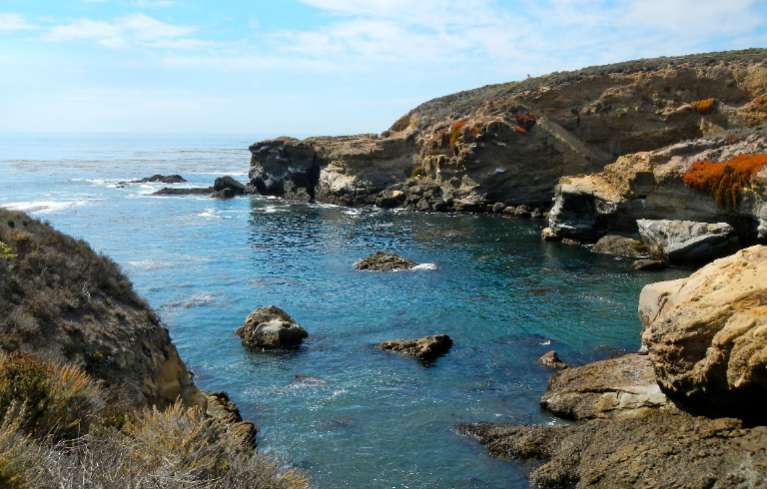
Point Lobos State Reserve in Carmel offers endless views of the Pacific Ocean. Photos/Kathryn Reed

Point Lobos State Reserve in Carmel offers endless views of the Pacific Ocean. Photos/Kathryn Reed

By Kathryn Reed

CARMEL – Tails smacking the water, backs breaking the surface and water spewing from the blowhole.

It’s an unusual sight in early October to see humpback whales breaching off Point Lobos. About a half dozen of these creatures were a few hundred yards from shore. A volunteer with the state preserve says a shelf about 1,000 feet deep provides plenty of food for the whales. He allows visitors to peek through his high-powered binoculars to get a better view of the action in the ocean.

A couple kayakers are out with the whales in what looks like a potentially precarious situation.

Point Lobos State Reserve is full on this first Sunday in October. We had to park on the road – which saved us $10. Maybe it had something to do with the federal shutdown; after all it’s why the four of us were there. Our girls camping weekend was canceled because we were headed to a national park. But Plan B was just fine – Carmel and its surroundings.

Birds are the most common and easiest form of wildlife to spot. Cormorants, herons, and pelicans flock to rock outcroppings and are in the bay area perched on kelp as they scout for food.

It would be near impossible, definitely exhausting, to hike all the trails in the reserve in one day. The $2 map that may be purchased at the parking kiosk is worthwhile. Besides letting you know where you are and how to get to the next spot, there is a wealth of information about the preserve.

Trails for all ability levels abound and some are wheelchair accessible. And those not into exploring by foot will find parking near the water.

Offshoots along many of trails provide sweeping vistas of the Pacific Ocean. The reserve is on a jagged slice of the Central Coast, which provides for several rather tranquil coves, at least on this day.

Windswept trees look deformed as their branches are not uniform. This just adds a unique natural beauty to the already stunning scenery. The Cypress Grove Trail goes through one of two naturally growing stands of Monterey Cypress trees that exist in the world.

Chinese fishermen built the Whalers Cabin in the 1850s. Now it’s a museum that tells stories of abalone being shipped to Japan, how cattle were brought to the area by the Carmel Mission padres in the 1770s, that Portuguese dairy farmers in about 1903 started making Monterey Jack cheese. The Jack is a tool, not a person.

Point Lobos is also a popular launching spot for scuba divers. In 1960, it became one of the country’s first underwater reserves.

In total, the reserve includes 775 acres underwater and 554 acres on land. The State Parks system began managing the area in 1933. It is on the National Register of Historic Places.

ngg_shortcode_0_placeholder (Click on photos to enlarge.)


Shoppers saying no to canned food

By Vanessa Wong, Bloomberg

Maybe canned foods remind us of school lunches. Or power outages. Or Y2K paranoia. Or cuisine from the ’50s. Perhaps it’s concern about BPA. Maybe the home canning trend keeps consumers from the supermarket. Because sales of preserved foods in the U.S. are fading.

Except during the recession, when consumers sought less expensive groceries, retail sales of canned, jarred, and otherwise preserved foods have been in decline. Ready meals such as canned stew, fruit, and seafood saw the steepest drops since 2003, according to researcher Euromonitor International.

Last year, volume sales of canned and preserved foods dropped by 1 percent, and Euromonitor estimates that by 2017, retail sales will be down 5 percent from 2012 levels, to 5 millions tonnes.

Sure, they’re affordable and can reduce food waste. But, as the firm explains in a report, because these products can be kept on shelves for years and can contain high levels of sodium, they are perceived to be less fresh and less healthy than even frozen and chilled foods. As the economy recovers, consumers are gradually trading back up. “Given the current health and wellness mind set of Americans, they are trying to avoid canned/preserved food if they can afford to do so,” Euromonitor writes. (This obsession with freshness doesn’t seem to be stopping people from hoarding Twinkies.)

Read the whole story


Feds to protect sage grouse in Calif., Nev.

By Jason Dearen, AP

SAN FRANCISCO — Federal wildlife officials on Friday proposed to list as threatened populations of greater sage grouse in Nevada and California in an effort to save the struggling species, a decision that promises to pose new challenges for ranching and energy development in the West.

The U.S. Fish and Wildlife Service found that invasive species and energy development in the desert have had a devastating effect on the large, ground-dwelling bird’s populations, said Ted Koch, Nevada state supervisor for the service.

“It’s not the eleventh-hour for sage grouse here, but it is maybe the 10th hour,” Koch said. “And that’s good news. It means we have some time and space to turn things around.”

The service found multiple threats facing this specific sub-population of the sage grouse, a chicken-size bird whose males have a large white tuft of feathers around their necks.

The service estimates there are only about 5,000 of the birds left.

Non-native pinyon pine and juniper trees introduced to the habitat and power lines have given low-to-the-ground perches for raptors, which eat the grouse, Koch said.

The service also found that an invasive grass from Asia that burns easily has helped decimate sagebrush, which is key to the grouse’s survival.

Industry, federal and local officials say a local effort already underway to save the bird is a promising start. Passed in 2012, the plan is being used by federal officials to help clear red tape for industry in the area.

Some state legislators greeted the proposed listing with suspicion, saying it could have wide-ranging economic impact on the rural economies in the region. Senate Majority Leader Harry Reid of Nevada said the decision will have “major ramifications” on the way of life in parts of Nevada and California.

“This listing is further proof that we need to work together to protect sensitive species before they get to such a dismal point and negatively affect our rural economies,” Reid said in a statement.

The final decision on the service’s proposal will occur next year, and the public will have 60 days to comment.

Ranchers, miners and energy developers who use the mostly public lands that serve as the sage grouse’s habitat have opposed the listing, saying it would have a deep economic impact in the rural West.

Friday’s proposed listing comes as the service is also determining whether the entire western sage grouse population should be federally protected. Sage grouse also live in Colorado, Idaho, Montana, North Dakota, Oregon, South Dakota, Utah, Washington, Wyoming and parts of Canada.

Ranchers worry that protections will scuttle or block outright vast grazing areas. They say it adds a lot of uncertainty to any plans to expand or even launch habitat restoration plans on their lands.

“For guys talking about expansion and going to the bank for loan, I’m not sure what the bank is going to tell me,” said JJ Goicoechea, a rancher and veterinarian who is president of the Nevada Cattlemens Association.

“And the rural economy is heavily dependent on those ranching families, who generate revenues that help keep towns and schools running. What’s going to happen to those rural communities?” he asked.

The Center for Biological Diversity, which sued the service to protect the sage grouse, said the decision was long overdue.

“The sage grouse we have here in Nevada and California is a true symbol of all that is wild — what a relief that it’s finally getting the protection it needs to survive,” Rob Mrowka, a Nevada-based center ecologist, said in a statement.


Garden of Joy brightens Mt. Tallac High campus

Garden of Joy of Mount Tallac High Schoo. Photo/Kathryn Reed

Garden of Joy at Mount Tallac High School. Photo/Kathryn Reed

By Kathryn Reed

“Who was that?”

“That’s one of my kids,” Joy Rothschild would say.

Biologically she didn’t have any children. But Rothschild had a bond with so many Lake Tahoe Unified students through being an aide in the schools, working to get those who in some manner were homeless to have a more stable life, and through volunteering with Court Appointed Special Advocates that she had many kids in a different way.

There was a special place in her heart for youngsters who didn’t fit into society’s definition of “normal teen”.

She regularly gave money for a scholarship to Mount Tallac High so students could continue their education.

Rothschild died in August 2012 at the age of 63. But her memory lives on and the work she did continues.

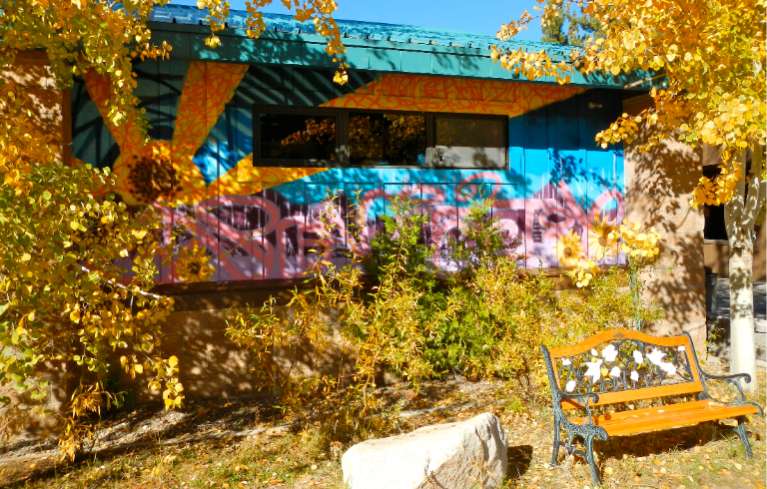
Today there is spot in the back of the Tallac campus in South Lake Tahoe called Garden of Joy. A bench was donated last year through the classified union and friends, with the mural being painted at the start of this school year. Pavers donated by Tahoe Paving Stones and laid by students under the direction of teacher Jackie Tan give it a more complete look.

In the stones is an 11-foot-by-11-foot chessboard. Tan plans to write a grant so by spring there would be large game pieces students could use to play chess.

Oct. 22 was Mount Tallac’s annual open house, with students giving tours of the campus. The garden is one of the stops along the way.

“Joy just loved the Tallac school. She was very loved by students who liked the alternative programs. She loved them,” Karen Tinlin, principal of Mount Tallac, told Lake Tahoe News.

Teri Rothschild believes her sister would be thrilled with the tribute. She and their father, Rocky, donated to the cause.

“I like having something up there that is permanent,” Rothschild said.

Rothschild and artist Matt Kauffmann met only once – and it was rather random. He works with the Sphere of Influence program that has kids paint electric boxes in the area. They are the type of youth Rothschild connected with and always helped. Kauffmann was on Ski Run Boulevard with some youths when a vehicle pulls up and out pops Rothschild saying, “I love what you are doing” – gives him a hug and gets back in the car.

Kauffmann spent a day creating the mural. A large sunflower represents Rothschild’s favorite flower. Aspens frame the artwork.

“I wanted to make it bright, alive and fun,” Kauffmann told Lake Tahoe News.


Study: Meat producers ignore calls for reform

By Eliza Barclay, NPR

Five years ago, a landmark report excoriated the animal agriculture industry’s practices and laid out a roadmap for how it could do better. But in the years since, the problems are just as bad — and maybe even worse.

That’s the conclusion of the Johns Hopkins Center for a Livable Future. This week, the center scolded the industry again with a review of how it has fared in the years since the Pew Commission on Industrial Farm Animal Production released its original report.

These pigs, newly weaned from their mothers, are at their most vulnerable stage of life. They’re getting antibiotics in their water to ward off bacterial infection.

“From a regulatory, or legislative, standpoint, we have actually regressed on many of these issues in the last five years,” says Bob Martin, who served as executive director of the original Pew commission, which included policymakers and scientists. Martin is now a program director at the Center for a Livable Future.

Though the Pew commission is not a foodie household name, its 2008 report has subtly shaped many consumers’ view of how our food animals are produced. It’s not the rosy view — it’s the highly critical one.

Back then, the commission identified the most worrisome systemic problems of producing 9.8 billion food animals every year in the U.S. It called out the animal agriculture industry for the excessive use of medically important antibiotics, particularly the industry’s habit of giving animals low doses for non-therapeutic uses like growth promotion.

Read the whole story


Ron Rose — 1930-2013

Legendary South Shore musician Ron Rose died Oct. 22. He was 83.

Born Rupert Ronald Rose on June 18, 1930, in Warren, Ohio, he began playing piano at age 4.

Jazz was hot and Ron took to it quickly. Before ever learning to read music, young Ron became an expert at his trade. In his hometown he was a bit of celebrity by his teens and playing at every town gathering from dances to roller rinks.

Ron Rose

Ron Rose

It was at one of these gatherings where he’d meet the love of his life, a petite blonde with a strong will to dance, Dorothy Louise Palmer. He’d later learn her strong will was a powerful force he would rely on to build a life and family together.

They were married in the summer 1950. They were blessed with the birth of their first daughter, Sandra Lee, in June 1951. One year later, their second daughter, Rhonda Jean, was born. Ron was playing gigs in the Ohio area and anywhere else he could to provide for his family such as Virginia Beach and Biloxi. While in Ohio, their son, Jeffrey Scott, was born. Soon to follow was daughter, Lynda Jo.

In 1958 Ron was invited to play at North Lake Tahoe at the North Shore Club. Upon arrival, Ron suspected his life would take a new turn. In fall 1958 he walked in to Harveys Lake Tahoe Casino where he played a tune for Bill Ledbetter, Harvey Gross’ son-in-law. He was hired on the spot and returned to Ohio to prepare his family for a move West.

At Harveys Ron found the reliable work he’d hoped for as he and Toots continued to grow their family. As they moved, Toots was pregnant with their second son, and final addition, David Allen. The hard winters in Tahoe were no match for Toots who had grown up in a working Ohio family and knew how to take care of herself. She continued to chop wood, plan around a tight budget, and shovel endless snow. Ron worked countless nights at the casino, a star on the South Shore.

Ron’s tunes at Top of the Wheel drew crowds from all over. Jazz lovers and young professionals from San Francisco and Sacramento would drive all night to hear him play and dance well into the night. Throughout his 43 years at Harveys, he would rub shoulders, play music and often host family dinners for talents coming through the South Lake Tahoe area, including BB King, Liberace, and Jay Leno, to name a small few.

A local living legend, Ron released three albums during his career among many single recordings and traveling from coast-to-coast sharing his love of melody and jazz.

The Rose family gained the reputation as a stronghold in the small Tahoe community. Always enough food to spare, family dinners created a community and family gatherings were commonplace.

The life of Rupert Ronald Rose will be celebrated Oct. 30 from 1-3pm at Montana Health and Fitness Community Center (Resort Course Genoa Lakes) 468 Mountain Meadows Drive, Genoa.