U.S. at bottom of pack to help working moms

By Sheelah Kolhatkar, Bloomberg

Bloomberg News has just completed an investigation into the plight of working mothers in America, and it’s not a pretty picture. Only 12 percent of those employed get paid time off to care for a new baby, according to U.S. Labor Department statistics. Only three states have programs offering paid family leave — California, since 2004; New Jersey, since 2009; and, as of last month, Rhode Island.

“Papua New Guinea is the only other nation that doesn’t provide or require a paid maternity leave, according to information on 185 countries compiled by the United Nations’ International Labor Organization,” Bloomberg reports. “It recommends 14 weeks off at a level no lower than two-thirds of previous earnings.”

Those who pay attention to the work-family debate have been aware of this for a long time. What is startling is how stubbornly it remains a non-issue in policy circles; even with increasing numbers of women now serving in Congress—20 in the Senate and 78 in the House, the highest ever—legislation that tries to address the current inadequate pregnancy and family policies is largely absent.

Currently, the Family and Medical Leave Act, which was passed in 1993, guarantees workers at companies with 50 or more employees 12 weeks of unpaid leave. The problem is that many people can’t afford to take it. Larger companies tend to offer more generous benefits, which have been shown to correlate strongly with an increase in women returning to their jobs after having a child.

Read the whole story


Brown urges caution in State of State speech

By David Siders, Sacramento Bee

Gov. Jerry Brown said today that California is continuing its “comeback,” with a budget surplus and am improving economy, but he urged the Legislature to restrain spending.

“This year, Californians have a lot to be proud of,” Brown told a joint session of the Legislature in his State of the State address. “For a decade, budget instability was the order of the day. … But three years later, here we are, with state spending and revenues solidly balanced, and more to come.”

However, Brown said the state budget is based on fluctuating revenue, and long-term liabilities are high. As he did in his State of the State speech a year ago, Brown offered the cautionary, biblical account of Joseph and the Pharaoh’s dream of seven cows.

The 17-minute speech was the final State of the State address of Brown’s third term. The 75-year-old Democrat is widely expected to seek re-election, and the speech served to preview his campaign.

Read the whole story


Dry conditions create winter fire threat

By Joseph Serna, Los Angeles Times

California is bracing for what officials fear could be an unprecedented winter fire season fueled by record dry conditions that show no signs of letting up.

January is typically a time when forest fire camps and air bases are closed and seasonal firefighters go home. But not this year. Calfire has responded to 150 wildfires so far. During the same period last January, there were none, and the historic average is 25.

Across California, vegetation that typically rehydrates with rain between December and April continues to get dryer and more dangerous. The fires so far this winter have been relatively moderate compared with some of the state’s largest, but officials worry that the fires will get worse as the fuel gets even dryer. Forecasters say there is little relief in sight. The National Weather Service last week released a forecast for the southwestern United States calling for unseasonably dry and hot conditions.

Read the whole story


Swanson cleared of bribery allegation

By Kathryn Reed

The bribery investigation involving South Lake Tahoe City Councilwoman Angela Swanson is over. No charges will be filed.

“At this time we don’t believe Mrs. Swanson intended on a criminal act,” Dave Stevenson, investigator with the El Dorado County District Attorney’s Office, told Lake Tahoe News.

Swanson has been under suspicion since August 2012 when Gino DiMatteo, then owner of City of Angels II medical marijuana dispensary, was arrested on a slew of drug charges. He implicated Swanson in a bribery case, claiming she would vote a certain way if he supplied cash to a charity she was involved with.

Angela Swanson

Angela Swanson

Stevenson said the investigation began based on a tip from a source, who wants to be anonymous, saying that there was some criminal wrongdoing going on.

“Throughout our investigation we look at different people and their involvement and their intent and if any laws were violated. Obviously, shortly into the investigation it was determined that Mr. DiMatteo had criminal wrongdoing and intent so we veered toward him,” Stevenson said. “That took a lot of time. Once it was completed, we focused on if anyone else was involved in criminal intent.”

DiMatteo pleaded guilty Jan. 9, 2013, to possession with the intent to distribute marijuana. He was sentenced to five years in prison. During the investigation it was uncovered that DiMatteo should never have been allowed to open a pot shop because he was a felon. But South Lake Tahoe officials never did a criminal background check on him.

“Ultimately, our investigation has concluded and found that while it is clear that Mr. DiMatteo believed he was attempting to bribe Councilmember Swanson, it is equally clear that the councilmember already intended to vote favorably for Mr. DiMatteo and his marijuana dispensary,” District Attorney Vern Pierson said in letter to South Lake Tahoe councilmembers.

Swanson’s vote for medical marijuana has been consistent since she has been on the council.

The bribery issue stems from Swanson and Nancy Rollston, the head of the Lake Tahoe Educational Foundation, accepting more than $1,000 in cash for the foundation from DiMatteo that was delivered in an unmarked brown bag. This was just prior to vote of the council involving DiMatteo. (Despite its being drug money, the foundation has never returned it. Swanson is on the nonprofit’s board.)

Swanson always maintained her innocence and has said there was nothing wrong with accepting that money. She did not respond to multiple inquiries.

A bit of potential irony is Swanson is running for El Dorado County supervisor and would be in a position to have some say over the District Attorney’s Office, at least budget-wise. And Pierson is up for re-election this year.


EPA’s process to OK pesticides raises health concerns

By Katia Savchuk, Center for Investigative Reporting

Tiny particles of silver could appear soon in children’s toys and clothing, embedded inside plastics and fabrics to fight stains and odors.

No one knows how the germ-killing particles, part of a new pesticide called Nanosilva, affect human health or the environment in the long run. But regulators have proposed letting Nanosilva on the market for up to four years before the manufacturer has to submit studies on whether the particles pose certain dangers.

That’s because the U.S. Environmental Protection Agency has backed approving Nanosilva through conditional registration, a fast-track process that recently has drawn criticism for oversight problems. Unlike regular registration, it allows a pesticide to be sold before all required safety studies are in. In this case, manufacturer Nanosilva LLC can move ahead even though it hasn’t explored fully the potential health risks if the product were to seep out of plastic or be inhaled.

Nanosilva’s approval, which could be finalized early this year, has renewed focus on the loophole, designed mainly to help the EPA speed up approvals of pesticides nearly identical to those already being sold.

Recent reviews have found vast problems with the EPA’s oversight of conditional registration. An internal audit showed in 2011 that 70 percent of all active pesticides had been conditionally approved. The audit also concluded that the agency used the label too broadly. Since then, its use has increased. Figures the EPA provided in December put the number at 80 percent.

Thousands of pesticides kept conditional status for more than 20 years, the Natural Resources Defense Council, a nonprofit environmental advocacy group, found in 2010. The EPA says studies typically are due within four years.

And last year, federal auditors found the agency couldn’t reliably track how many products were conditionally registered or whether safety studies were submitted. As a result, pesticides could linger on the market for years without critical tests, the Government Accountability Office warned in August.

These aren’t new problems. At least seven independent reviews dating back to 1980 have noted flaws with the agency’s systems for tracking pesticide registrations.

The EPA said it has enough data on Nanosilva to know that it’s safe while the manufacturer finishes testing, as the law requires. But some scientists and environmentalists say the agency is taking a risk on products that are hardly essential, like sports clothing that doesn’t stain or stink or toys that last longer.

“You could allow some uses that are justified based on human well-being, such as medical implements, but to allow the possibility that nanosilver would be released in plastic on children’s toys, and your kid could chew on it and ingest that material before we understand its toxicity – that’s unnecessary risk,” said Samuel Luoma, a research ecologist at the University of California, Davis. “It doesn’t make any sense.”

Conventional silver has been used as an antibacterial product for centuries. It releases ions that are deadly for many bacteria and fungi.

Recently, scientists have broken down silver into particles more than 1,000 times smaller than the width of a human hair – some not much wider than a DNA strand. They’re called nanosilver. Nanosilva is just one brand that contains them.

Nanosilver can be embedded directly into plastics, fabrics and other materials. Companies say this helps products last longer. It also allows them to call items antibacterial and attract germ-conscious consumers. Nanosilver needs to be registered as a pesticide because it claims to kill bacteria and other live organisms.

Regular silver is highly toxic to fish and other aquatic life but isn’t usually dangerous for humans. But scientists say nanosilver could pose unique hazards, and they know little about its long-term risks.

Animal studies show that nanosilver can slip into cells and build up in the brain, heart and other organs. The EPA doesn’t know whether nanosilver causes reproductive harm or cancer because there are no valid studies. Research on animals suggests that it can collect in the male reproductive system, potentially harming fertility, and may cause genetic mutations, which sometimes are linked to cancer.

Scientists have warned that nanosilver may be more toxic than regular silver and act as a carrier for other poisonous chemicals. Besides human health risks, researchers worry that nanosilver could kill fish and disrupt food chains if it makes its way into the environment.

The EPA argues that approving Nanosilva promotes innovation and lets consumers enjoy better products. The agency also says it didn’t give the manufacturer enough time to do safety tests. The EPA didn’t ask for those tests until nearly four years after an independent scientific advisory panel counseled the EPA on how it should evaluate nanosilver in 2009.

And, in evaluating Nanosilva, the EPA ignored some of that panel’s advice.

The scientists told the agency to evaluate every nanosilver product separately. Just because one is safe doesn’t mean others will be, they said. The agency instead figured out many health and environment risks based on studies on particles that were different from those in Nanosilva. The EPA said the tests were “scientifically appropriate.”

Nanosilva officials couldn’t be reached for comment.

This isn’t the first time the EPA has conditionally approved pesticides containing nanosilver.

In November, a federal appeals court overturned the approval of two nanosilver products, ruling that the EPA had incorrectly found they posed no risks to toddlers. That decision didn’t affect Nanosilva because the EPA used different calculations in each case.

Regulators still are grappling with how to deal with nanomaterials. While only two companies have asked for EPA approval, hundreds of products containing nanosilver already are on the market, according to an inventory by The Project on Emerging Nanotechnologies.

The EPA also has fast-tracked other controversial pesticides, including ones linked to the collapse of honeybee colonies and tree deaths.

All conditionally registered pesticides meet legal safety standards, the EPA said. The agency said it’s taken steps to prevent staff from coding registrations incorrectly, which it said was the main reason numbers appeared high.

The EPA also has reviewed some conditionally approved products to look for missing data and other problems. But it hasn’t traced the paper trail for all pesticides, as it told federal auditors it would do by last fall.

The EPA also doesn’t have a concrete plan for the main fix auditors prescribed, an automated tracking system to guarantee that studies arrive and get reviewed. Currently, pesticide managers sometimes rely on handwritten notes and memory to keep track.

“Until they figure out the system, they shouldn’t be using conditional registration,” said Mae Wu, an attorney for the Natural Resources Defense Council.

The EPA first told federal auditors it would develop an automated tracking system more than 25 years ago.




Epic Mix creates competition on, off the slopes

By Kathryn Reed

Based on the amount of vertical feet being skied by people at Heavenly Mountain Resort, it would be hard to know the whole mountain hasn’t opened because of the lack of snowfall.

Those who are into keeping track of where they ski, vertical feet, number of days and other stats just have to sign up for Epic Mix. The social media component to skiing is Vail Resorts way of making it more than just a ski day. And while it’s offered at all their mountains, Heavenly has the most enthusiastic Tahoe participants.

Its nicknamed “Epic crack” because it is so addictive.

At the end of a ski day, Shirley Hackett goes over her Epic Mix account online. Photo/Kathryn Reed

At the end of a ski day, Shirley Hackett goes over her Epic Mix account online. Photo/Kathryn Reed

Shirley Hackett, 56, skis every day at Heavenly – except when she’s skiing someplace else. In summer 2011 she was diagnosed with a life-changing illness that almost kept her off the slopes for good. When she got back in January 2012 her goal was to ski 1 million vertical feet. She ended that season with 2.5 million vertical feet in 85 days.

In the 40-plus days she has skied this season she is at more than 1 million vertical feet. It’s a little easier to do this at Heavenly compared to the New York resort where she learned to ski. It had 250 vertical feet top to bottom.

Hackett’s goal last season was to ski 100 days. She got in 112 – but not all at Heavenly. For her 102 days at a Vail owned resort she skied 2,619,439 million vertical feet. She finished the season top among all women at all Vail Resorts.

“So, now all of this seems quite easy,” Hackett said as she went over the various components of her Epic Mix page.

And the prize at the end of the season?

“There is nothing except bragging rights,” Hackett tells Lake Tahoe News with a smile. “It’s good clean fun. You are outside in one of the most beautiful places, exercising. You can’t beat that.”

Anyone can go online to see how people are doing – assuming they’ve made their profile public. It’s optional to activate Epic Mix.

Dave Maderis, who also skis at Heavenly, decided after the first year he could beat the record of 4.3 million vertical feet. So in 2011-12 at age 69 he began his quest. In 136 days he skied 4.8 million feet – for those bragging rights.

He did so through a viral infection and cracked ribs.

Maderis decided after turning 70 he didn’t need to challenge himself in quite the same way.

In year three, Mark Emmerling, who’s home resort is Heavenly, decided he was going to beat the Colorado guys who often have an earlier start to the season, sometimes a later ending date and resorts with longer runs. He did so – skiing 7,036,536 million vertical feet in 2012-13.

Robert Martin collects his vertical feet on a ski bike.

Then there are the stories of those who have camped out at World Cup to swipe their pass to get the feet without ever getting on the lift, let alone skiing down. It was also an easy way to earn the Dark Knight pin, which is 10 lifts after 4pm.

“I don’t think we had any idea how really, truly competitive our guests are,” Stacey Pool, director of online experiences for Vail Resorts said. And they are competing against people they may not know, especially people at another resort.

But Epic Mix isn’t just about vertical feet. It’s also about pictures, pins, lessons and racing. Vertical feet and photos are the two most popular features of the application.

Photos can be uploaded to Facebook within a matter of hours. It’s there with the resort’s logo, so it’s practically free advertising. Guests can buy photos if they want.

People can be seen on chairlifts tracking their pins, vert feet and posting photos. It’s that addictive. They don’t even wait until the end of the day to know their stats or share their info with others.

“You don’t have to be the best skier in the world. It’s a game,” Maderis told Lake Tahoe News. “It’s good for people who come up 15 to 20 days to see how many points they can acquire.”

The points are based on pins, vertical feet and other criteria.

Vail Resorts started Epic Mix as a way to tap into the burgeoning social media platform.

“It was a way to capture special memories, experiences you were having on the mountain and then you could share with friends,” Pool told Lake Tahoe News. “At first we measured social impressions – how many eyeballs were on social posts. It was in the millions of social impressions in the first year.”

Each year Vail has tweaked Epic Mix or added something to it. New this year is with ski or snowboarding lessons the ability to track one’s progression. It also has the name of the instructor and other details not available if the person has not activated Epic Mix. (Epic Mix is free and is available on season passes and day passes.)

Pool said Epic Mix is not being used to track where individuals are. However, it has been used when someone has turned up missing to see where they have been skiing so ski patrol can start with that area to locate the person.

With the pins that can be collected – and they are all virtual – it’s possible to put them up in a route on the mountain at times that would disperse skiers from congested areas. People know where they are by using their smart phones.

Otherwise, Epic Mix is considered a passive app, and that’s how Vail Resorts intends to keep it. What will be new for 2014-15 – if anything – Pool isn’t saying. After all, this season isn’t even half over.


Privacy an issue as car gadgets become the norm

By Craig Trudell, Bloomberg

Drivers’ privacy needs to be protected by law, said Alan Mulally, chief executive officer of Ford Motor Co., as more vehicles use data for services such as location tracking amid the booming in-car technology market.

The company is “supportive and participating” in talks with regulators who are considering such legislation, Mulally said this week at the Detroit auto show. He countered comments made last week by the automaker’s global marketing chief, who said Ford knows when drivers of its vehicles violate traffic laws through global-positioning system data.

Documents released by former government contractor Edward Snowden last year have sparked a firestorm in the U.S. related to data-privacy concerns with technology and telecommunications companies. The comments by Jim Farley, Ford’s executive vice president of global marketing, have directed attention to the car industry as in-vehicle technology becomes more common.

Read the whole story


Political groups in Nev. slow to disclose donors

By Andrew Doughman, Las Vegas Sun

Nevada’s politicians are assembling stockpiles of money, the ammunition for this year’s election campaign season.

They will report millions of dollars in campaign contributions this week on annual disclosure forms, but that’s just the money elected officials are required to report.

As in the 2012 election, groups unaffiliated with any candidate will likely spend millions of dollars to bankroll advertisements aimed at Nevada voters, and it’s unclear what, if anything, these groups need to tell you about who’s paying for the ads.

Judges in several Nevada court cases are considering whether groups sending political messages must disclose their donors in Nevada.

Read the whole story


Cal band brings music to Sierra’s slopes

By Susan Wood

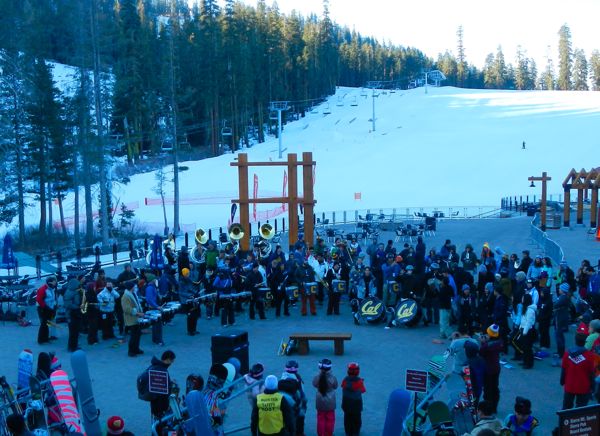
TWIN BRIDGES – Call it a prelude of things to come at Sierra-at-Tahoe ski resort.

The century-plus-old Cal band showed up for the 10th time to play and dance in its signature, animated style at the ski resort’s expansive, new plaza outside the main lodge this Martin Luther King, Jr. holiday weekend. Then, the members of the playful UC Berkeley band got on skis and snowboards to navigate the Broadway run with instruments in hand.

Members of the Cal band ski and play down the slopes at Sierra-at-Tahoe. Photo/Steven Hemphill

Members of the Cal band ski and play down the slopes at Sierra-at-Tahoe. Photo/Steven Hemphill

The exceptional eye-hand coordination would make the Winter Olympians the ski resort has spawned proud.

If the band can overcome a losing football season last fall, it can certainly negotiate the sparse snow of the Sierra Nevada this winter.

“It’s not too bad. The tuba is a well-balanced instrument,” tuba player Naddav Paran said after Saturday’s morning performance. Of course, it might help that he started skiing at age 4. And band members are instructed to take it slow.

Upon success of the midday ride, the tubas become the stars at the end of the day for their dancing rendition of “Lights Out.”

On skis and boards or not, the student-run Cal Band knows how to entertain. When the Bears band marches out of Memorial Stadium’s North Tunnel for football pre-games, the display is referred to as the “pacesetter of college marching bands” – or, “the pride of California.” Band members take over the streets when the team wins at home in Berkeley.

Stephen Ramaley is bundled up to play in below freezing temps. Photo/Kathryn Reed

Stephen Ramaley is bundled up to play in below freezing temps. Photo/Kathryn Reed

Guests and staffers of the ski resort located 12 miles west of Meyers were rocking out for the morning session near Tahoe, a non school-sanctioned event scheduled to wrap up the end of winter break.

“This is awesome,” ski school instructor Jen Gilardi screamed. The employee, who followed the band when she lived in Berkeley, was texting friends to join her for the day to see the band.

Guests of the resort, the Mayali family of Kensington, were all smiles while watching. Dad Xavier went to Cal, and he and his wife, Michelle’s, two children play band instruments – Emma, 8, saxophone and Max, 10, trumpet. The Cal Band, in one of its several appearances at games, reunions, weddings and birthday parties, staged a performance at Max’s school.

“We make a point of coming up here for this weekend,” the Mayali matriarch said.

Before the sun comes over the ridge, the band welcomes skiers to Sierra.

Before the sun comes over the ridge, the band welcomes skiers to Sierra.

Even the parents of the band members enjoy the venue.

“This is the only time I get to see him,” Doug Greer said of his piccolo-playing son, Ross.

Steps away, Kevin King of Folsom swayed and danced to the band’s repertoire of 150 songs ranging from the proverbial marching band tune “The Big C” to more contemporary hits such as “Carry On” by the rock band Kansas.

“I went to Davis, but the Cal Band is the best,” King said, adding he enjoyed the paving-stone plaza area Sierra installed this season.

The new area expands the base lodge space and seating, and resort management expects to stage many events there – particularly in the spring and summer. King’s alma mater band may play at the resort’s grand opening of the plaza.

Many people from all walks of life have connections to the Cal Band. Alumni musicians are invited at any time to join the band for the Tahoe-area weekend event, which continued on Sunday at Squaw Valley.

Keeping the cadence.

Keeping the cadence.

Despite the 19-degree temperatures early Saturday morning, most band members played without gloves, and at least one rotating conductor, a drummer, stripped off his hat and jacket upon taking the platform. Another percussionist rolled up his sleeves. The musicians have played in all sorts of weather conditions – even in a snowstorm a few years ago.

Senior manager Carolyn Richter recalled a time when she forgot to separate and defrost her mouthpiece one cold morning and paid for it with part of her lip sticking to the mouthpiece of her trombone. Still, she considers Sierra-at-Tahoe one of the more fun events the band puts on.

“It’s as much about the dancing as the playing,” Richter told Lake Tahoe News.

That’s one way to stay warm in the mountains.

“Our band (members) who come out for this also love to ski and snowboard, and Tahoe’s not too far away,” she added.

Agreeing was Richter’s No. 2 man up for the manager job next year, Stephen Stapleton. The trumpet player made a point of declaring the ski weekend as one of his favorites, and he’s apparently not alone. About 140 members of the 200-person band showed up to take part.

Playing without the assistance of gloves.

Playing without the warmth of gloves.

“The Cal Band brings great energy to the resort. It’s so fun to have them skiing down Broadway and playing music at the base,” Sierra General Manager John Rice said.

The Cal Band has made a variety of performances, including the San Francisco Symphony’s Black and White Ball and even the Ed Sullivan show years ago. More recently, the high-energy band led the San Francisco Giants downtown victory parade when the team won the World Series after a half-century drought.


Smart phones share data unbeknownst to users

By Elizabeth Dwoskin, Wall Street Journal

Fan Zhang, the owner of Happy Child, a trendy Asian restaurant in downtown Toronto, knows that 170 of his customers went clubbing in November. He knows that 250 went to the gym that month, and that 216 came in from Yorkville, an upscale neighborhood.

Businesses are tracking their customers and building profiles of their daily habits using a network of startups that have placed sensors in restaurants, yoga studios and other sites. Chris Gilpin, founder of one such site, Turnstyle, joins the News Hub.

The sensors, each about the size of a deck of cards, follow signals emitted from WiFi-enabled smartphones. That allows them to create portraits of roughly 2 million people’s habits as they have gone about their daily lives, traveling from yoga studios to restaurants, to coffee shops, sports stadiums, hotels, and nightclubs.

Read the whole story