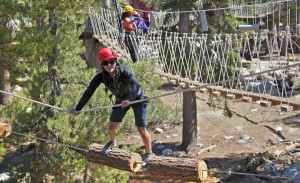
Haase family celebrates NCAA tournament run

UAB Coach Jerod Haase cuts down the net after his team won the conference title. Photo/Carol Haase

UAB Coach Jerod Haase cuts down the net after his team won the conference title. Photo/Carol Haase

By Kathryn Reed

UAB won’t make it to the final dance, but that’s OK. The men’s basketball team wasn’t ever expected to win its conference to advance to the NCAA tournament, let alone win a game at that tournament.

It was so unexpected that the coach’s mom had to keep changing her flight – and not just once – and rent a car for a long drive to Louisville.

Carol Haase and her husband El Hug flew out to see Jerod Haase coach UAB in the C-USA tournament. The South Lake Tahoe couple kept extending their trip.

Haase grew up in South Lake Tahoe and as a senior was on South Tahoe High School’s state championship team. He played his first year of college for Cal. The team made it to the NCAA Sweet 16. For a variety of reasons – including his father’s death – Haase transferred to Kansas.

His dream was to always play in the NBA. Multiple fractured wrists prevented that from happening. The boy who first learned to dribble in third grade didn’t have a strong enough wrist to muscle through the pros.

Instead, Haase turned to coaching. Under the guidance of Kansas coach Roy Williams, Haase learned the intricacies of what it takes to be a winning college coach. He was an assistant at Kansas and North Carolina before taking over the head coaching position at UAB three years ago.

This was UAB’s first C-USA tournament title. The Blazers had not been to the NCAA tournament in a decade. They lost March 21 in the third round to UCLA, 92-75.

Carol and Jerod Haase outside the coach's house where neighbors had placed celebratory balloons. Photo/Provided

Carol and Jerod Haase outside the coach’s house where neighbors had placed celebratory balloons. Photo/Provided

Carol Haase didn’t get to see much of her son, but she did tag along on a few interviews.

“The fun thing I got to do with Jerod was go to Fox News and CBS and watch the live interview with the cameras and green room. That was great,” Haase told Lake Tahoe News.

“Jerod was very calm. We didn’t get to see him much. He was more subdued than anything. I could see his mind was going, going, going. We just kind of gave him space.”

It also allowed Haase and Hug to spend more time with their daughter-in-law and three grandchildren.

During the conference tournament family watched the game from behind the bench. For the NCAA tournament they were across the court, but still almost courtside.

Haase said the energy was electrifying. Only one college is at a hotel. Everyone is dressed in their respective college’s clothing. A police escort is the norm. With the band traveling with the team, it added an extra flair. A small red carpet was rolled out wherever the team went.

What Coach Haase’s future holds remains to be seen. He says he wants to return to UAB, but the C-USA Conference may not welcome the school because it has cut other athletic programs. With UAB’s performance at the NCAA tournament, Haase’s stock is even higher, so it’s possible another college is looking for a coach of his caliber.


Dredging helps bind together Tahoe marinas

Sand Harbor boat launch is closed. If it does open, it won't be for a full season. Photos/Kathryn Reed

Sand Harbor boat launch is closed. If it does open, it won’t be for a full season. Photos/Kathryn Reed

Updated March 24 7:30pm

By Kathryn Reed

While the lake level is said to be the same across Lake Tahoe, marinas are not allowed to dredge to the same depth. That is one of the discrepancies the Lake Tahoe Marina Association is trying to remedy.

Nor are there any studies to prove a difference between new dredging and maintenance dredging when it comes to lake clarity or other environmental issues. Another topic for LTMA to get involved with.

The association first came about in the early 1990s when four North Shore marinas got together to try to be one voice. The union lasted a couple years. Then two years ago the idea to resurrect the group was floated and this time marinas throughout the basin are part of LTMA.

Pat Bagan, vice president of LTMA, said he believes the change in ownership and younger people will help sustain the association.

One of the biggest issues facing marinas is dredging. The average boat draws about 3½ feet, so the water level needs to be deeper than that. Most tour boats and sailboats need more clearance. The lake is at 6222.83 feet. The Tahoe Regional Planning Agency says marinas can dredge to depths ranging from 6,215 feet to 6,219.3 feet.

Last week Lahontan Regional Water Quality Control Board granted a dredging permit to the Tahoe Keys Marina and amended the permit for the Tahoe Keys Property Owners Association. No one from either entity was available for comment.

It’s estimated to cost more than $2 million to dredge the east channel or marina side, and more than $740,000 for the west or homeowners’ channel. TKPOA is obligated to pay all costs associated with its channel, while the marina dredging bill is split by the marina owners, TKPOA, and the Beach and Harbor Association.

The channel going to the Tahoe Keys Marins has dropped farther since fall 2014. Photo/LTN file

The channel going to the Tahoe Keys Marins has dropped farther since fall 2014. Photo/LTN file

The dredging for the TKPOA channel will start March 25.

“The goal is to be done by May 21. We are forecasting to finish two weeks prior to that, based on weather permitting,” Kirk Wooldridge, TKPOA general manager, told Lake Tahoe News. 

Ski Run Marina has been approved to dredge the mouth of the harbor; work should begin this week.

“There has been discussion of additional dredging in Lake Tahoe to support a channel for the Tahoe Queen tour boat there, but no one has applied for a permit. There is information that would qualify this as maintenance dredging,” Alan Miller with Lahontan told Lake Tahoe News.

Elie Alyeshmerni, who owns Ski Run Marina, told Lake Tahoe News that Aramark – owner of the Queen and the party responsible to dredge the channel – expects to soon apply for a permit.

North Tahoe Marina has a multi-year dredging permit, Tahoe City Marina finished its project, while Homewood Marina, Star Harbor and Fleur de Lac have applied for permits.

Sand Harbor officials don’t even know if the ramp will open this season.

“You have to go about 100 feet out from the bottom of the launch lanes now to gain about 12 inches of additional draft,” Jay Howard, supervisor of Lake Tahoe State Park, told Lake Tahoe News. He oversees Sand Harbor and Cave Rock launches. “The prognosis for Sand Harbor is not good. I think for Sand Harbor to be open we need at least 1½ to 2 feet of water to come off those hillsides above us. That might happen; we might get close to that.”

The problem, though, is the snow depth in the Marlette basin is 22 inches when it should be 5 to 6 feet, Howard said.

Normally Sand Harbor opens in early May. That won’t happen this year.

Cave Rock is open.

“I think the lake will come up enough where at the end of the season we would not expect Cave Rock to be any worse than it is right now,” Howard said.

Bob Hassett, who operates Lakeside, Timber Cove and Camp Richardson marinas, is working on a dredging permit application for Lakeside. He said it would be minor and that work should only take four hours.

Prep work at Ski Run Marina in anticipation of dredging. Photo/LTN

Prep work at Ski Run Marina in anticipation of dredging. Photo/LTN

“We were operating at Timber Cove Marina in 1992 — the last time the water was this low. Although it will require more care, we expect to operate just fine off the end of the pier. Larger boats may be limited and require a shuttle out to them.  We will lose a number of buoys but still expect to have availability,” Hassett told Lake Tahoe News.

Camp Richardson Marina has the longest floating pier on the lake.  A fuel rod will be used to get gas to boaters who are tied up to the floating dock.

“The first two rows of the buoy field will be too shallow to accommodate boats. With those gone, we still expect to have 96 buoys available for seasonal and day use guests,” Hassett said.

The marina association is asking the California Tahoe Conservancy to use money from SB630 to study the differences between new and maintenance dredging. Some of that money is paid to the state from marinas.

Working as a group, marina owners were able to get Lahontan to loosen its requirements for who can test water quality during storms. The state agency will be training marina representatives on March 26.

Alyeshmerni, who is president of LTMA, said the association is also looking to get all marinas certified as a clean marina within the next couple years.

“We want to be good stewards and guardians for the lake,” he said.

Those with certificates are: North Tahoe Marina, Sierra Boat Company, Tahoe City Marina and Sunnyside.

Starting this year the LTMA is going to recognize someone who went above the call of duty. On Thursday, Matt Williamson will be honored.

“He dove under the boat and saw someone who was in an air pocket and pulled them out and they were fine,” Alyeshmerni said.

A boat rented from Ski Run Marina last year capsized. One person was missing, that is when Williamson dove and found the woman.

“We are also trying to let the public know we are all working together. We want the public to enjoy the experience. What we are working toward as an association is to make it as pleasant and fun as possible at Lake Tahoe,” Bagan said.


Calif. overtime tops $1 bil., hits pre-recession high

By Associated Press

Overtime for California’s state workers rose 20 percent last year and topped $1 billion even though there are 20,000 fewer employees than in pre-recession 2008, the last time the state paid out so much, according to new payroll data.

The increase comes after years of recommendations from the state auditor and budget analyst calling for reducing vacancies, using more relief staff and negotiating less-costly labor contracts for workers in state prisons and hospitals, which generate the most overtime pay.

According to the state controller’s payroll data reviewed by the Associated Press, California spent $1.13 billion in 2014 in overtime pay for its 220,000 workers, compared to $947 million in overtime for roughly 215,000 workers in 2013. Overall payroll went up 7 percent from $15.3 billion to $16.4 billion as California enjoys a second year of budget surplus.

Some of the increase in overtime can be attributed to unanticipated costs, such as last year’s severe wildfire season. But departments with the highest overtime were not able to explain what drove the spike beyond usual challenges to fill vacant positions and cover critical shifts when employees take time off.

One taxpayer advocate said it’s unfortunate that because the economy is doing well, politicians lack the incentive to adopt personnel practices to restrain overtime.

“California remains the land of milk and honey for public employees,” said Jon Coupal, president of the anti-tax Howard Jarvis Taxpayers Association. “It’s always been that way.”

State officials acknowledged that more needs to be done to minimize overtime, particularly at institutions that treat patients and inmates for psychiatric and medical care. Half of all the overtime billed in 2014 came in the chronically understaffed Department of Corrections and Rehabilitation.

Jim Evans, a spokesman for Gov. Jerry Brown, said the administration is trying to make sure vacancies do not become an issue that drives overtime, but noted that some types of workers are difficult to recruit and retain because there’s a shortage of workers for some positions, such as psychiatrists.

Some overtime costs are difficult to budget. CalFire had $139 million in overtime last year, the most in the past 10 years, according to payroll data. The state battled 5,620 fires in 2014, nearly 1,000 more than the state’s five-year average.

But the bulk of overtime charges stem from long-standing vacancy and staffing problems at the 34 adult prisons run by corrections. In 2014, the main department logged more than $542 million in overtime pay, up 31 percent from $414 million in 2013. Bill Sessa, a corrections spokesman, said the state experienced a high rate of retirement in recent years while budgets were slashed with the recession. As a result, the department stopped training recruits, further exacerbating the vacancy problem, he said.

Since August, the academy has graduated 3,000 officers, and the goal is to hire 7,000 more over the next three years.

“Our ambition is to minimize overtime, in part, because officers work better when they’re not working 16-hour shifts,” Sessa said.

The federal court-appointed receiver overseeing inmate health care is also in the process of reviewing telemedicine capabilities to reduce costly overtime billing by physicians and nurses at prisons, said Joyce Hayhoe, a spokeswoman for receiver J. Clark Kelso. In one year, overtime has more than doubled for this branch of corrections, from more than $12 million to nearly $30 million. In all, about 1,500 correctional-related staff billed more than $100,000 in overtime in 2014, including physicians, psychiatrists, nurses, lieutenant, sergeants and officers.

Hayhoe said California struggles to find enough primary care physicians despite competitive pay, in part, because of the location of prison health care facilities. The Department of State Hospitals, which serves mentally ill patients, most of whom have committed serious crimes, is taking to social media and created a dedicated recruitment unit to attract applicants, spokesman Ken August said. The department charged nearly $104 million in overtime last year, up 5 percent from 2013.

For years, the California state auditor and Legislative Analyst’s Office have made governors and lawmakers aware of staffing inefficiencies and issued recommendations such as hiring more staff, increasing the use of relief staff similar to how substitute teachers are used in schools and re-negotiating labor provisions that require overtime shifts to be offered to senior officers first. Some of the recommendations don’t appear politically viable.

“No union will give up the right of seniority,” said Nichol Gomez-Pryde, a spokeswoman for the California Correctional Peace Officers Association, which represents correctional officers. The union is among four labor contracts up for negotiation this summer.


Thinning Sierra forest may help water supply

By Edward Ortiz, Sacramento Bee

With the state entering its fourth year of drought, some conservationists are looking at thinning Sierra forests to increase the amount of water that flows into area rivers.

The Nature Conservancy issued a report Friday that argues that thinning forests on public lands can reduce wildfire risk in the Northern Sierra. The report also found that such action brings a bonus: water conservation.

Thinning dense forests may lead to a 3 percent to 6 percent increase in mean annual stream flow to some watersheds, according to the report.

The conservancy based its estimates of stream flow on gauge records across 11 watersheds from 1980 to 2000 and found that the Feather River watershed would show the greatest increased water flow due to thinning.

This not the first time tree thinning has been examined for water conservation. However, the conservancy report is one of the first to look into the effect that ecologically based forest thinning would have on water yields in the Sierra Nevada and the economic benefit that could come from it.

Read the whole story


Low lake level changing life at Lake Tahoe

No water is flowing from Lake Tahoe to the Truckee River. Photos/Kathryn Reed

No water is flowing from Lake Tahoe to the Truckee River. Photos/Kathryn Reed

Publisher’s note: Lake Tahoe News spent March 22 driving around the lake looking at and documenting more than 20 locations to show what the drought looks like throughout the basin all on the same day.

By Kathryn Reed

It’s not unusual for Lake Tahoe to drop below its rim. What is unusual is when the spring runoff doesn’t bring it back up and above that 6,223-foot mark.

“This year the way things look it would take some pretty big precipitation to get back above its natural rim this year,” Scott McGuire, meteorologist with the National Weather Service in Reno, told Lake Tahoe News. “The projection is for Lake Tahoe to be significantly below its rim by fall 2015.”

ANALYSIS

When it fell below the rim in October 2014, this was the first time in five years. Some of the other times it was below the rim were 1977-78, 1961-62 and 1930-36.

On March 22, Lake Tahoe was at 6222.83 feet.

The record low of 6220.25 feet was set in 1992. (Records have been kept since 1900.)

In 2014, the snowmelt added 3 inches to Lake Tahoe. With substantially less snow falling this winter, it is near impossible the lake will rise by that much this spring.

Seasonal businesses were hurting last summer as documented by Lake Tahoe News.  For many of those same businesses it will only be worse this year.

Business owners may need to rethink how and when they do business because the model used even three to five years ago isn’t going to work today.

Instead of trying to get a jumpstart on Mother Nature with opening ski resorts pre-Thanksgiving, it might be time to have an intense, stellar shorter ski season. Then crank up the public relations to woo out-of-towners here for spring – a season often ignored.

If the weather patterns of the last few years are the new normal, it will mean learning to adapt to less snow and more summer-like days. In some ways this could be good for the Lake Tahoe Basin because summer has always been the busiest season. It may mean that season is now longer.

And if it’s hotter in the Central Valley and Bay Area sooner and longer, people may drive to Tahoe to cool off and recreate. This might solve the shoulder season blues.

Driving around the lake on Sunday was at times reminiscent of a summer weekend. Parking lots were full of people enjoying the outdoors. Restaurants were busy – at least the ones that were open.

Jumping in off piers and docks at Lake Tahoe is not advised.

Jumping off piers and docks at Lake Tahoe is not advised.

Signs of drought

For those in California, there will be much more beach access this year. (Nevada has different rules when it comes to public access on private beaches.) Sand and rocks are exposed in places that have not seen the light of day in years.

So many piers have little or no water under them. Signs saying “no diving, no jumping” are posted in some locales. It’s advice that will need to be adhered to at all piers and docks this year to avoid injury or worse.

Floating docks will have an easier time accommodating people. Many marinas have a combo of fixed and floating structures. This means the ramp between the two keeps getting steeper. Some are clearly not in compliance with the Americans with Disabilities Act. It would be tricky to walk down them carrying a cooler or small child.

Water marks on bulkheads and boulders are visible symbols of just how far the lake level has fallen.
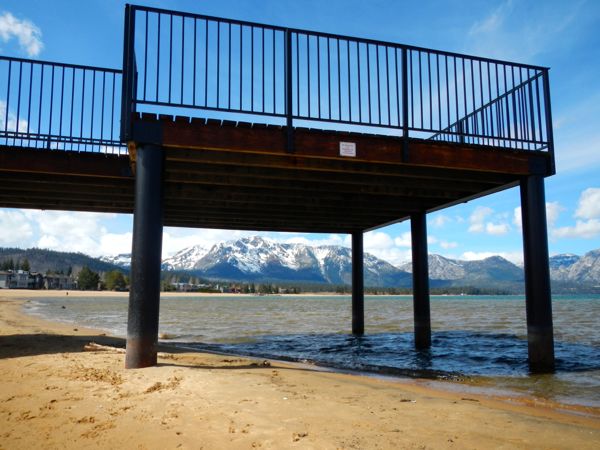
Tahoe piers-drought: Tahoe KeysTahoe Keys Property Owners Association Pier

Four of the six pilings making the extended seating area at the pier are in water – 6 inches at the deepest.

A small sandbar has been created near the shore, which has allowed pooling to occur between the beach and lake. The area nearest the water is muddy and uninviting.

Across the channel is Cove East, which extends even farther into the lake. But it, too, has a large swath that is more swampish than beach-like.
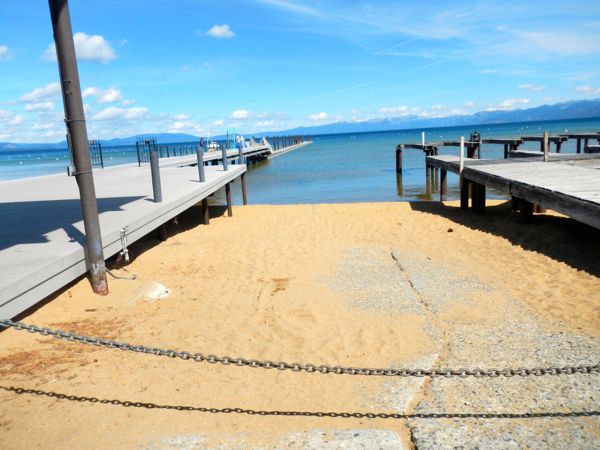
Tahoe piers-drought: Camp RichCamp Richardson

Much of the boat ramp is sand. The water level by the gas pumps looks as though not many boats would have clearance to get to them. They are on the fixed dock, so they seem even higher as the lake gets lower.

Looking down Jameson Beach, most of the private docks are covering only sand.

Tahoe piers-drought: Emerald BayEmerald Bay

Navigating the entrance to the bay was tricky last boating season. It’s only going to be worse this year, with some boats not able to get in.

It’s as though most of the bay is rimmed by sand. At the end by Vikingsholm and below the swath of mountain that decades ago sustained a landslide is debris from that slide that had been under water.

Tahoe piers-drought: Meeks BayMeeks Bay Resort

The sand, even near the water, is silky white. The water is incredibly clear, at times reflecting various hues of blue. It’s Caribbean-like.

The end of the walkway is now far from the water.

While the channel inside the bulkhead leading to the docks and boat launch is deep, the lake level outside this area is not going to permit all boats to come and go.

Tahoe piers-drought: Sugar Pine PointSugar Pine Point State Park

With all the rocks and pine cones on the beach, it won’t beckon sunbathers like the beach down the road does. Many more rocks are visible than last fall.

The last rung on the swim ladder at the end of the pier is no longer in the water.
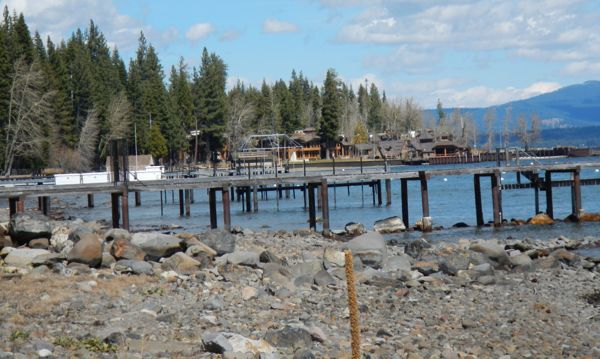
Tahoe piers-drought: West ShoreBetween Tahoma and Homewood

White moorings bob in the lake, only time will tell if they will be filled with boats. Not all marinas will be accessible for launching, and then some of the moorings will be in too shallow of water for deep-hulled vessels.

So many private docks along this stretch of the West Shore as well as ones closer to Tahoe City are covering rocks instead of water.
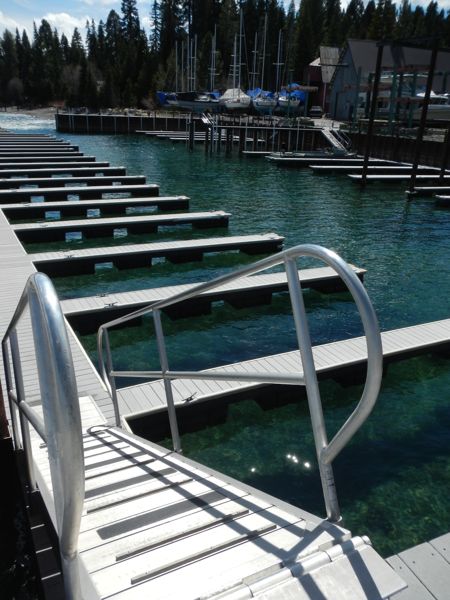
pier-obexersObexer’s

Water is no longer touching the concrete on the boat launch. Trailers will be backing onto rocks.

The ramps here have some of the more extreme angles going from the fixed pier to the floating docks.

Tahoe piers-drought: Tahoe City Dam, Truckee RiverTahoe City Dam

It’s possible to walk near the base of the dam because of the lack of water on the Lake Tahoe side of the dam. Buoys that say “Danger Dam” seem silly and sad without water.

On the other side of the dam there is water, but looking farther down the Truckee River it is more rocks than water.

This means the rafting season on the Truckee River is likely a no-go.
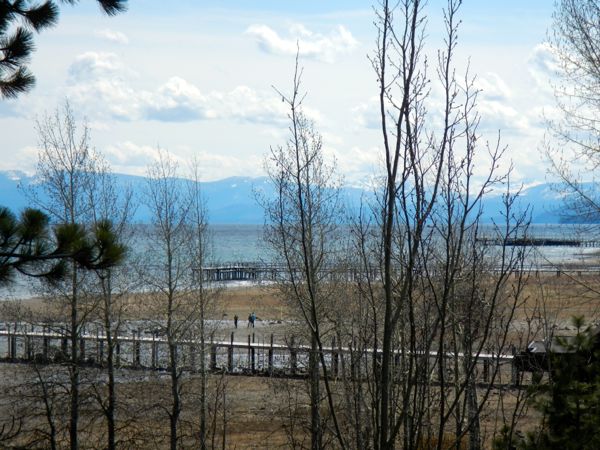
Tahoe piers-drought: Tahoe CityCommons Beach/Tahoe City Marina

Walking along the Lakeside Trail the lake is a little farther away. People don’t seem to mind as they wander along the rocks.

Tahoe piers-drought: Tahoe Vista Recreation AreaTahoe Vista Recreation Area

No boats will be launched here anytime soon.
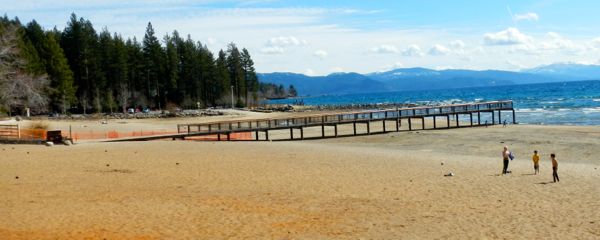
Tahoe piers-drought: Kings BeachKings Beach

The pier covers more sand than water.

California Tahoe Conservancy and California Department of Parks and Recreation are hosting a workshop April 1 from 6:30-8pm seeking input on the feasibility and design for a reconstructed public pier.
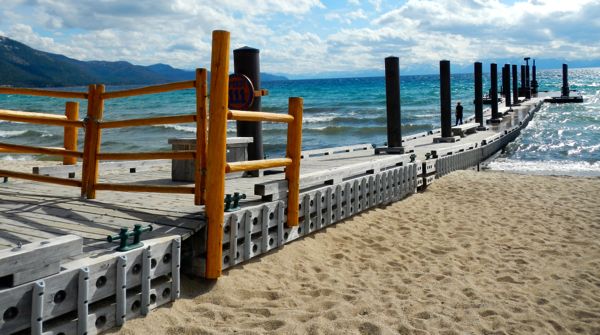
Tahoe piers-drought: Lone EagleLone Eagle Pier

The gate on the dock preventing people from walking to the end is over sand so it’s useless right now.

Tahoe piers-drought: Sand HarborSand Harbor

While this area is always rocky, now large boulders are exposed. Plenty of sand exists. The canvas Mother Nature is working with keeps getting more beautiful.

Tahoe piers-drought: GlenbrookGlenbrook

The creek running into the lake near the pier is rippling across a rocky beach. The pier looks more like something out of bygone Tahoe than a functioning structure today.

Tahoe piers-drought: Cave RockCave Rock

One of the few boat launches in the basin that is useable. Rocks, though, continue to be exposed near the beach area.
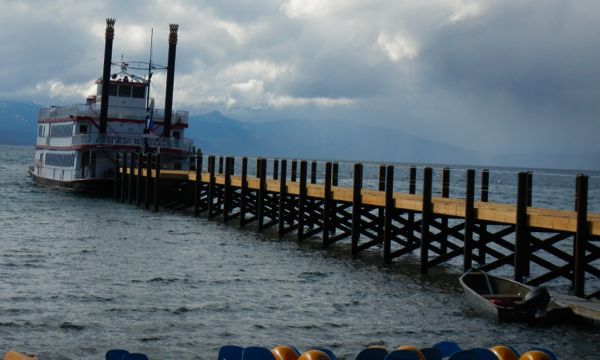
 

Tahoe piers-drought: Zephyr CoveZephyr Cove

The new dock is installed. The M.S. Dixie II wil run again after it is rehabbed.

Tahoe piers-drought: Ski RunSki Run Marina

The Tahoe Queen will be able to run again when the channel is dredged.
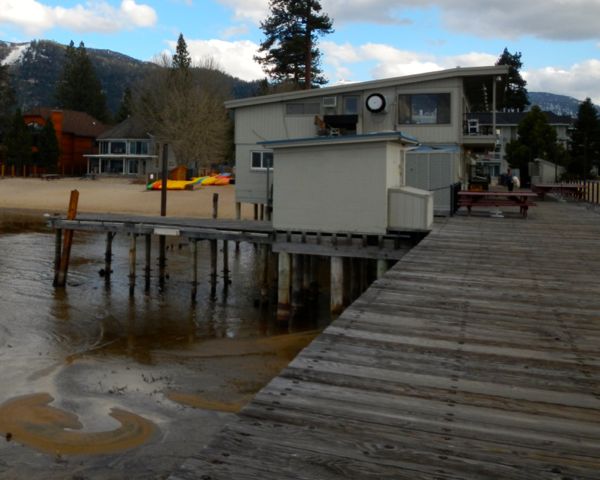
Tahoe piers-drought: Timber CoveTimber Cove Marina

Access via Bal Bijou Road still isn’t available because of Tahoe Beach Retreat’s lingering construction project. (The hotelier is also still arguing with South Lake Tahoe about signage on the beach.)

It would be hard to get a kayak under most areas of the pier because of the shallow water and sand bars. The gas pump on the dock is completely inaccessible.
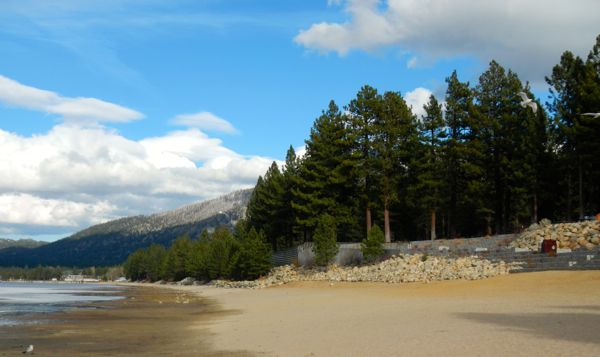
 

Tahoe piers-drought: Lakeview CommonsEl Dorado Beach Boat Launch/Lakeview Commons/Regan Beach

This launch has been off-limits for years. Now there is no chance anyone will drive onto the dirt to get to the water because of the boulders at the end of the launch.

With the amount of beach area, a much larger stage could be erected for Live at Lakeview Commons.

Pilings from piers of eras gone by can be seen from here down Lakeview Avenue past Regan Beach. At Regan Beach the dog beach used to be mostly water – not so anymore.




Drought alters the face of Tahoe tourism

By Dale Kasler and Matt Weiser, Sacramento Bee

Drought is reshaping Lake Tahoe and its all-important tourism industry.

Seven ski resorts have shut down early for the season because of a shortage of snow. The latest is Sugar Bowl Resort, which will turn off its chairlifts at the close of business Sunday.

The long-term impact goes deeper. As California’s drought stretches into its fourth year, ski resorts, hotel owners and others are scrambling to find new ways to get tourists to the lake. They’re relying less on snow and putting greater emphasis on entertainment, fine dining and other forms of recreation. With climatologists predicting long-term declines in snowfall throughout the Sierra Nevada, some resorts are building zip lines, mountain bike trails and even wedding venues, all in hopes of broadening their customer base.

Heavenly is on track to expand its offerings with more year-round activities that don't depend on snow. Photo/Carolyn Wright/Copyright

Heavenly Mountain Resort is on track to expand its offerings with more year-round activities that don’t depend on snow. Photo Copyright 2015 Carolyn E. Wright

“Resorts have been looking at their business models and seeing we have to be in the mountain recreation business, not the winter business,” said Bob Roberts, head of the California Ski Industry Association.

Tahoe isn’t giving up on traditional winter activities. Squaw Valley Resort, for instance, has spent tens of millions of dollars upgrading its facilities in the past few years, including a $5 million investment in additional snow-making equipment.

Nonetheless, the tourist attractions are conjuring up different ways to lure visitors. It’s telling that Squaw Valley is hosting its first-ever bluegrass and craft-beer festival this weekend, just a few weeks after it canceled a World Cup skiing and snowboarding tournament because of the poor conditions.

The closures are particularly painful for two reasons: One, the season had gotten off to a good start, thanks to two strong storms in December. Two, the Tahoe tourism industry was just beginning to climb out of a long period of hibernation prompted by the recession and fierce competition from California Indian casinos. Developers have been pouring millions into ski resorts, hotels and other amenities in hopes of weaning Tahoe from its historic dependence on gambling and turning the lake into an international destination and not just a day trip from Sacramento.

Read the whole story


Lottery proposal: Lifeline for Nev. education or DOA?

By J.D. Morris, Las Vegas Sun

Amid all the discussion in Carson City about improving education, one piece of legislation is refloating an old, but likely ill-fated, idea to help fund Nevada’s bottom-tier school system: creating a state lottery.

Assembly joint resolution No. 6 would authorize a lottery through an amendment of the Nevada Constitution, which currently bars the state from running one. The proceeds would support public education as well as “the health and welfare of senior citizens.”

A lottery might seem like a no-brainer for a state with such a vibrant gambling industry. But similar proposals have failed in the Legislature numerous times before, so if history is any indication, this one will be a tough sell, too.

Nonetheless, Assemblyman Harvey Munford, D-Las Vegas, is championing the bill because he said he was approached by many of his constituents wondering why a lottery wasn’t allowed in Nevada. So the longtime legislator — who’s termed out after this session — thought he’d give it a try, despite the issue’s poor track record in the Capitol.

Read the whole story


ZCES students learn from their surroundings

By Kathryn Reed

With Lake Tahoe – the land and water – being a continual scientific discovery, students at Zephyr Cove Elementary School are stepping outside to learn.

Each grade level is being taught something unique about Tahoe as part of the science curriculum. It’s called “place based learning” – something Principal Nancy Cauley and the teachers came up with at the beginning of the year and expect to put into full effect in the 2015-16 school year.

Tahoe Institute for Natural Science is helping to facilitate classes with the regular teachers as well as bringing in grade appropriate instruction. All of this will meet the state science standards.

“The Tahoe Institute for Natural Science is excited to work with Zephyr Cove Elementary School to help with their new focus on the natural environment of the Lake Tahoe Basin,” Kirk Hardie, TNS co-executive director, told Lake Tahoe News. “Teachers frequently comment that we provide their classes with their favorite guest programs. Two programs we are currently working on are geology and plant identification.”

Instruction at each level will focus on:

• Kindergarten – feathers, animals that fly

• First – fur, as in animals with fur

• Second – fins, the fish

• Third – forest

• Fourth – water, the lake, streams and rivers

• Fifth – geology

• Sixth — green energy.

“We feel with TINS they will provide quality, hands-on experiential programs with all six different aspects,” Cauley told Lake Tahoe News. “They will teach the children how special these resources are, and to care (for) and cultivate the ecosystem of Tahoe so future generations can enjoy it just as much.”

Cauley said staff started discussing what makes ZCES so special. Location is significant. It is surrounded by forest, with a stream out back. Lake Tahoe is walking distance from the school. The small size is another attribute.

Students don’t have to get on a bus to experience what most kids their age would have to. They can walk outside and be immersed in nature. And that then becomes the classroom.

But there are other nearby places that offer learning experiences. Zephyr Cove students went to Taylor Creek last fall to see the kokanee salmon spawning. Third-graders will be going to Spooner Lake for a hike.

“TINS has been working with area schools since 2010 to improve their science education and nature experience opportunities through hands-on, place-based programs that meet both Nevada and California state science education standards,” Hardie said.

Talking to students about invasive species will be incorporated into water issues.

“This could take off in a lot of different ways. It’s in an embryonic stage,” Cauley said of this new science program.


Hope alive to squeeze money from bankrupt Nevada Fire Safe Council for Tahoe businesses

By Jeff DeLong, Reno Gazette-Journal

Fed up with waiting, Nevada lawmakers are ramping up efforts to have private companies, fire districts and others paid for work conducted years ago to reduce fire danger in vulnerable areas around Lake Tahoe.

The Legislature earlier this month passed a joint resolution urging Congress to pay contractors who performed extensive fuels treatment work in the wake of Tahoe’s disastrous Angora Fire of 2007.

More than $3.4 million is still owed for work conducted through the now-defunct Nevada Fire Safe Council, which filed for bankruptcy in 2012 after a federal audit uncovered financial irregularities in how U.S. Forest Service and Bureau of Land Management grants were handled by the nonprofit group.

“It’s just really, really frustrating,” said Brian Rye, president of Bushwhackers Tree Service, Inc., which is still owed more than $16,000 for tree thinning and other fuel management work the firm preformed several years ago at Tahoe.

Read the whole story


Earth records warmest winter on record

By Chris Dolce, Weather

The winter of 2014-15 was the warmest on record worldwide, according to the state of the climate report released by the National Oceanic Atmospheric Administration on Wednesday.

NOAA says that December through February – for meteorological record-keeping purposes, winter is defined as those three months in the Northern Hemisphere – was 1.42 degrees Fahrenheit above the 20th-century average for all land and ocean areas.

This tops the previous warmest winter of 2007 by 0.05 degrees Fahrenheit. Global temperature records are available for the period 1880-2015.

Read the whole story