State makes it difficult to cut ties with NV Energy

By Kyle Roerink, Las Vegas Sun

CARSON CITY — In an opinion expected to be widely disputed by both consumer groups and advocates of competitive energy marketplaces, the Nevada Public Utilities Commission’s legal staff has ruled that a major digital technology company must pay $27 million to cut its ties with NV Energy and produce its own power.

The legal staff’s ruling sets the stage for debate about consumer choice and the interpretation of a 14-year-old law that the company, Switch, is referencing in hopes of removing itself as an NV Energy customer. The PUC’s legal opinion could foreshadow a decision that regulators will formally announce in June, and could be an indication that it will be difficult for Switch and other companies to unplug from NV Energy. In interpreting the law, the regulators’ legal staff in essence said the opt-out provision should be ignored now because market conditions have changed since it was enacted.

The PUC opinion is the latest in a six-month battle for Switch, which applied in November with the PUC for the ability to create and purchase power without NV Energy. The Las Vegas-based company provides data storage to an array of Fortune 1000 clients, including Google, Sony and eBay, through a high-bandwidth fiber optic network connected to at least four dozen major Internet providers.

Read the whole story


Congress considers treating wildfire like other natural disasters

By Elizabeth Shogren, High Country News

As the West girds itself for what looks likely to be a fierce wildfire season, a bipartisan group of Western senators is pushing a bill to rethink the way the federal government pays to fight catastrophic fires. The idea is that the largest wildfires would be treated like natural disasters. As with big hurricanes or earthquakes, funding for them wouldn’t have to come from an agency’s regular budget.

As HCN has reported, for seven of the last 12 years, wildfires have been so costly that the Forest Service ran through its fire budget in late summer, long before the season was over and had to raid other programs to keep fighting fires. The problem is so well known it’s got its own nickname, “fire borrowing.”

Forest Service Chief Tom Tidwell warned a Senate committee this week that there’s a 90 percent chance his agency will have to do that again this year. The drought and low snowpack across much of the West contribute to the forecast for a bad fire season this year. Tidwell said that with global warming, fire seasons could be expected to be longer — 80 days longer than they were just 15 years ago — and fiercer.

Read the whole story


Aquatic mammals thrive at Lake Tahoe

By Kathryn Reed      

When you go swimming in Lake Tahoe you aren’t alone. Besides the fish that call this body of water home, so do a handful of aquatic mammals.

Many of these critters are elusive and seldom seen. The work of some, like the beaver, is more apt to be visible than the actual animal.

Will Richardson, co-founder of the Tahoe Institute for Natural Science, gave a talk last week about the various  aquatic mammals that call Tahoe home. More than 40 people attended the Friends of the Library lecture.

The criteria he used for aquatic mammal was a “significant portion of their body is in contact with water most of their day.”

Minks are what Richardson called a “semi-aquatic.” They are native to Lake Tahoe, are about 2-feet long and weight 2 to 3 pounds.

“To swim they kind of undulate. They have a long, flexible spine,” Richardson said.

The problem is mink look a lot like river otter so people often confuse the two. The otter have a broader, flatter head than mink. Outside the family unit, mink are solitary, while otter are social. Both are part of the weasel family.

A river otter in January  finds plenty to dine on at Lake Tahoe. Photos/Bob Sweatt

A river otter in January finds plenty to dine on at Lake Tahoe. Photo/Bob Sweatt

River otter were in the basin in abundance prior to 1950. Then they were not seen from about 1950 to 2000. Richardson said scientists don’t know where they went or why.

Otters tend to be about 3½-feet long, with a tail that is 18-inches long.

They have been seen near the Tahoe Keys, Taylor Creek and Fallen Leaf Lake.

Water shrews are rodents that are semi-aquatic.

They eat close to their body weight every day.

“They are incredibly buoyant. They are so buoyant they can run on water,” Richardson said.

Because they are nocturnal, secretive, shy and nervous, they are seldom seen.

Mountain beavers are not actually beavers. They make burrows instead of dams. They were the least aquatic of the animals Richardson spoke about. However, they always need to have their feet wet, he said.

Their closest relative is a squirrel, they have opposable thumbs, and the only place they are found in Nevada is at Lake Tahoe.

A muskrat in the Tahoe Keys in South Lake Tahoe.  Photo/Bob Sweatt

A muskrat in South Lake Tahoe. Photo/Bob Sweatt

Muskrats are about 2-feet long and weigh approximately 4½ pounds. They close their ears when they swim and they have partially webbed feet.

Stories of beavers being trapped at Tahoe go back to at least 1785.

“The beaver was trapped out of the Sierra by the mid-19th century.

To help with wetland restoration and erosion control nine beavers from Idaho were released into the Truckee River watershed between 1934-45, according to Richardson. It is descendants of those beavers that can been seen today in the Tahoe basin.

Their teeth never stop growing.

Richardson said beavers can be great for the environment, but they create problems and conflicts with people.


Nev. to pay millions for storm-water runoff prevention

By Sean Whaley, Las Vegas Review-Journal

CARSON CITY — The cost of complying with an Environmental Protection Agency audit that found failures by the Nevada Transportation Department in addressing storm water runoff issues is coming due at $10 million for 42 new agency positions, equipment and travel.

Another $3 million will be spent on storm water upgrades at 15 highway maintenance facilities and more training for agency staff to comply with provisions of the federal Clean Water Act.

In all, 68 positions will be established to deal with the storm water issue, state lawmakers were told in a budget hearing last week.

In a site inspection of two facilities in Sparks and Lake Tahoe in November, EPA officials identified continuing problems, including the potential of dirty water runoff at the agency’s maintenance facility at Spooner Summit at Lake Tahoe that could have made its way into Lake Tahoe. A similar concern was identified at a parking lot at the Sparks facility that could affect the Truckee River.

Read the whole story


Taxes a conundrum for pot industry

By Jack Healy, New York Times

DENVER — Money was pouring into Bruce Nassau’s five Colorado marijuana shops when his accountant called with the bad news: The 2014 tax season was approaching, and Mr. Nassau could not rely on the galaxy of deductions that other businesses use to reduce their tax bills. He was going to owe the Internal Revenue Service a small fortune.

“I had to write a check for $275,000,” Mr. Nassau said. “Unbelievable.”

The country’s rapidly growing marijuana industry has a tax problem. Even as more states embrace legal marijuana, shops say they are being forced to pay crippling federal income taxes because of a decades-old law aimed at preventing drug dealers from claiming their smuggling costs and couriers as business expenses on their tax returns.

Read the whole story


Tahoe Paradise Park on unsure footing

By Kathryn Reed

MEYERS – There is no one to do maintenance, mow the lawn or book events at Tahoe Paradise Park.

This is because the board fired Steve Dunn, the park manager.

“It was a personnel issue,” Sue Novasel, Tahoe Paradise Resort Improvement District chairwoman, told Lake Tahoe News. She would not go into specifics about why Dunn was ousted last month from a job he had had for more than a decade.

Most of the board is new, with Judy Clot the veteran having been on the board since 2007. The others – Novasel, Joe Cardinale, Victor Babbitt, and Peter Nelligan – have been on the board less than a year.

Concerns have arisen with Dunn making money on the side. At a board meeting he admitted he bought chairs that he would lease to wedding parties. He was supposed to be the keeper of all the district’s records, but the board is having a hard time getting their hands on everything.

Tahoe Paradise Park's board is running the facility without a manager. Photo/LTN

Tahoe Paradise Park’s board is running the facility without a manager. Photo/LTN

Part of Dunn’s financial package included living in a house on-site for free. He took in a base salary of more than $30,000 a year. However, he was also entitled to 30 percent of every wedding that was booked as well as 30 percent from other group rental fees that were collected.

For the most part this was a seasonal job with a year-round salary. Dunn has until May 16 to move out. Novasel told Lake Tahoe News no board member has been inside the house to know what kind of condition it is in. Members aren’t sure of the exact square footage and don’t know what they could collect if they were to rent it or just to know the value if it were to be part of compensation package again.

Taxpayer dollars through Measure S – the recreation bond passed in 2000 – paid for a new roof and gas heater for that house.

In 2006 El Dorado County Auditor-Controller Joe Harn audited the Measure S books.

“The only unusual expenditures our examination has revealed to date related to the construction and acquisition fund by the Tahoe Paradise Resort Improvement District,” Harn wrote in a June 26, 2006, letter to then county Supervisor Norma Santiago, who was on the TPRID board. TPRID had spent nearly $30,000 on a skid steer loader and snowblower and $4,300 to replace the roof.

The district receives $50,000 a year from Measure S/R. In the last year it has received an additional $10,000 from the bond measure.

Today, the district is grappling with how to go forward. The board agreed last week to solicit bids for landscaping, event planning and camp host. (Board member Nelligan is in charge of getting information from perspective workers; he is at 209.985.8776.)

The camp host idea was brought up as a way to have someone at the park on a regular basis at little or no expense.

The board hopes to take action on those items at the May 28 meeting.

What to do about maintenance issues will first be addressed by a subcommittee and then brought back to the full board at the end of the month.

A brigade of volunteers is also being sought so some of the work is done in house without a check needing to be written.

“We are looking at other models and seeing where we go next,” Novasel said in regards to the caretaker’s house.

The bulk of the May 8 board meeting centered on how to get at least some of the work done that Dunn had been doing. The short-term answer is hiring multiple individuals. The long-term solution is still to be decided.

Also to be decided is if the park will continue to be in the wedding business. Some board members and park users believe the clubhouse should be used more for locals. But weddings are a revenue source, so others question the logic of turning off that cash spigot.


Lawsuit: Hard Rock owners stiff contractor

David and Jon Park, owners of the Lake Tahoe  Hard Rock, are being sued for $10 million by one of the contractors. Photo/Denise Haerr

David and Jon Park, owners of the Lake Tahoe Hard Rock, are being sued for $10 million by one of the contractors. Photo/Denise Haerr

By Kathryn Reed

A contractor who did millions of dollars worth of work at Lake Tahoe Hard Rock is suing the owners for lack of payment.

“There are a lot of good people out of a lot of money right now. We are fighting for all of them,” Joe Stewart with SMC Contracting told Lake Tahoe News. “They haven’t given us a legitimate reason why they won’t pay us. They have used a lot of stall tactics.”

SMC did most of the work on the ground level – meaning the casino floor and restaurants.

The original contract was for $9.6 million. It ballooned to more than $19 million. To date SMC has been paid about $10 million and has about that much more to collect.

“We worked with them on a daily basis, almost hourly,” Stewart said. “They signed change orders they have not paid us on.”

Stewart said the owners were well aware of what the costs were as they requested changes.

Brothers David and Jon Park own the property. In October 2013 it was announced that the Park family, which has a number of holdings on the South Shore and in the Carson Valley, would be dividing their assets. The brothers got possession of what was the Horizon at the time.

These two have nothing to do with the Edgewood Lodge that will break ground in August – which SMC is working on – nor Edgewood Tahoe Golf Course.

When the lease was about to expire at the Horizon they initially were going to create what was going to be called the Park Tahoe, which is what MontBleu was named when it first opened. Then last summer it was announced the brothers were infusing $60 million into what would become the Hard Rock hotel-casino.

Rumors had been swirling even before the Jan. 28 opening that there were cost overruns and not all of the improvements originally planned would be developed.

Neither of the Park brothers returned calls.

According to the lawsuit that was filed last week, the owners submitted revised drawings in November – this was listed as revision No. 9. But the changes didn’t stop there, they just weren’t numbered after that.

“… the fact that eight revisions beyond that were contracted for were provided during the course of construction, the value of work performed more than doubling the original contracted contemplation by the contractor, all demonstrates the bad faith and unscrupulous practices of Neva, its agents and its representatives,” the court documents states.

Neva is the name of the company the Park brothers started for the Hard Rock project.

Many of those who are owed money are subcontractors from the Lake Tahoe and Reno area, with a few from Sacramento. SMC has paid a few of the smaller ones out its pocket.

“The short story is the owners made an incredible amount of changes to the project after it started and they demanded it get open by Jan. 28, but that came at a big cost,” Stewart said. “Once the building opened, they said they won’t pay us.”


Calif. bottled-water business grows despite drought

By Associated Press

SAN FRANCISCO – A new Crystal Geyser Water Co. plant opening at the foot of Mount Shasta is adding to criticism of companies that are bottling water in California’s drought.

Crystal Geyser plans to eventually tap up to 365,000 gallons a day from groundwater in Northern California’s Siskiyou County, the San Francisco Chronicle reported Sunday.

Converted from an old Coca-Cola bottling plant, the facility will become the latest of 108 bottling operations by various companies in the state, the Chronicle reported. Operations are due to start this fall.

Crystal Geyser executive vice president Judy Yee said Crystal Geyser officials are in contact with local residents to ensure its groundwater pumping “will not impact the environment in any detrimental way.”

Resident Raven Stevens, however, says she fears groundwater pumping by the bottled-water plant will use up the water that she and her neighbors depend on for their households.

“Crystal Geyser in one day plans to pump more water than any three of my neighbors will use in an entire year,” Stevens said.

California law in general places no limits on the amount of groundwater that property owners can pump, although legislation passed last year will start phasing in regulation of the most endangered aquifers after 2020.

Grass-roots objections to bottled water companies tapping and selling groundwater are increasing as California’s drought moves deeper into its fourth year. Bottled-water companies tapping into groundwater on their own property are exempted from the 25-percent mandatory water cutbacks that Gov. Jerry Brown ordered for cities and towns earlier this spring.

“Bottling water is a legal use of water under the law,” said Nancy Vogel, spokeswoman of the California Department of Water Resources.

While local officials say the water bottling operation will bring jobs, some residents object to the heavy water use.

Joyce Kyle, 77, told the Los Angeles Times that she and her family have lost grazing business because local water authorities have restricted use of her property’s water.

In the drought, “everybody’s suffering, not just the people in the lower half of the state,” Kyle said. “Letting Crystal Geyser come in and draw down groundwater, it’s not right.”


STPUD encouraging residents to remove sod

By Kathryn Reed

More than 270,000-square-feet of grass have been eliminated in the six years since South Tahoe Public Utility District has had the turf buyback program. This equates to a savings of approximately 3.5 million gallons of water.

Last week the board agreed to put in $300,000 of district money into the program to be split between this season and next for residential customers and another $75,000 for businesses.

“We are committing our own resources to run the program irrespective of if the grant is approved,” General Manager Richard Solbrig told Lake Tahoe News.

To date the district has spent $400,000 on the program, with 95 percent of the money coming from grants. More grants have been applied for, but it’s not known yet if those dollars will be forthcoming.

The district is mandated by the state to reduce its water consumption by 28 percent. Turf buyback is a step toward meeting that requirement.

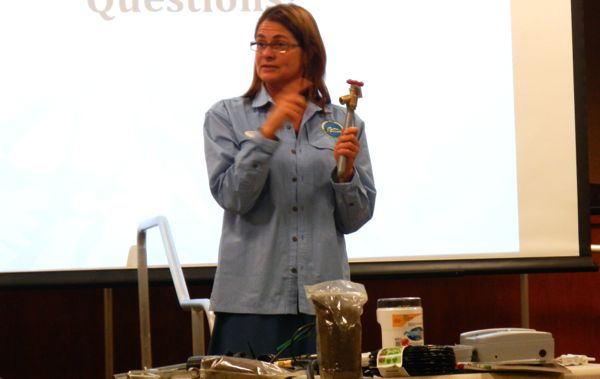
Jennifer Cressy with Tahoe Resource Conservation District explains various irrigation methods that don't use much water. Photo/LTN

Jennifer Cressy with Tahoe Resource Conservation District explains various irrigation methods that don’t use much water. Photo/LTN

The board on May 7 also agreed to keep the number of watering days to three, though that could change to two. The time to irrigate has been changed to between 6pm and 6am, with a maximum of 20 minutes per zone.

“The rebate program is an incentive to remove water intensive lawns with natural or adapted vegetation,” Donielle Morse explained at a turf buyback meeting last week. Morse is in charge of the district’s water conservation program.

She and Jennifer Cressy with Tahoe Resource Conservation District spent a couple hours telling about 20 people how the program works.

It is open to any STPUD water customer. It may be open to sewer customers if more money is available. About 200 households have participated going into this season.

It starts with getting your name on the list and then having Morse do a site visit. In years past the district insisted people have a living yard to be dug up. Because of the drought the district doesn’t want people watering something that will be removed, so dead lawns can be part of the program.

“We don’t want you to water your lawn. You will quality even if the lawn is brown. If it’s dirt, you won’t qualify,” Morse explained.

Another requirement is that at least 400-square-feet of turf must be removed. Residents don’t have to take all of their grass out, though. And it cannot be relocated to another area of the yard.

While the district doesn’t say exactly how people must fill in what will be a bare area, there are some requirements. The plot must be covered with 35 percent living plants at maturity. This is down from past years when it was 50 percent.

“When you remove the lawn you need to revegetate,” Morse said. “There needs to be efficient irrigation.”

A new watering system is usually in the form of drip irrigation. Sprinkler heads can be capped or retrofitted to comply.

Final inspections require having names of the plants that were used and the water capacity of the irrigation system.

Any dirt areas must be covered with a permeable mulch or ground cover like thyme or strawberries. Artificial turf is not an option. Rock, bark and woodchips are good choices.

While the district won’t be looking at Tahoe Regional Planning Agency best management practice rules or defensible space regulations, those policies should be followed, Morse said.

Rebate checks are not issued until STPUD verifies the lawn is out, and the new plants and irrigation system are in place. The rebate is $1.50 per square foot of turf that is removed, with a maximum of 2,000 square feet being eligible or $3,000.

Because of the uncertainty of cash flow for the program, it’s possible some people won’t receive checks until 2016. This also means people have two summers to complete the program, whereas previously it had to be done in one season.



Calif. environmentalists sue over oil industry water practices

By Rory Carroll, Reuters

California environmental groups filed a lawsuit on Thursday that seeks to halt oil industry injections of drilling wastewater into nearly 500 wells, a practice they say threatens fresh water supplies and is particularly critical in light of a prolonged drought.

The lawsuit was filed in state court against California’s oil drilling regulator, the Division of Oil, Gas and Geothermal Resources (DOGGR), by the Center for Biological Diversity, the Sierra Club and Earthjustice.

Oil drilling in California produces far more water than oil, most of which is not suitable for drinking. The wastewater is typically injected back underground.

The lawsuit also wants the DOGGR to stop allowing oil companies to pump steam into about 2,000 additional wells injecting into aquifers, which they say are protected under federal law. Oil drilling companies inject water and steam to increase the flow of oil to the surface.

Read the whole story