USFS concerned nasty fire season approaching

By Kathryn Reed

Despite the rains this month, it’s dry out there and will just get worse now that 70-degree days have returned. This has agencies on heightened alert in what is expected to be a dangerous fire season.

U.S. Forest Service firefighters are reporting to work three weeks earlier than normal.

“Every day we get a reprieve with the weather, it buys us more time. It also delays the inevitable,” Kit Bailey, the Lake Tahoe Basin Management Unit’s chief firefighter, told Lake Tahoe News. “It gives us more time to prepare and train.”

While the Forest Service is the main body dealing with wildland fires, it works in conjunction with the other fire districts in the basin, including CalFire. The mantra this season is “one less spark, one less wildfire.”

Illegal campfires are something the USFS is going to have zero tolerance for.
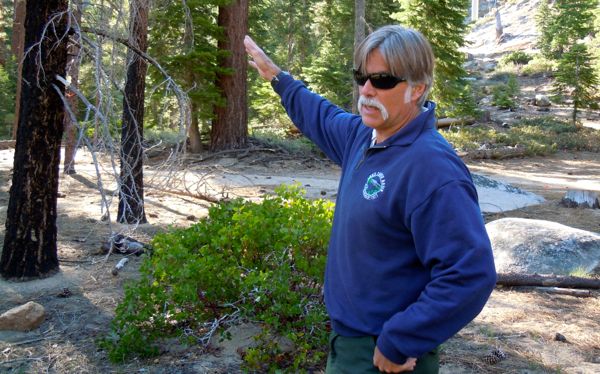
Kit Bailey with the U.S. Forest Service has been in the firefighting business for 36 years. Photo/Kathryn Reed

Kit Bailey with the U.S. Forest Service has been in the firefighting business for 36 years. Photo/Kathryn Reed

“Ninety-five percent of the fires here are human caused and most are from abandoned campfires,” Bailey said. “I don’t understand it. It’s frustrating. I’ve seen numerous times where there really wasn’t an effort to put it out.”

He said building, maintaining and extinguishing a campfire is a lost art. That is why his agency puts on a program at Taylor Creek to educate people about campfires.

It was an illegal abandoned campfire that started the devastating 2007 Angora Fire, which reduced 254 houses on the outskirts of South Lake Tahoe to ash.

The unfortunate thing is people who have left the smoldering campfires are seldom caught and even when they are it’s a hard case to prosecute.

While the entire Western United States is in a drought, California is at the “exceptional” level – making it at the top of the chart. Nevada isn’t much better off.

While staffing is always an issue, the agency has more people on the ground enforcing the rules, and will have access to numerous people to patrol the basin and backcountry during Fourth of July weekend.

Bailey is concerned, though, that there will be multiple fires at once that will stretch the firefighting ranks to the point that a fire will not be well staffed. Locally, the USFS has a cadre of on-call firefighters to call. Plus, there are the local government agency crews who have wildland experience. They were all used during Angora. The Forest Service is also training California Conservation Corps members to be a type two hand crew.

“The best way to fight a fire is to prevent it,” Bailey said. Education is one form of prevention. All fire agencies are doing their part to get the message out about the need to be diligent when it comes to all things fire related. The problem, as Bailey points out, is that often the people who need to hear the message most aren’t listening.

He said homeowners can start by making their residences less susceptible to fire. The Living with Fire website provides a wealth of information. Bailey believes the built zone – using flame resistant materials – is more important than defensible space.

When people see smoke, it’s imperative they call 911. The theory is that it’s better to get multiple calls than no call.

The fire cameras that are gradually being installed around the basin are another tool agencies can use.

It’s possible fire restrictions will go in place earlier than most years. June 15 is the likely date. The rules impact campfires, smoking and off roading. (The 2002 Gondola Fire was started from a cigarette being thrown from the Heavenly gondola.)

The forest is being stressed with the lack of moisture, which makes it more susceptible to a wildfire. The trees haven’t had enough to drink since this is year four of the drought.

“We are seeing a significant amount of tree mortality in the southern Sierra. It’s doubling every year,” Bailey said. A dead tree is more fuel for a wildfire.

The Forest Service has models to measure the fuel moisture content of trees. It should be in the 20s now, but it’s only in the teens.

“It’s a good indicator of what the season will look like,” Bailey said – hot, dry and prone to fire.
Covered California to cap price on drugs

By April Dembosky, NPR

In recent years, expensive specialty medicines used to treat cancer and chronic illnesses have forced some very ill Americans to choose between getting proper treatment and paying their rent.

To ease the financial burden, the California agency that governs the state’s Obamacare plans issued landmark rules Thursday that will put a lid on the amount anyone enrolled in one of those plans can be charged each month for high-end medicine.

The agency says its rules, set to take effect in 2016, “strike a balance between ensuring Covered California consumers can afford the medication they need to treat chronic and life-threatening conditions while keeping premiums affordable for all.”

Read the whole story


Food, beverage firms wake up to water risks

By Sandra Postel, National Geographic

Earlier this month, Starbucks announced that it would stop sourcing and producing its bottled water brand, Ethos Water, in California and shift production from the Golden State to Pennsylvania.

In explaining its decision, the beverage maker cited “the serious drought conditions and necessary water conservation efforts.”

With California in its fourth year of a historic drought, Starbucks has been called out for tapping springs in severely drought-stricken Placer County, which last month declared a water-shortage emergency.

The company faced not only the risk that its water supply might shrink, but that its reputation could be badly tarnished if it did not act.

Starbucks is by no means alone. Drought and water stress are affecting the decisions and bottom lines of a growing number of companies.

Read the whole story


7-year-old lands fish nearly as big as her


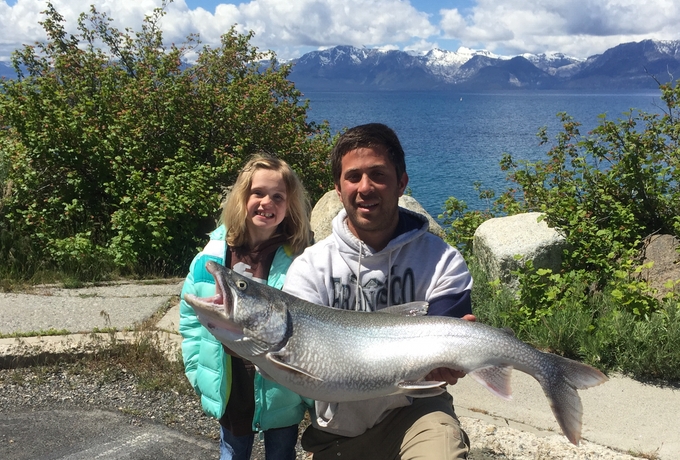
Circe Bailey with her massive mackinaw and Andrew Lubrano, the boat's captain. Photo/Provided

Circe Bailey with her massive mackinaw and Andrew Lubrano, the boat’s captain. Photo/Provided

A fisher girl did on her first outing what some veterans have never done – catch a mackinaw weighing more than 15 pounds.

“I think she wanted to cry she was so exhausted,” Capt. Andrew Lubrano of Nor-Cal Charters told Lake Tahoe News.

Seven-year-old Circe Bailey had a single minnow on the other end of her line that was about 150 feet down in 300 feet of water when the fish bit on May 24.

The Carson City youngster was fishing for the first time with her dad, brother and sister. The excursion started at 6am. They were close to Ski Run Marina when the fish took hold.

Circe said the captain was giving her direction and her sister helped a bit with reeling it in. It took about two hours to land it.

There was nothing easy about getting that fish to cooperate. Just when it was near the surface Lubrano would try to net it. But this fish wasn’t going to come aboard that easy. It dove and Circe kept hanging on.

“(It’s) one of the nicest fish I have seen working at Nor-Cal Charters,” Lubrano said. “There are fishing guides who have been on the lake for 20 years and have never caught a fish that good.”

About two hours after catching it, it was weighed – 15.1 pounds. Lubrano said fish lose about 10 percent of their muscle mass when they get in the boat, so the fish was closer to 17 pounds.

Usually the mackinaw pulled from Lake Tahoe are in the 3- to 5-pound category.

Fish tacos have been served now multiple nights in the Bailey household. Circe said they taste great.

— Kathryn Reed


Taxes top Nev. Legislature’s to-do list

By Ray Hagar, Reno Gazette-Journal

Last week, state lawmakers passed what will be a $7.2 billion general fund budget, complete with new programs for education and $8 million for a new medical school at the University of Nevada, Las Vegas.

As the 2015 Nevada Legislature enters its final week, Job One for legislators will be passing a tax plan to fund the budget.

Lawmakers cannot go home until the state budget is balanced for the next two years. And the only way to balance this budget is to find a tax plan that will produce $1.1 billion in new and extended taxes.

Most lawmakers see the need. The issue is finding a plan that can get the required two-thirds votes for new taxes in both houses.

Read the whole story


Nev. considers incentives to attract teachers

By Riley Snyder and Michelle Rindels, AP

CARSON CITY — Gov. Brian Sandoval announced Friday that he wants to launch a teacher training scholarship program and a series of bonuses aimed at tackling Nevada’s severe teacher shortage.

Lawmakers have expressed concerns that a workforce shortage will hamper some of the Republican governor’s ambitious education reform initiatives, and groups including the Latino Leadership Council have recommended bonuses to combat high turnover and teacher inexperience in some of Nevada’s toughest schools.

“Attracting and preparing educators for success in the classroom (is a) key component to changing Nevada’s education system for the better,” Sandoval said in a statement, saying the program was “an idea prompted by the ongoing struggle across Nevada to recruit and retain high-quality teachers in our public education system.”

The measure was introduced as SB511, and was expected to be up for a hearing before the full Senate in coming days.

Sandoval is seeking $5 million over the next two years to launch the Teach Nevada Scholarship. Funds would go to Nevada’s public and private colleges and entities that provide alternative routes to licensure programs, and would help future teachers complete their degrees.

A second program would offer $5,000 bonuses for 1,000 new teachers each year. The incentive program, which is expected to end after two years, aims to fill teaching positions in at-risk schools and make Nevada more competitive relative to other states that are also struggling with shortages.

“We really decided that the best way to do this was to provide as much financial assistance as we could,” said state Superintendent Dale Erquiaga. “Five thousand dollars per individual per year is a substantial increase. That’ll get those salaries to almost California levels.”

Clark County School District alone is trying to hire about 2,600 new teachers for the upcoming school year. Nevada’s public colleges are only expected to graduate about 800 teacher candidates this year, while the Teach for America program is expected to provide fewer teachers than planned, and enrollment in teacher preparation programs in California — Nevada’s main supplier — is about half what it was five years ago.

Lawmakers expressed concerns that the teacher shortage and lack of a teacher pipeline could unravel the progress Sandoval hopes to make by investing millions in Zoom Schools for English language learners and Victory Schools for students in poverty. Many of those initiatives require additional teachers to provide intensive reading instruction or to staff kindergarten and pre-kindergarten programs.

Joyce Haldeman, a lobbyist for Clark County School District, said she thinks incentives and scholarships are a step in the right direction.

“This is another piece of the puzzle that we think is part of a long-term solution,” she said.


Sierra lakes drop as needs to the west take toll

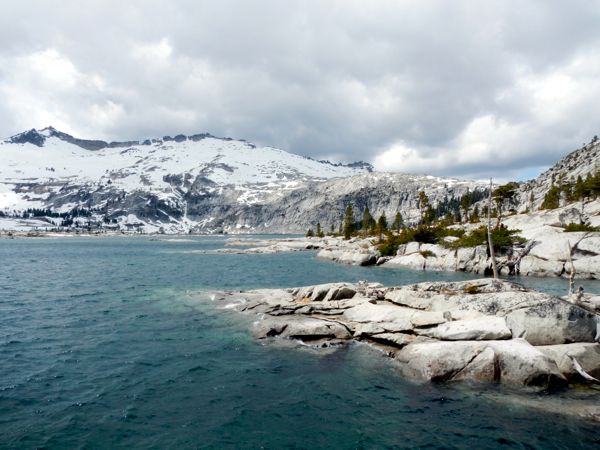
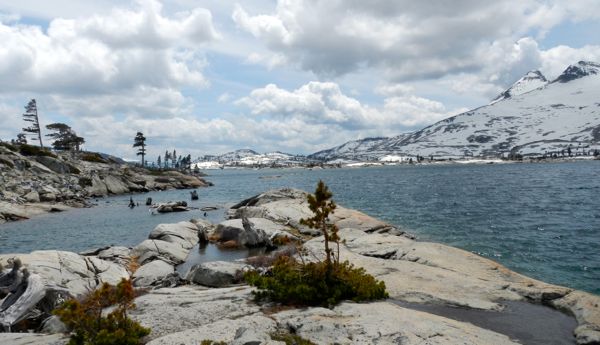
Lake Aloha in Desolation Wilderness is at 50 percent capacity and is expected to continue to be drained for use downstream. Photo/Kathryn Reed

Lake Aloha in Desolation Wilderness is at 50 percent capacity and will continue to be drained for use downstream. Photos/Kathryn Reed

By Kathryn Reed

The water level of so many Sierra lakes is anything but natural. That’s because of dams and the needs of water users downstream. This in turn affects those who use these water bodies for recreation.

As the fourth year of one of the worst droughts in California’s history drags on, the impact will become more pronounced as spring turns into summer.

There was significant legislation in 1914 that established rights that are still in effect today and have been brought to light because of the drought.

It was in 1925 that the El Dorado Irrigation District was formed. The voters did so “to protect water filings, ensure a secure water supply, keep irrigation rates reasonable, and increase the value of agricultural lands,” according to EID’s website.

Today, EID has 39,775 water customers, 21,498 sewer and 4,678 recycled water. The number of actual people, as opposed to households or businesses being served, is about 118,000.

Silver Lake is almost full thanks to the rain in May.

Silver Lake is almost full thanks to the rain in May.

Balancing needs

While those customers are on the West Slope, much of the water they use is from the Sierra – Lake Aloha, Echo Lake, Caples Lake and Silver Lake. They are storage facilities for EID for water consumption as well as the hydroelectric plant.

Water from these lakes goes into the South Fork of the American River, is diverted at Kyburz and then at Pollock Pines is rerouted again to the hydroelectric plant or for drinking water customers.

EID, though, doesn’t have complete control over its water. Rules are in place that mandate minimum stream flow into the South Fork of the American River. However, EID received a one-time variance that goes through the end of this month to limit that flow.

“This measure was to help us to ensure we can deliver our drinking water supply. We want to have water in the reservoirs so we have stream releases throughout the year,” Brian Deason, EID hydroelectric analyst, told Lake Tahoe News. “We want water next year, with enough storage in the event we have another drought year. We are positioning to respond to that.”

These four lakes are also popular recreation destinations for those who live in the Lake Tahoe Basin and visit the region.

“Drinking water needs take precedence over recreation needs by far,” Greg Hawkins, EID parks and recreation manager, told Lake Tahoe News. He is also in charge of Jenkinson Lake at Sly Park.

Still, Hawkins predicts the waterways EID oversees will be in better shape than reservoirs down stream, much like what occurred last year when Folsom Lake was so low and people headed east to EID’s lakes.

Saving water for human consumption outweighs all other needs – even making money off the hydroelectric operations, which in some years generates $14 million for EID. That is why Jenkinson Lake at Sly Park has fared well during the drought. EID is diverting water there for consumption and having less go to the South Fork for the 20-megawatt hydroelectric plant.

EID bought Jenkinson from the Bureau of Reclamation in 2003. Had it not done so, the state would be able to tap that water at will.

The boat shuttle at Echo Lake is operating now, but may have to stop if levels drop again.

The boat shuttle at Echo Lake is operating now, but may have to stop if levels drop again.

Tahoe area lakes

“At Silver, Caples and Echo the outlook is a lot better than it previously was. Some of these recent storms really helped,” Deason said.

He said Silver is near capacity and that Caples is a few thousand acre-feet from full. (An acre-foot covers an acre with water to a depth of 1 foot.)

Recreation sites at these two lakes off Highway 88 opened May 1. EID regulates the day-use areas and campgrounds, has rights to the water, but does not regulate those lakes. In other words, if unsafe conditions were to exist, it would be up to Alpine County officials for Caples and Amador County officials for Silver to make those decisions.

At Echo Lake the use of water by EID is much less – usually three weeks after Labor Day water is diverted into the South Fork.

EID has no say over any recreation activities at Echo. Operators of the boat shuttle are on a storm-by-storm watch in regards to whether the upper lake will be reached. Today the boat can make it through the channel, whereas earlier this month it couldn’t. Smaller boats, and human powered vessels, have not been hindered by the flow.

Lake Aloha is a different animal than Caples, Silver and Echo lakes because it is governed by post-1914 rules. Aloha spills forth and is what makes Horsetail Falls. It then goes to the South Fork for EID purposes. Deason said Aloha is at 50 percent capacity and will only keep getting lower.

The four Sierra lakes fall under Project 184 of the Federal Energy Regulatory Commission. The first 50-year license was issued to PG&E in 1922. EID took over the system in 1999. Until that time, EID bought water from PG&E. EID has a FERC lease that expires Oct. 1, 2046.

EID, like all water districts in the state, must curtail its use. Twenty-eight percent from 2013 totals is the magic number. Officials believe this will be met by reducing outdoor use. Last year EID cut its use by 24 percent.

The EID board meets May 26  to consider the staff recommendation to continue the restricted irrigation to two days per week. As of April 22, the most recent figures available, the district was at a 15 percent savings this year.

“This will limit customer confusion by conveying to customers that instead of changing to odd/even starting June 1, they simply must continue their current irrigation practices of watering no more than two days per week throughout the summer and fall. We went to twice a week water schedule on April 16 and if the board does not change the published schedule, it will go to the odd/even schedule on June 1, three days a week,” Mary Lynn Carlton, district spokeswoman, said.


World War I’s heart is kept in the heartland

By James MacLeod

World War I was one of the most destructive events in human history, killing about 16 million soldiers and civilians worldwide, including 116,000 Americans. It did more than just destroy lives. It destroyed confidence in progress, prosperity, and the rationality of civilized society, perhaps the most treasured characteristic of the 19th century.

The Great War also arguably destroyed much of the next generation: those who would have provided leadership to Europe in the dark days of the 1920s and 1930s, when once again the continent began sliding towards annihilation.

World War I also happens to be the most spectacularly memorialized war in history. In Britain alone, there are more than 50,000 war memorials. What many may not know is that three of the greatest World War I memorials in the world are located in the Midwestern United States: in St Louis, Kansas City, and Indianapolis.

The Soldiers’ Memorial Museum, in the heart of downtown St. Louis, is a huge and deeply impressive building dedicated in 1936 by President Franklin D. Roosevelt as a memorial to the 1,075 men from St. Louis who died in World War I. The memorial is spectacular — all mosaics and marble, with terrazzo floors and four huge Bedford stone sculptures entitled Loyalty, Vision, Courage, and Sacrifice.

The memorial’s centerpiece is a vast black granite cenotaph – Greek for “empty tomb” – covered with names of the fallen, in neat row upon neat row. It is a classical temple in some ways, full of symbolic carved figures, symbols of victory, with a huge empty tomb at its core.

The second impressive World War I site in the Midwest is the Liberty Memorial in Kansas City, which broke ground in 1921 and was dedicated on Nov. 11 (Armistice Day), 1926. It was the result of a remarkable design competition, and an even-more remarkable fundraising campaign. In less than a year, $2.5 million had been raised through donations from more than 83,000 contributors.

The winner of the international design contest for the structure was Harold Van Buren Magonigle, a distinguished American architect. It is centered on a 268-foot-tall tower that dominated – and still dominates — the skyline of this part of the city. At the top of Van Buren’s structure are four symbolic “guardians,” each standing at 40 feet high, entitled Honor, Courage, Patriotism, and Sacrifice.

A “flame of inspiration” burns from the tower each evening. Below this is the “Great Frieze,” which depicts the optimistic story of humanity’s march from an era of war to an era of peace. The sculpture, created by Great War veteran Edmond Amateis, runs about 488 feet long and is 48 feet tall.

The names of the 441 Kansas City war dead are listed inside of one of the two temple-like buildings that sit on either side of the tower. Outside, we see Kansas City’s version of the cenotaph – two empty cinerary urns, which would in antiquity have contained the ashes of the dead, flank the entrance of both buildings. And there are also two huge sphinxes: “Memory,” which faces the east toward the battlefields of Europe, shields its eyes from the atrocities of war. “Future” faces the west, covering its eyes from a future that is unknown. The overall effect of this memorial is quite stunning, and it is wholly appropriate that is now home to the National World War I Museum.

The third noteworthy U.S. World War I memorial is in Indianapolis. Five downtown blocks were razed to make space for War Memorial Plaza, which is the biggest war memorial project ever undertaken in the United States. It has three distinct elements – a cenotaph, an obelisk, and a war memorial shrine, which itself contains a shrine within a shrine. The cenotaph – which memorializes James Bethel Gresham of Evansville, the first American casualty of the war – is surrounded by four columns, topped by eagles.

The 100-foot black granite obelisk was built in 1923, and the square was completed in 1930. Near its base are four-by-eight-foot panels to represent law, science, religion, and education – the sculptor said, “upon these four fundamentals are built the foundation of our nation, without any one of which it could not long survive.”

Gen. John Pershing laid the cornerstone of the memorial shrine on July 4, 1927. One of the biggest war memorials in the world, it is so packed with symbolism and references to the history of memorialization that it almost defies analysis. One of the highlights is the sculpture on the outside steps entitled Pro Patria; it is 24 feet high, weighs seven tons, and was the largest cast bronze sculpture in the United States.

And finally, there is the “shrine room.” A huge American flag hangs over an empty tomb, blue lights shine from above, with light coming from an ornate chandelier known as “Star of Destiny.” The massive ceiling is supported by dramatic, blood-red marble columns, and the empty tomb, sometimes referred to as the “Altar of the Flag,” is guarded by four fire urns. In the words of American historian Jared Mayo, “Among American war memorials, there is no equivalent to the shrine room. The craftsmanship and grand opulence of its interior has not been surpassed.”

Like all war memorials, these three represent a paradox – they are elaborate celebrations of nationalism, and of military success, yet by having at their core a focus on the dead, they are also a powerful reminder of the cost of war. For all their splendor, the real purpose of these war memorials, and of our Memorial Day commemoration, is to draw our minds back to the men and women who fight the wars, and who pay the price for our freedoms.

Mayor Bernard Dickmann of St. Louis made these remarks upon the public opening of the St. Louis Soldiers’ Memorial to the public in 1938: “We who live, because others have died, should make of this shrine a place of love and a monument of peace.”

These are fitting words for any Memorial Day.

James MacLeod is professor of history at the University of Evansville. He has researched, written and lectured on war memorials, and is currently completing a book – “Evansville in World War II: A City Transformed” – that will be published by the History Press later this year. He wrote this for What It Means to Be American a national conversation hosted by the Smithsonian and Zocalo Public Square.


Military, civilians are increasingly divided

By David Zucchino and David S. Cloud, Los Angeles Times

Jovano Graves’ parents begged him not to join the Army right out of high school in 2003, when U.S. troops were fighting in Iraq and Afghanistan.

But their son refused his parents’ pleas to try college. He followed them both into the Army instead.

Last June, 11 years later, Staff Sgt. Jovano Graves returned home from Afghanistan, joining his mother, Chief Warrant Officer 4 Sonia Graves-Rivers, for duty here at Ft. Bragg.

“My family, going way, way back, has always felt so proud to be Americans,” said Graves-Rivers, who comes from a family in which military service spans six generations, starting with her great-great-grandfather, Pfc. Marion Peeples, who served in a segregated black unit during World War I.

Her father, Cpl. Harvey Lee Peeples, fought in the Vietnam War. Her uncle, Henry Jones, was career Air Force. Another uncle, Sgt. 1st Class Robert Graves, spent 22 years in the Army. Her sister, Janice, served 24 years.

“In our family, there’s a deep sense that being American means serving — showing gratitude by giving back to your country,” Graves-Rivers said.

Multi-generational military families like the Graveses form the heart of the all-volunteer Army, which increasingly is drawing its ranks from the relatively small pool of Americans with historic family, cultural or geographic connections to military service.


Surveys suggest that as many as 80 percent of those who serve come from a family in which a parent or sibling is also in the military. They often live in relative isolation — behind the gates of military installations such as Ft. Bragg or in the deeply military communities like Fayetteville, N.C., that surround them.

The segregation is so pronounced that it can be traced on a map: About 49 percent of the 1.3 million active-duty service members in the U.S. are concentrated in just five states — California, Virginia, Texas, North Carolina and Georgia.

The U.S. military today is gradually becoming a separate warrior class, many analysts say, that is becoming increasingly distinct from the public it is charged with protecting.

Read the whole story


Lake Aloha is no walk on the beach

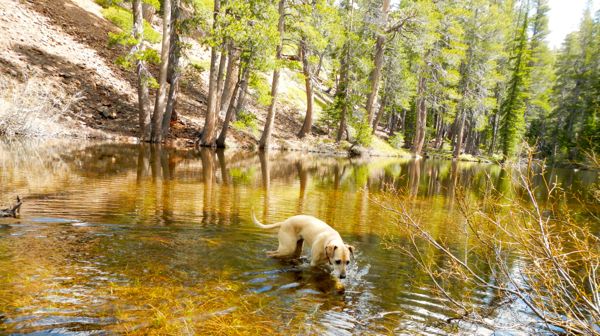
AJ gets a drink from what appears to be a new lake because of all of the runoff. Photos/Kathryn Reed

AJ gets a drink from what appears to be a new lake because of all of the runoff. Photos/Kathryn Reed

By Kathryn Reed

Susie and Heather were the only ones we were supposed to meet along the way. However, there is so much snowmelt that pools of water look like new lakes. This is not an exaggeration.

Water was everywhere. I expected the Glen Alpine Springs area to be a bit flooded, but it wasn’t bad. It was as we climbed that we came across these foreign water bodies.

Looming walls of granite appear to be weeping as water seems to stain the light gray rock.

Waterfalls not ordinarily running in the summer look like a spigot has been turned on.

Granite encapsulates the dark blue water of Lake Aloha.

Granite encapsulates the dark blue water of Lake Aloha.

It’s an interesting dichotomy. On the one hand there is so much water that it would be hard to know California is in year four of a major drought. On the other hand it was mid-May and runoff should not be so substantive; the moisture should still be in the form of snow. Thus, a clear sign this was no ordinary winter in regards to snowfall or spring because the warm weather has melted the little that did fall.

In several places it’s necessary to walk across logs or hop from rock to rock to cross the running water.

U.S. Forest Service crews still need to clear a few blow downs.

It was the second Monday of May that Donna and I made the 12-mile round-trip trek to Lake Aloha. This picturesque lake in Desolation Wilderness should have tons of snow on the trail. Not so. The couple snowfields we traversed across were no big deal.

Really, we shouldn’t have been able to be there. It’s too early in the season to be on this route without snowshoes. Actually, it’s doubtful I would be on it in the winter because Fallen Leaf Lake Road is usually closed and the route has no markers for winter recreationists.

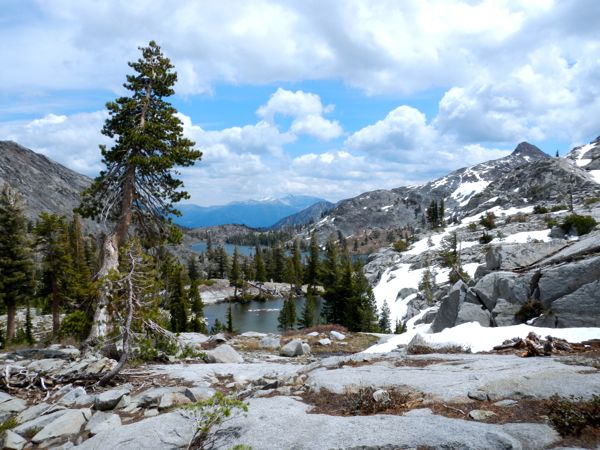
Just below Lake Aloha are flat "lunch" rocks that overlook Heather Lake.

Just below Lake Aloha are flat “lunch” rocks that overlook Heather Lake.

But I learned this is the time to make this ascent. One of the fabulous things about this hike in the early season is the lack of people on the trail. With this being one of the portals to Mount Tallac, there is often a bevy of foot traffic that can make it seem like anything but a wilderness area.

A few backpackers were coming and going. On this particularly windy day I was glad it was a day trip for us. My lone backpacking trip was to Lake Aloha and it was a miserable windy experience.

It was too windy and cold to spend much time at this lake that looks like it is from another world. We were reminded of the time of year by the snow lining the shore on the other side of the lake that then extends to peaks that seem to scratch the sky. Mount Pierce and Pyramid Peak are the most visible from this vantage point.

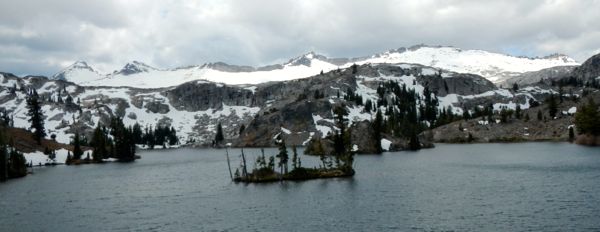
People are known to swim to the islands of Heather Lake on warm summer days.

People are known to swim to the islands of Heather Lake on warm summer days.

This granite basin has only a few trees protruding from the edges of the water. Rock is the dominant feature – including the islands.

I had forgotten how much granite there is on this trek – much more rock than dirt. So much that I was at the vet the next day. I had booties for my former dog for the overnighter. I was a bad mommy this time and AJ’s pads suffered because of it. One paw had to be bandaged.

Starting out at the trailhead we were at 6,560 feet. Lake Aloha is at 8,170 feet.

—–

Getting there:

From South Lake Tahoe go north on Highway 89. Turn left on Fallen Leaf Lake. Wind around and park at the trailhead. This is the Glen Alpine Trailhead.

Once on the trail, follow signs for Susie Lake and Lake Aloha.