Nev. allows businesses, investors to bet on sports

By Kimberly Pierceall, AP

Call it a mutual fund for sports bettors or maybe a legal framework for buddies to pool their money to bet on the big game.

Nevada is the first in the nation to allow business entities to wager on sports on behalf of investors, regardless of how big or small the enterprise.

Pushed by sports book manager CG Technology and signed by Nevada’s governor last week, Senate Bill 443 from state Sen. Greg Brower requires the businesses be based in Nevada, including its bank account. Staff and investors must fully disclose their identities to the sports book where they’re wagering, but investors don’t have to live in Nevada.

The activity was technically permitted before allowing common law partnerships to make wagers. Imagine a bunch of sports fans pooling their funds together and dispatching one of them to make the bet on their behalf, for example.

Brower, who pitched the idea unsuccessfully during the legislature’s 2013 session, said the aim is for the process to be more transparent and respond to a changing marketplace for sports betting that has diminished Nevada’s monopoly on the activity.

CG Technology and deputy general counsel Quinton Singleton pushed for the new “clear cut, black and white” framework. The company operates several sports books in Las Vegas including the Venetian and the Palazzo, the Cosmopolitan, the Palms, the Tropicana and the Hard Rock Hotel and Casino.

If disputes arise from investors feeling bilked, Singleton said the claim would take its normal legal course against the business entity, not the sports book or the state’s regulators.

“This is going to be, really, an alternative investment strategy,” he said.

Singleton described the new allowable scenario as something akin to a mutual fund, or sports investment betting.

As an example, he pointed to a firm in Australia, Priomha Capital, that’s a hedge fund that pools its client’s money and bets it via funds related to sporting events.

Rules will still bar individuals from accepting money to take bets on someone else’s behalf in Nevada sports books, the so-called messenger betting regulation, but the new law allows for the registered business and its employees to make bets, a distinction that satisfied regulators.

The key was making the sports books responsible for collecting the information about the businesses and identities of those involved, said Nevada Gaming Control Board chairman A.G. Burnett, adding that regulators would still be watching and would have the option of reviewing the business entity’s members and investors.

It’s up to the sports books if they want to accept the wagers. It’s also up to them to investigate the people behind the bets.

Johnny Avello, who runs the sports books for Wynn Resorts in Las Vegas, however says the new law doesn’t spell out specifics of how the bets and the businesses will work. He still has questions, he said.

“If you don’t know all the rules you’re bound to get yourself in hot water,” he said.

Jay Kornegay who runs the sports book at the Westgate Las Vegas, formerly the Las Vegas Hilton, has questions, too.

“We’re all trying to understand what it’s all about,” he said.

But Singleton, with CG Technology, said the law makes the process more clear and transparent, whether it’s three buddies who like to pool their money on bets or a hedge fund.

“You can run it like a real business,” he said.


Tahoe working to get homeless out of the cold

By Kathryn Reed

Putting a roof over people’s heads from Nov. 1-April 30 is the goal of a small coalition of people on the South Shore who are making strides to create a warm room.

Marissa Muscat, who has taken on the role of project manager, is spearheading the efforts to create a nonprofit that would be in charge of the homeless center.

The goal is that it would operate from 7pm-7am, be for men and women, allow pets, and that it would be within walking distance of a bus stop. It would accommodate 20 people in a space no smaller than 700-square-feet.

“The warm room will also work to break the cycle of homelessness by providing clients with connections to community-based services including subsidized housing, food-clothing resources, counseling, financial management, health care, empowerment, and other services as needed,” the draft proposal reads.

Mental illness, substance abuse and gambling problems are some of the issues facing local homeless people. Many are also veterans. Warm room committee members want to ensure people know what resources are available to them. They also recognize some people are resistant to change.

Advocates are working to provide homeless people a place to stay on the South Shore during the winter. Photo/LTN file

Proponents are working to provide homeless people a place to stay on the South Shore during the winter. Photo/LTN file

Advocates are looking for a fiscal sponsor. Live Violence Free’s board of directors is contemplating being that entity. This would help the warm room be able to go after grants as it works to establish itself as a standalone nonprofit.

“Fiscal sponsors provide a link to the community and fiscal oversight, and may be able to assist in acquiring liability insurance and filing taxes. The local faith community has been supportive and is participating in this project. The Red Cross has agreed to provide blankets, staff training, and cots for clients,” the proposal says.

Statistics show that the homeless situation in El Dorado County is increasing. The 2015 U.S. Housing and Urban Development count identified 247 homeless in El Dorado County, with 38 of them living in the South Lake Tahoe area. According to the warm room committee, local agencies believe the county homeless rate is closer to 600.

At a committee meeting last week some of the nuts and bolts of creating a warm room were vetted – such as discussing what the center should look like (it could be multiple places and not be at the same venue each night), creating intake forms for clients, security, the need to look at city codes, fundraising, getting volunteers, and being ADA compliant.

Besides creating the nonprofit, the committee is actively searching for a site or sites that would accommodate the seasonal warm room. Two toilets and a sink are needed, along with electricity, heat and trash removal. Showers would be optional. Storage for clients’ belongings would be ideal.

It’s estimated it will cost at least $20,000 to keep the warm room open for six months. And that is operating with a cadre of volunteers.

For more information about the warm room or to help with the project, contact Marissa Muscat at tahoewarmroom@gmail.com.


Panel: California water losses are huge

By Rong-Gong Lin II, Los Angeles Times

A panel of water experts on Sunday mapped out the challenges California faces in meeting future demands for water at a time when water sources are under stress and future supplies appear uncertain.

The panel, speaking at the Los Angeles Times book club, agreed the problems are serious and multifaceted: groundwater reserves underneath California’s Central Valley are estimated to have been depleted by 125 million acre-feet since the first wells were drilled more than a century ago and as water demand is forecast to outstrip supply coming from the Colorado River in the coming decades.

“What we’re really looking at is about a 20 percent problem of our supply being lost to climate change and over demand, and that’s huge,” said Jeff Kightlinger, general manager of the Metropolitan Water District, at a discussion of the book “Cadillac Desert,” by Marc Reisner.

Read the whole story


GOP seeks to speed up tree removal

By Kevin Freking, AP
WASHINGTON — Drought has killed about 12 million trees in California’s national forests. In the Rocky Mountain region, an epidemic of pine beetles has damaged trees over a stretch of 32 million acres. Altogether, up to 40 percent of the entire national forest system is in need of treatment to reduce the threat of catastrophic wildfire and disease.As the national forests suffer from drought, density and infestation, House Republicans are resurrecting efforts to thin more quickly millions of acres and take down dead trees.

It’s not a new battle by any means, but this time some of their proposals are winning positive feedback from the Obama administration, even as some environmental groups and House Democrats express concerns.

House Republicans have long sought more aggressive tree removal from national forest lands. Legislation in the last Congress would have required the government to increase significantly the amount of timber it offers for sale each year. The lawmakers say more aggressive timbering would make for a healthier forest and improve rural economies. But such mandates went nowhere in the Senate and prompted a veto threat from the White House.

This year, the Republican-led push is focused on excluding certain projects from an environmental review and by making a lawsuit to stop a project potentially much more expensive to file. The goal is to speed up timber harvests and the removal of underbrush the U.S. Forest Service deemed necessary. The House Natural Resources Committee is expected to vote on the bill on Wednesday.

When the U.S. Forest Service currently wants to undertake major work on a national forest, it talks with stakeholders such as the timber industry, local residents and environmental groups to develop a plan that addresses their concerns and uses the best science available. But, the process often takes too long and ends in a lawsuit, said a memorandum written by Republican staff for the House Natural Resources Committee.

“These policies may be making environmental law firms rich, but they are killing our national forest,” said Rep. Tom McClintock, R-Calif., chairman of the House subcommittee that oversees federal lands issues.

Democrats say they worry the legislation eroded hard-fought protections and will allow major projects to go forward without a proper review on the effect on the environment.

Under the proposed legislation, many projects fewer than 15,000 acres would be excluded from the required environmental review if the projects were designed to reduce hazardous fuel loads and disease, protect watersheds or improve critical habitat. That’s five times the current limit of 3,000 acres.

Also, groups suing the federal government over a thinning project would often have to buy an insurance bond in the event they lose so that the federal government could recoup the expense of defending itself in court.

Tom Tidwell, chief of the U.S. Forest Service, did not take a position on the legislation during a hearing last week, but said he was encouraged by some goals of the bill.

Robert Bonnie, an undersecretary who oversees the Forest Service, told the Associated Press that some of the GOP’s approaches are “interesting and we want to engage in the conversation.”

But both men emphasized that the biggest problems they face are budgetary. Fires are eating up so much of the agency’s budget that it has 39 percent fewer employees than it had nearly two decades ago.

“We’re taking people out of the field that put together the projects to reduce fire in the first place,” Bonnie said. “So even if you give the Forest Service a bunch of new tools and tool boxes, we don’t have enough people on the ground to reach the type of scale we need. So we have to fix the fire budget.”

Rep. Niki Tsongas, D-Mass., said that limiting environmental reviews can help in specific situations, “but this bill goes too far.”

Nearly three dozen environmental groups wrote McClintock and Tsongas to oppose the bill, including the Sierra Club, The Wilderness Society and Defenders of Wildlife. “Under the pretext of ‘forest health’ and ‘collaboration,’ the bill does the opposite by moving toward analysis-free, high-risk production-based logging on our national forests and reducing collaboration,” the groups wrote.

Kyle Tisdel, an attorney with the Western Environmental Law Center, said groups that end up suing the federal government to stop a project must take part in an extensive public participation process before they can go to court. He said the additional hurdle of requiring an insurance bond would have a substantial chilling effect on the public’s ability to engage the government and take their case to a final arbiter.

“These organizations operate on shoestring budgets for the most part,” Tisdel said.

The USDA’s Bonnie also expressed concern about requiring groups suing the department to acquire a surety bond.

“It’s important the public still have the ability to access the courts,” Bonnie said. “The best approach we have to reduce litigation is these collaborative efforts on the ground.”


Donner Museum captures region’s history

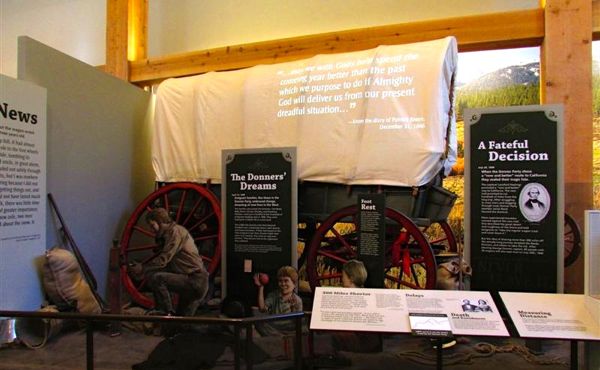
Exhibits at the Donner Museum tell the story of the region's past. Photos/Denise Haerr

Exhibits at the Donner Museum tell the story of the region’s past. Photos/Denise Haerr

By Denise Haerr

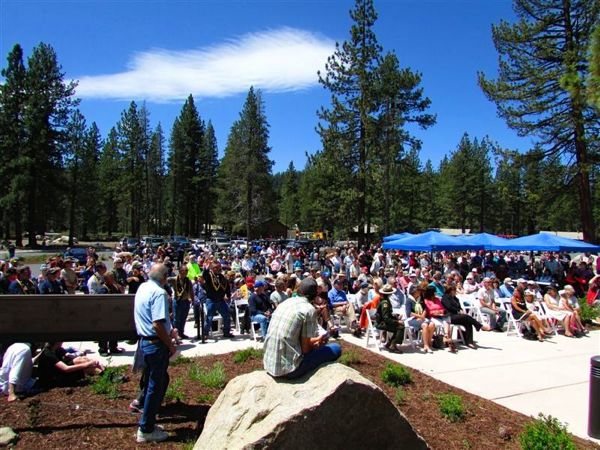
TRUCKEE – Hundreds gathered to be a part of history in the making in the impressive shadow of the Pioneer Memorial, whose own dedication occurred 97 years ago to the day. The grand opening of the Donner Memorial State Park Visitor Center on June 6 was a 20-year, $9.6 million endeavor that was a testament to collaboration.

Even its theme, “Crossing Barriers Changes Lives”, was clearly evidence by the emotional blessing prayer given by Washoe elder Steven James, encouraging everyone to continue to work together the make things better.

The High Sierra Crossing Museum – a 9,400-square-foot structure – has sat empty for about a year because of lack of funding to operate it. It replaces the Emigrant Trail Museum.

The state-of-the-art facility is full of innovative and engaging programs and exhibits. It is destined to be a much-visited park. It honors the ill-fated Donner Party, telling the history of the Donner region, including: Washoe settlements, Chinese workers building the transcontinental railroad, and early motoring experiences over Donner Pass. This is not just a look at museum. It’s something to experience, a place to learn about those who came before us.

Hundreds of people turn out for the June 6 museum opening.

Hundreds of people turn out for the June 6 museum opening.

The audience was asked to raise a hand if anyone was a descendant of the Donner Party. Dozens of hands rose.

Later, Tamara Anderson told of her relative, Sarah Graves, who was part of the Forlorn Hope, an offshoot of the original group. Graves was one of the few survivors. An exhibit in the museum titled “Why Women Survive?” gives insight into Anderson’s family legacy.

More women than men lived through the Donner Party ordeal.

While there were many dignitaries present on Saturday, the ceremony began with a flag raising, with the help of two little girls, Cora Medhurst and Abigail Quadros. They are the great-great-granddaughters of Louis De Rome, a pioneer bronze manufacturer and the caster of the Pioneer Memorial. While De Rome created the impressive statue, it was the Native Sons of the Golden West that secured the lands for the location in 1918. Members from all over California convened for this the 139th Grand Parlor Annual Meeting. As tradition dictates, the members combined sand, gravel and water from the far reaches of California to make cement. They then affixed part of the historic marker with the cement, a custom symbolic of the society’s original mission since its forming in 1875 – to preserve California’s historic resources with informational markers and fundraising for landmark restoration work. It was a memorable display of the magnitude of this endeavor.

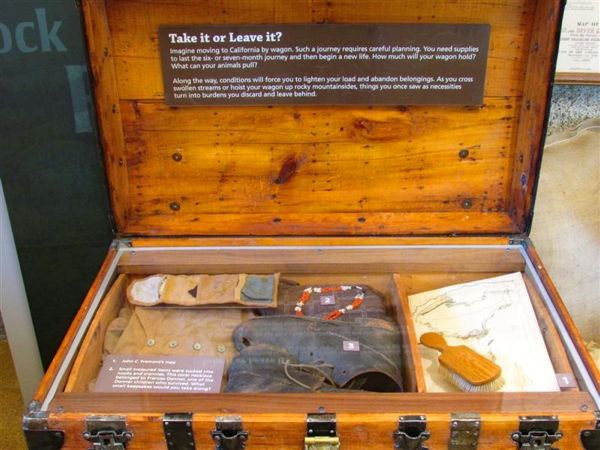
Displays show items from  days gone by.

Displays show items from days gone by.

“Donner Memorial State Park is a jewel in our system, and it’s recognized worldwide for its historical value. The new visitor center will enhance our visitors’ experience, and will allow us to showcase the significance of the park in a more interactive and innovative manner,” Lisa Mangat, acting director of California State Parks, said. “Giving our visitors an array of different experiences will help us instill a strong sense of pride for the wonderful cultural and historical resources there are at Donner Memorial State Park.”

Truckee Vice Mayor Joan deRyk Jones added an economic element to the dedication. She shared that for every $1 spent at a California State Park, $17 goes into the local community’s economy.

Team effort was the key description of the work involved for the grand opening.

Moderator Don Schmidt quoted past National Park Service Director William Penn Mott Jr., “A vision is a powerful thing. It is a dream based on a clear perception of the future combined with a commitment to take the necessary steps to make it happen.”

—–

Notes:

·      More information about the park may be found online.


Nevadans can expect tax hikes July 1

By Sandra Chereb, Las Vegas Review-Journal

CARSON CITY — A few pennies here, a couple of dollars — or millions — there.

From higher cigarette taxes, entertainment levies and the state’s first gross receipts tax on commerce, Nevada businesses and residents will pay more under tax measures approved by the 2015 Legislature to fund Gov. Brian Sandoval’s $7.3 billion general fund budget.

It’s too early to say how far Nevada consumers will have to dig into their pockets. But it’s a safe bet things will cost more under the levies, most of which take effect July 1.

“There are too many factors to be able to predict with any certainty how much the impact is going to be,” said Bryan Wachter of the Retail Association of Nevada, a trade group that opposed Sandoval’s gross receipts tax.

He said a lot will depend on an individual’s lifestyle and buying habits but added, “Certainly through consumer goods and utility providers, there will be an increase.”

The biggest component of the tax package — and a first in state history — is Sandoval’s gross receipts tax on business revenue. The second-term Republican won a hard-fought battle to get his plan through a tax-averse Assembly, a move Sandoval said will provide the state a more stable revenue stream with enough elasticity to expand as the state’s economy and needs grow.

Read the whole story


Proposed Squaw Valley high-rises spur controversy

By Brad Branan, Sacramento Bee

A proposed expansion of Squaw Valley USA would create “significant and unavoidable” effects on scenery, noise and traffic at the mountain resort near Lake Tahoe, according to a draft Placer County report released last month.

In a project expected to take 25 years to complete, Colorado-based KSL Capital Partners LLC plans to build hotels, condos, an indoor recreational facility, shops and more at the ski resort that hosted the 1960 Winter Olympics. The expansion would add 10, 100-foot-tall buildings to the Sierra Nevada skyline.

Environmentalists say the draft environmental impact report shows the project should not be built as proposed.

Read the whole story


Sidewinder puts a twist into Tahoe cycling

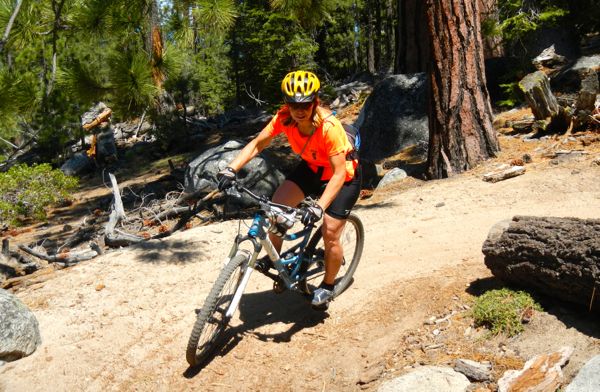
Brenda Stewart makes her way through a turn on Sidewinder. Photos/Kathryn Reed

Brenda Stewart makes her way through a turn on Sidewinder. Photos/Kathryn Reed

By Kathryn Reed

Be wary when a friend says it’s a tiny hill.

At least that’s how I remember Brenda describing the ascent up to the Corral Trailhead. The 2.2-mile uphill slog on a poorly paved road from the lower parking lot would have been a lot less painful had we not already ridden several miles to get to this point.

Oh, but the reward, well that was worth having to swallow my pride to push the bike a short ways. This is as vehicles, including shuttles from South Shore Bikes, passed us. While I did take the shuttle back to my vehicle at Spooner when I did the Flume Trail years ago, the shuttle to Corral almost seems like cheating.

Our destination was Sidewinder – formally known as Sierra Sidewinder.

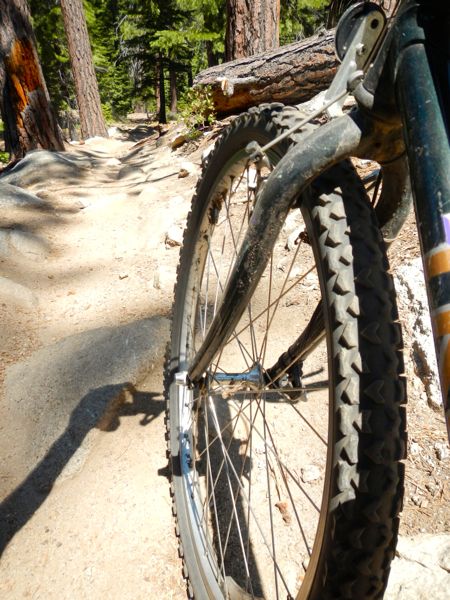
Shocks -- or a whole new bike -- would make some Tahoe trails more pleasurable.

Shocks — or a whole new bike — would make some Tahoe trails more pleasurable.

The banked turns had me wishing it hadn’t been three years since I took a mountain biking lesson at Northstar.  I was trying to remember what I had been taught – but didn’t necessarily learn – about how the bike is supposed to lean one way and I’m supposed to do something else.

I was just happy this was a weekday with few people on the trail. My brakes were getting a lot of action. So were my facial muscles – switching between smiling and serious concentration.

Many mountain bike trails have the green-blue-black designations like ski runs. Sidewinder is 1.25 miles of blue terrain.

It’s mostly about banked switchbacks. But there was one spot where Brenda and I both walked down a granite slab.

From there we did a gentle ride over the tabletops on Lower Corral. This is 1½ miles of green. I’ve seen video of people doing some spectacular riding on all sections of Corral. I don’t aspire to do that, but it will be fun to get more confident riding this trail.

(Upper Corral Trail is 1 mile and is a black diamond.)

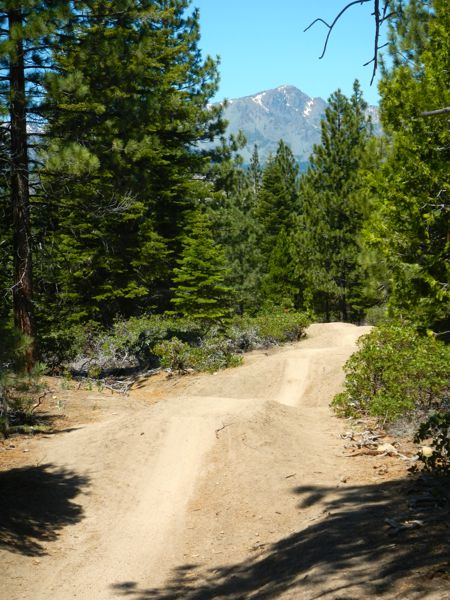
Mount Tallac from Lower Corral Trail.

Mount Tallac from Lower Corral Trail.

The U.S. Forest Service – whose property these trails are on – and TAMBA – the area’s preeminent mountain biking group – deserve all the props they get for having created a network of trails that just about anyone could get down.

I’m not a serious mountain biker by any means. In fact, my Trek is more than 20 years old. It doesn’t have any suspension. This either makes me so incredibly hardcore, super cheap, plain stupid or someone whose mountain biking escapades might just be evolving to the point where she needs to do some shopping for new wheels.

It was at the end of Lower Corral where my whole body was shaking and I started thinking having front or rear shocks, or both, would have been welcome. All I was thankful for was that I already had a massage booked for later in the week.

—-

Getting there:

From South Lake Tahoe, take Highway 50 west toward Meyers.

Turn left on Elks Club Drive.

Turn right on Pioneer Trail.

Turn left on Oneidas Street.

There is a lower parking lot. If the gates are open, there is parking farther up at the entrance to the trailhead.


IRS may lower threshold for reporting slot winnings

By J.D. Morris, Las Vegas Sun

The national casino industry and its allies in Congress are trying to send a message to the IRS: Lowering the threshold for reporting slot winnings is a bad idea.

Geoff Freeman, president of the Washington, D.C.-based American Gaming Association, said in a conference call today that about 13,000 people from across the country had spoken out against the potential threshold change. The IRS has been seeking public input on the possibility of someday lowering the amount at which casinos must report slot winnings from $1,200 to $600.

The idea comes as the IRS considers changes that would “update and simplify” gaming-related regulations. The agency plans to keep the current slot winnings threshold in place for now, but it’s accepting comments on the feasibility of a lower reporting requirement.

Read the whole story


Calif. is sinking, and it’s getting worse

By Nathan Halverson, Reveal

California is sinking – and fast.

While the state’s drought-induced sinking is well known, new details highlight just how severe it has become and how little the government has done to monitor it.

Last summer, scientists recorded the worst sinking in at least 50 years. This summer, all-time records are expected across the state as thousands of miles of land in the Central Valley and elsewhere sink.

But the extent of the problem and how much it will cost taxpayers to fix are part of the mystery of the state’s unfolding drought. No agency is tracking the sinking statewide, little public money has been put toward studying it and California allows agriculture businesses to keep crucial parts of their operations secret.

The cause is known: People are pulling unsustainable amounts of water out of underground aquifers, primarily for food production. With the water sucked out to irrigate crops, a practice that has accelerated during the drought, tens of thousands of square miles are deflating like a leaky air mattress, inch by inch.

Groundwater now supplies about 60 percent of the state’s water, with the vast majority of that going to agriculture. Tens of thousands of groundwater pumps run day and night, sucking up about 5 percent of the state’s total electricity, according to a Reveal analysis of the increased pumping resulting from the historic drought. That’s an increase of 40 percent over normal years – or enough electricity to power every home in San Francisco for three years.

The sinking is starting to destroy bridges, crack irrigation canals and twist highways across the state, according to the U.S. Geological Survey.

Two bridges in Fresno County – an area that produces about 15 percent of the world’s almonds – have sunk so much that they are nearly underwater and will cost millions to rebuild. Nearby, an elementary school is slowly descending into a miles-long sinkhole that will make it susceptible to future flooding.

Private businesses are on the hook, too. One canal system is facing more than $60 million in repairs because one of its dams is sinking. And public and private water wells are being bent and disfigured like crumpled drinking straws as the earth collapses around them – costing $500,000 or more to replace.

The sinking has a technical name: subsidence. It occurs when aquifers are drained of water and the land collapses down where the water used to be.

The last comprehensive survey of sinking was in the 1970s, and a publicly funded monitoring system fell into disrepair the following decade. Even the government’s scientists are in the dark.

“We don’t know how bad it is because we’re not looking everywhere,” said Michelle Sneed, a hydrologist with the geological survey. “It’s frustrating, I’ll tell you that. There is a lot of work I want to do.”

Some places in the state are sinking more than a foot per year. The last time it was this bad, it cost the state more than a billion dollars to fix.

In the 1920s, farmers began transforming desert lands into verdant crop fields by pumping groundwater to the surface. At the time, these farmers were not just head and shoulders above their modern-day counterparts – they were actually as much as three stories above them. But then the land started to sink.

In the 1930s, scientists first noticed the land was sinking. At the time, the cause was a mystery. A legendary hydrologist, Joseph Poland, was assigned to solve the puzzle starting in the 1940s.

He realized that underneath the sinking land, groundwater was being pumped rapidly to irrigate crops. It created massive sinkholes that stretched for miles in every direction. In the farming community of Mendota, the land sunk about 30 feet between 1925 and 1977.

The sinkhole is so vast that it is essentially impossible for residents to see that they are standing in one. Poland used a utility pole to build a temporary monument to show them just how much the land had sunk.

The sinking, which peaked in the late 1960s, wreaked havoc on the state’s rapidly expanding infrastructure, damaging highways, bridges and irrigation canals. One estimate by the California Water Foundation put the price tag at $1.3 billion for just some of the repairs during that time.

The sinking did not slow until the 1970s, after California had completed its massive canal system – the most expensive public works project in state history. It delivered water from wetter parts of the state to farmers in the Central Valley and elsewhere, relieving their reliance on groundwater. The problem was fixed – at least for a while.

‘When we looked back, whoa – it had gotten bad’
In 2012, Sneed, the hard-charging geological survey scientist, received a startling report. Land was subsiding along the San Joaquin River at a rate worse than during the 1987-92 drought. It was nearing the historic rates of sinking recorded by Poland in the late 1960s. She couldn’t believe it.

“Is this even real?” she asked. “We hadn’t seen rates of subsidence like that in a long time.”

She and others began assembling what little public data was available. They got funding to analyze satellite data for parts of the San Joaquin Valley. They discovered that in one of the worst observed areas, around the town of El Nido (Spanish for “The Nest”), land was sinking at a rate of about 1 foot per year in 2012.

“It’s incredible,” Sneed said, expelling a puff of air as if she still couldn’t believe it. “We looked away for a long time. And when we looked back, whoa – it had gotten real bad.”

The El Nido subsidence bowl was sinking so fast that the satellite couldn’t keep pace.

No one has monitored it since. But Sneed and others contacted by Reveal said they expect it now could be sinking by 2 feet per year. That would be an all-time record.

Chris White, general manager of the Central California Irrigation District, said that last year, a farmer near El Nido sent him a photo of a gas pipe that had protruded more than 18 inches from the ground in less than a year as the land sank around it.

White said Californians now might have the opportunity to witness firsthand the devastation Poland chronicled in the 1960s.

“There is that potential,” he said.

Sneed is practically begging to expand her limited research. A hodgepodge of about 350 ground-elevation monitors – many leftover from the 1960s – are all she and other researchers have to track tens of thousands of miles that are sinking. This includes vineyards in Sonoma and Napa counties, areas around Paso Robles and Santa Barbara, and agricultural regions encircling Los Angeles, all which have shown signs of sinking, according to a California Department of Water Resources report.

To draw awareness to the problem, Sneed replicated Poland’s 1977 photo. Her photo captures the early stages of today’s worsening subsidence problem, she said. But she and others expect that it will get much worse.

U.S. Geological Survey scientist Michelle Sneed shows where a farmer would have been standing in 1988, before a six-year drought triggered sinking in California’s San Joaquin Valley. It also shows how sinking accelerated in 2008.Credit: U.S. Geological Survey
Bridges are sinking and canals are cracking
Many businesses and state agencies appear to be unaware of the problem.

Sneed and her boss at the U.S. Geological Survey, Claudia Faunt, have tried reaching out to various government agencies and private businesses to warn them and inquire about the extent of damage being done to infrastructure.

“We tried calling the railroads to ask them about it,” Faunt said. “But they didn’t know about subsidence. They told us they just fixed the railroads and categorized it as repair.”

Thousands of miles of highways snaking through the state also are being damaged, she said.

“They go to repair the roads, but they don’t even know it’s subsidence that is causing all the problems,” Faunt said. “They are having to fix a lot because of groundwater depletion.”

A spokeswoman for the state Department of Transportation said the agency does not track costs related to subsidence and was not aware of any current bridge repairs resulting from it.

But Faunt pointed to the Russell Avenue bridge that crosses the Outside Canal in the Central Valley. It sank during two previous droughts – one in the late 1970s and then again between 1987 and 1992. Now with the current sinking, the 60-year-old bridge is almost totally submerged by canal water.

Down the road about a mile, Russell Avenue crosses another irrigation canal, the Delta-Mendota Canal. That bridge is sinking, too, and now is partially submerged in water. Plans to replace it are estimated to cost $2.5 million, according to an estimate by the Central California Irrigation District.

The bridge is part of an $80 million list of public and private repairs already needed near the El Nido subsidence bowl because of sinking, White said.

Last year, the state passed its first law attempting to regulate groundwater, but farmers won’t be required to meet goals until 2040 at the earliest. And the information on who is pumping what will be kept private.

“A doomsayer would say we will run out of water,” said Matt Hurley, general manager of the Angiola Water District, near Bakersfield. “But I don’t believe we’re heading there. We’ve been given a good opportunity with the sustainability law.”

But Devin Galloway, a scientist with the geological survey, sees devastation of a historic proportion returning to California. He says that even if farmers stopped pumping groundwater immediately, the damage already done to aquifers now drained to record-low levels will trigger sinking that will last for years, even decades.

“This could be a very long process. Even if the water levels recover, things could continue to subside,” he said. “This is a consequence of the overuse of groundwater.”