Partying tourists confronted with reality that South Lake Tahoe wants quiet neighborhoods
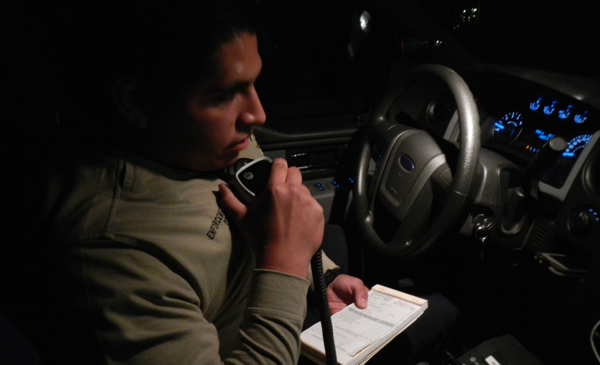
South Tahoe code enforcement officer Danny Loyola confirms details with dispatch. Photo/Kathryn Reed

South Tahoe code enforcement officer Danny Loyola confirms details with dispatch. Photo/Kathryn Reed

By Kathryn Reed

It’s about 12:30am Saturday and a distinct conversation can be heard coming from the back yard of the next street. It’s a group of about 10 who are up from the Bay Area partying. They are here for this long weekend.

They are going home with a $270 citation for excessive noise at a vacation home rental.

They claim they had no idea they needed to keep things down starting at 10pm. Danny Loyola, enforcement code officer for South Lake Tahoe, informs them excessive noise anytime of day won’t be tolerated.

In this case, a neighbor backing the Dedi Street rental called the police about the noise.

Loyola, who works Thursday-Sunday from 4pm-2am, is the man responsible for keeping the peace between loud out-of-towners and locals.

The woman who called about this house on Sept. 5 said she was woken up from a deep sleep. She tried conversing with the visitors over the fence. They reportedly told her they would keep it down. They didn’t. They were  “obnoxious” according to the caller, so she called SLTPD.

Loyola drove around the neighborhood to gauge the sounds from various vantage points. The vacationers were loud. It wasn’t just muffled sounds.

No sign was on the house designating it as a vacation home rental (VHR), which is mandated on the permit. Loyola makes a note of this.

For every encounter he has on a shift Loyola fills out a disturbance advisement card. It gets placed in the permittee’s file so there is a record of how many times enforcers are called to a particular house and for what reason. Noise is the primary reason the enforcers are called out at night. Garbage and parking are bigger issues for the day shift enforcers.

At each call Loyola asks to speak with the person who rented the house. In this case it was an intoxicated woman. She’s coherent to a point. She understands they were loud and that this is a bad thing. However, she seems confused as to why she is getting the citation. Loyola is patient with her. Her two male friends try to explain it.

Loyola had called for backup from a sworn officer. It just felt better. He goes into these situations not knowing who will be on the other side of the door. Most times he confronts people who have been drinking. His radio, flashlight and pepper spray are his “weapons” if things were to go sideways. That’s why when it’s possible, an officer with more firepower is by his side. More important, it’s just another body.

South Lake Tahoe is taking a more proactive approach to enforcing the rules about vacation home rentals. This includes having people dedicated to patrolling the streets during the likely days and hours when guests are more prone to misbehaving.

On this particular Friday-Saturday shift, Loyola receives just two calls. The other is on San Jose Avenue. From the street the voices are much more subdued compared to the other house. They are from Ohio and say they have no idea about the rule concerning noise.

Everyone seems to be out of the hot tub by the time Loyola leaves. He issues them a warning and says he hopes not to see them for the rest of the weekend. They agree.

Loyola has been much busier on previous weekends compared to this last long weekend of summer. When he’s not on a VHR call he is doing code enforcement of a different kind. This includes finding abandoned vehicles, cars parked on city streets without current registration and other infractions, as well as making sure all is well at the city parking garage at Heavenly Village. He also is another pair of eyes for law enforcement for anything suspicious that might be going on that falls outside of his scope of work.


Pastor believes Tahoe church vandalism based on Satanism

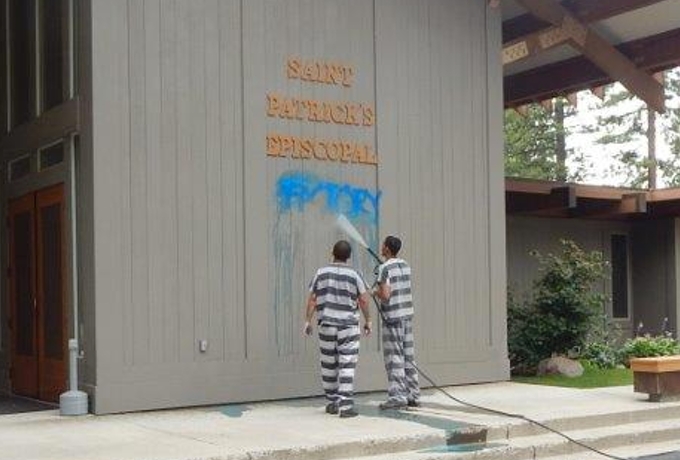
Washoe County inmates clean the graffiti off the church. Photo/Provided

Washoe County inmates clean the graffiti off the church. Photo/Provided

By Scott Sonner, AP

The minister of one of several churches hit by a string of vandalism on the North Shore of Lake Tahoe says they appear to be satanic attacks by an individual who is “very angry with Jesus.”

“I’ve seen nothing that would give a hint it was socially or politically motivated,” said the Rev. Jeffrey Ogden, Presbyterian pastor at Village Church in Incline Village.

“Everything that has been posted, the satanic symbols on the front doors of all the churches — it was satanic,” he told the Associated Press on Friday. “It was anti-Christian, anti-Jesus — more theologically motivated. This is a Satanist who is opposed to Jesus.”

The FBI is offering a reward for information leading to the arrest and prosecution of anyone responsible for the incidents, which began with graffiti at five Tahoe-area churches in April on Easter Sunday and continued in August.

The FBI has declined formal comment on the investigation, but Ogden said agents have told him they are “looking at this as a potential hate crime.”

Last weekend, someone tried to saw down a wooden across in front of Ogden’s church. They returned Tuesday night or early Wednesday and tried unsuccessfully again to bring the cross down at the Village Church, he said.

“This person seems to be very angry with Jesus, and the church,” Ogden said.

Some of the graffiti included, “Jesus has already lost,” and “Jesus won’t save your souls,” he said.

“So far from everything I’ve heard, it appears to be an individual,” Ogden said. “It does not appear to be rationale to me. Obviously the person seems to have a lot of anger inside them.”

fSt. Francis of Assisi Catholic Church also was hit a second time late last Saturday night. The considerable damage there included broken windows and equipment, Washoe County sheriff’s Lt. Jeff Clark said.

St. Patrick’s Episcopal Church also was vandalized again on Aug. 7, when someone painted graffiti on the building and a car parked on church property.

Ogden said it’s clear the vandal is not targeting a specific denomination.

“One church that was hit was one of the more liberal in the community. The Catholic church and ours — we are more conservative in our theology. They are not making distinctions based on our social or political views,” he said.

Several members of the churches attended a prayer gathering Monday night at Cornerstone Community Church to show support for each other.

“It has been a blessing to be able to gather together as people, not focused on traditions or theologies, but coming together to say we support one another as community members,” Ogden said.

“It doesn’t mean that as Christians we don’t have some differences — some pretty profound differences on some things. But when something like this happens, those are not as important. Love is more important, truth is more important, standing together is more important.”


Amid drought, thousands in Calif. cancel flood insurance

By Phillip Reese, Sacramento Bee 

State and local officials have preached for months that California’s historic drought could be “the new normal,” the precursor to more frequent years-long episodes of hotter temperatures, less rainfall and lower Sierra snowpack.

Californians across the state have responded en masse to the call for lifestyle changes, curtailing water use, particularly when it comes to watering their lawns.

And some have responded in a manner more concerning to government officials: They canceled their flood insurance.

The number of federal flood insurance policies active in California has fallen by 30,000, or 12 percent, since the drought began in 2012, according to data from the National Flood Insurance Program.

Read the whole story


Crews take ax to invasive weeds in Tahoe marsh

The invasive mullein weed is scattered about the Upper Truckee Marsh. Photo/Kathryn Reed

The invasive mullein weed is scattered about the Upper Truckee Marsh. Photo/Kathryn Reed

By Kathryn Reed

Long stalks lay lifeless on the ground; others are being carted away to be disposed off-site.

Mullein looks pretty, with stalks that can grow to 10 feet, and yellow flowers blooming every other year.

The problem is mullein is a weed – and an invasive one.

“They take resources away from plants that are indigenous,” Sarah Werick, land steward with the California Tahoe Conservancy, told Lake Tahoe News.

She was out at the Upper Truckee Marsh last month leading a crew that was removing the weed.

Where the plant is in its lifecycle determines how the agency handles it. What are left behind are portions of the plant that don’t have seeds. Just a little moisture and the mullein will reproduce. That is why the sections with seeds are removed from the area.

Mullein is scattered about this more than 400-acre section of the South Shore. Werick said the plant could take over a location – another reason to get rid of it.

Mullein can be allergenic, so some of the crewmembers have donned surgical masks to keep from inhaling anything that might make them ill.

As part of Werick’s job, she is always keeping an eye out for invasive plants.

“When we see a growth spurt, we come out and do a big weed removal,” she explained.

Also being removed on this particular day were thistles that are not native to the basin. However, there is indigenous thistle that remains untouched.

It takes a trained eye to know what is “good” vs. what is “bad,” which is why Werick discourages the public from pulling plants.


Skill-based slot machines inch closer to Nev. casinos

By Kimberly Pierceall, AP

Arcade-style slot machines that might require skill to win could be in Nevada casinos as early as next year, according to one game maker’s estimate now that a single regulatory vote remains.

The Nevada Gaming Control Board on Wednesday recommended legal language that would allow slot machines requiring skill to win or a combination of talent and luck.

The changes still need approval by the Nevada Gaming Commission before taking effect. That five-member regulatory board is expected to discuss the new language at a Sept. 17 hearing, a couple weeks ahead of the annual Global Gaming Expo, where slot makers will show off their latest innovations in Las Vegas.

If the changes are approved, “the store is open for business, so to speak,” said Gamblit Gaming CEO Eric Meyerhofer. His company has been developing skill-based games that can be played by multiple players in the style of “Angry Birds” and “Battleship,” among others.

Meyerhofer estimated that once the game submission process is approved and technical standards are written, casinos could offer skill-based video gambling by early or mid-2016.

The changes would also simplify rules that have governed the themes of casino games for years and were primarily aimed at limiting their appeal to children. Under the proposal, nothing will be allowed that is obscene or offensive based on race, religion, nationality, gender or sexual orientation, and game makers can’t use themes based on products that are primarily marketed to people younger than 21 years old.

Casino revenue has fallen from a peak of nearly $12.9 billion in 2007 to about $11 billion in 2014, with slot proceeds alone plunging 20 percent, and the industry is betting gamblers, particularly younger ones, want to do more than press a button and passively watch reels spin. They want skill-based games like the popular titles on their smartphones or video game consoles, except with real money on the line, video game and slot machine makers say.

In order to deliver on arcade-style games, the Association of Gaming Equipment Manufacturers pushed lawmakers this year to encourage innovation and direct the Gaming Control Board to make the regulations that govern games of chance more nimble and to allow elements of skill.

It’s not yet known what the games may look like except for what companies have shown off in development, including a digital pinball machine and first-person shooter games that award points for targets hit.

Of a few adopted suggestions the manufacturer’s group made to the board, one allows the chairman flexibility to waive the technical standards for a game if shown a good reason to do so, “since we don’t truly know how radical some of the new concepts may be,” said Marcus Prater, the executive director of the Association of Gaming Equipment Manufacturers.


Forest Service’s mission goes up in flames

By Jodi Peterson, High Country News

We’ve written quite a bit lately about “fire borrowing” —  what happens when the Forest Service runs out of the funds it’s budgeted for firefighting, which are based on average wildfire costs over the last 10 years. Then it’s forced to start dipping into money meant for other programs, including those intended to reduce the risk and  intensity of wildfires.

Agency chief Tom Tidwell recently told the Coloradoan, “The reality of the last two years — and where we’ll be headed this year — is that we have to use almost all the (prevention) funding (to pay for firefighting instead). …This is also the time of the year we do a lot of the planning for next year. That planning (won’t) get done.”

But not only do these budgetary borrowings, usually to the tune of about $500 million per year, hurt current projects, there’s a huge long-term cost as well. Critics ranging from members of Congress to agency staffers have charged that the Forest Service is rapidly becoming the Fire Service, an agency whose duty to “sustain the health, diversity, and productivity of the Nation’s forests and grasslands” has been utterly overrun by its need to put out fires.

Now, a new report from Agriculture Secretary Tom Vilsack lays out the problem created by the rapidly-rising cost of fighting forest fires, which have gotten much more severe in recent years thanks to climate change, drought, disease and insects, development near forests, and the overgrowth of flammable shrubs and small trees. Firefighting now consumes 42 percent of the Forest Service’s budget (if you count all fire-related expenses, it’s 51 percent), compared to just 16 percent in 1995.

Read the whole story


Calif. firm ordered to stop tapping Sierra springs

By Scott Smith, AP

FRESNO — Armed with evidence captured by surveillance cameras, California regulators have ordered a business to stop tapping Sierra Nevada spring water that is later bottled and sold in stores, officials said.

It would be the first such action taken this year against a commercial water bottling business under tight drought restrictions, said Kathy Mrowka, enforcement manager of the state Water Resources Control Board.

Sugar Pine Spring Water in the foothills of Tuolumne County also faces fines of nearly $225,000 for collecting and trucking the water to commercial bottling companies for two years despite notices to stop, according to the proposed sanctions by the state Water Resources Control Board.

With California in its fourth year of historic drought, residents are being told to cut back, and thousands of farmers and other users such as Sugar Pine have been notified they must stop using waters as streams and rivers run dry.

The state earlier this year proposed a $1.5 million fine against the Byron-Bethany Irrigation District east of the San Francisco Bay Area, accusing it of taking water despite similar drought restrictions. The district is challenging the case.

Springs tapped by Sugar Pine feed into the Tuolumne River watershed and drain into New Don Pedro Reservoir. The city of San Francisco and farmers in Turlock and Oakdale irrigation districts rely on the watershed, the complaint says.

Sugar Pine was launched in the early 1990s and holds junior water rights, which have been curtailed in 2014 and 2015 because of the drought.

Scott Fahey, the owner of the company, continued to divert a total of 22 acre feet of water over 170 days in the past two years after being notified no water was available under his rights, the complaint says.

One acre-foot is the volume of water sufficient to cover an acre of land to a depth of one foot, enough water to sustain a typical California household of four for one year.

The company pumps water captured from four springs to a transfer station before it is trucked to commercial bottling firms, the complaint says. The bottling firms are not identified in a complaint and Mrowka declined to name them.

Fahey can challenge the state action before the measures take effect. Fahey did not respond to a call seeking comment. His attorney, William “Bart” Barringer, declined to comment in an email, saying he anticipates a hearing before the state water board.

Officials say Fahey has refused requests to show state inspectors his operations behind locked gates on a remote road. Investigators said they mounted surveillance cameras outside the gates, capturing tanker trucks traffic. They also reported seeing tanker trucks rumble past them during a 90-minute visit in July to the site.

Despite opposition from residents, Crystal Geyser Water Co. plans to tap an aquifer at the base of Mount Shasta. Residents fear it would deplete nearby wells and the aquifer, which feeds headwaters of the Sacramento River.

State regulations didn’t intervene because groundwater monitoring in the state is years from implementation, said Tim Moran, a state water board spokesman.

Tuolumne County springs are considered surface water and within the state’s jurisdiction, he said.


El Dorado County board of ed seeks some say in how superintendent could be disciplined

By Kathryn Reed

El Dorado County Office of Education’s board has called for a special meeting with the sole agenda item being a discussion about Superintendent Jeremy Meyers.

Meyers is an elected official, so the board does not have control over any discipline or sanctions.

“On the surface, and my reading of the Education Code and of the law we don’t have any authority to have those kinds of policies about the superintendent,” board member Heidi Weiland told Lake Tahoe News.

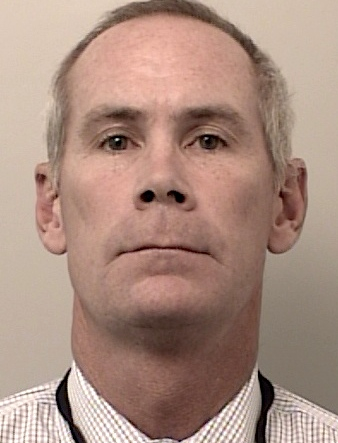
Jeremy Meyers when he was booked Aug. 22.

Jeremy Meyers when he was booked Aug. 22.

This means Meyers was allowed to continue to earn his $196,837 a year salary when he was on house arrest for five days, it means the board’s not being able to mandate he get any type of treatment or that members have oversight of it, nor can the board even discuss the situation in closed session because he is not an employee.

Because the board doesn’t meet in July, the Aug. 27 meeting was the first time the board had met since Meyers was cited June 9 by the California Highway Patrol for driving under the influence. Meyers usually attends all board meetings, but he was not at the Aug. 27 meeting. No reason was given for his absence.

It was at last week’s meeting that Weiland requested the Sept. 15 special meeting, to which her colleagues agreed, though none of them spoke to the issue.

The unadopted minutes from the Aug. 27 meeting summarize Weiland’s desire for the special meeting to have discussions include “but not limited to laws pertinent to the relationship between the elected superintendent and the elected board, the elected board’s ability to put in place systems or protections, and legal counsel as it relates to a possible conflict of interest.”

The current attorney, who works on a contract basis, works for the board and county office of ed so there is a potential conflict.

Board member Georgie Knight told Lake Tahoe News, “It needs to be very public out there what we can and cannot do. It’s important we know what our roles are and then adjust whatever that might be.”

She said if the board thought programs were being compromised or kids put at risk, then the board likely would have called for a special meeting sooner.

Board member Rich Fischer, who represents Tahoe on the board and is the vice president, did not return a phone call.

Requests to speak to Meyers are deferred to his criminal attorney.

While Meyers let the board know of his DUI shortly after it occurred, the public didn’t become aware of it until last month when he had to be booked into the El Dorado County jail in Placerville as part of his sentencing agreement.

Meyers eventually pleaded no contest to driving under the influence at just more than the legal limit. His five-day jail sentence was converted to house arrest. He is on probation and must complete court-mandated courses.

A California Highway Patrol officer found Meyers asleep in a construction zone on Highway 49 at 2:45pm June 9. He had attended a board meeting earlier that Tuesday that lasted about 15 minutes and ended at 11:59am. People who were at the meeting said he did not appear to be impaired.

Meyers’ blood alcohol level, according the CHP report, was 0.15 percent – nearly twice the legal limit. In addition to DUI, he was cited for being in possession of hydrocodone, a synthetic narcotic often prescribed for pain. It is along the lines of vicodin. That charge was later dropped when he produced the prescription.

Meyers, who is a long-distance runner, seriously hurt his foot about a year ago.

Instead of being taken directly to jail, Meyers was released to the custody of his wife. While the CHP has the authority to make that judgment call, others in law enforcement have told Lake Tahoe News it is “highly unusual” for that to have occurred.

—–

Notes:

·      The special meeting is Sept. 15 at 1pm in Placerville at the county education office.


If Calif. levees fail, impact would be global

By Nick Stockton, MSN

California’s always been for dreamers. Dreams of gold brought the forty-niners. Easy seasons and expansive arable acreage brought farmers, dreaming of an agricultural paradise. Fame, natural beauty, and the hang-loose cultural mosaic have brought dreaming millions to the state where summer never seems to end.

The summer dream has become a nightmare drought. But the years-long dry spell isn’t what keeps engineers, economists, and state water planners awake at night. No, they worry about the network of levees at the crux of California’s plumbing—a massive freshwater confluence called the Sacramento-San Joaquin River Delta.

Most of the state’s water is drawn from the Delta, protected by levees that pretty much amount to mounds of dirt, even when compared to infrastructure that infamously failed New Orleans during Hurricane Katrina. Hurricanes don’t hit NorCal, but these levees are alarmingly susceptible to disaster. If enough were to breach—in an earthquake perhaps, or severe El Niño storm—sea water from San Francisco Bay could rush in, tainting the water supply serving two-thirds of the state. The worst-case scenario could cause up to three years of severely curtailed water for most Californians.

Even if you’re not a California dreamer, this affects you. Delta water keeps Hollywood in the movie business, Silicon Valley in the tech business, and 750,000 acres of farmland in the business of producing half of America’s veggies, fruits, and nuts. If the levees go, so goes the water for 25 million residents of the world’s seventh largest economy.

Read the whole story


Grant means big changes in Nev. children’s mental health services

By Jackie Valley, Las Vegas Sun

A nearly $11 million federal grant will transform how Nevada cares for children with mental health issues, according to state officials who cheered the award.

On Tuesday, the administration of Gov. Brian Sandoval announced that the Nevada Division of Child and Family Services will receive a grant from the Substance Abuse and Mental Health Services Administration, a federal agency. The grant will support the development of comprehensive mental health services and wraparound support for children with serious emotional disturbances and their families.

Activities associated with the grant will last for four years, with the state receiving about $2.7 million per year.

Read the whole story