Electric cars and the coal that runs them

By Michael Birnbaum, Washington Post

ROTTERDAM — In this traffic-packed Dutch city, electric cars jostle for space at charging ­stations. The oldest exhaust-spewing vehicles will soon be banned from the city center. Thanks to generous tax incentives, the share of electric vehicles has grown faster in the Netherlands than in nearly any other country in the world.

But behind the green growth is a filthy secret: In a nation famous for its windmills, electricity is coming from a far dirtier source. Three new coal-fired power plants, including two here on the Rotterdam harbor, are supplying much of the power to fuel the Netherlands’ electric-car boom.

As the world tries to reduce greenhouse-gas emissions and combat climate change, policymakers have pinned hopes on electric cars, whose range and convenience are quickly improving. Alongside the boom has come a surging demand for power to charge the vehicles, which can consume as much electricity in a single charge as the average refrigerator does in a month and a half.

The global shift to electric cars has a clear climate benefit in regions that get most of their power from clean sources, such as California or Norway. But in areas supplied by dirtier power, like China, India and even the Netherlands, which is on track to miss ambitious emissions targets set for 2020, the electric-car jump has slimmer payoffs. In some cases, it could even worsen the overall climate impact of driving, experts say.

Read the whole story


Medical pot regs may cause Calif. growers pain

By Guy Kovner, Santa Rosa Press Democrat

As California prepares to bring in the $1 billion medical marijuana industry from the legal shadows, growers and marketers on the pot-rich North Coast are waiting to see how much the massive regulatory structure will cost them and whether to stick instead with the prosperous but risky outlaw status they have lived with for nearly two decades.

The regulatory scheme, which will cost up to $50 million, must be funded entirely by license fees paid by the industry, while new taxes on the cannabis trade — which some advocates say is one of Sonoma County’s major industries — offer the prospect of millions of dollars to help pay for paving roads, hiring police and other public services.

Investors have taken note of the imminent regulation of California’s cannabis industry, which accounts for nearly half of the nation’s booming $2.7 billion market in legal cannabis, according to one report.

Read the whole story


EDC school board pays superintendent to quit

By Kathryn Reed

Jeremy Meyers, the disgraced former superintendent of El Dorado County Office of Education, is receiving more than seven months worth of severance – aka taxpayer money.

The attorney for the district, David Girard, did not return multiple calls or an email asking how this is not a gift of public funds. Lake Tahoe News also asked Girard, as well as the public information officer for the district Dina Gentry, to site the Government, Education and/or Election code(s) that allow for the board to financially compensate an elected official upon his resignation. Neither did so.

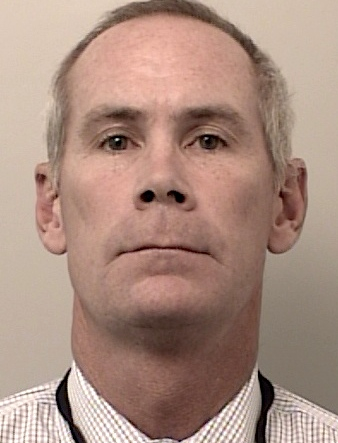
Jeremy Meyers when he was booked Aug. 22.

Jeremy Meyers when he was booked Aug. 22.

Board President John Lane also did not respond to an email from LTN.

After being arrested on DUI charges twice in five months and pleading no contest to the first offense, Meyers opted to sign a resignation agreement Nov. 13, while the board acted on in Nov. 16. Meyers had not worked since his Nov. 5 arrest.

On that day he had a blood alcohol level of 0.19 percent, more than twice the legal limit, according to the California Highway Patrol. This was in the middle of a work day. The district office shares a parking lot with an elementary school.

Meyers will receive $114,821.55 – the equivalent of his salary through June 30, 2016. The five elected board members agreed to also give him $10,930. This is what the value of his medical, dental and life insurance would be for that same time period.

Per the agreement Meyers has until Dec. 1 to return all property belonging to the district. This includes master keys, credit cards and security passes. A condition of getting paid off is those items must be turned in.

The agreement contained language that the document would not be released without an entity like Lake Tahoe News invoking the Public Records Request Act.

Lake Tahoe News had two attorneys with experience in municipal government law review the agreement and offer input into its legalities. Both believe it’s possible the payment is a gift of public funds.

“I have not found any basis upon which the $114K can be paid. If he had a contract with a severance clause, that would need to be examined, also the basis of such a contract in the first place,” one of the attorneys said. “The salary schedule for the superintendent does not outline a severance. Ordinarily when a resignation occurs, there is no basis for payment, although they may claim that it is in exchange for a release from potential suit.”

Anyone can challenge the agreement in court. This must be done within 90 days.

Because Meyers was elected and was not accused of committing a felony the board had little recourse.

Gentry emailed this statement, “The board of education determined that the separation agreement is in the best interest of the El Dorado County Office of Education. As an elected official, the county superintendent was legally entitled to complete the remaining three years of his term of office, and any legal or other challenge to the county superintendent’s right to continue in office would have been potentially expensive and lengthy.”

Had the board waited for a recall to occur, the odds are the process would have taken until next summer. Meyers would have been collecting his paycheck that whole time. Plus, there is no guarantee voters would have recalled him. Without a recall, he would have been on the job for the rest of his term – the end of 2018. With a recall, the district would have to pay the expense for a special election.

The statement from the district went on to say, “The board, with strong public input, came to the unanimous conclusion that it must take all reasonable and feasible steps to effect an immediate leadership change in the El Dorado County Office of Education.”

The board is looking to finalize the application process by Dec. 1, with the goal of naming a replacement in January.


Snow needs to fall now for drought relief

By Brian K. Sullivan, BloombergBusiness

The drought relief for California widely expected from El Nino in early 2016 will be far more effective if a chill descends soon — ideally with a bit of snow.

“If we can get some snow on the ground and some cold nights, it will set up the snowpack and get cool air pooling,” said California State Climatologist Mike Anderson.

Cool air, especially at high altitudes, will help ensure snow falls and stays on the ground in the mountains through the winter, as needed to supply the state’s reservoirs. While that may seem like a non-issue given the height of the mountains and the tradition of heavy snows there, recent years have seen some worrisome trends.

During the winter of 2014-15, the three-month average temperature in the Sierra region topped the freezing mark of 32 degrees Fahrenheit for the first time in records dating to 1950, data compiled by Anderson show.

California as a whole posted its warmest February on record and both December and January came in among the top 10, according to the National Centers for Environmental Information in Asheville, N.C.

Read the whole story


Massive excavation project necessary before Carson City I-580 connector can be paved

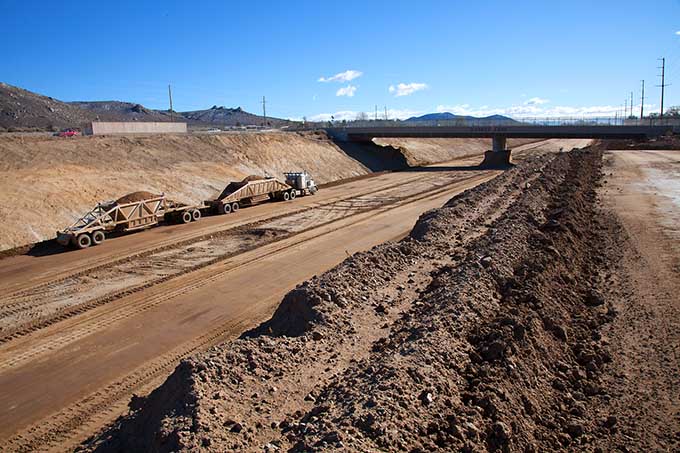
Crews work five days a week hauling 3,000 yards of dirt for what will be an extension of Interstate 580 in Carson City. Photo/Carolyn E. Wright/Copyright

Crews work five days a week hauling 3,000 yards of dirt for what will be an extension of Interstate 580 in Carson City. Photo Copyright 2015 Carolyn E. Wright

By Kathryn Reed

CARSON CITY – The pile of dirt at the end of Spooner Summit in Carson City never seems to change. Grown men in what look like life-size Tonka trucks move it around, and yet, it still seems to stay the same.

For 16 hours a day, six days a week, dirt moves under the highway via a 2,600-foot conveyor belt to the other side of the street, where another pile is being created. On the Spooner side it is a 1,500-foot-long continuous belt.

While it may seem like not much is happening, behind the 40-foot dirt wall that faces drivers as they descend into the capital city is a trove of workers excavating dirt for what in 2017 will be the extension of Interstate 580 from Fairview Drive to Spooner Summit.

A feeder – which looks like a grain feeder – separates out the larger rocks before it goes onto the conveyor belt.

The reason to move the dirt under South Carson Street is to keep trucks off the road, thus reducing traffic jams.

In 2017 the connector to Fairview Drive will be complete. Photo/Carolyn E. Wright/Copyright

In 2017 the connector to Fairview Drive will be complete. Photo Copyright 2015 Carolyn E. Wright

Road and Highway Builders based in Sparks this spring was awarded the $42 million contract to complete the final section of Interstate 580. Work began in June on what will be two lanes each going north and south.

Behind the wall is a dozer pushing a scraper as it picks up dirt with its belly. Backhoes are filling semi-trailers.

It’s a methodical process to dig down about 30 feet. Six thousand yards of dirt are being moved each day. By the time the project is done it’s estimated 600,000 yards will have been removed. The excavation work should be done in February.

Project manager Will Hellickson, left, and Mark Cooper with NDOT are the leaders on the project. Photo/Carolyn E. Wright/Copyright

Project manager Will Hellickson, left, and Mark Cooper with NDOT are the leaders on the project. Photo Copyright 2015 Carolyn E. Wright

“We are scraping to get down to the design elevation. We are close to the final grade,” Mark Cooper, an engineer with the Nevada Department of Transportation, said as he and Will Hellickson with Road and Highway Builders gave Lake Tahoe News a tour of the project site.

Part of the reason to dig so deep is to help reduce the noise to the neighboring residential area. Plus, the interstate will go under Clearview Drive and Koontz Lane. Those overpasses were built with the anticipation I-580 would one day be a reality. Before work began the dirt was as high as the concrete on the overpasses.

As the excavation work is being done, so is some of the electrical. Crews are putting in the footings for the 14,000 feet of sounds walls. The decorative barriers will be 8- to 13-feet high. In some locations the houses will be as close as 50 feet from the interstate.

Footings for the retaining wall near neighborhoods are being put in. Photo/Carolyn E. Wright/Copyright

Footings for the retaining wall near neighborhoods are being put in. Photo Copyright 2015 Carolyn E. Wright

At various locations some of the 20,000 feet of storm drainpipe is at the ready to be installed.

As the highway gets closer to Fairway Drive it is level with the side streets. NDOT has secured a 300-foot right-of-way.

This section from Fairview to Spooner will be 3.2 miles. It is actually 1.8 miles longer than going from Spooner via South Carson Street to Fairview. Still, NDOT estimates the time saved will be five minutes on the interstate.

“Within the next two decades, an estimated 43,000 vehicles are anticipated to travel on the south end of the freeway daily, meaning this time savings will really add up when considering all vehicles projected to drive the freeway every day,” Meg Ragonese with NDOT told Lake Tahoe News.

Dirt from the large pile in the background will all come across the conveyor. Photo/Carolyn E. Wright

The large pile of dirt will end up on the conveyor that goes under South Carson Street. Photo Copyright 2015 Carolyn E. Wright

Until the Carson City Freeway project came into being Nevada was one of the few states where the capital did not connect to the federal interstate system.

There are no plans to continue Interstate 580 farther south.

What is in the future is an overpass at the bottom of Spooner. That is why the dirt is being stored – with the idea it will be used for that project. However, that may not break ground for another 20 years. It’s dependent on funding. When the newest section of the interstate opens there will still be a light at the bottom of Spooner.

Excavate dirt is being stored for future projects.  Photo/Carolyn E. Wright/Copyright

Excavated dirt is being piled near the bottom of Spooner Summit. Photo Copyright 2015 Carolyn E. Wright

“By constructing the southern end of the freeway as a signalized intersection instead of the previously-planned overpass, the department deferred approximately $20 million to $24 million of construction costs in today’s dollars,” Ragonese said. “With limited funding available, not constructing the freeway overpass over South Carson Street was the only way we were able to secure enough funding to open the last leg of the freeway to traffic in 2017.”

—–

Notes:

·       Here is a YouTube video of the dirt conveyor system.


Experts urge statewide water metering, conservation to fight Nevada drought

By Sandra Chereb, Las Vegas Review-Journal

CARSON CITY — A state panel Friday finalized short-term and long-range recommendations for dealing with drought, from requiring meters on all water outlets in Nevada to stepping up drought monitoring and conservation efforts.

The recommendations to be delivered to Gov. Brian Sandoval from the Nevada Drought Forum are a starting point. Much of the heavy lifting, if the governor pursues the findings, will come during the 2017 Legislature.

Sandoval created the forum in April following four years of drought and looming uncertainties over how long it will last. While forecasts call this year for a strong El Nino year — a weather phenomenon associated with wetter than usual winters, especially in the Southwest — its effect on Northern Nevada is not assured.

Read the whole story


Nevada nightclubs under stricter scrutiny

By J.D. Morris, Las Vegas Sun

Nevada gaming officials put in place sweeping new regulations for nightclubs last week, increasing their oversight of a crucial but sometimes risky component of business at casino-resorts.

Under the set of rules adopted by the Nevada Gaming Commission on Thursday, casino operators must make at least one employee in charge of monitoring their nightclubs and a broad set of club employees need to register in the same way as casino workers, among other requirements. The regulations were hashed out in previous workshops that included the Gaming Control Board members and industry representatives.

The registration requirement applies to “all supervisors, managers, security and surveillance personnel, servers, server assistants, bussers, restroom attendants” and anyone employed or contracted to offer hosting or VIP services, according to a draft of the regulations.

Read the whole story


Restoration of Hope Valley meadow in the works

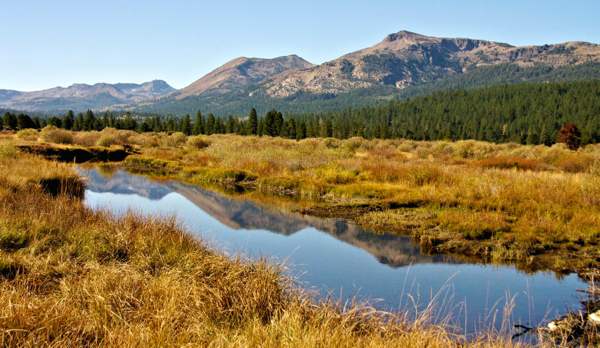
Preservation of Hope Valley meadow is in the works. Photo/Provided

Preservation of Hope Valley meadow in Alpine County has been assured. Photo/Provided

By Anne Knowles

The restoration of Alpine County’s Hope Valley meadow has been a long time coming.

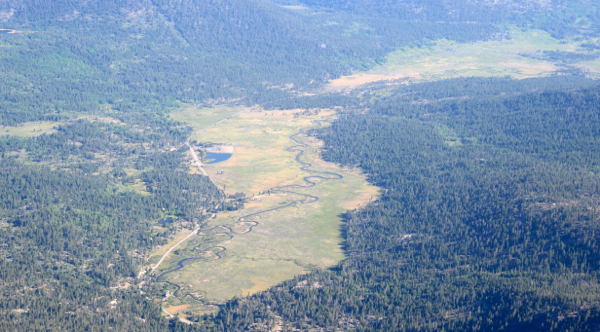
Within a year, work to restore a 400-acre portion of the 1,600-acre meadow, which includes three miles of the West Fork Carson River, should be complete.

That project, which is just the start of a long-term healing process, has been in the planning stages for five years. But everyone involved in the undertaking will tell you it all started more than a century ago.

“There had been heavy grazing there, sheep and cattle, since the Emigrant Trail days,” said Julie Fair, project manager with American Rivers in Nevada City. Her group is taking the lead on the restoration effort.

As a result, vegetation was nearly eliminated, causing erosion and incision that left some banks as much as 10 to 12 feet higher than the river and creeks, upending the overall ecosystem.

The meadow hasn’t been grazed for 20 years and during that time Friends of Hope Valley, a citizen’s group founded in 1985 to stop the installation of a power line in the valley, has been planting willows to stabilize the river’s banks.

Before that, the group was instrumental in saving the meadow from development.

In the early 1990s, ranchers in the area were planning to sell their land, possibly to a condo developer.

Friends of Hope Valley teamed up with the Trust for Public Lands, a 43-year-old organization that works to protect lands, to stop it.
There was a time when this area south of Lake Tahoe was slated to be paved over. Photo/Provided

There was a time when this area south of Lake Tahoe was slated to be paved. Photo/Provided

“We walked the halls of Congress and in 1992 we got $23 million to purchase the land,” Debbie Waldear, president, Friends of Hope Valley, told Lake Tahoe News.

The meadow was then turned over to the U.S. Forest Service and the California Department of Fish and Wildlife, which manage it now.

“Since then we’ve been the watch dog of the area. We prevented some logging and we’ve been doing restoration work everywhere,” Waldear said.

Now, American Rivers, in conjunction with its partners, is building on that work.

In 2011, it did an initial assessment of the meadow and, at the same time, the Alpine Watershed Group established its Hope Valley Meadows Stewards Program to collect data on the meadow in preparation for the restoration.

“Our goal is to protect water quality and the integrity of the meadow,” Shane Fryer, watershed coordinator for the Alpine Watershed Group, said. For the watershed group, the goals are to drop water temperature, lower the alkaline content and extend the river’s flow season past August.

“It’s an important water source for Carson Valley,” Fryer said.

After the initial assessment, Waterway Consulting Inc. in Santa Cruz and River Run Consulting Inc. in Cedarville did a more detailed plan.

From that, American Rivers determined the project should use a more “light-handed approach,” to the restoration, according to Fair.

A popular technique to quickly raise the water table is to do what she called pond and plug.

“You put in a series of berms in the channel and it raises the water table without damming it,” she told Lake Tahoe News. “It mimics what beavers do.”

It also creates ugly ponds, which eventually fill in with sediment. But it’s costly and causes more disturbances to the watershed.

“So we decided to focus on stabilizing the banks rather than raising the water table rapidly,” said Fair.

To do that, American Rivers is using several methods, including additional vegetation planting and excavating sod from high banks to essentially bring the meadow back down to the water.

“It’s a pilot in one part and if we had all the money in the world, we’d do that everywhere. It would create a wet meadow right away. We’ll see if we want to do more of it,” she said.

Another technique is using logs to stabilize the banks.

“You put in logs with roots still attached and lay the out with the root wad in the water and stabilize with other logs and willows,” Fair said. “The root wads will push flows away from the banks, create a buffer and as flows meander it creates a great fish habitat.”

The log crib structure was the first phase of the project, completed last month by Habitat Restoration Sciences Inc., an engineering firm that works throughout California.

“We had a short window because of the permits,” Fair said.

The overall project, which is costing about $750,000 to construct, has required four permits.

“Permitting is a bottleneck. Some permits haven’t been streamlined for restoration and you have to meet the same criteria as development projects,” said Fair.

But no delay came from any protest to the permits.

“Throughout developing the designs we worked with the Alpine Watershed Group, the Friends of Hope Valley and had public meetings,” Fair said. “I think that was critical to the process. Everyone was engaged and it reflected what the community wanted.”
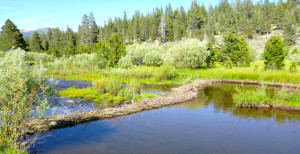
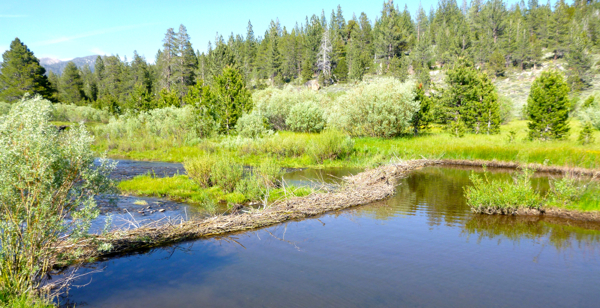
Beavers are good and bad when it comes to restoration. Photo/Provided

Beavers are good and bad when it comes to restoration. Photo/Provided

If any controversy remains, it’s over beavers, which are thriving there and have created more than 70 dams in the area at last count.

Everyone agrees they’re a mixed blessing, doing some of the restoration work, but some see the animals as more hindrance than help.

The beaver use the willows for dam making, reducing the vegetation, and the pools they create can heat up the water, said Fryer.

“Is this a beneficial use? The Forest Service will decide, they have management authority on this issue,” said Fryer. “We think the beaver should be managed where they’re a detriment and encouraged where they help.”

The remainder of the Hope Valley meadow restoration project is scheduled to be completed over a six to eight week period next summer.


Are daily fantasy sports contests gambling or games of skill?

By Michael Hiltzik, Los Angeles Times

If Californians — indeed, all Americans — had a thoughtful, consistent approach to gaming, daily fantasy sports sites such as FanDuel and DraftKings would be treated as gambling and their sponsors regulated and taxed. They’d be subjected to government oversight, background checks of employees, audits of their books and certification that their games aren’t rigged — just like most other forms of U.S. gambling.

Instead, fantasy sports games have become ensnared in the web of inconsistent laws and confusing regulations governing gaming. At issue is whether daily fantasy play really qualifies as gambling, and if so whether it should be outlawed or merely regulated.

The biggest stakes for the mushrooming fantasy sports industry may be in California, which could hold the largest population of fantasy sports players in the nation. And at the moment, the legality of their daily games is very much up in the air.

Read the whole story


Lake Tahoe chambers tout shop local campaigns

By Kathryn Reed

It pays to shop local.

To keep sales tax dollars in the Lake Tahoe Basin and Truckee areas groups are making it potentially profitable to not leave the hill to shop.

This is the inaugural year for Lake Tahoe South Shore Chamber of Commerce’s shop local campaign, while the North Shore-Truckee area started a similar campaign in 2013.

“We are encouraging people to change their habits by offering some prizes,” Shannon Earley with the South Shore chamber told Lake Tahoe News.

Awareness is the first step – for people to realize shopping outside the area, even online, is hurting local businesses as well as tax coffers.

“When you spend money locally, significantly more​ money stays and circulates in the community through payroll, taxes, and other expenditures, thus strengthening the economic base and well being of our community,” the North Lake Tahoe Chamber says on its website. “Local businesses help sustain vibrant, walkable town centers, which in turn improve​​ water and air quality. Even though things appear​ ​to ​cost less elsewhere, when you​ factor in the cost of shipping, ​driving and your time, a local purchase may be the best choice and helps to ​reduce your footprint.”

According to an economic report released this fall by the Tahoe Prosperity Center, retail spending has not reached prerecession levels in South Lake Tahoe, Incline Village, Stateline and Zephyr Cove. However, Northstar and Squaw Valley are posting numbers better than when the economy collapsed. This is attributed a new mix of retail at those villages.

The South Shore chamber say, “Money spent at a local business generates 3.5 times more wealth for the local economy compared to money spent at a chain.”

The incentive programs are different at each end of the lake.

On the South Shore – which goes from Zephyr Cove to Meyers to Camp Richardson – the shop local campaign requires customers to submit their receipts online. For five weeks the person spending the most money that week will win a prize. Grand prizes at the end of the promotion will go to the overall biggest spender as well as to the person who has the most number of receipts no matter the total.

Shopping does not have to be done at a store that belongs to this particular chamber. There are a few limits on what counts as shopping – insurance and mortgage payments don’t count, buying a new car does.

On the North Shore shoppers collect stickers for every $25 spent at a participating store. Each card with four stickers is then entered into a drawing.

The South Shore campaign runs Nov. 28-Jan. 1. The North Shore dates are Nov. 27-Dec. 24.

—–

Notes:

·       For more info on the South Shore program, go online.

·       For North Shore-Truckee info, go online.