
Nev. tax increase opponents not letting up

By Megan Messerly, Las Vegas Sun

A contingent of Nevada conservatives remains undeterred in its efforts to repeal a portion of Gov. Brian Sandoval’s $1.5 billion omnibus tax plan passed during the last legislative session, even as those repeal efforts remain tied up in the courts.

Lawyers from a coalition supporting the tax plan filed an appeal with the Nevada Supreme Court this week, asking the court to reconsider a ruling made by a lower court judge last month in favor of repeal supporters.

But that isn’t stopping Republican State Controller Ron Knecht and others involved with the RIP Commerce Tax PAC from continuing to push ahead in gathering signatures to get the measure on the ballot.

Read the whole story


Cyclists plot South Shore path improvements

By Kathryn Reed

The South Shore cycling community has big plans for this year that involve allocating money for trails and signage, as well getting jurisdictions to coordinate improvements to better leverage the limited dollars that are available.

Shay Navarro, head of the Bicycle Advisory Committee for the South Lake Tahoe Recreation Joint Powers Authority, on Jan. 29 presented her group’s goals for the year to the board.

The three-member board is comprised of reps from South Lake Tahoe (Austin Sass), El Dorado County (Sue Novasel) and Tahoe Paradise Resort Improvement District (Victor Babbitt). The men are new to the board, with this being their first meeting. The board is tasked with overseeing the expenditure of Measure S/R funds.

Last year’s pilot program to remove snow from the city’s class 1 trails barely happened because of lack of white stuff, so the money is being used this season.

With $22,000 left over from the Sawmill bridge decking project because the bid came in lower than expected, the bike committee is recommending that money be used to plow paths in the county that go from Viking Way to Meyers.

Novasel said the county’s department of transportation has questions about whether that path meandering through the woods (paralleling Lake Tahoe Boulevard) could sustain a vehicle regularly on it without damaging the asphalt, as well as questioning the need for snow stakes. She said a resolution won’t happen this winter.

It is estimated there will be $65,000 from the measures for bike-related improvements this year. While the board agreed with the committee’s priority list, final adoption will come in the summer when the exact figure is available. The preliminary list is necessary so committee members may work with city and county staff to get the projects on their calendars. Much of the this will be ironed out between the committee members and staff from the city and county at the March meeting of the bike group.           

El Dorado County officials have concerns about plowing the path that parallels Lake Tahoe Boulevard. Photo/LTN

El Dorado County officials have concerns about plowing the path that parallels Lake Tahoe Boulevard. Photo/LTN

The list in order of the bike committee’s priorities include:

·      Adding money to ensure completion of the class 1 segment along Rufus Allen Boulevard from the library to vector control and from Rufus Allen to the senior center. This includes the planned rehabilitation of paths between the bridge east of Meeks Lumber and Edgewood Circle and between Lakeview Commons and the Alta Mira site.

·      To decrease user conflicts, painting a yellow line down the Linear Park and Harrison Avenue paths is recommended. Widening Linear Park is also a suggestion.

·      Improve the pavement on paths at 15th Street, community playfields, and boardwalk by Lake Tahoe Golf Course.

·      As the city does work on Sierra Boulevard, create an extension from there to the class 1 trail behind Scusa restaurant and Fitness Evolution. “This is perfect timing because they plan to rip out the entire parking lot after the snow season,” Sass said.

·      Add green paint in the area of Eloise Avenue and Dunlap Street in the city when crews are striping the area to improve bike safety. This would be a pilot program. Green paint is a growing trend to help vehicles and bikes coexist on the same roads.

·      Increase signage where appropriate. They could give directions and mileage to key areas, as is the case with other signs the committee has funded.

·      While Measure R/S funds cannot be used to repave a street, the committee is urging the city to fix the dilapidated Eloise Avenue because it is a major route for cyclists and the surface is more suitable for a mountain bike than a road bike.

·      The committee wants to ensure intersection improvements included in the Tahoe Valley Area Plan are sensitive to the needs of cyclists.

·      The county is asked to realign the Pat Lowe trail for better access to Pioneer Trail and Highway 50 with funds from the On-Our-Way grant.

·      It is suggested the city extend a path from Melba Drive to Lake Tahoe Airport so cyclists have an alternative to getting to that facility, which doubles as city hall, without having to ride on Highway 50.

·      The group wants the city to apply for bike-friendly status, with the goal of getting a higher rating than bronze as has been awarded in the past.

—–

In other action:

·      Babbitt brought up the likelihood the park in Meyers will need more money than the $50,000 it currently receives via the voter-approved measures. Bike committee member Chuck Nelson pointed out this is not what voters approved and believes it would be illegal to do so. Novasel said the matter can be further investigated and discussed at the next meeting.


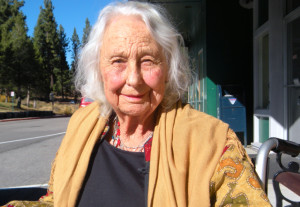
Marjorie Springmeyer — 1922-2016

Marjorie Springmeyer

Marjorie Springmeyer

By Kathryn Reed

Marjorie Johnson Springmeyer, pioneer, activist, environmentalist and vocal advocate for justice, died Jan. 28, 2016. She was 93.

Mrs. Springmeyer had been ill for a number of years.

She was born July 23, 1922, in Gardnerville.

Her mother, Stella Van Dyke, moved to the Carson Valley from Ohio to teach at Douglas High School. Her father, Knox Johnson, came to the United States from Denmark.

Mrs. Springmeyer spent her summers in Tahoe during the era when the basin had more cattle than people.

“We ran around all the time with our shoes off,” Springmeyer told this reporter.

The family owned a large swath of land in the basin – and still does. When her dad died Mrs. Springmeyer’s mother retained the land in the Bijou area of South Lake Tahoe. The family had already sold the land where the Truckee River goes under Highway 50 for $1,000 so the main thoroughfare through town could be built. The land where Safeway is has been owned for years by Mrs. Springmeyer and her brothers. Her estate also owns the property on Al Tahoe Boulevard where Lake Tahoe Wildlife Care is being built.

After World War II, she married Buzz Springmeyer on the family’s ranch in the Carson Valley. He had a garage in South Lake Tahoe where Auto Zone now exists.

Mrs. Springmeyer was the godmother to South Lake Tahoe City Councilman Hal Cole’s daughter. Cole wrote this article about Mrs. Springmeyer in 2012.

One of Mrs. Springmeyer’s biggest issues was having never seen the realization a city hall in South Lake Tahoe even though her family gave the land for this to be a reality.

She was a wealth of information about the history of the South Shore. She had volumes of documents; often which she kept in her vehicle when she would travel to City Council meetings.

The death of her daughter is how Happy Homestead Cemetery was created. Mrs. Springmeyer’s mother, Stella Johnson, provided the land for the cemetery. Since then the family has donated more acreage and some has been bought for the cemetery’s expansion.

She is preceded in death by her husband, Buzz Springmeyer; daughter Connie; and sons Jon Springmeyer and Fred Springmeyer.

Mrs. Springmeyer is survived by her brothers, Knox and Bill Johnson, and several grandchildren.

Services are expected to be in February.


Resolution to senior center dispute in the works

By Kathryn Reed

A lease or outright ownership of the senior center. That’s what South Lake Tahoe and El Dorado County officials are tasked with negotiating.

City Manager Nancy Kerry, all city councilmembers except JoAnn Conner, and Ken Sands from the senior center attended this week’s Board of Supervisors meeting in Placerville. The goal was to explain to the county electeds and staff the importance of changing how the senior center is operated.

The county since 1929 has owned the land in the middle of town that also houses the museum, art building and visitors center. The city leases the land and then handles who the tenants are.

The problem is the county hasn’t been investing any money into the facilities and has basically been an absentee landlord. The seniors feel at a loss because they have money to invest, but can’t get the county’s ear. The city, which has been doing upkeep, wants complete control.

The city has written checks totaling $2.5 million in a 15-year period to maintain the facilities located there. It has taken in revenue of about $300,000 in that time from weddings and other rental fees at the senior center.

Sands spoke Jan. 26 about how the seniors have money to invest. He gave the example of when the group attempted to put windows in, but the county stopped the process. Then there is the well-documented time a few years ago with the county against the seniors’ better judgment put the mental health office in the same building. This was in an area of the building the seniors had paid for in an expansion.

Both sides have been talking for months, which some people, including Supervisor Shiva Frentzen, thought were the formal negotiations. Not the case.

The supervisors in closed session agreed to enter formal negotiations.

Supervisor Sue Novasel told Lake Tahoe News the negotiations will resolve: “How do we get to where we want to go?”

She added, “For the county we want to try to create opportunities where we can go as county, whether it’s transfer or sell or whatever. The details need to be hammered out.”

Kerry told Lake Tahoe News, “We either negotiate a new facility-use agreement for all properties or we negotiate a transfer of the assets to the city so the city can negotiate with the tenants for long-term improvements.”

There is no time line when this will all be settled. The disagreement dates back to the 1990s.


Audit: Feds should shift firefighting burden in Calif.

By Michael Doyle, McClatchy Washington Bureau 

WASHINGTON — The U.S. Forest Service apparently overpaid for fighting some of California’s biggest wildland fires and was saddled with too many of the toughest areas to work in, federal investigators now say.

Citing expenditures that “may have been questionable and unreasonable,” the Agriculture Department’s Office of Inspector General questioned more than $4.5 million in administrative costs that the federal agency paid to local firefighting agencies within California.

“There was no assurance these costs were reasonable and accurate,” the investigators noted.

More broadly, investigators said an agreement with the state left the Forest Service shouldering an unequal share of areas where wildlands meet urban areas, the costliest to protect.

Read the whole story


Tahoe travel company focuses on creating experiences beyond typical tourist attractions

A woman spends her day making pottery on Majuli Island in northeast India. Photo/Toni Neubauer

By Jessie Marchesseau

A World War II memorial would never have made the list of places Jan Potter wanted to see while visiting India. It probably wouldn’t have even made the list of things she knew existed in India. But it does, and when she visited it in the small northeastern village, she was surprisingly intrigued.

“We all have different backgrounds and different cultures, but they are more interwoven than we think,” she said.

The memorial was just one of many new and unexpected experiences on Potter’s four-week trip to northeastern India and Bhutan. Potter, a retired school teacher, and her husband, Gil, made the trip last November along with a photographer from Texas and the founder of Incline Village-based adventure travel company Myths and Mountains, Antonia “Toni” Neubauer.

 2.Bhutanese children from the eastern part of the country sitting on the local farm produce. Photo/Toni Neubauer

Bhutanese children from the eastern part of the country sit on the local farm produce. Photo/Toni Neubauer

“In northeast India, I really knew nothing about it, and now my mind is so interested in learning about the background of that area,” Potter said of her trip.

The group traveled in private cars with local drivers who were adept at avoiding the never-ending procession of cars, buses, people, elephants and cows clogging up the roadways as well as rattling off the history of nearly every small village they came to. They visited a town in the middle of a river, slept in bamboo beds, ate authentic cuisine and visited community libraries.

They didn’t hit a single tourist attraction and saw less than a dozen American or European people in the entire four weeks.

The trip was designed and booked through Myths and Mountains. The itineraries the company offers travelers are not just about snapping pictures; they’re about interaction. Rather than hitting up the common tourist attractions and booking people in Holiday Inns, Myths and Mountains takes people inside the true culture of a country. Travelers have the opportunity to visit small communities, sit with local artisans, tour area businesses, and stay in boutique hotels or even the homes of local residents.

Bhutanese prayer flags flutter in the wind. Photo/Toni Neubauer

Bhutanese prayer flags flutter in the wind. Photo/Toni Neubauer

Neubauer calls Myths and Mountains more than an adventure travel company; it’s also an educational travel company.

“We live in a world today where people don’t understand each other; they’re afraid of each other,” she told Lake Tahoe News. “Travel provides that understanding we so desperately need.”

The company books pre-designed and custom trips featuring nearly a hundred itineraries in Asia, Southeast Asia and South America that can be divided into four categories: cultures and crafts, religion and pilgrimage sites, environment and natural history, and natural healing and traditional medicine.

If you would rather learn the finer points of Guatemalan cooking than take photos of the Eiffel Tower or make a mandala with monks instead of joining the throngs of tourists at the Vatican, then Myths and Mountains may have just what you’re looking for.

Neubauer says for Myths and Mountains there is no such thing as a “typical trip.” They have designed numerous custom trips over the years including one for a couple who wished to explore the art of puppetry in Vietnam and another focused on shamanism in Ecuador for the students of Emory University.

Neubauer’s passion for educating doesn’t end with travelers. Her background in education, a doctorate in educational administration to be exact, inspired her to form READ Global in 1991, just three years after she founded Myths and Mountains. An acronym for Rural Education and Development, READ was Neubauer’s way to give back to the rural communities in her travel destinations.

A dancer at the Trashigang Tsechu Festival in Bhutan. Photo/Toni Neubauer

A dancer at the Trashigang Tsechu Festival in Bhutan. Photo/Toni Neubauer

She saw how tourism could create a village of beggars, how schools and hospitals built with the best intentions would fail because the villages hadn’t the means or the knowledge to manage and maintain them once the organizers were gone. Instead, READ builds rural library community centers and helps form for-profit local businesses to sustain them, along with providing training to local residents so the centers can be maintained long after READ leaves. Since its inception, the organization has built 85 rural library centers.

READ has since branched off from Myths and Mountains, though Neubauer is still on the board. However, it still receives a great deal of support from Myths and Mountains and its clients.

It’s this way of giving back which recently earned Myths and Mountains the 2015 Tourism Cares Legacy in Travel Philanthropy award. The award recognizes travel companies with outstanding philanthropic efforts which have had a positive impact for more than 15 years.

However, it’s their outstanding knowledge of the regions they travel that earned Myths and Mountains numerous other awards and designations including being named a Trusted Travel Expert on Wendy Perrin’s 2015 WOW List for five different countries, a Conde Nast Nepal Top Travel Specialist and one of National Geographic Traveler’s 50 Tours of a Lifetime among others.

But the Potters didn’t choose their Myths and Mountains trip because of an award or something they read in a magazine. They chose it because they believe in the READ program and because this particular trip enabled them to visit READ libraries in India and Bhutan while exploring a new country in an intimate way.

“My favorite part,” Potter told Lake Tahoe News, “is how it makes you want to learn more about the world.”



Super Bowl will elicit $4.2 bil. in mostly illegal bets

By J.D. Morris, Las Vegas Sun

Americans are poised to wager $4.2 billion on the upcoming Super Bowl 50, with the vast majority of those bets expected to be placed illegally, according to a projection released Wednesday by the casino industry’s main lobbying and trade group.

The American Gaming Association said its sports betting projection for the Feb. 7 championship football game between the Denver Broncos and the Carolina Panthers represents an 8 percent increase from last year.

About 97 percent of the anticipated bets — $4.1 billion — will be wagered illegally, according to the gaming association.

Read the whole story


$4.5M award to Amtrak upheld in deadly Nev. truck crash

By Scott Sonner, AP

RENO — A federal judge has refused to grant a new trial for a Nevada trucking company ordered to pay more than $4.5 million in damages to Amtrak after a truck slammed into a passenger train at a rural highway crossing in 2011, killing six people.

Conductor Laurette Lee, 68, of South Lake Tahoe was one of those who died.

A U.S. District Court jury in Reno returned the verdict in September 2014 against the Battle Mountain-based John Davis Trucking.

The jurors concluded the truck driver who was killed along with five people on the California Zephyr was primarily to blame for the fiery crash in Northern Nevada’s high desert about 60 miles northeast of Reno.

Lawyers for the trucking company argued in a motion for a rehearing that Judge Howard McKibben should have instructed the jury to consider evidence suggesting a faulty signal and crossing gate could have contributed to the collision on Highway 95 just south of Interstate 80.

McKibben ruled Monday the verdict — which also awarded more than $210,000 to the Union Pacific Railroad for damage to the tracks — was a reasonable one.

John Davis Trucking “received a fair trial,” McKibben wrote in a four-page order, adding that the company’s motion was “comprised largely of arguments it has already raised — some repeatedly — and which the court has already decided.”

“The verdicts were not contrary to the clear weight of the evidence, the damages were reasonable and supported by the evidence and there is no basis for concluding that the jury was presented with false or perjurious evidence,” he said.

The National Transportation Safety Board concluded in December 2012 that the probable cause of the accident was an inattentive trucker with a history of speeding violations driving an empty tractor-trailer with faulty brakes.

The California Zephyr bound from Chicago to Emeryville was three hours behind schedule when it left Salt Lake City on June 24, 2011. It was going 77 mph in Nevada’s Forty Mile Desert when it approached the crossing north of Fallon, the NTSB said.

With the whistle blaring, the engineer initiated the emergency brakes about 450 feet from the crossing, the agency said. Rubber skid marks on the highway showed the truck driver hit his brakes 300 feet from the tracks but skidded nearly the length of a football field into the second car behind the engine. The truck embedded in the side of a crew car, which ultimately was destroyed by the fire that also charred a passenger car behind it.

The driver, Larry Valli, 43, of Winnemucca, was killed along with the train’s conductor and four passengers.


Douglas County grapples with solar regulations

By Anne Knowles

GARDNERVILLE — Douglas County is revising its ordinance for solar facilities after two large-scale projects failed to gain approval last year amidst public protest.

County officials this week wrapped up a series of 10 meetings with participants from the county’s towns and general improvement districts as well as business associations including the Carson Valley Agricultural Association.

The goal is to gather feedback to craft an ordinance that reflects the county’s different constituents who are at odds over the issue, including ranchers who want the option of selling or leasing their land to plant developers and some county residents who say they don’t want Carson Valley’s pristine landscape spoiled by acres of solar panels.

The county, like all in Nevada, is required by state law passed in 2013 to allow, with reasonable restrictions, solar energy installations like the two applied for and rejected last year.

Those projects were the 320-acre plant on Bentley Ranch land proposed by E.On Climate and Renewables, which was denied a special use permit by the county’s Planning Commission, and a 20-megawatt operation on 260 acres off Muller Lane.

The latter project was granted a special use permit, but it was appealed by Muller Lane homeowners Steve and Mary Walker to the Board of County Commission, which upheld the appeal.

Greenstone subsequently sued the county and the case is making its way through the court.

After reviewing the feedback, Douglas County planners will rewrite the ordinance and post it to the county web site by Feb. 2. The ordinance then goes to the Planning Commission on Feb. 9 and before the county commission at its March and April meetings, according to Hope Sullivan, planning manager.

Sullivan and Cynthea Gregory, deputy district attorney, led the recent public and private meetings, including the final gathering Jan. 25 at the Douglas County Community Center here.

About 40 people, all residents, attended the meeting, which included background on the issue, but focused on hearing public comment.

Nearly everyone spoke and there was broad consensus on a few ideas, while others were shot down as infeasible.

Several people suggested an ordinance so cumbersome that it would deter any solar development in the valley.

“We must request the BOCC to make this so difficult that it never happens,” said one woman. “We can’t allow solar companies to come in and ruin this beautiful valley.”

But state law prohibits “unreasonable restrictions,” and any ordinance must be legally defensible, meaning it would hold up under court scrutiny.

“Any restriction must have a rationale,” Gregory told Lake Tahoe News after the meeting.

Jim Slade, a county resident, suggested the utility selling the power generated by the solar installation be required to sell to Nevada customers and not to consumers in California.

The idea that developers are trying to exploit Nevada’s less onerous environmental regulations to serve customers in California came up often during last year’s battles over the projects.

But Gregory said that was unconstitutional. The dormant commerce clause, a clause implied by the Commerce Clause that gives the federal government the power to regulate interstate commerce, says states cannot discriminate against one another.

“I support solar and renewable but they do need an (special use permit),” said Slade. “I think it should not be in RA-5, RA-10 or A-19. It should be in FR-19. It shouldn’t be within half a mile of homes. Others would say one to two miles. I like a lot of things Churchill did. We should use that as a template.”

There was broad consensus at the meeting to exclude the three zones Slade mentioned, which are all designations for agriculture.

Currently, photovoltaic solar facilities are allowed with an special use permit in those zones as well as in LI for light industrial, PF for public facilities and FR-19 and FR-40 or forest and range.

Churchill County has the most restrictive ordinance of surrounding counties, according to Sullivan. It says studies and environmental assessments including effect on wildlife and water, and plans for closure and removal may all be required.

Sullivan said the Planning Commission and BOCC will receive all of the public comment before the revised ordinance is voted on, most likely at the BOCC’s April meeting.


Calif. snowpack deepest in five years

By Veronica Rocha, Los Angeles Times

California’s current snowpack is the deepest it has been in five years — a modest, yet encouraging milestone in a period of prolonged drought.

Readings of the Sierra Nevada snowpack on Tuesday showed water content statewide was 18.7 inches, or 115% of the historical average for that date, according to the California Department of Water Resources.

Water officials say the good news is that California’s snowpack and reservoirs have benefited from El Niño rainstorms. But they warned that it was too soon to determine whether winter rains were enough to make any major dent on the California’s drought.

Read the whole story