Marijuana industry poised for supercharged growth

By Trevor Hughes, USA Today

America’s fast-growing marijuana industry appears poised for supercharged growth after winning what cannabis entrepreneurs see as approval from the Trump administration to forge ahead.

The legal marijuana market was already growing exponentially despite fears of a federal crackdown under Trump and Attorney General Jeff Sessions, but Trump’s signal that he’ll respect state legalization may swing open the floodgates by reassuring traditional investors, entrepreneurs and local lawmakers that it’s OK to jump in.

Across the nation, risk-takers have poured billions of dollars into the industry while knowing they could be arrested by federal agents at any moment.

Read the whole story


Bill Morgan — 1934-2018

Bill Morgan

Bill Morgan, the former leader of the Lake Tahoe Basin Management Unit and Tahoe Regional Planning Agency, died April 14, 2018, at his home in Alpine County. He was 84.

In 1975, Bill was appointed the forest supervisor of the Lake Tahoe Basin Management Unit, which the U.S. Forest Service had recently established to manage the federal government’s landholdings with the goal of preserving the area’s natural resources and Lake Tahoe’s pristine water quality.

During his time at the LTBMU, he redirected the federal government’s land management policy in the basin from one of timber management to one of restoration and recreation. He also helped manage the federal government’s extensive land acquisition program in the basin. In 1965 only 47 percent of the basin was federally owned. This increased to 65 percent by 1980 to about 78 percent presently. One of the most significant land acquisitions made at that time was the purchase of two casino developments on the South Shore that Bill helped orchestrate to prevent their construction. Other acquisitions included Bliss/Shakespeare Point, Zephyr Cove, Round Hill Pines, and lands acquired under the 1980 Burton-Santini Act. He was also instrumental in furthering the historic preservation of the estates near Camp Richardson.

It was during this period that the recently formed Tahoe Regional Planning Agency was struggling to develop its own land management program for public and private lands. Battered by opposing political forces and legal challenges from environmentalists and property right advocates, the agency was on the verge of being disbanded. Having accomplished much at Lake Tahoe with the U.S. Forest Service, Bill retired early from that agency to work for the TRPA, which he viewed as being critical to protecting Lake Tahoe’s environment.

On April Fools’ Day 1985 he assumed the position of executive director with the embattled organization with the charge of developing a new Regional Plan to end a 1984 court order that had imposed a moratorium on further development in the basin affecting private landowners of more than 15,000 vacant lots around the lake. As he took the helm, Bill formed a consensus building team to help guide the development of the plan. After two years of intense work, the plan was completed. On July 15, 1987, a federal judge lifted the building moratorium order after accepting the new TRPA Regional Plan that would guide land-use in the Tahoe basin for the next quarter century. Those who worked with Bill on the plan labeled him as “the right man for the time”.

President Ronald Reagan and Sen. Paul Laxalt (who as governors of the states of California and Nevada earlier had created the TRPA) sent Bill personal notes of appreciation for his work in resolving the planning conflict.

When Bill retired from the TRPA on Sept. 30, 1989, he was given a piece of the original “consensus building table,” which he fashioned into a coffee table that remained a fixture in his living room until the time of his passing.

Over the years, that table was the site of many more epic battles between family and friends playing cribbage, poker, Jenga, and many other games.

It has been said that Bill’s ideas resolved many of the long standing issues at Tahoe and led eventually to a spirit of cooperation among the various interest groups that survives to this day.

In 1990, Bill moved to Woodfords in Alpine County with his wife, Carole, where they designed and built a home, Memdewee Down. It was at this home overlooking the distant snow-capped peaks that he chose to spend his final moments. During his “retirement” years, Bill served on the Alpine County Planning Commission, Tahoe Rim Trail Association, and the Lake Tahoe Baikal Institute. He also worked as a consultant to the Russian government on Lake Baikal environmental issues on behalf of the U.S Agency for International Development shortly after the dissolution of the Soviet Union in the early 1990s.

William A. Morgan was born March 16, 1934, in Sault Ste. Marie, Mich., to Luella (Bell) and William C. Morgan. He was the youngest of three children, with sisters, Mary Lou (Blanchard) and Mildred (Galinski). Bill spent his early years growing up in Michigan’s Upper Peninsula where he developed a passion for the natural environment. Hiking and canoeing with the Boy Scouts were two of his favorite activities. He earned the rank of an Eagle Scout.

At the age of 17, after graduating from high school, he and his high school buddies spent the summer trekking across Canada to Alaska on the crude roadway system that spanned the region, sleeping in the wide open spaces under the stars. This adventure further reinforced his love and respect for nature. Upon his return, he enrolled at Bay City Junior College.

Unsure of what he wanted to study, he left school after one year and enlisted in the U.S. Army for two years during the Korean War, leaving with the rank of sergeant. His time in the military left him with an appreciation for the work of teams and for the sacrifice and devotion of service members. After his discharge, he returned home to Michigan and enrolled at Central Michigan University and later Michigan State University. It was at Central that he became reacquainted with a high school friend, Carole Punches, whom he married in 1957. Two years later, daughter Stacey (Foster) was born, and Bill graduated from MSU with a bachelor’s degree in civil engineering.

Following college graduation, Bill joined the U.S. Forest Service as an engineer and moved with his young family to California where they were stationed first on the Klamath and then Angeles national forests. While stationed at the Angeles National Forest, sons Craig (1962) and Eric (1964) were born. In 1965, Bill and Carole moved the family to Grass Valley, where Bill served as the forest engineer for the Tahoe National Forest for 10 years.

In Grass Valley, Bill and Carole were active in the community, engaged with their church (Peace Lutheran, of which they were founding members), Boy Scouts, and their children’s sports. Bill and family traveled extensively across the wilderness areas of the U.S., Mexico, and Canada camping, hiking and fishing.

Travel, writing, and fitness were also life-long passions of Bill’s. He and Carole traversed the world, sometimes with friends, exploring North America, as well as Europe, Asia and Polynesia. But it was always the Sierra that they returned to as home. He wrote and published six books: five fiction and one (his last) a nonfiction account of his time with the U.S. Forest Service and the TRPA at Lake Tahoe. His writings reflect the landscapes and experiences of his life through a variety of genres including adventure, science fiction, memoir, and saga. He also was a past contributor to the Record Courier. A regular tennis player, hiker, skier, canoer, and snorkeler, Bill enjoyed all sports—especially those involving his children and grandchildren. Up until the last weeks of his life, he was engaged in healthy and friendly competitive contests.

Throughout his life, Bill Morgan championed public access to the outdoors and wild spaces while ensuring the preservation of such spaces for future generations. He was a consummate problem solver and worked tirelessly to bring opposing interests together using consensus building techniques while developing win-win solutions.

He is survived by his wife Carole of 61 years, daughter Stacey (Martin Foster), sons Craig (Michaela) and Eric (Susan); grandchildren Riley Kennedy (Sean), Christian Foster, Alexandra Morgan, Jack Morgan, Max Morgan, Cameron Morgan, and Nicole Morgan.

A celebration of life will be at the Carson Valley United Methodist Church in Gardnerville on April 28, 2018, at 10am.

The family is sincerely appreciative of the love and care from members of the Carson Valley United Methodist Church and from Barton Home Health and Hospice (South Lake Tahoe). In lieu of flowers, the family asks that individuals consider supporting these organizations. The family has also established the William Morgan Foundation for Environmental Excellence to recognize and support services and activities that promote appreciation, access, and sustainability for natural spaces.

Barton on leading edge with enhanced equipment

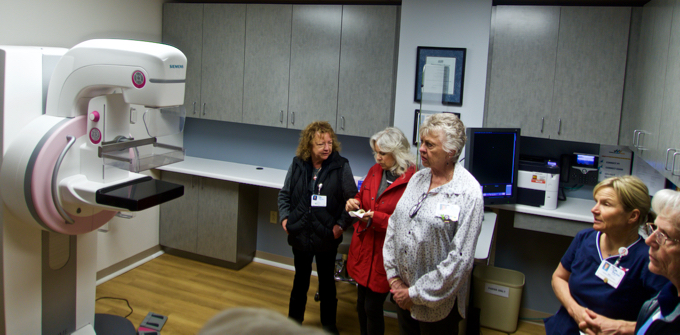
Barton Auxiliary members view the mammogram machine they helped buy for Barton Memorial Hospital. Photo/Kathryn Reed

By Kathryn Reed

South Lake Tahoe and its environs are not immune to the reality that breast cancer strikes 1 in 8 women in the United States.

Early, accurate detection can save lives. The right equipment can make a world of difference.

While Barton Memorial Hospital has had a 3D tomosynthesis mammogram machine for about a year, it wasn’t until this week that the women’s suite was officially dedicated.

If it weren’t for the Barton Auxiliary, the hospital likely would not have the machine.

“We thought this would help so many people at one time,” Vikki Egry, Auxiliary president, told Lake Tahoe News.

This volunteer group through its various fundraising efforts provided the hospital with $230,000 for the machine. This represents a fraction of the $7.5 million the group has raised through the years. The machine cost $402,000.

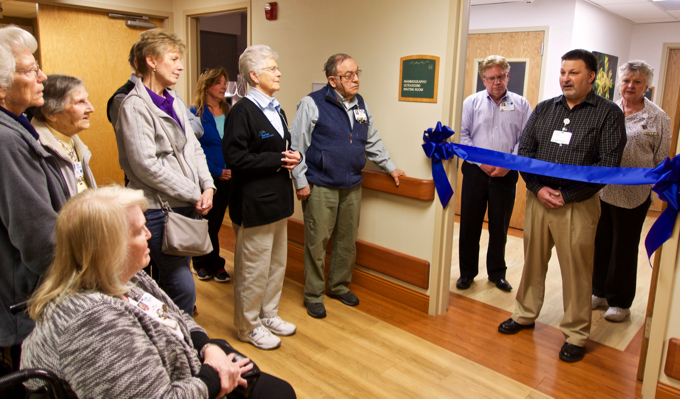
Tom Davis, head of medical imaging at Barton, talks to Auxiliary members and others on April 18 about the significance of the mammogram equipment. Photo/Kathryn Reed

“We get a lot of new equipment in radiology. It’s not often we get new technology that changes the game. This is the piece of equipment that will change the game,” Len Holmgren said. He is the lead radiologist at Barton Memorial Hospital.

Siemens, the manufacturer, has upgraded the machine at no cost so there won’t be a separate 2D image. A synthesized 2D image will be able to be created out of the 3D image.

“It will cut the radiation almost in half,” Holmgren said.

This technology was recently approved by the FDA. Barton is the first hospital on the West Coast to have it. It will be online in the coming weeks. Holmgren said it should also make the exam slightly faster.

“This should not be in a hospital this size,” Tom Davis, who heads medical imaging at Barton Memorial Hospital, said of the entire imaging machine. He added that Siemens wants to make Barton a show site with the added device, which is in large part why it was free.

The entire area where the mammogram machine is located has been remodeled into a women’s suite.

Davis said a goal was to get rid of the “institutional feel.”

In a separate room is the outpatient ultrasound room. This is used for obstetrics and other women’s care.

A plaque in the suite explains how all of this came into being because of the generosity of the Auxiliary volunteers.


Drought returns to huge swath of U.S.

By David Montgomery, Governing

Less than eight months after Hurricane Harvey pelted the Texas Gulf Coast with torrential rainfall, drought has returned to Texas and other parts of the West, Southwest and Southeast, rekindling old worries for residents who dealt with earlier waves of dry spells and once again forcing state governments to reckon with how to keep the water flowing.

Nearly a third of the continental United States was in drought as of April 10, more than three times the coverage of a year ago. And the specter of a drought-ridden summer has focused renewed urgency on state and local conservation efforts, some of which would fundamentally alter Americans’ behavior in how they use water.

In California, for example, officials are considering rules to permanently ban water-wasting actions such as hosing off sidewalks and driveways, washing a vehicle with a hose that doesn’t have a shut-off valve, and irrigating ornamental turf on public street medians. The regulations, awaiting a final decision by the California State Water Resources Control Board, were in force as temporary emergency measures during part of a devastating five-year drought but were lifted in 2017 after the drought subsided.

Read the whole story


Bike-share companies are transforming U.S. cities

By Douglas Johnson, The Conversation

Residents of major U.S. cities are becoming used to seeing docks for bike sharing programs nestled into parking spaces or next to subway station entrances. Adorned with stylish branding and corporate sponsors’ logos, these facilities are transforming transportation in cities across the country.

The modern concept of bike sharing – offering bikes for short-term public rental from multiple stations in cities – was launched in Copenhagen in 1995, but U.S. cities only started piloting their own systems in the past decade. Washington, D.C., led the way, launching SmartBike DC in 2008 and an expanded network called Capital Bikeshare in 2010. This program now boasts over 480 stations and a daily ridership of 5,700.

Within a few years, bike-share systems launched in Boston, New York, Chicago, San Francisco, Seattle and dozens of other cities. In 2016 there were 55 systems across the country with a total of over 40,000 bikes.

And momentum continues to grow. In 2017 Citi Bike in New York City added 2,000 bikes, increasing its fleet to a total of 12,000. San Francisco is expanding its system from just 700 bikes to 7,000, thanks to a sponsorship deal with Ford.

Going dockless

The newest twist in this rapid expansion is dockless bike sharing, which lets users park bikes anywhere within defined districts and lock and unlock their bikes with smartphone apps. Users don’t have to locate docking stations or worry about whether space will be available at their destination. These systems also are cheaper to set up, so providers can charge lower user fees. Some dockless bike-share companies offer rides for as little as $1 for the first half hour.

Dockless systems are also helping to address equity issues posed by public dock-based systems, which often are located in more affluent and predominantly white urban neighborhoods. Because dockless systems don’t require stations, they can be rapidly deployed in zones that dock-based systems may be slow to reach.

Students at Beijing University developed this approach in 2014 to improve campus mobility. Dockless bike-share companies have flooded Chinese cities with bikes in the past two years, leading to massive piles of discarded bicycles in public spaces.

 Seattle turned to dockless companies to fill the gap after a publicly funded dock bike-share system there failed in 2016. The city could soon have one of the largest bike-share systems in the country. Cities around Boston that are outside of the service area of Hubway, the area’s public bike-share system, just reached a deal to provide dockless bike-share service, expanding access to hundreds of thousands of people. And in San Francisco, Uber recently purchased Jump Bikes, a dockless electric bike-share startup, and soon will allow users to reserve electric bikes with their Uber app.

If recent examples are any indication, bike sharing in the United States will be a mix of complementary dock-based and dockless systems, run by both public entities and private companies. The humble bicycle, aided by smartphone technology, is resurging as an urban transportation option.

Douglas Johnson is a public involvement specialist and an adjunct professor at Boston University.


Tourists ignore signs not to drive in neighborhoods

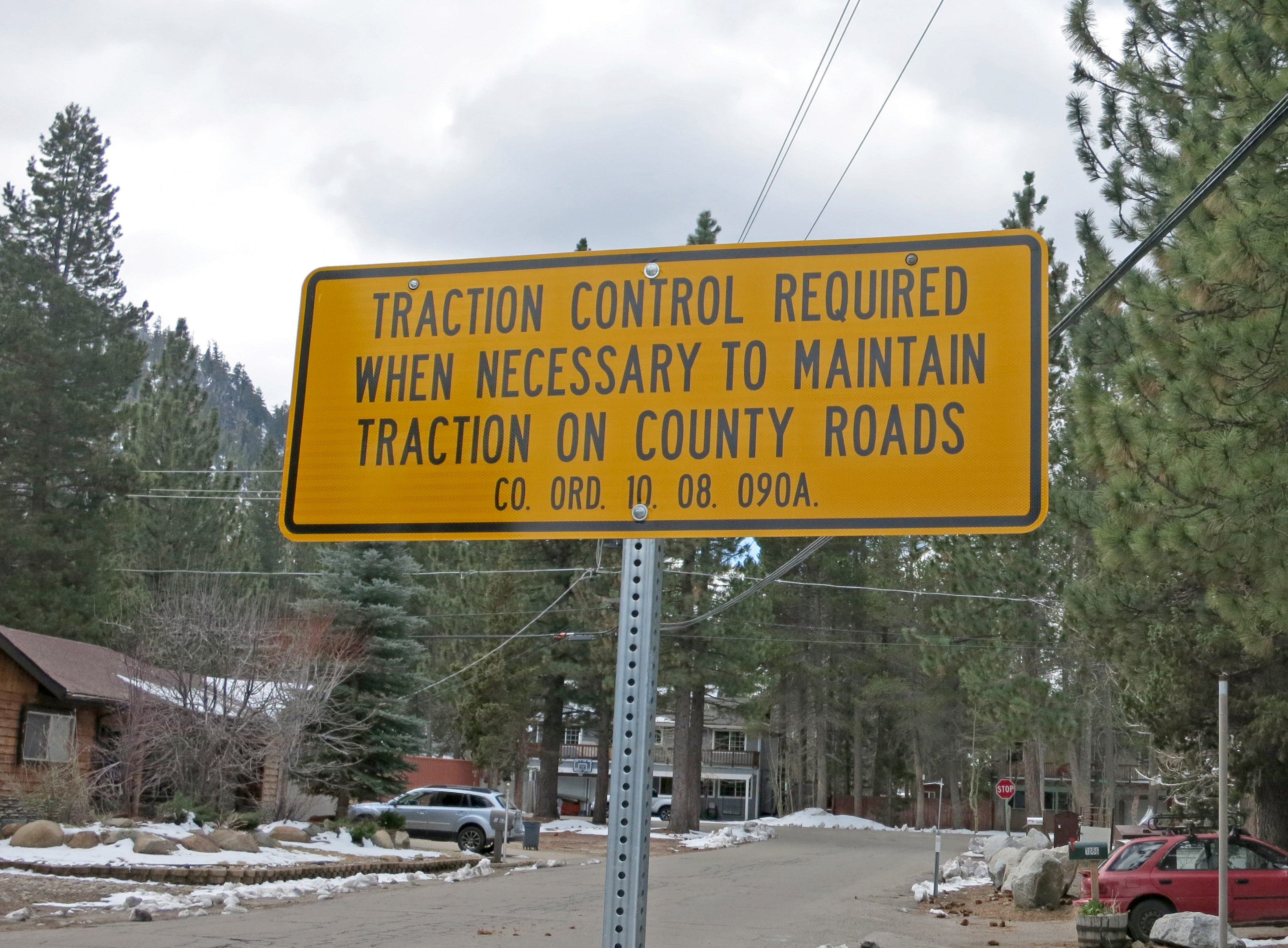
Signs are not enough to keep tourists from trying to find a short cut through residential areas. Photo/Jessie Marchesseau

By Jessie Marchesseau

MEYERS – Tourists are not paying attention to the signs designed to keep them on Highway 50 and out of South Shore neighborhoods.

El Dorado County Supervisor Sue Novasel said the signs were largely ineffective in diverting tourists from residential roads. She said the signs may be too hard to see or people are just following their GPS directions and not even paying attention to them.

Rafael Martinez, director of transportation for the county, explained that nonetheless, the presence of the signs enables law enforcement to cite drivers who end up stuck or run off the road in those areas. California Highway Patrol officers and El Dorado County sheriff’s deputies ticketed such drivers this winter. Martinez said the hope is that those drivers will spread the message to other drivers which will, in turn, start to deter nonlocals from choosing to use those routes.

On April 18, the county hosted a community meeting at the Lake Tahoe Environmental Science Magnet School to discuss traffic issues in the Lake Tahoe Basin, particularly on Sundays and holidays.

Representatives from El Dorado County Department of Transportation, Board of Supervisors and county counsel as well as the California Highway Patrol shared the results of the two pilot programs put into place this winter and discussed other options being considered for the future.

One of the pilot programs involved putting up 25 signs on residential roads warning drivers of traction control requirements.

In response to a suggestion of using “chains required” instead of “traction control” signs, Novasel explained that actual chain control signs require the presence of a chain installation area which the county does not have, nor could they be installed in multiple residential areas. It would also require hiring someone to turn or open/close the signs as conditions changed.

A suggestion was posed for adding flashing solar lights to the signs to make them more visible, something the county already explored, but at $800 per sign, Martinez explained they were not sure it would be the most effective use of their limited budget.

The second pilot program put into place this winter was what Martinez referred to as “the nudge.” It was an effort in behavioral modification of drivers attempting to use North Upper Truckee to leave town on Sundays. Signs were placed on Lake Tahoe Boulevard directing drivers to use Sawmill Road to get back to Highway 50 in order to leave town. “The nudge” was first implemented on March 4 and again on three more Sundays.

Much more effective than the traction control signs, Martinez said an unofficial study by the transportation department indicated that 60-70 percent of traffic was abiding by the signage and using Sawmill to get back to Highway 50 instead of North Upper Truckee. Considering that a large portion of the cars not obeying the signs was likely local traffic, he estimated the compliance rate could have been as high as 90 percent by tourists.

The nudge will be implemented again four times this summer and then reevaluated as a feasible and effective mid-range, though likely not long-term, solution. Expect to see signs diverting drivers down Sawmill on Memorial Day weekend, Fourth of July, celebrity golf week, and Labor Day weekend.

The cost of the program was about $800 for the signs and $300 to install and take down the setup each time. Should the project continue, it would need to be accounted for in future transportation budgets.

The panel proceeded to review status of the 21 suggestions gathered at the Feb. 28 community meeting.

The suggestion which received the most discussion and perhaps holds the most hope is putting the focus on the agriculture inspection station in Meyers. Part 1 involves installing signs notifying drivers that they are required by law to pass through the inspection station.

Part 2, and perhaps more important, EDC is drafting a letter to road mapping app companies alerting them to the state statute requiring motorists to pass through the station when entering California. The hope is that companies, in an effort to abide by state laws, will only direct drivers to leave the basin via Highway 50 through the inspection station.

County Counsel Mike Ciccozzi said there is a loophole the companies may use to avoid doing so. If that happens, it could result in lengthy litigation. While he does consider that a possibility, he says he is hoping it does not end up that way and they simply agree.

He expects the letter to be ready to send out within the next week or two.

A few other suggestions were offered up by residents at the meeting, but most had little traction. One person suggested adding a “local traffic only” lane onto Highway 50 for locals trying to get to Meyers. Novasel explained that widening Highway 50 had already been explored and was out of the question.

Another resident who lives off of Sawmill requested turning the traffic around at the high school. Martinez said that location is in the city, not the county, and the city had declined to do so, not wanting to direct traffic back into its jurisdiction.

Someone else suggested making Tahoe a little less attractive on holiday weekends so there aren’t quite as many people coming to town, such as a higher TOT tax. Novasel said that is unlikely as it will require legislation to do so.

So, while there is no long-term solution out there right now, Martinez said they are exploring solutions to work in the short- and mid-term while an ultimate long-term solution is decided and implemented.


Americans want legal pot; states disagree on regulations

By Santiago Guerra, The Conversation

On 4/20, many across the U.S. gather to celebrate their love and appreciation for marijuana.

Polls show that 64 percent of Americans favor legalizing marijuana. Despite the majority support, there’s no clear consensus on how it should be regulated. As a researcher who has studied the impact of drugs in the U.S. and Mexico, it’s been captivating to watch states adapt as they attempt to regulate this illicit and stigmatized substance.

Many states permit medical marijuana, but there’s a wide variety of approaches. Today, 29 states currently permit medical marijuana and have an established system for regulating it.

Another 17 states have limited medical programs. These programs provide access to products with low levels of tetrahydrocannabinol (THC) and high levels of cannabidiol (CBD), with the goal of eliminating the “high” and maximizing medical benefits. Beyond that, the conditions doctors and patients can treat with cannabis vary from state to state.

Minnesota, New York and West Virginia don’t permit marijuana smoking as part of their medical programs. West Virginia, however, allows patients to vaporize marijuana plant matter, while Minnesota only permits consumption of marijuana in liquid extract form.

Colorado, where I am based, has a much more expansive medical program. Patients can access an array of products, from extracts to strains of raw plant material. While New York caps the amount of THC that a product dose may contain, Colorado and other states have no such limit on their medical marijuana products.

Meanwhile, recreational marijuana use has been approved for adults 21 and over by nine states: Alaska, California, Colorado, Maine, Massachusetts, Nevada, Oregon, Vermont and Washington, as well as the District of Columbia.

However, once again, states haven’t implemented their policies uniformly. Vermont, for example, does not currently have a system for commercial sale and distribution, and only allows individuals to cultivate two plants. Colorado, on the other hand, has developed a robust commercial system, allows individuals to grow up to six plants, and limits the amount of marijuana products an individual can possess.

Most states have struggled with how to navigate the public consumption of cannabis, which remains illegal. As states continue to debate and implement marijuana policies, the American public will begin to recognize what works (and what doesn’t).

While these policy inconsistencies may raise concerns for some constituents, these state experiments are a valuable way to figure out how this substance works and how it affects society.

Santiago Guerra is an assistant professor of Southwest studies at Colorado College.


Study: Global warming mixing up nature’s dinner time

By Seth Borenstein, AP

Global warming is screwing up nature’s intricately timed dinner hour, often making hungry critters and those on the menu show up at much different times, a study shows.

Timing is everything in nature. Bees have to be around and flowers have to bloom at the same time for pollination to work, and hawks need to migrate at the same time as their prey. In many cases, global warming is interfering with that timing, scientists said.

A first-of-its-kind global mega analysis on the biological timing of 88 species that rely on another life form shows that on average species are moving out of sync by about six days a decade, although some pairs are actually moving closer together.

Read the whole story


S. Tahoe VHR rules getting attention of visitors

By Kathryn Reed

The adage there is no such thing as bad publicity may be tested as South Lake Tahoe’s reputation among vacation home renters spreads.

City officials are hoping the negative regional and national media attention about its $1,000 fines for owners and tourists turns out to be a positive. This is because going after the violators is intended to create a better experience for everyone – local and visitor.

People tend to forget when they are on vacation, staying someplace other than a hotel, that people next door are likely to live there full time. Those residents have jobs to get to that are best performed with a good night’s sleep, not a party next door. Visitors don’t take into consideration that even though there isn’t a fence, the yard next door is private property. For some reason they think the kayak tied up at a nearby dock is something they can use.

And while these examples may be isolated, they are happening enough to have necessitated the City Council to implement stringent rules with penalties that get people’s attention. A slap on the wrist wasn’t working.

“I did get an email from a potential visitor after the [Reno Gazette-Journal] article came out indicating that Lake Tahoe had been on their family’s bucket list but they would be removing it based on what they’d read,” Carol Chaplin, Lake Tahoe Visitors Authority executive director, told Lake Tahoe News. “I understand the visitor center has had a few folks in who have commented on the unfriendliness of the penalties. I couldn’t say if it will have a long-term impact, but my opinion is that we should be able, as a community, to find balance and respect for both residents and visitors. It’s not an issue unique to our destination, so I think we could look to other communities for best practices.”

On April 17, the council received its first quarterly update about how the rules that were put into effect just before Christmas are working.

Of the handful of people from the public who spoke, some suggested softening the message the city is putting out by welcoming people before threatening them. One person took issue with the public information officer having boasted about the city’s VHR rules being in the news outside the basin, and instead said it was more of a black eye for the city.

Here are some stats from Dec. 22-March 31 regarding the 188 VHR complaints:

·      Parking – 105 complaints, 40 violations

·      Noise – 34 complaints, 8 violations

·      Trash – 7 complaints, 3 violations

·      Occupancy – 8 complaints, 1 violation

·      Hot tub – 13 complaints, 4 violations

·      Camping – 1 complaint, 0 violations

·      No sign – 2 complaints, 0 violations

·      Unpermitted – 17 complaints, 7 violations

·      Miscellaneous – 1 complaint, 0 violations.

Twenty-nine paid the citations without question. Fifty-one percent of the 72 citations have been appealed. Eighteen were dismissed, 11 were upheld with seven of those paying the full amount, the rest are still in the hearing process.

Trash complaints could become a non-issue with bear boxes being mandatory at VHRs starting July 31.

There is bad behavior by locals as well. Going after repeat bogus complainers has been brought up. Then there are the people who are unwelcoming to out-of-towners.

“We’ve heard of visitors being heckled when they arrive at a reserved VHR, which is an unfortunate statement about how we treat people in general,” Chaplin said.

The LTVA board is expected to have a discussion about vacation home rentals in the coming months.

Then there are the visitors who don’t understand why they have to comply with rules they find restrictive such as not going into a hot tub between 10pm and 8am even without jets. That rule came into being because of the countless disruptive noisy guests who shattered the silence of an otherwise quiet neighborhood.

Helping with the enforcement is Host Compliance, which was hired by the city to find violators and take complaints. The 24/7 hot line (530.542.7474) is live. The company also monitors rental ad activity and transient occupancy tax collections.

Maureen Stuhlman, who oversees VHRs for the city, told the council Host Compliance has revolutionized how she and others are able to manage the short-term rentals. She showed a slide of the city with dots all over indicating that on April 17 1,072 VHRs with ads were compliant, while 319 were non-compliant. Staff is then able to use that data to track down the owners because Host Compliance has provided the addresses.

As of April 6, the city had 1,396 active VHR permits.


Calif. plan linking housing to public transit rejected

By Liam Dillon, Los Angeles Times

A robust effort to attack California’s housing shortage was rejected Tuesday by a state legislative panel at the Capitol, felled in part by opponents who argued that it treated small cities and large ones like San Francisco the same way.

The defeat for Senate Bill 827 came in its first legislative hearing, a surprisingly early end for a bill that had attracted national attention. Sen. Scott Wiener, D-San Francisco, was attempting to tackle two of California’s most pressing issues: the rising cost of housing and the need for development that is consistent with the state’s ambitious goals to reduce greenhouse gas emissions.

Wiener’s colleagues on the Senate Transportation and Housing Committee contended the bill would be too blunt.

Read the whole story